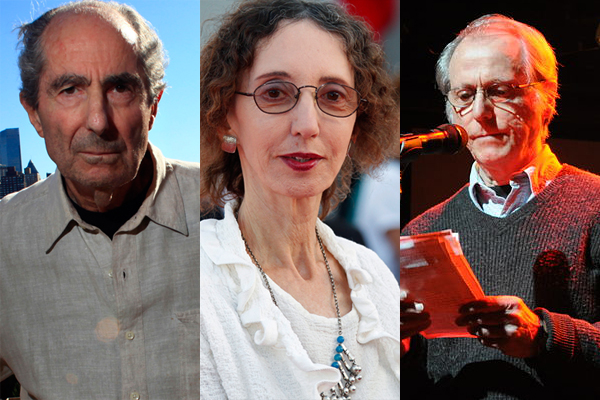
America wants a Nobel Prize in literature. America demands it! America doesn’t understand why those superannuated Swedes haven’t given one to an American since Toni Morrison in 1993. America wonders what they’re waiting for with Philip Roth and Thomas Pynchon. America wonders how you say “clueless” in Swedish.
OK, enough. But the literature Nobel will be announced this Thursday and if an American doesn’t win yet again, there will be the usual entitled whining — the sound of which has been especially piercing since 2008, when Nobel Academy permanent secretary Horace Engdahl deemed American fiction “too isolated, too insular” and declared Europe “the centre of the literary world.”
Boy, were we upset. Over at Slate, Adam Kirsch penned a scathing essay declaring that “the Nobel committee has no clue about American literature,” arguing that Philip Roth should have won the prize. New Yorker editor David Remnick said, “You would think that the permanent secretary of an academy that pretends to wisdom but has historically overlooked Proust, Joyce and Nabokov, to name just a few non-Nobelists, would spare us the categorical lecture.” He added John Updike (then living) and Don DeLillo to the mix of worthy laureates.
It’s true that the Academy, like any body of judges, has made some ill-informed decisions. And they’ve not done themselves any favors with some George W. Bush-era selections that plainly had more to do with politics than literature.
In 2005, British playwright Harold Pinter fulminated during his Nobel lecture about “the crimes of the United States” with all the embarrassing authority of a college freshman who just discovered Howard Zinn. In 2007, the prize was given to South African novelist Doris Lessing, who called 9/11 “neither as terrible nor extraordinary as [Americans] think.”
That only fed the vitriol directed at Stockholm, obscuring a valid point about American letters: We’ve become an Oldsmobile in a world yearning for a Prius. Our paint is flaking. Nobody wants our clunkers.
Stockholm has been trying to tell us this for a long while, and we would do well to listen. Between 1950 and 1959, every one of the 10 Nobel winners was a European male. Between 2000 and 2009, three women won the prize, as well as five non-Europeans. They have given it to Caribbean poets and Chinese absurdists. An American-born male hasn’t won since John Steinbeck in 1962. The last white American male to win the prize was Joseph Brodsky in 1987 — and though he wrote in English, his poetic training and intellectual sensibility are purely those of the Soviet émigré he was. Saul Bellow was born in Canada.
And yet here are the Americans who could win it this year, according to online oddsmakers Ladbrokes (in order of decreasing likelihood): Thomas Pynchon, Philip Roth, Cormac McCarthy, Joyce Carol Oates and Don DeLillo. Ladbrokes suggests they will most likely lose to front-runner Adonis, the Syrian poet who has the favorable breeze of the Arab Spring behind him. Swedish author Tomas Transtromer follows at 6-1, with Japanese novelist Haruki Murakami third, at 8-1.
But if we don’t win yet again, we are at fault. America needs an Obama des letters, a writer for the 21st century, not the 20th — or even the 19th. One who is not stuck in the Cold War or the gun-slinging West or the bygone Jewish precincts of Newark — or mired in the claustrophobia of familial dramas. What relevance does our solipsism have to a reader in Bombay? For that matter, what relevance does it have in Brooklyn, N.Y.?
The critical establishment was split on the award to Toni Morrison, but the Nobel Academy knew precisely what it was doing when it cited her “visionary force, [which] gives life to an essential aspect of American reality.” You struggle through “Beloved,” but you reach an understanding you didn’t have before. Can you honestly say that about Oates’ “We Were the Mulvaneys”?
Of the Americans thought to be on the long list, only Pynchon has written a big novel of big ideas — but it’s been 38 years since “Gravity’s Rainbow,” and his career since then has been a chiaroscuro patchwork of brilliance (“Mason & Dixon”) and frustrating arcana (“Against the Day”).
Four years after Morrison won the Nobel, David Foster Wallace predicted the current rut in which our literature finds itself in a New York Observer evisceration of John Updike’s “Toward the End of Time.” Though he took particular issue with Updike’s autumnal output, Wallace parceled blame to all of the Great Male Narcissists, with their hermetic concerns and insular little fictions. The following is Wallace’s estimation of Updike, but it could just as easily be said about anyone else in the postwar American pantheon: “The very world around them, as beautifully as they see and describe it, seems to exist for them only insofar as it evokes impressions and associations and emotions inside the self.”
Our great writers choose this self-enforced isolation. Worse yet, they have inculcated younger generations of American novelists with the write-what-you-know mantra through their direct and indirect influence on creative programs. Go small, writing students are urged, and stay interior. Avoid inhabiting the lives of those unlike you — never dream of doing what William Styron did in “The Confessions of Nat Turner,” putting himself inside the impregnable skin of a Southern slave. Avoid, too, making the kinds of vatic pronouncements about Truth and Beauty that enticed all those 19th-century blowhards.
As Bret Anthony Johnson, the director of the creative writing program at Harvard, noted in a recent Atlantic essay, our focus on the self will be our literary downfall, depriving literature of the oxygen on which it thrives: “Fiction brings with it an obligation to rise past the base level, to transcend the limitations of fact and history, and proceed skyward.” This sentiment is a sibling to Wallace’s anger — and both have a predecessor in T.S. Eliot’s 1919 essay “Tradition and the Individual Talent,” where he called art “a continual extinction of personality.”
The rising generation of writers behind Oates, Roth and DeLillo are dominated by Great Male Narcissists — even the writers who aren’t male (or white). Jhumpa Lahiri is a Great Male Narcissist whose characters tend to be upper-middle-class Indian-Americans living in the comfortable precincts of Boston or New York. Swap the identity to Chinese-American, move the story a couple of generations back on the immigrant’s well-trod saga, and you have Amy Tan. Colson Whitehead started promisingly with “The Intuitionist” and “John Henry Days” but his last novel, “Sag Harbor,” was little more than the bourgeoisie life made gently problematic by the issue of race. Jonathan Safran Foer is a narcissist disguised as a humanist. To his credit, Jonathan Franzen doesn’t even pretend.
That makes for a small literature, indeed. The following are words from citations for recent winners and runners-up of the Pulitzer Prize for fiction, inarguably our most prominent commendation for a novelist: tender, warmth, heartbreaking, celebration, polished and sensuous. It’s all small-bore stuff, lack of imagination disguised as artistic humility.
Just look back to 2008, when the slight “Olive Kitteridge” won the Pulitzer, but the Irish-Turkish writer Joseph O’Neill told the story of America in “Netherland” with far more eloquence, insight and humor than an American writer had in more than a decade.
That’s not to say our literature is barren. Dave Eggers has written a novel about the Lost Boys of Sudan, “What Is the What,” and a fine “nonfiction novel” about Hurricane Katrina, “Zeitoun.” Best of all, his 826 reading centers have been a wholly selfless bid to get poor children reading and writing in eight cities. Then there is Aleksandar Hemon, son of Chicago and Sarajevo, who writes the kind of fiction that still seeks to span worlds. Johnston quotes him in the Atlantic: “I reserve the right to get engaged with any aspect of human experience, and so that means that I can — indeed I must — go beyond my experience to engage. That’s non-negotiable.”
Maybe it’s the same story as in politics and industry: America, once great, has been laid low. The difference is that great art needs no tariffs, no financial stimuli, no elections or military campaigns. It only requires courage — though a courage of a special kind — to see beyond oneself, to speak across both space and time via what Ralph Ellison once called “the lower frequencies.”
Indeed, compare the Pulitzer-winning descriptions with these words pulled from the citations of recent Nobel Prize-winners: Revolt, visionary, clash, oppression, subjugating, outsider, barbaric, suppressed. And lastly, the one word that seems most elusive to our writers today, so much so that I fear we’ve become afraid of it: universal.
Alexander Nazaryan, a member of the editorial board of the N.Y. Daily News, has written about culture for the New York Times, the New Republic and the Village Voice, among other publications.
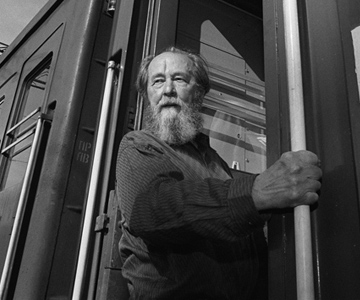
Aleksandr Solzhenitsyn, who died on Aug. 3 at the age of 89, was, by most accounts, a difficult man. His sizable oeuvre, urgent and prophetic in its condemnation of communism, left little room for moral inaction; he spent nearly two decades in the United States, but the comforts of America also disgusted him. And when he returned to his homeland in the 1990s, its headlong rush to materialism — a McDonald’s in Moscow! — offered a jarring contrast to the image of Holy Russia that had so long beguiled him. In the end, one gets the sense that the modern world disappointed Solzhenitsyn so thoroughly that he could only find refuge in words from which he fashioned a country — an agrarian, God-fearing Russia — scrubbed free of the distasteful century into which he was born.
The nearly 30 works he published were instrumental in bringing the Soviet Union to its knees, but none struck as deeply as his first, a slim volume called “A Day in the Life of Ivan Denisovich.” Its author was an artillery officer who, during World War II, had depicted Stalin unfavorably in a letter to a colleague, earning himself an eight-year sentence in a labor camp. In the camp he survived his first bout with cancer; then, facing internal exile in the outer reaches of the empire, began to write of his experiences while teaching science at a high school, guided by Dostoevski’s insight that “beauty will save the world.”
One could argue that “Ivan Denisovich” is not a beautiful book, since it lays bare, more than anything, how ordinary cruelty becomes when applied on a large enough scale. It is not terribly intricate, either: Ivan Denisovich Shukhov, a prisoner in a Soviet labor camp, wakes up late one morning and spends a day facing the indignities inflicted by his guards, fellow prisoners and freezing temperatures, spurred onward only by the animal need to survive. Unlike other critiques of the Soviet state, such as Mikhail Bulgakov’s “Master and Margarita” or the films of Andrei Tarkovsky, it did not disguise its condemnation of the Bolshevik regime in fantastical prose or historical reference. Solzhenitsyn sensed, instead, that the mere reporting of things as he had seen them would shake the Kremlin to its core.
But even he could not have expected the reception that would result from Alexander Tvardovsky’s desire to include his manuscript in the Novy Mir (New World) magazine in 1962. The ultimate decision to publish “Ivan Denisovich” would come not from the Novy Mir editorial offices but Nikita Khrushchev himself, who was desperate to distance himself from the unbridled cruelty of the Stalin years. In allowing for the publications of Solzhenitsyn’s debut, Khrushchev not only tacitly admitted to the existence of the gulag system of concentration camps but engendered a national conversation — whispered but pervasive — about how a state supposedly governed by common men and women could imprison and kill so many with such efficient ease.
Publication made a subversive hero of Solzhenitsyn, but he wanted only to continue writing, feeling that he must speak for the millions still silenced in the frozen plains of Siberia. As the brief liberalizations of the Khrushchev era faded, Solzhenitsyn faced unceasing harassment from a rejuvenated KGB, eager to punish the pious dissident. His manuscripts — treated like holy relics by those charged with their safekeeping — were seized, and he was not allowed to travel to receive the 1970 Nobel Prize in literature, which his detractors perceived as little more than a cruel jab from Europe at Moscow. Forced out of Russia in 1974, Solzhenitsyn finally claimed his prize in Stockholm, Sweden, declaring that he was “cheered by a vital awareness of world literature as of a single huge heart, beating out the cares and troubles of our world.”
“Ivan Denisovich” was just the start of a literary career that would cover four decades: “The Gulag Archipelago” left no doubt about the bedrock of political terror on which the Soviet Union rested, while “The Red Wheel” treated Russian history with the epic scope and grand moral concerns that had once been the domain of Tolstoy and Dostoevski. Yet nothing approached the power, page by page, of the straightforward account of Ivan Denisovich Shukhov, the wearied prisoner who wants badly to avoid a day of work out in the cold. His fate, at once horrible and quotidian, gripped the national imagination with such ferocity that the Communist Party was soon fighting a rising tide of writers who wanted to write about the gulags and little else.
The camps are long gone, but journalistic responsibility remains. Countless journalists have been killed in Russia for following in Solzhenitsyn’s path, for reporting honestly on the war in Chechnya and the restriction in civil liberties that unsurprisingly followed. Solzhenitsyn survived imprisonment, harassment and exile; today, a Russian journalist worth her salt can expect to be thrown from a window, shot in an apartment lobby, kidnapped and never seen again. Such, tragically, is the legacy of a science teacher from Ryazan who never wavered from the belief that the writer is “an accomplice to all the evil committed in his native land or by his countrymen.”
But even Solzhenitsyn had his blind spots. Despite a moral vision deeply informed by the Russian Orthodox tradition, he did not have the all-embracing vision that allowed leaders like Martin Luther King Jr. to transcend the constrictions of race, class and nationality. His fulsome criticism of the West and its “irresponsible” freedoms smacked too strongly of fundamentalist enmity; far uglier are the intimations of anti-Semitism that appear in late works like “Two Hundred Years Together,” which hints without much subtlety that Russia would have been better off without its Jewish citizens. Returning to Russia in the 1990s, Solzhenitsyn quickly wore out his welcome through vitriolic attacks on the fledgling democracy that could have been delivered at a less tender time. Yearning for the Russia of “War and Peace,” he seemed out of place in the Wild East ushered in by Boris Yeltsin and Vladimir Putin.
But there is still the matter of Ivan Denisovich, trudging through his day, subject to the outrageous fortune inflicted upon so many of his compatriots. His creator may not have been an agreeable man, but it was only because he burned with a vision so fervent that it left no room for anything but the most difficult questions a man, and his nation, could face. In that November ’62 issue of Novy Mir, an entire nation awoke with Ivan Denisovich.
Continue Reading
Close
Standing next to Vladimir Putin at a press conference in June 2001, George W. Bush famously looked into the Russian president’s soul and declared, with typical bravado, that he was a good man. The attacks of Sept. 11 would bring Russia and the United States even closer, with Putin drawing similarities between the “war on terror” and his own struggle against Chechen separatists. It seemed that lingering Cold War suspicions might finally dissolve: For the first time in almost a century, Russia had a free press, booming private enterprise and a glittering postmodern city in Moscow.
Today the two superpowers are at loggerheads again — over the Middle East, missile defense, energy prices, human rights — and Bush surely regrets that gushing optimism of six summers ago. Nearly all of the reforms Western observers once lauded have been rolled back by a regime increasingly uncomfortable with dissent. Hardly an independent news outlet remains in Moscow; the war in Chechnya, like our own venture in Iraq, continues with plenty of bloodshed but no coherent vision, and successful corporations have been systematically dismantled by the Kremlin.
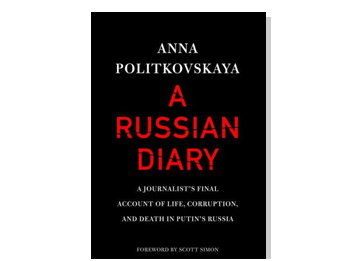
Anyone curious about why Russia’s post-Soviet flirtation with democracy has been such an erratic affair will find Anna Politkovskaya’s “A Russian Diary” an indispensable tome. A reporter for Novaya Gazeta (New Newspaper), one of Russia’s last organs of liberal media, Politkovskaya gained prominence — and notoriety — by chronicling the gradual depredation of civil liberties that began when Putin took power in 1999 and reopened the Chechen conflict that his predecessor, Boris Yeltsin, had waged to keep the small mountain region from gaining autonomy. Like the great accounts of Soviet life — most notably, Nadezhda Mandelstam’s “Hope Against Hope” and Aleksandr Solzhenitsyn’s “Gulag Archipelago” — “A Russian Diary” is at once an indictment of the ruling elite and a testament to Russia’s inability to reconcile national aspirations with the welfare of common citizens.
Sadly, “A Russian Diary” is a posthumous publication. Politkovskaya was gunned down in the lobby of her Moscow apartment last fall with several point-blank shots that, as any Russian knows, signal a contract killing. She certainly garnered enough enemies with her bare-knuckled approach to political commentary, and her dogged criticism of the Kremlin in Novaya Gazeta investigations and in unabashedly polemical books like “Putin’s Russia: Life in a Failing Democracy” and “A Small Corner of Hell: Dispatches From Chechnya” regularly infuriated the state apparatus and its military chiefs. That she died on Oct. 7, the birthday of Vladimir Putin, may be a coincidence, but it is a savage one, since she was his most pointed critic inside Russia, and the one most widely read in the West.
Her final work, which she was editing at the time of her death, is a loosely organized record, culled from her notebooks, of recent political firestorms. “A Russian Diary” opens in 2003, with Putin’s nationalistic United Russia party running roughshod over opponents in the parliamentary election, blithely handing out vodka for votes and assaulting opposing candidates. Its victory lays the groundwork for the following year’s presidential contest, which Putin wins with the kind of inflated margin only despots expect. Later chapters, which move from political analysis to frontline journalism, detail the unraveling of the Chechen War, a cancerous process that culminates in September 2005 when separatists seize a school in the border city of Beslan, outfitting its gymnasium with bombs that will kill almost 400 civilians, more than half of them children. Through all this, she writes with the breathless alarm of a geologist on the precipice of an erupting volcano, and nearly every entry — whether she is visiting veterans in Siberia, a demonstration in Moscow or a Chechen village mourning its dead — has the urgency of a last dispatch from the crater’s mouth.
American readers, accustomed to a measure of kinship with their authors, might be disappointed that Politkovskaya herself makes no appearance in these pages. We learn nothing of her birth in New York to parents who, as United Nations diplomats, gave her a vista of life beyond the Iron Curtain. Her daughters are absent from “A Russian Diary”; so is her husband, who allegedly left her with the words “I can’t take this anymore” as she returned from one of her sojourns in Chechnya. Such omissions may appear strange, but Politkovskaya was less Sylvia Plath than Joan of Arc, and her pugnacious rhetoric was meant to rouse her countrymen from the relative complacency that the Putin years, with their carefully parceled comforts, had instilled.
For while she found an audience in the West, where she was routinely showered with accolades and awards, Politkovskaya always wanted her words to resonate at home. “We have emerged from socialism as thoroughly self-centered people,” she pronounces in “A Russian Diary” with characteristic acerbity, noting that most of her countrymen would choose a luxury vacation over the freedom that Soviet dissidents had fought so hard to attain. Reading this uncompromising volume is not unlike listening to a parent scold a wayward child, and Politkovskaya’s anger can be hard to swallow unless one already sympathizes with her position. At the same time, it is difficult not to share her disgust with the “bacchanalia of indifference” that has allowed Putin to dismantle the nascent foundations of Russian democracy in favor of what he once ominously branded “the dictatorship of law.”
Her primary target is Putin himself, the bloodless KGB operative who rose quietly through the ranks of Yeltsin’s administration to become prime minister without having ever served in elected office. Weary of Yeltsin’s alcoholism and unpredictability, the West welcomed Putin’s promise to tame the Wild East with its trigger-happy mafiosi, sleek robber barons and restless liberals. Politkovskaya never bought it, espying in Putin the same ruthless impulses that sacrificed millions for the sake of hammer and sickle. “Who can say we are not returning to Stalinist ways under Putin?” she wonders after the ’04 presidential campaign, in which Putin suppressed media criticism while collecting endorsements from opposing candidates.
The Kremlin’s mismanagement of the Chechen separatist movement, however, has threatened to unravel Putin’s carefully sculpted image of stability. “First the Kremlin tried to show the Chechens that resistance to Putin was useless,” Politkovskaya writes of the smoldering hostilities that Putin stoked into a full-scale war. “That more or less worked; most of them gave up. Then it was the turn of the rest of Russia.” Indeed, one of her central convictions in “A Russian Diary” is that the repressive climate spreading across Russia stems from the Kremlin’s desire to keep the intractable conflict under wraps and punish anyone — journalists, human rights organizations, entrepreneurs and even ordinary citizens — who might question its authority.
But unlike so many critics of the American misadventure in Iraq, Politkovskaya shows a surprising lack of partisanship. As much human rights activist as journalist, she was equally appalled by all participants in the war, and she only appears self-righteous because her disgust with the Chechen mess is so pervasive. Many believe that her murder was ordered by Ramzan Kadyrov, the militia leader whom Putin crowned as president of Chechnya after he showed up in the Kremlin wearing a track suit; he is excoriated in “A Russian Diary” with merciless descriptions of his sybaritic pursuits and purported mental instability.
Death threats had materialized before, but Politkovskaya largely ignored them, choosing dissent over personal safety. “If I record what is actually happening, it will lead to change, to peace … I would be betraying these people if I walked away,” she told London’s Guardian in 2002, after her 39th trip to Chechnya.
This earnest belief that journalism can still affect change in the world is precisely what makes “A Russian Diary” essential reading. Hers may seem a Sisyphean task, perhaps even a touch naive, and it is easy to applaud her bravery with elegiac obituaries on journalistic integrity, as many have done from a safe distance in the West. The greater challenge, however, is the self-examination that Politkovskaya demanded of all democratic societies, which should reveal that Russia is only the mirror, however distorted, of any nation in which private interests and civil liberties negotiate an ever-shifting terrain.
There are also encouraging signs that Russia will not forget her as quickly as some in the Kremlin hoped. Putin at first refused to acknowledge her death, then curtly eulogized her as a person of “minimal influence.” But the population finally appears to be tiring of his heavy-handed Soviet tactics; thousands paid their respects and voiced outrage as Politkovskaya was laid to rest, and the last year has seen the resurgence of large-scale democratic protest across the nation, led by Garry Kasparov, the former chess champion and potential candidate of the left in the 2008 presidential election.
These developments offer hope, however slim, recalling prescient words from the opening of “A Russian Diary”: “When [the people] really want change, there is nothing you can do to stop it. Is this what they are afraid of?” For all her anger at Russia’s direction, Politkovskaya sincerely believed that, sooner or later, the Putin regime would pay for its hubris with a loss of public confidence. How tragic, then, that in her own lifetime she was reduced to a modern-day Cassandra, her earnest prophecies ignored by the very people she was trying to save.
Continue Reading
Close