Alicia Rebensdorf

In defense of a double D

They may be massive, but I'm not lopping off these babies.

  • more
    • All Share Services

In defense of a double D

My roommate’s bra hangs quietly on the bathroom doorknob. It’s a placid little thing. All lace and skinny straps, it lingers as lingerie should. Even her black brassiere is an innocent item. Its sheer fabric whispers only sweet nothings. I look at the monster I’ve just pulled off. The cups smile, huge and gaping. Instead of hushed secrets, my bra shouts out big words: mammaries and maternalism. Its attempts at coy femininity — an off-pink shade, a wee bow — are utterly unconvincing. I’ve seen less fabric in a sweater.

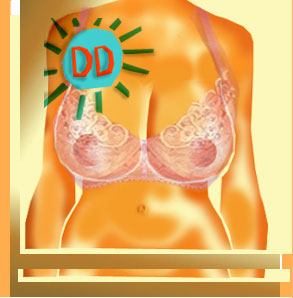
I survey my naked assets. There really is no good name for them: “titties,” “boobs,” “bosom,” “chest,” “breasts” — all these monikers are either too clinical or too comical. Although generously sized, mine are not the fantastic pneumatic spheres possessed by comic-book heroines, but neither do they sag near my navel. Their tops slope down and the bottoms curve up from their resting place on my rib cage. Most of the middle is dominated by my nipples, which usually spread out wide and relaxed but with a mere touch of the bathwater perk up to attention. As I ease my way in, my breasts bob up, floating to the surface like bath toys. Today, I don’t feel like playing. Today, I’m considering lopping them off.

Men may be taken with them, and some women may implant bigger ones, but when it comes down to it, having big boobs can be a big pain. (No, I don’t mean actual physical discomfort. That, for now at least, is thankfully not an issue.)

I try on clothes and none of them button closed in the front. I borrow my friend’s “cute” top and on me it turns “revealing.” I wear a baggy T-shirt and my breasts take up my entire torso. I wear a fitted one and co-workers make comments.

And don’t get me started on bra shopping. Judging from the selection, it seems that bra designers believe that no woman with double D’s was born after 1950. They create contraptions meant to maximize one’s profile by squishing tits into weird Estelle Getty-esque cones, or try to minimize cleavage with devices that push one’s breasts all the way into one’s armpits. Wearing a sports bra results in the uncomfortable and unflattering uniboob look — a monolith of flesh, an Ayers Rock rising from the chest. “Full-figure” bras are the modern-day corsets: Straps stretch the width of your shoulders, snaps cover half your back and there are enough constructive devices to support a minor bridge. Sleeveless tank tops and any neckline that dares dip below your collarbone are strictly forbidden.

Of course, I have options. With the help of modern technology, I could do away with all of this. I allow myself to consider the possibilities. How nice it would be to fit into the things I like, rather than have my cup size define the things that fit me. I could put on a bra with a single snap of my wrist, or even feel comfortable not wearing one at all.

About 70,000 breast reductions are performed each year in the United States. Punky Brewster, Star Jones, Roseanne Barr, Kim Fields and other (formerly) amply endowed celebrities have all publicly extolled the virtues of surgical reduction. I’ve read interviews with women who swear that reducing their rack decreased their self-consciousness and improved their self-confidence. I know at least three women who have undergone the procedure. Not one of them has ever expressed regret.

I stand in front of the mirror and push them flat. Is that how I would look? Would my waist look bigger? My shoulders straighter? Would I end up with huge scars? Or reduced sensitivity? Would I miss the cleavage, that undeniable oomph?

I tell my friends that I’m thinking about getting a boob job. Their support is unanimous and unwavering. They know I’ve considered it before and they have heard the happy testaments of friends who’ve already had it done. They are good friends, more supportive than my most high-tech bra.

But I can’t sleep that night. I tuck my breasts between my arms and my chest. Slowly, I realize I’m hurt. I’m angry. I’m mad that everyone, including me, assumed that my reasons for wanting smaller breasts were as simple as being able to wear a small bra.

Even if I set off electrical storms when I walked, my friends would not allow me to complain that my thighs were too fat. Knowing that I’m healthy and active, they would call me silly, tell me I was beautiful and demand that I get over it. So why did they unanimously agree that my boobs were massive enough to warrant surgical removal?

When my friends gave me their ringing endorsement of breast reduction, I took it to mean, “Yeah, you’re right, they’re friggin’ huge.” I’m not saying my friends should lie and pretend I’m a B-cup, but if they had pronounced reduction unnecessary and told me to get over it, I would have been much quicker to fight my insecurities and dismiss a butchering of my breasts.

Why does breast reduction meet with social approval while liposuction and tummy tucks are still considered vain? Aren’t all of them really about taking the surgical route to self-esteem?

It would be one thing if I was complaining that my breasts caused chronic back pain or other physical discomforts. But my discomfort with the size of my breasts is basically an issue of psychological discomfort and general inconvenience. For me, breast reduction would be essentially cosmetic surgery.

I have a mole that people always excuse for ink on my face. I’ve got skin that tans easily. Likewise, I have breasts that strain the most giving of T-shirts.

And fuck it, I would miss them if they were taken away. I enjoy the power they garner. I like how they fill out fitted T-shirts. I like how they enchant the men I’m with, as if they were casting sorcery or singing a siren’s call. Seduction is a cinch. I don’t wear V-necks to my navel, but neither do I wear muumuus.

I’m not against anyone else reducing her rack. I don’t presume to know what will give another woman self-confidence. But big or small, empowerment should not lie in the size of one’s endowment.

In the morning, I wander naked from my bed to the closet. I look through the mass of material and pick out my red underwire. I shorten the straps and pull my babies high. I still harbor yearnings for the ease of my roommate’s wee bra. But my own breasts perch there, reflected back to me in the mirror, pressing against each other like allies.

The other Scotland

Looking for the non-Disney version of the Outer Hebrides, I found it's not such a small world after all.

  • more
    • All Share Services

The other Scotland

We walked into a myth. This could not be Scotland. Irvine Welsh’s debunking bestseller “Trainspotting” was hitting Hollywood, I had seen Glasgow’s techno-scene firsthand and the only visible signs of tartan were in the tourist shops that crowded Edinburgh’s Royal Mile. No, this came from the pages of my childhood oversized atlas or the ancient nostalgia of a Burns poem. This was a Disneyfied clichi, not Scotland for real.

Several days after landing in Glasgow, I boarded a northbound bus with my small student group. Although I was in the midst of my pre-graduate days/daze, I stridently refused to be swept into a rose-hued view of Scotland’s much-mythicized past. I watched the post-industrial tenements fade into the Highland’s lochs, mist and mountains with skepticism. OK, so maybe a small part of me succumbed to the grandeur — the terrain looking like the backdrop to “MacBeth” or sea monsters, huge and foreboding — but I was still attentive to the corner shops with their Budweiser signs. I heard the American pop hits blaring from cars with Scottish plates and noticed those bucolic homes crowned with TV satellites.

The further north we climbed, the more severe the land became. Land spewed forth: rocks, edges and distant slanting storms, a chorus of grays and high greens, the trumpeting patches of blue. By the time we reached the outer shores, the towns grew less frequent, the familiar petrol stations and McDonald’s more random. We crossed Northern waters, hushed by cumbrous skies, and traversed quiet islands tucked close to the mainland. Boarded on a massive rusted ferry, I peered into the gray, unsuccessfully searching for my final destination, the Outer Hebrides. The sun, already elusive for the majority of our journey, had since given up and the muted hues took on darker tones. It was probably no later than 5 p.m., but the weight of the day made it feel later, and I could no longer make anything out. The wind moved west and my mind lay empty, dumbed by so much space.

It was in this stupor that I got off the ferry in Tarbert on the Isle of Harris. Wet, tired and hunched over with an overstuffed backpack, I slugged my way from the small town to our hotel. Even in the dark, you could tell the hotel was not for local consumption. Like a pompous relative, it held itself straight in the sideward rain. Its freshly painted walls stood out from the surrounding rocks rather than settling amongst them. This made sense to me. Even though this dreary weather did not make the island look particularly appealing, knowing tourism’s never-whetted appetite for the remote and romantic, this hotel fit right in with my world view.

I collapsed into a Victorian room with my traveling partner, Maggie. She was also an American, though she would shudder to be called that. Maggie had already traveled extensively and developed considerable scorn for the American abroad. A wee girl with a mass of dark red hair, an Irish complexion and a feline presence, she hid her nationality well. I was significantly less subtle. Larger framed and with a louder manner, I fit more the mold. Despite these differences, we bonded over our disdain for the rest of our group and our determination to experience the non-postcard Scotland.

This common focus must have been strong because I cannot remember any other motivation for us to leave our plush room on that otherwise unaccommodating evening. The night whipped cold and the rain blew horizontal. The hotel was probably less removed than it appeared, but it felt like an impressive trek into that town. We fought towards the only lights we could see and eventually found ourselves on Tarbert’s main drag: a couple of crumbled buildings and a gray, two-story hotel.

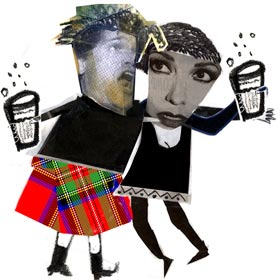
We spotted locals stumbling from a pub below the hotel and gravitated to it. In what I would learn was a tough trick to pull off, we tucked into the small pub almost unnoticed. The scene I happened upon was one I hadn’t known to be possible. Mouths opened in large laughs, flutes and accordions played in accompaniment. Thick with smoke, music and bodies, the pub was in full festivities. Lager spilled over the edges of toasting pints and rough hands negotiated cigarettes, drams and back slaps. And yes, almost everyone wore a kilt.

Maggie and I stayed close to the wall, not quite sure what we’d sauntered into. Unlike any other island pub I’d ever entered, we were not glared at or attacked like a foreign antibody. Furthermore, when we were acknowledged, we were quickly folded into the celebrations. Enthusiastic introductions were exchanged and pints were passed to our empty hands. We learned that the impetus for the evening was the wedding of the proprietor’s daughter, now a former Macleod, and this was the after-party. The fact that half the town of Tarbert was related to the Macleods explained the size of the party and preponderance of identical kilts.

Maggie’s minimal stature was soon lost behind round bellies and tall stories, each of us sucked into eager men’s tales of glories past and problems present. An older man with a red face chinked my glass and proceeded to tell me about his ancestors as if I had asked the question.

“Do ya knaw tha story of Robert tha Bruce?”

I pleaded ignorance.

“Savage. Pillag’r. Destroy’r,” he retorted with pride.

“I assume he had a cause.”

“Tha nobles’ of all; he fought agains’ tha bloody English!”

A young man named Roger with an Elvis coif and two days’ stubble leaned an elbow on the bar and shared a seemingly often-told story about his travel outside the islands. The men told me jokes I barely got and the others laughed as if hearing it for the first time. I took my cues and smiled along, buzzed and stunned from sensory overload. My glass never made it a quarter empty before I was given another, and single malts were given with slurred instructions. In Napa I was not.

I eventually fought my way back to Maggie, who was talking with the few women in the pub. They had ditched any signs of wedding wear, and their mascara was blurred below their eyes. Cigarettes hung lazily in their hands and their words seeped out like smoke. I’m not sure if they considered us a threat or if they were simply wiped out from working the wedding while the men celebrated it, but they took our arrival with considerably less enthusiasm. Once we had initiated introductions and adopted submissive body language, they returned the gesture by offering cigarette drags and thickly accented grumbles regarding the opposite sex.

The night continued at a slurred pace and Maggie and I followed suit. Like balls in a slow-motion pinball machine, we bounced where others willed us. We eventually settled among the two brothers of the bride, Donny and Angus Macleod. Both sported the fair Scottish complexion and had beaming eyes with grins to match. Donny was younger with a leaner build, Angus looked more weathered. His temples were prematurely graying, his laugh lines were well marked and Maggie and I both struggled to suppress our attraction.

The brothers took our company with neither the energy of the older men nor the skepticism of the women. Instead they treated us as if our presence was expected. They told us about themselves: the house Angus was building from scratch, the two brothers’ plans to hitchhike the globe in kilts to search out the world’s Macleods’ descendents. (“Ya see, cars stop fa blokes in kilts.”)

We shared music and movies, and when they couldn’t bother with making trivial conversation, they took slow drags or chatted among themselves in Gaelic. Pronounced like a Brooklynite saying “garlic,” Scottish Gaelic is the almost-extinct Scot version of the more-familiar Irish language. I had only read about it in history books, but it was Donny’s and Angus’s mother tongue.

This was almost too much for a decidedly non-naive girl like myself. As I peered down at the ashen knees that hung below the collection of kilts, tuning in the salubrious guitar and whole-hearted singing, my head spun. America may be everywhere, but everywhere was not America. Contrary to my constantly upgrading urban environs back home, this place did have a past, and that past was not just graffiti in a school textbook. I don’t pretend that the men of Tarbert always walked around in kilts, but they did know why their tartan had the colors it did, and where those colors came from.
(All my clothing claimed to be made in a country I could not place on a map.)

When the Tarberters sang songs, they knew the words that their ancestors two generations back did. (Most of my friends could not even sing a full Beatles refrain.) I was in the here-and-now of a real Scottish event where the Gaelic, kilts, scotch and songs had concrete significance. I had found the real Scotland, and it just happened to look a lot like the postcard.

If Scotland felt incredibly singular, this only intensified with what happened next. Abruptly, the crowd thinned, the music halted and the lights went off. Donny and Angus quickly ushered us into a back room where the newlyweds’ immediate family huddled and whispered. Between my altered body chemistry and my foreign ignorance, I was slow to realize what every other partygoer knew. The clock had struck midnight, the day had crossed from Saturday night to Sunday morning. We were in the Outer Hebrides, a place where people were scorned for doing laundry on Sunday, let alone partaking in God’s less-sanctioned pastimes. Angus’s remark that the last two Sundays “have not been too Hebridean” suddenly made sense.

Our presence — as witnesses, I suppose — pointed up the party’s transgression. It took us 10 minutes before Maggie and I realized this, and by then we were the topic of the terse whispers between the women and men. Once this became clear, we apologized profusely, acknowledged the generosity we’d been afforded and rushed out into the early morn.

Rain pelting our backs and the wind pushing us towards the brightness of our hotel, Maggie and I walked easily. Like kids after a Disney ride, we recounted moments and stories and before we knew it, we were back at the hotel. Peering out our room’s window, I considered all the surprises the evening had brought; perhaps, I thought, it is not such a small world after all.

Continue Reading Close

Navigating Nairobi

For a Western woman, waiting on a rainy day at a matatu stand illuminates some inescapable truths.

  • more
    • All Share Services

Navigating Nairobi

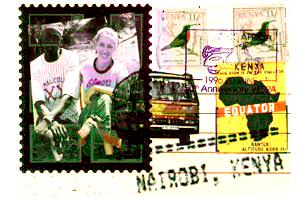
The puddle is formidable. I’ve already trekked a block to scout a crossing, and it’s beginning to defeat the purpose. My shirt sticks to my back and the wet hems of my pants swat my bare ankles. Car horns, matatu music and vendors shout, a cacophony barely audible over the rain banging in my ears. I’m on the corner of Moi and Kenyatta avenues at 3:15 p.m. in the rainy season. Nairobi is at its crescendo.

I’ve been in Kenya long enough to know that the afternoon showers are one of only two things in Africa that are punctual. The other was not my lunch date. I had planned to be back at my hotel by the time the rain hit. It comes fast and hard, and smears the city gray. Dirt spreads from unfinished sidewalks and rivers run brown down the non-drained streets. As I try to navigate a way across the murky moats, I count unclogged drains as No. 23 of the things I take for granted back home.

Rain falls fat like the drips off awnings and I search for some temporary shelter.

The sidewalks are already crammed tight with those waiting the storm out under awnings. The women bright with their dark skin and deep colors. Lanky men in suits. Teenagers in jeans and American T-shirts. Either having adapted to Nairobi’s overpopulation or never having a need for personal space in the first place, they press close. A woman’s round hip hugs a businessman’s thigh, a baggy-jeaned boy is squeezed tight to a grandmother’s bags. I squish between an older man with a Chevron cap and an umbrella vendor. I pull my wet shirt loose, concerned it might betray the rectangular outline of my passport hidden in my bra. No. 24.

The older man smells like urine and body odor; his elbow is bony. The umbrella man courts me and other pedestrians with his song. “Umbrrrrelli! Umbrrrrelli! Shilingi kidogo, umbrrrelli.” His rrr’s are round and buttery, his lli’s a click of the tongue; each of his words ends with a swing. I look at the striped umbrellas that look exactly like the umbrellas of the four other vendors on this block and the five on the block before this. He catches my glance and mistakes it for interest.

“Very good. Good price for pretty mazungu like you.”

“Asante lakini sihitaji umbrelli.”

“Oh, you speak Swahili. Very good. Do you have a boyfriend?”

I flash him my brass fake engagement ring and push back farther into the group. I squeeze next to a young woman with straightened hair. My breast presses against her arm. I’ve grown accustomed to Kenyan men asking about my availability, but it still makes me feel shitty.

I stand there, wet and squished, listening to the rain pelt the city. Cars continue driving on the asphalt islands at freeway speeds, ignoring, as usual, any puddles or people. Horns wail over the rain, scolding those pedestrians bold enough to cross their route. The umbrelli hawkers croon and the muffled bass of music thumps not too far away. I still smell the older man and his scent mingles with the waft of curry from an Indian cafe around the corner.

On my left is a line of people waiting for a matatu. Privately run buses and minivans, matatus are Nairobi’s most effective transportation system. In Swahili, matatu translates to “three people,” and although that may be the number they were designed to carry, the drivers seem to interpret it as meaning three people per seat. Crammed tight, these matatus careen around Nairobi’s roads, reading traffic signals as suggestions rather than orders and using their horns more than their brakes. If ever there were an antipode to Africans’ great patience, it can surely be found behind the wheel of African cars. People who wait hours in lines and months for mail suddenly can’t pause seconds for another car to pass.

The rumble of blaring speakers and vibrating metal alerts me to the arrival of a matatu. I can barely make out the familiar rap beat over the booming bass, the music hiked to a volume that neither the speakers nor the automobile were designed to withstand. Between the bass, potholes and lack of shocks, the matatu bounces down the road, catching as much air as it does asphalt. I stand back as the matatu swerves toward the curb. I am fortunate that I am shielded by a large woman who is less fortunate. Her generous hips catch the brunt of the puddle, her floral skirt made dark and muddy. The brightly painted matatu is similarly stained. Mud obscures the chartreuse paint job and splatters the steamed-up windows, plates of glass made pointless on each side. The driver leans on the horn and people scurry out of the small minivan. It is quickly reloaded and pushes its way back into traffic.

Occasionally people look at me, the white girl in the crowd, but I keep my eyes forward, pretending not to notice. My body casual, I act comfortable, inconspicuous, as if I belong in this mass. In truth, I have never felt so obvious; I feel as though I am standing naked in front of class. The young woman adjusts her stance and her thigh is now pressed against my own. She does not say a thing, but I can imagine what she thinks of this mazungu next to her. Paranoid, I feel her unspoken judgments and assumptions crowd me: rich, spoiled, egocentric, colonialist, slutty white chick horny for black dick. I feel claustrophobic, squeezed too tight. I want to fight them off, elbow my way into some room so I can stand on my own.

The rain lets up a little. Through the cars and crowds, I can just see across the street where two skittish tourists scurry to their destination. Costumed in their safari shorts and fanny packs, they act as if they are on the Serengeti, perked ears turning to every noise. A crippled man sitting on the corner with only one leg and a disfigured arm reaches out to them. His stump is visible through torn pants, the mangled arm curled in on itself. They stare and scoot away.

I look at the young woman beside me. Her lipstick is faded pink; her dark brown skin is flawless. I don’t want her to think I am like the tourists. I push on them all of the assumptions I fight off myself. I am different. I have to convince her that I am the exception. The noise of the rain and horns and vendors is too loud; she cannot hear my silent pleas. What I am unable to say aloud, I try to say through body language. I make my shoulders loose and my arms limp. I let the crowd squeeze me like a rag doll, as if this will distinguish me from the tourists and make our common pigment less evident. As if my skin pressed against the black woman’s arm will compel the colors to bleed, hers tinting mine just the least bit darker.

A small child wanders down the street. His dark skin is ashy and his gray ragged clothes look as if they were once bright colors. His eyes and stomach are large, his limbs small and snot gathers thick under his nose and runs down his chin. He spots me in the crowd. Evidently my body language is not quite the color camouflage I hoped it to be. One of his hands extends to me, palm up, while the other hand wraps tightly around a glue bottle. Sniffing glue is the drug of choice for Nairobi’s street children. Cheap and quick, it numbs the hunger and deadens the minds of the children who use it. This boy looks about 4. I’ve seen younger.

He stands there for a while, head tilted up, demanding eye contact. I ignore him. After about a minute, he tugs on my wet shirt.

“Mazungu, please money.”

Reluctantly, I return eye contact. “Poli, sina pesa,” I lie.

He remains where he is, hand still out, as I stare into the street. I may be accustomed to this, but I am not immune to it. I may look past the dirt, and weather, and noises, and crowds, and cripples, and smells, and stares, but I still see them. I may avoid those eyes pleading up at me, those eyes like a dog’s at the dinner table, but I still feel them.

Beneath my slack shoulders and self-righteous denials, I know I am more like those crowding judgments and timid tourists than I am like the people I touch. I cling to trite distinctions for a sense of superiority and to validate my right to be here, but all it really does is make me another white who claims to be an exception, another arrogant American with a cool stance and slightly strutted walk.

The boy waits for me to change my mind. The crowd waits for the rain to stop. The pedestrians wait for the cars to stop. The vendors wait for anyone to buy. The cripple waits for one unhardened heart. Kenya waits for long-promised aid, health care, hope, justice. No, I will never be used to this. I do not have the patience. I am sick of waiting for the streets to drain and the lines to shorten and the phones to work and the water to be hot and the frustration to ease. I cannot wait anymore. I push my way past the boy and out of the crowd.

The matatu seems to have displaced some of the water in the curb and I renew my search for a crossing. I watch one man make a leap to the other side. His gray suit makes it across safely. I figure he has found a spot and follow his lead. The sensation of water splashing up my calves reminds me that his legs are longer than mine. Kenyans may be known for their running, but there is something to be said for their long-jumps too. My sandals squish with water as I run to safety on the other side of the street. Here, there are tin-roofed shacks where merchants peddle colorful kenga cloths and dubbed tapes. I dash past them, their stereos competing with the rain on their roofs, their bright reds and yellows struggling to be seen through the dust and mud.

Nairobi consumes my senses, each of its parts fighting for my attention. Its colors deafen and its streets bang in my head. I’m almost to my hotel, but for just a second, I stop. From here, the rain beating on the tin roofs sounds like a song. For just a second, all I can hear is steel drums celebrating the afternoon.

Continue Reading Close