The light of the West Texas sky streams through big plate-glass windows and illuminates Jason Willaford and his wife, Rea, sipping freshly ground coffee in the Marfa Book Co. The slim and attractive couple, who met in Los Angeles, moved to Marfa last summer to open Galleri Urbane, a boutique specializing, like so much of the town, in contemporary art. So far, their experience has been wonderful. “Marfa’s a lot more sophisticated than most places,” Willaford says. “When someone here sets out to do something, they do it nice. That’s why people like it here — no Wal-Marts.”
When Tony Trento imagines Marfa, his voice, thickly upholstered with his native Long Island, N.Y., accent, grows excited. “Marfa needs more retail stores and affordable houses,” says the developer, who owns the American Plume and Fancy Feather Co., based in Marfa, which crafts boas and masks from turkey feathers and sells them to exotic dancers and Las Vegas showgirls. “There could be a truck stop, a McDonald’s, or maybe,” he says, contemplating something truly special, “a Wal-Mart.”
A classic Western showdown has come to the hottest little town in the country. Set amid the cedar-shaded, yucca-dotted lands of West Texas, surrounded by grasslands as wide as the Serengeti, Marfa may be the last un-Starbucked place in America. In the past few years, a covey of A-list artists, corporate players and real estate speculators have descended on the tiny town (pop. 2,121). Enchanted by its spare beauty — think “The Last Picture Show” with a Christian Liagre makeover — they’re also drawn by elite cultural institutions like the Chinati Foundation, dedicated to hip installation art, and the Lannan Foundation, a prestigious literary organization.
Trailing in the trendsetters’ wake has been the national media. Marfa’s press clips glow like newly lit luminaria. Publications such as Vanity Fair, Elle and ArtForum venerate Marfa’s Victorian ranch houses and Texas Territorial adobes, the burgeoning art scene and its rich patrons. The movie “Giant” was filmed in Marfa 50 years ago, when its stars James Dean, Elizabeth Taylor and Rock Hudson could be seen kicking around town. These days, the scene makers include Dan Rather, Frances McDormand, Dwight Yoakam and Tommy Lee Jones. A National Public Radio station is coming. The real estate madness already has. Four years ago, Marfa adobes were selling for $40,000. They’re now $200,000 and no doubt a good deal higher after the recent New York Times story, “The Great Marfa Land Boom.”
It’s a familiar pattern. Western havens like Aspen, Colo., Taos, N.M., and Missoula, Mont., were Marfas once, playgrounds for coast-hugging hipsters who could slip into jeans and the rustic camaraderie of the outback. But those towns are full up now, victims of their popularity. Now the sagebrush Medici come to Texas, piloting the corporate Gulfstream into tiny Marfa Municipal airport and bellying up to the jes-folks atmosphere of Joe’s Bar, where the Bud Light costs $1.75. The town remains an aesthete’s dream, devoid of Olive Gardens, Best Buys and any sign of the suburban middle class. Rather, Marfa is the honest texture of adobe and fine art set against a big sky. It’s the simplicity of line and the haunting emptiness of the land.
But this isn’t what Marfa means to everybody in Presidio County. Most residents don’t own much in this southwest corner of George Bush’s Ownership Society. The county is 84 percent Mexican-American; 36 percent of its residents live below the poverty line (the U.S. average is 12 percent). Marfa itself is 70 percent Hispanic.
Today, on Marfa’s main street, tony art galleries and wine shops are driving away traditional cafes and shops, whose local owners can’t afford the new sky-high rents. Everywhere you go the townsfolk, independent Texans to the core, lament the changes to their community. The term “ChiNazi” is used locally to describe anyone from out of town who arrives with artistic ambitions and a superior attitude. Observes one local cattle rancher, who asked to remain anonymous: “We’re filling up with triple A’s — artists, assholes and attorneys.”
Some of the new businesses hire people who were born and bred in Marfa, and that helps the local economy. At the same time, the cost of living is rising above their means, and they welcome Trento’s plan for big-box retail and ranchettes. To them, a steady job and an affordable home near extended families are more enticing than living in little Bauhaus on the prairie.
The ever-widening chasm between social classes in America has reached West Texas, with acrimony erupting all around. Trento’s plan threatens Marfa’s art community, spearheaded by the Chinati Foundation, which is determined to prevent the ambitious developer from besmirching its views. The tussle between subdivisions and sightlines stirs up questions to make the culturati squirm in their Eameses. Are the aesthetic desires of an elite more important than the economic needs of the majority? Will Marfa be a town where working-class residents can thrive or will it become Marfa’s Vineyard, a weekend sandbox for people whose tastes veer more toward pinot noir than Dairy Queen? Are big-box retail jobs less desirable than “All Things Considered”? Should you sell a Frenchman your adobe? What price arugula? Marfa is about to find out.
Marfa has always entertained great notions. Founded in 1883, it was named by an engineer’s wife after a servant in “The Brothers Karamazov.” She read the Dostoevski novel while waiting for her husband to finish working on the Southern Pacific railroad. Soon enough, the town grew rich on ranching. In the 1930s and ’40s, cattle barons attended elaborate balls and afternoon teas at the Hotel Paisano, an ornate, stuccoed affair that still stands and looks like a bit of Old Seville marooned west of the Pecos.
After World War II, Marfa was in trouble, its robust population having dwindled with the shuttering of its military bases. In 1971, the isolated town was just the place that hard-living Manhattan sculptor Donald Judd was looking for. He wanted a big backyard for his large works and here it was. A fractious and ornery character, Judd cottoned immediately to Marfa’s seclusion and affordability. With help from the Dia Foundation, a New York-based cultural organization founded by German art dealer Heiner Friedrich and his wife, Houston oil heiress Philippa de Menil, Judd began acquiring Marfa real estate for his installations. After a falling-out in 1986, the partners reached an out-of-court settlement that created the Chinati Foundation. Judd oversaw the foundation until he died of lymphoma in 1994.
Minimalism wowed the contemporary art scene in the ’70s, and because Judd was a giant in the movement, he drew disciples from all over the globe to West Texas. As minimalism increased in popularity, so did Judd’s mecca. Many of the pilgrims today evoke religious metaphors for the stark beauty of his work and its setting in wild Texas. A bumper sticker seen around Marfa sports the acronym “WWDJD?” (What Would Donald Judd Do?)
Visit Chinati and you can see why Trento’s planned subdivision is as welcome as a belch during a church service. Located in the low-slung barracks and Quonset huts of the former Fort Russell, the foundation and its spare, wind-swept grounds seem more monastery than museum. Buildings on Trento’s property, just south of the foundation, would obstruct the sightlines.
Today, articulate docents lead art lovers on a four-hour tour of installations created specifically for the site by world-famous artists such as Claes Oldenburg, Dan Flavin and Ilya Kabakov. The foundation’s prized pieces are 100 milled aluminum cubes and giant concrete rectangles made by Judd. These are dusted regularly by the resident interns, usually MFA candidates from Ivy League universities.
Chinati public affairs coordinator Nick Terry credits Chinati with Marfa’s renaissance. “Over the past 10 years, the Chinati Foundation has revitalized Marfa, has activated the economy and the town’s cultural life through manifold new initiatives,” he says. “It has attracted new residents who contribute to the well-being of the region.”
The foundation does try to be a good neighbor. In 2000, it lent the city storage space when Marfa was renovating its Victorian-era courthouse. Each year, Chinati waives its $10 entrance fee and invites the townspeople to its grounds to view works such as Tony Feher’s piece of basalt atop a plastic Tupperware-like container, 75 of which were given to Chinati donors.
In January this year, according to Jack Strain, who oversees American Plume and Fancy Feather Co., Chinati director Marianne Stockebrand “asked in an offhand manner if we were interested in selling to Chinati because they are very much against development south of their property.” Strain named a price, which he won’t reveal, but Stockebrand didn’t bite. “I never did think they were serious about making an offer that would reflect the value,” he says. “He was asking a very high price that we couldn’t afford,” is all Terry will say.
Following the January meeting, Stockebrand embarked on a campaign to stop American Plume from developing its property. On March 7, she wrote a letter to Marfa’s then mayor, Oscar Martinez, and Presidio County Judge Jerry Agan, expressing her concern about American Plume’s plans and their impact on Chinati’s views. Trento’s development “will greatly impact Chinati in its unencumbered vistas of 30 or more miles, its contemplative setting, and its natural wildlife,” she charged. To save the views, she raised some very high brows indeed, enlisting blue-chip museum directors and artist Oldenburg in a letter-writing campaign to force Marfa politicians to pluck American Plume’s plans before they sprout.
Martinez was unmoved, stating his first concerns were for the year-round residents and their needs. “Perhaps the near future will bring us a pharmacy, a dental clinic, dry cleaning and laundry services,” he responded in a letter to Michael Govan, director of the Dia Foundation, which supported Chinati. Judge Agan was also unmoved. “The letter they wrote us said they are all for the little people,” he says. “Just not in their backyard.”
Escaped feathers dance across the land surrounding the American Plume and Fancy Feather building. The company arrived in Marfa 13 years ago, when Trento, who currently runs the 83-year-old family business from Pennsylvania, discovered that Marfa’s arid climate made it a perfect place to dry turkey feathers.
Times are both good and bad for the company. Despite an uptick in business following a 9/11 slump, explains Strain, Trento’s son-in-law, American Plume is feeling the heat from Chinese competition. But thanks to Chinati’s helping popularize Marfa as a destination, the land beneath the factory has appreciated in value, an irony the art foundation probably doesn’t appreciate. In response to rising land prices, Strain and Trento plan to develop the property to boost their bottom line. On the drafting board are plans to subsidize the land into retail stores, 10-acre ranchettes, and a U.S. Border Patrol station.
Trento promises to build up to 20 affordable homes, priced from $40,000 to $60,000 — far cheaper than the antique adobes in town. “The artists and the Chinati people have driven up the costs, scaring the town’s residents,” he says. “I want to make it so the kids that grew up in town and want to stay in Marfa have got a place to go. Marfa doesn’t have much except for the scenery, its history and the open spaces.” The inexpensive homes will be tract housing, but, he is quick to add, built in a handsome ranch style. “Not like the trailer I lived in when I first came to Marfa,” he says.
Many residents welcome Trento’s plan, even newcomers like AmeriCorps volunteer Emily Mahoney, who moved to Marfa last year to help develop regional social services. Finding a place to live proved difficult. “I’m pretty low-income and nothing in town was manageable as far as houses go,” she says. “Marfa is becoming an increasingly difficult town in which to survive, especially if you have a family.”
“I hope Trento sticks to it and achieves what he wants to do,” says Presidio County tax appraiser Irma Salgado. “If not for us, then for our kids. They go to school, graduate, go to college and don’t come back. One reason they don’t stay is because there are no places like Wal-Mart here.” Live 160 miles from a big supermarket or drugstore and Wal-Mart isn’t viewed as the Beast of Bentonville. Instead it’s seen as a symbol of prosperity, job opportunities and, above all, convenience. “Out here, Wal-Mart stands for everything you can’t usually get in Marfa,” Mahoney says.
American Plume employs 13 local women, mostly Mexican-American, to create its boas. They are proud of their work. Posters and newspaper articles hang in the factory’s hallways. Their boas have graced Big Bird as well as coiled around Sandra Bullock in “Miss Congeniality 2.”
Sarah Villa, general manager for American Plume, supervises the artisans, who put the finishing touches on work produced in a sister factory located 58 miles south in the border town of Ojinaga, Mexico. Villa watches as Bertha Gradeja carefully steams, combs and fluffs blue ostrich plumes, readying them for a headdress that’ll dazzle them in Vegas. Above them, hundreds of brightly colored boas dangle from the rafters.
“We’re making art here, too,” Villa says. “These ladies are very talented. They’ve been here since we’ve been here,” she says of her crew. “They’re dedicated and hardworking and more like a family.” She shakes her head over the Chinati Foundation’s refusal to welcome more development. “I’m a lifelong resident of Marfa. All I want for Marfa is for it to thrive. We welcomed Chinati when they arrived. I don’t understand why Chinati doesn’t want Marfa to grow.”
Marfa’s growing reputation as an Aspen in the making is attracting the very rich — not just cash-poor artists and writers — who are giving the town its extreme makeover. The biggest threat to Marfa may not be Chinati or Trento but the town’s incipient fabulousness. How else to describe the Prada jacket cuddling Rainer Judd’s shoulders on a recent cover of Brilliant magazine? The Texas monthly specializing in debutantes, society party pix and lavish interior design devoted an entire issue last October to Marfa. To corral its rising buzz, the magazine trundled out two SUVs from Austin stuffed to the roll bars with photographers, stylists and fashion writers. They liked what they found. “Marfa Matters,” announced its cover. Yes, but to whom?
Rainer’s $34,500 little black number is $9,000 more than the average Marfa family sees in a year. Clearly the magazine wasn’t directed at them. Rather it was focused on the fashionable moths Marfa’s flame now attracts. Air-kiss arbiters Vogue and W have both profiled the Marfa Ballroom, a new arts organization, and its owners: two young Texas heiresses, Fairfax Dorn and Virginia Lebermann.
A more accessible cultural watering hole than Chinati, the Ballroom, housed in a former Mexican dance hall, opened in 2003 with a splash. The Ballroom maintains its independent cultural streak. It has screened Kurosawa retrospectives, hosted a performance artist named Lederhosen Lucil and various national DJs, and invited “Pink Flamingos” director John Waters to lecture in a packed theater for a Wild West evening that evoked the one in 1882 when Oscar Wilde visited Leadville, Colo.
Marfa’s popularity also means economic opportunity for those who understand the outlanders’ tastes. New restaurants like Maiya’s and the Brown Recluse have opened to serve them, and since Marfa is far from the nearest big airport in El Paso, the Hotel Paisano and the midcentury modern Thunderbird Motel, run by Austin hotelier Liz Lambert, mean the minimalist art pilgrims’ progress will be a comfortable one.
Some residents, meanwhile, feel community life has taken a giant step backward. And not just because they feel segregated from the artists. Seeing their town revitalized along the lines of Dwell magazine leaves them cold. “It’s about all the new things going on here — art galleries and things like that,” says a rancher whose family has raised cattle in Marfa for generations. “Newcomers would be better off in local people’s eyes if they did more that involved local people. Right now, you see them in the grocery store and eating together. But they’re not putting in businesses or restaurants that most locals will go to. They’ve come to Marfa because of the quaintness, yet they’re trying to change it, to citify it. Like the bookstore. It’s doing very well, and so is the wine bar, but is that something that is natural to the area of Marfa? They’ve redone the Thunderbird Motel, and that’s great, but is it doing much for Presidio County?”
It is for some Marfa residents, like Zane McWilliams, who’s worked on local ranches, and recently landed a job as a barista at the Brown Recluse. “The Marfa boom’s good if you can get a job from it,” he says. “If I wasn’t here at the Brown Recluse, I’d be digging ditches.”
It’s unlikely, though, that many locals could afford to buy a new home in town. “Houses worth $20,000 or $30,000 are selling for $250,000,” says Presidio County appraiser Salgado. “Adobes worth $20,000 are going for $200,000.” Like thirsty cattle who can smell water miles away, lowing investors are stampeding up Highway 90 eager to buy anything with daubed mud and a screen door. Their frenzy astonishes many locals.
“People call in and ask to get in on the ground floor,” observes Marfa real estate agent Linda Jenkins. “I tell them they’re six years too late.” Still, the inquiries keep coming. From New York. From Dublin. From Singapore. Even the French, who are making Marfa the new Paris, Texas. “I’ve sold four properties to French clients,” says Wright. “Guess they like the art.”
Some longtime residents benefit from an increase in property prices, but they are burdened by them, too. “If [the real estate boom] doesn’t stop, it will be so hard for the average taxpayer who has lived here forever to pay their taxes,” says Salgado. “I have to explain to them that because Mr. Smith from Houston bought a house like yours I have to charge the same rate. They ask me, ‘What have I done?’ and I have to tell them, ‘Nothing, it’s just the market.’”
The glamour carries another price tag invisible to the tourists tripping in from St. Germain or Williamsburg. The new eateries and bamboo-floored galleries have meant the end of more prosaic retailers. There wasn’t much to begin with, but what’s left is going fast. In February, Mary Arrieta lost the main street location for her store Ave Maria, which sold the town its religious icons, wedding crystal, and greeting cards. At the time, she paid $300 in rent. The new owner needed the Highland Street space for upscale lofts. Mike’s, the local cafe, had to move off Highland, too.
“For 29 years, I could afford to rent on [Highland]. Now I can’t,” says Arrieta. “It is sad the way the art crowd is working it out so that they don’t have to lift a finger to put us out. Mike’s Cafe was the only one left and he’s going to be out by July. Marfa Cable [TV] is looking for a place. They say to me, ‘Mary, where are we going to go?’ We cannot buy socks or pants here. The other people are rich. They jump in their planes, fly to the city and buy what they need.”
In the showdown between minimalism and big-box retail, there’s no truce in sight. “I guess the feather company feels Chinati is snotty and Chinati feels threatened,” says newly elected Marfa Mayor David Lanman, a transplanted Boston craftsman. Despite its protests, Chinati’s campaign seems doomed. As Judge Agan points out, Trento’s land is in unincorporated Presidio County. “He can build skyscrapers if he wants to,” Agan says. “As long as he has a permit, there’s nothing we can do.” Currently, Trento is waiting to hear whether his subdivision will be home to a new U.S. Border Patrol station. He’s in competition with another Marfa site and should know by fall. In the meantime, he continues to refine his blueprint for ranchettes and retail stores.
Lanman says the last thing he wants is to see Marfa become another Santa Fe. “When a town becomes a product and not a vision you lose something,” he says. He points to a “Third Way,” recognizing that Marfa must grow but in the process not ruin what is special about the town. “We’re trying to develop guidelines for Marfa to encourage or limit the size of buildings in particular areas,” he says. “People will have to apply for permits now — they won’t just be granted one over the counter [automatically].” (This won’t affect Trento’s development, as it’s outside city limits.) Lanman hopes that new ideas, what he calls “frontier vision,” will encourage townspeople to find solutions to how Marfa should grow. As an example that benefits everyone in town, he points to a new nonprofit health clinic, Marfa Health and Wellness, run by Kate Wanstrom, a local nurse practitioner, which opens this fall in an old Baptist church behind the Thunderbird Motel.
For now, though, the Marfa boom shows no signs of flagging. In fact, it is reverberating around the Texas big bend to Alpine, Fort Davis and Marathon. Each town is developing its own unique flavor. Austin politicos, such as columnist Molly Ivins, favor Marathon. (There’s a boutique there called AUSTINTaTIOUS.) Fort Davis draws affluent retirees, especially from the Houston area. Alpine, the region’s commercial hub and site of Sul Ross State University, attracts people from as far away as Germany.
For the next round of urban refugees, worried they’re too late to cash in on Marfa’s zeitgeist, fear not. The Texas Historical Commission, a state agency for historic preservation, says Alpine, the town next to Marfa, has the largest collection of historic adobe structures outside of El Paso. Drive to Alpine’s south side. There, on Gallego Avenue, across from Our Lady of Peace, the pretty Catholic Church fashioned from native stone, sits an old adobe. A hand-lettered sign is affixed in front: “For Sale — $25,000 — Price Firm.” Or said. It’s recently been removed.
As U.S. Special Forces scour Iraq for Baath Party poohbahs, Lone Star State Republicans are gunning for their own political outlaws. They’ve even published a card deck illustrated with the portraits of the evildoers.
Their quarry? Fugitive Democratic legislators, without whom the Republicans can’t rule Texas. The Dems are on the lam in order to derail a congressional redistricting plan widely credited to U.S. House Majority Leader Tom “The Hammer” DeLay, the former Houston exterminator who’s now one of the most powerful and relentless politicians in Washington.
Hogtied for the moment, and still well short of victory, angry Republican legislators have taken to calling their colleagues the “Chicken D’s” for leaving Austin. New GOP Gov. Rick Perry unsuccessfully dispatched state troopers to find the wayward pols, arrest them, and drag them back across the border. DeLay, calling the Democrats “cowards,” investigated putting federal agents on their tails. If so, FBI agents would stop hunting al-Qaida and instead try to smoke out security threats hailing from San Antonio, Fort Worth and El Paso, instead.
For Texans, the dramatic political fight has become the equivalent of a summer movie blockbuster — filled with busy troopers, back-stabbing, stalkings and skullduggery. But the fight holds serious national implications.
In the U.S. House of Representatives, Republicans currently outnumber Democrats 229 to 205, with one independent. But in the 32-member Texas delegation, Democrats outnumber Republicans 17-15. If the Republican redistricting plan passes, strategists say, Democrats could lose from four to seven congressional seats. In a Congress where the balance of power is so close, seven additional Texas Republicans who owe their jobs to DeLay could make it significantly easier for Republican President George W. Bush to give tax breaks to the rich, slash health programs for the poor, undermine environmental safeguards, and push through other central elements of his legislative agenda.
“The stakes are extremely high,” says Gary Keith, a lecturer on Texas politics at the University of Texas at Austin. “If you think about it — each of the last few national elections has been a battle over five to 10 House seats. Now [with the new redistricting plan], boom! [Republicans] could win with just one state.”
To prevent what they called a “relentless” effort by “Washington Republican political leaders” — read: Tom DeLay — to ram through the redistricting plan, the Texas House Democrats simply took the best and most effective political option available: They left town. The exiles — discovered last Monday in a Holiday Inn in Oklahoma — refuse to budge from their hideout until key legislative deadlines expire on Friday.
The GOP won control of the Texas legislature for the first time in 130 years during the 2002 elections. That all but assured they would have the clout to push through a plan that would redraw congressional district boundaries to the advantage of Republicans, allowing the party to solidify its power in Texas and in the U.S. House.
But the drama accelerated last Sunday night. Facing certain defeat over the redistricting plan inspired by DeLay, more than 50 Democratic members of the Texas House of Representatives fled the state capitol in Austin — sneaking across the state line on two chartered buses to Ardmore, Okla. They vow to remain there — holed up in the motel off Interstate 35 — until their GOP colleagues shelve the controversial bill.
With Republicans the majority party in Austin, the bill’s outcome was never in doubt. But Texas law mandates that 100, or two-thirds of the house’s 150 representatives, be present for a quorum.
The math isn’t complicated. The Democrats knew that a well-organized boycott could hamstring the GOP juggernaut, and so they counted heads and decided to make a run for the border. With 51 politicos missing and at large, the Republican redistricting bill will expire on Friday — effectively derailing the GOP’s plan, at least temporarily.
Furious Republicans asked Perry to issue warrants for the Democrats’ arrest. They urged him to send “wanted” bulletins to neighboring states. New Mexico state Attorney General Patricia Madrid, a Democrat, replied with a sarcastic promise of cooperation:
“I have put out an all-points-bulletin for law enforcement to be on the lookout for politicians in favor of healthcare for the needy and against tax cuts for the wealthy.”
By most accounts, the proposed congressional districts are blatantly political — designed to ensure the DeLay keeps his job and Dubya’s home state is colored red for a generation.
“The districts are drawn by Republicans to the advantage of the Republicans,” says Keith, who also points out that Democrats, when they ruled Texas, redrew districts to suit them.
What’s new, however, is how blatantly the plan gerrymanders Texas cities and towns.
“This plan takes the white conservative camp in Texas and institutionalizes it,” Keith says. “It completely smashes up communities all over [the state].” Keith uses liberal Austin as an example. Currently one congressional district, the city — under the Republican plan — would be redrawn and quartered — chopped up into four pieces. Each portion would be sewn onto a rural, Republican district.
To deflect the partisan nature of the dispute, the Democrats argue their boycott is about local control. There are also other issues caught up in the fight. Now that the Republicans hold the top jobs in Texas government, the Democrats are fighting a conservative assault on the environment and on health and home insurance reform. But the redistricting plan remains the flash point. The Dems insist they will return to Austin only if the GOP kills the bill.
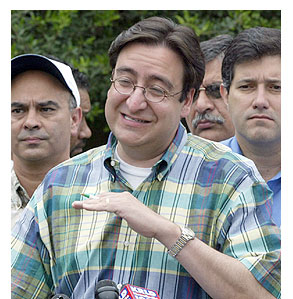
“We will hop on a bus two minutes from now and go home as soon as the Republican leadership agree that other issues are more important than redistricting,” says state Rep. Pete Gallego, a Democrat from Alpine who’s residing, temporarily, at the Holiday Inn in Ardmore. “We will be back in the capital post haste.”
So far the Republicans haven’t caved, and the state is gridlocked. “It’s a train wreck,” Keith says.
It’s also thrilling drama — even if most of the participants resemble actors on the suburban dinner theater circuit and not the buff, nostril-flaring thespians of “Matrix Reloaded.”
Depending on one’s politics, the spectacle resembles two different movies.
To Democrats, the Republican redistricting effort is a partisan “Frankenstein,” with the monster cobbled together by mad Dr. DeLay. House Democrats play the role of the torch-bearing, rake-rattling peasants, united in their efforts to destroy the monster and save the Democratic congressional delegation from destruction.
Republicans are more apt to believe Democrats are playing Glenn Close’s scorned yuppie from “Fatal Attraction.” As the GOP sees it, the Dems, dumped by voters, are out to avenge their rejection. The redistricting bill is the bunny they’ve dropped in the stew pot.
DeLay is nobody’s boiled rabbit. When the Dems went on the lam, the Republicans went ballistic. This being Texas, they called for the sheriff. State House Speaker Tom Craddick, a Republican, ordered Department of Public Safety troopers to go forth and arrest the missing legislators.
On Monday, staffers at Gallego’s offices in the West Texas town of Alpine were treated to the sight of three armed troopers arriving to capture the 74th District’s democratically elected representative. To no avail. Gallego was safe — already in Democrat-ruled Oklahoma, where the Republican troopers have no legal jurisdiction.
DeLay waded into the dust-up on Tuesday. The irritated majority leader ordered staffers to see whether the FBI might be brought in to arrest the absent Democrats.
Calling DeLay’s idea “incredible,” Keith warned that such tactics could backfire, especially if voters watch popular pols dragged back home to be displayed like Caesar’s captured Gauls in chains.
“I can’t imagine anything that would blow up in DeLay’s face more than having FBI agents arrest the Democrats,” he says. “The Republicans can be really hurt by this.”
Others have similar opinions. “When this goes down in history they [the Democrats] will be heroes, and we’ll be a bunch of schmucks,” Republican state Rep. Pat Haggerty of El Paso warned the El Paso Times.
That seems to be the impression in Gallego’s Alpine, a conservative town near Big Bend National Park. Voters here expressed a certain dismay upon learning the governor had ordered the Democrats’ arrest for, well, being Democrats.
“Does that mean they can come to my door and pick me up whenever they want?” wondered bartender and independent Michael Espinoza.
With the Republicans left hyperventilating in Austin, the Democrats are staying put north of the Red River.
“They’re still here,” says Shelba, who works in the Denny’s that adjoins the now famous Holiday Inn, “and they’re eating a little bit of everything, especially the Grand Slam [breakfasts].”
The Democrats-in-exile are eager to show the voters they’re not enjoying their time off. For instance, they’re not openly quaffing cosmos in the adjoining Gusher Lounge; nor are they enjoying Ardmore’s tourist marvels, which include the Gene Autry Oklahoma History Museum, which is “Dedicated to the Singing Cowboys of the B Westerns.” Instead, they’re holding meetings, scripture readings and working groups while dutifully turning out for the TV crews making the drive north from Dallas.
Republicans, meanwhile, have few options but to heap ridicule on their missing colleagues. Images of the wandering Democrats were pasted on milk cartons. Texas GOP’s Web site published a downloadable deck of cards of the “Chicken D’s,” each one sporting a photograph of a missing Democrat. Gallego, for example, is the 10 of spades.
The results only energized the Democrats. Ardmore was soon lousy with fruit baskets and Texas Democratic loyalists who drove north to Oklahoma to cheer on their heroes.
Such twists and turns might seems absurd to voters in other democracies, but Texas has a soft spot for cussed stubbornness. The cry “Remember the Alamo” is still taken seriously in the state — which was an independent country for nine years before joining the United States.
“We Texans are schizophrenic,” Keith says. “On one hand we want things to work smoothly, but when someone stands up against the odds we admire their chutzpah, to use a non-Texas term. There’s a rich history of Texas populism, of people liking it when those without power stand up to those with power.”
During the 1971 legislative session, 30 mostly liberal Democrats and even a few conservative Republicans revolted against state House Speaker Gus Mutscher. The legislators, dubbed the “Dirty Thirty,” pushed for a vote to investigate a scandal swirling around him. Mutscher retaliated by killing bills and ordering the reformers’ state districts redrawn to destroy them politically. The reformers retaliated by barnstorming the state urging Mutscher’s overthrow. It worked — the speaker was later voted out of office and convicted of bribery charges.
In 1979, 12 Democratic state senators called the “Killer Bees” hid out above an Austin garage for five days to stop the state legislature from recasting the presidential primary date to favor a former governor, the Democrat-turned-Republican John B. Connally.
Keith doesn’t see the Republicans buckling. The Democrats refuse to return. The redistricting bill will most certainly die. So what happens next?
“I think Tom DeLay wants a congressional redistrict so badly that if the bill expires this week, his supporters will try to resurrect it and attach it to another bill during the session’s final weeks,” Keith predicts. “At that point, Democrats won’t flee again, but probably use a filibuster or other guerrilla tactics to kill it.” By making speeches long enough to rival Castro’s — a whole series of them, in fact — they would block a vote and, in effect, talk the measure to death.
But even if the Democrats win this battle, Texas still needs to be governed. Bills on home insurance, healthcare and the state deficit — which is running at $9.9 billion — need to be debated, voted on and passed. What will happen if the entire legislative session collapses like the Hindenberg?
The result, Keith says, could well be an even bigger fight later this summer when the legislature will return for a special session before the fiscal year ends on August 30.
In Oklahoma, Gallego reiterates he and his fellow Democrats will cooperate fully with the majority Republicans — as long as redistricting’s a dead issue.
“The Republican leadership is out of step with folks at home. If you ask anybody in Del Rio, Fort Stockton or Alpine if lowering property taxes is more important than redistricting, they say yes. Is funding for education more important than changing congressmen? They say yes. Redistricting is not the fundamental priority of Texans.”
Will Texas stand down? Keith isn’t optimistic.
“Who can step in and cool things off?” he asks. “There are no candidates that have arisen yet.
“It’s always hot in Austin during the summer, but when the politicians get back here, the tempers are going to be so frayed it will be a very hot summer, indeed.”
Continue Reading
Close
Alpine, Texas, population 5,786, is a two-and-a-half-hour drive to the nearest frappuccino, and support for the president and the troops is strong. Texans make up 18 percent of the U.S. Army, so many residents have family and friends in the military. On Holland Avenue, Alpine’s main street, a huge American flag has replaced the Lone Star State banner at Pam and Ken Clouse’s Cowboys ‘n Cadillacs gift emporium. Jan Smith, who records the conversations heard at her quilting club for the weekly “Alpine Avalanche”, concluded her March 27 column by asking God to “bless America and those who protect her.”
But even here, in the straight-shooting Republican ranch lands of West Texas, the peace movement has found purchase — on Holland Avenue across from the Amtrak station. Every Friday at 12:15 p.m. for the past four weeks, anywhere from six to a dozen people assemble in a parking lot. For a half hour they stand in front of lunch-hour traffic holding signs painted with slogans such as “NO WAR KNOW PEACE” “A JUST CAUSE NOT A JUST WAR” and “JUSTICE NOT JUST U.S.” There’s a plastic beer pitcher filled with origami peace cranes and miniature peace poles — seven-inch-tall cedar pegs with peace messages in several languages.
Unlike the loud and theatrical acts of civil disobedience in New York and San Francisco, the Alpine protesters keep a silent vigil. Hectoring police or stopping commuters is not the way to win hearts and minds in West Texas.
“Block traffic?” asks housewife Dee Perkins, holding a poster board with the famous slogan “War is not healthy for children and other living things.” “They’d run us over!”
“We don’t want to be aggressive,” explains another middle-aged protester, “because we don’t support aggression.”
Their 30-minute vigil serves as an emotional thermometer, showing the temperature for war and peace. Today, most drivers just stare. A few honk their horns in approval. An equal number become irate.
A young man with a baseball cap in a gray pickup truck drives past. He screams “Shut the fuck up! Shut the fuck up!”
“What did he say?” asks Perkins. She sighs when told. “Usually they say things like ‘crawl under a rock’ or ‘get out of America, you communist fucks.’” With combat raging, the protesters say they’re unsure of what should happen next in Iraq. Should the bombings stop? Coalition troops return home? Leave the Iraqis to face their dictator? No one knows.
“Personally, I’d like to see a cease-fire,” says David Corbin, a physics professor at Alpine’s Sul Ross State University. “Give Iraq back to the U.N. and see what they can do with it. We have to stop killing civilians. We’ve done ourselves a lot of damage with this. We’ve squandered our prestige and credibility. And I’m not sure there’s any solution that involves the U.S.”
But the majority of Alpine doesn’t seem to believe that peace is the answer now. Not with American troops already there.
“No matter what you think about the war, we’re at least supportive of the troops,” says Allyson Santucci, owner of La Tapatia Cafe. Santucci said she was originally opposed to the war but now just wants the troops home. “I think it’s unfortunate they have to do the job that’s asked of them; they need our support and love even if I don’t support the policy behind it.”
What Santucci doesn’t want to see is protests blaming soldiers for any problems.
“I watched my friends in Vietnam come back and saw how the protests hurt them,” she said. “They had a job to do and did it admirably.”
Even in remote Alpine, tourists have been concerned about travel safety. Carla McFarland, proprietor of the historic Holland Hotel, a legendary ranching hostelry, said she’s fielded a few calls from worried reservation holders.
“Yesterday I talked with some guy who wanted to know if it was safe to come to Alpine,” she said.
“Since Alpine’s in Brewster County which adjoins Mexico, it seemed they were concerned about fedayeen infiltrating over the border from Chihuahua,” she snorted. “Security? I didn’t tell him the Holland’s housekeeping keys have gone missing for nine years.”
What people do worry about is what comes next — like the costs for occupying and reconstructing Iraq.
Joaquin Guerra wants Washington to level with taxpayers. “It bothers me,” said the Sul Ross senior. “We need to pay for our military’s salary, supplies and backing, and we’ve got so much need in this country. Now we’re taking on this extra burden of colonizing, protecting and providing services for Iraq. It’s going to be like taxation without representation.”
Pete Smyke, another Alpine resident, wondered if the conflict will change the way future enlistees think about the military and its benefits.
“We don’t think about it, but a lot of the kids who went into the Army did so to get money for college,” Smyke said. “Whether you support the war or not, that’s an important point, that we don’t allow kids to have money for college unless they’re willing to fight.”
On Holland Avenue the half-hour vigil nears its end. The protesters make plans for returning next Friday. They say they’ll stick to their schedule as March becomes April and heads into May. Before they leave, they hear one last comment.
“It’s not the ’60s, you hippies!” Another baseball-capped youth has popped out of an SUV moon-roof with the vocal force of a Fox TV pundit. But when a reporter asks him to explain his views for publication, the talking head and torso stop talking, apparently surprised by the request.
The vigil watches him disappear down the street.
“I feel dissent is a big part of what America is all about,” says Corbin. “That’s what I think our troops should be over there fighting for, our right to dissent here.”
Later in the day five high school students stage a demonstration of their own. The group walk down Holland Avenue holding signs supporting the president and his administration’s war efforts with slogans such as “ANARCHY’S GAY; IRAQ MUST PAY” and “BOMB BAGHDAD.”
Yet one of their slogans summarized Alpine’s conflicted mood these days.
“BUSH IS # 1,” the sign said. Below it, in smaller letters, was another sentiment: “BUT WAR SUCKS.”
Continue Reading
Close
The American South likes to sequester its vice, tucking away temptation on barge-casinos or inside the lap-dance palaces out on the strip leading to the airport. As for roadside attractions, there’s nothing that gets the blood racing like a motor court on the other side of the state line. As a Tennessee debutante of my acquaintance once explained, “Mississippi motels are where Memphis goes to sin.” Could anything be more wicked than Magic Fingers and rates by the hour?
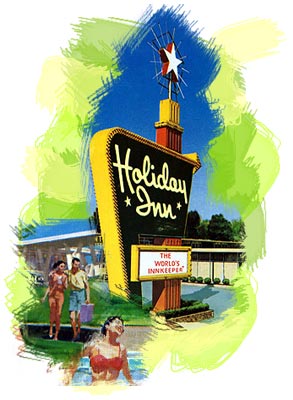
Apparently not in the Bible Belt. Yet it was a Memphis company named Holiday Inn that became a global brand by polishing the roadside hostel’s image as a place where one got a good night’s sleep and not a right good rogering. The company’s mission was embodied by its “Great Sign,” a glowing, exploding supernova of light and neon built to draw drivers off the highway and into its rooms while spelling out the purity of both its ideals and its bed sheets.
“Holiday Inn’s sign was a prop in a play,” says Andrew Wood, professor of communication studies at San Jose State University and an authority on motel history. “It communicated the playfulness, fantasy and optimism of the American roadside. And it meant safety for the [traveling] middle class.”
The Great Sign was brash, bold and a masterpiece. It is also, alas, extinct. The company ripped them down in a bid to be a little more upscale.
Fifty years old this year, Holiday Inn is now a cultural touchstone without its icon. Few people recall or care about the company architecture, but everyone remembers the sign. Designed by the Cummings Company of Nashville, the signs were bright as blazes, built to be visible from Dwight Eisenhower’s new interstate highway system.
Their marquees sported an emerald green curvilinear field with a big white neon “HOLIDAY INN” done in casual script. This was affixed to a red pylon atop which a yellow star exploded its energy into the night. Meanwhile a winking Vegas-style arrow pointed tired travelers to the office while an illuminated window box below advertised rates and local gatherings such as “Opaloosa Elks Fish Fry” or “Welcome Burlington High Senior Prom.” The kinetic radiance turned the Great Sign into a symbol of American razzle-dazzle, for-sure-buddy-can-do optimism. To borrow a turn of phrase from President John F. Kennedy, another icon of the times, “the glow from that flame can truly light the world.”
And it all started with a summer vacation from hell.
In 1951, Kemmons Wilson, a Memphis entrepreneur, took a family trip to Washington, D.C., and was appalled at the choice of fleabags on offer: Greasy motels, low-rent tourist camps and by-the-week boarding houses filled with persons of ill repute and encyclopedia salesmen.
The Wilson family’s dilemma was not an exceptional one. Like Rizzo, the fast girl in “Grease,” the motel industry developed a reputation early in life. The modern mo(tor) (ho)tel started in the 1920s as mom-and-pop motor courts for the auto pioneers traversing America in their tin lizzies. The courts were usually set on a town’s outskirts and featured a cluster of small cabins. Their anonymity made them favorite trysting places (known in the industry as the “hot trade”) or hideouts. Bonnie and Clyde were frequent guests. The hostels’ Petri-dish potential for breeding lust and larceny alarmed FBI chief J. Edgar Hoover, who demonized motor courts as “camps of crime” in a 1940 magazine article.
Wilson’s idea was to get the sleaze out. He built a series of identical motels within a day’s drive of each other that were intended to deliver a standardized experience, including clean sheets, air conditioning and a Bible in the bureau drawer. Throw in a pool for the kids and TV for adults (or was it the other way around?). A draftsman who had seen a 1942 Bing Crosby film penciled a name atop the blueprints: “Holiday Inn.” The first one opened on Summer Avenue in Memphis, Tenn., in 1952, near what would become Graceland.
The beacon and the bait was, of course, the Great Sign. It lured station wagons into the parking lot as confidently as the Pharos lighthouse, that wonder of the ancient world, guided galleys into Alexandria’s harbor.
John English, a Los Angeles architectural historian who specializes in commercial buildings of the mid-20th century (a style also known as Googie), says the Great Sign was a great communicator.
“This was not just a sign; it was an icon known around the country,” he says. “Its idea was simple: ‘Welcome. Enter. Sleep Here Now.’”
America’s travelers checked in, in droves. Holiday Inn expanded as freeway cloverleafs bloomed over the continent. The chain leapfrogged oceans. Today there are more than 1,000 Holiday Inns in the United States and in 70 countries around the globe, the most recent a resort in Tunisia. The Great Sign — not Elvis Presley — became Memphis’ first global brand. American business hailed Wilson as “The Father of the Modern Innkeeping Industry.” He is still alive at 89, although he no longer runs the company. His biography, “Half Luck and Half Brains,” tells his story.
The company lit its time in other ways. As Holiday Inn imposed order on the American road, standardizing and sanitizing the motel room, Washington was attempting the same thing in Europe, by way of NATO and the Marshall Plan. The collective enemy: Dirt, immorality and communism. Is your bathroom breeding Bolsheviks? Not at Holiday Inn, which fought the Cold War with sanitized toilet seat covers and the Great Sign. Of course, the spires of Moscow and Stalingrad also twinkled. But their stars were red, not gold.
The sign and its symbolism — prosperity and a worry-free road trip — was widely imitated. Then a funny thing happened. Holiday Inn lost its nerve. As the ’50s became the ’60s and then the bittersweet bad-ass ’70s, Holiday Inn began playing it safe. In 1975 executives came up with a new slogan to express its new conservatism: “The best surprise is no surprise.”
In an era of earth tones, puka shells and shag haircuts, the old Holiday Inn sign seemed dated and loud, like Dean Martin or the bossa nova. Architect John Portman introduced soaring atrium lobbies and exterior elevators to the lodging industry. They called it the “Jesus Christ” school of architecture. Crane your neck to take in a hotel’s 50-story lobby and that’s what you said. Sign graphics calmed down; Helvetica and Geneva became the hot type fonts. All this was clean, correct and fashionable, but to English and other aficionados it was the death knell for bawdy mid-century modernism.
“Good taste is a very dangerous thing,” says English. To the “Keep America Beautiful” crowd, he observes, the Great Sign “was considered garish, tacky crap that was destroying our cities.”
In 1982, the Great Signs came down. In their place rose dinky, back-lit plastic ones. The new signs were tasteful, of course, but they weren’t much fun.
“They remodeled a classic Mercedes and got a Geo Metro,” says Dickson Keyser, a principal in Idee, a San Francisco design firm specializing in architectural signing and graphics for clients from Siebel Systems to Stanford University.
In 1990, Holiday Inn was sold, and became another cog in the giant British conglomerate Bass PLC, since renamed Six Continents PLC. Holiday Inn is now efficient and boring, its onetime entrepreneurial exuberance squeezed out by yield-management techniques and greater return on investment. Wood, of San Jose State, calls this perfected state “omnitopia,” a place of “ubiquitous, ever-present environments.”
“It’s like downloading the same home page whereever you go,” he says. In omnitopia, a guest doesn’t check in to a room. She checks in to a node.
The irony, of course, is that the company’s efforts to appear modern have only dated it. Today plastic, rough concrete and ficus trees are of scant interest to aging boomers.
“It’s like, hello,” English says, “1980s green awnings and brass fern bars are long over. Wake up.”
Consumers hunger for nostalgic yesteryears and get them in products of faux-’50s and ’60s design, like Johnny Rockets soda fountains and the Austin Mini. They pay top dollar, too. Parabolas and boomerang-shaped design elements are found in newly gentrified downtown entertainment districts, not out on the suburban business loop. Might the Great Sign, like Liza, stage a comeback?
Fat chance, say the experts. It’s unlikely any original Greats remain intact.
“They were cut into pieces,” laments English. “Demolished. Recycled. And gone.”
He predicts Holiday Inn will cobble together various design elements from all eras. The result, he predicts, will be a Franken-sign, a symbol neither evocative of the old nor symbolic of something really new.
“They’ll bring them back, but not in the right way,” English says. “There’s so much caution, and corporations are afraid of being perceived as too wild or associated with the past.”
Meanwhile, we can hold out hope that some brave marketing VP or a lucky discovery behind an old barn will mean a resurrection. Then, perhaps, the American night will glow with exploding stars, dancing colors and neon letters blinking “NO VACANCY” once more.
Continue Reading
Close
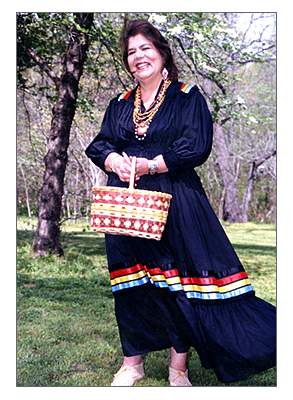
San Francisco transformed many people living there during the 1960s. Its shabby, lunch-pail-toting neighborhoods became crucibles for a society recasting its values. The fire eventually caught a shy housewife and mother in her 20s named Mrs. Hugo Olaya and alchemized her into Wilma Pearl Mankiller, a symbol of both feminism and Native American self-determination.
In 1985 Mankiller, now 57, became the first female chief of the Cherokee Nation, the 220,000-member Native American tribe based in Tahlequah, Okla., to which she belongs. She did it not only by overcoming the usual barriers set against Native Americans, but also by vaulting the chauvinistic hurdles imposed by her fellow Cherokees, who had never been led by a woman.
Once chief, Mankiller took the traditional “women’s issues” of education and health care and made them tribal priorities. She raised $20 million to build a much-needed infrastructure for schools and other projects, including an $8 million job-training center. The largest Cherokee health clinic was started under her tenure in Stilwell, Okla., and is now named in her honor. Mankiller also sought to reunite the Eastern Cherokee, a group based in North Carolina, with the larger Western division.
She ruled with grace and humor — she often teased patronizing Anglos by telling them her surname was due to her reputation; in fact, “Mankiller” is a Cherokee military term for a village protector — and with organizational smarts learned in the blue-collar neighborhoods of clapboard and “ethnic politics” that circled San Francisco Bay.
Her journey — from complacency to activism to political power — followed a familiar boomer flight path, but hers was a working woman’s ascendancy. It was born in the rural grit of Adair County, Okla., and the tough industrial neighborhood of San Francisco’s Hunters Point. Elite, tree-shaded suburbs like Pasadena or Grosse Pointe that shaped so many ’60s radicals couldn’t have been more remote to Mankiller.
Mankiller grew up on her father Charley’s ancestral Oklahoma lands. “Dirt poor” was how she described her early life. The Mankillers frequently ate suppers of squirrel and other game. The house had no electricity. Her parents used coal oil for illumination.
In 1956 Charley Mankiller, eager to provide a better life for his growing family, moved them from Oklahoma to California as part of a Bureau of Indian Affairs (BIA) program, initiated by the same bureaucrats who had “relocated” Japanese-Americans during World War II. The program, a misguided experiment in social engineering, transplanted rural Native Americans to jobs in industrial cities, thus serving to weaken reservation ties and diffuse the little political clout the tribes held. It was another insult in a history of them stretching back two centuries.
In 1838 the Cherokee Nation was ripped from its ancestral homelands in the Carolinas, Tennessee and Georgia by U.S. Army troops acting under orders from the federal government. The forced march to the Oklahoma reservations, the famous “Trail of Tears,” killed thousands of men, women and children. Buffeted by white assaults — both physical and legal — the Cherokees would spend more than 100 years as wards of the state. It wasn’t until 1970 that Washington allowed the tribe to elect its leaders directly.
Wilma was 11 when the Mankillers arrived in San Francisco. Charley found work as a rope maker and the family settled down. Wilma had a difficult transition. She and her siblings were the proverbial hicks in the big city. A kindly Mexican family showed them how to work a telephone and taught Wilma to roller skate. Charley Mankiller had instilled in his children a pride in their heritage, and San Francisco’s Indian Center, located in the Mission District, fostered it. The center became Wilma’s after-school refuge. The city’s diversity exposed her to other things. In high school, African-American girlfriends influenced Mankiller’s taste in popular culture. While white girls swooned over Fabian and Elvis, Mankiller absorbed Etta James and B.B. King. Life in a poor black neighborhood, Mankiller told a Sweet Briar College audience in 1993, taught her other valuable lessons.
“What I learned from my experience in living in a community of almost all African-American people,” she said, “is that poor people have a much, much greater capacity for solving their own problems than most people give them credit for.”
Mankiller exhibited no appetite for intellectual ambition as a teenager. In her 1993 autobiography, “Mankiller: A Chief and Her People,” co-written with Michael Wallis, she recalled hating the classroom. When she graduated from high school in June 1963, she expected that to be the end of formal schooling.
“There were never plans for me to go to college,” she said. “That thought never even entered my head.”
Instead, a tedious pink-collar job followed graduation, as did a fast courtship and marriage to a handsome Ecuadorean college student, Hugo Olaya, with whom Mankiller had two children. Olaya’s family was middle-class; his prospects were good. At 17 the pretty girl, whose dark, flashing eyes gave her a resemblance to actress Natalie Wood, settled down to live the life of a California hausfrau — replete with psychedelic pantsuits, baby strollers and European vacations.
The social protests of the ’60s didn’t touch Mankiller directly until the decade’s last days. On Nov. 9, 1969, 19 Native Americans made their way out to Alcatraz island, the abandoned federal prison in the middle of San Francisco Bay. The hunk of sandstone, in full view of San Francisco’s corporate skyline, was supposed to be handed over to Texas oil tycoon Lamar Hunt and turned into a futuristic shopping mall and revolving restaurant. Instead, the 19 Native Americans claimed the island “in the name of Indians of All Tribes,” transforming it into a symbol of Native American liberation.
Led by Mohawk tribesman Richard Oakes and Adam Nordwell, a Minnesota Chippewa, the protesters carried what they considered a fair price for the island: $24 worth of glass beads and red cloth. The beads and cloth were comparable to the ones the Europeans had used to buy Manhattan, but the federal government declined their offer. Coast Guard patrols escorted the protesters back to the mainland.
On Nov. 20 the protesters, now numbering 89, returned for another occupation of the island. This time they stayed 19 months. The rebellion soon bore all the trappings of a media circus. TV news crews hired speedboats to get close to the action, while tourists snapped photos from tour liners. Politicians dropped by. Jane Fonda and Anthony Quinn vowed solidarity. Candice Bergen showed up with a sleeping bag and crashed on the floor.
Mankiller didn’t come to Alcatraz in those first two waves, and her siblings Richard, James and Vanessa got there ahead of her. She had stayed in the background, but when she finally arrived, Alcatraz became a pivotal point in her life. While she had been conscious of Native American issues before that time, these protests “flashed like bright comets.”
“Every day that passed seemed to give me more self-respect and sense of pride,” she wrote.
Pop culture discovered Native American issues around then, too, and glommed onto Red Pride. Dustin Hoffman played the Cheyenne-raised hero in Arthur Penn’s film “Little Big Man,” released in 1970. Soon after, Cherokee injustices made the Top 40 with the Paul Revere and the Raiders’ hit “Indian Reservation.” Meanwhile, Mankiller found herself spending time at the Indian Center helping with fundraising and organizational efforts. She became acting director of East Oakland’s Native American Youth Center.
Soon Mankiller’s expanding idea of herself (she was now taking college classes in social work) clashed with the more traditional family her husband envisioned. He forbade her to buy a car; she got a little red Mazda with a stick shift and drove to tribal meetings all over the West Coast. Mankiller’s favorite song now, and the one she liked to dance to with her daughters, was Aretha Franklin’s “Respect.”
She and Olaya divorced in 1974. Mankiller found a job as an Oakland social worker. When she decided to return to Oklahoma with her daughters, she left California in a U-Haul with $20 in her pocket.
“I came home in 1976,” she says. “I had no job, very little money, no car, had no idea what I was going to do, but knew it was time to go home.”
Mankiller soon found a position as a community coordinator in the Cherokee tribal headquarters. The tribe was beginning to operate with less dependence on the BIA. Reforming the BIA, observed one Creek chief, was like rotating four bald tires on a car: Nothing changed. There were other ways to wrest money from the government. Mankiller, now finishing her degree at the University of Arkansas, became adept in the art of organizing as well as grant and proposal writing. She was proving to be a formidable leader.
In 1979 a head-on car crash seriously injured Mankiller and killed the other driver. By awful coincidence that driver was Sherry Morris, one of Mankiller’s best friends. Mankiller spent the next year in rehab wracked with physical pain and guilt. Then, in November 1980, she was diagnosed with the neuromuscular disease myasthenia gravis. An operation to remove her thymus cured her of the illness and she returned to her job in January 1981 to supervise the rejuvenation of the Cherokee town of Bell, Okla. The job involved urban planning and constructing a 16-mile water pipeline, and Mankiller excelled at it. She also met her second husband, Charlie Soap. They married in 1986.
Just three years before, ruling Cherokee Chief Ross Swimmer had asked Mankiller to run as his deputy in the next tribal election. After much debate she accepted and was promptly criticized — not for her liberal Democratic politics but for her gender. Mankiller described herself as “stunned” by the hostility. Charley Mankiller’s daughter toughened her hide.
“I expected my politics to be the issue,” she said later. “They weren’t. The issue was my being a woman, and I wouldn’t have it. I simply told myself that it was a foolish issue, and I wouldn’t argue with a fool.”
Swimmer and Mankiller won the election. Ironically, it was Ronald Reagan, whose policies Mankiller opposed, who gave her the opportunity to become Cherokee chief when he appointed Swimmer head of the BIA in September 1985. Succeeding him, Mankiller served as chief for the next 10 years — winning her second term with 82 percent of the vote.
As chief, Mankiller oversaw a historic self-determination agreement, making the Cherokee Nation one of six tribes to assume responsibility for BIA funds formerly spent by the bureau. She oversaw an annual budget of more than $75 million and more than 1,200 employees. Much of her focus was on developing adequate health care for her tribe. Ms. Magazine named her 1987′s “Woman of the Year.” She was becoming a national figure, hobnobbing with Bill Clinton and other leaders.
“People are always enormously disappointed when they meet me,” she said, “because I’m not handing out crystals or am not laden with Native American jewelry.”
In 1995 Mankiller was diagnosed with lymphoma — it’s now in remission — and did not seek another term. Joe Byrd was elected chief. His administration soon derailed over bitter tribal constitutional controversies. In 1999 Chad Smith, a legal scholar Mankiller endorsed, became chief and the political infighting abated.
Mankiller has remained in the public eye. In 1995 she received a Chubb Fellowship from Yale University, and in 1998 President Clinton presented her with the Presidential Medal of Freedom.
Illness continues to plague her. In 1990 and 1998 Mankiller underwent two kidney transplants, and in 1999 she was diagnosed with breast cancer. But she still lectures and stays active in the issues that have shaped so much of her life.
“If we’re ever going to collectively begin to grapple with the problems that we have collectively,” Mankiller has said, “we’re going to have to move back the veil and deal with each other on a more human level.”
With the courage to sweep old restrictions aside, Mankiller continues to be a warrior not just for the Cherokee but for humanity itself.
Continue Reading
Close
South of San Francisco’s Market Street, in a loft building pockmarked with the empty offices of dead dot-com companies, six professionals cluster around a conference table. They’re young, stylish, urbane and, now, afraid.
Since Sept. 11, many Americans are spinning scenarios formerly left to airport-lounge novels and pyromaniacal film directors: collapsed bridges, cities in chaos, families overcome in the street by terrible and silent plague. Fears of terrorist reprisals have only grown since Sunday, when the United States and Britain began bombing Afghanistan and health officials uncovered a second case of anthrax in Lantana, Fla. For former masters and mistresses of the American universe, the news over the last month has been profoundly unsettling. Dread has come to Pottery Barn.
“I’m worried,” admits Joan, 40, who works in San Francisco’s financial district. Like the rest of the group, the legal aide doesn’t want to supply her last name. “The government’s not telling us everything,” she says. “Anyone who thinks they’re hearing everything is fooling themselves.”
Does that sound paranoid? Those here on a Saturday afternoon appear earnest. They’re not Ted Kaczynskis in log cabins; they’re the “Friends” cast in an IKEA-furnished loft. No one wields M-16s — just Nokias. Children of the Information Age, Joan and her friends are here to get to the facts. What do you do when “it” happens? “It” is defined as whatever’s recently crawled up your spine to lodge in the cerebral cortex: biological attacks, chemical assaults, hot-wired nukes or car bombs. The list is limited only by the capacity of an individual’s imagination. How to regain control?
“We need to know more,” says the group’s host, an affable, smooth-speaking consultant named Gordon whose demographics would put a gleam in the eye of a Banana Republic marketing VP. He’s just turned 30. The leftover birthday cake and the microbrew are still in the fridge with the Red Bull. Around him are the signs of success: lots of computers, cool office furniture and a trilling cellphone.
“We need to understand more about what the threats are to us as citizens,” he says, “and what we can do about it.”
Know more. Gordon’s five-person consultancy helps its clients manage internal communications. Preparing for terrorism means planning for outcomes — language familiar to anyone whose butt has fallen asleep sitting through the PowerPoint presentation on 3Q marketing plans. Responding to terror means “managing” change.
Despite President Bush and other officials’ pitches for a return to normalcy, Gordon, for one, eschews the idea that Americans should “get back to our old routines.”
“I thought that was one of the silliest conversations I had heard of,” he says. “Things aren’t ‘routine’ anymore.”
He has a point. Since the attacks on the World Trade Center and the Pentagon, Americans have received contradictory messages about the threat of more terrorist violence. The president says it’s safe to fly, but fighter jets patrol the skies over our 15 largest cities as Attorney General John Ashcroft warns of “a clear and present danger.” Tommy Thompson, the secretary of health and human services, tells the nation it can meet a bioterrorist threat even as rumors career through suburbs from Manhasset, N.Y., to Marin County, Calif., about the hoarding of antibiotics such as Ciproflaxacin, which is thought to be helpful in cases of anthrax. Washington Post columnist Sally Quinn convenes a “Gas Mask Club” in a Georgetown restaurant and invites ex-Secret Service agents to explain the finer points of shielding homes from chemical agents.
“I have stocked up on bottled water, flashlights with batteries and canned goods, and I keep the car filled with gas,” Quinn wrote in her Oct. 3 column. If someone as well connected as Quinn (she’s married to Washington Post editor Ben Bradlee) is getting jumpy, should we start jittering, too?
Joan looks at the other brows at the table. The furrows mirror her own. “If something happens in the city we’re screwed,” she says.
Joan’s fears might have been considered paranoid in August, but this fall they’re smack in the middle of the bell curve. The Times of London reported on Oct. 6 that New Yorkers are hiring boats, purloining kayaks and sharing secret code words to spread the alarm if a new bout of terrorist attacks is unleashed. Then, of course, all eyes turned to Florida and the anthrax found there.
Others aren’t quite so agitated as Quinn or the San Francisco quorum. Faced with the outbreak of hostilities between the U.S. and the Taliban or al-Qaida, they go fatalistic, not ballistic.
“Nope,” says downtown Chicago resident Jocelyn Turpin, 43, when asked what plans she is making. “I am not stockpiling either food or antibiotics, nor do I intend to buy a gas mask. And I am still drinking the tap water and going to crowded places. I will not change my lifestyle or make survival plans unless a continued state of siege occurs. Then it would be prudent, but right now, I refuse to live in fear.”
Turpin’s got more immediate concerns. The former executive producer of Britannica.com was laid off last spring when the parent company, Encyclopedia Britannica, shuttered her award-winning site. Since her layoff, Turpin’s focus has been on finding a gig in the arid landscape of the new new economy.
“I am looking for a job,” she says. “That’s something I can do something about.”
Television researcher David Haynes, and his wife, Fawn, an elementary school teacher, live in Knoxville, Tenn., near Oak Ridge National Laboratories, a government nuclear facility that’s sometimes cited as a potential terrorist target. Haynes was asked if he had stockpiled anything out of the ordinary.
“I’m buying Raisinettes and DVDs like ‘The Omega Man,’” he says, referring to the 1971 post-apocalypse cult film that pits Charlton Heston against plague-infected zombies.
Humor may be a balm. Or it may be denial. Professionals are learning for the first time in their lives that someone might want them dead. This represents a big paradigm shift for a generation that thought “Fear Factor” kept to the TV and would not stalk the mall food court.
“We have to redefine our entire model of our mental reality,” Gordon says. “It’s hard to accept. There’s a lot of projection and rejection around.”
What can be done? Marsha, 32, is in Gordon’s loft to learn what options she and her husband have if terrorists strike San Francisco.
“I want knowledge and to be prepared so I’m not panicked — so I’m thinking logically, and so I can conduct my life as normally as possible,” the soft-spoken art designer says.
To that effect, Gordon passes around red folders that his assistant prepared earlier. Inside are neatly photocopied pages, gleaned from assorted Web sites. He holds up the first page, a list of what look to be camping supplies. “These are items you’ll need for a ‘go pack,’” he explains. A go pack, the group learns, is a pack or duffel bag filled with survival supplies covering aspects of water, food, shelter, fire and transportation. The pack should be prepared and left near the door, ready to be grabbed if its owner has to evacuate. The items on the list can be purchased in prepacked units and include things such as whistles, first aid kits, sunblock and AquaBlox tablets used to purify drinking water.
The other pages in the folder feature tips from sites such as SurvivalSuppliers.com and RedCross.org. Gordon also recommends reading survivalist writer Tom Brown Jr.’s books –”The Tracker,” for example — which teach survival skills. Someone else mentions Michael Osterholm’s “Living Terrors: What America Needs to Know to Survive the Coming Bioterrorist Catastrophe,” a tome on germ warfare. The suggestions meet with Marsha’s approval. “This is ideal,” she says, thumbing through her folder.
But it’s not enough to pack your luggage. Contingencies, plans and strategies for spiriting away family and friends come next. A lot of these involve retreats to rural properties and farms.
“My mother-in-law has our emergency plan all ironed out,” says Rodger Brown, a general manager for an Atlanta communications company and a 42-year-old father of two. “It’s this: ‘Everybody meet at Kaye’s.’”
Kaye, Brown explains, is his aunt. “She lives in the North Georgia mountains on about 1,000 acres of family land, with its own water supply, fertile bottom land and three chicken houses with 20,000 birds in each one. So, no matter where you are when the bombs go off, head to Kaye’s.”
Husband and wife Chet Flippo and Martha Hume, both 50-something writers in Nashville, Tenn., say Martha’s sister’s farm in Eastern Kentucky will be their 69-acre redoubt in case any dire scenarios unfold. Meanwhile they’re laying in some emergency supplies at home.
“Chet and I are stocking up,” Hume says. “So far, we have a dozen each of C, D, AAA and AA batteries, 50 pounds of dog food, 24 rolls of paper towels and toilet paper and eight cans of Beanie Weenies.”
But where do you go if you’re a solo city dweller with no immediate family to run to, nor rural compounds in which to deposit your Beanie Weenies and batteries? The dilemma posed by such questions — “Hey, I’m alone here!” — isn’t lost in the loft. In fact, it’s another reason to come together. If you’re single or new in town, acting as part of a group is better than reacting alone.
“I’ve been talking with my own family, but they’re in Ohio. It felt very good to be with a group of like-minded people,” says Joan. “They seemed very rational, very think-things-through.”
The best part of a civil defense may just be the civil part — citizens banding together in order to protect themselves and come up with a plan. Gordon thinks so. The consultant and his group are planning a second meeting, what he calls “a strategic planning session” to cover contingencies.
Are such preparations necessary? The most prevalent reaction still remains the urge not to change one’s routine or succumb to fear. Says Turpin, “If we do, they win. And I hate losing.”
But even she admits she’s leaving a backpack by the door “just in case.”
Continue Reading
Close