Andy Kroll

The unlikely oracle of Occupy

Jonathan Schell, who argued in 2003 that nonviolence could still topple empires, discusses OWS and the Arab Spring

People protest against spending in federal elections in front of the U.S. District Courthouse in Baltimore, Friday, Jan. 20, 2012 (Credit: AP Photo/Patrick Semansky)
This piece originally appeared on TomDispatch.

When Jonathan Schell’s “The Unconquerable World,” a meditation on the history and power of nonviolent action, was published in 2003, the timing could not have been worse. Americans were at war — and success was in the air. U.S. troops had invaded Iraq and taken Baghdad (“mission accomplished”) only months earlier, and had already spent more than a year fighting the Taliban in Afghanistan. Schell’s book earned a handful of glowing reviews, and then vanished from the public debate as the bombs scorched Iraq and the body count began to mount.

Now, “The Unconquerable World’s” animating message — that, in the age of nuclear weaponry, nonviolent action is the mightiest of forces, one capable of toppling even the greatest of empires — has undergone a renaissance of sorts. In December 2010, the self-immolation of a young Tunisian street vendor triggered a wave of popular and, in many cases, nonviolent uprisings across the Middle East, felling such autocrats as Tunisia’s Zine el Abidine Ben Ali and Egypt’s Hosni Mubarak in mere weeks. Occupations, marches and protests of all sorts spread like brushfire across Europe, from England to Spain to Greece, and later Moscow, and even as far as Madison, Wis. And then, of course, there were the artists, students and activists who, last September, heard the call to “occupy Wall Street” and ignited a national movement with little more than tents, signs and voices on a strip of stone and earth in lower Manhattan’s Zuccotti Park.

You might say that Schell, a former New Yorker staff writer renowned for his work on nuclear weapons and disarmament (his 1981 book “The Fate of the Earth” was a best-seller and instant classic), prophesied Occupy and the Arab Spring — without even knowing it. He admits to being as surprised as anyone about the wave of nonviolent action that swept the world in 2011, but those who had read “Unconquerable World” would have found themselves uncannily well prepared for the birth of a planet of protest whenever it happened.

That book remains the ideal companion volume for the Occupiers and Egyptian revolutionaries, as well as their Spanish, Russian, Chilean and other counterparts. Schell traces the birth of nonviolent action to Gandhi’s sit-in at Johannesburg’s Empire Theater in 1906, and continues through the twentieth century, all the while forcing you to rethink everything you thought you knew about what he calls “the war system” and its limits, as well as protests and rebellions of every sort, and the course of empire.

One afternoon in January, I met Schell, now the Nation’s peace and disarmament correspondent, in his office at the Nation Institute, where he’s a fellow, a few blocks from Union Square in Manhattan. It was a bright space, and for a writer, surprisingly clean and uncluttered. A Mac laptop sat opened on his desk, as if I’d walked in mid-sentence. Various editions of Schell’s books, including his Vietnam War reportage “The Village of Ben Suc,” were nestled into the bookshelves among titles popular and obscure. I settled into an empty chair next to Schell, who wore a jacket and khakis, and started my recorder. Soft-spoken and articulate, he described the world as elegantly in person as he does in his writing.

***

Andy Kroll: You’ve written a lot before on the nuclear problem, and one feels that throughout the book. But “The Unconquerable World” also stands on its own as something completely original. How did you come to write this book?

Jonathan Schell: It was a long time in the making. The initial germ was born toward the end of the 1980s when I began to notice that the great empires of the world were failing. I’d been a reporter in the Vietnam War, so I’d seen the United States unable to have its way in a small, third world country. A similar sort of thing happened in Afghanistan with the Soviet Union. And then of course, there was the big one, the revolutions in Eastern Europe against the Soviet Union.

I began to think about the fortunes of empire more broadly. Of course, the British Empire had already gone under the waves of history, as had all the other European empires. And when you stopped to think about it, you saw that all the empires, with the possible exception of the American one, were disintegrating or had disintegrated. It seemed there was something in this world that did not love an empire. I began to wonder what exactly that was. Specifically, why were nations and empires that wielded overwhelmingly superior force unable to defeat powers that were incomparably weaker in a military sense?

Whatever that something was, it had to do with the superiority of political power over military power. I saw that superiority in action on the ground as a reporter for the New Yorker in Vietnam starting way back in 1966, 1967. Actually, the National Liberation Front and the North Vietnamese understood this, and if you read their documents, they were incessantly saying “politics” was primary, that war was only the continuation of politics.

AK: As you say in the book, they sounded eerily like Carl von Clausewitz, the famed Prussian war philosopher of the eighteenth century.

Schell: Yes exactly, because they knew that the heart of their strength was their victory in the department of hearts and minds.  Eventually, the U.S. military learned that as well. I remember a Marine commandant, “Brute” Krulak, who said the United States could win every battle until kingdom come — and it was winning almost every battle — and still lose the war. And it did lose the war. That was what I saw in Vietnam: the United States winning and winning and winning until it lost. It won its way to defeat.

Then there was the rise of the Solidarity movement in Poland. I had friends, Irena and Jan Gross, who had been kicked out of Poland in 1968 for being dissidents and for being Jewish (thanks to an anti-Semitic campaign of that moment).  Even if there were sparks of rebellion in Poland, it seemed the definition of noble futility: to be up against a government backed by the Polish secret police, and the whole repressive apparatus of the Soviet Union — the Red Army, the KGB, a nuclear arsenal. What did the rebels have to work with? They weren’t even using guns.  They were just writing fliers and demonstrating in the street and sometimes occupying a factory. It looked like the very definition of a lost cause.

Yet, as the years went by, I began see some of the names of people Irena and Jan had been contacting in the papers. They’d been sending packages of crackers and cheese and contraband literature to someone called Adam Michnik and someone called Jacek KuroÅ„ — who turned out to be kingpins in the precursor movement to Solidarity and then in Solidarity itself.

And when Solidarity bloomed, being entirely nonviolent, it shed new light on the question I’d been asking myself: What was this something that overmatched superior violence?

Solidarity exhibited another version of political power, an entirely nonviolent kind. From there, I was led to see that there were forms of nonviolent action that could unravel and topple the most violent forms of government ever conceived — namely, the totalitarian. This went entirely against the conventional wisdom of political science, which taught that force is the ultima ratio, the final arbiter; that if you had superior weaponry and superior military power you were the winner. Really that was the consensus from left to right with very few exceptions.

So I asked myself what exactly is nonviolent action? What is popular protest? How does it work?

The Einstein of Nonviolence

AK: You pinpoint the birth of this force at a single event on September 11, 1906.

Schell: Precisely, a peaceful protest led by Mohandas Gandhi at the Empire Theater in Johannesburg, South Africa, on September 11, 1906. It’s rare that you can date a social invention to a particular day and meeting, but I think you can in this case.  Gandhi called himself an experimenter in truth. He’s really the Einstein of nonviolence.

Soon enough, I began to ask myself about other nonviolent movements and that, of course, very much involved the civil rights movement in the United States.

AK: You point to four key moments in history — the French, American, Glorious and Bolshevik revolutions — and describe how the real revolution, the nonviolent one, took place in the hearts and minds of the people in those countries. And that the bloody fighting that, in some cases, ensued was not the true revolution, but an extension of it. It’s a revelatory part of the book. Did you already have this idea when you began “Unconquerable World,” or was it an Aha! moment along the way?

JS: It was really the latter. Gandhi’s movement landed the most powerful blow against the entire British Empire, and the Solidarity movement and the revolution in Czechoslovakia and other popular activities in those places were in my opinion the real undoing of the Soviet Union. That’s not the small change of history. Those were arguably the two greatest empires of their time. So, having seen that there was such power in nonviolence, I began to wonder: How did things work in other revolutions?

I was startled to discover that even in revolutions which, in the end, turned out to be supremely violent, the revolutionaries — some of whom, like the Bolsheviks, didn’t even believe at all in nonviolence — nonetheless preceded largely without violence.  Somebody quipped that more people were killed in the filming of Sergey Eisenstein’s storming of the Winter Palace [in his "Ten Days That Shook the World"] than were killed in the actual storming. That was true because the Bolsheviks were really unopposed.

How could that be? Well, because they had won over the garrison of Saint Petersburg; they had, that is, won the “hearts and minds” of the military and the police.

AK: The Bastille was like that as well.

JS: The Bastille was absolutely like that. In that first stage of the French Revolution there was almost no violence at all. Some people were beheaded in the aftermath of the action, but the victory was not won through violence, but through the defection of the government’s minions. It didn’t mean the revolutionaries loved nonviolence.  On the contrary, what followed was the Terror, in the case of the French, and the Red Terror in the case of the Bolsheviks, who went on to shed far more blood as rulers than they had shed on their way to power.

Usually the cliché is that the stage of overthrow is the violent part, and the stage of consolidation or of setting up a new government is post-violent or nonviolent. I discovered it to be just the other way around.

AK: On this subject, as your book makes clear, some re-teaching is in order.  We’re so conditioned to think of overthrow as a physical act: knocking down the gates, storming the castle, killing the king, declaring the country yours.

JS: In a certain sense, overthrow is the wrong word. If you overthrow something, you pick it up and smash it down. In these cases, however, the government has lost legitimacy with the people and is spontaneously disintegrating from within.

AK: As you note, the Hungarian writer György Konrád used the image of an iceberg melting from the inside to describe the process.

JS: He and actually the whole Solidarity movement had already noticed how Franco’s cryptofascist regime in Spain sort of melted away from within and finally handed over power in a formal process to democratic forces. That was one of their models.

AK: Reading “The Unconquerable World” feels like swimming against the tide of conventional wisdom, of conventional history. Why do you think antiquated ideas about power and its uses still grip us so tightly?

JS: There is a conventional assumption that superior violence is always decisive. In other words, whatever you do, at the end of the day whoever has the biggest army is going to win. They’re going to cross the border, impose their ideology or religion, they’re going to kill the women and children, they’re going to get the oil.

And honestly, you have to say that, through most of history, there was overwhelming evidence for the accuracy of that observation. I very much see the birth of nonviolence as something that, although not exactly missing from the pages of history previously, was fundamentally new in 1906. I think of it as a discovery, an invention.

The fundamental critique of it was that it doesn’t work. The belief, more an unspoken premise than a conviction, was that if you want to act effectively in defense of your deepest beliefs or worst cravings, you have to pick up the gun, and as Mao Zedong said, power will flow from the barrel of that gun.

It took protracted demonstrations of the kind that we’ve been talking about to put nonviolence on the map. Now, by the way, states have come to understand this power and its dangers much better. Certainly, those who govern Egypt understand it. And what about the apparatchiks of the Soviet Union? They saw it firsthand — the whole thing going down almost without a shot being fired.

Take, for instance, the government of Iran. They’re very worried foreign activists or certain books might show up in their country, because they’re afraid that a soft or velvet revolution will take place in Iran. And they’re right to worry. They’ve had two big waves of protest already, most recently the Green Revolution of 2009-2010.

It hasn’t succeeded there yet.  And to be clear, there’s nothing magical about nonviolence. It’s a human thing.  It’s not a magic wand that you wave over empires and totalitarian regimes and they simply melt away, though sometimes it’s seemed that way. There can, of course, be failure. Look at what the people in Syria face right now. And look at the staggering raw courage they’ve displayed in going out into the streets again and again in the face of so many slaughtered in their country. It’s anyone’s guess who’s going to emerge as the victor there.

AK: It can fail.

JS: It does fail. But the fact that it can succeed suggests something new historically. People, I think, are only beginning to understand this and notice it. Certainly, governments have noticed it. As soon as they see a few people getting out in the streets now, they start to get very nervous. For instance, Russia’s Vladimir Putin is obviously feeling this nervousness right now in the wake of the sub-zero activists in the streets of Moscow.

The Hidden Sphere of the Human Heart and Mind

AK: “Unconquerable World” was published in the run-up to the Iraq war, when the drum beat of invasion mania reached a deafening roar. How did that affect the book’s reception?

JS: At the moment it came out, in this country certainly, the believers in violence reigned supreme. Here I was saying all empires are going under the waves, and here under George W. Bush was the U.S. styling itself as the last world-straddling imperial superpower about to administer an unstoppable, shock-and-awe demonstration of its might. So it was a particularly unpropitious moment for a message about the power of nonviolence. There were some favorable reactions, but at that point the book didn’t really enter the broader discussion.

I honestly wondered myself whether this history of successful nonviolent movements hadn’t… [he hesitates] if not ended, at least come to a pause. Eight years later, I was as surprised as anyone by the Arab Spring. And while I’d certainly hoped for something like the Occupy movement in the United States, I hadn’t foreseen that either. I was happily surprised by these movements, which gave new life to the whole tradition of nonviolent action and revolution.

The reason I had wondered whether we weren’t at some sort of pause was that so much of the nonviolent action of the twentieth century had been tied to the anti-imperial and anti-colonial movements. Certainly that was true with Gandhi and the Soviet Union. Even the civil rights movement in the United States was, in a certain sense, a response to a crime that had really begun under imperial auspices — namely, the slave raids in Africa, which were distinctly an imperial enterprise. If I was right that a certain kind of territorial imperialism imposed by force had run its course, then maybe so had the movements generated in opposition to it. There were a few examples where that wasn’t the case.  Myanmar, for example.

There was, however, another aspect to the surprise of 2011. I think it may be the nature of such nonviolent movements that they come as a surprise, because at their very root seems to be a sudden change in the hidden sphere of the human heart and mind that then becomes contagious. It’s as though below the visible landscape of politics, whose permanence and strength we characteristically overestimate, there’s this other landscape we rather pallidly call the world of opinion.

And somewhere in this landscape of popular will, in these changes in hearts and minds — a phrase that has become a cliché but still expresses a deep truth — lie hidden powers that, when they erupt, can overmatch and bring down existing structures. That’s what John Adams said about the American Revolution: the revolution was in the hearts of the people, the minds of the people. It was amazing to find that very Vietnam-era phrase in Adams’ eighteenth century writings. What John Adams was saying you find over and over again in the history of revolutions, once you look for it.

Occupy and Freedom

I used to say that, before the Occupy movement here, we Americans were suffering from our own energy crisis, which was so much more important than not being able to drill for crude oil.  We didn’t know how to drop a bucket into our own hearts and come up with the necessary will to do the things that needed to be done. The real “drill, baby, drill” that we needed was to delve into our own consciousness and come up with the will.

AK: How do you see the history of nonviolent action since ”Unconquerable World” was published? What were you thinking about the Tunisian uprising, the Egyptian uprising, the Occupy movement, the general global protest movement of the present moment that arose remarkably nonviolently?

JS: I was astonished. Even now, I don’t feel that I understand what the causes were. I’m not even sure it makes sense to speak of the causes.  If you point to a cause — oppression, food prices rising, cronyism, corruption, torture — these things go on for decades and nothing happens. Nobody does anything. Then in a twinkling everything changes. Twenty-three days in Egypt and Mubarak is gone.

How and why a people suddenly develops a will to change the conditions under which it’s living is, to me, one of the deep mysteries of all politics. That’s why I don’t blame myself or anyone else for not expecting or predicting the Arab Spring. How that happens may, in the end, be undiscoverable. And I think the reason for that is connected to freedom.  Such changes in opinion and will are somewhere near the root of what we mean when we talk about the exercise of freedom. Almost by definition, freedom refers to something not visibly or obviously caused by anything else. Otherwise it would be compelled, not free.

And yet there is nothing obscure — in the sense of clouded or dark — about freedom. Its exercise is perhaps the most public of all things, as well as the most powerful, as recent history shows. It’s a daylight mystery.

To stay on top of important articles like these, sign up to receive the latest updates from TomDispatch.com here.

The OWS victory no one’s talking about

How the movement redefined the national narrative and won big in the fight for workers' rights in Ohio

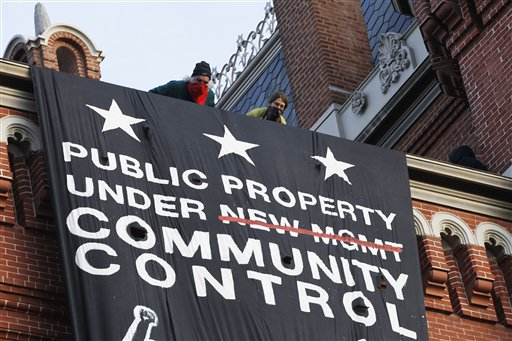
A group of protesters inspired by Occupy D.C. protest hang a banner on Franklin School building, in Washington, Saturday, Nov., 19, 2011 (Credit: AP Photo/Pablo Martinez Monsivais)
This originally appeared on TomDispatch.

No headlines announced it. No TV pundits called it. But on the evening of November 8th, Occupy Wall Street, the populist uprising built on economic justice and corruption-free politics that’s spread like a lit match hitting a trail of gasoline, notched its first major political victory, and in the unlikeliest of places: Ohio.

You might have missed OWS’s win amid the recent wave of Occupy crackdowns. Police raided Occupy Denver, Occupy Salt Lake City, Occupy Oakland, Occupy Portland and Occupy Seattle in a five-day span. Hundreds were arrested. And then, in the early morning hours on Tuesday, New York City police descended on Occupy Wall Street itself, fists flying and riot shields at the ready, with orders from Mayor Michael Bloomberg to evict the protesters. Later that day, a judge ruled that they couldn’t rebuild their young community, dealing a blow to the Occupy protest that inspired them all.

Instead of simply condemning the eviction, many pundits and columnists praised it or highlighted what they considered its bright side. The Washington Post’s Ezra Klein wrote that Bloomberg had done Occupy Wall Street a favor. After all, he argued, something dangerous or deadly was bound to happen at OWS sooner or later, especially with winter soon to arrive. Zuccotti Park, Klein added, “was cleared… in a way that will temporarily reinvigorate the protesters and give Occupy Wall Street the best possible chance to become whatever it will become next.”

The New York Times’ Paul Krugman wrote that OWS “should be grateful” for Bloomberg’s eviction decree: “By acting so badly, Bloomberg has made it easy to see who won’t be truthful and can’t handle open discourse.  He’s also saved OWS from what was probably its greatest problem, the prospect that it would just fade away as time went on and the days grew colder.”

Read between the lines and what Klein, Krugman and others are really saying is: you had your occupation; now, get real. Start organizing, meaningfully connect your many Occupy protests, build a real movement. As these columnists see it, that movement — whether you call it OccupyUSA, We Are the 99 percent, or the New Progressive Movement — should now turn its attention to policy changes like a millionaire’s tax, a financial transaction fee or a constitutional amendment to nullify the Supreme Court’s Citizens United decision that loosed a torrent of cash into American elections. It should think about supporting political candidates. It should start making a nuts-and-bolts difference in American politics.

But such assessments miss an important truth: Occupy Wall Street has already won its first victory its own way — in Ohio, when voters repealed Republican governor John Kasich’s law to slash bargaining rights for 350,000 public workers and gut what remained of organized labor’s political power.

Commandeering the Conversation

Don’t believe me? Then think back to this spring and summer, when Occupy Wall Street was just a glimmer in the imagination of a few activists, artists and students. In Washington, the conversation, such as it was, concerned debt, deficit and austerity. The discussion wasn’t about whether to slash spending, only about how much and how soon. The Washington Post’s Greg Sargent called it the “Beltway Deficit Feedback Loop” — and boy was he right.

A National Journal analysis in May found that the number of news articles in major newspapers mentioning “deficit” was climbing, while mentions of “unemployment” had plummeted. In the last week of July, the liberal blog ThinkProgress tallied 7,583 mentions of the word “debt” on MSNBC, CNN and Fox News alone. “Unemployment”? A measly 427.

This all-deficit, all-the-time debate shaped the final debt-ceiling deal, in which House Speaker John Boehner and his “cut-and-grow”-loving GOP allies got just about everything they wanted. So lopsided was the debate in Washington that President Obama himself hailed the deal’s bone-deep cuts to health research, public education, environmental protection, childcare and infrastructure.

These cuts, the president explained, would bring the country to “the lowest level of annual domestic spending since Dwight Eisenhower was president.” After studying the deal, Ethan Pollock of the Economic Policy Institute told me, “There’s no way to square this plan with the president’s ‘Winning the Future’ agenda. That agenda ends.” Yet Obama said this as if it were a good thing.

Six weeks after Obama’s speech, protesters heard the call of Adbusters, the Canadian anti-capitalist magazine, and followed the lead of a small crew of activists, writers and students to “occupy Wall Street.” A few hundred of them set up camp in Zuccotti Park, a small patch of concrete next door to Ground Zero. No one knew how long the occupation would last, or what its impact would be.

What a game-changing few months it’s been. Occupy Wall Street has inspired 750 events around the world, and hundreds of (semi-)permanent encampments around the United States. In so doing, the protests have wrestled the national discussion on the economy away from austerity and toward gaping income inequality (the 99 percent versus 1 percent theme), outsized executive compensation, and the plain buying and selling of American politicians by lobbyists and campaign donors.

Mentions of the phrase “income inequality” in print publications, web stories and broadcast transcripts spiked from 91 times a week in early September to nearly 500 in late October, according to the website Politico — an increase of nearly 450 percent. In the second week of October, according to ThinkProgress, the words most uttered on MSNBC, CNN, and Fox News were “jobs” (2,738), “Wall Street” (2,387) and “Occupy” (1,278). (References to “debt” tumbled to 398.)

And here’s another sign of the way Occupy Wall Street has forced what it considers the most pressing economic issues for the country into the spotlight: conservatives have lately gone on the defensive by attacking the very existence of income inequality, even if to little effect. As AFL-CIO president Richard Trumka put it, “Give credit to the Occupy Wall Street movement (and historic inequality) for redefining the political narrative.”

Wall Street in Ohio

The way Occupy Wall Street, with next to no direct access to the mainstream media, commandeered the national political narrative represents something of a stunning triumph. It also laid the groundwork for OWS’s first political win.

Just as OWS was grabbing that narrative, labor unions and Democrats headed into the final stretch of one of their biggest fights of 2011: an up-or-down referendum on the fate of Ohio governor John Kasich’s anti-union law, also known as SB 5. Passed by the Republican-controlled state legislature in March, it sought to curb the collective bargaining rights of 350,000 police, firefighters, teachers, snowplow drivers and other public workers. It also gutted the political clout of unions by making it harder for them to collect dues and fund their political action committees. After failing to overturn similar laws in Wisconsin and Michigan, the SB 5 fight was labor’s last stand of 2011.

I spent a week in Ohio in early November interviewing dozens of people and reporting on the run-up to the SB 5 referendum. I visited heavily Democratic and Republican parts of the state, talking to liberals and conservatives, union leaders and activists.  What struck me was how dramatically the debate had shifted in Ohio thanks in large part to the energy generated by Occupy Wall Street.

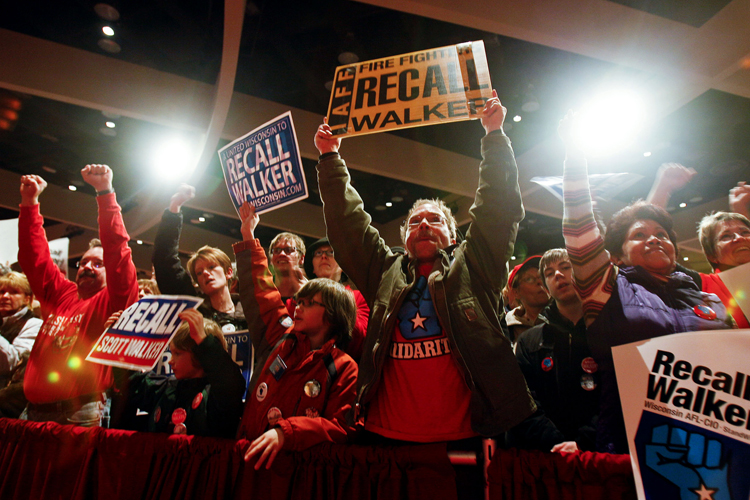
It was as if a great tide had lifted the pro-repeal forces in a way you only fully grasped if you were there. Organizers and volunteers had a spring in their step that hadn’t been evident in Wisconsin this summer during the recall elections of nine state senators targeted for their actions during the fight over Governor Scott Walker’s own anti-union law. Nearly everywhere I went in Ohio, people could be counted on to mention two things: the 99 percent — that is, the gap between the rich and poor — and the importance of protecting the rights of the cops and firefighters targeted by Kasich’s law.

And not just voters or local activists either.  I heard it from union leaders as well. Mary Kay Henry, president of the Service Employees International Union, told me that her union had recruited volunteers from 15 different states for the final get-out-the-vote effort in Ohio. That, she assured me, wouldn’t have happened without the energy generated by OWS. And when Henry herself went door-to-door in Ohio to drum up support for repealing SB 5, she said that she could feel its influence in home after home. “Every conversation was in the context of the 99 percent and the 1 percent, this discussion sparked by Occupy Wall Street.”

This isn’t to take anything away from labor’s own accomplishments in Ohio. We Are Ohio, the labor-funded coalition that led the effort, collected nearly 1.3 million signatures this summer to put the repeal of SB 5 on the November ballot.  (They needed just 230,000.) The group outspent its opponents $30 million to $8 million, a nearly four-to-one margin. And in the final days before the November 8th victory, We Are Ohio volunteers knocked on a million doors and made nearly a million phone calls. In the end, a stunning 2.14 million Ohioans voted to repeal SB 5 and only 1.35 million to keep it, a 61 percent to 39 percent margin. There were repeal majorities in 82 of Ohio’s 88 counties, support that cut across age, class, race and political ideologies.

Nonetheless, it’s undeniable that a mood change had hit Ohio — and in a major way. Pro-worker organizers and volunteers benefited from something their peers in Wisconsin lacked: the wind of public opinion at their backs. Polls conducted in the run-up to Ohio’s November 8th vote showed large majorities of Ohioans agreeing that income inequality was a problem. What’s more, 60 percent of respondents in a Washington Post-ABC poll said the federal government should act to close that gap. Behind those changing numbers was the influence of Occupy Wall Street and other Occupy protests.

So, as the debate rages over what will happen to Occupy Wall Street after its eviction from Zuccotti Park, and some “experts” sneer at OWS and tell it to get real, just direct their attention to Ohio. Kasich’s anti-union law might still be on the books if not for the force of OWS. And if the Occupy movement survives Mayor Bloomberg’s eviction order and the winter season, if it regroups and adapts to life beyond Zuccotti Park, you can bet it will notch more political victories in 2012.

To stay on top of important articles like these, sign up to receive the latest updates from TomDispatch.com here.

Continue Reading Close

America’s lost economic decade

The once-powerful middle class has collapsed, and the poor have it even worse. Will the U.S. ever recover?

(Credit: Jim Barber via Shutterstock)
This originally appeared on TomDispatch.

Food pantries picked over. Incomes drying up. Shelters bursting with the homeless. Job seekers spilling out the doors of employment centers. College grads moving back in with their parents. The angry and disillusioned filling the streets.

Pan your camera from one coast to the other, from city to suburb to farm and back again, and you’ll witness scenes like these. They are the legacy of the Great Recession, the Lesser Depression, or whatever you choose to call it.

In recent months, a blizzard of new data, the hardest of hard numbers, has laid bare the dilapidated condition of the American economy, and particularly of the once-mighty American middle class. Each report sparks a flurry of news stories and pundit chatter, but never much reflection on what it all means now that we have just enough distance to look back on the first decade of the twenty-first century and see how Americans fared in that turbulent period.

And yet the verdict couldn’t be more clear-cut. For the American middle class, long the pride of this country and the envy of the world, the past 10 years were a bust. A washout. A decade from hell.

Paychecks shrank. Household wealth melted away like so many sandcastles swept off by the incoming tide. Poverty spiked, swallowing an ever-greater share of the population, young and old. “This is truly a lost decade,” Harvard University economist Lawrence Katz said of these last years. “We think of America as a place where every generation is doing better, but we’re looking at a period when the median family is in worse shape than it was in the late 1990s.”

Poverty Swallows America

Not even a full year has passed and yet the signs of wreckage couldn’t be clearer. It’s as if Hurricane Irene had swept through the American economy. Consider this statistic: between 1999 and 2009, the net jobs gain in the American workforce was zero. In the six previous decades, the number of jobs added rose by at least 20 percent per decade.

Then there’s income. In 2010, the average middle-class family took home $49,445, a drop of $3,719 or 7 percent, in yearly earnings from 10 years earlier. In other words, that family now earns the same amount as in 1996. After peaking in 1999, middle-class income dwindled through the early years of the George W. Bush presidency, climbing briefly during the housing boom, then nosediving in its aftermath.

In this lost decade, according to economist Jared Bernstein, poor families watched their income shrivel by 12 percent, falling from $13,538 to $11,904. Even families in the 90th percentile of earners suffered a 1 percent percent hit, dropping on average from $141,032 to $138,923. Only among the staggeringly wealthy was this not a lost decade: the top 1 percent of earners enjoyed 65 percent of all income growth in America for much of the decade, one hell of a run, only briefly interrupted by the financial meltdown of 2008 and now, by the look of things, back on track.

The swelling ranks of the American poor tell an even more dismal story. In September, the Census Bureau rolled out its latest snapshot of poverty in the United States, counting more than 46 million men, women, and children among this country’s poor. In other words, 15.1 percent of all Americans are now living in officially defined poverty, the most since 1993. (Last year, the poverty line for a family of four was set at $22,113; for a single working-age person, $11,334.) Unlike in the lost decade, the poverty rate decreased for much of the 1990s, and in 2000 was at about 11 percent.

Even before the housing market imploded, during the post-dot-com-bust years of “recovery” from 2001 to 2007, poverty figures were the worst for any recovery on record, according to Arloc Sherman, a senior researcher at the Center on Budget and Policy Priorities. The Brookings Institution, meanwhile, predicts that the ranks of the poor will continue to grow steadily during the years of the Great Recession, which officially began in December 2007, and are expected to reach 50 million by 2015, almost 10 million more than in 2007.

Hitting similar record highs are the numbers of “deep” poor, Americans living way below the poverty line. In 2010, 20.5 million people, or 6.7 percent of all Americans, scraped by with less than $11,157 for a family of four — that is, less than half of the poverty line.

The ranks of the poor are no longer concentrated in inner cities or ghettos in the country’s major urban areas as in decades past. Poverty has now exploded in the suburbs. Last year, more than 15 million suburbanites — or one-third of all poor Americans — fell below the poverty line, an increase of 11.5 percent from the previous year.

This is a development of the last decade. Those suburbs, once the symbol of by-the-bootstraps mobility and economic prosperity in America, saw poverty spike by 53 percent since 2000.  Four of the ten poorest suburbs in America — Fresno, Bakersfield, Stockton, and Modesto — sit side by side on a map of California’s Central Valley like a row of broken knuckles.  The poor are also concentrated in border towns like El Paso and McAllen, Texas, and urban areas cratered by the housing crash like Fort Myers and Lakeland, Florida.

The epidemic of poverty has hit minorities especially hard. According to Census data, between 2009 and 2010 alone the black poverty rate jumped from 25 percent to 27 percent. For Hispanics, it climbed from 25 percent to 26 percent, and for whites, from 9.4 percent to 9.9 percent. At 16.4 million, more children now live in poverty than at any time since 1962.  Put another way, 22 percent of kids currently live below the poverty line, a 17-year record.

America’s lost decade also did a remarkable job of destroying the wealth of nonwhite families, the Pew Research Center reported in July. Between 2005 and 2009, the household wealth of a typical black family dropped off a cliff, plunging by a whopping 53%; for a typical Hispanic family, it was even worse, at 66 percent. For white middle-class households, losses on average totaled “only” 16 percent.

Here’s a more eye-opening way to look at it: in 2009, the median wealth for a white family was $113,149, for a black family $5,677, and for a Hispanic family $6,325. The second half of the lost decade, in other words, laid ruin to whatever wealth was possessed by blacks and Hispanics — largely home ownership devastated by the popping of the housing bubble.

The New Lost Decade

As for this decade, less than two years in, we already know that the news isn’t likely to be much better. The problems that plagued Americans in the previous decade show little sign of improvement.

Take the jobs market. Tally the number of jobs eliminated since the recession began and also the labor market’s failure to create enough jobs to keep up with normal population growth, and you’re left with an 11.2 million jobs deficit, a chasm between where the economy should be and where it is now. Filling that gap is the key to any recovery, but to do so by mid-2016 would mean adding 280,000 jobs a month — a pipe dream in an economy limping along creating an average of just 35,000 jobs a month for the past three months. Unless the country’s jobs engine were somehow jump-started, 11.2 million jobs in this decade would be a real stretch.

But few in Congress, and none of the controlling Republican politicians, will even think about using the jumper cables. President Obama’s relatively modest American Jobs Act, for instance, was declared a corpse on arrival at the House of Representatives. On Monday, a reporter asked House Majority Leader Eric Cantor (R-Va.), “The $447 billion jobs package as a package: dead?” Yes, Cantor assured him, indeed it was.

The president and his administration watch despondently from the other end of Pennsylvania Avenue. And for the majority of Americans, a jobless “recovery” exacts an ever-greater toll on their earnings, their families, their health, their basic ability to make ends meet.

The question on many economists’ minds is: Will the U.S. slump into a double-dip recession? But for so many Americans living outside the political and media hothouses of Washington and New York, this question is silly.  After all, how can the economy tumble back into recession if it never left in the first place?

No one can say for certain how many years will pass before America regains anything like its pre-recession swagger — and even then, there’s little to suggest that the devastating effects of the middle class’s lost decade won’t have changed this country in ways that will prove permanent, or that the gap between the wealthy and everyone else will do anything but increase in good times or bad in the decade to come. The deep polarization between the very rich and everyone else has been decades in the making and is a global phenomenon. Reversing it could be the task of a lifetime.

In the meantime, the middle class has flat-lined. Life support is nowhere close to arriving. One lost decade may have ended, but the next one has likely only begun.

To stay on top of important articles like these, sign up to receive the latest updates from TomDispatch.com here.

Continue Reading Close

What’s next for Wisconsin progressives?

After falling just short of its summer goals, the fledgling movement may try to recall Gov. Walker

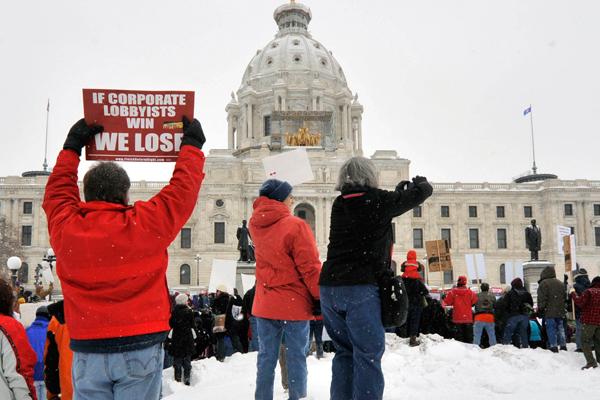
Supporters of workers' rights carry signs in front of the state Capitol in St. Paul, Minn., on Saturday, Feb. 26, 2011

Stephanie Haw needed a good cry.

On the night of Aug. 9, the rowdy crowd inside Hawk’s bar in downtown Madison grew ever quieter as the election results trickled in. Earlier that day, with the nation watching, voters statewide cast their ballots in Wisconsin’s eagerly awaited recall elections that threatened the seats of six Republican state senators. Democrats needed to win three of them to regain control of the state Senate and block Republican Gov. Scott Walker’s hard-line agenda. But it wasn’t to be. Deep into the night, an MSNBC anchor announced that a fourth GOP senator, Alberta Darling of north Milwaukee and the nearby suburbs, had clinched a narrow victory.

Haw slipped outside. It wasn’t supposed to turn out like this, she thought. Progressives had mobilized damn near every possible supporter they could, phone banking and door knocking and Facebooking and tweeting, and in the end, it still wasn’t enough. She thought of all the energy poured into the recall effort, and of her 2-year-old daughter running around the house shouting, “Recall Walker! Recall Walker!” Standing on the sidewalk, she burst into tears.

I met Haw and her mother later that night at Hawk’s. We sat around chewing over the election results till the bar emptied. Haw, who was wearing a red T-shirt with “Solidarity” emblazoned on the front, said simply, “I feel terrible that we lost.” I reminded her what the Democrats had been up against: With one exception, the six districts in play leaned to the right, and all six of those Republicans had won in 2008 despite the Obama frenzy that gripped the state. (He won it by nearly 14 percentage points.) She nodded along with me and then summed her feelings up this way: “I guess it’s the best of times and the worst of times.”

That ambivalence seemed to carry through Wisconsin’s historic summer of recalls, which ended on Aug. 16 when a pair of Democratic state senators easily defended their seats from a Republican recall effort. Which is to say, when the dust settled in the Badger State, there was no clear winner.

Wisconsin Democrats took five out of the summer’s nine recalls, and also won the overall vote count by 50.7 percent to 49.3 percent. They failed, however, in their chief goal: winning enough seats to wrest control of the state Senate majority and so shift the balance of power away from Gov. Walker and his allies in the legislature.

That didn’t stop Mike Tate, chairman of the state Democratic Party, from crowing that Democrats had clinched the “overall victory.” Republicans, meanwhile, cast the results as a vindication of Walker and his Republican game plan. “Wisconsin now emerges from this recall election season with a united Republican majority,” Wisconsin GOP chairman Brad Courtney bragged. “[We've] beaten off an attack from national unions and special interests and emerged steadfastly committed to carrying forward a bold job creation agenda.”

Liberal and conservative media similarly claimed victory. The Nation’s John Nichols, the most vocal cheerleader for the Democrats, wrote that their recall wins dealt “a serious blow to [Republican] authority inside the state Capitol.” Conservative blogger Owen Robinson was typical when he opined in the West Bend Daily News, “The people decided that they were pretty happy with the direction the Republicans are moving the state and let them retain power in Madison.”

Can it be both? If not, then who really won in Wisconsin? And what does that portend for the fledgling movement sparked by the labor uprising in February and March?

The Union Manpower Machine

The night before the Aug. 9 recalls, people clutching stacks of paper and cradling cellphones to their ears spilled out of the Laborers’ Local 464 union hall on the north side of Madison. The Democratic Party had moved its phone-banking operation to the union hall to accommodate the waves of volunteers who had turned out to help the six Democrats in the next day’s election. The hall itself buzzed with the din of a few dozen conversations, and with volunteer trainers getting the next crop of callers ready for their upcoming three-hour shift.

I logged 1,200 miles driving around Wisconsin before the GOP recall elections, and saw the same enthusiasm nearly everywhere I went. It was something to behold, the staggering get-out-the-vote (GOTV) effort mounted by the labor unions and the Democratic Party — at a time of year when many Wisconsinites are normally more preoccupied with last night’s Brewers game and heading out to the lake for the weekend.

One Sunday afternoon, I tagged along with a savvy, relentless community organizer named Austin Thompson in a mostly black, low- and middle-income neighborhood that locals call “Far North” Milwaukee. At door after door, Thompson stressed the importance of voting in the recalls; by the time I met him, he’d visited some houses five or six times, determined to mobilize a pocket of the city that, he reminded me, barely turned out the vote in the 2010 election.

That energy carried right up until the polls closed. Tom Bird, a whip-smart grad student I’d befriended during Madison’s labor protests back in February, texted me at 6 p.m. on Election Day from a local union meeting place, “I can’t even phone bank because the labor temple is full.” Democrats and the unions had thrown everything in the ring.

All that GOTV effort paid off — but for both parties. Forty-four percent of eligible voters in the six state Senate districts cast a ballot on Aug. 9, just shy of the combined turnout for the 2010 governor’s race. The GOP’s biggest fear — that a small but motivated base of opponents would come out while their supporters stayed home — did not happen. “Everybody voted. Ultimately, that probably hurt,” Democratic pollster Paul Maslin told the Milwaukee Journal Sentinel. “We didn’t have that kind of aggrieved-party advantage [we needed].”

Nor did Democrats have a big money advantage. Mike McCabe, director of the Wisconsin Democracy Campaign, a nonpartisan outfit that tracks money in Badger State politics, said upwards of $40 million was spent on the nine recall races, with both left- and right-leaning groups spending roughly the same amount. By contrast, $3.75 million went into the entire slate of legislative races in 2010. The key difference, McCabe explained, was the wave of “dark money” spent by right-leaning groups, who, thanks to the Supreme Court’s Citizens United decision of 2010, didn’t have to disclose their donors. (Left-leaning groups almost entirely disclosed their funders.) Such staggering recall spending, he said, “is so out of whack from everything we’ve ever seen.”

Make no mistake: The Democrats and labor unions won the overall GOTV fight. In the nine Senate districts in play this summer, more ballots were cast for Democrats than for Tom Barrett, the Democratic gubernatorial candidate, in last November’s general election. Sure, Republican turnout was higher than expected, but a majority of the districts at stake were colored red on the political map anyway. “Union money is being matched or outmatched by money from conservative organizations,” wrote Slate’s Dave Weigel, “but union turnout operations are outmuscling conservatives and the Tea Party.”

Putting the Cart before the Donkey

A week before the Aug. 9 recalls, Democratic Party of Wisconsin Chairman Mike Tate held a national conference call with reporters to deliver some rosy news. Internal polling (always to be taken with a hefty pinch of salt) showed Democrats leading in three races and tied in the remaining three. Tate didn’t say so outright, but the swagger in his voice sent a message: We’re gonna win this thing. Next stop, Senate majority.

When I arrived in Wisconsin four days before the vote, many of the activists, operatives and candidates with whom I talked brimmed with confidence. Polling data from the liberal Daily Kos website showed Democrats ahead in three races, albeit by the narrowest of margins in two of them. “In my mind we get all six,” Jessica King, one of the six Democratic challengers, told me on the steps of the Waupun City Hall. (And she would, in fact, unseat the Republican she was facing.)

Then, on the eve of the elections, I sensed a subtle shift. A succession of union and Democratic staffers pulled me aside to remind me about what an uphill fight their candidates faced, and how difficult it was going to be to win on GOP turf in the dead of summer. You could feel then that, by trumpeting their chances of ousting three or more senators, left-leaning groups feared that they had put the cart before the donkey (if you will). Suddenly, the bluster was gone, and they were racing to manage expectations.

It was too late. When Democrats fell one seat short of winning back the Senate majority, their opponents promptly portrayed what was certainly a victory as an embarrassing loss, a waste of money and manpower, a sign of the left’s waning clout. “They came, they spent, they lost,” was how one conservative blogger put it. “Unions made Wisconsin a great battleground to send a message to other states that politicians who challenge union power will pay a price,” the Wall Street Journal editorial board opined. “The real price was paid by the unions themselves, in the national demonstration of their diminishing power.” Never mind that the Republicans had fired the first shot in the summer’s recall battle, and that the Democrats had launched their own recall efforts only in response to Republican threats — a point, it should be added, that Democrats failed to hammer home.

And so even though left-leaning groups turned out more voters, won more races, and left Gov. Walker with a razor-thin majority — and one Republican senator who voted against Walker’s anti-union bill and might be willing to work with the Democrats on key issues — they found themselves losing the messaging war. They had pinned their hopes on instant and total victory, on flipping the Senate, when they just as easily could have kept expectations in check. Such lofty ambitions in the face of very long odds and unfriendly demographics gave Republicans an opening to snatch victory from the jaws of defeat.

Further to the Left — and Right

Matt Thompson leaned back in his chair at the Argus pub just off Capitol Square in Madison, and thought about what came next. (Heavy political discussion in Wisconsin, you might have noticed, is often accompanied by even heavier ales.) Thompson had taken to the streets during the winter labor uprising to protest Walker’s anti-union actions, and since then has been a voice in the debate over the future of Wisconsin’s re-energized progressive movement, a discussion cultivated on the Twitter hashtag #wiunion. “I just don’t want this movement, whatever you want to call it, to fade,” he told me. “But if we don’t get three seats, I feel like that’s gonna hurt our momentum.”

Thompson was right to worry. With no obvious winner in Wisconsin’s summer recalls, it’s unclear what comes next for progressives. Many of the Wisconsinites I met told me that they were tired of the attack ads and political fisticuffs; they couldn’t wait for the Senate recalls to end so they could get on with their lives. Yet left-leaning groups insist that the nine races were mere previews for the biggest recall of all: Gov. Walker’s.

There are plenty of reasons why a Walker recall would be a long shot. For starters, only two governors have been recalled in this country’s history: North Dakota’s Lynn Frazier in 1921 and California’s Gray Davis in 2003. Walker’s opponents will need to collect upward of 600,000 signatures in 60 days to trigger a recall. And they will have to decide whether to begin collecting signatures in January, the moment Walker is eligible for recall — he has to have been in office for a full year — or plan their effort to coincide with the November presidential election.

Collecting 600,000 signatures, activists told me, isn’t that daunting; 1 million Wisconsinites voted for Walker’s opponent in 2010 in an election featuring a mediocre turnout and before anyone knew that Walker wanted to kneecap public-sector unions. But winning a recall election remains a very tall order.

If the Senate recalls succeeded at anything, experts say, it was in further polarizing the voters of Wisconsin, widening the chasm between left and right in a state previously known for compromise. (Remember, it was Republican Gov. Tommy Thompson who ushered in BadgerCare, the state’s renowned health insurance program for low-income parents and children.)

Then there’s the recall fatigue felt by many. After weeks of nasty attack ads blanketing the airwaves, some of them peddling outright lies, there was a general feeling that people wanted to get on with their lives. A recent survey by left-leaning Public Policy Polling captured that wariness, with 50 percent of respondents opposing a Walker recall while 47 percent supported it. Any such recall effort would also fall within the shadow of the 2012 presidential race, if not on Election Day itself, raising an important question: Would the Democratic Party and liberal outside groups that spent tens of millions of dollars in Wisconsin this summer siphon money away from defending President Obama or preserving their U.S. Senate majority in a difficult effort to defeat Walker?

When you play the angles, a Walker recall looks increasingly unlikely, says Charles Franklin, a University of Wisconsin-Madison political scientist. “I think it could happen,” he told me, “but between the letdown of not having succeeded fully this time and the competition in 2012, I think it’s going to wither away.”

Progressives at the Crossroads

Not if the unions can help it. After returning from Wisconsin, I interviewed Mary Kay Henry, the president of the Service Employees International Union (SEIU), at her organization’s headquarters just off Dupont Circle in Washington, D.C. Henry’s spacious office was splashed with colorful maps depicting SEIU membership around the country or various states’ positions on issues like anti-gay and right-to-work legislation.

She was, Henry said, “incredibly proud of the heroic efforts” of the unions in pushing back against Walker and Wisconsin Republicans, but also “disappointed with the outcome.” Most of all, she went on, the big challenge for SEIU and other unions was transforming the Wisconsin uprising into something larger. “I have waited all my life to see what I saw in February,” she told me. “And I think the question for us is how do we add oxygen to that?”

Henry acknowledged the possibility that a Walker recall election might go forward, but insisted that the key for Wisconsin’s progressives was “not to limit [the movement] or narrow it into electoral politics.” Instead, she considered it crucial to make sure “it’s expanded into a demand for jobs from the private sector in the state, and getting people back to work.” She summed things up this way: “I just think we need to expand the fight.”

Even activists on the ground in Wisconsin don’t yet know if that will happen. For the rest of us, their decision either to press on or pack it in will speak volumes about where progressive organizing stands in America, a nation where too many protesters believe it’s enough to turn up for a few rallies and then go home, even though the foundations for real mass movements (like Egypt’s democracy uprising) are laid years before lasting change occurs.

Americans need such a movement, built on economic populism and the dream of shared prosperity. The question is: Are Wisconsin’s progressives the first spark in that movement? Or is theirs a flare that is already flickering out?

To stay on top of important articles like these, sign up to receive the latest updates from TomDispatch.com here.

Continue Reading Close

The persistent black-white employment gap

African-Americans are twice as likely to be jobless as their Caucasian peers -- and they have been for 60 years

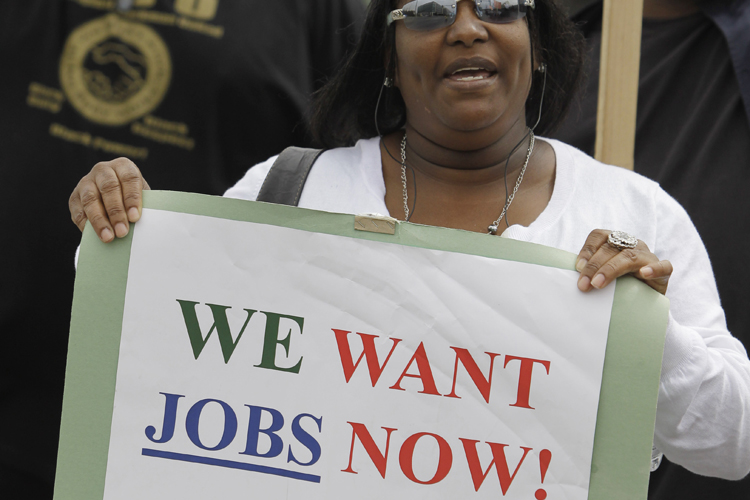
Unemployed Deanna Rice holds up a sign at a workers rally in San Francisco, Thursday, Sept. 16, 2010.

Like the country it governs, Washington is a city of extremes. In a car, you can zip in bare moments from northwest District of Columbia, its streets lined with million-dollar homes and palatial embassies, its inhabitants sporting one of the nation’s lowest jobless rates, to Anacostia, a mostly forgotten neighborhood in southeastern D.C. with one of the highest unemployment rates anywhere in America. Or, if you happen to be jobless, upset about it, and living in that neighborhood, on a crisp morning in March you could have joined an angry band of protesters marching on the nearby 11th Street Bridge.

They weren’t looking for trouble. They were looking for work.

Those protesters, most of them black, chanted and hoisted signs that read “D.C. JOBS FOR D.C. RESIDENTS” and “JOBS OR ELSE.” The target of their outrage: contractors hired to replace the very bridge under their feet, a $300 million project that will be one of the largest in District history. The problem: Few D.C. citizens, which means few African-Americans, had so far been hired. “It’s deplorable,” insisted civil rights attorney Donald Temple, “that … you can find men from West Virginia to work in D.C. You can find men from Maryland to work in D.C. And you can find men from Virginia to work in D.C. But you can’t find men and women in D.C. to work in D.C.”

The 11th Street Bridge arches over the slow-flowing Anacostia River, connecting the poverty-stricken, largely black Anacostia neighborhood with the rest of the District. By foot the distance is small; in opportunity and wealth, it couldn’t be larger. At one end of the bridge the economy is booming even amid a halting recovery and jobs crisis. At the other end, hard times, always present, are worse than ever.

Live in Washington long enough and you’ll hear someone mention “east of the river.” That’s D.C.’s version of “the other side of the tracks,” the place friends warn against visiting late at night or on your own. It’s home to District Wards 7 and 8, neighborhoods with a long, rich history. Once known as Uniontown, Anacostia was one of the District’s first suburbs; Frederick Douglass, nicknamed the “Sage of Anacostia,” once lived there, as did the poet Ezra Pound and singer Marvin Gaye. Today the area’s unemployment rate is officially nearly 20 percent. District-wide, it’s 9.8 percent, a figure that drops as low as 3.6 percent in the whiter, more affluent northwestern suburbs.

D.C.’s divide is America’s writ large. Nationwide, the unemployment rate for black workers at 16.2 percent is almost double the 9.1 percent rate for the rest of the population. And it’s twice the 8 percent white jobless rate.

The size of those numbers can, in part, be chalked up to the current jobs crisis in which black employment is being decimated. According to Duke University public policy expert William Darity,  blacks are “the last to be hired in a good economy, and when there’s a downturn, they’re the first to be released.”

That may account for the soaring numbers of unemployed African-Americans, but not the yawning chasm between the black and white employment rates, which is no artifact of the present moment. It’s a problem that spans generations, goes remarkably unnoticed, and condemns millions of black Americans to a life of scraping by. That unerring, unchanging gap between white and black employment figures goes back at least 60 years. It should be a scandal, but whether on Capitol Hill or in the media it gets remarkably little attention. Ever.

The 60-year scandal

The unemployment lines run through history like a pair of train tracks. Since the 1940s, the jobless rate for blacks in America has held remarkably, if grimly, steady at twice the rate for whites. The question why has vexed and divided economists, historians and sociologists for nearly as long.

For years the sharpest minds in academia pointed to upheaval in the American economy as the culprit. In his 1996 book “When Work Disappears,” the sociologist William Julius Wilson depicted the forces of globalization, a slumping manufacturing sector and suburban flight at work in Chicago as the drivers of growing joblessness and poverty in America’s inner cities and among its black residents.

He pictured the process this way: As corporations outsourced jobs to China and India, American manufacturing began its slow fade, shedding jobs often held by black workers. What jobs remained were moved to sprawling offices and factories in outlying suburbs reachable only by freeway. Those jobs proved inaccessible to the mass of black workers who remained in the inner cities and relied on public transportation to get to work.

Time and research have, however, eaten away at the significance of Wilson’s work. The hollowing-out of America’s cities and the decline of domestic manufacturing no doubt played a part in black unemployment, but then chronic black joblessness existed long before the upheaval Wilson described. Even when employment in the manufacturing sector was at its height, black workers were still twice as likely to be out of work as their white counterparts.

Another commonly cited culprit for the tenaciousness of African-American unemployment has been education. Whites, so the argument goes, are generally better educated than blacks, and so more likely to land a job at a time when a college degree is ever more significant when it comes to jobs and higher earnings. In 2009, President Obama told reporters that education was the key to narrowing racial gaps in the US. “If we close the achievement gap, then a big chunk of economic inequality in this society is diminished,” he said.

Educational levels have, in fact, steadily climbed over the past 60 years for African-Americans. In 1940, less than 1 percent of black men and less 2 percent of black women earned college degrees; jump to 2000, and the figures are 10 percent for black men and 15 percent for black women. Moreover, increased education has helped to narrow wage inequality between employed whites and blacks. What it hasn’t done is close the unemployment gap.

Algernon Austin, an economist for the Economic Policy Institute in Washington, D.C., crunched data from the Bureau of Labor Statistics and found that blacks with the same level of education as whites have consistently lower employment levels. It doesn’t matter whether you compare high-school dropouts or workers with graduate degrees, whites are still more likely to have a job than blacks. Degrees be damned.

Academics have thrown plenty of other explanations at the problem: declining wages, the embrace of crime as a way of life, increased competition with immigrants.  None of them have stuck. How could they? In recent decades, the wage gap has narrowed, crime rates have plummeted, and there’s scant evidence to suggest immigrants are stealing jobs that would otherwise be filled by African-Americans.

Indeed, many top researchers in this field, including several I interviewed, are left scratching their heads when trying to explain why that staggering jobless gap between blacks and white won’t budge. “I don’t know if there’s anybody out there who can tell you why that ratio stays at 2 to 1,” Darity says. “It’s a statistical regularity that we don’t have an explanation for.”

Behind bars, the invisible unemployed

So what keeps blacks from cutting into those employment figures? Among the theories, one that deserves special attention points to the high incarceration rate among blacks — and especially black men.

In 2009, 7.2 million Americans — or 3.1 percent of all adults — were under the jurisdiction of the U.S. corrections system, including 1.6 million Americans incarcerated in a state or federal prison. Of that population, nearly 40 percent percent were black, even though blacks make up only 13 percent percent of the American population. Blacks were six times as likely to be in prison as whites, and three times as likely as Hispanics. For some perspective, consider what the author of “The New Jim Crow,” Michelle Alexander, wrote last year: “There are more African Americans under correctional control today — in prison or jail, on probation or parole — than were enslaved in 1850, a decade before the Civil War began.”

Incarceration amounts to a double whammy when it comes to African-American unemployment. Rarely mentioned in the usual drumbeat of media reports on jobs is the fact that the Labor Department doesn’t include prison populations in its official unemployment statistics. This automatically shrinks the pool of blacks capable of working and in the process lowers the black jobless rate.

In the mid-1990s, academics Bruce Western and Becky Pettit discovered that the American prison population lowered the jobless rate for black men by 5 percentage points, and for young black men by 8 percentage points. (Of course, this applies to whites, Asians and Hispanics as well, but the figures are particularly striking given the overrepresentation of blacks in the prison population.)

Even that vast incarcerated population pales, however, in comparison to the number of ex-cons who have rejoined the world beyond the prison walls. In 2008, there were 12 million to 14 million ex-offenders in the U.S. old enough to work, according to the Center for Economic and Policy Research. So many ex-cons represent a serious drag on our economy, according to CEPR, sucking from it $57 billion to $65 billion in output.

Of course, such research tells us how much, not why — as in, why are ex-cons so much more likely to be out of work? For an answer, it’s necessary to turn to an eye-opening and, in some circles, controversial field of study that may offer the best explanation for the 60-year scandal of black unemployment.

Twice as hard, half as far

In 2001, a pair of black men and a pair of white men went hunting for work in Milwaukee, Wis. Each was 23 years old, a local college student, bright and articulate. They looked alike and dressed alike, had an identical educational background and remarkably similar past work experience. From June to December, they combed the Sunday classified pages in the Milwaukee Journal Sentinel and searched a state-run job site called Jobnet, applying for the same entry-level jobs as waiters, delivery-truck drivers, cooks, and cashiers. There was one obvious difference in each pair: One man was a former criminal and the other was not.

If this sounds like an experiment, that’s because it was. Watching the explosive growth of the criminal justice system, fueled largely by ill-conceived “tough on crime” policies, sociologist Devah Pager took a novel approach to how prison affected ever growing numbers of Americans after they’d done their time — a process all but ignored by politicians and the judicial system.

So Pager sent those two young black men and two young white men out into the world to apply for perfectly real jobs. Then she recorded who got callbacks and who didn’t. She soon discovered that a criminal history caused a massive drop-off in employer responses — not entirely surprising. But when Pager started separating out black applicants from white ones, she stumbled across the real news in her study, a discovery that shook our understanding of racial inequality and jobs to the core.

Pager’s white applicant without a criminal record had a 34 percent callback rate. That promptly sank to 17 percent for her white applicant with a criminal record. The figures for black applicants were 14 percent and 5 percent. And yes, you read that right: in Pager’s experiment, white job applicants with a criminal history got more callbacks than black applicants without one. “I expected to find an effect with a criminal record and some with race,” Pager says. “I certainly was not expecting that result, and it was quite a surprise.”

Pager ran a larger version of this experiment in New York City in 2004, sending teams of young, educated and identically credentialed men out into the Big Apple’s sprawling market for entry-level jobs — once again, with one applicant posing as an ex-con, the other with a clean record. (As she did in Milwaukee, Pager had the teams alternate who posed as the ex-con.) The results? Again Pager’s African-American applicants received fewer callbacks and job offers than the whites. The disparity was particularly striking for ex-criminals: a drop off of 9 percentage points for whites, but 15 percentage points for blacks. “Employers already reluctant to hire blacks,” Pager wrote, “appear particularly wary of blacks with known criminal histories.”

Other research has supported her findings. A 2001-02 field experiment by academics from the University of Chicago and the Massachusetts Institute of Technology, for example, uncovered a sizable gap in employer callbacks for job applicants with white-sounding names (Emily and Greg) versus black-sounding names (Lakisha and Jamal). They also found that the benefits of a better résumé were 30 percent greater for whites than blacks.

These findings proved a powerful antidote to the growing notion, mostly in conservative circles, that discrimination was an illusion and racism long eradicated. In “The Content of Our Character” (1991), Shelby Steele argued that racial discrimination no longer held black men or women back from the jobs they wanted; the problem was in their heads. Dinesh D’Souza, a first-generation immigrant of Indian descent, published “The End of Racism” in 1995, similarly claiming racial discrimination had little to do with the plight of black America.

Not so, insist Pager, Darity, Harvard’s Bruce Western, and other academics using real data with an unavoidable message: Racism is alive and well. It leads to endemic, deeply embedded patterns of discrimination whose harmful impact has barely changed in 60 years. And it cannot be ignored. As the old African-American adage puts it, “You’ve got to work twice as hard to get half as far as a black person in white America.”

Is there a solution for black America?

Tracing black unemployment in America since World War II, there are two moments when, briefly, the gap between black and white joblessness narrowed ever so slightly — in the 1940s and again in the late 1960s and early 1970s. For example in 1970, unemployment was at 5.8 percent for blacks and 3.3 percent for whites, a sizable gap but significantly better than what followed in the Reagan era. Those are moments worth revisiting, if only to understand what began to go right.

According to University of Chicago professors William Sites and Virginia Parks, those periods were marked by a flurry of civil rights and antidiscrimination activity on the federal level. A series of actions ranging from the creation of the Fair Employment Practice Committee in 1941 to the passage of the Civil Rights Act of 1964 (which mandated the Equal Employment Opportunity Commission), the Voting Rights Act of 1965, and the Equal Employment Opportunity Act of 1972, write Sites and Parks, had “dramatic impacts on employment discrimination.”

But those gains of the 1970s were soon wiped out. The thinning of union membership and the dwindling power of organized labor didn’t help either, after decades of pressure on employers to end discrimination against workers of color.

Today, in terrible times, with the possibility of social legislation off the table in Washington, the question remains: What, if anything, can be done to close the jobless gap between blacks and whites? When I asked Devah Pager, she called this the “million-dollar question.” This form of discrimination, she pointed out, is especially difficult to deal with. As she noted in 2005, many employers who discriminate don’t even realize they’re doing so; they’re just going with “gut feelings.” “It’s not that these employers have decided that they are not going to hire workers from a particular group,” Pager told me.

What won’t work is relying on discrimination watchdogs to crack down more often. The way federal antidiscrimination law works, it’s up to the person who was discriminated against to raise an alarm. As Duke’s William Darity points out, that’s a near impossibility for a job applicant who must convincingly read the mind of a person he or she doesn’t know. Worse than that, the applicant who wants to lodge charges of discrimination also has to prove that the discrimination was intentional, which, as Pager’s experiments make clear, is no small feat. Under the circumstances, as Darity told me, perhaps no one should be surprised to discover that blacks “grossly underreport their exposure to discrimination and whites grossly overreport it.”

Of course, fixing a problem first requires acknowledging it — something the nation has yet to do, says Austin, of the Economic Policy Institute. To put blacks back to work, lawmakers should invest federal money directly in job creation, especially for black workers. Other avenues for putting people back to work, like a payroll tax credit, won’t do the trick. “We’ve spent billions in trying to build jobs overseas” in war zones, Austin told me. “But if we invested that money here in our cities, we wouldn’t have this racial gap.”

But how likely is that at a moment when, in a Washington gripped by paralysis, any discussion of spending in Washington begins and ends at how much to cut? The painful reality of permanent crisis for black workers is here to stay. That’s how it seems to blacks in D.C., especially those who live east of the river. In April, another group of protesters took to the 11th Street Bridge to demand more D.C. hires, and the following month, the group D.C. Jobs or Else took their complaints to City Hall. But progress is slow. “We’re being pushed out economically,” said William Alston El, a 63-year-old unemployed resident who grew up in D.C. “They say it’s not racism, but the name of the game is they have the money. You can’t live [in] a place if you can’t pay the rent.”

To stay on top of important articles like these, sign up to receive the latest updates from TomDispatch.com here.

Continue Reading Close

McDonald’s is killing the middle class

Jobs are being created -- but mostly ones that will widen America's income gap between rich and poor

McDonald's employee hands a patron a salad at the drive up window at McDonald's in Williamsville, N.Y.

Think of it as a parable for these grim economic times. On April 19th, McDonald’s launched its first-ever national hiring day, signing up 62,000 new workers at stores throughout the country. For some context, that’s more jobs created by one company in a single day than the net job creation of the entire U.S. economy in 2009. And if that boggles the mind, consider how many workers applied to local McDonald’s franchises that day and left empty-handed: 938,000 of them. With a 6.2 percent acceptance rate in its spring hiring blitz, McDonald’s was more selective than the Princeton, Stanford, or Yale University admission offices.

It shouldn’t be surprising that a million souls flocked to McDonald’s hoping for a steady paycheck, when nearly 14 million Americans are out of work and nearly a million more are too discouraged even to look for a job. At this point, it apparently made no difference to them that the fast-food industry pays some of the lowest wages around: on average, $8.89 an hour, or barely half the $15.95 hourly average across all American industries.

On an annual basis, the average fast-food worker takes home $20,800, less than half the national average of $43,400. McDonald’s appears to pay even worse, at least with its newest hires. In the press release for its national hiring day, the multi-billion-dollar company said it would spend $518 million on the newest round of hires, or $8,354 a head. Hence the Oxford English Dictionary’s definition of “McJob” as “a low-paying job that requires little skill and provides little opportunity for advancement.”

Of course, if you read only the headlines, you might think that the jobs picture was improving. The economy added 1.3 million private-sector jobs between February 2010 and January 2011, and the headline unemployment rate edged downward, from 9.8 percent to 8.8 percent, between November of last year and March. It inched upward in April, to 9 percent, but tempering that increase was the news that the economy added 244,000 jobs last month (not including those 62,000 McJobs), beating economists’ expectations.

Under this somewhat sunnier news, however, runs a far darker undercurrent. Yes, jobs are being created, but what kinds of jobs paying what kinds of wages? Can those jobs sustain a modest lifestyle and pay the bills? Or are we living through a McJobs recovery?

The Rise of the McWorker

The evidence points to the latter. According to a recent analysis by the National Employment Law Project (NELP), the biggest growth in private-sector job creation in the past year occurred in positions in the low-wage retail, administrative, and food service sectors of the economy. While 23 percent of the jobs lost in the Great Recession that followed the economic meltdown of 2008 were “low-wage” (those paying $9-$13 an hour), 49 percent of new jobs added in the sluggish “recovery” are in those same low-wage industries. On the other end of the spectrum, 40 percent of the jobs lost paid high wages ($19-$31 an hour), while a mere 14 percent of new jobs pay similarly high wages.

As a point of comparison, that’s much worse than in the recession of 2001 after the high-tech bubble burst. Then, higher wage jobs made up almost a third of all new jobs in the first year after the crisis.

The hardest hit industries in terms of employment now are finance, manufacturing, and especially construction, which was decimated when the housing bubble burst in 2007 and has yet to recover. Meanwhile, NELP found that hiring for temporary administrative and waste-management jobs, health-care jobs, and of course those fast-food restaurants has surged.

Indeed in 2010, one in four jobs added by private employers was a temporary job, which usually provides workers with few benefits and even less job security. It’s not surprising that employers would first rely on temporary hires as they regained their footing after a colossal financial crisis. But this time around, companies have taken on temp workers in far greater numbers than after previous downturns. Where 26 percent of hires in 2010 were temporary, the figure was 11 percent after the early-1990s recession and only 7 percent after the downturn of 2001.

As many labor economists have begun to point out, we’re witnessing an increasing polarization of the U.S. economy over the past three decades. More and more, we’re seeing labor growth largely at opposite ends of the skills-and-wages spectrum — among, that is, the best and the worst kinds of jobs.

At one end of job growth, you have increasing numbers of people flipping burgers, answering telephones, engaged in child care, mopping hallways, and in other low-wage lines of work. At the other end, you have increasing numbers of engineers, doctors, lawyers, and people in high-wage “creative” careers. What’s disappearing is the middle, the decent-paying jobs that helped expand the American middle class in the mid-twentieth century and that, if the present lopsided recovery is any indication, are now going the way of typewriters and landline telephones.

Because the shape of the workforce increasingly looks fat on both ends and thin in the middle, economists have begun to speak of “the barbell effect,” which for those clinging to a middle-class existence in bad times means a nightmare life. For one thing, the shape of the workforce now hinders America’s once vaunted upward mobility. It’s the downhill slope that’s largely available these days.

The barbell effect has also created staggering levels of income inequality of a sort not known since the decades before the Great Depression. From 1979 to 2007, for the middle class, average household income (after taxes) nudged upward from $44,100 to $55,300; by contrast, for the top 1 percent, average household income soared from $346,600 in 1979 to nearly $1.3 million in 2007. That is, super-rich families saw their earnings increase 11 times faster than middle-class families.

What’s causing this polarization? An obvious culprit is technology. As MIT economist David Autor notes, the tasks of “organizing, storing, retrieving, and manipulating information” that humans once performed are now computerized. And when computers can’t handle more basic clerical work, employers ship those jobs overseas where labor is cheaper and benefits nonexistent.

Another factor is education. In today’s barbell economy, degrees and diplomas have never mattered more, which means that those with just a high school education increasingly find themselves locked into the low-wage end of the labor market with little hope for better. Worse yet, the pay gap between the well-educated and not-so-educated continues to widen: in 1979, the hourly wage of a typical college graduate was 1.5 times higher than that of a typical high-school graduate; by 2009, it was almost two times higher.

Considering, then, that the percentage of men ages 25 to 34 who have gone to college is actually decreasing, it’s not surprising that wage inequality has gotten worse in the U.S. As Autor writes, advanced economies like ours “depend on their best-educated workers to develop and commercialize the innovative ideas that drive economic growth.”

The distorting effects of the barbell economy aren’t lost on ordinary Americans. In a recent Gallup poll, a majority of people agreed that the country was still in either a depression (29 percent) or a recession (26 percent). When sorted out by income, however, those making $75,000 or more a year are, not surprisingly, most likely to believe the economy is in neither a recession nor a depression, but growing. After all, they’re the ones most likely to have benefited from a soaring stock market and the return to profitability of both corporate America and Wall Street. In Gallup’s middle-income group, by contrast, 55 percent of respondents claim the economy is in trouble. They’re still waiting for their recovery to arrive.

The Slow Fade of Big Labor

The big-picture economic changes described by Autor and others, however, don’t tell the entire story. There’s a significant political component to the hollowing out of the American labor force and the impoverishment of the middle class: the slow fade of organized labor. Since the 1950s, the clout of unions in the public and private sectors has waned, their membership has dwindled, and their political influence has weakened considerably. Long gone are the days when powerful union bosses — the AFL-CIO’s George Meany or the UAW’s Walter Reuther — had the ear of just about any president.

As Mother Jones’ Kevin Drum has written, in the 1960s and 1970s a rift developed between big labor and the Democratic Party. Unions recoiled in disgust at what they perceived to be the “motley collection of shaggy kids, newly assertive women, and goo-goo academics” who had begun to supplant organized labor in the Party. In 1972, the influential AFL-CIO symbolically distanced itself from the Democrats by refusing to endorse their nominee for president, George McGovern.

All the while, big business was mobilizing, banding together to form massive advocacy groups such as the Business Roundtable and shaping the staid U.S. Chamber of Commerce into a ferocious lobbying machine. In the 1980s and 1990s, the Democratic Party drifted rightward and toward an increasingly powerful and financially focused business community, creating the Democratic Leadership Council, an olive branch of sorts to corporate America. “It’s not that the working class [had] abandoned Democrats,” Drum wrote. “It’s just the opposite: The Democratic Party [had] largely abandoned the working class.”

The GOP, of course, has a long history of battling organized labor, and nowhere has that been clearer than in the party’s recent assault on workers’ rights. Swept in by a tide of Republican support in 2010, new GOP majorities in state legislatures from Wisconsin to Tennessee to New Hampshire have introduced bills meant to roll back decades’ worth of collective bargaining rights for public-sector unions, the last bastion of organized labor still standing (somewhat) strong.

The political calculus behind the war on public-sector unions is obvious: kneecap them and you knock out a major pillar of support for the Democratic Party. In the 2010 midterm elections, the American Federation of State, County, and Municipal Employees (AFSCME) spent nearly $90 million on TV ads, phone banking, mailings, and other support for Democratic candidates. The anti-union legislation being pushed by Republicans would inflict serious damage on AFSCME and other public-sector unions by making it harder for them to retain members and weakening their clout at the bargaining table.

And as shown by the latest state to join the anti-union fray, it’s not just Republicans chipping away at workers’ rights anymore. In Massachusetts, a staunchly liberal state, the Democratic-led State Assembly recently voted to curb collective bargaining rights on heath-care benefits for teachers, firefighters, and a host of other public-sector employees.

Bargaining-table clout is crucial for unions, since it directly affects the wages their members take home every month. According to data from the Bureau of Labor Statistics, union workers pocket on average $200 more per week than their non-union counterparts, a 28 percent percent difference. The benefits of union representation are even greater for women and people of color: women in unions make 34 percent more than their non-unionized counterparts, and Latino workers nearly 51 percent more.

In other words, at precisely the moment when middle-class workers need strong bargaining rights so they can fight to preserve a living wage in a barbell economy, unions around the country face the grim prospect of losing those rights.

All of which raises the questions: Is there any way to revive the American middle class and reshape income distribution in our barbell nation? Or will this warped recovery of ours pave the way for an even more warped McEconomy, with the have-nots at one end, the have-it-alls at the other end, and increasingly less of us in between?

Continue Reading Close

Page 1 of 3 in Andy Kroll

www.salon.com/writer/andy_kroll/index.html