Andy Kroll

Return to Wisconsin

Are we seeing the beginning or the end of the labor movement?

  • more
    • All Share Services

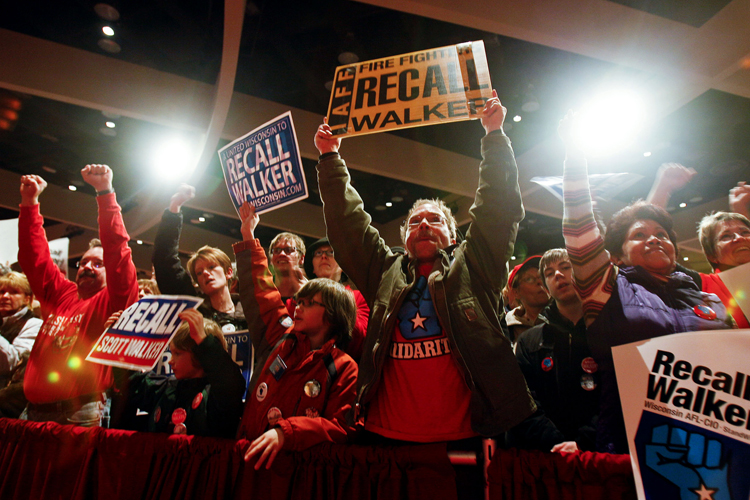
Return to WisconsinThousands of pro-labor protesters rallied at the Wisconsin Capitol Saturday, March 12, 2011, in Madison, Wis., vowing to fight back after the state's Republican governor signed into law a controversial bill that eliminates most union rights for public employees.(AP Photo/Morry Gash)(Credit: AP)

This piece originally appeared on TomDispatch.

It is easy to see the beginnings of things, and harder to see the ends.

– Joan Didion

In the February weeks I spent in snowy Madison, Wisconsin, that line of Didion’s, the opening of her 1967 essay “Goodbye to All That,” ricocheted through my mind as I tried to make sense of the massive protests unfolding around me. What was I witnessing? The beginning of a new movement in this country — or the end of an existing one, the last stand of organized labor? Or could it have been both?

None of us on the ground could really say. We were too close to the action, too absorbed by what was directly in front of us.

Of course, the battle between unions, progressive groups, and Wisconsin Republican Governor Scott Walker is not over. Not by a long shot. A county judge recently blocked “publication” of Walker’s anti-union legislation, saying it was possible Senate Republicans violated Wisconsin’s rigorous open records law when they rammed through a vote on his bill to do away with the collective bargaining rights of state workers. The case could end up before the state Supreme Court. But that didn’t stop the state’s Legislative Reference Bureau from publishing Walker’s bill anyway, touching off another round of arguing about the tactics used to make the bill into law. As of this writing, its actual status remains unclear. If a judge does force a new vote, it’s unlikely the outcome will change, though even that’s not certain.

Either way, the meaning of Madison, and also of what similar governors are doing amid similar turmoil in Columbus, Indianapolis, and other Midwestern cities, remains to be seen. Without the ability to bargain collectively, unions may indeed be fatally weakened. So, you could argue that the wave of attacks by conservative governors will gut public-sector unions in those states, if not wipe them out entirely.

On the other hand, those same efforts have mobilized startling numbers of ordinary citizens, young and old, educated and not, in a way none of us have seen since perhaps the 1930s. I know this for a fact. I was there in Madison and watched hundreds of thousands of protesters brave the numbing cold while jamming the streets to demand that Governor Walker back down. The events in Madison radicalized many young people who kept the flame of protest burning with their live-ins inside the Wisconsin State Capitol.

What remains to be seen is whether the new spark lit by the Republican Party’s latest crusade against unions can in some way fill the space left by those unions which, nationwide, stare down their own demise.

“Take the Unions Out at the Knees”

Madison was the beginning. When Scott Walker threatened to use the Wisconsin National Guard to quell a backlash in response to his draconian “budget repair bill,” it set off a month of protests. Almost as soon as Madison erupted, Ohio Republican Governor John Kasich, a former executive at Lehman Brothers, unveiled a union-crushing bill of his own, known as Senate Bill 5. Kasich sought even more power to curb unions than Walker, proposing to curb bargaining rights for all public-sector unions — Walker’s exempts firefighters and cops — and even outlaw strikes by public workers.

As in Madison, thousands of protesters poured into the Ohio Capitol in Columbus — that is, those who got inside before state troopers locked and blocked the doors. They brought megaphones and signs saying “Protect Workers’ Rights” and “Daughters of Teachers Against SB 5.” And in response, like Scott Walker, John Kasich has shown not the slightest willingness to negotiate; earlier this month, he promised to sign the bill into law as soon as the legislature approves it.

Meanwhile, the union-busting movement continues to spread. Iowa’s House of Representatives, controlled by Republicans, passed its own law in March gutting collective bargaining rights for public-sector unions. The measure, nearly identical to Wisconsin’s, would have made it to the desk of Republican Governor Terry Branstad, who backed the bill, and into law had the state’s Democrat-controlled Senate not killed it on the spot.

In early March, Idaho’s legislature voted to eliminate most bargaining rights for public school teachers, not to mention tossing out tenure and seniority. Two separate anti-union bills are wending their way through the Tennessee legislature — one in the state House that resembles Idaho’s, and another in the Senate that aims to outlaw collective bargaining for teachers altogether.

And now comes Alaska, one of the latest states to join the fight. There, on March 21st, a Republican state legislator introduced a measure nearly identical to Wisconsin’s that would strip most public-sector unions of the right to collectively bargain on health-care and retirement benefits. By one estimate, more than 20 state legislatures are considering bills to limit collective bargaining for unions.

Not to be forgotten is Indiana, where Democrats in the legislature’s lower chamber camped out beyond state lines for more than a month (as had Wisconsin Senate Democrats before them) to protest multiple pieces of legislation that would hurt unions and public-education funding. They returned to Indianapolis on Monday to cheers from supporters, their protest having killed a bill that would have made Indiana a “right to work” state while undermining support for other anti-union measures.

Even if, in the end, its lawmakers don’t pass any anti-union legislation, Indiana is already illustrative of what happens when collective bargaining is wiped out. With a flick of his pen, Republican Governor Mitch Daniels banned it for state employees in 2005 by executive order. The result, as the New York Times reported, was significant savings for the state, but skyrocketing health insurance payments and a pay freeze for state workers. Management fired more experienced employees who would have had seniority under old union rules. And union membership among state workers dwindled by 90%, with one former labor activist claiming workers, fearing repercussions from their bosses, were afraid to pay union dues.

Not that unions can’t exist in states without collective bargaining rights. In Arizona and Texas, for instance, unions still operate, even though both are heavily conservative “right-to-work” states, which means employees can opt out of union membership but still enjoy the wage increases and benefits negotiated by unions. Still, in those states, organized labor’s influence pales when compared to that of unions in Michigan or Wisconsin.

Then there are the political ramifications. Elected officials in each of these embattled states denied that any political motives lay behind their bills, but that’s obviously not true. Public-sector unions like the American Federation of State, County, and Municipal Employees are a pillar of support for the left wing of the Democratic Party. Knock out the unions, and you effectively “defund” that Party, as my colleague Kevin Drum put it recently.

Despite their pleas of ignorance, Republicans in Wisconsin, Iowa, Tennessee, Ohio, and every other state where legislation of this type is being considered understand perfectly well the damage their bills will inflict on their political opponents. As the top Republican in the Wisconsin Senate said, “If we win this battle, and the money is not there under the auspices of the unions, certainly what you’re going to find is President Obama is going to have a…much more difficult time getting elected and winning the state of Wisconsin.”

Indeed. So, in one sense, the intensifying assault on unions across much of the nation may represent an ending for a labor movement long on the wane and at least 30 years under siege by various Republican administrations, national and state. It is visibly now in danger of becoming a force of little significance in much of the country.

This is exactly what conservatives and the GOP want. As a director for the Koch brothers-backed advocacy group Americans for Prosperity recently admitted, “We fight these battles on taxes and regulation, but really what we would like to see is to take the unions out at the knees so they don’t have the resources to fight these battles.” If the bills mentioned here make it into law, the power wielded by public-sector unions — to fight for better wages and benefits, to demand a safer workplace, to elect progressive candidates — will wither. And with history as a guide, if union clout fades away, so, too, does the spirit of democracy in this country.

“If you look at the last 150 years of history across all nations with a working class of some sort, the maintenance of democracy and the maintenance of a union movement are joined at the hip,” Nelson Lichtenstein, a professor and labor historian at the University of California Santa Barbara, said recently. “If democracy has a future, then so, too, must trade unionism.”

The Radicalization of Tom Bird

If the events in Wisconsin and elsewhere do signal an end, they may also mark a beginning. I saw it in the outpouring of protesters in Madison, the young and old who defied convention and expectation by showing up day after day, weekend after weekend, signs in hand, in snow or sun, to voice their disgust with Scott Walker and his agenda. For me, the inspiration in that crowd came in the form of a tall, string-bean-thin 21-year-old with a sheepish smile named Tom Bird.

Bird’s radicalization, if you will, began innocently enough. As he told me one evening, when the news leaked out about the explosive contents of Walker’s bill, his reaction was typical: angry but resigned to the fact that, in a GOP-controlled legislature, it would pass. “What was I going to do about it?” was, he said, the way he then felt.

Bird was no labor activist. Far from it. A master’s student in nuclear engineering at the University of Wisconsin-Madison, he felt at home in the world of plasma physics. He’d opposed the Iraq war, but collective bargaining, walkouts, picket lines… well, not so much. He joined his first student-organized march from the university campus to the Capitol downtown in the days after Walker announced his bill more out of curiosity than indignation. He was, he told me, just tagging along with a friend.

Yet something kept pulling him back to the growing protests. He’d drop in on the demonstrators on his way to and from campus, wading through the throngs of people, admiring the signs taped to the walls of the Capitol rotunda, taking in the exhortations of the speakers at its center. The first night he spent in the Capitol, Bird testified in the all-night hearings taking place by reading a statement once given by Clarence Darrow, the famous civil liberties lawyer, in defense of a man named Thomas I. Kidd charged with treason for inciting workers to unionize in Bird’s hometown of Oshkosh. And in doing so, Bird felt something new: an urge to be part of a movement.

Day after day he gravitated closer to the drum circle and the speaker’s pulpit, the beating heart of those Capitol protests. And then, one day, someone handed him the megaphone. It was his turn to speak. He hadn’t necessarily planned this, so feeling the energy of the moment he simply stepped up and said what he thought. Before long, he was an activist whose impassioned cries rang out in the rotunda as loud as anyone’s. Any time I ventured into the Capitol I looked for Bird, with his Wisconsin baseball cap, lining up new speakers and keeping the drums beating. Someone even dubbed him “Speaker of the Rotunda.”

Bird and his newfound activist friends even organized the disparate groups inside the Capitol — the medic team, university teaching assistants, protest marshals, and more — into the Capitol City Leadership Committee. The CCLC, while short-lived, was created to ensure that the protests remained safe, peaceful, and forceful. It had its own leadership structure and governing bylaws. Once the police squeezed the protesters out of the Capitol for good, instead of dissolving and disappearing, the group evolved into the Autonomous Solidarity Organization, an outfit now determined to continue the fight for workers’ rights and social justice.

I’ve thought a lot of about Bird since then. If a 21-year-old plasma physics geek can be transformed into an activist in mere weeks, then maybe the crushing effects of Walker’s and Kasich’s bills and all the others can be channeled into new energy, into a new movement. It may not look like organized labor as we’ve known it, but it could begin to fill a void left in states where governors and legislatures are gutting the unions.

In Wisconsin, the upcoming weeks will put this new energy to a test. Right now, campaigns are underway to recall eight Republican state senators for their support of Walker’s “repair” bill; in the case of GOP Senator Randy Hopper, opponents have already collected enough signatures, including that of Hopper’s estranged wife, to demand a recall vote. And on April 6th, Wisconsinites will go to the polls to choose between a liberal candidate and a corporate-backed Republican for a seat on the state Supreme Court. That race is the first since the protests, and so could be the first true test of whether the crowds that stormed the Capitol can translate their anger into pressure at the polls.

No one can say for certain what Wisconsin, or Ohio, or Iowa will look like if organized labor is whacked at the knees. Will public-sector unions find a way to reinvent themselves, or will they slide into irrelevance like so many unions in the private sector?

As grim as the bills may be, I can’t help but feel hopeful, thinking about the massive protests I witnessed in Madison. I particularly remember one frigid night, when a group of protesters and reporters adjourned to a local bar for beers. At some point, Tom Bird bounded in, so full of energy, moving restlessly between our table and another with friends.

At one point, he rolled up his sleeve to reveal a scrawny bicep. Some of his fellow activists, he told me, wanted to get tattoos of one of the most enduring images from the protests, a solidarity fist in the shape of Wisconsin. “Except on mine,” he told us, “I want the Polish version: Solidarnosc.”

That, of course, was the labor movement that, after a decade-long struggle, helped bring down the Soviet Union. Who knows what could happen here if Bird and his compatriots, awakened by the spark that was Madison, were to keep at it for 10 years or more? Who knows if Wisconsin wasn’t the beginning of the end, but the beginning of something new?

How Egypt inspired Wisconsin

Protests in the Middle East reignited our dormant labor movement's fight for worker's rights

  • more
    • All Share Services

How Egypt inspired WisconsinThousands of opponents of Wisconsin Wisconsin Governor Scott Walker's budget repair bill gather for protests at the Wisconsin State Capitol in Madison, Wisconsin Saturday, February 26, 2011. (AP Photo/Wisconsin State Journal, John Hart)(Credit: AP)

This piece originally appeared on TomDispatch.com.

The call reportedly arrived from Cairo. Pizza for the protesters, the voice said. It was Saturday, February 20th, and by then Ian’s Pizza on State Street in Madison, Wisconsin, was overwhelmed. One employee had been assigned the sole task of answering the phone and taking down orders. And in they came, from all 50 states and the District of Columbia, from Morocco, Haiti, Turkey, Belgium, Uganda, China, New Zealand, and even a research station in Antarctica. More than 50 countries around the globe. Ian’s couldn’t make pizza fast enough, and the generosity of distant strangers with credit cards was paying for it all.

Those pizzas, of course, were heading for the Wisconsin state capitol, an elegant domed structure at the heart of this Midwestern college town. For nearly two weeks, tens of thousands of raucous, sleepless, grizzled, energized protesters have called the stately capitol building their home. As the police moved in to clear it out on Sunday afternoon, it was still the pulsing heart of the largest labor protest in my lifetime, the focal point of rallies and concerts against a politically-charged piece of legislation proposed by Wisconsin Governor Scott Walker, a hard-right Republican. That bill, officially known as the Special Session Senate Bill 11, would, among other things, eliminate collective bargaining rights for most of the state’s public-sector unions, in effect eviscerating the unions themselves.

“Kill the bill!” the protesters chant en masse, day after day, while the drums pound and cowbells clang. “What’s disgusting? Union busting!”

One World, One Pain

The spark for Wisconsin’s protests came on February 11th. That was the day the Associated Press published a brief story quoting Walker as saying he would call in the National Guard to crack down on unruly workers upset that their bargaining rights were being stripped away. Labor and other left-leaning groups seized on Walker’s incendiary threat, and within a week there were close to 70,000 protesters filling the streets of Madison.

Six thousand miles away, February 11th was an even more momentous day. Weary but jubilant protesters on the streets of Cairo, Alexandria, and other Egyptian cities celebrated the toppling of Hosni Mubarak, the autocrat who had ruled over them for more than 30 years and amassed billions in wealth at their expense. “We have brought down the regime,” cheered the protesters in Cairo’s Tahrir Square, the center of the Egyptian uprising. In calendar terms, the demonstrations in Wisconsin, you could say, picked up right where the Egyptians left off.

I arrived in Madison several days into the protests. I’ve watched the crowds swell, nearly all of those arriving — and some just not leaving — united against Governor Walker’s “budget repair bill.” I’ve interviewed protesters young and old, union members and grassroots organizers, students and teachers, children and retirees. I’ve huddled with labor leaders in their Madison “war rooms,” and sat through the governor’s press conferences. I’ve slept on the cold, stone floor of the Wisconsin state capitol (twice). Believe me, the spirit of Cairo is here. The air is charged with it.

It was strongest inside the Capitol. A previously seldom-visited building had been miraculously transformed into a genuine living, breathing community. There was a medic station, child day care, a food court, sleeping quarters, hundreds of signs and banners, live music, and a sense of camaraderie and purpose you’d struggle to find in most American cities, possibly anywhere else in this country. Like Cairo’s Tahrir Square in the weeks of the Egyptian uprising, most of what happens inside the Capitol’s walls is protest.

Egypt is a presence here in all sorts of obvious ways, as well as ways harder to put your finger on. The walls of the capital, to take one example, offer regular reminders of Egypt’s feat. I saw, for instance, multiple copies of that famous photo on Facebook of an Egyptian man, his face half-obscured, holding a sign that reads: “EGYPT Supports Wisconsin Workers: One World, One Pain.” The picture is all the more striking for what’s going on around the man with the sign: a sea of cheering demonstrators are waving Egyptian flags, hands held aloft. The man, however, faces in the opposite direction, as if showing support for brethren halfway around the world was important enough to break away from the historic celebrations erupting around him.

Similarly, I’ve seen multiple copies of a statement by Kamal Abbas, the general coordinator for Egypt’s Center for Trade Unions and Workers Services, taped to the walls of the state capitol. Not long after Egypt’s January Revolution triumphed and Wisconsin’s protests began, Abbas announced his group’s support for the Wisconsin labor protesters in a page-long declaration that said in part: “We want you to know that we stand on your side. Stand firm and don’t waiver. Don’t give up on your rights. Victory always belongs to the people who stand firm and demand their just rights.”

Then there’s the role of organized labor more generally. After all, widespread strikes coordinated by labor unions shut down Egyptian government agencies and increased the pressure on Mubarak to relinquish power. While we haven’t seen similar strikes yet here in Madison — though there’s talk of a general strike if Walker’s bill somehow passes — there’s no underestimating the role of labor unions like the AFL-CIO, the Service Employees International Union (SEIU), the American Federation of State, County, and Municipal Employees, and the American Federation of Teachers in organizing the events of the past two weeks.

Faced with a bill that could all but wipe out unions in historically labor-friendly states across the Midwest, labor leaders knew they had to act — and quickly. “Our very labor movement is at stake,” Stephanie Bloomingdale, secretary-treasurer of Wisconsin’s AFL-CIO branch, told me. “And when that’s at stake, the economic security of Americans is at stake.”

“The Mubarak of the Midwest”

On the Sunday after I arrived, I was wandering the halls of the Capitol when I met Scott Graham, a third-grade teacher who lives in Lacrosse, Wisconsin. Over the cheers of the crowd, I asked Graham whether he saw a connection between the events in Egypt and those here in Wisconsin. His response caught the mood of the moment. “Watching Egypt’s story for a week or two very intently, I was inspired by the Egyptian people, you know, striving for their own self-determination and democracy in their country,” Graham told me. “I was very inspired by that. And when I got here I sensed that everyone’s in it together. The sense of solidarity is just amazing.”

A few days later, I stood outside the capitol building in the frigid cold and talked about Egypt with two local teachers. The most obvious connection between Egypt and Wisconsin was the role and power of young people, said Ann Wachter, a federal employee who joined our conversation when she overheard me mention Egypt. There, it was tech-savvy young people who helped keep the protests alive and the same, she said, applied in Madison. “You go in there everyday and it’s the youth that carries it throughout hours that we’re working, or we’re running our errands, whatever we do. They do whatever they do as young people to keep it alive. After all, I’m at the end of my working career; it’s their future.”

And of course, let’s not forget those almost omnipresent signs that link the young governor of Wisconsin to the aging Hosni Mubarak. They typically label Walker the “Mubarak of the Midwest” or “Mini-Mubarak,” or demand the recall of “Scott ‘Mubarak.’” In a public talk on Thursday night, journalist Amy Goodman quipped, “Walker would be wise to negotiate. It’s not a good season for tyrants.”

One protester I saw on Thursday hoisted aloft a “No Union Busting!” sign with a black shoe perched atop it, the heel facing forward — a severe sign of disrespect that Egyptian protesters directed at Mubarak and a symbol that, before the recent American TV blitz of “rage and revolution” in the Middle East, would have had little meaning here.

Which isn’t to say that the Egypt-Wisconsin comparison is a perfect one. Hardly. After all, the Egyptian demonstrators massed in hopes of a new and quite different world; the American ones, no matter the celebratory and energized air in Madison, are essentially negotiating loss (of pensions and health-care benefits, if not collective bargaining rights). The historic demonstrations in Madison have been nothing if not peaceful. On Saturday, when as many as 100,000 people descended on Madison to protest Walker’s bill, the largest turnout so far, not a single arrest was made. In Egypt, by contrast, the protests were plenty bloody, with more than 300 deaths during the 29-day uprising.

Not that some observers didn’t see the need for violence in Madison. Last Saturday, Jeff Cox, a deputy attorney general in Indiana, suggested on his Twitter account that police “use live ammunition” on the protesters occupying the state Capitol. That sentiment, discovered by a colleague of mine, led to an outcry. The story broke on Wednesday morning; by Wednesday afternoon Cox had been fired.

New York Times columnist David Brooks was typical of mainstream coverage and punditry in quickly dismissing any connection between Egypt (or Tunisia) and Wisconsin. On the Daily Show, Jon Stewart spoofed and rejected the notion that the Wisconsin protests had any meaningful connection to Egypt. He called the people gathered here “the bizarro Tea Party.” Stewart’s crew even brought in a camel as a prop. Those of us in Madison watched as Stewart’s skit went horribly wrong when the camel got entangled in a barricade and fell to the ground.

As far as I know, neither Brooks nor Stewart spent time here. Still, you can count on one thing: if the demonstrators in Tahrir Square had been enthusiastically citing Americans as models for their protest, nobody here would have been in such a dismissive or mocking mood. In other parts of this country, perhaps it still feels less than comfortable to credit Egyptians or Arabs with inspiring an American movement for justice. If you had been here in Madison, this last week, you might have felt differently.

Pizza Town Protest

Obviously, the outcomes in Egypt and Wisconsin won’t be comparable. Egypt toppled a dictator; Wisconsin has a democratically elected governor who, at the very earliest, can’t be recalled until 2012. And so the protests in Wisconsin are unlikely to transform the world around us. Still, there can be no question, as they spread elsewhere in the Midwest, that they have reenergized the country’s stagnant labor movement, a once-powerful player in American politics and business that’s now a shell of its former self. “There’s such energy right now,” one SEIU staffer told me a few nights ago. “This is a magic moment.”

Not long after talking with her, I trudged back to Ian’s Pizza, the icy snow crunching under my feet. At the door stood an employee with tired eyes, a distinct five o’clock shadow, and a beanie on his head.

I wanted to ask him, I said, about that reported call from Cairo. “You know,” he responded, “I really don’t remember it.” I waited while he politely rebuffed several approaching customers, telling them how Ian’s had run out of dough and how, in any case, all the store’s existing orders were bound for the capitol. When he finally had a free moment, he returned to the Cairo order. There had, he said, been questions about whether it was authentic or not, and then he added, “I’m pretty sure it was from Cairo, but it’s not like I can guarantee it.” By then, another wave of soon-to-be disappointed customers was upon us, and so I headed back to the capitol and another semi-sleepless night.

The building, as I approached in the darkness, was brightly lit, reaching high over the city. Protestors were still filing inside with all the usual signs. In the rotunda, drums pounded and people chanted and the sound swirled into a massive roar. For this brief moment at least, people here in Madison are bound together by a single cause, as other protesters were not so long ago, and may be again, in the ancient cities of Egypt.

Right then, the distance separating Cairo and Wisconsin couldn’t have felt smaller. But maybe you had to be there.


Andy Kroll is a reporter in the D.C. bureau of Mother Jones magazine and an associate editor at TomDispatch.com. He will never again sleep on the frigid stone floor of a state capitol.


Continue Reading Close

The face of America’s lost generation

As the jobs crisis stretches on, older members of the workforce are hit the hardest

  • more
    • All Share Services

The face of America's lost generationIn this photo taken June 28, 2010, job seekers wait in line to register and attend a National Career Fair in San Francisco. Initial claims for unemployment benefits rose for the second time in three weeks last week, a sign that layoffs are rising. (AP Photo/Eric Risberg)(Credit: Eric Risberg)

Sometime in early June — he’s not exactly sure which day — Rick Rembold joined history. That he doesn’t remember comes as little surprise: Who wants their name etched into the record books for not having a job?

For Rembold, that day in June marked six months since he’d last pulled a steady paycheck, at which point his name joined the rapidly growing list of American workers deemed “long-term unemployed” by the Department of Labor. In the worst jobs crisis in generations, the ranks of Rembolds, stranded on the sidelines, have exploded by over 400 percent — from 1.3 million in December 2007, when the recession began, to 6.8 million this June. The extraordinary growth of this jobless underclass is a harbinger of prolonged pain for the American economy.

This summer, I set out to explore just why long-term unemployment had risen to historic levels — and stumbled across Rembold. A 56-year-old resident of Mishawaka, Indiana, he caught the unnerving mix of frustration, anger, and helplessness voiced by so many other unemployed workers I’d spoken to. “I lie awake at night with acid indigestion worrying about how I’m going to survive,” he said in a brief bio kept by the National Employment Law Project, which is how I found him. I called him up, and we talked about his languishing career, as well as his childhood and family. But a few phone calls, I realized, weren’t enough. In early August I hopped a plane to northern Indiana.

In job terms, my timing couldn’t have been better. I arrived around lunchtime, and was driving through downtown South Bend, an unremarkable cluster of buildings awash in gray and brown and brick, when my cell phone rang. Rembold’s breathless voice was on the other end. “Sorry I didn’t pick up earlier, man, but a friend just called and tipped me off about a place up near the airport. I’m fillin’ up my bike and headin’ up there right now.” I told him I’d meet him there, hung a sharp U-turn, and sped north.

Twenty minutes later, I pulled into the parking lot of a modest-sized aircraft parts manufacturer tucked into a quiet business park. Ford and Chevy trucks filled the lot, most backed in. Rembold roared up soon after on his ’99 Suzuki motorcycle. Barrel-chested with a thick neck, his short black hair was flecked with gray, and he was deeply tanned from long motorcycle rides with his girlfriend Terri. “They didn’t even advertise this job,” he told me after a hearty handshake. Not unless you count the inconspicuous sign out front, a jobless man’s oasis in the blinding heat: “NOW HIRING: Bench Inspector.”

His black leather portfolio in hand, Rembold took a two-sided application from a woman who greeted us inside the tiny lobby. He filled it out in minutes, the phone numbers, names, dates, and addresses committed to memory, handed it to the secretary, and in a polite but firm tone asked to speak with someone from management. While we waited, he pointed out the old Studebaker factories in a black-and-white sketch of nineteenth century South Bend on the wall, launching into a Cliffs Notes history of industry in this once-bustling corner of the Midwest.

A manager finally emerges with Rembold’s application in hand. Rembold rushes to explain away the three jobs he had listed in the “previous employers” section — stints at a woodworking company, motorcycle shop, and local payday lender.  They’re not, he assures the man, indicative of his skills; they’re not who he is. You see, he rushes to add, he’s been in manufacturing practically his entire life, a hard and loyal worker who made his way up from the shop floor to sales and then to management. That kind of experience won’t fit in three blank spots on a one-page form. Unswayed, the manager thanks him formulaically for applying.

If the company’s interested, the manager says — and it feels like a kiss-off even to me — they’ll be in touch, and before we know it we’re back out in the smothering heat of an Indiana summer. Rembold tucks his portfolio into one of the Suzuki’s leather saddlebags. “Well, that’s pretty standard,” he says, his tone remarkably matter-of-fact. “At least I got to talk to somebody. You’re lucky to get that anymore.”

A Perfect Storm Hits American Labor

The numbers tell so much of the story. The 6.76 million Americans — or 46 percent of the entire unemployed labor force — counted as long-term unemployed in June were the most since 1948, when the statistic was first recorded, and more than double the previous record of 3 million in the recession of the early 1980s. (The numbers have since dipped slightly, with a total of 6.2 million long-term unemployed in August.) These are people who, despite dozens of rejections, leave phone messages, send emails, tweak their cover letters, and toy with resume templates in Microsoft Word, all in the search for a job.

Not counted in this figure are so-called “discouraged workers,” including plenty of former searchers who have remained on the unemployment sidelines for six months or more. In August of this year, 1.1 million Americans had simply stopped looking and so officially dropped out of the workforce. They are essentially not considered worth counting when the subject of unemployment comes up. Nonetheless, that 1.1 million figure represents an increase of 352,000 since 2009. In effect, the real long-term unemployment figure now may be closer to 7.5 million Americans.

So who are these unfortunate or unlucky people? Long-term unemployment, research shows, doesn’t discriminate: no age, race, ethnicity, or educational level is immune. According to federal data, however, the hardest hit when it comes to long-term unemployment are older workers — middle aged and beyond, folks like Rick Rembold who can see retirement on the horizon but planned on another decade or more of work. Given the increasing claims of age discrimination in this recession, older Americans suffering longer bouts of joblessness may not in itself be so surprising. That education seemingly works against anyone in this older cohort is. Nearly half of the long-term unemployed who are 45 or older have “some college,” a bachelor’s degree, or more. By contrast, those with no education at all make up just 15 percent of this older category. In other words, if you’re older and well educated, the outlook is truly grim.

As for the causes of long-term unemployment, there’s the obvious answer: There simply aren’t enough jobs. Before the Great Recession, there were 1.5 workers in the U.S. for every job slot; today, that ratio is 4.8 to one. Put another way, with normal growth instead of a recession, we’d have 10 million more jobs than we currently do. Closing that gap would require adding 300,000 jobs every month for the next five years. In August 2010, the economy shed 54,000 jobs. You do the math.

Worse yet, if you imagine five workers queued up for that single position, the longer you’re unemployed, the further back you stand. Economists have found that long-term unemployment dims a worker’s prospects with each passing day. “This pattern suggests that the very-long-term unemployed will be the last group to benefit from an economic recovery,” Michael Reich, an economist at the University of California-Berkeley, told Congress in June.

But when you consider the plight of the long-term unemployed, don’t just think jobs. The 2008 recession was a housing-driven crisis, thanks to the rise of subprime mortgage lending, government policy, and greed. As a result, 11 million borrowers — or nearly 23 percent of all homeowners with a mortgage — now find themselves “underwater”: that is, owing more on their mortgages than their houses are worth. Negative equity at those levels creates what Harvard economist Lawrence Katz calls a “geographic lock-in effect,” stifling jobs recovery. Typically, American workers are a mobile bunch, willing to bounce from one city to the next for new jobs, but not when homeowners are staying put to avoid selling their underwater houses for a loss.

Another factor in the explosion of long-term unemployment lies in a shift away from temporary layoffs. In the recessions of 1975, 1980, and 1982, 20 percent of unemployed workers had been only temporarily laid off; as of August of this year, just 10 percent had. In their heyday, automakers and steel companies laid off workers as demand dipped, but backstopped by powerful labor unions, those workers were regularly recalled as demand and production revved up again. No more. Now, if you’re long-term unemployed, you’re undoubtedly trying to find a new job with a new employer, a more daunting process. Add it all up and you have Rick Rembold.

“Feast or Famine” in RV Land

Rembold calls himself a Democrat — “not the peace sign, hit-the-bong type,” he hastens to add, but “a tear-off-your-head-and-shit-down-your-neck Democrat.” He can’t stomach Glenn Beck or talk radio here in the Land of Limbaugh, and with equal zeal he watches MSNBC’s Rachel Maddow and FX’s “Sons of Anarchy,” a gritty, violent series about outlaw motorcycle gangs.

It was a Friday morning, and we were in Rembold’s kitchen, drinking coffee and talking politics. He wore jeans and a black polo shirt, and paced as he spoke. Ideas and frustrations poured out of him like water from an open spigot; the man had a lot on his mind. The night before, I had asked him to show me around the area, especially the economic engine that sustains it: the recreational vehicle, or RV, industry. Once the coffee ran dry, we piled into my car and set off.

Cities such as Elkhart and Middlebury and Mishawaka and Wakarusa are the cradle of the RV industry. Headquartered here are major manufacturers like Jayco and Forest River. At its peak, northern Indiana churned out three-quarters of all RVs on the road — motor homes and fifth-wheels, pop-up campers, travel trailers, and toy haulers. Producing them was grueling work, but you could fashion a middle-class lifestyle out of what it paid. “Workin’ in the RV industry, they’ll work you to death,” Rembold said. “People would literally be sprintin’ from one place to the next with power tools in their hands.”

Then came “the Panic of ’08,” as one RV salesman put it to me. Teetering banks choked off consumer lending as credit markets froze. The downturn pummeled the industry. In 2009, sales of fifth-wheels, a smaller trailer you hitch to a truck or SUV, plummeted by 30 percent, travel trailers by 23.5 percent, campers by 28 percent. Manufacturers like Jayco, Monaco Coach, and others collectively laid off thousands, and the region’s unemployment rate spiked by more than 10 percent in a year. When a newly elected Barack Obama arrived in Elkhart in February 2009 to tout his stimulus plan, the jobless rate was 15.3 percent; a month later, it reached 18.9 percent, more than twice the national rate. At one point, Elkhart County, with a population of 200,000, was shedding 95 jobs a day.

In the 1990s and first years of the new century, RV manufacturers couldn’t hire enough workers. They ran ads in regional and national newspapers looking for more bodies. “We couldn’t even get people to drive over from South Bend to work in Elkhart,” a sales rep for Jayco told me.

By the time I arrived, though, the industry had left its feast years, hit the famine ones fast, and was showing the first signs of crawling back. Driving through Middlebury, a town of 3,200 east of Elkhart, I saw a few carrier trucks hustling in or out of plants, some full employee parking lots, and rows of gleaming new RVs dotting the green landscape like herds of boxy cattle.

Whether the industry will ever fully recover, however, is unclear. The manufacturers I spoke to were optimistic about future sales. “Despite the logic of what’s going on in the economy, the buyers are still there,” said Jerimiah Borkowski, a spokesman for Thor Motor Coach. But a 2009 analysis by Indiana University’s Business Research Center projected that by 2013 annual RV shipments still won’t have returned to their 2006 peak. “I personally don’t think it’ll ever rebound to pre-2008 levels,” says Bill Dawson, vice president and general manager of Clean Seal Inc., a South Bend-based supplier of parts to the RV industry. Dawson points to industry contractions — Thor’s $209 million acquisition of Heartland RV, the Damon Motor Coach-Four Winds merger, as well as numerous factory closings — and says, “Fewer players mean fewer units and fewer people making them.”

Rembold knows the RV industry’s ebb and flow all too well. He’s lived in its shadow for the majority of his working career, including 18 years with Architectural Wood Company (AWC), an Elkhart-based manufacturer of wood products used to outfit RVs and conversion vans. He’s made handcrafted tables, faceplates, valences, and overhead consoles, usually from oak or maple, finishing them with the gloss that gives Kimball grand pianos and Fender guitars their shine.

But by the 1990s and 2000s, his line of work looked to be headed the way of the 8-track tape. The conversion van industry was sinking. RV manufacturers had begun replacing wood with cheaper plastics and vinyl-wrapped plywood. (At an RV show we visited, Rembold could step inside a vehicle and determine by smell alone if the manufacturer used the real thing or not.) Orders plummeted at AWC. By early 2006, the company’s financial health was so dire that the owner, a good friend of Rembold’s, let him go. A few years later, the company itself folded.

Rembold then caromed from one job to the next: selling used cars and motorcycles, driving a semi truck, working behind six inches of bulletproof glass as a teller at Check$mart. He briefly ended up back in RVs, supervising employees sewing tents for campers, and then, last winter, temped at a struggling wood shop. That was his last job.  After the holidays, he was never called back.

Like millions in his predicament, Rembold knows his chances of finding a decent-paying job doing what he loves decrease with each temporary, non-manufacturing job he’s taken. What doesn’t fit on a resume — and so frustrates him most — is his adaptability, if only he could convince an employer of it.  College degree or not, certification or not, he insists, he’s always adapted to new settings. “Could I do construction? Hell, yeah, I could do it. I could measure in metric, in standard; I’d correct cutting mistakes, do it all. I just can’t get anyone to let me do it.”

As we talked, the RV plants gave way to lush farmland and we found ourselves driving through Amish country, sharing quiet two-lane roads with horse-drawn buggies. By early afternoon we rolled into the town of Topeka (pop. 1,200), past the Seed and Stove store and the Do-It Better hardware shop. Then Rembold’s cell phone buzzed, a rare break in the conversation. It was his daughter, Angie, 28, the youngest of his three kids.

He listened, then yanked off his sunglasses. “You what?”

Angie managed the Check$mart in Goshen, the check-cashing outfit Rembold once worked for, and she was good at her job, Rembold had told me earlier. Now she was agitated, talking so loudly that I caught bits and pieces of the conversation over the din of the radio. Something about a bonus owed that she didn’t receive. When Rembold abruptly hung up, he muttered, “Jesus H. Christ.”

Later, over lunch at what looked to be Topeka’s lone diner, he explained that Angie planned to quit her job over the unpaid bonus. After a full morning telling me about the nightmare of being out of work, he looked stunned. “You’d think she’d have learned from my situation. I don’t think she realizes how her life is going to change.”

The Trauma of Long-Term Unemployment

It’s hard, even for the long-term unemployed, to grasp just how drastically life can change without work. Studying past recessions to discover just what does happen, researchers often focus on the collapse of the steel industry in Pennsylvania in the late 1970s that would turn a once-thriving region into a landscape of shuttered factories and ghost towns. Eighty thousand people worked in steel in the 1940s; by 1987, 4,000 remained.

In one study, male Pennsylvania workers with high seniority experienced a 50 percent to 100 percent spike in mortality rate in the first year after job loss. The life expectancies of those laid off after age 40 decreased by one to one-and-a-half years. In the long run, these laid-off Pennsylvanians suffered a 15 percent to 20 percent reduction in earnings. Those hardest hit in terms of lifelong earnings, economists found, were not low-skilled laborers or highly skilled wealthy elites, but workers who had managed to forge a middle-class lifestyle.

Suicide rates also increase, researchers have found, when unemployment rises. (In Elkhart County, near where Rembold lives, suicides exceeded the annual average by 40 percent last year.)

The 1980s recession in Pennsylvania was no outlier either, economic researchers have discovered, and the effects of long-term unemployment spread well beyond directly afflicted workers. In the short run, for instance, a child whose parent loses his or her job is 15 percent more likely to repeat a grade year in school, according to University of California-Davis economists Ann Huff Stevens and Jessamyn Schaller. This is especially true for children with less-educated parents.

Over their lifetime, the children of jobless fathers earn, on average, 9 percent less each year than similar children without laid-off dads, and are more likely to receive unemployment insurance and social welfare support at some point in their lifetimes. New research also suggests that the children of laid-off parents may have lower homeownership rates and higher divorce rates.

“I’m Not Competing With Some College Kid”

In the early evening, Rembold and I holed up in his office, a small room off the main hallway with a computer, two desks, and countless framed photos. Rembold clicked open a folder on his Internet browser labeled “Careers” and walked me through his daily online job-hunting routine. He checks half-a-dozen job boards regularly, though openings tend to pay only in the $8- to $10-an-hour range. He rejects most of those out of hand.

“Wouldn’t that be better than no job at all?” I ask.

Rembold gnaws on the question. “I can’t afford my home at $8 or $10 an hour,” he finally replies. Right now, he’s getting by on unemployment checks, a small inheritance from his mother that’s rapidly dwindling, and loans from family members. Still, he’d rather keep trolling the job boards in the hopes of finding something offering a living wage. “I’ve got a mortgage to pay, for Christ’s sake,” he told me. The few openings he sees with good pay, however, involve odd hours, dusk-to-dawn shifts that would mean he’d almost never see Terri, whose schedule at an aluminum company in Elkhart is early morning to mid-afternoon.

And then, under the dollar signs lurks something else: self-respect. Unlike his father, Rembold never went to college, and doesn’t consider himself too good for service-sector jobs.  But he visibly agonizes over the fact that, as a 56-year-old man with decades of experience, he’s competing with people half his age for low-wage jobs. After all, as a machine operator fresh out of high school at White Farm Equipment, he earned $8.64 an hour. That was 1976. Adjusted for inflation, that’s equivalent to $42.42 today. No wonder the man’s reluctant to flip burgers or trim hedges for $9 an hour.

His friends have suggested selling his condo and moving somewhere smaller and cheaper, maybe renting for a while, but that’s the last thing he wants. It’s that self-respect again. He’s already sold off one motorcycle and various musical instruments, and he and Terri now skip the big vacations that were part of their past life. Which isn’t to say that Rembold currently lives like a monk.  He still has the big screen in the basement, the DVD collection, the video-game systems for when the grandkids visit, a life’s worth of possessions from decades of earning good money. “Why should you have to give up your home?” he wanted to know. “It’s so unbelievable to me that I don’t even want to think about it. I’m in denial.”

A Lost Generation?

What’s to be done for people like Rick Rembold? As in most economic debates, the answer to this question divides economists and policymakers. On the left are those who lobby for more aid to jobless Americans, including another extension of unemployment insurance beyond the present cut-off date of 99 weeks. (In normal times, laid-off workers once got 26 weeks of unemployment insurance.) Some Democrats in the Senate had hoped to extend unemployment insurance by another 20 weeks up to 119 weeks, an effort spearheaded by Senator Debbie Stabenow (D-Mich.) that ultimately failed last week in the face of Republican opposition. That same camp supports a one-time “reemployment bonus,” a lump-sum payment that unemployed workers would receive to reward them for finding a new job and leaving the unemployment rolls.

Another idea gaining traction in policy circles is “wage insurance,” in which the government would supplement the income of workers rehired at lower-paying jobs. Consider Rembold who, in his prime, earned $25 an hour. He says can’t live on a $10-an-hour job, but if that were to become $12 or $15 an hour, thanks to a government subsidy, he’d be much more interested.

More conservative voices believe cutting jobless benefits — a bitter pill, to be sure — will force people back into the workforce. The Rembolds of America will then scramble harder and take those low-wage jobs faster. Of course, those who can’t find work at all will be left adrift with no safety net. What’s more, the cost of such cuts to taxpayers might actually prove higher, economists note, because without those benefits the jobless might instead apply for disability or other support programs and give up the search altogether.

Ideally, of course, employers and governments should avoid widespread layoffs altogether. One option sometimes suggested would be a “work-share” program. Imagine a factory of 100 workers with a boss looking to cut costs. Instead of laying off 25 workers, he would reduce all of his workers’ hours by 25 percent. The government would then step in to fill the earnings gap. Think of it as the equivalent of collecting unemployment before you’re laid off, a preventive measure to avoid the trauma — to income, health, family — of job loss.

None of this is likely to happen soon which is little consolation for the long-term unemployed like Rembold. Unfortunately, there are few proven solutions to their situation. Job retraining programs for unemployed workers are all the rage these days, touted by Education Secretary Arne Duncan, Treasury Secretary Tim Geithner, and President Obama as a transition to a new line of work. But a 2008 study commissioned by the Labor Department found minimal-to-no gains for 160,000 workers who went through retraining, concluding that the “ultimate gains from participation are small or nonexistent.”

In the end, facing an economy that may never again generate in such quantity the sorts of “middle class” jobs Rembold was used to, what we may be seeing is the creation of a graying class of permanently unemployed (or underemployed) Americans, a genuine lost generation who will never recover from the recession of 2008. As Mike Konczal and Arjun Jayadev of the Roosevelt Institute, a left-leaning think tank, recently wrote, unemployed workers today are more likely to abandon the workforce than find work — something never before seen in four decades’ worth of labor data. “These workers need targeted intervention,” they concluded, “before they become completely lost to the normal labor market.”

“All I Need Is One Chance”

I first noticed Rembold’s tic on Sunday, my last day in Indiana. Out of nowhere, without provocation, he’d suddenly say things like “Man, I just need a job,” or “All I need is a chance,” or “I wanna work, make stuff with my hands.” He’d been filling the lulls in our conversations with these little outbursts, symptoms, I assumed, of the worry and anxiety that never left his side. Which is why I called a few weeks after my visit, hoping for good news.

And there was, after a fashion.  Angie, his daughter, had ended up sticking with Check$mart, much to his relief. But for him, the leads were sparser than ever. “There’s this neighbor here,” he said, “her son’s a shift manager at the Walmart, so he’s gonna see what they might have.” He also mentioned an electronic wire and cable manufacturer with openings in Bremen, a half-hour south. He’d recently applied there for the third time this year. This time around, he went on, he planned to march in and demand the interview he’d never gotten. “I mean, what’s it take to get in to see someone there?” he asked me.

Rembold doesn’t have time on his side. Unlike the now-famous “99ers,” the folks who received nearly two years’ worth of unemployment benefits, his will expire sometime this winter, short of the 99-week mark. He’s not sure what he’ll do by then if he can’t find work. Maybe take one of those $8-an-hour jobs after all. For now, though, he’s just checking the job boards each morning, shipping off resumes and cover letters, firing up the Suzuki, chasing leads.

I asked if he still had any hope left that something good would happen. “I don’t know,” he replied. ” ‘Course if ya don’t go, ya don’t know.”

Continue Reading Close

Holding on to the dream

As desperate California homeowners take a last shot at averting foreclosure, decimated communities try to survive

  • more
    • All Share Services

Holding on to the dreamVolunteer Rajesh Kumar wears a motivational t-shirt at the Cow Palace in Daly City, Calif., Friday, Oct. 16, 2009. Thousands of home owners turned out to an event sponsored by NACA, A Boston-based non-profit helping people to re-structure high risk loans. (AP Photo/Marcio Jose Sanchez)(Credit: Associated Press)

I. Rescuing the Dream

At the end of a week in mid-October when the Dow Jones soared past 10,000, Goldman Sachs recorded “just another fantastic quarter” with a $3.2 billion quarterly profit, JPMorgan Chase raked in a cool $3.6 billion, and a New York Times headline declared “Bailout Helps Revive Banks, and Bonuses,” I spent a Saturday evening with about 100 people camped out in a northern California parking lot. A passerby, stealing a quick glance, might have taken the crowd for avid concertgoers staked out for tickets. There was, however, no concert here — just weary, huddled souls, slouched in vinyl folding chairs, covered by blankets, windbreakers and knit hats against a late autumn chill.

A ragged line of them wound through the lot outside the entrance to the Cow Palace, a dingy arena decades past its prime on the southern edge of San Francisco. These people, and thousands more like them who had streamed into the arena all day long from as far away as Los Angeles, Phoenix and Las Vegas, were unemployed, broke, bankrupt or at their wit’s end. They were here waiting for help — for their chance to make it inside the warm arena to participate in “America’s Best Mortgage Program.”

For these homeowners, the last shot at saving their homes — and their personal version of the American dream — lay under the glow of the floodlights in an expanse where tiers of brown and yellow seats encircled a desk-lined floor more accustomed to livestock shows and rodeos. This was, in fact, the latest stop on the “Save the Dream” tour, a massive homeowner-relief event organized by a consumer advocate group, the Neighborhood Assistance Corporation of America (NACA).

The turnout was staggering: close to 45,000 desperate homeowners showed up during NACA’s five-day stand at the Cow Palace for the chance to renegotiate their disastrous subprime mortgages or sky-high interest rates or interest-only payments. For them, this event beat any chance at a star-studded concert — and best of all, it was free.

Inside, homeowners received housing-related financial advice and met with NACA’s counselors, a stoic crew, always with coffee or energy drinks in hand and clad in red and yellow T-shirts with “Stop Loan Sharks” and “Sharks Beware” emblazoned on their backs. Here, homeowners could have their income, taxes and spending habits analyzed, and possibly walk away with a monthly mortgage payment that actually fit their situations. With that payment figure in hand, homeowners could then meet with representatives from their mortgage companies in the same arena and try to hammer out new terms on more affordable mortgages.

The process would save many of them thousands of dollars, defuse an explosive mortgage, even avert foreclosure. To boost morale, NACA officials occasionally ushered chosen homeowners to a makeshift lectern where each offered a glowing testimonial over a P.A. system to the work taking place. They spoke fervently of new fixed-interest loans and fought back tears, while thanking their counselors, friends, NACA and — regularly — God.

“It’s a beautiful thing,” said Venus Roberts, a homeowner from Los Angeles who came away from the event with lower mortgage payments. I caught up with her in the arena’s parking lot as she was heading for the Amtrak station and a train home. A small, floral-printed suitcase in tow, Roberts had arrived early Friday morning, waited all day long, and finally spent the night in a nearby hotel. Back in line Saturday morning, she finally saw a counselor. The wait, she assured me, couldn’t have been more worth it. In the sort of reverential tone normally reserved for the miraculous, she avowed, “NACA is spreading the news that help is here.”

Not everyone was so inspired. Near the tables behind which bank representatives were arrayed I spoke with Maria Hernandez of San Jose, who was fuming about her meeting with representatives from the bank Wachovia. Hernandez, haggard and emotional, struggled for words. “It was a … what’s the word? A mockery. Yes, a complete mockery.” Wachovia, she insisted, had failed customers like her, letting desperate people wait in line for days only to send them home essentially empty-handed. (No representatives of mortgage companies were made available for comment at the event.)

So impassioned was Hernandez that a small crowd of the frustrated and curious soon gathered around her. Even Bruce Marks, NACA’s pugnacious CEO, stopped to hear Hernandez. “All this information is related to us, then we get to Wachovia, and for what?” she asked indignantly. “To just come back another day? Or have your kids in the van spend another night here?”

Most of the people I met at Save the Dream, though, weren’t either as elated as Roberts or as disgruntled as Hernandez; they were still in limbo, waiting in line, their futures hanging in the balance. That line began in the parking lot and, once inside, filled huge sections of the arena’s seats where thousands of bleary-eyed homeowners, some there for up to 36 hours, waited to see a counselor or to meet with Spanish-speaking advisors. Those earlier in the process sat in yet another section of the cavernous arena before an initial orientation workshop, a sort of Home Economics 101 held in an adjoining annex.

Some of the homeowners I interviewed that Saturday had already been in line for 10 or 12 hours on the previous day, and had returned before sunrise once again to take up their posts. Some had slept under blankets in their seats; others clutched rolled-up sleeping bags clearly meant for an expected camp-out that night.

As I waded through the main seating area around midday, Ed Kidwell, a burly, boisterous truck driver from Fontana, Calif., sporting a University of Southern California hat, stopped me. Noting my camera and pad, he wrapped a big arm around my shoulder as if we were lifelong friends reuniting. “I’m just waiting for some good news to take home to take the stress off my wife and kids,” he explained. Though dog-tired — he’d arrived in the wee morning hours — Kidwell assured me he’d do just about anything to get his mortgage fixed. As proof he offered to sing me a mortgage-themed song in the style of soul singer Sam Cooke. With a few thousand pairs of eyes trained on us, Kidwell promptly cleared his throat and belted out lyrics that featured some mix-and-match combination of the words “relief,” “modification,” “IndyMac” and “baby.”

A man crooning about mortgage relief, retired couples camping in a parking lot for counseling appointments, 4,000 exhausted “fans” cheering announcements of 2 percent fixed-interest-rate loans as if they were so many slam dunks — after a day at Save the Dream, you’d be forgiven for thinking that, when it came to working-class and middle-class Americans, the housing market and the American economy in general hadn’t exactly improved since its implosion in the fall of 2008. Surveying the organized chaos in the Cow Palace, you might also be forgiven for thinking that all the talk of “recovery” was little more than that — unless you happened to work for Goldman Sachs. Indeed, the beleaguered faces of the desperate homeowners at Save the Dream brought to my mind a famous Dorothea Lange photo of a Depression-era bread line in San Francisco’s Mission District, an image captured 75 years earlier just miles from where I stood.

If you happened to be at the Cow Palace that Saturday, the daily news about the very financial players who had fueled the subprime debacle and the global economic collapse returning to their risky, overleveraged ways could seem little short of surreal. Here, after all, was a reasonable selection of what the media likes to call “Main Street” mired in debt, clinging to homes at the edge of foreclosure, struggling through a jobless “recovery.”

A “recovery,” that is, in which the true underemployment rate is 17.5 percent, average employee wages continue to drop, and the housing market is in shambles. The 937,840 foreclosure filings from July to September of 2009 set yet another industry record. So many people are returning to school that some community colleges have extended classes until 2 a.m. and are turning away hordes of new students. No one — not a single person — I interviewed at Save the Dream agreed with Treasury Secretary Tim Geithner or Federal Reserve Chairman Ben Bernanke that their country was on the economic rebound.

Mary McCleese, an Oakland resident, who was, at least for the moment, keeping her home thanks to NACA’s help, was typical. “If you look around, you see how many people is out of work, number one, and you see how many people is in foreclosure or lost their homes or in default because they’ve lost their jobs,” she said. “That tells you right there what the economy is doing.”

II. Housing Meltdown, Ground Zero

About a week before the Save the Dream event, I rented a car and headed east from San Francisco toward ground zero of the subprime mortgage meltdown. Visiting one of the hardest-hit cities in the country would, I reasoned, offer another measure of whether the “green shoots” of “recovery” were truly pushing up through the overleveraged earth — better, surely, when it came to ordinary Americans, than the rising price of AIG’s stock or the Dow’s ascent. While many cities can contest for the title of “most devastated by the meltdown,” including metropolitan hubs like Las Vegas and Fort Lauderdale or suburban areas like Bakersfield, Calif., or Mesa, Ariz., it turns out I didn’t have far to drive.

After all, Stockton, Calif., an arid, unremarkable city in the San Joaquin Valley, was only 80 miles away. A place for which “decimated” isn’t hyperbole but a mathematical statement of fact, Stockton, with its population of around 300,000, recorded nearly one foreclosure for every 10 houses in 2008. As other towns like to call themselves “the artichoke heart of America” or “America’s Bread Basket,” Stockton could call itself the heart of America’s subprime meltdown.

It’s an hour-and-a-half drive from San Francisco to Stockton, up through the Altamont Pass with its rows of wind turbines, then down into the Central Valley’s wide expanse and, via I-5, into the open streets of Stockton, a city that has often seemed to embody the vicissitudes of the housing crisis. In February 2008, for instance, national media outlets latched onto the story of a local man who, struck by the entrepreneurial spirit, started a business called Greener Grass Co. His service: Spray-painting the dead, burned-out yards of foreclosed houses a hue of green so realistic that the local newspaper described the painted lawns as “good enough for a golf course or a professional football stadium.”

When I pulled into Stockton last month, more than a year had passed since CNBC had pegged it the “Foreclosure Capital of the World” — and painting lawns green was still de rigueur. Local government workers had now taken up the job. Dead lawns, the thinking went, signaled empty houses and so attracted trouble. Painting lawns, the city hoped, might dissuade people from breaking into deserted homes.

Around mid-morning, I pulled into the Little John Creek neighborhood near the airport on the city’s southern outskirts, and one of the first things I saw was an abandoned house displaying their handiwork. The green was, in fact, a sickly teal hue and had been laid down in bizarre stripes on a dead lawn on Togninali Lane. It was, to say the least, a far cry from fairways, football stadiums or even the perfectly real turf on neighboring lots where grass grew and people lived.

Here, the houses without occupants stood out like so many missing teeth in a wide smile. On just about every street, foreclosures dotted the landscape: stucco homes with sheriff’s notices taped to front doors, “For Sale” signs askew in front yards, lawns burned into suburban hay by the summer sun that had yet to receive their eerie coats of green. I parked near foreclosed house after house and walked up front paths and driveways to peer through windows and over backyard fences. Most of the homes were starkly empty, often gutted — “trashed out” in industry parlance — with not a trace of their former owners.

In a few, though, there were hints of lives lived and lost. A deflated basketball, a toy truck and a skateboard sat in the backyard of a tan house with a two-car garage in Little John Creek, the back porch light still unnervingly aglow in broad daylight. At a nearby house, the front flower bed was filled with foreclosure-crisis detritus, including the business cards of realtors and mortgage specialists.

The half-dozen neighborhoods I drove or walked through in various parts of Stockton proved but repeats of Little John Creek, still littered with empty homes — “decimated” — more than a year after the financial meltdown occurred. Though Stockton’s foreclosure rate has dropped from 9.5 percent of the city’s houses in 2008 to 3.5 percent in the third quarter of 2009, that’s nothing to brag about. It remains the fourth-highest rate in U.S. metropolitan areas.

Before arriving, I had envisioned the foreclosure crisis as a somewhat localized event with the majority of such homes in a limited number of lifeless neighborhoods. In Stockton, at least, the opposite was true: Foreclosed homes were salt-and-peppered around the city. They often sat singly or in twos and threes among occupied homes in still lived-in neighborhoods, in cul-de-sacs where kids played basketball, on blocks where neighbors waxed their cars on a Sunday afternoon, or down streets where friends were barbecuing in open two-car garages.

The thought of an emptied-out neighborhood may pack a more visceral punch for a story, but from an economic or social standpoint, a mix of foreclosed and occupied properties is far more damaging to those still in their homes. A report from the Center for Responsible Lending estimates that foreclosures will cost neighbors $500 billion in home value in 2009, or an average of $7,200 for 69.5 million homes. A study by the Federal Reserve Bank of Chicago also found that when foreclosures increase, so, too, does violent crime in neighborhoods.

For those who have clung to their homes in hard-hit areas, the value of those investments has plummeted, while the ability to sell and so move elsewhere — to take a new job or live in a cheaper market — is now greatly hindered. In other words, a crisis like this one in a city like Stockton is not easily escaped.

III. A Bubble Grafted Onto Rubble

The billboards and roadside ads lining Stockton’s streets like campaign signs repeatedly proclaim: “Mortgage Modification Works!” and “Call for Loan Modifications!” I counted five of them on one block alone, and together they created the impression that help had arrived. Yet I knew they were scams, with anonymous local phone numbers and little other identification, meant to relieve desperate homeowners in a city not lacking in desperation of whatever money they had left. The subprime meltdown, as it turns out, has been a boon for crooks preying on the vulnerable. (Not long ago, the FBI announced a nine-month mortgage fraud investigation in Florida involving 500 defendants and $400 million in loans.)

Outnumbering the scams 3-to-1 along Stockton’s main thoroughfares were glossier professional ads. At almost every intersection they urged locals to take advantage of the federal government’s recently extended $8,000 homebuyer tax credit. Never mind that this tax credit has been criticized by economists and experts alike who say it could create a new housing bubble amid the devastation. Even while the rubble of the subprime meltdown is still smoking, developers here in California’s Central Valley are already dreaming again about speculation on new homes.

At one point, I followed a succession of these tax-credit come-ons out to a subdivision called Cobblestone Bay. There, at the city’s edge, new homes with white picket fences are popping up at the edge of the undeveloped valley beyond. It was hard, having spent much of the day in foreclosure-riddled neighborhoods, to walk around this new development without a sense of déjà vu. I couldn’t shake the feeling that Cobblestone Bay was already being prepared for future foreclosure. All it lacked — for the time being — was the fake green lawns.

In fact, all the ad trails touting the $8,000 tax credit I followed led to subdivisions like this one, cookie-cutter communities lacking distinguishing characteristics that might remind you of California (rather than, say, Arizona or Florida). These were, of course, the very kinds of neighborhoods that were thrown up wherever land was cheap in the California boom construction years of 2005 and 2006, and the kinds of neighborhoods now in subprime ruin.

As my visit was ending and the sun disappearing behind the valley’s edge, I made one last stop on the outskirts of town at the ornate entrance to a subdivision called Golden Eagle. It included, as its centerpiece, an impressive five-tiered water fountain, while large wrought iron gates depicting eagles-in-flight separated Golden Eagle from the surrounding neighborhood. Except there was no Golden Eagle — just a single unfinished house on the weedy, 15-acre property. Construction equipment sat motionless on the dusty earth. A placard outside the gated entrance trumpeted grand expectations, but the new neighborhood looked stillborn.

I took down a phone number from the entrance placard and, later that week, called Golden Eagle’s developer, a man named Tom Ruemmler. He told me that he had been on the project for more than three years, and envisioned it as a luxury, energy-efficient community for the green future. Ruemmler was no rube when it came to mortgages and the housing market: in the mid-1990s, he won a multimillion-dollar mortgage-fraud whistle-blower suit involving a Sacramento bank whose Stockton loan office he once managed.

Who, I asked him, would buy a custom, high-end, zero-energy, hypoallergenic home in a city leveled by foreclosures where housing prices have plummeted and nearly one in six people are unemployed? “I’m dealing with a different clientele,” he responded, bridling at the question. “I’m dealing with probably one-fiftieth of 1 percent of the buying public.” Did he honestly think he could sell 30 of these lots to such a small percentage of people in a place like Stockton? “Now is the time to build a custom home,” he insisted. “Somebody out there is going to have money that has somebody in the family that has allergies.” And out in the San Joaquin Valley, with a foreclosure on almost every block, he intended to find them.

Andy Kroll works for Mother Jones magazine and is a frequent contributor to TomDispatch. He lives in San Francisco.

Continue Reading Close

Lobbyists still run Washington

It was supposed to change when Obama took office. But D.C.'s influence machine is going strong. Just ask Max Baucus

  • more
    • All Share Services

Lobbyists still run Washington

At the end of this summer of discontent, of death panels and unplugging poor Grandma, of Birthers and astroturfers and rifle-toting picketers, the halcyon early days of the Obama administration feel increasingly like hazy, gilt-edged memories. The president’s sprawling legislative agenda — a healthcare overhaul, financial regulation reform, slashing wasteful military spending, and climate change legislation legislation — is slowly grinding its way through the halls of Congress. Barack Obama’s sheen, his administration’s unflagging confidence, and all the bipartisan, post-racial aspirations have been replaced by the hard realities of Washington politicking. And with the media’s lens more tightly focused than ever on Washington’s every move and utterance 24/7, anything said a few months back feels like a lifetime ago.

One particular statement from distant April, however, bears revisiting. The president’s chief of staff, Rahm Emanuel, then grasped not only the magnitude of what was being undertaken, but the raft of entrenched interests lining up in opposition. As he told the New York Times:

We’re not taking on a fight; we’re taking on a multiple-front fight because we’ve taken on a series of entrenched interests across the waterfront — from education to health care, and the defense industry, and the lobbying industry as a whole … There will be a scorecard at the end of which ones we won and which ones we didn’t, but every one of those policy challenges have been initiated by us.

Never short on chutzpah, Emanuel made it clear: it was Us vs. Them in a “multiple-front fight.” A “scorecard at the end” would determine winners and losers. As a candidate on the campaign trail, Obama himself regularly decried the undue influence of moneyed interests and lobbyists. Announcing his candidacy on Feb. 10, 2007, for instance, he declared it “time to turn the page” on the “cynics, and the lobbyists, and the special interests who’ve turned our government into a game only they can afford to play.” And on Jan. 21, 2009, the very day he came into office, Obama issued one of his first executive orders aiming to limit the influence of lobbyists in the new administration. He planned to “close the revolving door that lets lobbyists come into government freely, and lets them use their time in public service as a way to promote their own interests over the interests of the American people when they leave.”

The new White House stood confident in those early months that it could take on “K Street” — a street in the capital notorious for the density of its lobbying firms as well as Washington shorthand for their growing ranks. Tallied up today, however, the administration’s seven-month scorecard tells a different story. Just as sweeping as the administration’s packed domestic agenda has been the sheer force with which the lobbying industry and its clients have fought back, blocking, maligning or undermining its progress. In a Washington version of Newton’s third law, the president’s actions and those of his allies in Congress have elicited an equal and opposite reaction from opponents — inside the Beltway and beyond it.

Spending eye-popping sums of money, deploying armies of lobbyists, dispatching grass-roots foot soldiers as agents of disruption, the special interests have fought fiercely to derail the White House reform agenda. It’s now apparent that Obama and his advisors, including Rahm Emanuel, underestimated their strength. Even if Congress were to move in all four areas targeted for reform, the concessions already made, the softening of prospective regulations and restrictions, would likely signal a series of genuine victories for those special interests.

What does it mean when an intelligent, ambitious and well-liked president, who broke through one of the nation’s most glaring racial barriers and enjoys majorities in both houses of Congress, can’t overcome the deeply rooted interests that now seem thoroughly embedded in the American political system? A look at the unprecedented opposition to Obama’s plans reveals why Rahm Emanuel might want to pocket that scorecard.

An opposition that knows no limit

The sheer presence of lobbyists cannot be underestimated. Case in point: the legislative battle over healthcare reform. As of mid-August, there were six lobbyists trying to influence healthcare legislation for every single member of the House and Senate, Bloomberg News reported.

That’s 3,300 lobbyists working on a single issue (three times the number of defense lobbyists) with nearly three new lobbyists joining the fray each day. So far this year, $263 million (or more than $1 million a day) has been shelled out just for lobbying health-related issues, according to the Center for Responsive Politics. Industry players have waged war to sway public opinion, spending $75 million on TV ads. Lawmakers up for election in 2010 have already seen $23 million flow into their nascent campaign coffers.

And the biggest spenders in healthcare lobbying aren’t doling out their largesse to just anyone. Take Sen. Max Baucus, D-Mont., the chairman of the influential Senate Finance Committee, leader of the bipartisan “Gang of Six” spearheading the Finance Committee’s healthcare negotiations, and architect of that committee’s much anticipated healthcare legislation. He’s also one of the top five recipients of health industry-related money in Congress, pocketing $2.9 million in his career. For his 2008 reelection campaign, the unassuming Baucus took in $1.2 million from health industries, $690,050 of which came from health-related political action committees, the most for any Washington politician. Not that the six-term senator needed it: He steamrolled his opponent, an 85-year-old serial also-ran who’d lost 14 elections in 44 years and campaigned on a platform to turn the U.S. into a parliamentary system, by 48 percentage points.

Sen. Chuck Grassley, R-Iowa, the ranking Republican member of the Finance Committee, not surprisingly ranks among the top recipients of health-related money as well. He’s received $2.1 million from health industry players. And yet another Senate Finance Committee member and Gang of Sixer, Sen. Kent ConradD-N.D., has likewise enjoyed a steady flow of donations to his political action committee from lobbyists working for the pharmaceutical and health-insurance industries.

Loosening up lawmakers with lobbying and campaign donations is one way in the door; having worked for them doesn’t hurt, either. According to the Sunlight Foundation, five former Baucus staffers — two of whom are former chiefs of staff — now lobby or work for major players in the healthcare debate, including the Pharmaceutical Research and Manufacturers of America (which outright opposes the House’s promising healthcare legislation that includes a public option) and drug makers Wyeth, Merck and AstraZeneca. Similarly, all but one of the Finance Committee’s 10 Republican members have ties to former staffers now lobbying for healthcare-related companies and organizations.

Perhaps, then, it’s not so surprising to learn that none of the Big 3 — Baucus, Grassley or Conrad — backs a true public option in healthcare legislation, arguably the only way to keep insurers honest, ensure competition, and lower costs. Before the August recess, Democrats had hoped Grassley might come on board with healthcare legislation, giving the Obama administration the bipartisan imprimatur it sought. Grassley had other ideas, and spent his recess propagating the myth that the House was trying to “pull the plug on Grandma.” He was even more forthright in a fundraising letter, declaring, “I am and always have been opposed to the Obama Administration’s plans to nationalize health care. Period.”

Baucus and Conrad, meanwhile, back a nonprofit co-op model, a pseudo-public option that, while successful in a handful of settings nationwide, would, most experts believe, likely fail dismally in any competition with heavyweight private health insurers. Indeed, an early outline of Baucus’s long-awaited legislation lists Elizabeth Fowler, the senator’s chief health aide, as the apparent author; Fowler, it turns out, formerly worked as an executive for Wellpoint, a big-time health insurer that — you guessed it — opposes a true public option.

Nor has the White House withstood the pressure of the deep-pocketed health industries. Before the August congressional recess, Health and Human Services Secretary Kathleen Sebelius broke new ground, declaring that a public option was “not the essential element” of a healthcare overhaul. By then, the Obama administration had already made its “secret,” backroom deal with top drug company representatives. In exchange for early support for its reform agenda, the White House agreed to limit how much (via drug price negotiations and industry rebates) Big Pharma would have to decrease the cost of its products, now borne by taxpayers, to $80 billion over 10 years. The deal was a coup — for the drug makers. After all, the total sales of the top five U.S. pharmaceutical companies alone totaled almost $660 billion in the past half decade, more than eight times the agreed-upon cost savings.

Healthcare may be the most striking example of what’s been going on in Obama-era Washington, but this sort of lobbying onslaught actually extends to Obama’s whole agenda. Almost 2,400 lobbyists are, for instance, working on financial industry-related issues like the White House’s proposed financial-regulation and consumer-protection reforms. Influential players, among them the U.S. Chamber of Commerce and Business Roundtable, have already spent a staggering $222 million on lobbying in just the first half of 2009. The Chamber of Commerce, in particular, ranks first this year in finance-related lobbying (total spending: $26.2 million; total number of lobbyists employed: 167). A senior director for the Chamber of Commerce, which vehemently opposes a White House-proposed Consumer Financial Protection Agency that would consolidate authority over credit cards, mortgages, loans and other consumer products into one centralized regulator, pulled no punches in a comment offered to Reuters: “We are working to kill the bill.”

In fact, Wall Street’s lobbying battle against increased financial regulation has been so powerful and smothering that, one year after the financial crisis began, plenty of experts already foresee future crises like the one in our not-so-distant past. Of the mega banks on Wall Street, MIT professor and former International Monetary Fund chief economist Simon Johnson says, “They will run up big risks, they will fail again, they will hit us for a big check.”

On the Waxman-Markey climate bill, the first in U.S. history to tackle global warming, opponents have thrown everything but the classic kitchen sink at lawmakers to persuade them to drop their support. One of the heaviest hitters, the American Coalition for Clean Coal Energy (ACCCE), an umbrella advocacy group representing mining, coal, manufacturers and other energy interests, has spent nearly $12 million since 2008 lobbying against climate change efforts. But the 2,800 lobbyists weighing in on the Waxman-Markey bill in Washington — more than 75 percent representing industry interests — are only the tip of a rapidly melting iceberg.

The American Energy Alliance, headed by oil lobbyist Thomas Pyle, has hit the road with its “American Energy Express” bus tour visiting county fairs, horse shows and baseball games in coal-friendly Midwestern and Appalachian states, claiming that Waxman-Markey is actually a national energy tax that would eliminate jobs. The ACCCE has also hired a firm specializing in astroturfing — that is, in creating or funding phony grass-roots organizations or networks — to put together “America’s Power Army,” a 225,000-strong volunteer network to spread misinformation at the town-hall meetings of congressional representatives and other forums.

The anti-Waxman-Markey warfare reached a new low when one sleazy D.C. lobbying firm, showing the lengths to which opponents will go, fabricated letters opposing the bill and sent them to members of Congress. A congressional investigation found that Bonner and Associates, a specialist in grass-roots/astroturf campaigns working for ACCCE, forged more than a dozen separate letters and sent them to Rep. Tom Perriello, D-Va., and several other congressmen. The purported authors of the phony letters ranged from an American veterans’ organization and the American Association of University Women to a Hispanic advocacy group, Creciendo Juntos, and the NAACP. But their message was the same: Fight Waxman-Markey, it will cost us jobs.

The F-22′s false promise

In April, Defense Secretary Robert Gates signaled the Obama administration’s new philosophy on military spending by announcing an array of notable budget cuts intended to curtail or eliminate some of the unsuccessful or unnecessary weapons systems that litter the Pentagon’s bloated budget and reflect the previous administration’s military excesses. “We must reform how and what we buy,” Gates explained, “meaning a fundamental overhaul of our approach to procurement, acquisition and contracting.”

In Gates’ crosshairs were projects like the F-22 Raptor jet fighter, a Cold War relic that’s run wildly over-budget and never flown a mission in Iraq or Afghanistan; the VH-71 presidential helicopter, which Obama specifically insisted he didn’t want or need; the C-17, a transport plane Gates said the country already had enough of; and the Army’s lackluster Future Combat Systems modernization program, the brainchild of former Defense Secretary Donald Rumsfeld. After years of excessive military spending, Gates’ plan to trim these wasteful projects (though, sadly, not the defense budget in toto) potentially presented a stark change of fortune to defense contractors and corporations accustomed to the beneficence of Washington’s lawmakers.

In response, the defense industry and its lobbyists mobilized. Six months later, as new defense legislation staggers through Congress, just north of 1,000 defense-related lobbyists are hard at work. This year $62 million has been spent on Pentagon lobbying efforts. In particular, Lockheed Martin, the F-22′s main manufacturer, has sunk almost $7 million into lobbying in 2009, in part through a campaign targeting lawmakers with F-22 manufacturing sites in their states, while extolling the number of jobs an F-22 program would create. Lockheed even launched a faux-grass roots Web site, PreserveRaptorJobs.com, to drum up public support for the plane. (It has since been taken down.)

Obama, however, stood firm. Even after House lawmakers tried to restore F-22 funding, the president insisted that he’d veto any bill with more of the planes in it. This was made crystal clear in a “Statement of Administration Policy” (SAP) on the House defense appropriations bill. The plane’s loyal supporters like Sen. Saxby Chambliss, R-Ga., and Rep. John Murtha, D-Pa., got the message and left the F-22 on the cutting-room floor.

But the question remains: How pyrrhic was the administration’s F-22 “victory”? Gates has, as a start, agreed to order four more of the useless F-22s at a cost of $351 million a pop — they are included in the 2009 supplemental defense bill — and he plans to more than double the future run of F-35 Joint Strike Fighters, a cumbersome, accident-prone, prohibitively expensive plane like the F-22. It will surprise no one that the F-35 is also made by Lockheed — and it is easy to imagine that the F-35 commitment could, in fact, have been a corporate trade-off for the lost F-22, which Lockheed still hopes to sell abroad with the Senate’s help.

And what about those other projects eyed by Gates: the VH-71 helicopter or the C-17 transport? The Obama administration, by all evidence, seems to be wilting in its defense of their termination. (That the second most powerful Pentagon official, William Lynn, is a former lobbyist for defense contractor Raytheon undoubtedly doesn’t help.) The same SAP with the F-22 veto is noticeably softer on the VH-71, saying only that “the President’s senior advisors would recommend that he veto the bill,” but stopping short of insisting that the helicopter must go. As for the C-17, any kind of administration recommendation is MIA in the SAP.

“Gates and Obama got tough on the F-22, and in Congress the porkers backed off, and Murtha even took the F-22s he had in his bill out,” Winslow Wheeler, director of the Straus Military Reform Project at the Center for Defense Information and a former Capitol Hill staffer for three decades, told TomDispatch. “But in the same bill, Murtha also packed in more C-17s, more presidential helicopters, more F-35 engines, challenging Gates and Obama. They need to understand that they need to put up a fight.”

If not Obama, then who?

Rahm Emanuel knew back in April that the administration was entering the ring, but how ready have Obama and his team been to duke it out on all fronts? On paper, Obama has appeared ready enough. In his moving address to Congress last week, for instance, he not only emphasized the need for a public option in healthcare reform, but directly debunked the “bogus claims” being used to attack his healthcare reform vision.

His actions, though, have been less reassuring. While committing his administration to the Afghan war, the president has appeared unwilling to fight defense boondoggles down the line, as he did in the case of the F-22, and he’s been less than forceful in defending sorely needed financial reforms — like those for the $592 billion over-the-counter derivatives market — in the face of Wall Street’s lobbying clout.

Once again, this isn’t entirely surprising: For all the talk of the flood of small, individual donations to Obama’s historic 2008 election campaign, its coffers overflowed with money from financial powerhouses like Goldman Sachs and JPMorgan Chase and corporations like General Electric, Google and Microsoft. According to the Center for Responsive Politics, Obama still ranks near the top among all recipients when it comes to contributions from the health, defense, financial and energy industries.

The same goes for Obama’s staff. In an interview with Politico.com, Bill Moyers put it vividly. “I think Rahm Emanuel, who is a clever politician, understands that the money for Obama’s reelection would come primarily from the health industry, the drug industry and Wall Street, and so he is a corporate Democrat who is destined, determined that there would be something in this legislation,” Moyers asserted, that will appease those powerful interests.

If the president’s sprawling agenda has revealed anything, it’s the extent to which private industries and their foot soldiers on K Street and Capitol Hill influence — and in some cases dictate — American policymaking. Right now, about 12,500 federally registered lobbyists make their trade in Washington, but believe it or not, they’re only a small slice of the pie. James Thurber, director of the Center for Congressional and Presidential Studies at American University, tells TomDispatch that the number of people in the political advocacy business who aren’t registered — the astroturfers, public relations firms, and strategy groups, among others — number anywhere from 90,000 to 120,000. Conservatively speaking, that adds up to 168 influence peddlers for every member of Congress.

Now you know the players. The teams, uneven as they may be, are on the field. So take out that scorecard. Beating the Washington influence machine, flush with cash, amply staffed and relentless in its mission, will be no small feat for Obama’s team. And if they fail, then it will be possible to say that no matter who’s voted in, it’s the influence machine that rules Washington.

Continue Reading Close

Bank bailout: The greatest swindle ever sold

The six biggest ways (we know about) that TARP scams taxpayers.

  • more
    • All Share Services

Bank bailout: The greatest swindle ever soldThe greatest swindle ever sold

On Oct. 3, as the spreading economic meltdown threatened to topple financial behemoths like American International Group (AIG) and Bank of America and plunged global markets into free fall, the U.S. government responded with the largest bailout in American history. The Emergency Economic Stabilization Act of 2008, better known as the Troubled Asset Relief Program (TARP), authorized the use of $700 billion to stabilize the nation’s failing financial systems and restore the flow of credit in the economy.

The legislation’s guidelines for crafting the rescue plan were clear: The TARP should protect home values and consumer savings, help citizens keep their homes, and create jobs. Above all, with the government poised to invest hundreds of billions of taxpayer dollars in various financial institutions, the legislation urged the bailout’s architects to maximize returns to the American people.

That $700 billion bailout has since grown into a more than $12 trillion commitment by the U.S. government and the Federal Reserve. About $1.1 trillion of that is taxpayer money — the TARP money and an additional $400 billion rescue of mortgage companies Fannie Mae and Freddie Mac. The TARP now includes 12 separate programs, and recipients range from megabanks like Citigroup and JPMorgan Chase to automakers Chrysler and General Motors.

Seven months in, the bailout’s impact is unclear. The Treasury Department has used the recent “stress test” results it applied to 19 of the nation’s largest banks to suggest that the worst might be over; yet the International Monetary Fund as well as economists like New York University professor and economist Nouriel Roubini and New York Times columnist Paul Krugman predict greater losses in U.S. markets, rising unemployment, and generally tougher economic times ahead.

What cannot be disputed, however, is the financial bailout’s biggest loser: the American taxpayer. The U.S. government, led by the Treasury Department, has done little, if anything, to maximize returns on its trillion-dollar, taxpayer-funded investment. So far, the bailout has favored rescued financial institutions by subsidizing their losses to the tune of $356 billion, shying away from much-needed management changes and — with the exception of the automakers — letting companies take taxpayer money without a coherent plan for how they might return to viability.

The bailout’s perks have been no less favorable for private investors who are now picking over the economy’s still-smoking rubble at the taxpayers’ expense. The newer bailout programs rolled out by Treasury Secretary Timothy Geithner give private equity firms, hedge funds, and other private investors significant leverage to buy “toxic” or distressed assets, while leaving taxpayers stuck with the lion’s share of the risk and potential losses.

Given the lack of transparency and accountability, don’t expect taxpayers to be able to object too much. After all, remarkably little is known about how TARP recipients have used the government aid received. Nonetheless, recent government reports, congressional testimony, and commentaries offer those patient enough to pore over hundreds of pages of material glimpses of just how Wall Street-friendly the bailout actually is. Here, then, based on the most definitive data and analyses available, are six of the most blatant and alarming ways taxpayers have been scammed by the government’s $1.1 trillion, publicly funded bailout.

1. By overpaying for its TARP investments, the Treasury Department provided bailout recipients with generous subsidies at the taxpayer’s expense.

When the Treasury Department ditched its initial plan to buy up “toxic” assets and instead invest directly in financial institutions, then-Treasury Secretary Henry Paulson Jr. assured Americans that they’d get a fair deal. “This is an investment, not an expenditure, and there is no reason to expect this program will cost taxpayers anything,” he said in October 2008.

Yet the Congressional Oversight Panel (COP), a five-person group tasked with ensuring that the Treasury Department acts in the public’s best interest, concluded in its monthly report for February that the department had significantly overpaid by tens of billions of dollars for its investments. For the 10 largest TARP investments made in 2008, totaling $184.2 billion, Treasury received on average only $66 worth of assets for every $100 invested. Based on that shortfall, the panel calculated that Treasury had received only $176 billion in assets for its $254 billion investment, leaving a $78 billion hole in taxpayer pockets.

Not all investors subsidized the struggling banks so heavily while investing in them. The COP report notes that private investors received much closer to fair-market value in investments made at the time of the early TARP transactions. When, for instance, Berkshire Hathaway invested $5 billion in Goldman Sachs in September, the Omaha-based company received securities worth $110 for each $100 invested. And when Mitsubishi invested in Morgan Stanley that same month, it received securities worth $91 for every $100 invested.

As of May 15, according to the Ethisphere TARP Index, which tracks the government’s bailout investments, its various investments had depreciated in value by almost $147.7 billion. In other words, TARP’s losses come out to almost $1,300 per American taxpaying household.

2. As the government has no real oversight over bailout funds, taxpayers remain in the dark about how their money has been used and if it has made any difference.

While the Treasury Department can make TARP recipients report on just how they spend their government bailout funds, it has chosen not to do so. As a result, it’s unclear whether institutions receiving such funds are using that money to increase lending — which would, in turn, boost the economy — or merely to fill in holes in their balance sheets.

Neil M. Barofsky, the special inspector general for TARP, summed the situation up this way in his office’s April quarterly report to Congress: “The American people have a right to know how their tax dollars are being used, particularly as billions of dollars are going to institutions for which banking is certainly not part of the institution’s core business and may be little more than a way to gain access to the low-cost capital provided under TARP.”

This lack of transparency makes the bailout process highly susceptible to fraud and corruption. Barofsky’s report stated that 20 separate criminal investigations were already under way involving corporate fraud, insider trading and public corruption. He also told the Financial Times that his office was investigating whether banks manipulated their books to secure bailout funds. “I hope we don’t find a single bank that’s cooked its books to try to get money, but I don’t think that’s going to be the case.”

Economist Dean Baker, co-director of the Center for Economic and Policy Research in Washington, suggested to TomDispatch in an interview that the opaque and complicated nature of the bailout may not be entirely unintentional, given the difficulties it raises for anyone wanting to follow the trail of taxpayer dollars from the government to the banks. “[Government officials] see this all as a Three Card Monte, moving everything around really quickly so the public won’t understand that this really is an elaborate way to subsidize the banks,” Baker says, adding that the public “won’t realize we gave money away to some of the richest people.”

3. The bailout’s newer programs heavily favor the private sector, giving investors an opportunity to earn lucrative profits and leaving taxpayers with most of the risk.

Under Treasury Secretary Geithner, the Treasury Department has greatly expanded the financial bailout to troubling new programs like the Public-Private Investment Program (PPIP) and the Term Asset-Backed-Securities Loan Facility (TALF). The PPIP, for example, encourages private investors to buy “toxic” or risky assets on the books of struggling banks. Doing so, we’re told, will get banks lending again because the burdensome assets won’t weigh them down. Unfortunately, the incentives the Treasury Department is offering to get private investors to participate are so generous that the government — and, by extension, American taxpayers — are left with all the downside.

Joseph Stiglitz, the Nobel Prize-winning economist, described the PPIP program in a New York Times Op-Ed this way: 

“Consider an asset that has a 50-50 chance of being worth either zero or $200 in a year’s time. The average ‘value’ of the asset is $100. Ignoring interest, this is what the asset would sell for in a competitive market. It is what the asset is ‘worth.’ Under the plan by Treasury Secretary Timothy Geithner, the government would provide about 92 percent of the money to buy the asset but would stand to receive only 50 percent of any gains, and would absorb almost all of the losses. Some partnership!

“Assume that one of the public-private partnerships the Treasury has promised to create is willing to pay $150 for the asset. That’s 50 percent more than its true value, and the bank is more than happy to sell. So the private partner puts up $12, and the government supplies the rest — $12 in ‘equity’ plus $126 in the form of a guaranteed loan.

“If, in a year’s time, it turns out that the true value of the asset is zero, the private partner loses the $12, and the government loses $138. If the true value is $200, the government and the private partner split the $74 that’s left over after paying back the $126 loan. In that rosy scenario, the private partner more than triples his $12 investment. But the taxpayer, having risked $138, gains a mere $37.”

Worse still, the PPIP can be easily manipulated for private gain. As economist Jeffrey Sachs has described it, a bank with worthless toxic assets on its books could actually set up its own public-private fund to bid on those assets. Since no true bidder would pay for a worthless asset, the bank’s public-private fund would win the bid, essentially using government money for the purchase. All the public-private fund would then have to do is quietly declare bankruptcy and disappear, leaving the bank to make off with the government money it received. With the PPIP deals set to begin in the coming months, time will tell whether private investors actually take advantage of the program’s flaws in this fashion.

The Treasury Department’s TALF program offers equally enticing possibilities for potential bailout profiteers, providing investors with a chance to double, triple, or even quadruple their investments. And like the PPIP, if the deal goes bad, taxpayers absorb most of the losses. “It beats any financing that the private sector could ever come up with,” a Wall Street trader commented in a recent Fortune magazine story. “I almost want to say it is irresponsible.”

4. The government has no coherent plan for returning failing financial institutions to profitability and maximizing returns on taxpayers’ investments.

Compare the treatment of the auto industry and the financial sector, and a troubling double standard emerges: As a condition for taking bailout aid, the government required Chrysler and General Motors to present detailed plans on how the companies would return to profitability. Yet the Treasury Department attached minimal conditions to the billions injected into the largest bailed-out financial institutions. Moreover, neither Geithner nor Lawrence Summers, one of President Barack Obama’s top economic advisors, nor the president himself has articulated any substantive plan or vision for how the bailout will help these institutions recover and, hopefully, maximize taxpayers’ investment returns.

The Congressional Oversight Panel highlighted the absence of such a comprehensive plan in its January report. Three months into the bailout, the Treasury Department “has not yet explained its strategy,” the report stated. “Treasury has identified its goals and announced its programs, but it has not yet explained how the programs chosen constitute a coherent plan to achieve those goals.”

Today, the department’s endgame for the bailout still remains vague. Thomas Hoenig, president of the Federal Reserve Bank of Kansas City, wrote in the Financial Times in May that the government’s response to the financial meltdown has been “ad hoc, resulting in inequitable outcomes among firms, creditors, and investors.” Rather than perpetually prop up banks with endless taxpayer funds, Hoenig suggests that the government should allow banks to fail. Only then, he believes, can crippled financial institutions and systems be fixed. “Because we still have far to go in this crisis, there remains time to define a clear process for resolving large institutional failure. Without one, the consequences will involve a series of short-term events and far more uncertainty for the global economy in the long run.”

The healthier and more profitable bailout recipients are once financial markets rebound, the more taxpayers will earn on their investments. Without a plan, however, banks may limp back to viability while taxpayers lose their investments or even absorb further losses.

5. The bailout’s focus on Wall Street mega-banks ignores smaller banks serving millions of American taxpayers that face an equally uncertain future.

The government may not have a long-term strategy for its trillion-dollar bailout, but its guiding principle, however misguided, is clear: What’s good for Wall Street will be best for the rest of the country.

On the day the mega-bank stress tests were officially released, another set of stress-test results came out to much less fanfare. In its quarterly report on the health of individual banks and the banking industry as a whole, Institutional Risk Analytics (IRA), a respected financial services organization, found that the stress levels among more than 7,500 FDIC-reporting banks nationwide had risen dramatically. For 1,575 of the banks, net incomes had turned negative due to decreased lending and less risk-taking.

The conclusion IRA drew was telling: “Our overall observation is that U.S. policy makers may very well have been distracted by focusing on 19 large stress test banks designed to save Wall Street and the world’s central bank bondholders, this while a trend is emerging of a going concern viability crash taking shape under the radar.” The report concluded with a question: “Has the time come to shift the policy focus away from the things that we love, namely big zombie banks, to tackle things that are truly hurting us?”

6. The bailout encourages the very behaviors that created the economic crisis in the first place instead of overhauling our broken financial system and helping the individuals most affected by the crisis.

As Joseph Stiglitz explained in the New York Times, one major cause of the economic crisis was bank overleveraging. “[U]sing relatively little capital of their own,” he wrote, “[banks] borrowed heavily to buy extremely risky real estate assets. In the process, they used overly complex instruments like collateralized debt obligations.” Financial institutions engaged in overleveraging in pursuit of the lucrative profits such deals promised — even if those profits came with staggering levels of risk.

Sound familiar? It should, because in the PPIP and TALF bailout programs the Treasury Department has essentially replicated the very overleveraged, risky, complex system that got us into this mess in the first place: In other words, the government hopes to repair our financial system by using the flawed practices that caused this crisis.

Then there are the institutions deemed “too big to fail.” These financial giants — among them AIG, Citigroup and Bank of America — have been kept afloat by billions of dollars in bottomless bailout aid. Yet reinforcing the notion that any institution is “too big to fail” is dangerous to the economy. When a company like AIG grows so large that it becomes “too big to fail,” the risk it carries is systemic, meaning failure could drag down the entire economy. The government should force “too big to fail” institutions to slim down to a safer, more modest size; instead, the Treasury Department continues to subsidize these financial giants, reinforcing their place in our economy.

Of even greater concern is the message the bailout sends to banks and lenders — namely, that the risky investments that crippled the economy are fair game in the future. After all, if banks fail and teeter at the edge of collapse, the government promises to be there with a taxpayer-funded, potentially profitable safety net.

The handling of the bailout makes at least one thing clear, however: It’s not your health that the government is focused on, it’s theirs — the very banks and lenders whose convoluted financial systems provided the underpinnings for staggering salaries and bonuses while bringing our economy to the brink of another Great Depression.

Continue Reading Close

Page 2 of 3 in Andy Kroll