Barbara Ehrenreich

The poor: America’s piggy bank

How government and corporations use underhanded strategies to extract money from the poverty-stricken

  • more
    • All Share Services

The poor: America's piggy bank (Credit: ventdusud via Shutterstock)
This piece originally appeared on TomDispatch.

Individually the poor are not too tempting to thieves, for obvious reasons. Mug a banker and you might score a wallet containing a month’s rent. Mug a janitor and you will be lucky to get away with bus fare to flee the crime scene. But as Business Week helpfully pointed out in 2007, the poor in aggregate provide a juicy target for anyone depraved enough to make a business of stealing from them.

The trick is to rob them in ways that are systematic, impersonal, and almost impossible to trace to individual perpetrators. Employers, for example, can simply program their computers to shave a few dollars off each paycheck, or they can require workers to show up 30 minutes or more before the time clock starts ticking.

Lenders, including major credit companies as well as payday lenders, have taken over the traditional role of the street-corner loan shark, charging the poor insanely high rates of interest. When supplemented with late fees (themselves subject to interest), the resulting effective interest rate can be as high as 600% a year, which is perfectly legal in many states.

It’s not just the private sector that’s preying on the poor. Local governments are discovering that they can partially make up for declining tax revenues through fines, fees, and other costs imposed on indigent defendants, often for crimes no more dastardly than driving with a suspended license. And if that seems like an inefficient way to make money, given the high cost of locking people up, a growing number of jurisdictions have taken to charging defendants for their court costs and even the price of occupying a jail cell.

The poster case for government persecution of the down-and-out would have to be Edwina Nowlin, a homeless Michigan woman who was jailed in 2009 for failing to pay $104 a month to cover the room-and-board charges for her 16-year-old son’s incarceration. When she received a back paycheck, she thought it would allow her to pay for her son’s jail stay. Instead, it was confiscated and applied to the cost of her own incarceration.

Government Joins the Looters of the Poor

You might think that policymakers would take a keen interest in the amounts that are stolen, coerced, or extorted from the poor, but there are no official efforts to track such figures. Instead, we have to turn to independent investigators, like Kim Bobo, author of “Wage Theft in America,” who estimates that wage theft nets employers at least $100 billion a year and possibly twice that. As for the profits extracted by the lending industry, Gary Rivlin, who wrote “Broke USA: From Pawnshops to Poverty, Inc. — How the Working Poor Became Big Business,” says the poor pay an effective surcharge of about $30 billion a year for the financial products they consume and more than twice that if you include subprime credit cards, subprime auto loans, and subprime mortgages.

These are not, of course, trivial amounts. They are on the same order of magnitude as major public programs for the poor. The government distributesabout $55 billion a year, for example, through the largest single cash-transfer program for the poor, the Earned Income Tax Credit; at the same time, employers are siphoning off twice that amount, if not more, through wage theft.

And while government generally turns a blind eye to the tens of billions of dollars in exorbitant interest that businesses charge the poor, it is notably chary with public benefits for the poor. Temporary Assistance to Needy Families, for example, our sole remaining nationwide welfare program, gets only $26 billion a year in state and federal funds. The impression is left of a public sector that’s gone totally schizoid: on the one hand, offering safety-net programs for the poor; on the other, enabling large-scale private sector theft from the very people it is supposedly trying to help.

At the local level though, government is increasingly opting to join in the looting. In 2009, a year into the Great Recession, I first started hearing complaints from community organizers about ever more aggressive levels of law enforcement in low-income areas. Flick a cigarette butt and get arrested for littering; empty your pockets for an officer conducting a stop-and-frisk operation and get cuffed for a few flakes of marijuana. Each of these offenses can result, at a minimum, in a three-figure fine.

And the number of possible criminal offenses leading to jail and/or fines has been multiplying recklessly. All across the country — from California and Texas to Pennsylvania — counties and municipalities have been toughening laws against truancy and ratcheting up enforcement, sometimes going so far as to handcuff children found on the streets during school hours. In New York City, it’s now a crime to put your feet up on a subway seat, even if the rest of the car is empty, and a South Carolina woman spent six days in jail when she was unable to pay a $480 fine for the crime of having a “messy yard.” Some cities — most recently, Houston and Philadelphia — have made it a crime to share food with indigent people in public places.

Being poor itself is not yet a crime, but in at least a third of the states, being in debt can now land you in jail. If a creditor like a landlord or credit card company has a court summons issued for you and you fail to show up on your appointed court date, a warrant will be issued for your arrest. And it is easy enough to miss a court summons, which may have been delivered to the wrong address or, in the case of some bottom-feeding bill collectors, simply tossed in the garbage — a practice so common that the industry even has a term for it: “sewer service.” In a sequence that National Public Radio reports is “increasingly common,” a person is stopped for some minor traffic offense — having a noisy muffler, say, or broken brake light — at which point the officer discovers the warrant and the unwitting offender is whisked off to jail.

Local Governments as Predators

Each of these crimes, neo-crimes, and pseudo-crimes carries financial penalties as well as the threat of jail time, but the amount of money thus extracted from the poor is fiendishly hard to pin down. No central agency tracks law enforcement at the local level, and local records can be almost willfully sketchy.

According to one of the few recent nationwide estimates, from the National Association of Criminal Defense Lawyers, 10.5 million misdemeanors were committed in 2006. No one would risk estimating the average financial penalty for a misdemeanor, although the experts I interviewed all affirmed that the amount is typically in the “hundreds of dollars.” If we take an extremely lowball $200 per misdemeanor, and bear in mind that 80%-90% of criminal offenses are committed by people who are officially indigent, then local governments are using law enforcement to extract, or attempt to extract, at least $2 billion a year from the poor.

And that is only a small fraction of what governments would like to collect from the poor. Katherine Beckett, a sociologist at the University of Washington, estimates that “deadbeat dads” (and moms) owe $105 billion in back child-support payments, about half of which is owed to state governments as reimbursement for prior welfare payments made to the children. Yes, parents have a moral obligation to their children, but the great majority of child-support debtors are indigent.

Attempts to collect from the already-poor can be vicious and often, one would think, self-defeating. Most states confiscate the drivers’ licenses of people owing child support, virtually guaranteeing that they will not be able to work.  Michigan just started suspending the drivers’ licenses of people who owe money for parking tickets.  Las Cruces, New Mexico, just passed a law that punishes people who owe overdue traffic fines by cutting off their water, gas, and sewage.

Once a person falls into the clutches of the criminal justice system, we encounter the kind of slapstick sadism familiar to viewers of “Wipeout.” Many courts impose fees without any determination of whether the offender is able to pay, and the privilege of having a payment plan will itself cost money.

In a study of 15 states, the Brennan Center for Justice at New York University found 14 of them contained jurisdictions that charge a lump-sum “poverty penalty” of up to $300 for those who cannot pay their fees and fines, plus late fees and “collection fees” for those who need to pay over time. If any jail time is imposed, that too may cost money, as the hapless Edwina Nowlin discovered, and the costs of parole and probation are increasingly being passed along to the offender.

The predatory activities of local governments give new meaning to that tired phrase “the cycle of poverty.” Poor people are more far more likely than the affluent to get into trouble with the law, either by failing to pay parking fines or by incurring the wrath of a private-sector creditor like a landlord or a hospital.

Once you have been deemed a criminal, you can pretty much kiss your remaining assets goodbye. Not only will you face the aforementioned court costs, but you’ll have a hard time ever finding a job again once you’ve acquired a criminal record. And then of course, the poorer you become, the more likely you are to get in fresh trouble with the law, making this less like a “cycle” and more like the waterslide to hell.  The further you descend, the faster you fall — until you eventually end up on the streets and get busted for an offense like urinating in public or sleeping on a sidewalk.

I could propose all kinds of policies to curb the ongoing predation on the poor. Limits on usury should be reinstated. Theft should be taken seriously even when it’s committed by millionaire employers. No one should be incarcerated for debt or squeezed for money they have no chance of getting their hands on. These are no-brainers, and should take precedence over any long term talk about generating jobs or strengthening the safety net. Before we can “do something” for the poor, there are some things we need to stop doing to them.

What “other America”?

As more and more Americans slip out of the middle class, it's time to realize: There is no "culture of poverty"

  • more
    • All Share Services

What (Credit: Arman Zhenikeyev via Shutterstock)
This originally appeared on TomDispatch.

It’s been exactly 50 years since Americans, or at least the non-poor among them, “discovered” poverty, thanks to Michael Harrington’s engaging book “The Other America.” If this discovery now seems a little overstated, like Columbus’s “discovery” of America, it was because the poor, according to Harrington, were so “hidden” and “invisible” that it took a crusading left-wing journalist to ferret them out.

Harrington’s book jolted a nation that then prided itself on its classlessness and even fretted about the spirit-sapping effects of “too much affluence.” He estimated that one quarter of the population lived in poverty — inner-city blacks, Appalachian whites, farm workers and elderly Americans among them. We could no longer boast, as President Nixon had done in his “kitchen debate” with Soviet Premier Nikita Khrushchev in Moscow just three years earlier, about the splendors of American capitalism.

At the same time that it delivered its gut punch, “The Other America” also offered a view of poverty that seemed designed to comfort the already comfortable. The poor were different from the rest of us, it argued, radically different, and not just in the sense that they were deprived, disadvantaged, poorly housed or poorly fed. They felt different, too, thought differently, and pursued lifestyles characterized by shortsightedness and intemperance. As Harrington wrote, “There is… a language of the poor, a psychology of the poor, a worldview of the poor. To be impoverished is to be an internal alien, to grow up in a culture that is radically different from the one that dominates the society.”

Harrington did such a good job of making the poor seem “other” that when I read his book in 1963, I did not recognize my own forbears and extended family in it. All right, some of them did lead disorderly lives by middle class standards, involving drinking, brawling, and out-of-wedlock babies. But they were also hardworking and in some cases fiercely ambitious — qualities that Harrington seemed to reserve for the economically privileged.

According to him, what distinguished the poor was their unique “culture of poverty,” a concept he borrowed from anthropologist Oscar Lewis, who had derived it from his study of Mexican slum-dwellers. The culture of poverty gave “The Other America” a trendy academic twist, but it also gave the book a conflicted double message: “We” — the always presumptively affluent readers — needed to find some way to help the poor, but we also needed to understand that there was something wrong with them, something that could not be cured by a straightforward redistribution of wealth. Think of the earnest liberal who encounters a panhandler, is moved to pity by the man’s obvious destitution, but refrains from offering a quarter — since the hobo might, after all, spend the money on booze.

In his defense, Harrington did not mean that poverty was caused by what he called the “twisted” proclivities of the poor. But he certainly opened the floodgates to that interpretation. In 1965, Daniel Patrick Moynihan — a sometime-liberal and one of Harrington’s drinking companions at the famed White Horse Tavern in Greenwich Village — blamed inner-city poverty on what he saw as the shaky structure of the “Negro family,” clearing the way for decades of victim-blaming. A few years after The Moynihan Report, Harvard urbanologist Edward C. Banfield, who was to go on to serve as an advisor to Ronald Reagan, felt free to claim that:

“The lower-class individual lives from moment to moment… Impulse governs his behavior… He is therefore radically improvident: whatever he cannot consume immediately he considers valueless… [He] has a feeble, attenuated sense of self.”

In the “hardest cases,” Banfield opined, the poor might need to be cared for in “semi-institutions… and to accept a certain amount of surveillance and supervision from a semi-social-worker-semi-policeman.”

By the Reagan era, the “culture of poverty” had become a cornerstone of conservative ideology: Poverty was caused, not by low wages or a lack of jobs, but by bad attitudes and faulty lifestyles. The poor were dissolute, promiscuous, prone to addiction and crime, unable to “defer gratification,” or possibly even set an alarm clock. The last thing they could be trusted with was money. In fact, Charles Murray argued in his 1984 book “Losing Ground,” any attempt to help the poor with their material circumstances would only have the unexpected consequence of deepening their depravity.

So it was in a spirit of righteousness and even compassion that Democrats and Republicans joined together to reconfigure social programs to cure, not poverty, but the “culture of poverty.” In 1996, the Clinton administration enacted the “One Strike” rule banning anyone who committed a felony from public housing. A few months later, welfare was replaced by Temporary Assistance to Needy Families (TANF), which in its current form makes cash assistance available only to those who have jobs or are able to participate in government-imposed “workfare.”

In a further nod to “culture of poverty” theory, the original welfare reform bill appropriated $250 million over five years for “chastity training” for poor single mothers. (This bill, it should be pointed out, was signed by Bill Clinton.)

Even today, more than a decade later and four years into a severe economic downturn, as people continue to slide into poverty from the middle classes, the theory maintains its grip. If you’re needy, you must be in need of correction, the assumption goes, so TANF recipients are routinely instructed in how to improve their attitudes and applicants for a growing number of safety-net programs are subjected to drug-testing. Lawmakers in 23 states are considering testing people who apply for such programs as job training, food stamps, public housing, welfare, and home heating assistance. And on the theory that the poor are likely to harbor criminal tendencies, applicants for safety net programs are increasingly subjected to finger-printing and computerized searches for outstanding warrants.

Unemployment, with its ample opportunities for slacking off, is another obviously suspect condition, and last year 12 states considered requiring pee tests as a condition for receiving unemployment benefits. Both Mitt Romney and Newt Gingrich have suggested drug testing as a condition for all government benefits, presumably including Social Security. If granny insists on handling her arthritis with marijuana, she may have to starve.

What would Michael Harrington make of the current uses of the “culture of poverty” theory he did so much to popularize? I worked with him in the 1980s, when we were co-chairs of Democratic Socialists of America, and I suspect he’d have the decency to be chagrined, if not mortified. In all the discussions and debates I had with him, he never said a disparaging word about the down-and-out or, for that matter, uttered the phrase “the culture of poverty.” Maurice Isserman, Harrington’s biographer, told me that he’d probably latched onto it in the first place only because “he didn’t want to come off in the book sounding like a stereotypical Marxist agitator stuck-in-the-thirties.”

The ruse — if you could call it that — worked. Michael Harrington wasn’t red-baited into obscurity.  In fact, his book became a bestseller and an inspiration for President Lyndon Johnson’s War on Poverty. But he had fatally botched the “discovery” of poverty. What affluent Americans found in his book, and in all the crude conservative diatribes that followed it, was not the poor, but a flattering new way to think about themselves — disciplined, law-abiding, sober, and focused. In other words, not poor.

50 years later, a new discovery of poverty is long overdue. This time, we’ll have to take account not only of stereotypical Skid Row residents and Appalachians, but of foreclosed-upon suburbanites, laid-off tech workers, and America’s ever-growing army of the “working poor.” And if we look closely enough, we’ll have to conclude that poverty is not, after all, a cultural aberration or a character flaw. Poverty is a shortage of money.

To stay on top of important articles like these, sign up to receive the latest updates from TomDispatch.com here.

Continue Reading Close

How the 99 percent was born

The Great Recession destroyed the right's myth of a "liberal elite," and forced the middle class to band together

  • more
    • All Share Services

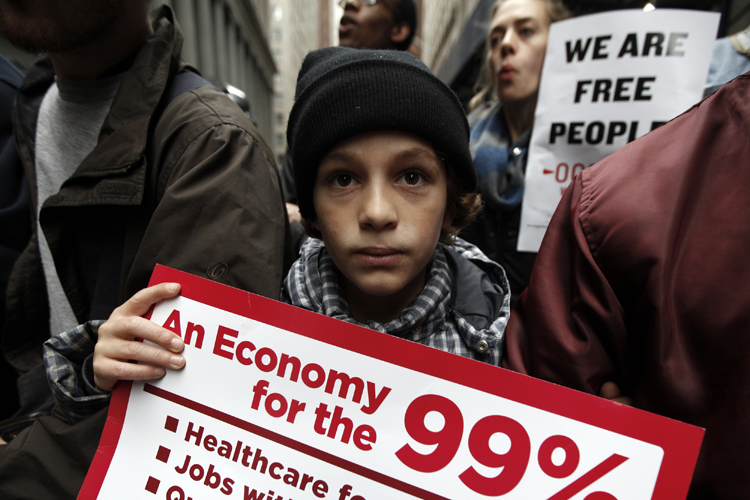
How the 99 percent was bornAn Occupy Wall Street demonstrator holds a sign during what protest organizers call a "Day of Action" in New York November 17, 2011. (Credit: Brendan Mcdermid / Reuters)
This originally appeared on TomDispatch. It is a joint TomDispatch/Nation article and appears in print at the Nation magazine.

The “other men” (and of course women) in the current American class alignment are those in the top 1 percent of the wealth distribution — the bankers, hedge-fund managers, and CEOs targeted by the Occupy Wall Street movement. They have been around for a long time in one form or another, but they only began to emerge as a distinct and visible group, informally called the “super-rich,” in recent years.

Extravagant levels of consumption helped draw attention to them: private jets, multiple 50,000 square-foot mansions, $25,000 chocolate desserts embellished with gold dust. But as long as the middle class could still muster the credit for college tuition and occasional home improvements, it seemed churlish to complain. Then came the financial crash of 2007-2008, followed by the Great Recession, and the 1 percent to whom we had entrusted our pensions, our economy, and our political system stood revealed as a band of feckless, greedy narcissists, and possibly sociopaths.

Still, until a few months ago, the 99 percent was hardly a group capable of (as Thompson says) articulating “the identity of their interests.” It contained, and still contains, most “ordinary” rich people, along with middle-class professionals, factory workers, truck drivers and miners, as well as the much poorer people who clean the houses, manicure the fingernails and maintain the lawns of the affluent.

It was divided not only by these class differences, but most visibly by race and ethnicity — a division that has actually deepened since 2008. African-Americans and Latinos of all income levels disproportionately lost their homes to foreclosure in 2007 and 2008, and then disproportionately lost their jobs in the wave of layoffs that followed.  On the eve of the Occupy movement, the black middle class had been devastated. In fact, the only political movements to have come out of the 99 percent before Occupy emerged were the Tea Party movement and, on the other side of the political spectrum, the resistance to restrictions on collective bargaining in Wisconsin.

But Occupy could not have happened if large swaths of the 99 percent had not begun to discover some common interests, or at least to put aside some of the divisions among themselves. For decades, the most stridently promoted division within the 99 percent was the one between what the right calls the “liberal elite” — composed of academics, journalists, media figures, etc. — and pretty much everyone else.

As Harper’s Magazine columnist Tom Frank has brilliantly explained, the right earned its spurious claim to populism by targeting that “liberal elite,” which supposedly favors reckless government spending that requires oppressive levels of taxes, supports “redistributive” social policies and programs that reduce opportunity for the white middle class, creates ever more regulations (to, for instance, protect the environment) that reduce jobs for the working class, and promotes kinky countercultural innovations like gay marriage. The liberal elite, insisted conservative intellectuals, looked down on “ordinary” middle- and working-class Americans, finding them tasteless and politically incorrect. The “elite” was the enemy, while the super-rich were just like everyone else, only more “focused” and perhaps a bit better connected.

Of course, the “liberal elite” never made any sociological sense. Not all academics or media figures are liberal (Newt Gingrich, George Will, Rupert Murdoch). Many well-educated middle managers and highly trained engineers may favor latte over Red Bull, but they were never targets of the right. And how could trial lawyers be members of the nefarious elite, while their spouses in corporate law firms were not?

A Greased Chute, Not a Safety Net

“Liberal elite” was always a political category masquerading as a sociological one. What gave the idea of a liberal elite some traction, though, at least for a while, was that the great majority of us have never knowingly encountered a member of the actual elite, the 1 percent who are, for the most part, sealed off in their own bubble of private planes, gated communities, and walled estates.

The authority figures most people are likely to encounter in their daily lives are teachers, doctors, social workers and professors. These groups (along with middle managers and other white-collar corporate employees) occupy a much lower position in the class hierarchy. They made up what we described in a 1976 essay as the “professional managerial class.” As we wrote at the time, on the basis of our experience of the radical movements of the 1960s and 1970s, there have been real, longstanding resentments between the working-class and middle-class professionals. These resentments, which the populist right cleverly deflected toward “liberals,” contributed significantly to that previous era of rebellion’s failure to build a lasting progressive movement.

As it happened, the idea of the “liberal elite” could not survive the depredations of the 1 percent in the late 2000s. For one thing, it was summarily eclipsed by the discovery of the actual Wall Street-based elite and their crimes. Compared to them, professionals and managers, no matter how annoying, were pikers. The doctor or school principal might be overbearing, the professor and the social worker might be condescending, but only the 1 percent took your house away.

There was, as well, another inescapable problem embedded in the right-wing populist strategy: Even by 2000, and certainly by 2010, the class of people who might qualify as part of the “liberal elite” was in increasingly bad repair. Public-sector budget cuts and corporate-inspired reorganizations were decimating the ranks of decently paid academics, who were being replaced by adjunct professors working on bare subsistence incomes. Media firms were shrinking their newsrooms and editorial budgets. Law firms had started outsourcing their more routine tasks to India. Hospitals beamed X-rays to cheap foreign radiologists. Funding had dried up for nonprofit ventures in the arts and public service. Hence the iconic figure of the Occupy movement: the college graduate with tens of thousands of dollars in student loan debts and a job paying about $10 a hour, or no job at all.

These trends were in place even before the financial crash hit, but it took the crash and its grim economic aftermath to awaken the 99 percent to a widespread awareness of shared danger. In 2008, “Joe the Plumber’s” intention to earn a quarter-million dollars a year still had some faint sense of plausibility. A couple of years into the recession, however, sudden downward mobility had become the mainstream American experience, and even some of the most reliably neoliberal media pundits were beginning to announce that something had gone awry with the American dream.

Once-affluent people lost their nest eggs as housing prices dropped off cliffs. Laid-off middle-aged managers and professionals were staggered to find that their age made them repulsive to potential employers. Medical debts plunged middle-class households into bankruptcy. The old conservative dictum — that it was unwise to criticize (or tax) the rich because you might yourself be one of them someday — gave way to a new realization that the class you were most likely to migrate into wasn’t the rich, but the poor.

And here was another thing many in the middle class were discovering: The downward plunge into poverty could occur with dizzying speed. One reason the concept of an economic 99 percent first took root in America rather than, say, Ireland or Spain is that Americans are particularly vulnerable to economic dislocation. We have little in the way of a welfare state to stop a family or an individual in free-fall. Unemployment benefits do not last more than six months or a year, though in a recession they are sometimes extended by Congress. At present, even with such an extension, they reach only about half the jobless. Welfare was all but abolished 15 years ago, and health insurance has traditionally been linked to employment.

In fact, once an American starts to slip downward, a variety of forces kick in to help accelerate the slide. An estimated 60 percent of American firms now check applicants’ credit ratings, and discrimination against the unemployed is widespread enough to have begun to warrant Congressional concern. Even bankruptcy is a prohibitively expensive, often crushingly difficult status to achieve. Failure to pay government-imposed fines or fees can even lead, through a concatenation of unlucky breaks, to an arrest warrant or a criminal record. Where other once-wealthy nations have a safety net, America offers a greased chute, leading down to destitution with alarming speed.

Making Sense of the 99 percent

The Occupation encampments that enlivened approximately 1,400 cities this fall provided a vivid template for the 99 percent’s growing sense of unity. Here were thousands of people — we may never know the exact numbers — from all walks of life, living outdoors in the streets and parks, very much as the poorest of the poor have always lived: without electricity, heat, water, or toilets. In the process, they managed to create self-governing communities.

General assembly meetings brought together an unprecedented mix of recent college graduates, young professionals, elderly people, laid-off blue-collar workers and plenty of the chronically homeless for what were, for the most part, constructive and civil exchanges. What started as a diffuse protest against economic injustice became a vast experiment in class building. The 99 percent, which might have seemed to be a purely aspirational category just a few months ago, began to will itself into existence.

Can the unity cultivated in the encampments survive as the Occupy movement evolves into a more decentralized phase?  All sorts of class, racial, and cultural divisions persist within that 99 percent, including distrust between members of the former “liberal elite” and those less privileged. It would be surprising if they didn’t. The life experience of a young lawyer or a social worker is very different from that of a blue-collar worker whose work may rarely allow for biological necessities like meal or bathroom breaks. Drum circles, consensus decision-making, and masks remain exotic to at least the 90 percent. “Middle class” prejudice against the homeless, fanned by decades of right-wing demonization of the poor, retains much of its grip.

Sometimes these differences led to conflict in Occupy encampments — for example, over the role of the chronically homeless in Portland or the use of marijuana in Los Angeles — but amazingly, despite all the official warnings about health and safety threats, there was no “Altamont moment”: no major fires and hardly any violence.  In fact, the encampments engendered almost unthinkable convergences: people from comfortable backgrounds learning about street survival from the homeless, a distinguished professor of political science discussing horizontal versus vertical decision-making with a postal worker, military men in dress uniforms showing up to defend the occupiers from the police.

Class happens, as Thompson said, but it happens most decisively when people are prepared to nourish and build it. If the “99 percent” is to become more than a stylish meme, if it’s to become a force to change the world, eventually we will undoubtedly have to confront some of the class and racial divisions that lie within it. But we need to do so patiently, respectfully, and always with an eye to the next big action — the next march, or building occupation, or foreclosure fight, as the situation demands.

To stay on top of important articles like these, sign up to receive the latest updates from TomDispatch.com here.

Continue Reading Close

Homelessness becomes an OWS issue

Protesters are discovering just how difficult the government makes life for its most downtrodden citizens

  • more
    • All Share Services

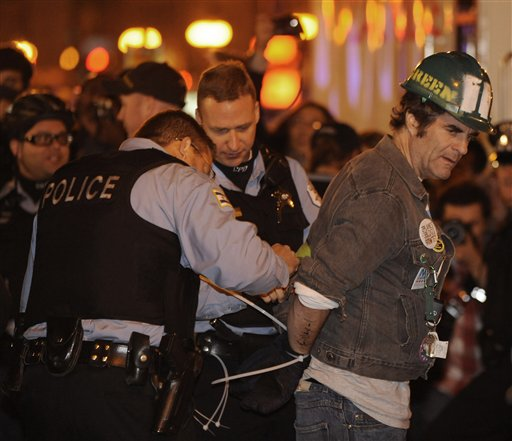
Homelessness becomes an OWS issueA protester gets arrested during an Occupy Chicago march and protest in Grant Park in Chicago, Sunday, Oct. 23, 2011(Credit: AP Photo/Paul Beaty)
This originally appeared on TomDispatch.

As anyone knows who has ever had to set up a military encampment or build a village from the ground up, occupations pose staggering logistical problems. Large numbers of people must be fed and kept reasonably warm and dry. Trash has to be removed; medical care and rudimentary security provided — to which ends a dozen or more committees may toil night and day. But for the individual occupier, one problem often overshadows everything else, including job loss, the destruction of the middle class, and the reign of the 1 percent. And that is the single question: Where am I going to pee?

Some of the Occupy Wall Street encampments now spreading across the U.S. have access to Port-o-Potties (Freedom Plaza in Washington, D.C.) or, better yet, restrooms with sinks and running water (Fort Wayne, Indiana). Others require their residents to forage on their own. At Zuccotti Park, just blocks from Wall Street, this means long waits for the restroom at a nearby Burger King or somewhat shorter ones at a Starbucks a block away. At McPherson Square in D.C., a twenty-something occupier showed me the pizza parlor where she can cop a pee during the hours it’s open, as well as the alley where she crouches late at night. Anyone with restroom-related issues — arising from age, pregnancy, prostate problems, or irritable bowel syndrome — should prepare to join the revolution in diapers.

Of course, political protesters do not face the challenges of urban camping alone. Homeless people confront the same issues every day: how to scrape together meals, keep warm at night by covering themselves with cardboard or tarp, and relieve themselves without committing a crime. Public restrooms are sparse in American cities — “as if the need to go to the bathroom does not exist,” travel expert Arthur Frommer once observed. And yet to yield to bladder pressure is to risk arrest. A report entitled “Criminalizing Crisis,” to be released later this month by the National Law Center on Homelessness and Poverty, recounts the following story from Wenatchee, Washington:

“Toward the end of 2010, a family of two parents and three children that had been experiencing homelessness for a year and a half applied for a 2-bedroom apartment. The day before a scheduled meeting with the apartment manager during the final stages of acquiring the lease, the father of the family was arrested for public urination. The arrest occurred at an hour when no public restrooms were available for use. Due to the arrest, the father was unable to make the appointment with the apartment manager and the property was rented out to another person. As of March 2011, the family was still homeless and searching for housing.”

What the Occupy Wall Streeters are beginning to discover, and homeless people have known all along, is that most ordinary, biologically necessary activities are illegal when performed in American streets — not just peeing, but sitting, lying down, and sleeping. While the laws vary from city to city, one of the harshest is in Sarasota, Florida, which passed an ordinance in 2005 that makes it illegal to “engage in digging or earth-breaking activities” — that is, to build a latrine — cook, make a fire, or be asleep and “when awakened state that he or she has no other place to live.”

It is illegal, in other words, to be homeless or live outdoors for any other reason. It should be noted, though, that there are no laws requiring cities to provide food, shelter or restrooms for their indigent citizens.

The current prohibition on homelessness began to take shape in the 1980s, along with the ferocious growth of the financial industry (Wall Street and all its tributaries throughout the nation). That was also the era in which we stopped being a nation that manufactured much beyond weightless, invisible “financial products,” leaving the old industrial working class to carve out a livelihood at places like Wal-Mart.

As it turned out, the captains of the new “casino economy” — the stock brokers and investment bankers — were highly sensitive, one might say finicky, individuals, easily offended by having to step over the homeless in the streets or bypass them in commuter train stations. In an economy where a centimillionaire could turn into a billionaire overnight, the poor and unwashed were a major buzzkill. Starting with Mayor Rudy Giuliani in New York, city after city passed “broken windows” or “quality of life” ordinances making it dangerous for the homeless to loiter or, in some cases, even look “indigent,” in public spaces.

No one has yet tallied all the suffering occasioned by this crackdown — the deaths from cold and exposure — but “Criminalizing Crisis” offers this story about a homeless pregnant woman in Columbia, South Carolina:

“During daytime hours, when she could not be inside of a shelter, she attempted to spend time in a museum and was told to leave. She then attempted to sit on a bench outside the museum and was again told to relocate. In several other instances, still during her pregnancy, the woman was told that she could not sit in a local park during the day because she would be ‘squatting.’ In early 2011, about six months into her pregnancy, the homeless woman began to feel unwell, went to a hospital, and delivered a stillborn child.”

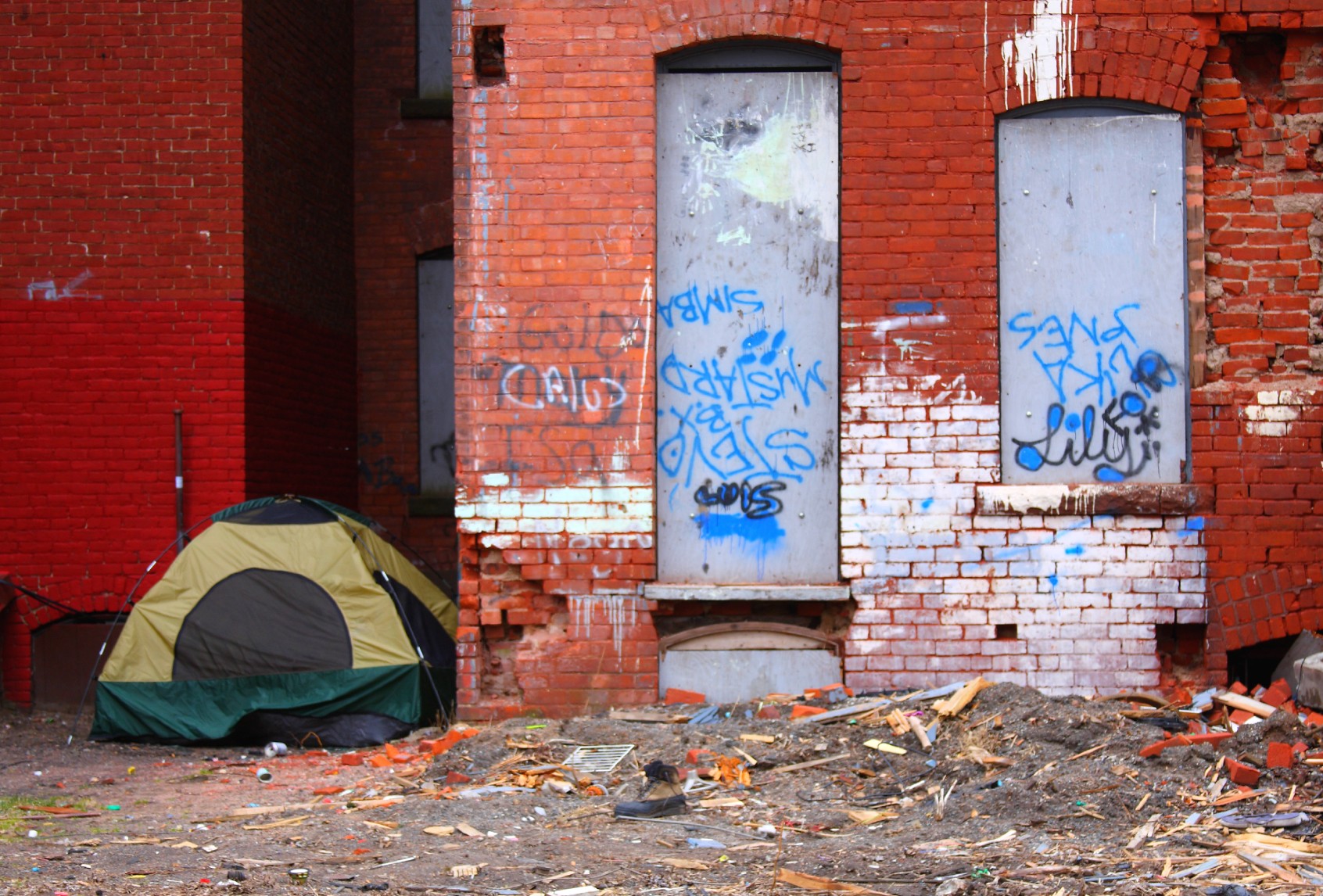
Well before Tahrir Square was a twinkle in anyone’s eye, and even before the recent recession, homeless Americans had begun to act in their own defense, creating organized encampments, usually tent cities, in vacant lots or wooded areas. These communities often feature various elementary forms of self-governance: food from local charities has to be distributed, latrines dug, rules — such as no drugs, weapons, or violence — enforced. With all due credit to the Egyptian democracy movement, the Spanish indignados, and rebels all over the world, tent cities are the domestic progenitors of the American occupation movement.

There is nothing “political” about these settlements of the homeless — no signs denouncing greed or visits from leftwing luminaries — but they have been treated with far less official forbearance than the occupation encampments of the “American autumn.” LA’s Skid Row endures constant police harassment, for example, but when it rained, Mayor Antonio Villaraigosa had ponchos distributed to nearby Occupy LA.

All over the country, in the last few years, police have moved in on the tent cities of the homeless, one by one, from Seattle to Wooster, Sacramento to Providence, in raids that often leave the former occupants without even their minimal possessions. In Chattanooga, Tennessee, last summer, a charity outreach worker explained the forcible dispersion of a local tent city by saying, “The city will not tolerate a tent city. That’s been made very clear to us. The camps have to be out of sight.”

What occupiers from all walks of life are discovering, at least every time they contemplate taking a leak, is that to be homeless in America is to live like a fugitive. The destitute are our own native-born “illegals,” facing prohibitions on the most basic activities of survival. They are not supposed to soil public space with their urine, their feces, or their exhausted bodies. Nor are they supposed to spoil the landscape with their unusual wardrobe choices or body odors. They are, in fact, supposed to die, and preferably to do so without leaving a corpse for the dwindling public sector to transport, process, and burn.

But the occupiers are not from all walks of life, just from those walks that slope downwards — from debt, joblessness, and foreclosure — leading eventually to pauperism and the streets. Some of the present occupiers were homeless to start with, attracted to the occupation encampments by the prospect of free food and at least temporary shelter from police harassment. Many others are drawn from the borderline-homeless “nouveau poor,” and normally encamp on friends’ couches or parents’ folding beds.

In Portland, Austin, and Philadelphia, the Occupy Wall Street movement is taking up the cause of the homeless as its own, which of course it is. Homelessness is not a side issue unconnected to plutocracy and greed. It’s where we’re all eventually headed — the 99 percent, or at least the 70 percent, of us, every debt-loaded college grad, out-of-work school teacher, and impoverished senior — unless this revolution succeeds.

To stay on top of important articles like these, sign up to receive the latest updates from TomDispatch.com here.

Continue Reading Close

How America turned poverty into a crime

The poor aren't just struggling during the recession; they're being actively hounded by urban officials

  • more
    • All Share Services

How America turned poverty into a crimeElias Pirela, 6, right, holds his brother Ahmad Phillips, center, as he stands with his mother Latasha Phillips, 33, left, before leaving for the first day of school from his temporary home at the Community Partnership for Homeless in Miami, Monday, Aug. 23, 2010

I completed the manuscript for “Nickel and Dimed” in a time of seemingly boundless prosperity. Technology innovators and venture capitalists were acquiring sudden fortunes, buying up McMansions like the ones I had cleaned in Maine and much larger. Even secretaries in some hi-tech firms were striking it rich with their stock options. There was loose talk about a permanent conquest of the business cycle, and a sassy new spirit infecting American capitalism. In San Francisco, a billboard for an e-trading firm proclaimed, “Make love not war,” and then — down at the bottom — “Screw it, just make money.”

When “Nickel and Dimed” was published in May 2001, cracks were appearing in the dot-com bubble and the stock market had begun to falter, but the book still evidently came as a surprise, even a revelation, to many. Again and again, in that first year or two after publication, people came up to me and opened with the words, “I never thought…” or “I hadn’t realized…”

To my own amazement, “Nickel and Dimed” quickly ascended to the bestseller list and began winning awards. Criticisms, too, have accumulated over the years. But for the most part, the book has been far better received than I could have imagined it would be, with an impact extending well into the more comfortable classes. A Florida woman wrote to tell me that, before reading it, she’d always been annoyed at the poor for what she saw as their self-inflicted obesity. Now she understood that a healthy diet wasn’t always an option. And if I had a quarter for every person who’s told me he or she now tipped more generously, I would be able to start my own foundation.

Even more gratifying to me, the book has been widely read among low-wage workers. In the last few years, hundreds of people have written to tell me their stories: the mother of a newborn infant whose electricity had just been turned off, the woman who had just been given a diagnosis of cancer and has no health insurance, the newly homeless man who writes from a library computer.

At the time I wrote “Nickel and Dimed,” I wasn’t sure how many people it directly applied to — only that the official definition of poverty was way off the mark, since it defined an individual earning $7 an hour, as I did on average, as well out of poverty. But three months after the book was published, the Economic Policy Institute in Washington, D.C., issued a report entitled “Hardships in America: The Real Story of Working Families,” which found an astounding 29 percent of American families living in what could be more reasonably defined as poverty, meaning that they earned less than a barebones budget covering housing, child care, health care, food, transportation, and taxes — though not, it should be noted, any entertainment, meals out, cable TV, Internet service, vacations, or holiday gifts. 29 percent is a minority, but not a reassuringly small one, and other studies in the early 2000s came up with similar figures.

The big question, 10 years later, is whether things have improved or worsened for those in the bottom third of the income distribution, the people who clean hotel rooms, work in warehouses, wash dishes in restaurants, care for the very young and very old, and keep the shelves stocked in our stores. The short answer is that things have gotten much worse, especially since the economic downturn that began in 2008.

Post-Meltdown Poverty

When you read about the hardships I found people enduring while I was researching my book — the skipped meals, the lack of medical care, the occasional need to sleep in cars or vans — you should bear in mind that those occurred in the best of times. The economy was growing, and jobs, if poorly paid, were at least plentiful.

In 2000, I had been able to walk into a number of jobs pretty much off the street. Less than a decade later, many of these jobs had disappeared and there was stiff competition for those that remained. It would have been impossible to repeat my “Nickel and Dimed” “experiment,” had I had been so inclined, because I would probably never have found a job.

For the last couple of years, I have attempted to find out what was happening to the working poor in a declining economy — this time using conventional reporting techniques like interviewing. I started with my own extended family, which includes plenty of people without jobs or health insurance, and moved on to trying to track down a couple of the people I had met while working on “Nickel and Dimed”.

This wasn’t easy, because most of the addresses and phone numbers I had taken away with me had proved to be inoperative within a few months, probably due to moves and suspensions of telephone service. I had kept in touch with “Melissa” over the years, who was still working at Wal-Mart, where her wages had risen from $7 to $10 an hour, but in the meantime her husband had lost his job. “Caroline,” now in her 50s and partly disabled by diabetes and heart disease, had left her deadbeat husband and was subsisting on occasional cleaning and catering jobs. Neither seemed unduly afflicted by the recession, but only because they had already been living in what amounts to a permanent economic depression.

Media attention has focused, understandably enough, on the “nouveau poor” — formerly middle and even upper-middle class people who lost their jobs, their homes, and/or their investments in the financial crisis of 2008 and the economic downturn that followed it, but the brunt of the recession has been borne by the blue-collar working class, which had already been sliding downwards since de-industrialization began in the 1980s.

In 2008 and 2009, for example, blue-collar unemployment was increasing three times as fast as white-collar unemployment, and African American and Latino workers were three times as likely to be unemployed as white workers. Low-wage blue-collar workers, like the people I worked with in this book, were especially hard hit for the simple reason that they had so few assets and savings to fall back on as jobs disappeared.

How have the already-poor attempted to cope with their worsening economic situation? One obvious way is to cut back on health care. The New York Times reported in 2009 that one-third of Americans could no longer afford to comply with their prescriptions and that there had been a sizable drop in the use of medical care. Others, including members of my extended family, have given up their health insurance.

Food is another expenditure that has proved vulnerable to hard times, with the rural poor turning increasingly to “food auctions,” which offer items that may be past their sell-by dates. And for those who like their meat fresh, there’s the option of urban hunting. In Racine, Wisconsin, a 51-year-old laid-off mechanic told me he was supplementing his diet by “shooting squirrels and rabbits and eating them stewed, baked, and grilled.” In Detroit, where the wildlife population has mounted as the human population ebbs, a retired truck driver was doing a brisk business in raccoon carcasses, which he recommends marinating with vinegar and spices.

The most common coping strategy, though, is simply to increase the number of paying people per square foot of dwelling space — by doubling up or renting to couch-surfers.

It’s hard to get firm numbers on overcrowding, because no one likes to acknowledge it to census-takers, journalists, or anyone else who might be remotely connected to the authorities.

In Los Angeles, housing expert Peter Dreier says that “people who’ve lost their jobs, or at least their second jobs, cope by doubling or tripling up in overcrowded apartments, or by paying 50 or 60 or even 70 percent of their incomes in rent.” According to a community organizer in Alexandria, Virginia, the standard apartment in a complex occupied largely by day laborers has two bedrooms, each containing an entire family of up to five people, plus an additional person laying claim to the couch.

No one could call suicide a “coping strategy,” but it is one way some people have responded to job loss and debt. There are no national statistics linking suicide to economic hard times, but the National Suicide Prevention Lifeline reported more than a four-fold increase in call volume between 2007 and 2009, and regions with particularly high unemployment, like Elkhart, Indiana, have seen troubling spikes in their suicide rates. Foreclosure is often the trigger for suicide — or, worse, murder-suicides that destroy entire families.

“Torture and Abuse of Needy Families”

We do of course have a collective way of ameliorating the hardships of individuals and families — a government safety net that is meant to save the poor from spiraling down all the way to destitution. But its response to the economic emergency of the last few years has been spotty at best. The food stamp program has responded to the crisis fairly well, to the point where it now reaches about 37 million people, up about 30 percent from pre-recession levels. But welfare — the traditional last resort for the down-and-out until it was “reformed” in 1996 — only expanded by about 6 percent in the first two years of the recession.

The difference between the two programs? There is a right to food stamps. You go to the office and, if you meet the statutory definition of need, they help you. For welfare, the street-level bureaucrats can, pretty much at their own discretion, just say no.

Take the case of Kristen and Joe Parente, Delaware residents who had always imagined that people turned to the government for help only if “they didn’t want to work.” Their troubles began well before the recession, when Joe, a fourth-generation pipe-fitter, sustained a back injury that left him unfit for even light lifting. He fell into a profound depression for several months, then rallied to ace a state-sponsored retraining course in computer repairs — only to find that those skills are no longer in demand. The obvious fallback was disability benefits, but — catch-22 — when Joe applied he was told he could not qualify without presenting a recent MRI scan. This would cost $800 to $900, which the Parentes do not have; nor has Joe, unlike the rest of the family, been able to qualify for Medicaid.

When they married as teenagers, the plan had been for Kristen to stay home with the children. But with Joe out of action and three children to support by the middle of this decade, Kristen went out and got waitressing jobs, ending up, in 2008, in a “pretty fancy place on the water.” Then the recession struck and she was laid off.

Kristen is bright, pretty, and to judge from her command of her own small kitchen, probably capable of holding down a dozen tables with precision and grace. In the past she’d always been able to land a new job within days; now there was nothing. Like 44 percent of laid-off people at the time, she failed to meet the fiendishly complex and sometimes arbitrary eligibility requirements for unemployment benefits. Their car started falling apart.

So the Parentes turned to what remains of welfare — TANF, or Temporary Assistance to Needy Families. TANF does not offer straightforward cash support like Aid to Families with Dependent Children, which it replaced in 1996. It’s an income supplementation program for working parents, and it was based on the sunny assumption that there would always be plenty of jobs for those enterprising enough to get them.

After Kristen applied, nothing happened for six weeks — no money, no phone calls returned. At school, the Parentes’ seven-year-old’s class was asked to write out what wish they would present to a genie, should a genie appear. Brianna’s wish was for her mother to find a job because there was nothing to eat in the house, an aspiration that her teacher deemed too disturbing to be posted on the wall with the other children’s requests.

When the Parentes finally got into “the system” and began receiving food stamps and some cash assistance, they discovered why some recipients have taken to calling TANF “Torture and Abuse of Needy Families.” From the start, the TANF experience was “humiliating,” Kristen says. The caseworkers “treat you like a bum. They act like every dollar you get is coming out of their own paychecks.”

The Parentes discovered that they were each expected to apply for 40 jobs a week, although their car was on its last legs and no money was offered for gas, tolls, or babysitting. In addition, Kristen had to drive 35 miles a day to attend “job readiness” classes offered by a private company called Arbor, which, she says, were “frankly a joke.”

Nationally, according to Kaaryn Gustafson of the University of Connecticut Law School, “applying for welfare is a lot like being booked by the police.” There may be a mug shot, fingerprinting, and lengthy interrogations as to one’s children’s true paternity. The ostensible goal is to prevent welfare fraud, but the psychological impact is to turn poverty itself into a kind of crime.

How the Safety Net Became a Dragnet

The most shocking thing I learned from my research on the fate of the working poor in the recession was the extent to which poverty has indeed been criminalized in America.

Perhaps the constant suspicions of drug use and theft that I encountered in low-wage workplaces should have alerted me to the fact that, when you leave the relative safety of the middle class, you might as well have given up your citizenship and taken residence in a hostile nation.

Most cities, for example, have ordinances designed to drive the destitute off the streets by outlawing such necessary activities of daily life as sitting, loitering, sleeping, or lying down. Urban officials boast that there is nothing discriminatory about such laws: “If you’re lying on a sidewalk, whether you’re homeless or a millionaire, you’re in violation of the ordinance,” a St. Petersburg, Florida, city attorney stated in June 2009, echoing Anatole France’s immortal observation that “the law, in its majestic equality, forbids the rich as well as the poor to sleep under bridges…”

In defiance of all reason and compassion, the criminalization of poverty has actually intensified as the weakened economy generates ever more poverty. So concludes a recent study from the National Law Center on Poverty and Homelessness, which finds that the number of ordinances against the publicly poor has been rising since 2006, along with the harassment of the poor for more “neutral” infractions like jaywalking, littering, or carrying an open container.

The report lists America’s ten “meanest” cities — the largest of which include Los Angeles, Atlanta, and Orlando — but new contestants are springing up every day. In Colorado, Grand Junction’s city council is considering a ban on begging; Tempe, Arizona, carried out a four-day crackdown on the indigent at the end of June. And how do you know when someone is indigent? As a Las Vegas statute puts it, “an indigent person is a person whom a reasonable ordinary person would believe to be entitled to apply for or receive” public assistance.

That could be me before the blow-drying and eyeliner, and it’s definitely Al Szekeley at any time of day. A grizzled 62-year-old, he inhabits a wheelchair and is often found on G Street in Washington, D.C. — the city that is ultimately responsible for the bullet he took in the spine in Phu Bai, Vietnam, in 1972.

He had been enjoying the luxury of an indoor bed until December 2008, when the police swept through the shelter in the middle of the night looking for men with outstanding warrants. It turned out that Szekeley, who is an ordained minister and does not drink, do drugs, or cuss in front of ladies, did indeed have one — for “criminal trespassing,” as sleeping on the streets is sometimes defined by the law. So he was dragged out of the shelter and put in jail.

“Can you imagine?” asked Eric Sheptock, the homeless advocate (himself a shelter resident) who introduced me to Szekeley. “They arrested a homeless man in a shelter for being homeless?”

The viciousness of the official animus toward the indigent can be breathtaking. A few years ago, a group called Food Not Bombs started handing out free vegan food to hungry people in public parks around the nation. A number of cities, led by Las Vegas, passed ordinances forbidding the sharing of food with the indigent in public places, leading to the arrests of several middle-aged white vegans.

One anti-sharing law was just overturned in Orlando, but the war on illicit generosity continues. Orlando is appealing the decision, and Middletown, Connecticut, is in the midst of a crackdown. More recently, Gainesville, Florida, began enforcing a rule limiting the number of meals that soup kitchens may serve to 130 people in one day, and Phoenix, Arizona, has been using zoning laws to stop a local church from serving breakfast to homeless people.

For the not-yet-homeless, there are two main paths to criminalization, and one is debt. Anyone can fall into debt, and although we pride ourselves on the abolition of debtors’ prison, in at least one state, Texas, people who can’t pay fines for things like expired inspection stickers may be made to “sit out their tickets” in jail.

More commonly, the path to prison begins when one of your creditors has a court summons issued for you, which you fail to honor for one reason or another, such as that your address has changed and you never received it. Okay, now you’re in “contempt of the court.”

Or suppose you miss a payment and your car insurance lapses, and then you’re stopped for something like a broken headlight (about $130 for the bulb alone). Now, depending on the state, you may have your car impounded and/or face a steep fine — again, exposing you to a possible court summons. “There’s just no end to it once the cycle starts,” says Robert Solomon of Yale Law School. “It just keeps accelerating.”

The second — and by far the most reliable — way to be criminalized by poverty is to have the wrong color skin. Indignation runs high when a celebrity professor succumbs to racial profiling, but whole communities are effectively “profiled” for the suspicious combination of being both dark-skinned and poor. Flick a cigarette and you’re “littering”; wear the wrong color T-shirt and you’re displaying gang allegiance. Just strolling around in a dodgy neighborhood can mark you as a potential suspect. And don’t get grumpy about it or you could be “resisting arrest.”

In what has become a familiar pattern, the government defunds services that might help the poor while ramping up law enforcement. Shut down public housing, then make it a crime to be homeless. Generate no public-sector jobs, then penalize people for falling into debt. The experience of the poor, and especially poor people of color, comes to resemble that of a rat in a cage scrambling to avoid erratically administered electric shocks. And if you should try to escape this nightmare reality into a brief, drug-induced high, it’s “gotcha” all over again, because that of course is illegal too.

One result is our staggering level of incarceration, the highest in the world. Today, exactly the same number of Americans — 2.3 million — reside in prison as in public housing. And what public housing remains has become ever more prison-like, with random police sweeps and, in a growing number of cities, proposed drug tests for residents. The safety net, or what remains of it, has been transformed into a dragnet.

It is not clear whether economic hard times will finally force us to break the mad cycle of poverty and punishment. With even the official level of poverty increasing — to over 14 percent in 2010 — some states are beginning to ease up on the criminalization of poverty, using alternative sentencing methods, shortening probation, and reducing the number of people locked up for technical violations like missing court appointments. But others, diabolically enough, are tightening the screws: not only increasing the number of “crimes,” but charging prisoners for their room and board, guaranteeing they’ll be released with potentially criminalizing levels of debt.

So what is the solution to the poverty of so many of America’s working people? Ten years ago, when “Nickel and Dimed” first came out, I often responded with the standard liberal wish list — a higher minimum wage, universal health care, affordable housing, good schools, reliable public transportation, and all the other things we, uniquely among the developed nations, have neglected to do.

Today, the answer seems both more modest and more challenging: if we want to reduce poverty, we have to stop doing the things that make people poor and keep them that way. Stop underpaying people for the jobs they do. Stop treating working people as potential criminals and let them have the right to organize for better wages and working conditions.

Stop the institutional harassment of those who turn to the government for help or find themselves destitute in the streets. Maybe, as so many Americans seem to believe today, we can’t afford the kinds of public programs that would genuinely alleviate poverty — though I would argue otherwise. But at least we should decide, as a bare minimum principle, to stop kicking people when they’re down.

Barbara Ehrenreich is the author of a number of books including “Nickel and Dimed: On (Not) Getting By in America” and “Bright-Sided: How the Relentless Promotion of Positive Thinking Has Undermined America.”

Continue Reading Close

Will drones change how we see war?

As machines take the place of humans on the battlefield, our relationship to combat is shifting

  • more
    • All Share Services

Will drones change how we see war?An unarmed U.S. "Shadow" drone is launched in this undated photograph, released on January 5, 2011

For a book about the all-too-human “passions of war,” my 1997 work “Blood Rites” ended on a strangely inhuman note: I suggested that, whatever distinctly human qualities war calls upon — honor, courage, solidarity, cruelty and so forth — it might be useful to stop thinking of war in exclusively human terms. After all, certain species of ants wage war, and computers can simulate “wars”that play themselves out on-screen without any human involvement.

More generally, then, we should define war as a self-replicating pattern of activity that may or may not require human participation. In the human case, we know it is capable of spreading geographically and evolving rapidly over time — qualities that, as I suggested somewhat fancifully, make war a metaphorical successor to the predatory animals that shaped humans into fighters in the first place.

A decade and a half later, these musings do not seem quite so airy and abstract anymore. The trend, at the close of the 20th century, still seemed to be one of ever more massive human involvement in war — from armies containing tens of thousands in the 16th century, to hundreds of thousands in the 19th, and eventually millions in the 20th-century world wars.

It was the ascending scale of war that originally called forth the existence of the nation-state as an administrative unit capable of maintaining mass armies and the infrastructure — for taxation, weapons manufacture, transport, etc. — that they require. War has been, and we still expect it to be, the most massive collective project human beings undertake. But it has been evolving quickly in a very different direction, one in which human beings have a much smaller role to play.

One factor driving this change has been the emergence of a new kind of enemy, so-called non-state actors, meaning popular insurgencies and loose transnational networks of fighters, none of which are likely to field large numbers of troops or maintain expensive arsenals of their own. In the face of these new enemies, typified by al-Qaida, the mass armies of nation-states are highly ineffective, cumbersome to deploy, difficult to maneuver, and from a domestic point of view, overly dependent on a citizenry that is both willing and able to fight, or at least to have their children fight for them.

Yet just as U.S. military cadets continue, in defiance of military reality, to sport swords on their dress uniforms, so our leaders, both military and political, tend to cling to an idea of war as a vast, labor-intensive effort on the order of World War II. Only slowly, and with a reluctance bordering on the phobic, have the leaders of major states begun to grasp the fact that this approach to warfare may soon be obsolete.

Consider the most recent U.S. war with Iraq. According to then-president George W. Bush, the casus belli was the 9/11 terror attacks. The causal link between that event and our chosen enemy, Iraq, was, however, imperceptible to all but the most dedicated inside-the-Beltway intellectuals. Nineteen men had hijacked airplanes and flown them into the Pentagon and the World Trade Center — 15 of them Saudi Arabians, none of them Iraqis — and we went to war against… Iraq?

Military history offers no ready precedents for such wildly misaimed retaliation. The closest analogies come from anthropology, which provides plenty of cases of small-scale societies in which the death of any member, for any reason, needs to be “avenged” by an attack on a more or less randomly chosen other tribe or hamlet.

Why Iraq? Neoconservative imperial ambitions have been invoked in explanation, as well as the American thirst for oil, or even an Oedipal contest between George W. Bush and his father. There is no doubt some truth to all of those explanations, but the targeting of Iraq also represented a desperate and irrational response to what was, for Washington, an utterly confounding military situation.

We faced a state-less enemy — geographically diffuse, lacking uniforms and flags, invulnerable to invading infantries and saturation bombing, and apparently capable of regenerating itself at minimal expense. From the perspective of Secretary of Defense Donald Rumsfeld and his White House cronies, this would not do.

Since the U.S. was accustomed to fighting other nation-states — geopolitical entities containing such identifiable targets as capital cities, airports, military bases and munitions plants — we would have to find a nation-state to fight, or as Rumsfeld put it, a “target-rich environment.” Iraq, pumped up by alleged stockpiles of “weapons of mass destruction,” became the designated surrogate for an enemy that refused to play our game.

The effects of this atavistic war are still being tallied: In Iraq, we would have to include civilian deaths estimated at possibly hundreds of thousands, the destruction of civilian infrastructure, and devastating outbreaks of sectarian violence of a kind that, as we should have learned from the dissolution of Yugoslavia, can readily follow the death or removal of a nationalist dictator.

But the effects of war on the U.S. and its allies may end up being almost as tragic. Instead of punishing the terrorists who had attacked the U.S., the war seems to have succeeded in recruiting more such irregular fighters, young men (and sometimes women) willing to die and ready to commit further acts of terror or revenge. By insisting on fighting a more or less randomly selected nation-state, the U.S. may only have multiplied the non-state threats it faces.

Unwieldy armies

Whatever they may think of what the U.S. and its allies did in Iraq, many national leaders are beginning to acknowledge that conventional militaries are becoming, in a strictly military sense, almost ludicrously anachronistic. Not only are they unsuited to crushing counterinsurgencies and small bands of terrorists or irregular fighters, but mass armies are also simply too cumbersome to deploy on short notice.

In military lingo, they are weighed down by their “tooth to tail” ratio — a measure of the number of actual fighters in comparison to the support personnel and equipment the fighters require. Both hawks and liberal interventionists may hanker to airlift tens of thousands of soldiers to distant places virtually overnight, but those soldiers will need to be preceded or accompanied by tents, canteens, trucks, medical equipment and so forth. “Flyover” rights will have to be granted by neighboring countries; air strips and eventually bases will have to be constructed; supply lines will have be created and defended — all of which can take months to accomplish.

The sluggishness of the mass, labor-intensive military has become a constant source of frustration to civilian leaders. Irritated by the Pentagon’s hesitation to put “boots on the ground” in Bosnia, then-Secretary of State Madeline Albright famously demanded of Secretary of Defense Colin Powell, “What good is this marvelous military force if we can never use it?” In 2009, the Obama administration unthinkingly proposed a troop surge in Afghanistan, followed by a withdrawal within a year and a half that would have required some of the troops to start packing up almost as soon as they arrived. It took the U.S. military a full month to organize the transport of 20,000 soldiers to Haiti in the wake of the 2010 earthquake — and they were only traveling 700 miles to engage in a humanitarian relief mission, not a war.

Another thing hobbling mass militaries is the increasing unwillingness of nations, especially the more democratic ones, to risk large numbers of casualties. It is no longer acceptable to drive men into battle at gunpoint or to demand that they fend for themselves on foreign soil. Once thousands of soldiers have been plunked down in a “theater,” they must be defended from potentially hostile locals, a project that can easily come to supersede the original mission.

We may not be able clearly to articulate what American troops were supposed to accomplish in Iraq or Afghanistan, but without question one part of their job has been “force protection.” In what could be considered the inverse of “mission creep,” instead of expanding, the mission now has a tendency to contract to the task of self-defense.

Ultimately, the mass militaries of the modern era, augmented by ever-more-expensive weapons systems, place an unacceptable economic burden on the nation-states that support them — a burden that eventually may undermine the militaries themselves. Consider what has been happening to the world’s sole military superpower, the United States. The latest estimate for the cost of the wars in Iraq and Afghanistan is, at this moment, at least $3.2 trillion, while total U.S. military spending equals that of the next 15 countries combined and adds up to approximately 47 percent of all global military spending.

To this must be added the cost of caring for wounded and otherwise damaged veterans, which has been mounting precipitously as medical advances allow more of the injured to survive. The U.S. military has been sheltered from the consequences of its own profligacy by a level of bipartisan political support that has kept it almost magically immune to budget cuts, even as the national debt balloons to levels widely judged to be unsustainable.

The hard right, in particular, has campaigned relentlessly against “big government,” apparently not noticing that the military is a sizable chunk of this behemoth. In December 2010, for example, a Republican senator from Oklahoma railed against the national debt with this statement: “We’re really at war. We’re on three fronts now: Iraq, Afghanistan, and the financial tsunami [arising from the debt] that is facing us.” Only in recent months have some Tea Party-affiliated legislators broken with tradition by declaring their willingness to cut military spending.

How the warfare state became the welfare state

If military spending is still for the most part sacrosanct, ever more spending cuts are required to shrink “big government.” Then what remains is the cutting of domestic spending, especially social programs for the poor, who lack the means to finance politicians, and all too often the incentive to vote as well. From the Reagan years on, the U.S. government has chipped away at dozens of programs that had helped sustain people who are underpaid or unemployed, including housing subsidies, state-supplied health insurance, public transportation, welfare for single parents, college tuition aid, and inner-city economic development projects.

Even the physical infrastructure — bridges, airports, roads and tunnels — used by people of all classes has been left at dangerous levels of disrepair. Antiwar protesters wistfully point out, year after year, what the cost of our high-tech weapon systems, our global network of more than 1,000 military bases, and our various “interventions”could buy if applied to meeting domestic human needs. But to no effect.

This ongoing sacrifice of domestic welfare for military “readiness” represents the reversal of a historic trend. Ever since the introduction of mass armies in Europe in the 17th century, governments have generally understood that to underpay and underfeed one’s troops — and the class of people that supplies them — is to risk having the guns pointed in the opposite direction from that which the officers recommend.

In fact, modern welfare states, inadequate as they may be, are in no small part the product of war — that is, of governments’ attempts to appease soldiers and their families. In the U.S., for example, the Civil War led to the institution of widows’ benefits, which were the predecessor of welfare in its Aid to Families with Dependent Children form. It was the bellicose German leader Otto von Bismarck who first instituted national health insurance.

World War II spawned educational benefits and income support for American veterans and led, in the United Kingdom, to a comparatively generous welfare state, including free healthcare for all. Notions of social justice and fairness, or at least the fear of working-class insurrections, certainly played a part in the development of 20th-century welfare states, but there was a pragmatic military motivation as well: If young people are to grow up to be effective troops, they need to be healthy, well-nourished and reasonably well-educated.

In the U.S., the steady withering of social programs that might nurture future troops even serves, ironically, to justify increased military spending. In the absence of a federal jobs program, congressional representatives become fierce advocates for weapons systems that the Pentagon itself has no use for, as long as the manufacture of those weapons can provide employment for some of their constituents.

With diminishing funds for higher education, military service becomes a less dismal alternative for young working-class people than the low-paid jobs that otherwise await them. The U.S. still has a civilian welfare state consisting largely of programs for the elderly (Medicare and Social Security). For many younger Americans, however, as well as for older combat veterans, the U.S. military is the welfare state — and a source, however temporarily, of jobs, housing, healthcare and education.

Eventually, however, the failure to invest in America’s human resources — through spending on health, education and so forth — undercuts the military itself. In World War I, public health experts were shocked to find that one-third of conscripts were rejected as physically unfit for service; they were too weak and flabby or too damaged by work-related accidents.

Several generations later, in 2010, the U.S. Secretary of Education reported that “75 percent of young Americans, between the ages of 17 to 24, are unable to enlist in the military today because they have failed to graduate from high school, have a criminal record, or are physically unfit.” When a nation can no longer generate enough young people who are fit for military service, that nation has two choices: It can, as a number of prominent retired generals are currently advocating, reinvest in its “human capital,” especially the health and education of the poor, or it can seriously reevaluate its approach to war.

The fog of (robot) war

Since the rightward, anti-”big government” tilt of American politics more or less precludes the former, the U.S. has been scrambling to develop less labor-intensive forms of waging war. In fact, this may prove to be the ultimate military utility of the wars in Iraq and Afghanistan: If they have gained the U.S. no geopolitical advantage, they have certainly served as laboratories and testing grounds for forms of future warfare that involve less human, or at least less governmental, commitment.

One step in that direction has been the large-scale use of military contract workers supplied by private companies, which can be seen as a revival of the age-old use of mercenaries. Although most of the functions that have been outsourced to private companies — including food services, laundry, truck driving, and construction — do not involve combat, they are dangerous, and some contract workers have even been assigned to the guarding of convoys and military bases.

Contractors are still men and women, capable of bleeding and dying — and surprising numbers of them have indeed died. In the initial six months of 2010, corporate deaths exceeded military deaths in Iraq and Afghanistan for the first time. But the Pentagon has little or no responsibility for the training, feeding or care of private contractors. If wounded or psychologically damaged, American contract workers must turn, like any other injured civilian employees, to the workers’ compensation system, hence their sense of themselves as a “disposable army.” By 2009, the trend toward privatization had gone so far that the number of private contractors in Afghanistan exceeded the number of American troops there.

An alternative approach is to eliminate or drastically reduce the military’s dependence on human beings of any kind. This would have been an almost unthinkable proposition a few decades ago, but technologies employed in Iraq and Afghanistan have steadily stripped away the human role in war. Drones, directed from sites up to 7,500 miles away in the western United States, are replacing manned aircraft.

Video cameras, borne by drones, substitute for human scouts or information gathered by pilots. Robots disarm roadside bombs. When American forces invaded Iraq in 2003, no robots accompanied them; by 2008, there were 12,000 participating in the war. Only a handful of drones were used in the initial invasion; today, the U.S. military has an inventory of more than 7,000, ranging from the familiar Predator to tiny Ravens and Wasps used to transmit video images of events on the ground. Far stranger fighting machines are in the works, like swarms of lethal “cyborg insects” that could potentially replace human infantry.

These developments are by no means limited to the U.S. The global market for military robotics and unmanned military vehicles is growing fast, and it includes Israel, a major pioneer in the field, Russia, the United Kingdom, Iran, South Korea and China. Turkey is reportedly readying a robot force for strikes against Kurdish insurgents; Israel hopes to eventually patrol the Gaza border with “see-shoot” robots that will destroy people perceived as transgressors as soon as they are detected.

It is hard to predict how far the automation of war and the substitution of autonomous robots for human fighters will go. On the one hand, humans still have the advantage of superior visual discrimination. Despite decades of research in artificial intelligence, computers cannot make the kind of simple distinctions — as in determining whether a cow standing in front of a barn is a separate entity or a part of the barn — that humans can make in a fraction of a second.

Thus, as long as there is any premium on avoiding civilian deaths, humans have to be involved in processing the visual information that leads, for example, to the selection of targets for drone attacks. If only as the equivalent of seeing-eye dogs, humans will continue to have a role in war, at least until computer vision improves.

On the other hand, the human brain lacks the bandwidth to process all the data flowing into it, especially as new technologies multiply that data. In the clash of traditional mass armies, under a hail of arrows or artillery shells, human warriors often found themselves confused and overwhelmed, a condition attributed to “the fog of war.” Well, that fog is growing a lot thicker. U.S. military officials, for instance, put the blame on “information overload” for the killing of 23 Afghan civilians in February 2010, and the New York Times reported that:

Across the military, the data flow has surged; since the attacks of 9/11, the amount of intelligence gathered by remotely piloted drones and other surveillance technologies has risen 1,600 percent. On the ground, troops increasingly use hand-held devices to communicate, get directions and set bombing coordinates. And the screens in jets can be so packed with data that some pilots call them “drool buckets” because, they say, they can get lost staring into them.

When the sensory data coming at a soldier is augmented by a flood of instantaneously transmitted data from distant cameras and computer search engines, there may be no choice but to replace the sloppy “wet-ware” of the human brain with a robotic system for instant response.

War without humans

Once set in place, the cyber-automation of war is hard to stop. Humans will cling to their place “in the loop” as long as they can, no doubt insisting that the highest level of decision making — whether to go to war and with whom — be reserved for human leaders. But it is precisely at the highest levels that decision making may most need automating. A head of state faces a blizzard of factors to consider, everything from historical analogies and satellite-derived intelligence to assessments of the readiness of potential allies. Furthermore, as the enemy automates its military, or in the case of a non-state actor, simply adapts to our level of automation, the window of time for effective responses will grow steadily narrower. Why not turn to a high-speed computer? It is certainly hard to imagine a piece of intelligent hardware deciding to respond to the 9/11 attacks by invading Iraq.

So, after at least 10,000 years of intra-species fighting — of scorched earth, burned villages, razed cities and piled up corpses, as well, of course, as all the great epics of human literature — we have to face the possibility that the institution of war might no longer need us for its perpetuation. Human desires, especially for Earth’s diminishing supply of resources, will still instigate wars for some time to come, but neither human courage nor human bloodlust will carry the day on the battlefield.

Computers will assess threats and calibrate responses; drones will pinpoint enemies; robots might roll into the streets of hostile cities. Beyond the individual battle or smaller-scale encounter, decisions as to whether to match attack with counterattack, or one lethal technological innovation with another, may also be eventually ceded to alien minds.

This should not come as a complete surprise. Just as war has shaped human social institutions for millennia, so has it discarded them as the evolving technology of war rendered them useless. When war was fought with blades by men on horseback, it favored the rule of aristocratic warrior elites. When the mode of fighting shifted to action-at-a-distance weapons like bows and guns, the old elites had to bow to the central authority of kings, who, in turn, were undone by the democratizing forces unleashed by new mass armies.

Even patriarchy cannot depend on war for its long-term survival, since the wars in Iraq and Afghanistan have, at least within U.S. forces, established women’s worth as warriors. Over the centuries, human qualities once deemed indispensable to war fighting — muscular power, manliness, intelligence, judgment — have one by one become obsolete or been ceded to machines.

What will happen then to the “passions of war”? Except for individual acts of martyrdom, war is likely to lose its glory and luster. Military analyst P.W. Singer quotes an Air Force captain musing about whether the new technologies will “mean that brave men and women will no longer face death in combat,” only to reassure himself that “there will always be a need for intrepid souls to fling their bodies across the sky.”

Perhaps, but in a 2010 address to Air Force Academy cadets, an under secretary of defense delivered the “bad news”that most of them would not be flying airplanes, which are increasingly unmanned. War will continue to be used against insurgencies as well as to “take out” the weapons facilities, command centers, and cities of designated rogue states. It may even continue to fascinate its aficionados, in the manner of computer games. But there will be no triumphal parades for killer nano-bugs, no epics about unmanned fighter planes, no monuments to fallen bots.

And in that may lie our last hope. With the decline of mass militaries and their possible replacement by machines, we may finally see that war is not just an extension of our needs and passions, however base or noble. Nor is it likely to be even a useful test of our courage, fitness, or national unity. War has its own dynamic or — in case that sounds too anthropomorphic — its own grim algorithms to work out. As it comes to need us less, maybe we will finally see that we don’t need it either. We can leave it to the ants.

To stay on top of important articles like these, sign up to receive the latest updates from TomDispatch.com here.

Barbara Ehrenreich is the author of a number of books including “Nickel and Dimed: On (Not) Getting By in America” and “Bright-Sided: How the Relentless Promotion of Positive Thinking Has Undermined America.”

Continue Reading Close

Page 1 of 2 in Barbara Ehrenreich