Brad DeLong

Why Ben and Hank are right, mostly

Our economic system is indeed on the verge of a serious meltdown, but lawmakers should not grant Bernanke and Paulson the far-reaching powers they call for in their plan.

  • more
    • All Share Services

Why Ben and Hank are right, mostly

This is bad.

Treasury Secretary Henry Paulson and Federal Reserve chairman Ben Bernanke are not yelling for help — asking for permission to print up $700 billion of Treasury bonds, sell them, and use the cash to buy up mortgage-backed securities — for no reason. Things are bad in the financial economy and always threatening to spill out over into the real economy, destroying jobs and boosting unemployment. But things could easily get much worse: That is what Bernanke and Paulson are trying to stop with their valid call for assistance and their needed, albeit badly flawed, three-page plan.

Today’s announcement that lawmakers are close to an early agreement in principle on the plan is good news for the country. Let’s hope it has some teeth.

But what is going on? Back up for a second into the abstractions of economic theory. If on the morning of Thursday, Sept. 18, 2008, you had set out to park your money in a three-month Treasury bill, you would have found that the interest you could get was … zero. Well, not quite zero: You would get $1 in interest over three months on a $1,000 Treasury bill investment — an annual interest rate of 0.4 percent. By contrast, if you had taken that $1,000 and put it into a major bank in a three-month bank certificate of deposit — a CD — you would have been promised $14 in interest at the end of three months: an annual interest rate of 5.6 percent.

Why this big spread in interest rates? What does it mean? It means that even though the bank has promised to pay you back your CD principal plus $14 in interest in three months, the CD is a higher-risk asset, because people are not sure that the bank will be around to keep its promise to pay them back with interest. (By contrast, people are reasonably sure that the United States government will not dry up, blow away and stop payment on its debts in the next three months.

What if you show up in three months to get your money and the bank is locked tight with the lights off — as in fact happened to people who showed up at the London office of Lehman Brothers on the morning of Monday, Sept. 15? If the bank goes belly-up in the next three months your investment is probably not a total loss: You will probably get three-quarters of your money back, eventually, after being tortured by lawyers over a period of years. On the other hand, if the bank goes belly-up it is probably because other very bad financial things are happening and you really need your money right then. The $250 you will have lost will be as painful to you as a loss of $500 in normal times.

So interpret the $13 spread in the interest paid over the next three months on a CD vs. a T-bill as an indication that one investment is a much better bet. The market thinks the T-bill is a sure thing.

But there are — the market thinks, or thought last Thursday — 26 chances in 1,000 that a typical bank will go belly-up in a 13-week period: one chance in 500 each week, or the average bank goes belly-up every 10 years at last Thursday’s levels of risk. And not just banks: Every financial institution that borrows short-term and invests in assets that have value for the long-term, whether it calls itself a commercial bank, an investment bank, a universal bank, a hedge fund or a multipurpose bank, is now in trouble because the market fears that lending to it is risky and so is forcing it to pay through the nose when it tries this week to keep borrowing the same amount of money that it had borrowed last week. The normal level of this T-bill-to-CD spread is much smaller: Up until August 2007 it corresponded to one chance in 10,000 that a typical bank would go belly-up each week, or that the average bank would be expected to go belly-up once every 200 years. The market thinks that the banks are way risky right now.

In large part because the market thinks banks and other financial institutions are way risky, they are. There is a self-fulfilling prophecy element here. No bank or other financial institution can survive for more than a month or two when market risk is at current levels. Banks borrow a lot of money. They lend out a lot of money at a slightly higher interest rate. They make their profits on volume — on the amount of money borrowed and loaned. Most of their loans are long-term: Their terms don’t change when market conditions change. Most of their borrowings are short-term: Their terms do change when market conditions change. The high level of market risk and its rapid run-up from normal levels only a year ago last August means death to all banks, and near-banks, and shadow-banks, and banklike institutions — unless the economic fever is broken and is broken soon.

“Good riddance!” you might say. “Death to all the banks! Those bankers — those smug overpaid suit-wearing bastards piously lecturing others on financial responsibility while they collect big, big bucks and wind up with fortunes in the $50 million or more range. Let their institutions die! Let them go bankrupt! Let all the bankers have to get minimum-wage jobs working at the Rubbermaid Plant in Winchester, Va.!” But that would not be wise. I could get behind the Winchester, Va., part — it has pros and cons — but the “death of institutions” part is probably not what we want to do.

Why don’t we want to do it? Because right now we are relying on our banks and other financial institutions to cushion and manage a great economic migration. Eight million American workers who used to have jobs in construction or in high-end consumer services funded by free-spending yuppies using their homes as ATMs and taking out home equity loans on the appreciation of their residences have lost and are losing their jobs. They have to get other jobs in other sectors.

The natural place for them to go is our export goods and services industries, and our import-competing manufacturing industries, which are expanding rapidly right now as the decline in the value of the dollar gains them market share from Americans and foreigners who now find it cheaper to buy American. But our exporters and our import-competing manufacturers need to borrow money to buy buildings and install machines if they are going to expand. If Wall Street freezes up, then they cannot borrow money — and the 8 million American workers don’t successfully complete their migration across the economic desert to the water hole. And then it gets worse. As domestic spending drops, still more people in other industries that had relied on this spending to create demand for the products they made lose their jobs. Et cetera.

Up until two weeks ago I was hoping that we could get out of this without the unemployment rate ever going above 7 percent (it’s 6.1 percent now) and with economists in the future having learned disputes in cinderblock-walled seminar rooms over whether 2007-09 was a recession or a not-quite-recession. Now I think we’ll be very lucky if we get out of this without the unemployment rate going above 8 percent, and without entering into a deep recession.

The game that Ben Bernanke and Hank Paulson are playing right now is an extremely tricky one: try to keep the banking system from freezing up; try to restore risk perceptions to normal levels; try to keep finance flowing so that we have a peak level of only 8 million unemployed in America next year, rather than 15 million or more; try to accomplish this while keeping feckless financiers who are responsible for the catastrophic failure of risk management that has gotten us into this from escaping with too large a share of their ill-gotten gains.

Bernanke and Paulson have decided that they need extra help to accomplish these goals: permission to borrow an extra $700 billion on the faith and credit of the United States of America and then use that $700 billion to invest and buy mortgage securities. The hope is that the economy will recover and risk perceptions will drop so fast that the government will make a profit on the deal — we did, after all, make a healthy profit in 1995-96 on the government’s interventions during the last Mexican peso crisis. Bernanke and Paulson do not expect that all the $700 billion requested to buy bad debt will go down the drain — the expectation for net losses is around $100 billion. But that is a social investment worth making. If the bailout ends up preserving the jobs of 5 million Americans during the next two bad years, then we have about $50,000 x 5,000,000 x 2 = $500 billion on the plus side. Without doing anything, therefore, we’d be down $500 billion instead of just $100 billion. A 400 percent net profit rate is a good deal.

Treasury Secretary Paulson has a plan: give him the $700 billion and trust him.

The big problem is that it is unlikely that he will still be Treasury secretary on Jan. 21, 2009, and there is a 48 percent chance that the next Treasury secretary will be chosen by a man who thinks Sarah Palin is the American most qualified to be vice president. Sen. McCain’s chief economic advisor is former Sen. Phil Gramm, the prime architect of the financial deregulation of the past two decades and a true believer that deregulation was for the best. He would not implement the Troubled Asset Relief Program the way that Paulson would — indeed, he probably would not want to implement it at all.

Sen. McCain’s second most prominent economic advisor is ex-Hewlett Packard CEO Carly Fiorina, who was issued a $21 million golden parachute by Hewlett Packard’s board of directors if she would just go away and not manage the company anymore. She does not seem to be someone to set up as a watchdog to reduce the sizes of the fortunes that the feckless escape the wreck carrying. And it is not our way to issue blanket grants of unreviewable power. We believe in checks and balances, separation of powers, accountability to the law. The idea of issuing blanket authority to officials to do what they see fit belongs not to the American republic but to the Roman Republic. Remember the Roman Republic’s grant of imperium — unlimited discretionary power — to Gaius Julius Caesar covering the provinces of Cisalpine Gaul, Transalpine Gaul and Illyria? Remember how that turned out? Trust is OK, but verification is better.

Corporations give broad grants of power to executives to use their best business judgment. The United States government does not give unreviewable grants of power to Cabinet secretaries.

Sen. Chris Dodd, chairman of the Senate Banking Committee, has the responsibility for writing the bill to give Bernanke and Paulson the authority they believe that they need. It’s a hard problem — protection of the taxpayer’s interest vs. flexibility, punishing the feckless vs. effectiveness at restoring the flow of finance, rescuing deserving homeowners vs. rewarding those who used the housing boom to fund la dolce vita.

The most ingenious and clever thing about how Sen. Dodd wants to structure the Troubled Asset Relief Program is in how the monies the Treasury pays to businesses for the troubled assets it is taking off their hands change classification depending on what happens in the future. If the Treasury is able to sell the assets for a good price, the monies paid by the Treasury were a purchase. If the Treasury is not able to sell the troubled assets ever and must eat a large loss, the monies paid by the Treasury are deemed to have been an investment in the firm — and the government and the taxpayers own a pro-rata share of the firm, and get a pro-rata share of the dividends and the capital gains the firm earns in the future.

It’s exciting to watch, if you are an economist.

No, Hillary Clinton shouldn’t be winning

Sean Wilentz spun a fantasy in his Salon piece about Clinton's electability. In the real world, it's Barack Obama who's more electable.

  • more
    • All Share Services

No, Hillary Clinton shouldn't be winning

Hillary Rodham Clinton has won fewer votes this spring in contested primaries than Barack Obama. She has persuaded fewer of her supporters to turn out for caucuses. She has won fewer pledged delegates. Yet Sean Wilentz writes that she “should be winning.” And in response I say: “Huh?”

It turns out that when Sean Wilentz says that Hillary Clinton “should be winning” the race for the Democratic presidential nomination, what he means is that if all the Democratic caucuses and primaries had been winner-take-all, then “Clinton would now have 1,743 pledged delegates to Obama’s 1,257.”

Sean Wilentz is a Yankees fan. I am a Red Sox fan. Perhaps Sean Wilentz could write that the American League championship should go to the team with the most hits instead of the most wins, which would have made the Yankees rather than the Red Sox the real champions last year. After all, isn’t the real point of baseball to hit the ball and get on base? That’s why it’s called baseball, and not run-ball or win-ball, right? I would not find that argument convincing. Wilentz’s winner-take-all gambit is a talking point, not an argument: “If my grandmother had wheels, she would be a bus” is rarely a persuasive line of reasoning. If the rules for winning delegates and the nomination had been different, the candidates would have run different campaigns and put their resources into different places and different proportions.

Is there another argument out there, one based on the way things actually work in 2008? Does Sean Wilentz have an argument that, say, a critical mass of superdelegates might take as a reason that they should support Hillary Clinton over Barack Obama for the Democratic presidential nomination? Reading through his piece, I see unsupported allegations of cheating, references to “blatantly anti-democratic maneuvers” by the Obama campaign, and “the same kind of tactics as George Bush’s camp used in Florida in 2000.” But I find two, and only two, things that I would take to be real arguments. They are interrelated:

1) “Clinton has won the popular vote in all … large states [except Illinois].” Wilentz claims that Clinton is the stronger candidate because she would deliver big states in the fall.

2) “The latest state-by-state figures … indicate that if the election were held today, Clinton would defeat McCain … because of her lead in big, electoral-vote-rich states such as Florida, Ohio and Pennsylvania — and McCain would beat Obama.”

Argument 1 is simply wrong. Small states have electoral votes too — more electoral votes per capita, in fact, than large states. A good many large states are not in play in any reasonable election: The Democrat will win New York and California, and the Republican will win Texas and Georgia, unless it is an absolute blowout landslide.

Argument 2, by contrast, is interesting, since it posits that Clinton is the stronger candidate against the GOP nominee in specific swing-state matchups. If true, this could provide a good reason for public-spirited superdelegates to support Hillary Rodham Clinton over Barack Obama at the Democratic National Convention. Wilentz cites “DaveOinSF,” writing on March 20 at MyDD, who updated state-by-state polls and found that Hillary Clinton does better than Barack Obama against John McCain in 13 swing states, meaning the 13 states where the margin between the two major-party candidates in the last two presidential elections was closest to the nationwide split. In five states with a total of 42 electoral votes — Michigan, New Hampshire, Iowa, Nevada and Colorado, Obama beats McCain and Clinton does not. In four states with a total of 78 electoral votes — Pennsylvania, Minnesota, Florida and Ohio — Clinton beats McCain and Obama does not. Both Democrats lead McCain in three states with 22 electoral votes, Oregon, Wisconsin and New Mexico. McCain beats both Democrats in Missouri, which has 11 electoral votes.

I take this to be an argument about “electability,” meaning an assertion about which candidate has the greatest chance of capturing the electoral votes of the true swing states. I take Wilentz to be saying that Barack Obama is less electable — that there is something about Barack Obama and his campaign that makes him less likely to win a majority of electoral votes in a close election this November.

Unfortunately for all of us, Wilentz doesn’t develop this argument. This means that I have to do Sean Wilentz’s job as well as my own.

The Argument Sean Wilentz Should Have Made
So: Consider the 153 electoral votes in these 13 swing states — Michigan, Pennsylvania, Minnesota, Oregon, Wisconsin, New Hampshire, Iowa, New Mexico, Florida, Ohio, Nevada, Missouri and Colorado. What reasons do we have to think that one or the other of the Democratic candidates would have an easier time capturing the bulk of these crucial electoral votes?

The best — what I think is actually the only — “electability” argument for Hillary Clinton was made by Josh Marshall of Talking Points Memo in a commentary on posts by bloggers David Sirota and Brendan Nyhan. Marshall wrote that he believes that states with a midsize African-American population are especially difficult for Obama to win:

[R]acially polarized voting increases with the size of the black population in a given state. That leaves Obama winning a lot of states with few blacks. But once the black population gets into the high single digits, racialized voting kicks in and Obama then can’t get enough of the white population to win. Only when blacks approach 20% of the population does the black population get large enough to make up for and often overcome the increased white resistance to voting for Obama …

Only a quarter of the nation lives in states where the African-American population is in “the high single digits” — that is, where “racialized voting kicks in” but where the African-American population is not large enough “to make up for and often overcome the increased white resistance to voting for Obama.” But 96 out of the 153 swing electoral votes belong to five key states where voting is racially polarized, and where the black population is not big enough for an increased black turnout to offset the white vote. The states, in order of black population by percentage, are Michigan and Florida (14 percent); Missouri and Ohio (11 percent); and Pennsylvania (10 percent).

The argument that Wilentz should have made is that this spring’s primary results show that white reluctance to vote for an African-American candidate could be a real and important factor this November — and potentially key in these five states, all of them crucial to Democratic hopes. Superdelegates should therefore make a coldblooded calculation to cater to the prejudices of the American electorate in swing states by choosing Clinton over Obama.

Is this argument true? Is it supported by statistical fact? As best as I can tell, no.

As Nyhan pointed out, there is no visible tendency for Obama to fare worse than Clinton as the African-American portion of the population increases. Nyhan presents a graph showing that the higher the black share of the population, the better Barack Obama has done in the primaries. Any increasing racial polarization as the black share of the population rises is offset by greater African-American turnout.

But would this same logic apply to the general election? I believe that it would. First of all, there is no sign that states with demographic compositions like the key five — Pennsylvania, Ohio, Florida, Michigan and Missouri — are necessarily hard terrain for Democratic politicians. Consider this graph, which is constructed to show the correlation between percentage of black population and the Democratic vote in the 50 states and the District of Columbia.

With the exception of Washington, D.C. — that blue dot way off in the upper-right corner, which has both a black majority and a population that votes 80 percent Democratic — the linear relationship between African-American population share and Democratic vote share is flat. There is some evidence, albeit weak, that states with demographics like the key five are the most hospitable to Democrats. Democratic presidential candidates do fine in states in the middle of the black population range, like New York. It’s mostly the states with the lowest and the highest African-American shares — both Idaho, less than 1 percent black, and Mississippi, nearly 40 percent black, are GOP fiefdoms — that are the least hospitable to Democrats.

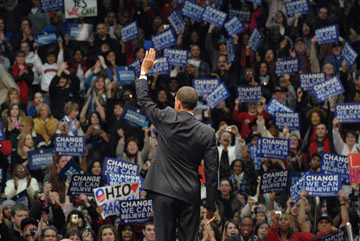
Second, wherever Barack Obama has campaigned this spring, the results in terms of voter turnout have been astonishing and phenomenal. There are two ways to win a general election: mobilizing and achieving a high turnout from your issue and demographic base, and persuading independent swing voters to come to your side. Barack Obama has shown a remarkable power to get independents who do not usually turn out for the Democratic primary to show up and vote for him. And he has shown a remarkable power to turn out his base. Both of these would have to vanish mysteriously in the general election before Obama could be called less “electable.”

Thus my judgment is that the argument that superdelegates should support Hillary Clinton because Barack Obama is not very “electable” falls to the ground of its own weight.

I think that Wilentz agrees with me. He talks about a winner-take-all system that doesn’t exist, but spends little time engaging the real-world issue of electability. And that is: Which Democratic candidate, Obama or Clinton, has a better chance of carrying Michigan, Pennsylvania, Minnesota, Oregon, Wisconsin, New Hampshire, Iowa, New Mexico, Florida, Ohio, Nevada, Missouri and Colorado against John McCain in November?

And, alas, the arguments that Clinton would fare worse in those states, and that she is less electable generally than Obama, are numerous and distressingly powerful:

  • She is a Clinton, and hence will energize the Republican base against her nationwide as nobody else can.
  • The press corps has never given her a fair shake, and as Machiavelli once said, we can never forgive and be fair to those to whom we have done injury.
  • Barack Obama is a charismatic, historic figure.
  • The positions that Clinton has been taking vis-à-vis Obama in the past month appear to open up major vulnerabilities in the fall. McCain’s national security experience in Vietnam trumps Clinton’s national security experience in Tuzla, Bosnia.

Now, none of these are Hillary Rodham Clinton’s fault — well, except for that last one, which is her fault, or perhaps Mark Penn’s. None of these are fair. But they do make me believe that flinty-eyed Democratic superdelegates making coldblooded calculations about the national interest are making a better bet on the future if they decide to support Barack Obama.

Continue Reading Close

Mike Huckabee wants to abolish the IRS

His loopy tax plan would be an economic disaster -- but it's more honest than the schemes being peddled by the establishment Republican candidates.

  • more
    • All Share Services

Mike Huckabee wants to abolish the IRS

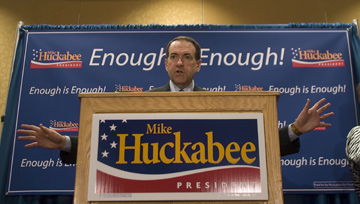
For a generation Republicans have won elections by promising to do something new — and usually strange — to America’s tax system, and by making wild and improbable claims about how great what they propose will turn out to be. This was how Ronald Reagan rode to victory in 1980 with his tax cut plan — a plan that his own vice president and successor to be, George H.W. Bush, dismissed as “voodoo economics.” This was what George W. Bush did back in 2000 when he claimed that faster economic growth would be guaranteed by yet another tax cut for the rich. And this is what Republican presidential front-runner Mike Huckabee is doing today with the “FairTax”: a plan to replace the income tax and the Internal Revenue Service with a nationwide federal sales tax.

From one perspective, you have to wish Huckabee, and the other FairTax backers in the Republican field, well. All of the GOP’s second-tier candidates — Alan Keyes, Duncan Hunter and Ron Paul — are FairTax proponents, as was the recently departed Tom Tancredo. The other major Republican candidates, including John McCain and Mitt Romney, are all singing the same old song. They are promising a) income tax cuts and b) expanded government services because c) they are willing to claim that cutting income tax rates will trigger so much extra economic growth that revenues will not suffer but will instead expand. One way or another, all the GOP front-runners except Huckabee are lying. They are either a) lying to their supporters who want tax cuts or b) lying to their supporters who want expanded government or c) lying to everybody, perhaps themselves included.

Huckabee, to his credit, doesn’t think this is a good game to play.

This view, however, leaves Huckabee and company at a disadvantage. They need to distinguish themselves somehow from the establishment candidates with better organizations and more media visibility. But they don’t want to find themselves in the future in the place where George H.W. Bush found himself in 1990. Two years after running for president on a promise that he would block any tax increase by telling congressional Democrats, “Read my lips, no new taxes,” he was forced to raised taxes. Huckabee et al. need a new game to play.

Enter the FairTax. It promises to be a game changer. It would abolish the IRS and all current federal taxes, including Medicare, Social Security, and personal and corporate income taxes, and replace them with a national, across-the-board, 23 percent point-of-purchase retail sales tax. It would also give each household a multi-thousand-dollar “prebate” every year on their expected annual taxes and exempt people living below the poverty line from taxes altogether.

The FairTax asks: Don’t we all hate the IRS? Don’t we wish it would just die? And once Huckabee has made the don’t-we-all-hate-the-IRS move, his establishment competitors are suddenly thrown on the defensive. They are the defenders of the hated IRS. They are the people who applaud when the IRS audits you. Cynical on the part of Huckabee? Surely. Dishonest? Somewhat. But remember that this move of Huckabee’s is less cynical and dishonest than the standard Republican line on how tax cuts raise revenue, which the other front-running GOP candidates are still mouthing.

From another perspective, however, you have to scorn Huckabee. He is adding yet more layers of confusion to America’s conversation about taxes. Huckabee says that the FairTax would mean a 23 percent sales tax rate on all items. First of all, the real tax rate proposed is 30 percent. The FairTax would add 30 cents to every dollar spent, but since 30 cents is 23 percent of $1.30, the FairTaxers call the rate 23 percent.

Second, and more important, both conservative and liberal economists believe the real rate would end up even higher. Estimates of the actual rate of taxation required for the FairTax to be “revenue neutral” (meaning for it to bring in exactly the same amount of revenue that the federal government collects under the current system) start at 30 percent and keep climbing. William Gale of the liberal Brookings Institution think tank says it’s a de facto 44 percent sales tax. Calculations go still higher once you add in all the necessary and politically inevitable exemptions on big-ticket items — like a new home or hospital care. Congress’ Joint Committee on Taxation, which draws members from both parties and both houses, says the real rate would be 57 percent. (And this leaves aside the enormous federal outlay required by the “prebates,” which even FairTax advocates say would cost the government $485 billion per year.)

Also, Huckabee calls his proposal a “fair” tax. But it’s a mammoth tax cut for the crowd making more than $200,000 a year and a substantial tax increase for those making between $30,000 and $200,000 a year. Does this make economic sense? It is hard to see how: What makes the $200,000-plus crowd especially deserving of a tax cut? This is part of a pattern with Huckabee. Anxious to distinguish himself on policies from his competitors but without the staff and the network to perform due diligence on policy proposals, he ends up with ideas that aren’t fully worked out and don’t make much substantive policy sense.

Does the FairTax make political sense? It is hard to see how — at least not if people know what he is really proposing. After all, a lot more people make between $30,000 and $200,000 a year than make more than $200,000. Politicians prefer, other things being equal, to take positions that are advantageous to more people rather than those that are advantageous to fewer.

So why is Huckabee doing this?

I believe the reason is that he is counting on people not knowing what he is really promising. I believe he is counting on the nigh total fecklessness of America’s press corps — a fecklessness that I at least now see as deployed with a sharp partisan edge. As economist John Irons laments on his blog, ArgMax.com: “I’m not sure how he is getting away with adopting the FairTax as part of his platform. Wouldn’t Democrats be skewered in the media if they proposed a tax increase on people making between $30,000 and $200,000?” Yes.

But Huckabee is a Republican. And it is different if you are a Republican. The New York Times in its big Huckabee profile by Zev Chafets said:

Huckabee’s answer to his opponents on the fiscal right has been his Fair Tax proposal … Governor Huckabee promises that this plan would be “like waving a magic wand, releasing us from pain and unfairness.” Some reputable economists think the scheme is practicable. Many others regard it as fanciful … In any case, the Fair Tax proposal is based on extremely complex projections.

And that’s all the crack journalism of the New York Times has to say. If you are seeking information in a daily newspaper, look elsewhere — I recommend the Financial Times.

Since America’s mainstream press believes that it cannot talk about the substance of policy, about who actually would gain and who would lose from a shift to a national sales tax — that, you see, depends on “extremely complex projections” — the only point to grab onto when talking about the national sales tax is that it eliminates the IRS. And that sounds very good. And sounding very good is what Huckabee is counting on.

But what replaces the IRS? What agency administers a national sales tax. Conservative economist and former George H.W. Bush administration official Bruce Bartlett fears the:

incredible complexity and intrusiveness of tracking every American’s monthly income [for the rebate program] … massive technical and administrative problems with collecting all federal taxes at the checkout counter and relying entirely on state governments to collect the federal government’s revenue … What is to stop [states] from slacking off [sales tax enforcement] and giving their citizens a tax cut at federal expense?

Thus this FairTax selling point is bogus too. The FairTax doesn’t eliminate the IRS. It replaces the IRS with another agency — the United States Fair Tax Federal Revenue Administration and State Tax Authority Reconciliation Service, or the USFTFRASTARS. It is true that the USFTFRASTARS doesn’t audit individuals — it audits businesses and state governments instead. This is a good thing for the $200,000-plus crowd: They are the ones who get audited, and so they get both a big tax cut and greatly increased peace of mind. But this is not a good thing for everybody else. The administrative and enforcement burden does not go away but, rather, becomes even more complicated.

Is Huckabee’s FairTax smoke and mirrors? Yes. Is it voodoo economics? Yes. But remember one more thing: It is more reality based than the proposals of the establishment Republican candidates.

Continue Reading Close

A man who hated government

Conservative economic guru and liberal nemesis Milton Friedman disliked intervention of any sort, whether in the market or in recreational drug use.

  • more
    • All Share Services

A man who hated government

“Lord, enlighten thou our enemies,” prayed 19th century British economist and moral philosopher John Stuart Mill in his “Essay on Coleridge.” “Sharpen their wits, give acuteness to their perceptions, and consecutiveness and clearness to their reasoning powers. We are in danger from their folly, not from their wisdom: their weakness is what fills us with apprehension, not their strength.”

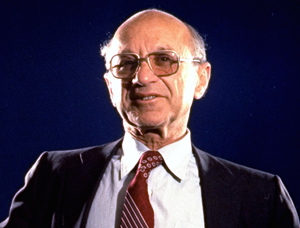
For every left-of-center American economist in the second half of the 20th century, Milton Friedman (1912-2006), Nobel Prize winner, founder of the conservative “Chicago School” of economics and advisor to Republicans from Goldwater to Reagan, was the incarnate answer to John Stuart Mill’s prayer. His wits were sharp, his perceptions acute, his arguments strong, his reasoning powers clear, coherent and terrifyingly quick. You tangled with him at your peril. And you left not necessarily convinced, but well aware of the weak points in your own argument.

Gen. William Westmoreland, testifying before President Nixon’s Commission on an All-Volunteer [Military] Force, denounced the idea of phasing out the draft and putting only volunteers in uniform, saying that he did not want to command “an army of mercenaries.” Friedman, a member of the 15-person commission, interrupted him. “General,” Friedman asked, “would you rather command an army of slaves?” Westmoreland got angry: “I don’t like to hear our patriotic draftees referred to as slaves.” And Friedman got rolling: “I don’t like to hear our patriotic volunteers referred to as mercenaries.” And he did not stop: ” If they are mercenaries, then I, sir, am a mercenary professor, and you, sir, are a mercenary general. We are served by mercenary physicians, we use a mercenary lawyer, and we get our meat from a mercenary butcher.” As George Shultz liked to say: “Everybody loves to argue with Milton, particularly when he isn’t there.”

Thinking as hard as he could until he got to the root of the issues was his most powerful skill. “Even at 94,” wrote “Freakonomics” author Steven Levitt, currently a professor in the same University of Chicago economics department where Friedman taught from 1946 to 1976, “he would teach me something about economics whenever we talked.” In Friday’s New York Times, Chicago economist Austen Goolsbee quotes from Milton Friedman’s Nobel autobiography:

Friedman said that when he arrived [at the University of Chicago] in the 1930s, he encountered a “vibrant intellectual atmosphere of a kind that I had never dreamed existed.”

“I have never recovered.”

His worldview began with a bedrock belief in people and their ability to make judgments for themselves, and thus an imperative to maximize individual freedom. On top of that was layered a trust in free markets as almost always the best and most magical way of coordinating every conceivable task. On top of that was layered a powerful conviction that a look at the empirical facts — a comparison, or a “marking to market,” of one’s beliefs with reality — would generate the right conclusions. And crowning that was a fear and suspicion of government as an easily captured tool for the enrichment of cynical and selfish interests. Suffusing all was a faith in the power of argument and the primacy of reason. Friedman was an optimist. He was convinced people could be taught the truths of economics, and if people were properly taught, then institutions could be built to protect society as a whole against the corruption and overreach of the government.

And he did fear the government. He was a conservative of the old, libertarian school, from the days before the scolds had captured the levers of power in the conservative movement. He hated any government intrusion into people’s private business. And he interpreted “people’s private business” extremely widely. He detested the war on drugs, which he saw as a cruel and destructive breeder of crime and violence. He scorned government licensing of professionals — especially doctors, who heard over and over again about how their incomes were boosted by restrictions on the number of doctors that made Americans sicker. He abhorred deficit spending — again, he was a conservative from another era. He feared that cynical politicians could pretend that the costs of government were less than they were by pushing the raising of taxes to pay for spending off into the future. He sought to inoculate citizens against such political games of three-card monte. “Remember,” he would say, “to spend is to tax.”

This did not mean that government had no role to play. He endorsed the enforcement of property rights, adjudication of contract disputes — the standard and powerful rule-of-law underpinnings of the market — plus a host of other government interventions when empirical circumstances made them appropriate. Sometime empirical circumstances could win Friedman some unexpected allies. Left-wing Mayor Ken Livingstone’s congestion tax on cars in central London is an idea straight out of Milton Friedman. Friedman’s negative income tax is one of the parents of what is now America’s largest anti-poverty program: the earned-income tax credit, which was greatly expanded by Bill Clinton. And, most important, government had a very powerful and necessary role to play in keeping the monetary system working smoothly through proper control of the money stock. If there was always sufficient liquidity in the economy — enough but not too much — then you could trust the market system to do its job. If not, you got the Great Depression, or hyperinflation.

Prior to Friedman, the economic giant of the previous generation, John Maynard Keynes, was an equally ferocious debater. The Great Depression had convinced Keynes that central bankers alone could not rescue and stabilize the market economy. In Keynes’ view, stronger and more drastic strategic interventions were needed to boost or curb demand directly. Keynes was perhaps the prime influence on U.S. liberals and U.S. economic policy up through the Reagan era; Friedman worked tirelessly to supplant and minimize his influence.

In their “Monetary History of the United States,” Friedman and coauthor Anna J. Schwartz argued that the Keynesian reliance on intervention was a misreading of the lessons of the Depression. Friedman did think that government was required to undertake relatively narrow but crucial strategic interventions to stabilize the macroeconomy — keep production, employment and prices on an even keel. But he believed the Depression might have been rapidly alleviated by skillful monetary management alone. Over the course of 40 years, Friedman’s position carried the day, in a few developing economies like Chile that have applied Chicago School theories, and at home. Current Federal Reserve chairman Ben Bernanke now holds Friedman’s view, not Keynes’, of what kind of strategic interventions in the economy are necessary to provide for maximum production, employment and purchasing power, and stable prices.

Friedman’s thought is, I believe, best seen as the fusion of two strong and very American currents: libertarianism and pragmatism. Friedman was a pragmatic libertarian. He believed that — as an empirical matter — giving individuals freedom and letting them coordinate their actions by buying and selling on markets would produce the best results. It was not that he thought this was a natural law. He didn’t believe that markets always worked best. It was, rather, that he believed that places where markets failed were atypical; that where markets failed there were almost always enormous profit opportunities from entrepreneurial redesign of institutions; and that the market system would create new opportunities for trade that would route around market failures. Most important, his distrust of government told him that government failure was pervasive, and that any expansion of government beyond the classical liberal state would be highly likely to cause more trouble than it could solve.

For right-of-center American libertarians, Milton Friedman was a powerful leader. For left-of-center American liberals, Milton Friedman was an enlightened adversary, and one whose view is now ascendant. We are all the stronger for his work. We will miss him.

Continue Reading Close

The pause that might not refresh

Tuesday, for the first time in two years, the Federal Reserve didn't raise interest rates -- but is the damage already done?

  • more
    • All Share Services

Shortly before 2:15 p.m. Eastern time Tuesday, after a meeting in Washington that nearly every American would’ve found mind-numbingly dull, someone made a phone call to the Federal Reserve Bank in New York. The purpose of the phone call was to tell the bank’s trading desk that the Federal Reserve’s Federal Open Market Committee, known as the FOMC, had decided that the level of bond prices — specifically, the price of three-month Treasury bills: promises by the U.S. Treasury to pay cash in three months — was just right.

The price didn’t need to be raised or lowered to be consistent with price stability and with maximum employment, purchasing power and growth. The FOMC told the trading desk to buy and sell some of its three-month Treasury bills to keep their price stable, and thus keep the interest rate the Treasury bills would earn stable: 5.25 percent. This is the first time in two years (and 18 meetings — the meetings are held every month and a half) that the FOMC has not raised interest rates, which have climbed 4.25 percentage points since the spring of 2004.

From one perspective these FOMC decisions are trivial and tiny. As a result of this phone call, the trading desk at the Federal Reserve Bank will buy or sell a few extra billion dollars in bonds, far less than $100 worth for each person in the United States. Banks and other financial institutions will have a little more or less cash, and a little fewer or more bonds, but the proportion of cash and bonds in their portfolios will change by what seem to be insignificant amounts.

Yet such relatively small actions by the Federal Reserve’s FOMC affect every single bond price and interest rate in the entire world. Traders on Wall Street are now revising their expectations about the future path of interest rates.

When the FOMC raises interest rates, as many expected would happen Tuesday, corporations tend to borrow a little bit less than they would have otherwise, spend a little bit less on new factories and equipment, and so hire fewer people. Construction companies borrow a little bit less, spend a little bit less building houses, and so hire fewer people. The slightly higher interest rates lead a few households to decide not to take out that home equity loan after all. Those households spend less, so the businesses that supply what they buy hire fewer people.

The chain of decisions triggered by raising interest rates is costly. Unemployment would be a little bit higher if the FOMC had raised interest rates today: By November 2007 there would probably be an extra 250,000 Americans unemployed. That’s why the FOMC didn’t do it. That’s why the FOMC stood pat and kept bond prices and interest rates constant Tuesday.

But raising interest rates would have had benefits as well. Lower demand lowers inflation. Because the FOMC didn’t raise interest rates this time, by November 2007 inflation will probably be higher by about 0.1 percent per year. If you believe — as the FOMC does, with a faith so strong that St. Paul would marvel at it — that the economy works much better if prices are roughly stable, with lower average unemployment and faster growth, then that creep-up of inflation is not something that should be allowed to continue indefinitely.

Every economist in the world wishes Federal Reserve chairman Ben Bernanke and his team at the FOMC well. We all hope that he makes the right decisions, even when we disagree with him. We would prefer that his decisions be right and our judgments be wrong rather than his decisions be wrong and our judgments be right. But we all have our views, and so the FOMC’s meetings every month and a half are surrounded by a chorus of commentary from economists, each of them saying what he or she thinks the FOMC should do.

For the Federal Reserve is trying to hit the sweet spot. It would be bad if inflationary pressures returned to the levels they were in the 1970s, and growth slowed as people became confused about which prices were rising because goods were in short supply and which prices were rising simply because the Federal Reserve had pumped too much cash into the economy by keeping bond prices too high and interest rates too low. It would be bad if the Federal Reserve pushed bond prices too low and interest rates too high and then discovered that it had pushed unemployment higher as well.

Some think that the FOMC has already raised interest rates too high. They see an economy in which the principal danger is not that inflationary pressures are gathering but that spending is already falling. Dean Baker of the Center for Economic and Policy Research notices rapid increases in credit-card debt outstanding in May and June, and fears that this is a sign that past FOMC interest rate increases are already shutting down the home-equity ATM, and that households that can no longer borrow attractively against home equity are maxing out their credit cards. If that’s true, they will be forced to cut back on the consumer spending that has fueled so much of the current business cycle expansion. The economy is still growing now, but Baker and others think that’s because a lot of the consequences of the past two years of interest rate increases have not yet had their full effect. These increases are still “in the pipeline,” and come November 2007, according to this point of view, we will all be glad that that the FOMC did not raise interest rates Tuesday.

On the other side, Marty Feldstein of Harvard, president of the National Bureau of Economic Research, and former chairman of the President’s Council of Economic Advisors under Ronald Reagan, believes that the Federal Reserve must “convince the markets that inflation will be contained” as successfully under the stewardship of Bernanke as it was under Alan Greenspan, and as a result the FOMC “must show that it is willing to take the risk of tightening [interest rates] too much.” But John Berry (who used to make the Washington Post’s coverage of the Federal Reserve the most sophisticated of all daily newspapers before he jumped to Bloomberg) judges that the markets expect a pause, and that there will not “be much of a backlash from analysts wringing their hands about Fed Chairman Ben S. Bernanke being ‘soft on inflation’ or about the loss of Fed credibility as an inflation fighter. After all, a pause would be just that.”

Feldstein recognizes that uncertainty is immense, and that he could well be wrong in his judgment that inflationary pressures are the major risk to be guarded against: “The consequences of the past [two years' worth of] interest rate hikes are difficult to predict … [a] fall in house prices; residential construction plummet[ing] ; lower housing wealth; [a] sharp fall in mortgage refinancing, bringing down consumer spending, expenditures on equipment and software slow[ing] sharply  A much sharper slowdown than the central tendency forecasts is certainly possible.”

This uncertainty is the reason that the FOMC is feeling its way month by month, moving interest rates in small, bite-sized quarter-percent increments, and warning everyone that it does not know what it is going to do next. The FOMC calls its decisions “data dependent,” and the committee members know the stakes and risk and the magnitude of uncertainty as well as anyone.

From one perspective this looks like witchcraft: a group of people in a room pulling and pushing metaphorical levers when they are not sure how strongly these levers are attached to anything.

From another perspective this is a triumph of technocracy. Trained professionals are trying their best to socially engineer a healthy and productive economy. They’re thinking and making decisions at a level of detail and sophistication that not one person in a thousand can follow, and yet those decisions have a powerful impact on all of us.

Continue Reading Close

The odds of economic meltdown

With interest rates and oil prices rising and consumers spending beyond their means, we may be headed for recession -- and worse.

  • more
    • All Share Services

The odds of economic meltdown

Forecasting recessions is a fool’s game. If there is enough solid economic information to make it appear highly likely that a recession is coming — that production, employment and consumer demand will actually fall — then it is highly likely that there already is a recession. Businesses are not stupid, and they don’t have to wait for economists to tell them what they already know. By the time a gloomy forecast has been issued they’ve probably already noticed a drop in consumer demand and responded by firing workers and reducing production.

So: Never say that a recession is coming. Say only that a recession is here, or that there might be a recession on the way. Which, in fact, is what I’m saying today. As of the beginning of August 2006, a recession is not here, and I’m not going to violate my own rule by saying one is coming. But there is a good chance — for the first time since 2003 — that there might be a recession in progress six months from now.

Why? Three factors: 1) A Federal Reserve that finds itself with less inflation-fighting credibility than it thought it had; 2) upward pressure on inflation from rising energy and, perhaps, import prices; and 3) millions of middle-class homeowners who for too long have treated their houses as gigantic ATMs, using home equity loans and refinancing to generate extra spending money.

First, the Federal Reserve, now chaired by Bush appointee Ben Bernanke. The Federal Reserve sets interest rates, and when it does it tries to hit the economy’s sweet spot: that point that produces maximum employment, purchasing power and growth without generating enough upward pressure on prices to produce expectations of inflation. The Federal Reserve does this by pushing interest rates up and down. Push interest rates up and businesses find it more expensive to expand capacity and production, causing them to cut back on investment spending. Push interest rates up and households’ balance sheets deteriorate, causing them to cut back on consumption spending. Push interest rates down and firms find it cheaper to expand capacity and production, and so they ramp up investment spending. Push interest rates down and households find their balance sheets looking better and feel flush, expanding consumption spending.

There is one major complication: what Milton Friedman calls the “long and variable lags” in the system. Every action the Federal Reserve takes now affects production, demand and inflation roughly 15 months in the future. What the Federal Reserve has done in the past 15 months has not yet had a chance to affect the economy.

This leads to the Federal Reserve’s current dilemma. The last two percentage points’ worth of increases in interest rates — increases in interest rates that will in the end make businesses cut back on investment spending and households feel pinched — have not yet had a chance to affect the economy. Because of “long and variable lags,” they are still “in the pipeline.” When they emerge from the pipeline they will slow the economy further. By how much? Nobody is really sure.

In this situation it seems reasonable that the Federal Reserve should stop raising interest rates. Waiting to see what the interest-rate increases of the past couple of years will do to the economy would be a prudent strategy. Indeed, since last December the Federal Reserve has been quietly signaling that it is about to “pause,” to adopt such a wait-and-see strategy. Yet so far it has not done so. Why not? One important reason is that the Federal Reserve is scared that if it pauses too soon it will convince many observers that it is not truly serious about fighting inflation — and a central bank has a hard time fighting inflation if businesses, speculators and workers ever conclude that it is not truly serious.

The Federal Reserve is also unwilling to stop increasing interest rates because it is afraid of recession risk factor No. 2: a rise in oil and import prices. Those fears are justified. Remember how the invasion of Iraq, besides bringing a golden age of democracy to the Middle East, was also supposed to produce $15-dollar-per-barrel oil? Oil is now at $75 a barrel, and this rise in oil prices is putting upward pressure on prices in general. As for import prices, they are vulnerable to a U.S. dollar that has been weakened by the Bush budget deficit and massive borrowing from China. Suppose the dollar declines suddenly, which is not a far-fetched possibility. Should the dollar fall by, say, 30 percent, and should importers raise their dollar prices in proportion, then the one-sixth of U.S. spending that is spending on imports will see prices rise by 30 percent. Because 30 percent times one-sixth equals 5 percent, that would boost U.S. consumer prices by 5 percent nearly overnight.

Thus there are two big reasons for the Federal Reserve to keep raising interest rates, in spite of how much downward pressure on demand is still in the pipeline. The Federal Reserve thinks it needs to do so in order to establish its long-term credibility, and there are the twin dangers of oil- and import price-triggered inflation to guard against.

Most likely the Federal Reserve’s continued raises in interest rates will not send the economy into recession. But there is that chance, and the chance is raised from a low-probability possibility to a serious worry by the third factor: that home-as-ATM problem. The unprecedented use of home loans to squeeze cash out of equity has allowed middle-class consumers to spend well beyond their means. Someday this spending spree has to come to an end. If it comes to an end suddenly, at a time when the Federal Reserve has raised interest rates a little too much, then we have our recession.

Make no mistake about it: The U.S. economy is close to the edge. Retail sales in the second quarter were rising at only a 2.1 percent annual pace. Business investment in equipment and software was falling. Residential construction was falling. Either households will continue spending beyond all reason, or businesses will start boosting investment, or exports will start booming, or there will be a recession sometime in the next year. Figure the odds at 3 out of 10.

What can be done to head off the danger? Unfortunately, very little. The bag of macroeconomic tricks is empty. In 2000-2001 the Federal Reserve could lower interest rates to the floor, boosting residential construction and consumer spending to offset the decline in high-tech investment, and turn the 2001 recession into a very small event indeed. In 2002-2003 the short-run stimulative effect of the Bush tax cuts came online at exactly the right moment to offset fears of a deflationary spiral. But today further fiscal stimulus would increase global imbalances — meaning, raise the trade deficit — and do more damage to confidence than it might do good in curing a recession. And sharp reductions in interest rates would lower the value of the dollar and increase inflationary pressures from import prices in a way that the Federal Reserve does not dare allow.

The past 24 years have been an amazing run as far as the business cycle is concerned. There have been only two recessions, and both of those were short and shallow. But Ben Bernanke and Co. are now at real risk of presiding over the third.

This story has been corrected since it was originally published.

Continue Reading Close

Page 1 of 2 in Brad DeLong