Carlos Amantea

A persistent old fart with St. Vitus’ dance

How one member of the Liver Spot Set beat Mexican bureaucracy; the joy of giant duck love; and the geezer is asked to revisit fatherhood.

  • more
    • All Share Services

A persistent old fart with St. Vitus' dance

One of the advantages of geezerhood besides getting up four times a night and forgetting our children’s married names (and even our children’s names) is that you often can get your way, even when you shouldn’t. I had a chance to experience this when I went to Mexico this fall.

My friend Jesús and I drove for a day across the upper part of Mexico from Tijuana to the end of the free zone and the jumping-off point of Sonoita. However, when we went to pick up the papers for my car (which would enable me to legally make the long drive south to my home in Oaxaca), I was told that since I didn’t surrender the car papers when I returned last year, I am technically still in Mexico, illegally.

My truck and I are right there in front of them to prove that I have indeed returned, but the great logic of all bureaucracy of all times is that if you didn’t do it right, you didn’t do it at all.

I am told thus that they will not issue me a new visa. It’s 8 p.m. The temperature has dropped to subfreezing. The office of appeal that they direct me to has no heat and is all government — dull fluorescent lights, dirty walls, stacks of papers everywhere. The man at the front desk, a Mr. Toad, demands to know what I want. I have never seen a grown man who looks more like a bufadora, warts and all. Even to the hands, set on the desk, palms down, fingers turned inward. He’s squatting there, and I’m his fly.

I explain to Toad Man that I have been going to Mexico for 15 years and it is ridiculous that they will not give me a visa. I tell him I want to see whoever is in charge. He says that’s impossible, that La Abogada de la Frontera, the chief, is very busy. I say I have to see her just for 30 seconds. He says it cannot be done. I say I’ll wait.

I have Jesús put my wheelchair right next to El Bufadoro’s desk, so that I’m in his line of vision. Then, with no prompting, after five minutes, I begin to shake. Northern Mexico desert country can be very cold, and I am, after all, a nervous old guy with the heebie-jeebies in a wheelchair in an unheated government office. In the words of the old Appalachian folk song as collected by John Jacob Niles, I begin to shake, rattle and roll.

My wheelchair is an antique (Quickie II — like a 1953 Bentley). It has loose wheels and mysterious chains and hanging things, so, under normal operation, there’s always clanking and banging. In the cold, it is redoubled. And while my wheelchair cranks up with the “Anvil Chorus,” my teeth decide to join in. Also my arms — this one’s new to me — go into attacks of palsy. It gets quite noisy in that normally quiet office.

I say nothing to Mr. Toad, don’t even look at him, just sit there and jingle my bells. There might even be a splotch or two of saliva that escapes my purple lips (I am no longer in control, right?). After an hour of this, the Toad gives Jesús a tight smile and tells him that La Abogada is still busy. But I sense, through all the racket, that something has changed.

I have proved my stoicism, my willingness to sit — neither cool, calm nor collected, but at least a presence, perhaps an artistic statement out of Laurie Anderson: “Persistent Old Fart with St. Vitus’ dance.”

A signal is passed somewhere. The Abogada’s pretty assistant comes and asks me what I want. “Si mira Vd. mis documentos … ” I hand her my papers and give her my well-rehearsed 30-second explanation of why I’ve been terribly wronged.

In 10 minutes she is back, tells us to go on down the ramp, that they will give us our papers. I thank her profusely, smile at the sullen Mr. Toad — thank him too — and we are off in a flash.

I live half the year south of the border, and it is written, despite NAFTA and all good sense, that certain animals, along with drugs and guns, are not to be admitted into Mexico. Some animals are OK. For instance, they let in Americans by the millions, those who have nothing better to do than drink themselves silly on $6-a-gallon mescal beginning at the breakfast hour, ending at midnight or so, lurching about the bars, cursing Mexicans and looking for a good fight.

These — along with dogs, cats and, possibly, Gila monsters — are acceptable. But feathered creatures, no. This includes chickens, ducks and, presumably, ostriches and moas. I suppose the rationale is that the Mexican government wants to prevent the spread of certain avian diseases, like dropsy, henbane fever, chicken pox and cockamamie.

For those of us who are chicken or duck lovers, this amounts to discriminatory treatment. Why should a poodle with pink ribbons be given preferential treatment over a Cochin, a White Crested Black Polish or a Pekin?

Fortunately for those of us who have this feathery love that dare not speak its name, our pets come in two forms: born and unborn. If you can’t import the full motley, there are always a dozen or so hard-shelled fetuses, delivered fresh from the womb, ready to be scrambled, fried … or hatched.

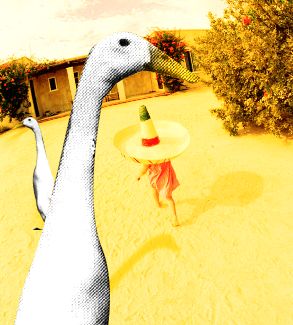
This year I’ve come to be interested in the rarest of the rare of ducks. They are called Indian Runners, and they’ll knock your socks off. Runners do that all the time — that is, they run about, willy-nilly. Also, unlike your regular duck, which is hung fairly close to the ground, the runner stands upright, like a penguin. If it weren’t for their wings and coloration, it would be like having a flock of Emperors in your backyard.

Last year, I shipped 20 black Indian Runner eggs down to my winter shack in Southern Mexico, along with an incubator. When they arrived, Jesús popped them in the incubator, and exactly 28 days later, 12 of them were, as they say in Spanish, “dierón a luz” — given to the light. Three of them succumbed to what I believe was excessive quackery. The other nine have grown at an alarming rate, and now stand 6 foot 3.

I exaggerate a bit, but given their noise and blind, down-home stupidity and their need to run about — should I say it? — like chickens with their heads cut off, they fill a space as big as all outdoors. They measure about 30 inches from stem to stern.

I left these noisy freaks in the hands of Jesús and he cared for them next to his outhouse until I returned this fall. There they were — nine black beauties — waiting for me. With only one problem.

Puerto Perdido is forever short of water, and so Jesús had not been able to give them a swimming area. Thus when I arrived, my ducklets did not recognize the tub of water we set out for them. They thought it was something dangerous and moved to the far side of their cage, eyeing it warily. I immediately instituted daily YMCA swim classes for our charges.

You would think it easy to teach a duck how to tread water, right? No dice. They are as receptive as your mother was to your first sweetie. And these quackers have immense wing power, somewhere around, it’s been estimated, 25,000 foot-pounds per square inch of lift.

They struggle when we pick them up, scream when we put them in the tub of water. They fly out of it as fast as they can, sopping us — their loyal instructors — and then skulking about on the far side of the cage, muttering like American teenagers after you’ve invited them to do a little yardwork. In other words, they were not overly fond of our Esther Williams Beauty Swim Course.

But I am patient, and loving — and we are still far from the Hatchet Solution (duck à l’orange) for our landlocked Indian Runners. I hope to report to you shortly that they have accepted their lap pool — that they have come to know and love what is, after all, their true nature: that they have taken to it like a duck to water.

You’d probably like No Name. She has eyes bigger than my own, skin of fine mahogany, a nose they used to call “button” and a mouth given to much smiling and little crying. She’s exactly a year old, and she was offered to me yesterday; if I want another daughter, she’s mine.

Her mother is María. María’s poor, pretty and now pregnant with child No. 2. She “likes the men,” says my worker Jesús. We don’t know who the father is and the child has no name because her mother hasn’t gotten around to it. Thus, “Sin Nombre.”

I thought about that one for a while: being a father again. The last time I did it was over 40 years ago. I’m not sure if I am up to it. There’s a certain, well, running about to be done — responsibility, caring, love. It’s something we might do if we were 35, or even 50 again. But no matter how fetching the young lady, no matter how well behaved, I don’t think I can pull it off at this late date.

She scarcely cries — “No Name” is not given to tears. She does know how to hug, however. She took quite naturally to my holding her, laid an affectionate hand on my arm, head on my chest. They are quite warm at that age, sweet-smelling.

Is it immoral, this offering up of one’s own flesh and blood to a stranger — albeit a stranger who’s a gringo, and, presumably, will have the wherewithal to care and feed for her? Who’s to say? She was born at a time when her mother was 17, ill-prepared for diapers and the messy world of child care.

Her mother is smitten with the men. Among the caravan, No Name’s father is an unknown. He was one of a series who came through the hutch, spent a night or two, moved on. It was only after a year of motherhood that María let it be known to her family (which includes the wife of my worker Jesús) that the child was available for the taking.

Up north, public service agencies would become involved to keep the family — what little there is of it — together. A social worker would be called in to deal with the violence (the mother has a tendency to slap her unwanted daughter around, I am told). There might be a foster family found who would be paid on a per diem basis, willing to take her on for the cash flow, if for nothing else. In any event, it would have been handled differently — not this general call put out to all comers, with the need of a quiet girl-child, of winning ways, who is, now, of so little interest to her mother.

I asked Jesús and his wife, Maruga, if they could take No Name. “Creo que no,” he said. They already have two boys, one 6, the other 4. Jesús and Maruga grew up in families where there were many hungry mouths and little food — sometimes, for days at a time, nothing in the house to eat but tortillas and salt. There was not much in the way of help from the fathers (Jesús’ father disappeared; hers was an alcoholic). Both had to drop out of school early on to support a dozen or so brothers and sisters.

They have vowed that their two boys will do better: Felipe of the shy smile, Rogelio — who, full of 4-year-old wisdom, will talk your ear off if you give him half a chance. Telling me, for example, the important news of the day: He and his mother went to the public market; she bought him an apple; he wanted a balloon; she told him he’d have to wait for Los Reyes — the Day of the Three Wise Men — he told her he didn’t want to wait and so on.

Jesús and Maruga want their two boys to escape the world they grew up in. They want them to have more than one set of shirts and shorts, shoes that aren’t falling apart, a doctor to look after them when they get sick. They want the two to go to school and to stay there. Two boys — for now, that’s enough. Thus they rejected her cousin’s offer. She then asked Maruga if she would ask me.

“Sin Nombre.” No name. A tiny human life. Offered up just like that. This is no book or television “novela.” This is the real thing. Her fingers clutch around my index. She looks at me, looks into the heart of me. Will you be my father? Ah, those eyes. Stop looking at me, will you?

A child with, perhaps, no future, unless I choose to give her one. A child I could raise as if she were my own. Or, maybe, just to be the affectionate uncle: to be sure that she has all she needs, to protect her from the anger of a frustrated mother. A mother who, after all, just wants to get out of the house, to be with the boyfriends she fancies more than setting up housekeeping for her daughter, and the second on the way.

A sweet child. For the taking. If I want.

The sensual tortilla, the ambassador and Mr. Hulot

Extolling the glories of cornmeal, lime and a male Shirley Temple for the 21st century.

  • more
    • All Share Services

The sensual tortilla, the ambassador and Mr. Hulot

If there’s nothing else to eat here, there are always tortillas. Tortillas! Forty cents a kilo, which contains (I just counted) 53 of them.

Where would we be without tortillas? There is nothing more sensual for us Mexico-philes than the first hot tortilla of the day. Biting into it is not unlike biting into the skin of your sweet young love back 40 years ago when her skin was so succulent, her flesh hot and ever ready to be nibbled on and love was everywhere, floating up before you like a steamy vision, and you could hardly make it through the day without this passionate love of warm flesh rising up on you like a fecund summer storm to sweep you along with the protein-rich smell of it. Eating a hot, just-made tortilla fresh from the hands of the tortilla lady is something like that.

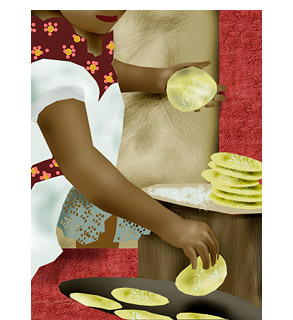
Your average tortilla is fabricated with whitewash — that stuff we used to use to paint the outhouse walls. (We’d also throw a handful down the hole to make the place a little less smelly.) In English, it’s called lime. To make tortillas with it, you mix a pinch or so of the lime with water, and boil the corn in it for a short time. Drain and wash, grind it up and you have tortilla flour. Pat it flat with your hands and heat it on a special round, warm plate called a “comal” until it is cooked through, stack the tortillas on a white cloth with a red flower design, take them home and open up the cloth, wrap one up in what they call a “flauta” and pop it in your mouth. You have the taste and feel of divine flesh, eating the flesh of the gods.

Lime — known here as “cal” — turns up everywhere: not only in tortillas but in cement for making buildings and for laying down bricks. It’s that white stuff painted around the base of trees — presumably to keep the ants from carrying off the fruit and leaves. It’s also used to make piggy banks — “figuras” — for storing change, and to paint lines on soccer fields.

But mostly, it’s tortillas. Cal, it turns out, provides just enough minerals to make it possible for people to survive on them alone, which not a few do in this poor area. You can’t say the same for Hostess Twinkies and Coca-Cola, the preferred dishes of the poor to the north.

Every time I think of cal, I think of warm-soft-yum tortillas — but I also think of whitewash, and Tom Sawyer, and that great song from World War I, sung by the “limeys” immersed in the gook of the front-line trenches. Can you hear them now, lying in their filthy, rat-infested dugouts, black with mud and ooze, poised for yet another battle of Ypres, singing loud and clear?

“Whiter than the whitewash on the wall,
Whiter than the whitewash on the wall,
Wash me in your water
That you wash your dirty daughter
And I shall be whiter than the whitewash on the wall.”

- – - – - – - – - – - -

King Carlos II

When I first met Carlos II he was dying. He was barely a month old, and couldn’t hold down his food — the technical term is “distal bowel obstruction.” His father was working for me and I had come over to see him about something that needed to be done and Carlos’ mother came out to the car and showed me her disheveled baby and said that he was sick and couldn’t hold down his food and she thought he might die. She wondered if she could borrow 300 pesos — about $35 — to take him to DIF, the government hospital for kids in Puerto Perdido, and I said get in the car. We got to DIF in 10 minutes, and an hour later they operated on him and untangled his tiny impacted small intestine, and now this child is alive and does all the normal 3-year-old things. The only thing to show what happened is a tiny scar just above the navel.

Carlos has taken a fancy to me and I’ve taken a fancy to him and it’s not just because they gave him my name after the lifesaving routine. It’s also not because my godson is the smartest, most beautiful, most charming, most intelligent being in the whole sentient world.

I go to the house to visit with his father and mother, and Carlos II comes to the door of my car and stands there and makes an impromptu speech. “Tiya pol,” he says. “Andoo. Si bikka siga pa’ ‘ya.”

They tell me he is speaking Spanish, and although I am not letter perfect in the language I know enough about it to know they are dead wrong. Carlos isn’t speaking Spanish — he’s speaking Mandarin Chinese. Thus he is neither a Oaxacan nor even a Mexican — he’s a visiting Chinese, an ambassador of goodwill reborn from that far land and sent secretly from so far away to charm the hell out of the rest of us.

His family doesn’t know what Carlos is talking about either, but that’s OK. When kids first learn to talk, we aren’t expecting the Gettysburg Address or monologues from “Hamlet.” His mother pretends to understand him, but Holden Caulfield says that all mothers are crazy and he’s right. She says that “tiya” is tortilla and “pol” is pollo — for chicken — and “bikka” is the dog Victoria, or maybe his dad’s bicycle. But I know Mandarin Chinese when I hear it and I am already planning for Carlos’ ambassadorship to that country in 30 years or so. Meantime, I’ll get him a job in a fortune cookie factory. “Tiya pol,” indeed.

The main reason I have him pegged for an ambassadorship at the very least is that as I soon as I am out of the car, he’s delivering this speech of welcome (a very serious speech it is, too; he doesn’t let himself smile once, even though he has a smile that would knock your ears off), and all the while he is delivering this homily I’m thinking I should call up MGM immediately, if it still exists, and set him up to be a child star — the male version of Shirley Temple for the 21st century.

These children have a way about them, don’t they? When I first met Carlos he certainly wasn’t much to look at, all wrapped up in a dirty blanket, so listless and wan that I figured we’d have to lay him in the grave by nightfall. Now look at him. He touched my heart then; he owns it completely now.

I’ve told his father and mother about Hollywood and his upcoming job with the State Department — remember, Shirley Temple ended up at the United Nations — but I have yet to tell them that I am also going to see that he is elected president of the world and, soon after, I’ll wangle a Nobel Prize for him, the Nobel Prize of Deliverance. For all of us who know him and care for him greatly it makes us shiver in fear thinking that this one we almost buried a couple of years ago — but now he’s alive and well and busy, making fine and serious speeches, capturing the hearts of all those around him.

- – - – - – - – - – - -

Mr. Hulot Goes Home

It’s late April so it’s time for us to leave Puerto Perdido. We put my swimsuit in mothballs, clean up the shack, bar the windows and doors against the sand and the siroccos of the summer. We say goodbye to the beach and the sun and the gentle waves that slap up against the shore. We say farewell to suntanned shoulders and peeling noses and the mosquitoes that come to sup on our blood all the long night.

We say goodbye to the nightly margaritas and the dogs that bark from 8 p.m. to 6 a.m. without stop. We say goodbye to the grackle that nests in the ficus next to my bedroom and wakes me up with a beep — I swear — exactly like an electronic alarm clock.

We say goodbye to the ants that erupt nightly from the woodwork and live (and die) in the speakers of my computer. We say goodbye to the scorpions that, on occasion, nest inside my shoes and surprise me in the mornings by being so irritated when I stick my feet in their bedroom.

We say farewell to the geckos that run willy-nilly across the ceiling of the kitchen at inopportune times, and at odd intervals make their strange gecko noises (what one famous writer called the “kissy-kissy”). Too, we say adios to the colonel bird, with its mournful cry from the next canyon over — the sweet sad sound that echoes across the hills at night.

We say goodbye to the evenings when we come home and turn on the spigot and nothing comes out because there has been a leak in the toilet that we’ve been meaning to get fixed but we never got around to, and since they turn on the water only every third day to fill the tank on the roof it will mean that for the next two days we’ll be giving ourselves what they call a “Tijuana bath” — a rag moistened from the 5-gallon jug we use for drinking water.

We say goodbye to the water that does, on occasion, actually flow from the spigot, which may be good enough for mopping the floors or flushing the toilet or taking a shower (with the eyes and mouth shut tight) but which one never drinks, since it’s drawn from the latrine and garbage area just outside Puerto Perdido, thus sporting an exotic collection of bacteria, viral infections, green floaty things that you don’t want to hear about and, for all we know, ebola.

We say goodbye to that miserable joke that for some reason gets repeated here endlessly. I swear, I’ve heard this one or its variation about 1,000 times — I even heard it once when I was waiting to fly out of the Huatulco airport, being repeated (as if it were a koan) by a 6-year-old Mexican kid: “Que entra parado, sale mojado, y oliendo pescado?”

Strictly translated, it means:

What goes in standing up (or, better, erect) and comes out all wet, and smells like fish?

The answer: Un buso (someone in a wet suit who just got out of the ocean).

It strikes me that this nationally known bit of doggerel is not unlike the ones we used to fabricate from the poems they made us memorize in school. I recall one by Robert Frost about stopping in the woods on a snowy night that got changed to:

“My little horse must think it queer/That I stop to give it to him/In the ear.”

Or Henry Wadsworth Longfellow’s sappy poem about the village square that got wonderfully transmogrified into:

“Under the spreading chestnut tree,/The village idiot stands/Amusing himself by abusing himself/And catching it in his hands.”

We also get to say farewell to our weekly visits to the telephone company, trying in vain to get plugged into the world. The last time we were there, the lady said (again) that there were no connections to be made in our neighborhood and there would be none any time in the foreseeable future. We have to wait until any of our neighbors who has a telephone either moves to Ouagadougou or dies. Since people never move out of here, even to Ouagadougou, our only recourse is to wait until flowers and wreaths and weeping ladies dressed in black appear next door and then hurry over to the Compania de Telefonos and lay claim to the vacated line.

It’s time to depart and I feel like I’m in the last scene of “Mr. Hulot’s Holiday”: The sand is blowing across the oceanfront roads, the fireworks went off last week for Semana Santa, that same old song is winding down on the phonograph — only it’s the radios playing at the public market — and all the gringos are packing up their butterfly nets and tennis rackets and heading back to the place where the sun don’t shine, at least not as fiercely and as well as it does here.

Continue Reading Close

Wheelchairs, pig guts, computers and machetes

Let me tell you what happened in the Mississippi of Mexico while I was out with the Pusher Divine, and visited by Peter Lorre and his giant knife.

  • more
    • All Share Services

Wheelchairs, pig guts, computers and machetes

The other day I sent Lirio into the local bank to get some money out of my rapidly dwindling account. I would have gone myself but Bancomer has set up its local branch with a narrow doorway and five high steps that aren’t very accessible, so I sent Lirio instead.

Some of us who have been in wheelchairs long enough have gotten past bitching about this shit. At one hospital I was in they had the staff take a day off to travel around town in a wheelchair, no cheating, so they could get some sense of our real world. When I picket Bancomer and its building designers, I’ll suggest that they send the architects out into the streets in a wheelchair for a day or two so they can see how the other half lives with these narrow doors and 11-inch-riser steps.

If I am in a crabby mood, being in a wheelchair always adds an extra dimension to my crabbiness. Everywhere they set up these walls: curbs with no cuts, six steps into my favorite restaurant, 11 steps down to the beach, five steps into the bank, five steps out of the bank. Some of us don’t take lightly to being carried in or out of buildings or on or off beaches or in or out of banks.

Then there are the passersby. One night I’m sitting in the “adoquin,” the pedestrian part of town where all the gringos go to eat and buy gewgaws and ice cream, and I’m minding my own business, sucking my thumb, and this guy comes by and pats me on the head and says, “God’s gonna cure you” and then ambles on down the street.

He looks like a normal enough guy — no dueling scars on his face to indicate that he is into abusing himself (or others) — but he doesn’t know beans about those of us who live in wheelchairs. He also obviously doesn’t know that we have a special reaction to being patted on the head like a doggy, especially when it’s accompanied by a slightly skewed message from the divine.

Most of us crips live in the eternal “Show-Me” state — so when people presume to speak on God’s behalf, we are often eager to know about their credentials, how they can speak with certainty. We expect such messengers to have wings and halos, or at least a divine glow. This guy didn’t have wings, a halo or a glow — at least as far as I could tell — so I didn’t pay much attention to his pontificating.

When people do the head pat and deliver the message of cheer, they are assuming that I am in despair and that I am in need of words of hope. But since I’ve been in a wheelchair off and on for about half a century, they are addressing a part of me that probably doesn’t respond too well to their message.

Lest you think that the world is made up only of fools and nitwits, let me tell you what happened last week. Lirio is pushing me up and down the public market so we can find some lunch, but first I should tell you about Lirio. He is the master chauffeur, the Pusher Divine. When they give prizes at the next Convention of the Americans With Disabilities Association, I’m going to nominate Lirio for a gold medal for his mastery of the Wheelchair Go-Round.

There are wheelchair people who run you into walls and tumble you down stairs. These we tend to avoid. Then there are those who are merely competent — they can get you up a curb or down a hump in the road without dumping you, but they don’t do it with any art.

Lirio? He’s the Tiger Woods of wheelchairology. He sees things long before I do: pits in the roadway, channels in the sidewalk, tubes under the macadam, arroyos in the dirt roads and dog shit just around the corner on the sidewalk that anyone else would miss.

In your typical Mexican public market, there is always a puddle of smegma somewhere about, usually next to the meat section. With or without smegma, the meat section is a study — filled with dark red, striated hanging things with a thick, hair-curling, eye-watering, nose-wrinkling stink, along with a superb collection of flies. It’s enough to make you a permanent vegetarian.

Somewhere near the meat-and-fly department of the public market is a runoff area, a runnel of dark, ominous liquids, made up of blood, rotten exudate, upchuck, stools and other goodies — all collected together into a thick and loathsome puddle.

Now if Fredo or Jose was pushing my chair, he’d breeze right through these smegma marshes with not a care in the world, not thinking that in a couple of hours these selfsame wheelchair tires would be coursing through my home, bearing in the treads unseen billions of bacteria, germs, viruses, the Black Plague.

Lirio knows better. He always gets me over or around the pipes and cables and holes in the cement and the dog poop, keeps me well away from the smegma puddle so I won’t have to worry about whether I am carrying an army of festering bacteria along with me on my tires into my clean home.

Last week Lirio and I were in the public market looking for a place to eat among the 30 or so stalls with tables and five or six chairs and a kitchen so small you have to go outside to change your mind, trying to find one that might have something to satisfy this gnawing in Lirio’s tum.

In the stall marked “Doqa Alicias” there’s a lady watching us, a lady with her hair pulled back in a bun and the face of one who has lived in this area long enough to know that it’s no piece of cake trying to make it through life in what is in effect the Mississippi of Mexico. When she sees me coming down the aisle she steps out from behind the counter and hands me 5 pesos. What to do?

This stuff happens all the time. In the old days it used to drive me crazy. I mean, one of my monthly payments from Social Security alone could take care of this hair-bun lady and her eight children and drunken husband for the next year. What to do? Give her back her 5 pesos and say thanks but no thanks?

There is a better solution, and Lirio figures it out at once. He shoves my chair up to the table of her cafe and asks her what’s available to eat. She tells us that she has arroz y frijoles — beans and rice. Also caldo de pollo — chicken soup. And, finally, sopa de panzita de puerco — tripe soup.

I opt for the beans and rice; Lirio takes the tripe. The perfect solution: The meal costs 35 pesos — about $3.50 — which means I can leave a 5-peso tip, no problem.

Later, Lirio claims she poisoned him with her gut soup because he has problems with his own tripe that evening, but I tell him that she’s a nice lady, possibly a saint, and he can trust her and her food and that anyone who has no more than 5 pesos in her pocket yet comes out and offers it as a gift to the tall gringo with the dewlaps and the shaky hands in his wheelchair is OK in my book. I also point out to him that anyone who chooses to eat a bowl filled with “tripas de puerco” — pig guts — well deserves what he gets.

- – - – - – - – - – - – - – - – -

Computers and Machetes

No sooner had I put my trailer up at the place that we call La Huerta here in Puerto Perdido than I was set upon by two officials of the local “secondaria” — the public school. They came by to tell me that they admired my truck and said that they would like me to contribute it to their school.

I responded by saying that I often had trouble with the language and was probably going deaf on top of that, so perhaps they could repeat their words so that I might better understand what they were asking of me.

The group leader looked not unlike a grizzled Peter Lorre, and his compadre was a parody of the Mexican “bandito” — dirty white pants, unshaven face, scar on the left upper lip, no smile. He had on a T-shirt that praised the virtues of Acapulco and showed the backside of a plump lady in the buff. Both of my visitors — but not the nude lady — were carrying machetes.

They repeated that they would like my truck. As a gift. For their school.

Now I well understand that carrying machetes in this part of Mexico is not unlike people carrying an umbrella in England — it goes with the territory. Still, it made our conversation somewhat strained, especially since the bandito type kept whacking the machete against his thigh for emphasis.

After some back and forth I said, “Look. I can’t give you my truck. I need it to do things in. Like get to the store, get around town and eventually — if I survive — go back to the U.S. What I could do, if you want, is perhaps when I come back I could bring you something for the school like a computer.”

No sooner said than done. Peter Lorre and his slippery companion slipped away and I immediately forgot the conversation. They didn’t.

We had many visits after that, and they always brought their machetes. I came to understand that schools here have no local tax base; they are dependent for operating expenses on whatever they can wheedle from the state. People, especially gringos, who live in the school’s territory are expected to give what they call “una cooperacion.” I also found out that those who make promises, even ones extracted by the proximity of machetes, are expected to live up to them.

So this year, after several needlings, I found an old Macintosh Quadra up north and flew it down with me. When the Machete Squad turned up, I showed it to them and said I would carry it out to the school the next day.

When I arrived, as I was getting out of the car, a bell rang, and 200 freshly washed students in clean white and khaki uniforms marched out of their classrooms and stood in formation in the sun. The school director stood up and made a speech about my generosity; the special projects chief made a speech about my generosity; their star student — a lovely young lady with walnut-colored skin and long black hair — gave a speech about my generosity. Then they handed me the microphone, and in my John Gorrie Junior High School Spanish I thanked them for thanking me. Peter Lorre and his sidekick were nowhere to be seen.

Later, I thought of all the things I should have said. I should have said that they were the hope of Mexico, the dream of the future of their country and the world; that the world and their lives were filled with hope; that they would be assuming the burdens that were soon to be laid down by my generation; and that, like a tree growing by the side of the deep river, they would extend their roots of hope and dreams into the heartland of their homeland, or the homeland of their heartland, with branches stretching up into the bright skies that would carry all our hopes and dreams like clouds, sailing along smartly into the future.

That was the speech I should have given but didn’t because the sun was hot and they, in their crisp, clean uniforms, were standing directly in the sun and, furthermore, my John Gorrie Junior High Spanish didn’t include in its vocabulary words like “heartland” and “homeland” and “aspirations.”

One thing I did notice about my local school was the bright faces and the fact that no one was laughing at me and at the ceremony for my $400 used Quadra computer. I knew these people; I had visited their homes; some of their parents had worked for me. I knew what a sacrifice many of them were making to keep their kids in school, to buy the uniforms and the books, not letting the children drop out to work in the fields, to make money to pay for food and shelter for them and their brothers and sisters.

I also noticed no metal detectors, no guards, no I.D. badges. Just 200 bright-faced, clean, uniformed kids, standing in formation, applauding me, and my humble gift, with a great deal of enthusiasm.

Continue Reading Close

“The whores are always smiling”

The Geezer's scribblings are a mystery even to him, but eloquently blunt nicknames like Cross-eyes, Crooked Back and Gimpy need no explaining.

  • more
    • All Share Services

Lately, my memory has turned a little soft around the ages, so I often carry a small notebook with me. I write down bits of conversations, fleeting ideas, funny signs, strange personal tics and — we are always learning — the Spanish that is spoken by my teachers, my friends and workers.

These notes can be a bane, for when I get home and read something like “Strange words for strange speakers. Like lightning storm. (Storms of laughter),” I have to confess, I am baffled. What was I thinking when I put down those words? Do people around here talk like lightning, and when they laugh, does it turn into some kind of storm?

Last week I wrote: “Where does the phrase ‘displaced symmetry’ come from?” Beats the hell out of me. It is written in my hand, on a 3-by-5 card I found in my pocket, so it must have meant something to me at the time.

“The whores are always smiling.” That one I do remember. I was driving with Lilo and he saw a woman crossing the street, and he muttered under his breath, “Prosti.” And I said, “How do you know?” (“Prosti” is short for — what else? — “prostituta.”) He said, “Porque ellas siempre sonrien” (“Because they are always smiling”).

I jotted that down as a cultural icon, perhaps even as displaced symmetry. To be an honorable woman in this part of the world — i.e., one who is seen as virtuous — one must never smile. Also, she should never look at a male directly in the eyes, the way most American women do. In this culture, that is seen as an invitation to a bedding.

“Tailgate on Sol truck.” I remember that one well, too. We were driving home about 10 one night, and we passed a truck of the Sol beer company, with the brightly rising sun displayed along the side, in reds and yellows — and there were about six men, mostly in Sol uniforms, standing around the tailgate of the truck, drinking beer, laughing, having a fine time. And that set me to thinking: When was the last time I saw a driver from Schlitz or Miller up north, standing in the dark with his buddies around the tailgate of a truck and having a high old time? Not permitted. Poor America.

“Plato de lengua.” And, scrawled right next to it, “Caldo de trompa.” “Plato de lengua” means “a plate of tongue” — as if one’s tongue were being served for dinner. “Caldo de trompa” means “soup of snout.” (“Trompa” is a slightly vulgar word for the nose of an animal.) The two, I find out, are elegant phrases for someone who talks too much, one who is much filled with “chisme” — gossip.

“Peel my love like an onion.” That one puzzled me for a few days; then I remembered it refers to a book I read recently that I found rather tedious. My friend Anna, on the other hand, whom I lent it to, thought the book witty, funny, delightful. I had written a snotty review of it, saying that the title was probably the best part of it. She couldn’t find what I wrote, lost in the morass we call the Internet. I promised to look it up for her. That note was my memo to me, and my failing mind.

All the time I am writing stuff down — writing in my morning notebook, in my pocket notebook, on scraps of papers that I save. I recall the doctor in Sherwood Anderson’s “Winesburg, Ohio.” He would jot down Truths on scraps of paper and stuff them in his jacket pocket. Over time, the writing would fade and the papers would turn into hard wads. Often, when he was drinking and talking with his pals, he’d pull these balls of paper out of his pockets and throw them at his friends, laughing all the while. Anderson called them “paper pills.”

I’m in Mi Oficina Cantina, or at someone’s house, or in my huerta with the workers. I am always pulling out my notebook, writing stuff in it. Often, I take down the words and phrases that people use for future reference, to try to figure out what the hell they are saying to each other. They are my dictionary of the language of the people, the words that never came up in my Spanish II class, the street words — and, especially, the street language peculiar to this region.

Take the word for pimple — “pañoso.” My workers and friends are kicking the “futbol” around or cleaning a piece of land or at lunch. I am sitting near them, writing down the words I don’t get. Later I’ll ask Felipe or José what they mean.

The nicknames they use for each other, the insults, are sprinkled around everywhere, raisins in the pie. I don’t remember my friends and I being that rough with names. One of the workers, Juan, has pimples all over his face, so they call him “Pañoso.” In the vernacular of the street, it means just that: “pimple.” “Hey, Pimple, hand me a shovel.”

Felipe has scoliosis, so his nickname is “Pandiado” — “crooked back.” (At other times I’ve heard them call him “Camello” — “the camel.”) Vicente fell on his arm, which never got fixed; it’s perpetually cocked, held out a little from his torso. They call him “Chacál,” “the fiddler,” for those little crabs that live on the shore, the male with one small claw and another so exaggerated as to be misshapen.

It all reminds me of my time in another life, when I collected records of blues singers from the 1930s, ’40s and ’50s. With no apology, the singers would carry names like Cripple Clarence Lofton, Blind Willie McTell, Peg-Leg Robinson, Li’l Son Jackson and Blind Lemon Jefferson. More recently, we’ve had Fats Waller, Little Richard, Fats Domino and, my favorite of them all, Eddie “Cleanhead” Vinson.

Where does this directness come from? It’s something that you and I would shy away from, no? Would we, in these enlightened times, call a plump friend “Gordito” — “the little fat one”? Would we ever say to Manuel, the worker with the wandering eye, “Hey, Cross-eyes, come over here.”

Here in Puerto Perdido, when a baby arrives, if it has light skin, it will be referred to as the “Güero,” or “whitey.” Such a complexion is a cause for rejoicing, for people with that characteristic fine mahogany skin of southern Mexico — the skin that some of us find so appealing — seem to end up mostly as fieldworkers, policemen, common soldiers, the drones. The words most used for them are “Negro,” pronounced “NAY-grow,” and “Moreno,” or “darkie.” They never appear on television, except in roles as thieves, villains or the slapstick bumpkin comic. On airplanes, they are the ones in the back who are being shipped north, to work in the tobacco fields in North Carolina, in the luxury hotels of California and on construction sites in Atlanta.

And me? Usually, I’m “El Viejo” — the old geezer. But sometimes when they are talking about me and my wheelchair, they don’t use the formal word “inválido,” but rather — and it’s spoken with no shame — “jodido.” I’ve heard my loyal worker Juan use it when talking of me to others. I take no umbrage, even though some might translate it as “gimpy.”

Continue Reading Close

The naked, the dead and the occasional vision

Mexico mysterioso: A tabloid depicts crime at its most graphic, a corpse wears rather nice Adidas and giant redwoods flourish in the desert.

  • more
    • All Share Services

The naked, the dead and the occasional vision

Our regional newspaper, the Imparcial, has a bit of the New York Times and quite a bit of the Police Gazette/Fox TV about it. The New York Times is represented by serious, long-winded editorials shipped in from the north and reprinted in small type with no pictures. None at all. The society pages are Times-like material too, with merry debutantes named Marma de la Cruz Villahermosa or Carmen Sevilliana de Bosco or Adriana Aguilar de Piqon — complete with merry smiles, white dresses and fine teeth.

The Fox TV/Police Gazette-flavored goodies are hidden away on the last four pages, after the classifieds, in a daily crime section called “Policiaca.” In “Policiaca,” all wrecks, murders, drug arrests, prostitution busts, sex scandals, exhumed bodies and other malfeasances get banner headlines and extensive reporting — safely segregated from Maria, Adriana and the New York Times editorials.

It’s typical police-blotter stuff. The only difference is the gritty photographs, shots as raw as one could want. Ladies of the night standing in a row, a bit out of focus but clear enough so we can see them glowering at the camera. Males arrested for pimping, pandering and plundering are all given a nice spread — black-and-white mug shots of sullen members of the cartel, caught with 5 kilos of this or that tucked away in the trunks of their cars.

Above everything else, reality shines through: those startling head-on photographs of the shot, stabbed, garroted, mutilated, drowned and buried alive — those who have been hurried from this vale of tears by accidents, mayhem or other violent means. Apparently there’s no limit to the blood, gore, stained mortuary sheets, bloated faces and rot that the good readers of the Imparcial will put up with.

I have before me yesterday’s issue, which features a newly discovered, unidentified, “calcificado” body — male, approximately 25 years of age — who recently turned up in a homemade lime pit in the wilds somewhere south of Santa Cruz Xoxocotlan. Such is the newspaper’s interest in our calcified stranger that we get a distant shot from the back side, a second, closer view — complete with police clutching notebooks and cameras — and, as the coup de main, a side shot of the head taken from mere inches away. The photographs are three columns wide, and I found they made a surprisingly rich accompaniment to my bacon and eggs, tortillas, jam and coffee at the Cafe Tia Marma, my usual breakfast nook.

The “calcificado” is not the only showstopper in yesterday’s issue of Imparcial. There’s a particularly clear head shot of one Manuel Perez Alonso who was, apparently, nailed between the eyes while visiting the community of Zimatlan. We don’t know, at least the Imparcial doesn’t know, why young Manuel, 18 or so, was wasted. There is, too, Seqor Anonymous, approximately 50 years of age, head and torso shown from his left (or weaker) side. He was done in, we are informed, by El Escuadrsn de Muerto — “The Squadron of Death.”

Next comes Seqor Silvino Juarez, two bullets to the breadbasket (no photo). On the back page we have four young men in regulation black T-shirts, sneering at the camera, arrested in Oaxaca for stealing a radio (two columns — radio not shown); a very hairy and dirty Edgar Ramirez picked up for beating up on people at a cantina in Zaachila; and a large public notice, without pix, telling us that one Juan Lspez Sanchez is pothering around town, telling everybody that he works for the Imparcial.

They vigorously deny him and his employment. The rest of us want to know why he would ever bother.

- – - – - – - – - – - -

Recently one of my faithful workers, Josi, had a chance to participate in one of these Imparcial police-blotter scandals. It happened last summer, thank God, while I was still north of the border, during my summer hiatus, but it was reported to me as soon as I got back here in November.

Each day, faithful Josi comes to clean and rake the huerta — the place in the foothills of Oaxaca where, in the winter, I park my trailer, hang my hat and say my prayers that I have been delivered, again, from the madness to the north. Every day Josi walks over the saddleback between his village and this property with its palm trees, its mango trees, its bougainvillea, its clear, cold, flowing creek and my heart.

One Saturday he was crossing the boundary between our land and the neighbor’s and he noticed that some dirt had been recently tossed about. He also noticed an unusual number of sopolotes. Sopolotes are turkey vultures — Cathartes aura — who turn up everywhere, especially around dinner time, circling lazily on the updrafts, with their vulgar little wrinkled red heads darting back and forth, looking about for the table d’htte.

In this poor country, there is no provision for animal cemeteries to match those to the north (with names like “Harthaven,” “Pet’s Rest,” “Garden of Love” and, I swear, “Final Paws.”) A dog, mule or horse that has outlived its usefulness is dumped in the fields outside of town. A few days later, if you were to return, you would find the carcass cleaned to a fare-thee-well by these bone pickers — putting one in mind of what Faulkner once said about his plans for the next life. He said that he was going to return as a buzzard. Why? “Because they eat everything they want, and no one eats them.”

Josi noticed a profusion of buzzards in the sandy arroyo at the edge of the huerta. He stopped to converse with neighbor Raul, who is rebuilding the fence dividing the two properties, a simple fence that befits those who aren’t given to fights over property lines: posts hacked from the local trash wood, hung with a couple of strands of barbed wire.

When Josi left, Raul continued working his way up the arroyo and as he was digging a posthole he ran across a rather nice Adidas shoe sticking out of the dirt. He thought it strange because in this part of the world, people just don’t throw away good shoes. He dug a bit farther and found the shoe filled with foot, which, he then found, attached to the ankle bone, which was, in turn, attached to the knee bone and so on.

The deceased, come to find out, was a worker for the local Comisisn de Luz — Mexican Light and Power. He had been laid in the grave several weeks before Raul started fixing the fence, and was, to say the least, a bit rank. After Raul had come across as much of Sr. Luz as he cared to, he hastened off to seek out the “federales” and tell them of his discovery.

There was the usual investigation. Seems that our electrical worker had an unseemly affection for the juice, and not necessarily of the power plant variety. He also had an insatiable affection for a certain lady of the night.

Our locals who have these double affections head over to our local passion pit. I described this to you last year at some length. It’s called the Chamisal, and it’s a collection of five houses or shops or whatever you want to call them located just outside of town, right across the street from the gasworks.

Chamisal is a place — similar to those in any respectable Mexican town — where you can wet your whistle while ogling the merchandise. Our electrical worker, it turns out, was a man who not only liked to ogle the merchandise, but, once fully juiced, developed a bellicose lust and strange fantasies.

The light of his life was the lady known as Lucinda. Not long ago, through the aegis of an overdose of his favorite poison, our light man became somewhat demanding of Lucinda, also known as Lu. He told her that he was going to help her to fly away: He was going to steal her forever from her den of sin, sail with her to the crystalline shores of Lake Paradiso, make her his light and love eternally in some far land.

Lugubrious Lu was not averse to selling her wares to the electrical man for an hour or so — after all, that was her chosen trade — but she wasn’t quite ready to take off for the golden isles with him. She, a lady of no little experience, suspected that when he awoke the next day, his plan of eternal fealty might be dimmed by the slings and arrows of reality in the form of a “crudo,” a royal, head-busting hangover.

The more noisy and demanding Seqor Luz became, the more hesitant she was. When he finally rose up from their bed of joy — both of them as naked as jaybirds — and started hustling her out the door and down the stairs, fate intervened in the form of Pistol Packing Pedro, Luisa’s plump pimp.

In the altercation that ensued, a .45 went off and Luisa’s would-be gallant rescuer fell back to the floor, a slug in his love-filled heart. It was during the week, and very late, and somehow, no one heard when Sr. Luz was wasted by the pop of Pedro’s heater. Luisa reluctantly joined Pedro in stuffing our now listless customer into the trunk of their Camaro, and they hauled him to a deserted area — not far, it happens, from my winter home. With the help of a couple of shovels, they left the now defunct light man, as we used to say, “taking a dirt nap.”

That would have been all she wrote if Raul hadn’t been doing his annual repair work on the property line. The federales were quick to seek out sullen Luisa and sneering Pedro. They got 20 years each, and the rare chance to appear side by side on the police pages of the Imparcial, along with a blurry shot of the remains — all that was left of the overweening lust of poor love-filled Seqor Luz.

The GIANT Redwoods of Baja California

Those of us who came of age in the 1960s have a fondness for visions. We often look back on them with great pleasure (and, too, sometimes a bit of terror).

Visions make great conversation pieces, and — on days when the world seems tedious and careful — we hark back to the times when we lay there on the sofa, bent out of shape by what were then quite legal mind-expander brain medicines, where we could, for instance (I swear this actually happened) watch an army of Chinese course through the house. There were many of them, although — being Chinese and all — they were quite circumspect, even considering the fact that they were marching though my living room without my permission.

They were moving four abreast. I figured out that they were there to prove something I had read years before in “Ripley’s Believe It Or Not.” It had to do with the fact that if all the Chinese in the world marched four abreast past a certain point, they would never stop passing, for, as they were aging and dying, they would be having their babies, which too, would eventually join the march up the patio, through the living room and out the back door. The march would never end, because there were and would continue to be so many of them. (As far as I know, they are still marching through. It’s just that I can no longer see them.)

Now you can see why some of us look back with such fondness on the ’60s.

Those of us who went through such experiences never quite lost that ability to have a vision or two every now and again. I have a couple that come to visit me quite regularly as I drive. One comes to me early on a foggy morning; the other, late at night. Promise me you won’t tell the people at the driver’s license bureau.

The daytime visitations are in the form of stray pieces of the Eiffel Tower that appear on the horizon. It’s morning, and my companions and I have risen up much too early in order to make good time to, say, the town of Rosario. If it is early enough, just after sunrise, and with just the right amount of fog, if you’ll look over there to the far horizon, you’ll see various pieces of the Eiffel Tower rising up at various angles out of the ground, going heavenward.

There is no Eiffel Tower per se — just a leg over here, a strut over there, a support to the left, a crossbar to the right. They all have that characteristic late 19th century industrial look: the dark supports with the rivets and the crossbars and the heavy lugs.

That’s the morning vision, which I always enjoy (and will be glad to point out to you the next time you and I are traveling together just outside of El Dorado). Then there’s the evening vision that comes about when we are well outside the lights of the cities, when, perhaps, we shouldn’t be driving at all. That’s when all the trees appear, thousands of them, towering up on both sides of the road. If another car appears, with its bright headlights, they will disappear. Once we are alone on the road again, however, they reappear, hovering up into infinity in the dark sky above.

The first time the redwoods appeared to me was several years ago when we were heading north from Mzlege. It was 10 or so in the evening; we had been driving for 14 hours; suddenly when we passed into a forest I thought, “This is great. They’ve finally figured out to grow redwoods on one of the Earth’s most barren pieces of land.” No water, no soil to speak of — and here they have thousands, perhaps millions of board feet of pure forest towering over us on both sides of the road.

“Fantastic,” I said out loud.

“What’s fantastic?” said my companion, someone I had known for years.

“The redwoods,” I said.

“The redwoods,” he said.

“How do you think they get them to grow here in the middle of one of the most barren pieces of real estate in the world?”

“Right. Redwoods. In Baja. How do they do it?”

“There must be a million dollars’ worth of them, right here in the middle of nowhere. Wow.”

Well, fortunately, my companion had journeyed with me on several of those ’60s flights. We had traveled together to the center of the Earth. We had flown, several times, out to Saturn, to observe the rings firsthand. We had once actually journeyed together into his brain (what a zoo!) Then we got up and went to a supermarket (an epic journey it was, too) to admire the canned pickles and dried chickpeas.

So when my companion heard me muttering about the redwoods, he wasn’t tempted to call in the thought police at all. He just considered it a pleasant reminder of pleasant eons we had spent, some years ago, admiring the black holes of space and the Del Monte party pickles.

And soon enough he had fallen back to sleep, leaving me alone in my wet, shady forest of the night, passing by, rapidly, on both sides of us, stretching way into the future.

Continue Reading Close

I love my teenage bartender

Perhaps there are some things Mexico shouldn't improve upon -- like child labor and treatment of the disabled.

  • more
    • All Share Services

I love my teenage bartender

I brood about my waiters and waitresses. My favorite waitress in my favorite restaurant in Puerto Perdido is named Flor. She’s a pretty little thing, takes orders conscientiously, brings the food promptly, cleans the table nicely as we are departing. I always leave her a big tip, because she is polite, bright — and 9 years old.

When I first started coming here in 1990, Flor’s sister Rosa was our waitress. She was only 10, but because of what happened to Rosa, we have great hope for her young sister’s future. For Rosa is now enrolled in architecture school in Oaxaca.

When she returned home for vacation at Christmas, she stepped right back into helping her family at the Mayordomo, but told me she will continue in school, and will graduate in two years. She’ll go into practice in Puerto Perdido or perhaps in Oaxaca. She positively glowed as she told me some of the intricacies of structure and form, the art of design drawings, the concept of weight-bearing arches.

I was not surprised that this lovely round-faced, soul-eyed young woman had gone into such a career — from serving red snapper and shrimp al mojo de ajo to, someday, designing buildings. Mexico is changing radically, and the role, future and hope of women are changing even more radically. When Rosa’s mother was starting out, running a restaurant and raising a family were about the only fields of employment available to women. However, in the past 10 years, I have met young women in law school, medical school, architecture school and practical engineering.

What in the United States would be a gross violation of the child labor laws is here the norm. I’ve seen kids of 10 or 11 working in their father’s tire shop, or fruit stand, or auto repair shop. I still can’t figure out who’s being hurt more: they or their peers in the United States who — because of the child labor laws — are kept off the rolls of the working class.

Many Mexican kids start work at what we think of as a delicate age, in a family enterprise like that of Rosa and Flor. The schools are designed to permit this. Students attend either morning or afternoon classes, with the rest of the day set aside for work.

The average American juvenile, on the other hand, is probably in a school designed along the lines of a prison — complete with I.D.s and guards — or sitting at home eating pizza and watching “Jerry Springer” or “Survivor.”

If I had my druthers, I’d choose for my child to have the path of Rosa or Flor. They are an honorable part of the family’s survival. They work, and they work hard. For many in Oaxaca, there is no television to watch — the consumer revolution has barely begun here. They also have no shopping mall to visit where they can waste their evenings and get yelled at by security guards.

Most of all, it would be unheard of for the locals to go to a concert with 25,000 peers to smoke dope and watch the Goo Goo Dolls or Pearl Jam; rather, they go to a twice-monthly fiesta with their local band — Los Chingaderos — at which there will be 500 people of all ages. The concerts here are a social event for everyone, not a juggernaut for juveniles.

I admit that I’ve seen children working at jobs that would break your heart. The guy who fixes my tires at the local llanteria is, to my distress, a 10-year-old. His father noisily supervises this backbreaking work while downing the day’s seventh or eighth bottle of Corona.

But for every one of these malfeasances, I have found dozens of little people helping me with the carrots and beans at the public market, pumping gas, serving food at the restaurants, even fixing my watch, without obvious pain or suffering. The bartender at El Paradmso — the Paradise Bar — is probably no more than 13. He works my hours — 6 to 10 p.m. His name is the same as mine, Carlos, and his conversation and philosophy are no better or worse than the meanderings I used to get from Bud, at the It’ll Do Tavern, back when I was living in the cold north.

- – - – - – - – - – - -

If Superman lived in Mexico

The rest of the world might say that Josi’s is a classic tragic case. He’s 21 now. Three years ago, when he was blind drunk, he fell out of the loft where he slept at night. It was not unlike the bizarre fall of Christopher Reeve — for Josi fell in such a way that he was instantly paralyzed from the neck down.

The difference is that Josi was a poor field worker in the poorest part of Mexico. There is no government help or support system for the permanently disabled, and there is no insurance to help a family deal with such a severely paralyzed man.

They let him stay at the local hospital for a couple of months until his lungs were working properly; then, with practically no rehabilitation training, shipped him home to his wife and 1-year-old son.

Some of his friends have decided to help Josi get a ramp. We want him to be able to get in and out of his house and down to the road below without being toppled out of his wheelchair, onto the ground, which — he tells us with no small amusement — has happened several times.

For $300 we figure we can build a pathway that will get rid of the humps and bumps and make it possible for his wife to get him down to the street without braining him in the process.

I knew Josi slightly before the accident. He was funny, innocent, unworldly — but quite a boozer. He’s changed now. His face is sharper than it used to be. He looks a bit like a young Samuel Beckett. (Beckett always considered himself a hopeless cripple. When asked why, he told an interviewer, “The trouble with me was that I was never truly born.”)

When I visited Josi last week, we talked easily of this and that — of his two children (one born 18 months after the accident), of his wife (a good lady) and our plans for the ramp and for fixing the roof over his bedroom so he doesn’t get rained on when the wet season starts in July.

Josi lives with his extended family in a compound that is a collection of four palapa huts — made mostly of saplings, driftwood and palm fronds. There are six brothers and sisters, with their assorted wives and husbands. There are also 10 young nephews and nieces — and several more on the way. During the course of our conversation, at any one time, at least two of the children are sitting on his lap, or climbing up and down the wheels of his wheelchair, trying merrily to distract him from his conversation.

I know that if Josi were in the United States, he would have — at the very least — up-to-date equipment to help him survive. Perhaps he would have a car; perhaps — if he could badger the Supplemental Security Income people into being generous for a change — he would have personal care attendants to help him in and out of bed, to turn him, to clean him up, to feed him.

On the surface, his situation here is terrible. There’s no government dole. He has no rehabilitation equipment at all. There is no easy way in or out of the house. He has nothing other than a wheelchair and a towel tied around his chest to keep him from falling over. He has no trained help.

And yet I am wondering if he is better or worse off than his quadriplegic brothers and sisters in the U.S. He is never alone, has dozens of pairs of helping hands, day or night. There is always someone to feed him, to move him from here to there, tend to him, talk to him, play chess with him.

His brothers help him get in and out of the house; his wife, children and nieces help to clean him up; and when his own children grow to the age where they will start school, there will be a half a dozen more to care for him.

The Josi I talked to the other day lives on one-thousandth of the budget of the average spinal-cord-injured (SCI) person in the United States, and probably a millionth of the budget of Reeve. Still, like Reeve, there is an easiness to him, a brightness, that hope in face of absolute disaster.

But, unlike for most of the SCI in the north — and in the midst of the most appalling poverty — there’s a lively bunch around Josi day and night, dozens of family and friends always there, always at the ready. The “freedom” for the disabled that we push in the United States — with all our independent living centers — has a price. That price is loneliness. One has only to visit the online chat rooms of the SCI to see the heartbreak of those who have learned how to be powerfully self-sufficient and, as part of their independence, often live alone (except for paid help).

The coming of a disability not only cripples the individual but the whole family. It’s almost a clichi in the United States that a physical disaster like this will destroy the marriage of those younger than 35. In one frank account in “Spinal Network,” a young woman explained why she was leaving her SCI husband: “It just wasn’t in our marriage vows that I had to feed him, clean up after him, do his ‘bowel program.’”

That attitude seems to be something peculiar to post-industrial society. Whatever it is that the very poor have (in what we often call “the backward countries”) — mute acceptance, religious fatalism, willingness to put up with family no matter how pained — something strange and wonderful has protected Josi and those around him from being destroyed by his unhappy accident.

Continue Reading Close

Page 1 of 2 in Carlos Amantea