David Amsden

I dream of Vargas Girls

In these sexually saturated times, with naked celebrities, amateur orgies and live-action Barbie dolls just a click away, I long for the days when a woman's pout was enough to send a man into conniptions.

  • more
    • All Share Services

I dream of Vargas Girls

I knew something was wrong when I found myself, the other night, yawning through a program on VH1 called “All Access: Totally Naked,” which consisted of little more than a parade of nude famous people — mainly women — cavorting through the televised ether. No, this was not the proper reaction from a 25-year-old man, someone who only a few years ago would’ve had to suppress the urge to write a letter to such a show’s producers thanking them for their fine, thoughtful product. Something had to be done. And so, 18 seconds ago, I typed the words “Vargas pinups” into Google with the hopes of escaping these sexually saturated times and imagining what it was like to be a guy my age in the 1950s, when these innocent sirens were sexual contraband, bona fide smut sought out by men with burning cheeks and sinful minds.

And look at them, here they come! An assault of coy glances, glossy hair, seamed stockings, baroque garter belts. There are boas, bows, blush, lace, glitter, gauze, dimples, curves, curls. Pouty red lips, peachy grins, painted fingers, painted toes, teardrop breasts, buxom behinds, and tiny skirts being hijacked by sudden breezes. Really, though, it’s all about those faces … those smooth, indelible faces hovering in some land between melancholy and mischief, some continent where the expression “Please come here, you funny man” and “Don’t even think about it” mean the same thing. There is a blonde in a white satin teddy, hand grazing her forehead, staring off at … at what? Me? Another has slipped her Rubenesque self into a vaguely see-through catsuit. It’s glorious, yes, and yet I have to admit that something here is still off, something is wrong. Each girl inspires in me the same sad reaction …

Oh, you pretty things! How I wish I found you sexy!

Call me a fool for searching out these pastel pixies in the first place, for hoping they could do the trick. Especially when another, just as simple Google search could provide dorm-room webcams, streaming video, movie clips, amateur orgies, live-action Barbie dolls, celebrities without digitally blurred nipples, perverted teachers, perverted students, barely legal babes and kinky MILFs gone wild. But I don’t know. I’m convinced that it was somehow saucier back in the ’50s, when sex came in fleeting whiffs, when titillation wasn’t so omnipresent that it had ceased to matter. As a man today I live in an age where almost everything (that Britney video, that bikini-clad ditz eating maggots on “Fear Factor”) is geared toward the overt idea of getting me off, as if those controlling the pop cultural universe sit around conference tables saying things like, “It’s good, very good, but could you masturbate to it?” Theoretically, this should be a modern man’s utopia. And yet it’s often the opposite, muting males with a kind of erotic impotence, a jaded boredom that comes with having seen it all without having to do anything to get it.

“We’re so inundated with tits and ass all day,” says my friend the Edgy Fiction Writer, a 32-year-old man who lives in New Jersey, echoing something that I heard from about 20 guys during a wholly unscientific survey, “that you just can’t be as enthusiastic about seeing cleavage compared to a guy in the ’50s. It’s depressing. Could you imagine what it was like back then? A woman takes off her shirt and you go into conniptions. You’d be a permanent 13-year-old boy.” Another man in this late 20s, a Manhattan movie producer who’d put a hit on me if I named him here, confessed to having recently issued a personal masturbatory edict: Having OD’d on pornography, extraneous erotic inspiration is now limited to workout programs, to honeydew skin and glistening spandex, because A) that’s all he could find when he was a 13-year-old boy and B) everything else is just so … obvious. You’re finished before you’ve started.

And now here I am, staring at a sea of pinups, these beaming, lustrous fawns. Oh … and wait a second … something is … starting to … happen. A second ago they were nothing but retro kitsch, but now … I get it. The appeal of the Vargas Girl — and so much of the Marilynesque sexuality of that era — is complicated, a hall of mirrors that requires some patience for a mind like mine to grasp in a manner that moves past the intellectual and into the visceral. These creatures are all about negative space, about simultaneously revealing and concealing. “Hey, there’s more to see here,” these dewy-eyelashed girls whisper to me, “things you can’t possibly understand. And, if you’re lucky, you may one day learn. But, my poor pathetic darling, you’ll never be that fortunate, so look hard, stare at me until it hurts. Also, I smell like roses.” Diablo! My only option is to throw up my arms and beg.

Our modern sexpots, on the other hand, exist in a gradient of pornography, from softcore (Christina Aguilera, Lindsay Lohan) to hardcore (Jenna Jameson and her moaning minions) to the newly etched midground (Paris Hilton, Pamela Anderson). “You’d like to have sex with me, wouldn’t you?” they shout from bullhorns. “Good, you can, because I’m easy. Also, I smell like plastic and rubber.” Don’t get me wrong: I am a man, and I’m fine with these women in my life in all their bubbly, rock-stupid brand of hotness. The problem is that they’re perishable, these brash explosions of distorted femininity: You get everything immediately and, a second later, there’s nothing left to desire, just a sarcophagus of extinct wants and wishes. They are all answers, whereas the Vargas Girl is 100 percent questions, a million “What ifs …?” neatly packaged in a pink and white corset. They are sexy in a way that you can’t quite imagine what it would be like to actually have sex with them, which, really, is what it’s all about. After all, the best sort of sex is when your mind gets overloaded, panics, hands over the reins to your body, and the only thought left whirling through your shattered little brain is that you can’t believe that what’s happening is actually happening.

Am I getting out of hand here? Yeah, probably. Nostalgia is crack; life an exercise in suspending disbelief, in getting sentimental about things you don’t really know anything about. Was it actually sexier back then? Did young men experience more of a cosmic shock at the sight of live female flesh than we do today? And what about the bedroom mechanics? Were they legitimately more fiery, or were they a series of painfully earnest fumblings and bumblings that can’t compete with our all-knowing age? It’s impossible to say. Innocence is bogus because it’s relative. For all I know there was some 25-year-old in 1952 longing for the days when a sliver of a woman’s ankle brought on hormonal seizures. Still, I can’t help thinking that we’ve reached a sort of zenith of sexual exposure. I mean, where to go from here? Holographic porn? Reality TV for the bestiality set? (Jeff Zucker, I want a finder’s fee!) Hell, I don’t even need to pretend to be a ’50s-era man to pine for a more wholesome past.

A case in point: I was born in 1979 and was 13 years old when “Basic Instinct” was released, a film that feels G-rated now but which represented the first ever full-frontal female nudity I’d seen that was … moving. Every day my best friend James and I would go to the video store and he’d distract the guy at the counter while I put the “Basic Instinct” tape into the case of something innocuous like “Gleaming the Cube.” Then we’d go home, and stare and study. The bottom line was, like the mythic man with his Vargas Girls, we felt lucky getting these peeks, as if someone like Sharon Stone was one of, say, 30 nude women we’d ever see in a lifetime, pixelated or in person. Little did we know we’d grow up and they’d be everywhere, bursting forth from every corner of culture, that we’d one day become eager young men hoping for women to … put some clothes on so we could find them crazy attractive again. That way, we’d be reminded of all we don’t know. That women have the secret, whatever it is.

Grinding

My neighbor was a taut dancer whose sweaty appearances on MTV's "The Grind" had fueled my high school masturbatory fantasies. Now we were having a strange affair, and my archives of lust were burning.

  • more
    • All Share Services

Grinding

D. and I were on the tar rooftop of my old studio in the Village, drinking too much and telling half-true stories — the kind that made our lives sound more dramatic than they were. Too much red wine, too much beer, too much whiskey, too much of something I can’t quite remember — when her beautiful demon face lit up in a manner that was perfectly terrifying, paralyzing in the best sense of the word. That damn look. I think of it. I could feel it in my fingertips, behind my kneecaps, burning holes in my cheeks.

“You know what we should do?” she said.

“No.”

“Let’s run from your apartment to mine naked.”

“No.”

“Come on — don’t be such a pussy.”

“I’m not a pussy.”

“Yes, you are.”

“Then why am I taking off my pants right now?”

“To show me your pussy?”

I’d like to tell you here that her apartment was in Spanish Harlem, or hidden along a bleak postindustrial stretch of Brooklyn, or smack in the middle of a neighborhood in Queens that even people in Queens have never heard of, and that sprinting from my apartment to hers in the buff was a truly epic feat of human idiocy. But I’d be lying. D. lived across the street from me, just a few strides away — that’s how we collided into each other in the first place.

Over the previous three years I’d developed a pathetically obvious routine of sitting out on my stoop for two hours in the summer mornings, pretending to read a book while pretending to move a car I pretended to own, all the while waiting for D. to show up. She’d always be walking a hyperactive Jack Russell that (I’d soon learn) was a gift from a lesbian stalker. And wearing a pair of shredded-up sweats, a shredded-up tank top, tattoos poking out on all sides, gigantic colorful ones, tiny dark secretive ones. She had long red hair that went down to her ass, alabaster skin, a million random bracelets jangling on her wrists, glittery dark eyes, intimidating lips, a lethal swagger, and the sort of impossibly taut figure found only on people who dance in music videos for a living, which (I’d soon learn) is exactly what D. did.

Like this: Every day she’d show up, sauntering past me, oblivious to my existence. Then one day, for reasons I still can’t comprehend, she approached. We talked: smiles stinging our faces, growing wider by the microsecond. It was one of these classic exchanges of banal questions that manage to feel fresh, dangerous even, because both parties involved are being attacked by the same brutal epiphany: that you want to take the other’s clothes off, and commit sins. So, how long have you lived on the block? In the city? Is that your natural hair color? How about this humidity? Where are you from? Have you seen that one movie with Whatshisname? Are your parents still married? Do you eat meat? What’s your name? What do you do? What do you really want to do?

At that time in my life — I was 19 — I answered phones for a vicious woman who had a simmering lump of coal where the rest us have hearts, a job that had me questioning my moral existence on an hourly basis, but I told D. that I wrote books and magazine articles, because I had a nasty habit of using strangers to test out optimistic incarnations of my future self. D. told me she was a dancer from New Jersey: a cheerleader for the Knicks at one point, then some stuff with MTV, then music videos full time, these days trying to break into acting — most recently she’d played a junkie on a soap that got canceled before it ever aired.

“Cool,” I said. “Not the canceled part, I mean. Shit, now I feel like an idiot. Um … what sort of stuff with MTV?”

D. didn’t respond immediately, which was jarring: This girl radiated verve, was immune to inhibitions, and here she was, suddenly coy, suddenly reserved, and all because of something as innocuous as MTV.

“Nothing,” she eventually said.

“What’s that mean?”

“It means I don’t want to say.”

“That’s not fair,” I said. “I just told you I answer phones for a heartless witch who makes me question my moral existence on an hourly basis.”

“You said you were a writer.”

“By writer I meant answering phones for a heartless witch. I probably should’ve made that clear.”

She smiled. Then sighed, and said, “I was on ‘The Grind.’”

“Holy shit!”

‘It’s ridiculous, I know…”

“Holy shit!”

“…but we do what we do and…”

“Holy shit!”

“…maybe you want to shut up now?”

This was the start of a cruel trend between us: D. had no idea what I was really trying to say, and I never got to tell her because back then my faculties of articulation were on a par with those of an inbred baboon. Everyone of a certain generation knows “The Grind”: that show where Eric from the first “Real World” danced in a fake warehouse to forgettable hip-hop — MTV’s curiously irresistible cannibalization of “American Bandstand.” It’s a prime target for mocking now, but please: resist the urge. Those were different times in America, there was no Internet, and if you happened to be a jittery 14-year-old boy (as I was) there were few better places to go for a daily dose of damp, gyrating, half-clothed women than “The Grind.” Everyday I’d come home from school after smoking a joint with my best friend, sprawl out in front of the TV, flip to “The Grind,” stare at the girls, and do what young boys are prone to do in such scenarios: inventing personalities for those impossible women that all had something to do with their figuring out they loved me. Laugh if you must, I don’t care: I had braces, I’d only kissed one girl, and all she did was wince and run away. Those were heavenly moments.

Anyway, the point here is this: The instant I learned that D. had been on “The Grind” I realized why just staring at her wrecked me so. My subconscious was being electroshocked. It was residual recognition, which is something no man should have to go through. To be confronted by archival masturbatory fodder in the form of someone you’re flirting with, and hoping to maybe even date, is a lethal fusion of fantasy and reality — of current expectations refracted through the malicious prism of early erotic nostalgia. Sitting on my stoop right there, I was no longer with the D. who lived across the street — no, I was remembering the D. of my pubescent years. There she was, holding the mock-industrial railing on the upstairs balcony, camera in low and tight, sporting that minuscule red skirt and halter top, those pale thighs, those aggressive hips, all that relentless motion, all topped off by a wicked, distant expression on her face that had me praying to God that my mother didn’t come home anytime during the next two minutes.

This was not a healthy situation.

We spent the rest of the day together, the rest of the week. I learned more about her: that she was bisexual, that she had gone to high school with Lauryn Hill, that she’d dropped out of college, that she’d been addicted to cocaine, that she’d been a background dancer in a few unfortunate workout programs that (of course) I also used to watch as a child. We started dating, striking up the sort of destructive relationship I was an expert at establishing in those days: where each person likes the other more than they ever let on, thereby driving each other mad, steering the whole enterprise into the flames. It didn’t help that D. was a borderline schizophrenic: craving me one minute, squinting at me the next, as if she had no idea who this anxious young man was trying to kiss her in the back of a bar. Then again, maybe I have it all wrong. Maybe she was just a perfectly nice, perfectly normal girl, but I couldn’t see this; I could see only her “Grind” persona, the bumping, grinding menace resurrected from my adolescence and superimposed onto the present.

Whatever the facts, this much is true: D. liked to drink, and when she drank she’d become a little unhinged, which drove me crazy, because like most people who have an ingrained fear of human connection, I’m most taken with those who seem on the verge of imploding — or, at the very least, demanding that I strip down naked and run to her apartment.

Clothes off now, we sprinted down my stairwell, laughing, past the trash bags, past an elderly Colombian woman whose reaction was so blasé (“You no live on this floor…”) that you’d think belligerent, naked kids could always be found traversing my building’s stairwell. From there it was into the wretched little lobby, out the door, into the public domain. OK, so it was just across the street — so what? Have you ever been naked in public? Have you ever been stared at by at least 14 people, one of whom is your landlord, one of whom is a 6-year-old girl who just dropped her ice cream cone, five of whom a family of splotchy, cornfed tourists reaching for their disposable cameras? Have you ever hated yourself for being so turned on by being so humiliated? Have you ever experienced this whole ugly vertigo because you were chasing pixilated lust in human form, all thanks to one of the most inane television programs in the history of cable?

I don’t remember exactly what happened up in her apartment, things were blurry, it was dark, just that it was rough and clumsy and unrelenting and perfect and ridiculous and that we seemed to be attempting to do everything at once, because somewhere in our minds, beyond the haze of lust, past the veil of alcohol, we knew that our demise was near.

I’ve always envied authors who can write candidly about sex, the nuances, the various positions, the smells, the mistakes, the triumphs, because for me doing so is next to impossible: I reach this part of the story and my mind trembles, goes ballistic, becomes white space. I search for meaning, knowing it’s there, but come up only with random motion, flashes of skin that are relevant only to the private confines of my mind. To me, this is a reflection of what’s so great about sex: Everyone does it, and yet no one understands it. We’re always hedging, looking for answers, coming up short, going back for more.

Anyway, that was the first time with D., which is all I was trying to describe here. There were others. And then, a few blinks later, there was nothing: We fought, we stopped talking to each other, we avoided eye contact on the street. It was like we’d made the whole thing up, that it only ever existed in fantastical memory form — at least that’s what it was like for me, which I guess makes sense, given the circumstances. In the years since I’ve moved away, but I still run into D. from time to time in the place where we first met: on TV, where I catch glimpses of her in a commercial, a sitcom, a music video. I watch, feeling dumb and mischievous, as if I know something profound, some secret, the absolute truth. And then it hits me: No, I don’t. I don’t know anything. I never did.

Continue Reading Close

To bleach his own

The media-fed obsession with the perfect smile has helped create an army of chalky, Tic Tac-like teeth so blindingly white they appear to be ... blue.

  • more
    • All Share Services

To bleach his own

The other day I was at some sort of art opening, standing in the corner, surrounded by the kind of burnished people who instinctively make me a little nervous — the way they refer to things like art openings as “events,” garments of clothing as “pieces,” even the world’s crappiest movies as “films.” I was talking to a woman whose jarringly luminescent smile had a peculiar effect on me: Staring at her, I was reminded of a moment during my freshman year of college when my then-girlfriend invited me up to her dorm room to give me a gift, which ended up being her freshly waxed genitals.

Don’t laugh. I’m being serious here.

Let me explain: The art-opening woman — 30s, stunning, perfectly disheveled in designer jeans and one of those curious tops that coyly expose a single shoulder — had these teeth that were tremendously, shockingly, eerily white. I had to squint. I was envious, turned on, repulsed and a little frightened all at once — which, as it happens, is exactly how I felt that night in the dorm room as my girlfriend stood there in the buff, blinking, and in a babyish voice asked, “You like?”

No doubt you’ve encountered such a creature: someone whose teeth have gone through the modern-day whitening ringer to the point where they come out funny-looking, whiter than white. Maybe adhesive night strips were involved. Or some sort of paint-on gel. A regimen of specialized toothpastes. Trips to a “cosmetic dentist” or, as they now have in SoHo, a “whitening spa.” Perhaps it was a misguided, overzealous combination of all of the above. Whatever the specific concoction may be, the result is always the same: teeth that have passed through the barrier of “human” and into some mannequin-like terrain — teeth as natural-looking as, yes, a pubic region that appears plucked from a Mr. Potato Head kit.

Some fun facts: According to William Chappell, an analyst at SunTrust Robinson Humphrey in Atlanta, well over 50 percent of all toothpaste is marketed as having some kind of whitening powers, and in the near future, he says, that figure will approach 100 percent, with “whitening” joining more health-conscious phrases as “tartar control” and “plaque fighting” as mandatory toothpaste tube rhetoric. In the last four years, the tooth-whitening industry has grown 300 percent, 86 percent in the past year alone. This year, 10 million Americans will contribute to a $15 billion franchise by having their teeth professionally whitened, and untold millions more will treat themselves to some sort of over-the-counter procedure — bright white cogs in a $300 million machine. Turn on the TV, flip through a magazine, go to the drug store, and you are bombarded with strange new products: Crest has Night Effects, Whitestrips Premium, a new SpinBrush Pro whitening toothbrush. BriteSmile, a professional whitening center, seduces customers with celebrity endorsements from Alan Thicke and someone from “Survivor.” Trident offers whitening chewing gum. Mentadent presents a whitening mouth tray to compete with Natural White’s at-home whitening kit. Rembrandt, the granddaddy of them all, is proud to promote something called the Whitening Wand, disposable whitening strips (“Just bleach and toss!”), two-hour whitening kits, and an “age-defying” whitening mouthwash, to say nothing of its exhaustive line of whitening toothpastes that are widely imitated by Aquafresh, Arm & Hammer, Colgate and everyone else in the game.

In the annals of human self-consciousness run amuck, this isn’t exactly a new development. Cro-Magnons would apparently chew on sticks to protect their pearly whites after, say, a hearty snack of raw wild boar tendons. In the 1800s the gentry class had their teeth doused in various enamel-dissolving acids. Being supremely clean and shiny has, in other words, always been a way for us humans to remind ourselves of our supremacy over the rest of the animal kingdom. (And, interestingly, health is not as important as the perception of health: The FDA has approved almost none of these magic potions, and very little independent health research on the safety of tooth whiteners exists.)

Still, the phenomenon’s current incarnation doesn’t quite seem like a natural step in the evolutionary development of what I believe scientists call the Irrationally Insecure Gene. Rather, it’s a media-created fad, like those gaudy bracelets that are slapped tight around your wrist, or hypercolor T-shirts. What’s next? Whitening mirrors, whitening ground beef, vitamin water infused with whitening extract? Starbucks will introduce whitening coffee; Elmer’s, a whitening tooth enamel that, in a scandal that’ll grip the gleaming world, will be revealed to be nothing more than its classic glue! What started out as a fine little addition to the national morning hygiene routine has, lately, gone a little berserk.

And the reason is simple.

Toothpaste manufacturers have finally figured out a way to push their unsexy products using sex. When tooth whitening started to pick up speed — thanks to the marketing gurus at Rembrandt, who discovered that you could triple the price of toothpaste if you used a grave font and printed the word “whitening” on the tube — the product was always packaged seriously, soberly. It looked like medicine. Something for people with something wrong with them: chronic smokers, coffee fiends, winos, old folks still telling themselves they didn’t need dentures.

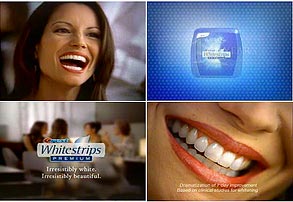
Not anymore. “Get twice the satisfaction in bed,” reads one of the print ads that Crest, the current leader of the movement, uses to promote its Night Effects, a nail-polish-like substance you apply to your teeth before turning out the lights. In another, a sultry blonde wearing what appear to be black panties lies in bed with a giddy, yes-I-just-got-some grin on her face. “Wake up with a whole new reason to smile,” we are told. In a TV spot for the company’s Whitestrips Premium — a kind of bleaching Band-Aid — we watch a foursome of women who look like “Sex and the City” extras have a lunchtime debate about why one of the gang looks so damn happy. “OK, who is he?” one demands, gazing haughtily at her friend as if she’s strolled into the restaurant bowlegged, it’s that obvious. “Trust me,” the grinning gal replies, “there’s no guy.” Her comrades are unfazed. “You’re in love,” another chimes in. “Look at that smile!” But, alas, a voiceover comes along to set things straight: “It’s not love — it’s new Crest Whitestrips Premium.”

Hell, if that’s the case, why hold back? Here’s an idea for future spots, free of charge: Crest Whitestrips Premium — the vibrator of oral hygiene!

A quick clarification: You may be picturing me typing this essay in a clay hut, my unibrow proudly furrowed, my current (unshaved) girlfriend asleep on the pile of hay next to me, her jaundiced teeth glinting in the morning light. For the record, I use Aquafresh whitening toothpaste because I like the glittery box it comes in, and I am all for combating the coffee and red wine that I have no plans of ever giving up — not to mention that I’m plenty aware women will find me more attractive if I don’t have yellow teeth. My concern here is that by making these products seem so sexy, and therefore so necessary (“Irresistibly white. Irresistibly beautiful” is Crest’s irresistible tagline) the companies have accidentally persuaded people to whiten their teeth as if whitening is an X-Games event, emancipating their enamel without noticing what’s happening to their faces.

More and more I find I’m staring at teeth that are chalky and plastic-y, like Tic Tacs. I’m accosted by smiles that could guide me on a spelunking mission. When such souls eat a poppy seed bagel, their teeth look like dice. In the most extreme cases (the art-opening woman, for example) such teeth have surpassed the whole spectrum of white — from nimbus to bone, pearl to opal — and have turned a shade off … blue. This is scary. All the more so when you realize that it’s becoming accepted as the way humans should look. To want to appear young and hot is perfectly understandable. To want to appear a bit like a movie star is slightly pathetic but, in this day and age, palatable enough. But to morph into a nation of possessed mutant anchormen and beauty pageant queens is flat-out freaky.

But I actually think this whiter-than-white trend is about something bigger than the sly Smurfification of our teeth; it’s about a new, discombobulating phase in our quest to “fight age” that extends far beyond our teeth. We are creating an archetype of beauty that’s not simply young, but younger than young. It’s the modern-day paradox: Never before have people looked so young and felt so old, and the impossible race toward the former is precisely what propels that latter. Comb through the tooth-whitening products, as I have, and you’ll see that what they have in common is their promise to reverse time. As a result, human smiles are mutating into something nonhuman: teeth that are whiter than they were on that virgin day long ago when they first poked through the gum line.

A confession: There was a reason I used the waxed-genitals metaphor earlier, and it was to hammer home this very point. So, without further ado, I ask you to please turn your attention back to my ex-girlfriend’s hairless crotch. Stand there in the dorm room with me. Hell, become me for a moment: a 17-year-old male who has waited an entire adolescence for this moment — a real woman presenting herself to me, naked and willing! — and what I get is a faux-sheepish, ersatz 11-year-old girl. Someone who has had pubic hair only for a few years, and already it’s dragging her down. She looks silly, sure, but I can’t lie. My attitude is: If this is how it’s gonna be, I’ll adjust. Soon enough, I’ll forget how weird it actually is…

OK. Now file that away and take another look at the Crest Whitestrips ad with the foursome of sassy women deconstructing what must be their friend’s lovemaking-induced glow. The product purports to “take off 14 years in 7 days.” Well, I ran these numbers by a team of mathematicians who informed me that, when applied to the woman in question — and, by extension, Crest’s target demographic, aka the entire human race — this means our radiant fox has acquired the “irresistible” smile of a … 14-year-old girl! What could be sexier? What grown man could say no? Of course she got laid!

I’m exaggerating — but only slightly. I don’t think the nice people who run Crest or any other such company are purposely subscribing to the Pederast’s School of Beauty. That said, something’s gone awry, and I have a tip for all you chronic tooth whiteners out there: Turn away from the big bright light. Have a cup of coffee or maybe a nice glass of red wine. Trust me, everything will be OK.

Continue Reading Close

Mike Ditka wants to help you score

TV ads for impotency drugs are targeting sports fans and beer drinkers, and they have a new message: If you're not taking a pill to help your sex life, you're not a real man.

  • more
    • All Share Services

Mike Ditka wants to help you score

Mike Ditka is staring me down, trying to intimidate me with his icy, unblinking blue eyes. The fleshy finger of his left hand is extended and aimed, pistol-like, directly at my face. The guy looks ruthless. Cruel. Downright menacing. Which is a little bizarre, actually, considering that Mike Ditka — one of the NFL’s most notorious badasses, a Pro Bowl tight end, a Super Bowl-winning head coach, a man whose very stare lets you know that he is The Man — is putting on this red-blooded act because he’s concerned about my penis.

All this, and I’m just sitting on the couch.

Here I am, watching TV, my programming interrupted by one of those ubiquitous commercials for Levitra, the erectile dysfunction (ED) drug for which Mike Ditka has recently become spokesman, lending his famously “smashmouth” persona to promote a product about as manly as Monistat 7. And there he is, Mr. Man, taunting me to “take the Levitra challenge,” chiding, “How tough can it be?” In other words: Mike Ditka is calling me a pussy because his penis doesn’t work and, well, he wants to know how mine’s doing.

And I’m so used to this that it takes a moment to register as strange.

Viagra may have just celebrated its sixth birthday, but it wasn’t until recently, starting this past football season, when Levitra, and then Cialis, made their national debuts that malfunctioning penises became truly embedded in the American ethos. If you’ve sat on your couch watching TV for longer than 10 minutes lately you know what I’m talking about: pitches for puttering penis cures assault you with the same commando-style aggressiveness as those for bullet-proof SUVs and babe-magnet beers. For instance: In Levitra’s Super Bowl ad, Ditka scoffs at baseball players, calling them chumps in comparison to football players who have the “toughness” required to “stay in the game.” Clearly this is a not-so-sly jab at Rafael Palmeiro, the Texas Rangers slugger and Viagra spokesman, but it’s certainly a strange dig when you think about it: Ditka is saying (follow me here) that he’s manly enough to be sensitive enough to admit that his penis doesn’t work well enough.

It’s kind of funny, yes.

It’s also audaciously brilliant marketing. The suits at GlaxoSmithKline, the pharmaceutical giant responsible for Levitra, are in a sense trying (with some success) to make impotency synonymous with virility: the perfect gimmick for a country whose sexual identity is so schizophrenic that we demand T&A from all TV programming yet get in a tizzy over a microsecond-long peek at Janet Jackson’s actual goods. The initial ads for Levitra were some of the most peculiar in memory: A guy who has the Marlboro Man’s rugged handsomeness and indeterminate age (maybe he’s 35, maybe 65) finds an old football in the shed, dusts it off, and tries to toss it through a tire swing. But … he hits the rim! Poor guy. Cue Levitra’s logo (a virile orange flame); cut quickly back to the man: Lo and behold, the ball is going through the hole like there’s no tomorrow! His girlfriend/wife comes out to join in the fun! What a babe! Can’t be older than 35! They put the ball through the hole together! Over and over and over …

As laughably literal as it was (a friend of mine joked that Levitra was for men whose penises always just miss locating their partner’s vaginas), the ad was effective in A) making its point without having to actually make its point (and therefore being able to avoid mentioning the disquieting possible side effects like dizziness, nausea and those rare four-hour-long erections); B) linking impotency with über-masculinity in the same manner the Marlboro Man did with smoking many moons ago; and C) making Levitra seem cool in a grisly, macho sort of way. “Our goal with that ad was to mobilize men to take action,” says Michael Fleming, director of product placement at GlaxoSmithKline, who claims that the spot caused a 36 percent spike in men asking their doctors about ED. Whether that’s true or not, one thing is certain: The ad was so effective that it seemed like the folks behind Cialis, the ED drug that lasts a whopping 36 hours, had no idea how to top it when they entered the fray in Levitra’s wake.

I mean, just look at the Cialis ad (flashing right now on my TV screen, only two minutes after Levitra’s!): A husband and wife — notice the ring — sit peacefully in separate old-fashioned bathtubs, perched atop a pristine country hill, touching hands, blissfully taking in the view. The viewer is asked, by an omniscient voice: “Are you ready?” Basically, Eli Lilly is attempting to market hot sex the same way Hallmark markets eternal love: gauzily, delicately, completely nonsensically. The two tubs are like a modernized version of the separate beds in which the ’50s sitcom couple sleeps. And what’s with the tubs, anyway?

When I pose this question to Carole Coupland, spokesperson for Eli Lilly, she first makes a point of saying that, no, the ads were in “no way” affected by Levitra’s machismo marketing strategy and that, no, Cialis has no plans for any “train-through-tunnel type stuff in the future.” Then she explains the logic of the commercial: “It wasn’t as if we hired any tub consultants, or anything like that. The tub was chosen because it was an arresting image, the kind of thing you see and think: Wow, I’d love to be there!” (Oh … OK. My only guess had been that Cialis had given this couple so much repeated pleasure — 36 hours! — without diminishing performance that they had to stick the old guy in a tub of ice to cool off.)

And yet: The fey little Cialis ad becomes almost as super-masculine as Levitra’s, thanks to the fact that during nearly every commercial break on nearly every major channel you can watch the two duking it out for some sort of ED Awareness Award (just imagine that trophy).

TV, especially sports TV, has up to now been a kind of last bastion of clichéd portrayals of masculinity. You saw that men liked beer. That men got lots of bleached, tweezed, halter-topped babes (often because men drink so much beer). And that men drove really big trucks (because, in part, they could hold lots of bleached, tweezed, halter-topped babes). It was an inane vortex, no doubt, but it was also a kind of absurd sanctuary where men could slump into the sofa cushions, do absolutely nothing, and still feel like masters of the universe.

Well, not anymore. When Viagra came on the scene ED still seemed like an embarrassing ailment, largely because Pfizer hired an old, cold guy like Bob Dole to spread the love. Now the onslaught of ED ads — and their fierce competition to one-up each other — has (accidentally) exposed a glaring truth that many of us liked to ignore while zoning out in our living rooms: Men drink too much beer. Sexual malfunction ensues. Hence the purchasing of automobiles to compensate for chronically flaccid penises. Which, well … just doesn’t quite do the trick.

The executives at Pfizer, GlaxoSmithKline, and Eli Lilly have (unwittingly) pulled off a vaguely feminist agenda: a national unearthing of male vulnerability, and not just among super-sensitive urban types; they’ve exposed the (literal) soft spots of those stoic dudes in the middle of the country as well. The toughest, most challenging men to reach when it comes to such persnickety issues are now ready to ask for help en masse. They’re admitting that, truth be told, they’re not the bedroom stallions they’ve been purporting to be.

Which is kind of endearing, actually.

It’s also important. The very fact that these ads are so omnipresent highlights a barely hidden subtext of their overall goal: These drugs are being marketed not only to those men who need them, but to those who merely want a little extra help in the erectile department, too. (I’m in my 20s, still shaking off my adolescent husk, and I’ll admit that I’m a bit curious about Levitra, if only because I developed a slight crush on the impotent guy’s girlfriend in the commercial; I’d be embarrassed to tell you this if I didn’t think that millions of others feel the same way — if I didn’t open up GQ magazine, which is these days aggressively targeting men my age, and see a “test drive” of both Cialis and Levitra.)

Of course, the companies won’t confess that they’re selling lifestyle drugs, but the whole trick is that they won’t ever need to. Zoloft, after all, entered the market as a drug for the clinically depressed, the sort of pill swallowed by your fragile friend who only listened to the Smiths and talked constantly about suicide — the kind of person (kidding aside) who really needed help. But then last year the drug was quietly approved by the FDA for treating “social anxiety disorder,” something that in earlier eras was diagnosed as “shyness” or “sadness,” and cured with a prescription of “you’ll get over it.” The term “erectile dysfunction,” meanwhile, is already malleable enough to apply to any penis that acts the slightest bit finicky (e.g. all penises). Zoloft is having enormous success for a simple reason: We humans are a pretty sad lot. Levitra, Cialis, and Viagra are now exposing something else: We humans have pretty tepid sex lives, too.

But is this really just because many of us American men can’t get it up anymore? Can it be that simple?

In some cases, yes, it is, and in those instances these drugs are truly wonderful. (I’m sure that if I’m not blessed with, say, Saul Bellow’s stamina in my twilight years, I’ll probably give one of these pills a go.) When Carole Coupland at Eli Lilly tells me that they interviewed “thousands of men and their partners,” with the goal of “helping them become spontaneous again,” I must say that I’m genuinely touched. At the same time, I can’t help but think these cases are the minority. Though it’s unlikely that a study will ever be conducted to support this, my theory is that the majority of men asking their doctors if a free trial is right for them are doing so, in large part, because of a more complicated reason: They’re stilted; they have no idea how to communicate what they really want in bed.

Men are a notoriously dense species, but one whose oafish exterior is offset by a jittery undercurrent of wants and needs just as fragile as you find in any female. So maybe what these ads and drugs are surreptitiously pointing out is just how few men really have a grasp on how to express this side of themselves and, with it, their true bedroom wishes.

I’m really not making such a leap here: We are a country where the unabashed force driving all mass media is the concept of sex, whereas anything hinting at actual sex is demonized. Hence the NC-17 rating given to Bernardo Bertolucci’s “The Dreamers” because the film shows a close-up of a (flaccid) penis, as if staring straight at that diabolical part of the body would cause untold damage to the same masses being inundated with ads promising turbocharged erections.

Simply stated: When it comes to sex, we are a masturbatory nation, far more comfortable being aroused by thinking about doing it than actually doing it.

Sex, as anyone who has done it knows, is a funny and awkward endeavor, and that’s part of what makes it such glorious fun: you feel vulnerable, sliced down the middle, all your pros and cons out on the table, saying: Take it or leave it (but please, please take it). The same way that all of us find ourselves depressed, the fact is that every man, to one degree or another, finds himself at odds with his penis over the course of a sexual life. (“At times the urge intrudes uninvited,” St. Augustine wrote during the third century A.D. “At other times, it deserts the panting lover, and, although desire blazes in the mind, the body is frigid.”) Maybe the cause is too much booze. Maybe it’s fear of wanting something sort of kinky from someone who seems sort of square. Maybe it’s being so emotionally overwhelmed that your physicality goes momentarily haywire. What the current onslaught of ED drugs overlooks is that the cause of the “problem” may be more important than the supposed solution, and that embracing, rather than shunning, our vulnerabilities may be as effective as popping pills.

But let’s be real: That’s an awfully sissy way to look at things, especially when Mike Ditka appears on my TV, yet again, telling me to stop being such a pansy, and to go out there and get a goddamn erection.

Continue Reading Close

Page 2 of 2 in David Amsden