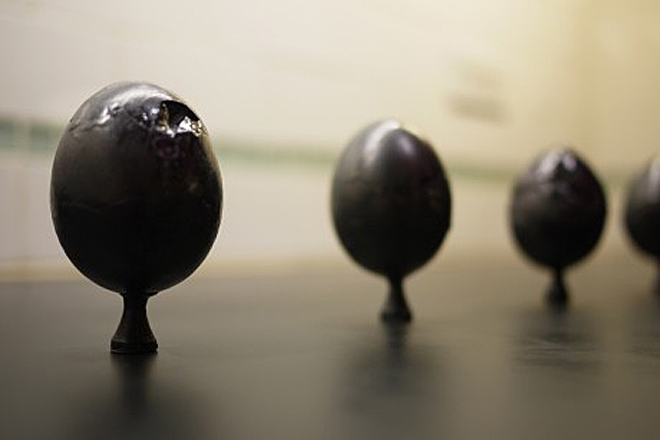
Using simple household objects, I began building something obsessively. Now, it all makes complete sense
It’s rare that I’m not at work on some sort of craft project. I’ve often enthused about the need to make things; how it employs a unique set of muscles — physical, intellectual, spiritual — that I can attain a state of flow when making something that I almost never can when writing. Much like those of an athletic bent who are constantly succumbing to, or having to resist, the impulse to turn everything into a ball (or so I assume. I have never been moved to use a ball even as a ball), if you make things, all objects house the potential to be turned into something else. They fairly beg to be turned into something else.
The eggs were something of a departure, given their utter uselessness. Actually, strike that. That insistence on functionality over aesthetics is something of a lie I tell myself, possibly homophobic in nature, or else it’s a penitential inoculation against my getting too big for my britches. If I stress utility, I will be less tempted to think of the visual stuff I make as “art,” and consequently of myself as a you-know-what, a label really only rightly conferred by others. I’ve certainly lost myself in making purely ornamental things before — lino cuts, paper cuts, snow globes, etc. — but I do get an extra lift if the finished product is practical to boot.
The most recent obsession just prior to the egg project was duct tape wallets, a perfect storm of pretty and pragmatic that lasted for a good few years. Virtually everyone I know received a duct tape wallet (or in a few rare cases — three to be exact — a duct tape evening clutch), rendered in multicolored Paul Smith-style stripes. (Check out TapeBrothers.com, which features an extraordinary selection, even my most-loathed pattern of all time after perhaps animal print anything: camouflage. But brace yourself for the hatred of your UPS guy; good duct tape is very heavy.)
The wallets got nicer and nicer, the craftsmanship ever more deft, and often there is sufficient gratification in that, but with each new billfold, I felt the pleasure of creation ebbing ever farther out. Until one day, like Chris Cooper’s orchid thief character in the movie “Adaptation” who, having exhausted his ichthyological jones to such an extent that it was expunged from his system with a final pescaphobic verdict of “fuck fish,” I knew that I could not, for the time being, bear to hear that whining protest from the sticky roll as I tore off another length of tape, no matter how pretty the color. So, no more wallets. They would take their place alongside the miniature Japanese folding screens, slide-top wooden boxes, and countless other crafting jags, never to be returned to, for the moment at least.
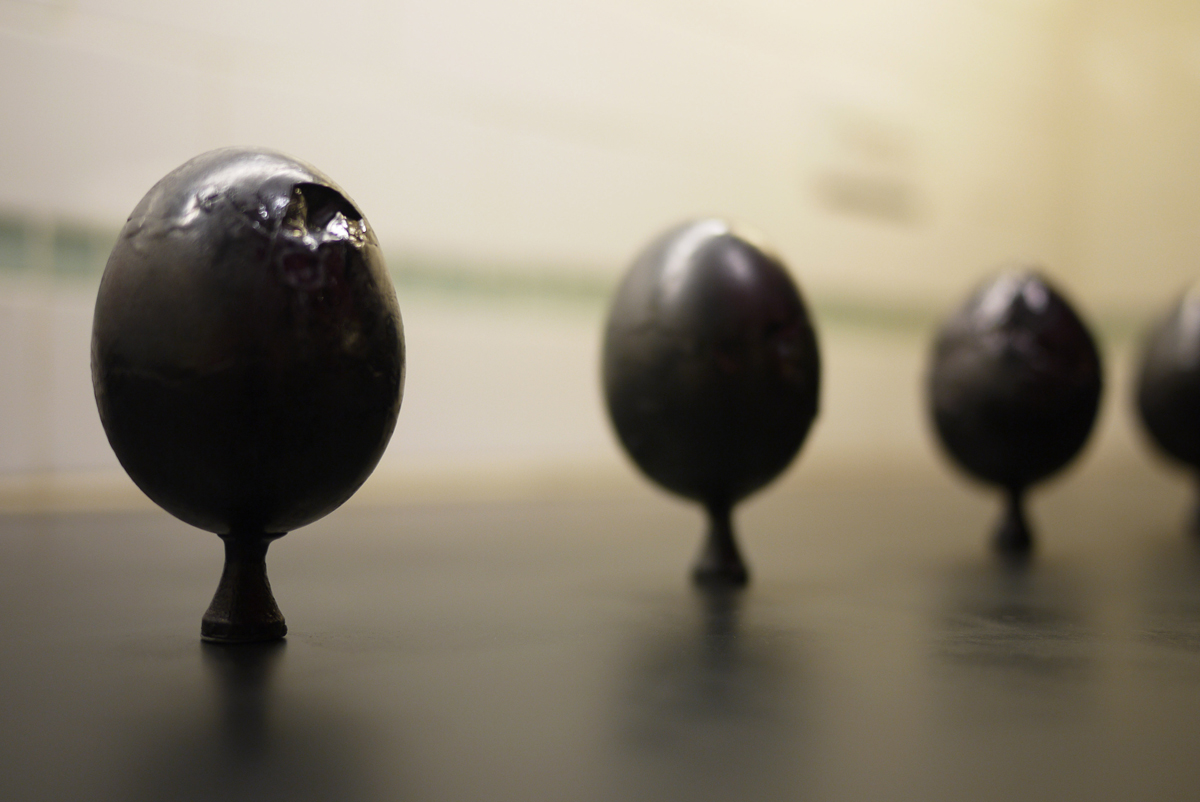
The fallow period never lasts long, though. I have let half-decades elapse between books, because books have to be written and writing is awful, but if you are the type of person who makes things, there is no profit in worrying about how or why or when the next project will come into being beyond simply acknowledging that it is inevitable that it will be very soon. In this particular instance, I was cooking something and thought, Why don’t I blow these eggs out instead of cracking them and then I can mount them on those golf tees? (Wooden golf tees, easily 500 in number, a failed promotion for a sports book at a day job I left over 12 years ago. I took them out of the publisher’s garbage and brought them home where they sat in a cupboard all these years, just waiting for the moment they would be needed. Needed for what? I never knew, only that their day would come and that I should resist the occasional desire to make some order in the apartment by throwing out a tin of 500 golf tees.) It really was as simple as that.
There was at least something gratifying in how, if they couldn’t be useful, they evidenced thrift; kitchen and office waste, both repurposed, coming together as a unified object. The eggs sank — their downward slide slowed by a bead of glue — and settled upon their small wooden pedestals with a satisfying stability, the way an arch actually derives strength from downward pressure. But the putty-brown eggshell and colored wooden tees were ugly. Happily, other corporate pilferings over the years meant I have a drawerful of good old-fashioned Sharpies. Now matte black, the egg sculptures’ chromatic sins were hidden, leaving behind the pristine and almost Brancusi-like elegance of their form.
After describing them to a sculptor friend, she showed up the next day with a small plastic container of powdered graphite and two solid Koh-i-Noor graphite sticks. “I thought it might make the surfaces more interesting.” She was right. Graphite is a marvelous material to work with; slippery and fine and deeply insinuating. The hematite-black powder worked its way into the pores of the shells, deepening and silvering the shell; the light and the dark occupying the same space like a photographic negative.
Now they looked forged, as heavy as iron doorstops. Another friend misjudged the weight of one — it is an empty egg — her hand ready for the heft of at least 5 pounds of metal against her palm. The thing went flying, breaking in pieces.
I was surprised by two things: One, that the inner membrane of the egg was still moist, and even warm, fully weeks after being emptied. Such enduring evidence of its animal past despite its mineral-looking present. Second, it was incredibly easy to repair. Actually, let’s make that three things: I was unprepared for the repaired egg, with its dings and divots and fissures, to be not just lovelier and more interesting-looking than its whole counterpart, but to evoke feelings of almost parental protectiveness and affection in me. My friend left, apologizing profusely. I impressed upon her repeatedly how little I minded, how truly OK it was.
When she was a safe distance from the apartment, I broke all the eggs.
The reassembly is slapdash, employing all manner of adhesives: Elmer’s, a stronger wood glue found in the cupboard, nail polish (the cheapest clear varnish purchased from a clearance bowl at the Duane Reade). There was one specimen I feared was irreparable, so uniquely smithereened was he in his table drop (despite their undeniable femalehood — they are ova, after all — I think of them as male, probably something to do with the gunmetal masculinity of their finish and the scrimmaging jostle required in their creation). He had to be triaged, reassembled shard by shard with tweezers and a fine-webbed ligature of hospital gauze, making him resemble one of the evil neighbor boy Sid’s chimerical monsters from the original “Toy Story” movie. He’s found a good home and is doing quite well by all accounts.
Calamity might be central to their creation, but the fact that I settled on the graphite eggs only proves that there are no accidents. These wounded soldiers are really the only logical things I could be making right now. In the last year-and-a-half, I have been in surgery four times, with more likely still to come. What choice do I have, really, than to mend, resurface and buff these marred specimens back to some sort of life, and to hope to see in their patched and valiant surfaces something like beauty?
Continue ReadingWhy “Br
Sacha Baron Cohen's character could have been a bold stab at homophobia. Instead it's a mincing minstrel show
Sacha Baron Cohen, star of "Bruno," arrives at the Los Angeles premiere of the film on June 25.
Even without a television, one could not avoid the ubiquity of the “Brüno” promotional machine. The months of planted news stories (like the fashion show disrupted by our Velcro-clad hero who stumbled onto the runway from backstage, dozens of pricey outfits stuck to him), his name with its saucy umlaut spray-painted everywhere, all pointing to the same thing: that “Brüno” would be a hilarious cultural corrective. Just like his predecessor, Borat, who exposed America’s vulgarity, ignorance and, more darkly, its entrenched anti-Semitism, Brüno would shine the light of truth on the last acceptable bigotry: homophobia. “Brüno” would be bracing and minty and somehow good for the gays for a variety of reasons.
First — in a reversal of the old principles of immunology where the merest hint of the antigen is introduced into the host body — this portrayal of an out, mincing, bubble-brained queen would be such a huge dose of gay, a veritable balloon drop of queer, that America would be inoculated; further, in an age where gay men and lesbians are clamoring to be seen as safe, hetero-normative, marriage-minded, child-rearing responsible citizens, it would be good to remember the adage that we are only as emancipated as the least among us, the most upsetting and problematic, and that Baron Cohen, in embodying an inexorably femme gay man who lives for sex and can’t even butch his way into a button-down collar, would be a perfect demonstration of that. Finally, I had hoped that here we’d have a character whose homosexuality would be just one strand of his essential self — along with his ignorance, narcissism and two-tone Zac Efron-last-week hair; a trait that is separable and easily teased-away. At long last, sexual inversion would take its place in the dustbin of history alongside other empty referenda on character such as red hair and left-handedness.
Alas.
Baron Cohen’s Brüno is a gay minstrel, in the most literal sense of the word. Just as the characters of the burnt-cork vaudevillians had, bound up ineluctably with their dark complexions, traits like being shiftless, lazy, and “a-feared of spooks” as their eyes bugged out in Neanderthal, superstitious terror, Brüno’s homosexuality comes bundled up with a lot of unattractive software. He is an open hydrant of empty, venal ignorance, a fame-chasing, grandiose fucktard, all because he is a cockaholic (his term). The repeated pistoning of sucking dick has scrambled his brains, just as surely as a muddler pulverizes mint leaves. Make no mistake: It is gay sex that has made Brüno stupid. Perez Hilton has the sobriety, moral rectitude and class of Lewis Lapham by comparison.
Unlike Borat’s evident naiveté, with his cheap suit and wide-eyed wonder at American plenty, unfamiliar with the felicities of monied, first-world civilization, Brüno, a successful Austrian talk-show host, cuts a figure of slippery, continental media-savviness. The power dynamic is completely reversed here. The obvious class differences between Brüno and his American subjects initially obliterate the sexual ones. It is, by now, a tired given that the presence of a camera has the taming effect of a curare dart, making people do things they would never normally agree to, but with the exception of brief interviews with Paula Abdul and Ron Paul (who really didn’t deserve this, if only for his having catalyzed the downfall of the vile Rudy Giuliani’s national political aspirations), most everyone else Brüno encounters is poor.
He interviews parents who are agenting their infant children for film work, asking them if their tots are comfortable working with dead or dying animals, mixing harsh chemicals, portraying Nazis … you get the picture. Later on in the film, there is a shot of a baby Jesus on the cross, with little tyke centurions milling around at the base. But it’s clearly been done with Photoshop. It’s insult upon injury to make people degrade themselves in theory, and then condemn them as if they’d actually done so in practice. Three men of demonstrably modest means in Alabama, their cheeks sunken with Appalachian want like Dust Bowl portraits, agree to take him hunting. Brüno, trying to pass, engages them in some enthusiastic banter about how much he loves “vah-ghee-nas.” The men look mildly amused, but again, they don’t take it and run with it. There is no trash-talking about women. Later that night by the fire, he relentlessly gender-fucks them, trying to liken the four of them to the “Sex and the City” girls. He compares the multitude of stars in the sky to how many hot guys there are in the world. This is followed by an excruciatingly long silence in which the men, humiliated and high-hatted, are unable to even look at one another.
Indeed, aside from Baron Cohen’s portrayal, the film is hearteningly scant in instances of overt homophobia. Brüno brushes past a group of “God Hates Fags” poster-toting crazies from Fred Phelps’ Westboro Baptist Church — lunatics infamous for being as vocal in their hatred of dead soldiers as sodomites, and more important, not there in response to him.
More often than not, people are merely mute with discomfort, politely waiting for the moments of childish provocation to pass. The Christian “therapist” who counsels men away from homosexuality, who it should be pointed out never once touts a “cure,” will not rise to the bait when Brüno tells him that he has perfect blow job lips. (It seems the height of perversion and merely an indication of how noxious the film that I should be defending an evangelical charlatan whose actions only increase the torment of already tortured gay men, but there you go.) A karate instructor demonstrates a series of evasive moves while Brüno is armed with dildos, teaching him how to avoid attacks from homosexuals. The instructor does his job gamely and with great dignity. The only victims in this joke are rape-minded, cock-drunk fags.
Even a crowd in Arkansas, having been lured to an arena with a chain-link-fenced boxing ring in the center; drunk, raucous, wearing concession T-shirts that read “My Asshole’s Just for Shitting,” don’t respond according to plan. Brüno, now posing as a mullet-wearing redneck named Straight Dave, whips the crowd into a Nascar-level frenzy about how happy they all are to be breeders (again, entirely personal professions of heterosexuality, no collective “Jew Down the Well” pronouncements against gays). Bringing an audience plant into the cage, they begin fighting, which in short order devolves into a clothes-stripping make-out session. Editing can only do so much, and while it is true that one drink and one chair are thrown, I would submit that this is standard operating procedure for such venues even when the spectators are completely satisfied. For the most part, after some raised eyebrows, dropped jaws and catcalling, the crowd leaves. And who can blame them? A theater full of queens come to hear Kristen Chenoweth would respond in much the same manner if the proceedings turned into a monster truck show. There is no larger cultural point to making someone flinch by giving them a chocolate truffle you’ve stuffed with anchovies.
The film is cringily thin broth, even as many will view Baron Cohen’s gay-face portrayal as a testament to his versatility as a performer. Such a performance by an out gay actor would have the opposite effect: It would be the final nail, confirming his essential uncastability. But no actual gay guy would ever have made this film. “Brüno” preaches a false emancipation. It’s Jerry Lewis playing Steve Biko. A shot of Snoop Dogg, mere seconds long, rapping in the film’s closing number — which includes Bono and Elton John — “He’s gay. He’s gay …” He shrugs. “OK,” does more to advance the cause than the previous, interminable 80 minutes.
If there is any comfort to take away from this it is that Baron Cohen exhibits a similar disconnect and misunderstanding about attitudes toward gay men as the government, since most polls show that Washington lags behind popular opinion when it comes to tolerance.
There will be those who will tell me to lighten up, and it’s not like I don’t want to. I really, really do. Brüno gets his anus bleached in the movie, whereas I don’t know if there is Clorox enough in the world to make me clean again.
Whatsizface
Two Beverly Hills plastic surgeons showed me the promise of a perfect face. So why am I keeping this shabby old one?
I am not a handsome man. All that means is that my face has never been my fortune. Luckily for me, it hasn’t been my punch line, either. I have some pretty eyes and, like everyone, I have my moments. I may even be thought attractive by those who love me, but that is emphatically not the same as the irrefutable mathematics of plane and placement that make for true beauty.
As a teenager reading “Death in Venice,” I understood the world to be divided between the Aschenbachs and the Tadzios. There are those who gaze, and those who are gazed upon. I am not talking about the natural inequity of attention that the old bestow upon the young — we are all hardwired to respond to babies, for example, but it would take the rare and deeply odd child to singsong to a grown-up, “Who’s got a cute receding hairline? Oh yes it is.” I am talking about within one’s own cohort: some are destined to promenade the Lido in Venice, blooming like flowers under the heat of appreciative stares, while the rest of us are born to watch, sweating through our grimy collars and eating our musty strawberries while the plague rolls in.
Inveterate Aschenbach that I have always been, we are at peace, my face and I, although it can be a tenuous cease-fire. A certain degree of dissatisfaction with my features is part of my cultural birthright. In my largely Jewish high school scores of girls got new noses for their birthdays, replacing their fantastic Litvak schnozes with “the Mindy,” as Paul Rudnick has dubbed that shiny-skinned, characterless lump. Despite the prevalence and remarkable timing of these operations, coinciding as they so often did with upcoming Sweet Sixteens, they were always framed as life-or-death necessities — emergency procedures to repair lethally deviated septa and restore imperiled breathing. Even then, we knew enough to lie. Elective cosmetic surgery was the province of the irretrievably shallow. It was also a largely female pursuit. For most boys, failing the unlikely scenario wherein you infiltrated the mob, turned state’s evidence, and got a new set of features thanks to the good doctors at the witness protection program, your face was an irreducible fact.
Still, without benefit of a mirror I can easily reel off all of the things I might change, given the opportunity. Starting at the top, they include a permanent red spot on the left side of my forehead; a brow pleated by worry: a furrow between my eyebrows so deep that at times it could be a coin slot; purple hollows underneath my eyes that I’ve had since infancy, and, also since childhood, lines like surveyors marks on my cheeks — placeholders for the inevitable eye bags I will have; a nose more fleshy and wide than prototypically Semitic, graced with a bouquet of tiny gin blossoms resulting from years of using neither sunscreen nor moisturizer; a set of those Fred Flintstone nasal creases down to the corners of my mouth; a permanent acne scar on my right cheek; a plank-like expanse of filtrum between the bottom of my nose and the top of my too-thin upper lip; and, in profile, a double chin.
None of which is really a problem in New York City. Being a little goofy looking suits the supposed literary life-of-the-mind I lead here. (What a paper-thin lie. There are days when I’d throw out every book I own for the chance to be beautiful just once. Reading is hard, to paraphrase that discontinued Barbie.) Seriously contemplating the erasure or repair of any of these is inconceivable within the city limits. It’s too small a town. There is a place, though, where the sunny notion of physical perfection and its achievement by any means necessary is carried unashamedly on the smoggy, orange-scented air: swimming pools, movie stars. Cue the banjo music.
- – - – - – - – - – - -
I make consultations with two Beverly Hills surgeons. I want them to tell me what they might do, as though I had limitless inclination and resources, with no input from me. The reason for my silence is that I’d like outside confirmation of those things that are true flaws and those that are dysmorphic delusions on my part. There is also the vain hope that it is all dysmorphic delusion. That if I fail to bring it to their attention, somehow it will turn out that I’ve had the nose of a Greek statue all along. Primarily, though, I am hoping to catch them out in a moment of unchecked avarice; instead of proposing the unnecessary pinning back of my ears, I imagine them letting slip with their true purpose, as in, “I recommend the Italian ceramic backsplashes in my country house kitchen.” Or “You’d look much better if my toxic punishing bitch of an ex-wife didn’t insist on sending our eight-year-old daughter, Caitlin, to riding lessons in Malibu for $300 an hour.”
- – - – - – - – - – - -
Garth Fisher’s practice is decorated with a grandeur disproportionate to the space, like a studio apartment tricked out with pieces from the set of “Intolerance.” The waiting area has overstuffed sofas, a small flat-screen TV in the corner, tasseled wall sconces, and a domed oculus in the low ceiling, painted with clouds. Fisher’s office is full of bulky antique furniture in dark wood with turned legs, armoires, walnut bookcases. Behind his desk are many photographs of his wife, Brooke Burke, a model and television personality. Were I differently placed on the Kinsey scale, I might even pronounce her “hot,” dropping my voice an octave and adding an extra syllable to the word. She is a near-perfect beauty.
Fisher himself is also nice-looking, a handsome man in his early forties. Blue-eyed and chestnut-haired, he has a bit of the early-seventies Aqua Velva hunk about him. I ask him, looking directly at the enviable cleft in his chin, if he’s had any work done himself. Very little. A tiny bit of botox between his brows and some veneers on his teeth. He also had his nose done, to correct some football injuries. To my dismay, he is similarly conservative in his approach to others. Of the eight potential patients he saw that day, he refused to take on seven of them. Some were not candidates while others had unreasonable expectations about what plastic surgery can realistically do, even now.
“This is the Dark Ages. This is like 1904,” he says. Future generations will be amazed by the inevitable advances, he predicts. For now he is more than willing to allow other doctors to use their patient populations as the guinea pigs for new and experimental treatments. He has not done a penile augmentation, for example (“scary business”), neither does he offer those silicone pectoral or calf implants.
“I want a simple life. All I’ve got to do is do a good job and tell the truth.”
The only reason he agrees to give me unsolicited advice is that he knows I am a writer (indeed, the only way I could get an appointment with two top Beverly Hills plastic surgeons is that they know I am a writer). He remains notably uncomfortable with the charade. “If someone comes in here like this,” he pulls his ears out from his head like Dumbo, “and all they want fixed is the mole on their chin, then that’s all I’m going to mention.” Assured of my thick skin, he eventually allows as how he might “clean some things up” that steal focus from my eyes.
We go into an examining room where he keeps his computer simulator. The process begins with taking two photographs — the “befores.” I look the way I always do, but it’s embarrassing to see myself up on the monitor with another person sitting there. My profile looks careworn, simultaneously bald and hairy. My eyes are sunk into craters of liver-colored flesh, and my ear is a greasy nautilus, as if I’d just come from listening to a deep-fat fryer.
Fisher demonstrates his morphing tool by drawing a circle around my chin with the mouse. Pulling the cursor, he extends my jaw out like a croissant. It is a fabulous toy. I want to wrest the mouse from his control and really go to town, giving myself fleshy horns, pointy corkscrew ears. If he would only let me, I would pull out the flanges of my nostrils until they looked like the wings of Eero Saarinen’s TWA terminal at JFK. “But your chin is perfect,” he says, snapping it and me back to reality. “Three millimeters behind your bottom lip.” Instead, he points out how the end of my nose droops down to the floor, while the arch of my nostrils is very high. (I write “too high” in my notebook before realizing that these are my words, not his.) He raises the tip, lowers my nostrils, and then straightens out the slope of the nose itself. It is subtle and aquiline. He then smoothes out the area under my eyes. In real life this would involve the removal of some fat and tightening up the skin. Finally, he points to the small vertical indentation between my brows, just like the one he had before botox. He recommends a small amount of the neurotoxin, just enough to smooth it out without robbing me of my capacity to emote. Of all the features that render me less than perfect, I’ve actually always sort of been attached to those that lend me an air of gravitas, covering up my shortcomings of character and intellect. I ask if it’s all right to leave it as is. “Well,” he shrugs, “it’s okay if you’re playing a lawyer or a judge.” Instead, I get him to give me a slight Mick Jagger moue. “I don’t like those lips, but I’ll let you have them.” He plumps up my mouth.
The photographs are printed out, the two images side by side against a dark background with no discernible seam between them. I am a set of twins. My original self seems a melancholic killjoy. His reengineered brother, on the other hand, looks clean and a little haughty. And how about that marvelous new nose! Pointy, sharp, a weapon. Despite that old stereotype about Jewish intellectual superiority, I think I appear cleverer as well (“perspicacious,” as my ethnically cleansed self might say). Fisher’s instinct about my new mouth was also right on the money. It gives me the beginnings of a snarl, like I’ve wedged a handful of Tic Tacs in front of my upper teeth.
But even my misbegotten new upper lip cannot dampen my spirits. I step out into the beautiful California dusk to catch a cab with a spring in my step. I’m feeling handsome, as though Fisher’s changes were already manifest on my face and not just in the envelope of photographs I clutch. Reality soon sets in. The sidewalk of Santa Monica Boulevard simply ends without warning and I have to dart, terrified, across four lanes of traffic. I cannot find a taxi on the deserted leafy streets of Beverly Hills, and I have to walk all the way back to my hotel. “Good evening,” the beautiful young doorman says to me when I arrive, an hour and a half later. He smiles in my direction, but his eyes are looking just above my left ear.
Studying the photographs the next morning, I am already experiencing some misgivings. It is not the regret of “What have I done?” that dogs me so much as a feeling that I want more. I briefly curse Garth Fisher’s innate professionalism and hope that Richard Ellenbogen, my next surgeon, will not hang back and keep me from achieving my true physical glory.
If his office is any indication, I’m in luck. Where Fisher’s was the McMansion version of the baths at Pompeii, Richard Ellenbogen’s Sunset Boulevard practice (hard by the Hamburger Hamlet where Dean Martin ate every day) defies easy aesthetic description. It is an astonishment of styles and motifs. The reception desk is framed by two arching female figureheads as might be found on the prow of a Spanish galleon. The walls of the waiting room are peach plaster set with Tudor timbers. There is an ornamental brick fireplace in the corner, sofas in floral chintz, and everywhere, absolutely everywhere –on the mantel, along the plate rail (hung with swags of floral chintz bunting) — are ormolu clocks, Bakelite and old wooden radios, commemorative plates, lamps and small sculptures of those young, barely pubescent deco-era girls, the kind who festoon old movie-palace plaster and frequently hold aloft globe lights. All of it in under 150 square feet.
There is a benevolence to this crowded exuberance; one’s own physical flaws shrink to nothing in the midst of such riotous excess. The staff is friendly and funny. “Here to get your breasts done?” cracks one woman when she sees me. Another confides, “Sometimes he,” meaning Ellenbogen, “will just say to a patient, ‘You don’t need this. Buy a new dress and save your money.’ We love our patients.”
Ellenbogen is known for fat grafting and facial reshaping. Instead of pulling and tightening a face, he replaces the fat in the areas that used to be fuller, before aging and gravity did their work. For a patient in their mid-fifties, for example, he will analyze a photograph of them at half that age and isolate the facial regions in need of filling. The patients I look at in his albums do seem juicy, for lack of a better word, although the result looks not so much younger as vegetal. They look like Arcimboldo paintings, those Renaissance portraits constructed entirely out of fruit. To give them their due, they don’t look like drum-tight gorgons, either. In folder after folder, I do not come across even one of those monstrous surgerized analogues of Joan Rivers. Where are those faces, I wonder aloud to Ellenbogen?
“We call that the New York look,” he says. Apparently, there is less need for that kind of wholesale renovation in Los Angeles, where Hollywood hopefuls have been a self-selecting group for almost a century. “People are prettier here. It’s now the children and grandchildren of Sandra Dee. In New York, you’ve still got all those great Jewish immigrant faces.” Ellenbogen is allowed to say this, possessed of one as he is himself. (He’s had some botox, his neck done, and lipo on his love handles, although he still supports a somewhat cantilevered belly as befits a man of sixty.)
He doesn’t do computer imaging. “It’s hokey. It’s used by people who aren’t artists. It’s not a true representation of what a surgeon can actually do. It’s like a real estate agent saying, ‘This would be such an incredible view if you just planted some trees here and put in a garden…’ ” Instead, he takes two Polaroids and, using a small brush, mixes together unbleached titanium and burnt umber and paints the changes on one of them. Like Fisher, even with carte blanche, Ellenbogen only envisions minor treatments. Again with the straightening of the nose and raising the tip (one hour), he would also build out my chin a little bit, using a narrow curving strip of milky white silicone — like something from the toe of a high-end running shoe — fed down through the mouth behind the lower lip (ten minutes), and a final procedure (fifteen minutes) in which he would inject fat into my extremely deep nasojugal folds, those tear troughs under my eyes. (Garth Fisher is not a fan of re-grafting. “You’d love your doctor for six months,” and no longer, he implies.) Total cost, around $12,000.
There is nothing so intimately known as our own face. Even the most deprived existence provides opportunities to gaze into a reflective surface now and then — puddles of standing water, soup spoons, the sides of toasters. We know what pleases us, and also have a fairly good sense of what we would change if we could. Sometimes, though, we just get it plain wrong. Ellenbogen shows me a photo of a young man in his twenties; a pale, strawberry blond with the kind of meek profile that gets shoved into lockers. “This kid came in and wanted me to fix his nose. ‘It’s too big!’ he said. I told him, ‘It’s not your nose. I’ll prove it to you. I’ll build out your chin. If you don’t like it, I’ll take it out and do your nose for free.’ ” Ellenbogen was right. The merest moving forward of the jaw has made the nose recede. The change is remarkable.
The fellow may have been focusing on the wrong feature, but at least he wanted something. There is a reason that both Fisher and Ellenbogen were so reluctant to suggest procedures to me. An unspecified and overarching desire for change speaks to a dissatisfaction probably better served by a psychiatrist. One surgeon I spoke to will not treat people in their first year of widowhood for just that reason. To briefly rant about “The Swan,” the television show that takes depressed female contestants — all of whom seem to need little more than to change out of their sweat suits and get some therapy — and makes them all over to look like the same trannie hooker: what makes “The Swan” truly vile is that for the months that these women are being carved up like so much processed poultry, all of the mirrors in their lives are covered over. Such willing abrogation of any say or agency in how they will be transformed by definition means that in the real world, they would not be candidates for surgery. It is the very sleaziest of all the plastic-surgery makeover shows — quite a distinction, that; like being voted the Osbourne child with the fewest interests.
Garth Fisher, in what might be considered an unconscious act of penance for contributing to the culture in which something like “The Swan” can exist (he is the in-house surgeon for the comparatively classier “Extreme Makeover”), has created a five-hour DVD series called “The Naked Truth About Plastic Surgery.” Each hour-long disk is devoted to a different procedure and region of the body — breast augmentation, brow lifts, etc.
In spirit, “The Naked Truth” is more educational tool than sales pitch. It is refreshingly up front about the complications that can arise, like bad scarring, hematoma, numbness, pigment irregularities, infection, skin loss, even embolism and death. In the liposuction section, there is a shot of Fisher in the operating room. The backs of the patient’s legs are shiny brown from the pre-surgical iodine wash, and crisscrossed with felt-tip marker. Fisher is sawing away under the shuddering skin with the cannula, a tool resembling a sharp, narrow pennywhistle attached to a hose. There is a savagery to his movements, the way one might angrily go back and forth over a particularly tenacious piece of lint with a vacuum cleaner. He looks up at the camera, his arm going the whole time. Although wearing a mask, his eyes crinkle in an unmistakable “Well, hello there!” smile.
There are shots of clear plastic containers of extracted fat — frothy, orange-yellow foam floating atop a layer of dark blood — and pictures of postoperative faces looking like Marlon Brando after he’s been worked over in “On the Waterfront.” Such footage might have once had a deterrent effect but is now familiar to any toddler who has ever been parked in front of The Learning Channel. That these images have to be followed up by the cautionary tone of a narrator who says, “just because something can be done does not mean it should be done” and “if you can reach your goal without surgery, then you are better off,” speaks to how far down the rabbit hole we’ve tumbled. It’s as if the whole country regularly watched newsreel footage of buses full of children going off of cliffs and was still blithely picking up the phone to make bookings with Greyhound.
I might be more apt to drink the Kool-Aid if I was more impressed by the results. The before and after photos of liposuction, for example, do show a reduction in volume. But if I were to endure the risks of general anesthetic, the pain, the constriction garment that must be worn like a sausage casing for weeks after the surgery, and the months-long wait for final results, I wouldn’t just want a flatter stomach with no trace of love handles. I would insist upon the tortoiseshell reticulation of a six-pack, that abdominal Holy Grail. That’s hard to achieve with liposuction. There is a procedure that replicates the look, called “etching,” where the coveted tic-tac-toe pattern is suctioned out of the adipose tissue, giving the appearance of musculature with no muscles present; morphology absent of structure, like the false bones in McDonald’s creepy McRib sandwich. Garth Fisher doesn’t recommend or offer it. Gain weight, he points out, and the artificially differentiated lobes of your fat expand and rise from your stomach like a pan of buttermilk biscuits.
- – - – - – - – - – - -
In the end, it is neither thrift nor fear of the knife that deters me. Far more than the physical transformation, it would be the very decision to go ahead with it that would render me unrecognizable to myself.
I once bleached my hair almost to platinum for a part in a short film. It lent me a certain Teutonic unapproachability, which I liked. But as it grew out, it faded to an acid, Marshmallow Peep yellow and my head started to look like a drugstore Easter-promotion window. Dark roots and straw-dry hair look fine on a college kid experimenting with peroxide, but I looked like a man of a certain age with a bad dye job clutching at his fleeting youth with bloody fingernails. I could see pity in the faces of strangers who passed me on the street. Mutton dressed as lamb, they were thinking. To all the world, I was the guy who broadcasts that heartbreaking and ambivalent directive: “Look at me, but for the reasons you used to!”
It must be murder to be an aging beauty, a former Tadzio, to see your future as an ignored spectator rushing up to meet you like the hard pavement. What a small sip of gall to be able to time with each passing year the ever-shorter interval in which someone’s eyes focus upon you. And then shift away.
From: “Don’t Get Too Comfortable” by David Rakoff. Copyright )2005 by David Rakoff. Posted by arrangement with Doubleday, a division of Random House, Inc..
The love that dare not squeak its name
Even as a child I suspected I had something special in common with Stuart Little.
Had E.B. White written his children’s classic “Stuart Little” today, he would have a hard time portraying Stuart, the second child of Mrs. Frederick C. Little of New York City — a child who was “not much bigger than a mouse” and who also “looked very much like a mouse in every way” — as anything other than some freakish monster. That’s precisely why the current film adaptation shows Stuart being adopted, rather than being born. In this post-”Alien” age, examining too closely how a boy like Stuart might be made by human parents immediately brings to mind images of a tiny, hairless rodent slithering horribly from his mother’s loins with a viscous plop.
But White wrote “Stuart Little” in 1945, when the biological process was shrouded in anaesthetized mystery. For those who were neither obstetricians nor women, childbirth must have seemed little more than checking into the hospital and, after three weeks of bed rest, emerging with offspring.
And Stuart is certainly no monster in White’s vision. He is very much the Littles’ flesh and blood — ultimately a human child, albeit one with “the pleasant shy manner of a mouse.” But, phenotype will out, and we are told that “before he was many days old he was not only looking like a mouse but acting like one, too — wearing a gray hat and carrying a small cane.”
At age 7, having the book read to me in second grade by the sainted Mrs. Brailey, it was this initial confluence of traits — Stuart’s unquestioned membership in a family despite one glaring material difference from them and his tinyness only accentuating his courtly manners and dandy tendencies — that made me realize that I was somewhat like Stuart and that Stuart seemed, somewhat like myself, pretty gay.
This is not to say that Stuart Little necessarily sought the embraces of other boy mice. But had White, even in 1945, placed Stuart in his worsted blue suit with patch pockets anywhere near a schoolyard (there is an episode where he actually teaches school, but more on that later), Stuart would have learned conclusively from his human peers that he was, at the very least, a big fag, a sissy, a ‘mo and a poof.
Nor do I mean to claim the fine feeling and higher sentiment embodied by Stuart’s rarefaction as the exclusive province of the gays. Heaven knows that we inverts contain within our ranks many who have no manners to speak of, either shy or pleasant. And certainly a gray felt hat and cane are not necessarily gay props.
But props in and of themselves are an integral part of a gay childhood, with its vigilance against exposure, its years of passing. As a gay child, your life essentially consists of writing checks your ass can’t cover. The two remedies to this problem are either stepping back and remaining more an observer than a full-on, good faith participant, or going in for more performative behavior (during more judgmental times, we used to call this second option “living a lie”) until such time as one can move to New York.
Stuart’s very mouse-ness — indeed, at just over 2 inches tall, his intrinsic lack when push comes to shove — means that he must rely on props and costume throughout the book, if only to face the exigencies of negotiating a human-sized (and human-faced) world. His use of visual aids hardly makes him a closet-mouse. Quite the contrary.
As part of Stuart’s quest for human straight-boy realness, White unwittingly has him repeatedly embodying gay stereotypes. And Stuart does so with the exactitude and heightened attention to detail of the drag artist, right down to the cinematic lexicon of each new scenario. Stuart has the patois down pat.
Donning his sailor suit one fine morning, Stuart sets out for Central Park. Boarding the Fifth Avenue bus, he tries to pay with one of the small tin foil coins made for him by his father. The conductor is understandably patronizing.
“Well, I’d have a fine time explaining that to the bus company. Why, you’re no bigger than a dime yourself.”“Yes I am,” replied Stuart angrily. “I’m more than twice as big as a dime … Furthermore … I didn’t come on this bus to be insulted.”
“You’ll have to forgive me, for I had no idea that in all the world there was such a small sailor.”
“Live and learn,” muttered Stuart tartly, putting his change purse back in his pocket.
A thoroughly modern Stuart might just as easily have appended a withering “Mary” to the end of that riposte.
He butches it up considerably by the time he reaches the boat pond, where he asks the owner of a toy sloop, the Wasp (what a fitting name for the vessel on which to earn some measure of societal acceptability) to sign him on for a position as a crewman on deck.
“I’m strong and I’m quick.”“Are you sober?”‘ asked the owner of the Wasp.
“I do my work,” said Stuart, crisply.”
Like that first highly encoded meeting of Glenn Ford and George Macready in “Gilda,” or Paul Cadmus’ paintings of shore leave, there’s an almost pornographic quality to this waterside transaction; the young matelote brusque cataloging of his physical prowess to the older gentleman. Even the clipped manner of the exchange, the grudging half-disclosure, has something of the Genet rough trade encounter about it: Stuart of Brest.
White does give Stuart a love interest. A small, wren-like bird named Margalo who stops briefly in the Little household. And Stuart’s devotion is ardent to be sure, but not precisely romantic. It is closer in nature to Janet Reno’s self-admitted “abiding fondness for men”: somewhat theoretical and confusing. I’m not advocating that Stuart prove himself by engaging in a little hetero-normative trans-species loving; it is, after all, still a children’s book. But even within that chaste context, Stuart is only playing at lover, as he plays at everything.
He is unable to resist stepping back in commentary, even as he is saving Margalo from the jaws of Snowbell, the Littles’ cat. He grooves on the theatrics of the situation, casting himself in the Sidney Carton role: “‘This is the finest thing I have ever done,’ thought Stuart.” But feelings of devotion and protective nobility are not love. Almost every gay boy I know had that awkward adolescent moment when he made his very close female friend doubt her own desirability because he displayed no interest in jumping her bones, even as he himself was thinking, “Well, lip-synching into hairbrushes to the Supremes in her bedroom … this is really romantic … right?”
Margalo eventually flies from the Little home, possibly tired of waiting around fruitlessly for a little action (the official White version being that the feline peril in the house has become too great). Stuart takes to the open road, ostensibly to find her and make her his own, although he doesn’t entirely commit to the he(te)roism of that romantic quest, either. “While I’m about it, I might as well seek my fortune, too,” he muses. It’s a little bit like resignedly hoping that there might be some cute guys at your engagement party.
It is during these travels that Stuart volunteers to substitute teach at the one-room schoolhouse in a small town. It is perhaps his finest drag performance. As proof of his qualifications for the job, Stuart disappears into the bushes and emerges in striped trousers, a tweed jacket with waistcoat, and a pince-nez. There would be no epithets hurled by the schoolyard boys at his current incarnation.
Stuart has transformed himself into a forbidding yet ultimately kind, highly cultivated pedagogue. The children are rapt by his cunning size, his stern air of authority and his common touch in talking to them on their own level about deep ethical questions. The subject turns to stealing and he has one of the boys steal a small sachet pillow from one of the girls. When the discussion is over, Stuart turns his attention to the pillow, which attracts him; it might make a lovely, fragrant bed.
“That’s a very pretty thing,” said Stuart, trying to hide his eagerness. “You don’t want to sell it, do you?”“Oh, no,” replied Katherine. “It was a present to me.”
“I suppose it was given you by some boy you met at Lake Hopatcong last summer and it reminds you of him,” he said to her, dreamily.
“Yes, it was,” said Katherine, blushing.
“Ah,” said Stuart. “Summers are wonderful, aren’t they, Katherine?”
Everything but breaking out into a rendition of “September Song” by Kurt Weill. Who is this old queen, suffused with nostalgic yearning? Stuart is still only about 7 and a half years old at this point, but here he is, suddenly transformed into Mann’s Aschenbach, an aging roui, his summers of love and beauty all far behind him now, watching the epiceine young Tadzio on the Venice Lido as the plague creeps in.
White gives Stuart one last crack at romance. As he passes through yet another town, a shopkeeper tells Stuart there is someone he should meet — a human girl just his size. Like Edward Everett Horton the ur-Confirmed Bachelor, Stuart doesn’t even feign interest anymore. “What’s she like … Fair, fat, and forty?” he cracks.
But he does agree to meet the tiny Miss Harriet Ames. He purchases a small birch bark canoe, he prepares a picnic. He runs over and over again the details of their assignation, how they will paddle to a lily pad, what swim trunks he will wear, etc. At almost no point in his fantasy does Harriet make much of an appearance. When their date finally arrives and some large, rude boys have laid waste to his toy canoe, he is disconsolate and cannot continue with the charade. Design Queen Stuart has taken control.
Harriet suggests they try to have a nice time just the same. “We could pretend we’re fishing.” she gamely suggests. “‘I don’t want to pretend I’m fishing,’ cried Stuart, desperately. ‘Besides, look at that mud! Look at it!’ He was screaming now.” The aesthetics of the date — the true locus of his fixation — have been ruined, the amorous simulacrum has been destroyed. I don’t speak with anything resembling personal experience, but surely a damaged canoe should not be enough to ruin a lovely summer night by a river with a willing young woman by one’s side. If anything, it sounds like the aquatic equivalent of that old saw, “Looks like we’re out of gas (heh heh).”
Stuart once more lights out for the territories, again putatively to find Margalo. Even White understands by now that this is probably not a phase. Certain things might just not be in the tiny cards for some. And it was Stuart who taught me, in no small part, that this would be fine, too. Sitting on that classroom floor, legs crossed, I realized that I, like Stuart, might one day hope to walk down a big city street, a little mouse among many, “full of the joy of life and the fear of dogs.”
The Writer's Life
A titan of American letters reflects on his timeless art and the sacrifices it exacts.
Behold the Writer on Writing. Oh, how that very question — How does the writer write? — rings in my ears, unasked but clearly etched across the eager faces of the steady stream of hopeful young acolytes who make the long trip up here to my little outpost in the country. “Please,” they seem to beseech, “what alchemy, what ethereal fire transforms our wordy soup of glottals and fricatives into language and that language into writing … your writing, Mr. Rakoff?” Why even attempt an answer when so few truly agree what constitutes writing? Surely, the act is not merely confined to those moments, all too rare sadly, when pen is taken in hand, digit raps against typewriter key or, in my case, when I speak into this cunning little recorder or dictate aloud to Caitlin, amanuensis in excelsis extraordinaria, whom I plucked lo these many years ago from that fiction colloquium at the New School. [CAITLIN: REMIND REMIND REMIND ME ABOUT THE BLURB FOR TOBY WOLFF. DO NOT LEAVE THE HOUSE THIS EVENING WITHOUT MAKING ME COME UP WITH SOMETHING!]
All is Writing, I tell them. And, of course, Writing is All, I tell them, as well. For me the “writing” of my day begins the very instant I open my eyes, even before perhaps, when I sleepily hear my wife Jane, pathological early riser that she is, get up to dress and start breakfast. A writer’s cortex kicks into gear even then. On cold mornings, that calming interval of staying warm among the labial folds of my eiderdown, mesmerized by the whorls of frost upon the windowpane by the bed — the only sounds being the hiss of the wood-burning stove in the kitchen and the regular whack! whack! of Jane as she chops more wood outside — that, too, is writing. Don’t let anyone tell you different.
I tend to write best with a little privation, a numinous absence, a lack to push my thoughts forward: that hour of growing hunger before Jane fixes lunch; a brief period last summer when Celia, our youngest, shut the piano cover down on Caitlin’s fingers and I was forced to bang out an entire chapter myself on the old Royal; during the frozen-earthed silence of winter. Especially during winter.
Luckily for me, winter comes early to these parts. Autumn’s end is signaled by the grackles, those cacophonous weird sisters, those ludic brigands, their greasy black pin feathers brilliantined in the sunlight like the multi-hued spumy plume upon an oily puddle, laying waste to the damson plum in the yard. (Once, sitting in my Nakashima chair in my study, I watched for hours as Jane tried to wrap the oft-stripped fruit tree in meter upon meter of protective plastic sheeting. How many times did she fall from the ladder in her efforts that day? Strange the details that evade memory. And all to no avail. The birds still, like robber bridegrooms, absconded happily with the small, stone-hard purple hearts.) Not six short weeks thereafter, do the clouds come scudding across the low mountains to the North carrying with them the cold winds and the immense hibernative quiet. A little hardship: so good for the writer.
Above all, the writer must write for himself. Accolades and external laurels can be lovely but prove wanting in the end if the inner yearning to write (and write and write) is lacking. No sooner had we moved up here than, for example, Jane — talk of her National Book Award nomination for poetry and the attendant vicious gossip about the jealousies of the two-artist couple still buzzing on the carrion-glazed lips of that pack of vultures we call the literary establishment — stopped writing almost entirely. I always wondered at her much-professed time constraints. Was it a flagging desire, perhaps? After all, I often tell her, writers write.
O larkspur! O hawthorn!
Just as Meg Ryan, in “You’ve Got Mail,” waxes panegyric about “bouquets of pencils,” [CAITLIN: HAVE I THANKED NORA FOR THE AMARYLLIS? LET'S DO A NOTE SOONEST IF NOT] so I, too, even though I have not used a pencil in years, will spend a meditative hour arranging my bouquet. This, too, is writing: Red blue yellow yellow blue green yellow blue; yellow blue yellow green blue blue red yellow; yellow green blue blue blue red yellow yellow, I go on and on only to look up hours later to find the sky fading into indigo, the pale column of smoke rising from the wood fire Jane has lit under the washbasin out back.
The noxious, detergent fumes of the machine-bruised garment choke me and keep me from my work. I sneeze and become rheumy-eyed and quite sullen and I am not a man given to truculence. Give me the elemental, tidal smell of the clothesline, the fragrance of sun, of hands lovingly snapping a garment in the breeze to pendulously sway on the line and then suddenly, gloriously, the wind rushes in, a momentary presence in the shirt, a Woman of Air puffing out that dress. What visiting soul, what shade? My muse, perhaps?
But the breeze filling the clothes on the line is colder these days as they grow ever shorter. Jane’s hands will be red and raw from the effort. No matter, supper can wait. Perhaps I shall rise from my desk early and make Jane a cup of tea! Ah, the too-giving writer is the doomed writer. My curse, alas.
I look down at my pencils. Those steadfast wooden soldiers. There is no judgment in them. “Go,” they say. “There shall be work tomorrow. Tonight you can sit in front of the fire, your lips grow dark from purple wine. Go.” It is a good day. A writer’s day.
[CAITLIN: THEY WANT 1,000 WORDS. I THINK THIS IS ABOUT THAT. FOR WHAT THEY'RE PAYING ME, I'M NOT ABOUT TO BUST MY ASS ON THIS ONE. I BET THEY GAVE JOYCE CAROL OATES AT LEAST $5,000, LIKE SHE NEEDS THE MONEY. A FEW FINAL THINGS BEFORE YOU GO: CALL UP GOZZI'S IN GREENWICH AND ORDER AN ORGANIC TURKEY FOR THANKSGIVING. NOT THE WILD, THE ORGANIC. THE WILD IS TOO TOUGH. IT SHOULD PROBABLY BE A BIG ONE THIS YEAR. THE DIDION-DUNNES MIGHT BE COMING. ALSO, FIND OUT REMNICK'S WIFE'S NAME -- MAKE SURE HE EVEN HAS A WIFE; HE SEEMED A LITTLE RAREFIED AND SUSPICIOUSLY TRIM WHEN I MET HIM, IF YOU KNOW WHAT I MEAN -- AND LET'S ORDER ONE OF THOSE PASHMINA THINGS FOR HER. CHECK TO SEE WHAT COLOR WE SENT TINA LAST CHRISTMAS, WE DON'T WANT ANY DOUBLING UP. THE GIRLS WANTED TO SEE SOME ANIMALS AT THE FARMER'S MARKET, THEY SET UP A PETTING ZOO OR SOMETHING. I TOLD THEM YOU'D TAKE THEM, I HOPE THAT'S OK. I'D ASK JANE BUT THE "MISTRESS OF THE MANOR" IS, AS ALWAYS, "TOO BUSY." BEFORE I FORGET, I HAVE SOME NOTES ON YOUR STORY. SOMEONE'S BEEN READING HER ALICE MUNRO A LITTLE TOO CLOSELY, DON'T YOU THINK? NOT TO WORRY, WRITING TAKES TIME, CAITLIN. AND WE'VE GOT LOTS OF THAT. SEE YOU IN THE MORNING.]
Glorious Gwyneth
She's the backlash queen at the moment, but she should be judged on her talent -- and that's formidable.
Gwyneth Paltrow, the current backlash queen, is worthy of every scintilla of positive hype conferred upon her. Or rather, every bit of hype about her acting. (Once, watching a segment devoted to her on the mind-numbing E! channel, grinning yahoo Steve Kmetko turned to his co-host and said, with genuine wonder in his voice, “Could she be any prettier?” Well, yes, she could be, actually. She’s far too thin — alarmingly so at the Oscars — and she certainly blows the lid off the whole rabbi’s granddaughter stereotype, but it’s not as if she was Grace Kelly, for God’s sake. From certain angles, she might even be considered a jolie laide.)
That said, I still think she is an enchanting, light-absorbing star. In the interest of full disclosure, I have only seen her in about three films, and I left the Oscar party I was at immediately after Elia Kazan’s appearance, so I also missed her much-maligned tearful speech. But there’s precious little she could have said — an assertion that slavery is a “state’s rights issue,” or a public tribute to Charlton Heston, perhaps — that could make me feel otherwise.
I like Gwyneth Paltrow because she bears out my good taste, because I predicted all of this for her. Some five or six years ago, I went to a screening of the unwatchable film “Flesh and Bone,” starring Dennis Quaid and the chemically, intrinsically annoying Meg Ryan. Paltrow had a small part as a drifter who does bad-girl things like smear her lips with obscene amounts of lip balm and then use the excess grease to slide the rings from the fingers of corpses in open caskets. Her presence simply could not be ignored. And while the average melon or bag of chips could act Meg Ryan off the screen, the term “walks away with the movie” was invented for the kind of shock and amazement of seeing this unknown girl’s performance.
Let me not misrepresent myself. Like most New Yorkers, I frequently see the happiness of others as a rebuke; good fortune that is not my own is usually enough to evoke feelings of Schadenfreude. And there is the irrefutable and obvious charge to which even the staunchest defender must stipulate: that at age 26, as the affluent offspring of a famous actress and successful television producer, educated at one of Manhattan’s premier schools, with her genuine talent, naturally speedy metabolism, pronounced clavicle and swan-like neck, Gwyneth Paltrow has had, from an external point of view at least, an inordinately and undeservedly easy time of it. There is a whiff of the too-good-to-be-true about her. Friends even told me of turning on their television and seeing her speaking perfect Spanish. Hers has been the kind of riches-to-riches story upon which we like to think this great country of ours is not (no, nor never shall be!) built.
But I cannot join the hordes of angry, torch-bearing villagers storming the castle, now demanding the monster be killed; that shift in public sentiment happens with all the inevitability of love’s inexorable progress through burgeoning to bliss to ruin. Bad star! Bad, bad, formerly beloved star! How dare you try to seduce us? We hate you we hate you we hate you! Let us see your home in In Style! Let us download telephoto pictures of your naked boyfriend on vacation! Come here! Fuck off!
Just as Katherine Hepburn’s hauteur and good fortune got her briefly labeled box office poison (before she came roaring back with “The Philadelphia Story,” it should be noted), Paltrow must now contend with the backlash as the same star-maker machinery that built her up decides to bring her down a peg. Make way for the wave of unverifiable, incriminating stories. Allow me, briefly, to play Lohengrin to her Elsa.
Last Thursday’s New York Times ran an item about Paltrow’s parents buying her the $160,000 Harry Winston diamond necklace (aptly called the “Princess,” as if named by her detractors) that she wore to the Oscars. It’s an embarrassing story, to be sure; necklaces costing this much money should be against the law. So, for that matter, should studio apartments renting for upward of $2,000 a month. But even the Times, generally so intoxicated with entrenched wealth and power, couldn’t resist the impulse to spin her good fortune derisively. They did this simply by quoting one Carol Brodie, a Harry Winston official, verbatim: “I go, ‘Congratulations.’ She looks up and goes, ‘My daddy’s buying me the necklace.’”
There are legions of Gwyneth-haters who read that item and rolled their eyes in disgust at Paltrow’s acquisitive, myopic venality. She gets no points for desiring a necklace like that, let alone owning it, but I seriously doubt that Gwyneth Paltrow “went” precisely according to the eloquent Ms. Brodie’s account (note to Harry Winston management: give that silver-tongued young lady a raise!) “Daddy,” after all, is a locution for children and prostitutes. There isn’t a grown woman who doesn’t know this, especially one whose very image is her job.
What of the rumor that Paltrow actually stole the part of “Shakespeare in Love” from her former best friend, Winona Ryder? Ask yourselves, America: How is this remotely possible? The only conceivable manner in which this could be carried out is in the all-too-likely scenario that the admittedly beautiful yet thin-voiced and virtually talent-free Ryder had actually gone and gotten herself trapped inside a paper bag and been unable to act her way out, and that would have surely made the trades.
Even Paltrow’s having given up being Brad Pitt’s girlfriend is now somehow being trotted out as an indictment of her character. Let us always bear in mind that, in order to maintain continued carnal access to Pitt, she probably had to watch all of his movies, some of them more than once. Walk a mile in those stultified shoes before you judge.
Does America really need yet another slender blond to triumph, to ascend the ranks of the pulchritocracy? Of course not. But inasmuch as we do live in a pulchritocracy, at least this blond is genuinely very, very good at what she does. The Greeks had it right — talent is a moral virtue. And when the backlash has had its effect and Gwyneth Paltrow is less powerful than she was last week, when she is (gasp!) older, and there is an entirely new crop of blonds and their machinations to hate, it is her talent that will save her.
Page 1 of 2 in David Rakoff

Interview With My Bully: When I confronted my bully about racism
Iran’s Greens aim to rise again
The prettiest boy in the world
Should I donate a kidney to my friend?
America’s billionaire-run democracy
The bishops go off the deep end
No, Newt, don’t quit to make room for Santorum
Whose Wisconsin recall is it?
Can Greece thwart a complete meltdown?
Ruth Bader Ginsburg’s alternative abortion history