Edward Neuert

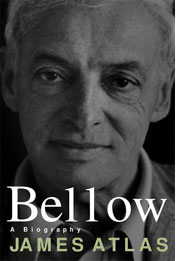
“Bellow” by James Atlas

The long-awaited chronicle of the Nobel laureate's path from bootlegger's son to literary boychik to cranky old man shows why Saul Bellow has many admirers but few friends.

It is right up there on the shortlist of memorable first sentences in American fiction: “I am an American, Chicago born — Chicago, that somber city — and go at things as I have taught myself, freestyle, and will make the record in my own way; first to knock, first admitted; sometimes an innocent knock, sometimes a not innocent.” That sinuous, braided opening of Saul Bellow’s “Adventures of Augie March” announced the arrival, in the spring of 1953, of one of the most important literary groups of the 20th century, American Jewish fiction writers. Formed on the streets of urban ghettos and in the corridors of city high schools, sharpened by the political give-and-take in the cafeterias of city colleges, they had long been appearing on the pages of small but influential journals like Partisan Review.

But with Bellow’s National Book Award-winning breakthrough with “Augie March,” his third novel, the walls to the great American readership, to the book clubs and college reading lists, were breached. Bellow had knocked, not so innocently, and the reading public not only answered but proceeded, over the course of the next two decades, to give him, Bernard Malamud and Philip Roth a regular place on the bedside reading table.

Nearly half a century since his breakthrough, and almost 25 years since he was awarded the Nobel Prize for literature, Bellow is the subject of a new biography by James Atlas, a New Yorker writer and author of an acclaimed biography of Partisan poet Delmore Schwartz. Atlas writes in the introduction to the new book that he had originally expected to tackle the life of man of letters Edmund Wilson, but found himself in a dry hole five years after signing the contract for the book. “I had a toxic response to [Wilson's] character,” he writes. “The bullying proclamations, the tedious self-revelations, the drinking and philandering — in the end, he just didn’t appeal to me as a subject to whose life and work I was willing to apprentice myself for the better part of a decade.” Instead, partly at Roth’s urging, Atlas set out on a 10-year project to chronicle Bellow’s bullying proclamations, tedious self-revelations and (relatively alcohol-free) philandering.

Over the past few weeks, Atlas has taken multiple hits from critics on both sides of the Atlantic, who have accused him of placing undue emphasis on Bellow’s narcissistic, arrogant traits. Atlas is not, unfortunately, the sort of writer who can take a wry view of the disparity between Bellow’s moralistic tone in his writings of the past few decades and the novelist’s own less than admirable behavior. The same nature whose reaction to Wilson’s faults reached toxic levels is at work here, and the chemistry is apparent. Yet it seems impossible that any biographer could examine Bellow without displaying some aversion to some of his behavior, and to the moral lecturing made hollow by those deeds. Atlas has also been accused of tracing the real-life sources of certain of Bellow’s characters in a ham-handed way, but this is also a dubious charge. There has not been a writer since James Joyce who has reveled like Bellow in the real-life connections to his fictional characters. That Atlas spends a large amount of his time tracking down these models is true, but what reader would not want to know these sources, fragmentary as they must surely be? Atlas’ main crime in the eyes of his critics seems to be felony-level failure to rhapsodize. To all but card-carrying fan club members, this is an offense to be welcomed.

Let’s be glad Atlas made the switch from Wilson to Bellow. Bellow’s life, while it may have mirrored Wilson’s in some ways, at least has a genuinely interesting “up from his bootstraps” quality to it, and a far higher artistic quotient. When Bellow first sat down to write at a card table in the back bedroom of his in-laws’ Chicago apartment in 1938, he had nothing like the head start that the privileged Wilson had going for him — no key to the clubby publishing world, no publicly recognized right to take aim at the world around him. He was the bearer of a bachelor’s degree from Northwestern, recently fired from a job at his brother’s coal business and completely without prospects. And yet he wrote, wrote into the void, with energy and with admirable discipline. It would be three years before his first published story appeared, in the pages of Partisan Review, and six years before the publication of his first novel, “Dangling Man.”

It was a lonely road but, as Atlas portrays it, one that suited a nature that ego and family circumstances had made solitary in the extreme. Born in 1915 near Montreal to Russian immigrant parents who had seen their upper-middle-class life in St. Petersburg fall apart, Bellow was beset from an early age by a violent, tyrannical father and two money-hungry brothers who belittled his artistic aspirations. When he was 8 years old a severe bout of pneumonia kept him confined by himself to a ward in a Montreal hospital. “The void created by this long separation from his family remained with him all his life,” writes Atlas. It was “the primary life experience that defined him … It showed him there was no one to count on.” “I never belonged to my own family,” Bellow later said. “I was always the one apart.”

Through a rough-and-tumble upbringing in grimy 1920s and ’30s Chicago, where his family had moved in 1924, Bellow charted his own aloof course and continued doing so into adulthood, where he had few lasting friends and personal relationships. The story of Bellow’s adulthood is one of a continuing series of academic appointments (at Bard College, the universities of Minnesota and Chicago and most recently Boston University), marriages to increasingly younger women, affectionate but inattentive relationships with his children and multiple adulteries. Atlas chronicles it all with a mixture of distaste for the failed family man (he must have soon tired of writing variations on the phrase “and the old pattern repeated itself”) and admiration for the disciplined writer.

Of course, for a writer, the more uncomfortable his experience, the more ready material he has. Bellow is the undisputed master of 20th century catch-and-release fiction, wherein personal relationships are swiftly unhooked and tossed into that vaguely parallel stream of the written oeuvre. The result has been a body of work heavily weighted with neo-romans à clef. These can yield fascinating figures like the Allan Bloom-inspired title character in this year’s “Ravelstein,” the fervent Moses Herzog or Von Humboldt Fleisher, the Delmore Schwartz-like poet of “Humboldt’s Gift.” It can also memorialize the tedious, as in the case of the cranky, heavily academic worlds of “Mr. Sammler’s Planet” and “The Dean’s December.”

It took only a decade and a half for Bellow to go from literary boychik to cranky old man. The middle of 1964, when “Herzog” was riding high on the bestseller lists, was probably the author’s professional apex. In a few years, as the country plunged into the unrest of the late ’60s, Bellow would become the literary poster boy for neoconservatism. Political, cultural and sexual crankiness has been a Bellow hallmark for the past three decades, most famously in his dismissive comments on multiculturalism: “Who is the Tolstoy of the Zulus? The Proust of the Papuans? I’d be glad to read him.”

In Bellow, Atlas found a subject whose life straddles the two career patterns of the 20th century American writer. Before 1950, most struggling novelists paid the bills with work on newspapers, magazines and trade journals while writing books in their off time. The latter half of the century has seen the numbers of papers and magazines dwindle, and new MFA and creative writing programs spring up to provide the day jobs. Bellow was in the first wave of this trend. A chronicle of the jumps from one visiting professorship to another may not provide much excitement, and it certainly means we’re in for some real snoozer bios when the lives of today’s academic scribblers come up for recording; but Bellow’s story is enlivened as few are by the rich trove of his letters — perhaps the last great body of literary correspondence by an American writer — that fills in the interstices of his patterned life with his rich inner musings.

“I had no idea our time would be so brief,” Bellow laments about the 30-year rise and eclipse of his crowd of intellectuals who had rendered the Jewish American experience. Today, at 85, with a new novel and a new baby daughter, he can certainly be said to have made the record in his own way. And the freewheeling narrative voice he brought to literature has influenced many other writers. Bellow’s star, unlike those of all his contemporaries except the slightly younger Roth, has declined but not fallen. The ultimate value of this biography is in the lucid view it gives of the ascension and subsidence of a worldview — one that, in Bellow’s case, has left a body of work with many admirers and few friends.

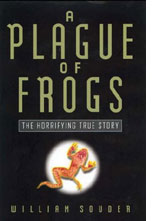
“A Plague of Frogs: The Horrifying True Story” by William Souder

Does a sudden upsurge of five-legged croakers spell the end of the world?

While reading William Souder’s “A Plague of Frogs,” I conducted a running survey of friends and acquaintances about their awareness of the deformed-frog problem. I found a ubiquitous but low-level awareness of the situation. Everyone had heard some alarming news report a few years back; nobody knew what it all meant or what the cause was. Somewhere, everybody recalled, frogs were turning up with a lot more legs than they needed. So a book like Souder’s would seem to be coming along at just the right time to tie together the answers that science has surely found by now — right? Not quite. “A Plague of Frogs” earns its subtitle, “The Horrifying True Story,” by showing that the problems affecting amphibians are far too environmentally complex to be easily solved.

It was in 1995 that a group of schoolchildren out for a nature walk first found a chillingly high number of deformed frogs in a Minnesota pond. (Scientists prefer to term these creatures “malformed,” but the “deformed” label has stuck and is now used universally.) Within a short time, other populations of creepy-looking frogs showed up all around the Land of 10,000 Lakes, as well as in other states and in parts of Canada. Frogs are extremely permeable creatures and spend most of their lives in the water, so they have acquired a reputation, deserved or not, as canaries in the coal mine when it comes to water quality. Whether the connection has any scientific basis or not, the feeling is inescapably there when you wade into a puddle full of monstrous croakers in the middle of your watershed: Today it’s Kermit’s problem, but tomorrow it could be my newborn daughter sprouting an extra leg.

Souder, who first covered the phenomenon for the Washington Post, utilizes a “how I got that story” approach throughout. The reader follows along as he interviews scientists, hangs out around the coffee urn at conferences and staggers through thigh-deep muck to net study samples. It soon becomes apparent that establishing a base line of the “normal” level of deformity is a tough but important endeavor. Souder also paints an interesting and disturbing picture of the quietly vicious infighting that takes place between scientists of competing laboratories as they debate all the possible causes, from parasites and pesticide-sourced retinoids in the water to increased ultraviolet light from the ozone-depleted sky. If you think scientists are dispassionate seekers of the truth without also being passionate builders of successful careers, you will come away wiser.

By that time, though, you will also have been disappointed by Souder’s graceless, chunky prose. Ultimately, the reader is far more interested in the story — what the heck is happening to frog populations? — than in how Souder tracked down the details; with less “how I got” and more “that story,” this book could be a slimmer, clearer examination of a complicated problem.

But these reservations cannot really detract from the complex and troubling conclusions of “A Plague of Frogs.” Where we expect one ultimate answer to the problem — one pesticide we can ban, say — we find an interlinking of many possible culprits, most of them of our own making. And suddenly both the canary and we seem to be not in a coal mine but in an enormous maze.

Continue Reading Close

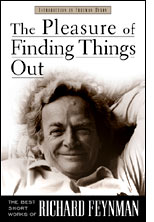
The Pleasure of Finding Things Out: The Best Short Works of Richard Feynman”

The new Richard Feynman collection is as illuminating, pleasurable and frustrating as the scientist himself.

How strange that the popular image of one of the greatest minds of the
century rests so heavily on a flimsy set piece involving a glass of ice
water and a scrap of rubber. But Richard Feynman is fixed in the memories of many
non-scientists as the iconoclast on the Rogers Commission, which investigated
the space shuttle Challenger explosion — the lab geek with the crazy hair
who, in the middle of a hearing, cut through the bureaucratic obfuscation
to perform his own telling experiment.

Knowing that flexibility was crucial to the rubber o-ring’s ability to contain the intense heat of the shuttle’s solid-fuel boosters, Feynman immersed a piece of the material in a glass of ice water on the hearing-room table — showing simply and clearly that the ring
had lost its ability to flex on the cold January morning of the Challenger’s launch.
“Feynman,” commission chair William Rogers is reported to have whispered to a colleague, “is becoming a real pain.”

This Mr. Wizard Goes to Washington performance nicely summed up the public
Richard Feynman: genius, rule-breaker, simplifier of the seemingly complex.
And this was a guy who knew from complex. Winner of the 1965 Nobel Prize
in physics for his work in reconstructing the theory of quantum
electrodynamics, Feynman was recruited to the Manhattan Project while he
was still in his early 20s. But unlike most people with intimate knowledge
of subatomic particles, Feynman could function and communicate in the world
of large, everyday objects.

“The Pleasure of Finding Things Out,” a new gathering of Feynman pieces, is as
illuminating, pleasurable and frustrating as the scientist himself.
Subtitled “The Best Short Works of Richard Feynman,” the book presents a
baker’s dozen pieces culled from a career’s worth of lectures, reports,
interviews and articles. Feynman discourses on the philosophy of science,
the relationship of science to religion and the world of the top-secret
Los Alamos lab. The collection also gives us Feynman’s prescient looks at
“the future” that has become our present, seen most strongly in his
groundbreaking 1959 Cal Tech lecture on the possibilities of
miniaturization. Reading Feynman’s Cal Tech musings on possible ways to
build tiny electrical circuits makes you feel you are witnessing the
birth of the silicon chip, and you pretty much are. Just as affecting in
different ways are his descriptions of his father — who encouraged Feynman’s
boyish scientific curiosity with “no pressure, just lovely interesting
discussions” — and an account of the physicist’s deep despair after the
product of interesting discussions at Los Alamos had twice been dropped on
Japan.

Feynman was a world-class talker who seemingly had little time or patience
for mundane rewrite work. So a large portion of this book consists of
spoken-word transcriptions that could have benefited from the clarifying
process of editing. Quite a few have already been edited,
in fact, and appeared some years ago, polished up in two as-told-to books: “Surely You’re Joking, Mr. Feynman!” and “What Do You Care What Other People Think?” To say Feynman needed an editor may be heresy to his disciples, who rival Bucky Fullerites in their level of devotion. But I’d hazard a guess that the man himself would be pleased to know, 11 years after his death, that he’s still capable of being both a pain and a pleasure, and much more the latter.

Continue Reading Close

“Faster: The Acceleration of Just About Everything”

The more efficient we get the less efficient we feel, and other paradoxes of the sped-up world.

James Gleick’s “Faster” is a wry, many-faceted meditation that takes as its starting point the notion that our lives, both at work and at leisure, have inexorably sped up. That’s not a new idea, of course. Get any group of people 35 or older reminiscing, and the topic will eventually be chewed over till everyone sounds like Dana Carvey’s Cranky Old Man on “Saturday Night Live”: Why, we remember the days when you had to actually go into a bank and see a teller to get cash, when nobody had a fax machine, when we had to keep from playing our favorite tunes too often because, as every audiophile knew, the grooves on the LP needed time to rest; and, dammit, we liked it that way!

Employing a knowing, tongue-in-cheek style and, yes, a suitably fast pace, Gleick examines every time-related dimension of life in what he calls this “epoch of the nanosecond.” He observes that “a compression of time characterizes the life of the century now closing,” and he proceeds to peg our obsession with correct time, our frustration with things that go too fast or too slow, the evolution of the concept of speed, the pervasive influence of the computer and the effect of the culture of acceleration on the arts.

His most resonant chapter heading is “The Paradox of Efficiency.” Gleick uses the phrase to describe the complicated systems that businesses use in order to become vastly more efficient (and less likely to bend to your whim). Missed your connecting flight? Thanks to modern flight planning programs that keep far fewer “extra” planes on hand, you stand a good chance of waiting longer than ever for another one. But the paradox of efficiency doesn’t apply to customer service alone. The nemesis of the “just in time” inventory systems that have made auto production much more efficient is that little spare parts factory in Ohio that, each time it suffers a strike, shutters every GM plant in the Midwest.

Closer to home, this paradox is the creepy certainty that the more you have the resources to work with every day — the more words you can process, the more e-mails and faxes you can send and instantly answer — the more expectations of your output expand. You can now do more, so you can’t do enough. One day the Internet is a marvelous new tool; the next afternoon you’re drumming your fingers during transfer time, despairing that it takes 15 seconds to have an entire library catalog a continent away at your fingertips.

With the rise of time consciousness has come, Gleick notes, the rising status of the overbooked. Think of all the exaggerators you know who with straight faces claim 80-hour work weeks. Why revel so in the notion of overwork? For many people today, having time on your hands feels downright dirty. What kind of a slacker are you? “The transformation of time into a negative status good has odd social consequences,” Gleick writes, and he quotes Michael Lewis on the “wonderful new prestige [of] any new time-saving device. After all, who needs such a device? People who have no time. And who has the least time? The best people!”

There is a benefit to reading about acceleration beyond the fact that this book is consistently witty and fine: “Faster” makes you consider your own role in accepting the acceleration of modern life. Time, Gleick reminds you, “is not a thing you ever had. It is what you live in. You can drift or you can swim, and it will carry you along either way.”

Continue Reading Close

“Time, Love, Memory”

Can molecular biologists dissect our urges?

Take a piece of cardboard and cut out a shape roughly like that of a child’s balsa-wood glider: two round-edged wings, a long, thin body and a stubby nose. Hold it over a group of just-hatched goslings and move it with the body forward: It will resemble the outline of a long-necked goose in flight, and the goslings will pay it no mind. But make one small change, moving it the other direction so that it now looks like the silhouette of a predatory hawk, and the goslings will scatter for safety in an instant. Instinct, the hard-wiring of behavior, is a fascinating thing, and a lot more comfortable to believe in in a species other than one’s own. Jonathan Weiner’s “Time, Love, Memory” examines unsettling developments in 20th-century molecular biology — specifically, discoveries about the genetic programming of behavior — that demonstrate that instinct controls the human being as fully as it does the gosling.

Weiner has a penchant, already demonstrated in his 1994 Pulitzer Prize-winning “The Beak of the Finch,” for opening up the lives of scientists who have built deep relationships with communities of tiny creatures. The primary focus of this most recent work is Seymour Benzer, a Cal Tech researcher who works with fruit flies. In the mid-1960s, Benzer devised a simple system for examining the fly’s attraction to light and found (among other things) that the odd fly that doesn’t like to cluster around a bulb can pass that preference for darkness on to its offspring. It had been known since the early part of the century, also from studies of fruit flies, that inherited genes control the physical makeup of living creatures — how our bodies look from the outside and the inside. But the discoveries of Benzer and his colleagues seem to show (they are not undisputed) that what we do with that body has also been at least partly passed along from our forebears, that “behavior is as much a part of the material world … as the atoms within us.” Since Benzer’s first experiments, molecular biologists have been taking apart the cognition of time, the act of remembering and the urge to love.

Weiner is an able simplifier of the enormously complicated atomic theory of behavior, a field that Francis Crick, the co-discoverer of DNA, has described as existing on the “borderline between the living and the nonliving.” On the other hand, Weiner has a tendency to overpraise, describing more discoveries than you can comfortably count as the most important of the century. And only a writer who is part science nerd himself would include descriptions of the mundane antics of people who haven’t seen the outside of a lab in years and desperately need to. (They put movie posters from “The Fly” on their office walls and cross their eyes when people take their picture! What a bunch of kooks!) Such lab-coat sniffing wears thin fast. But anyone who can describe the “furrowed lobes of the human brain” looming “attractively … like attainable mountains” deserves to be forgiven his occasional overenthusiasm.

Just as the obscure chalkboard scratchings of a few physicists early in this century gave birth to the most powerful military and political force of our time, Benzer and company’s little-known research may affect substantial parts of our lives in the near future. If the human genome is fully mapped a decade or so from now, the possibility that you (or your employer or your insurance company) might be able to order up a map of your future travels through the land of disease is fraught with quite enough moral peril. But the potential for your upcoming devilish doings? If that’s quantifiable, it is indeed time to run for the hills.

Continue Reading Close

I'll Be Watching You

Edward Neuert reviews 'I'll Be Watching You' by Victoria Gotti

My tastes in beach reading were formed 20 years ago, on the largely manufactured strands of the Jersey shore — the kind of crowded places where sunbathers lay packed along the sand, the smell of Sea ‘N’ Ski lotion filled the air, the sound of the flotsam-filled surf competed with the constant murmur of AM radio and every now and then somebody’s mom would jump up to yell toward the waterline, “Dom-in-iccc! Come have a crulluhh!” This was no place to quietly read Proust. The ideal beach novel had the nutritional content and edible ease of, well, the average cruller.

Into this realm of sand and sugar comes Victoria Gotti, serving up her new thriller, “I’ll Be Watching You.” As any kid on the beach from here to Coney Island can tell you, Victoria has the distinction of being the daughter of John “The Teflon Don” Gotti, the convicted former head of the Gambino crime family now serving a life sentence for murder and racketeering. Since publishing her first novel, “The Senator’s Daughter,” last year, she’s made the rounds of TV talk shows telling of her upbringing (in a family she loyally maintains has no connection to the Mob), her life these days in a Long Island mansion and the countless rejections she got from publishers in her quest to become a writer of romantic thrillers. Well, she’s arrived, thanks in part to her infamous surname, with a million-dollar contract to write a couple of novels and, so help me, what her publisher describes as a “combination cookbook and family history.”

Gotti draws heavily on her personal history in “I’ll Be Watching You.” It’s the story of Rose Miller, an internationally famous writer of thrillers, a resident of a Long Island mansion, the wife of a prominent lawyer and the sometime paramour of a misunderstood mob boss. Into this world enters a homicidal stalker intent on making Rose his next victim, just as life is being enormously complicated by the noisy indictment of said misunderstood mob boss on the eve of Rose’s husband’s entrance into politics. Pretty standard stuff for this genre — particularly if you’re the daughter of a made man — and on the face of it a natural for the beach blanket. But with the best writers of frothy fiction — the Sheldons, Folletts and Clarks — you sense at least an accomplished technician who knows he or she is reaching down to make a salad of improbabilities and thin characters. Gotti’s spent her life in a world of the improbable and now she’s reaching up, with not quite the skills of a good writer, to try to make something out of it all.

What results is a novel filled with bad grammar, strangely placed commas, a slew of unnecessary apostrophes and characters who can compete with the mighty sequoia in the wood department. Here’s one standout howler: “After successfully completing Evan’s first semester at Columbia Law School, his father planned a dinner to celebrate.” (Greater love hath no poppa than to endure tort lectures for his offspring: Eat hearty, Dad.) Doesn’t anybody at Crown publishing read this stuff before they send it to the printer?

It’s not a high art to write a good potboiler, but it’s an art nonetheless. Gotti needs fewer million-dollar contracts and — if she’s not going to stick to the cookbook business — a few more lessons in craft. You have to hand it to her, though. Unlike her dad, she’s found a way to make a tidy profit in the trash business, and the feds can’t touch her.

Continue Reading Close

Page 1 of 2 in Edward Neuert

www.salon.com/writer/edward_neuert/index.html