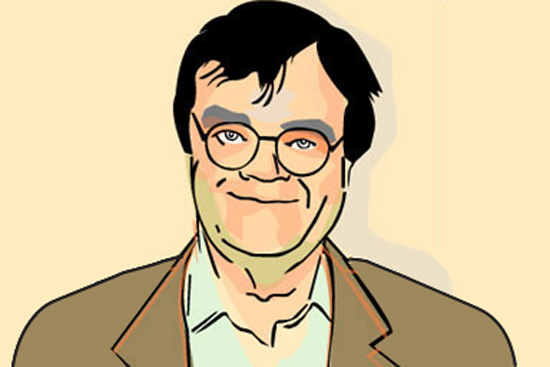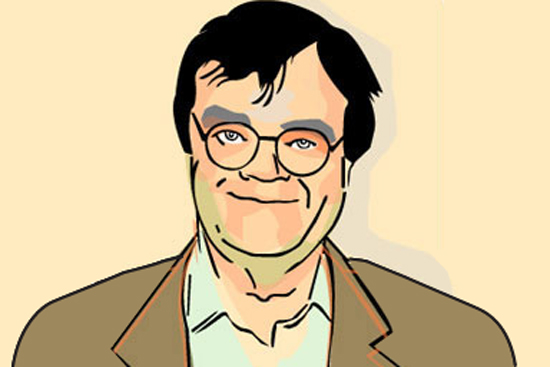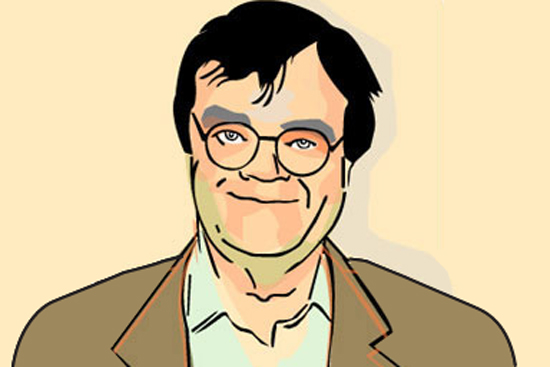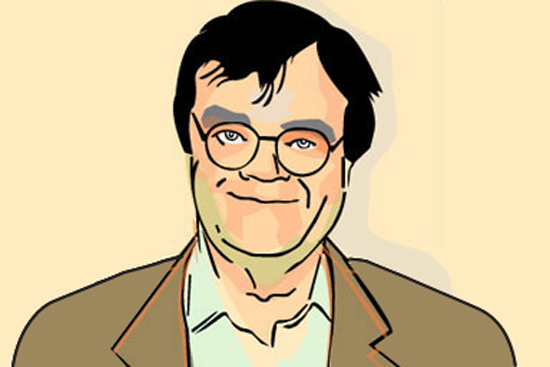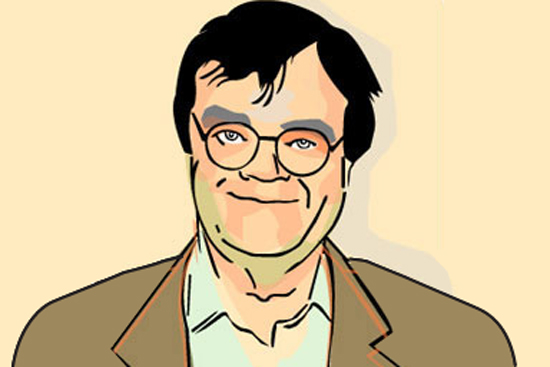
Garrison Keillor

English majors, Swedish flings and American dreams

In which Garrison Keillor, who has been around the block and lost that showroom shine, shares his wisdom.

  • more
    • All Share Services

[NOTE TO THE READER: In Salon's Table Talk, Mr. Blue will take part in discussions of writing, the writer's life, publishing, love, romance, the erotic life, marriage and how to live life. Please do not ask for investment advice or help on your term paper. Letters will only appear in this space this week. In the future, Mr. Blue will write a brief introduction and the discussion will be carried out in Table Talk.]

Dear Mr. Blue,

I groaned when I heard that Salon was going to start a lovelorn column — Salon used to be such a distinguished magazine, a beacon of wit and intelligence in the landfill that is the Internet, and now what? You’re going to tell people whether to kiss on the first date or not? What do you know about it anyway?

Disappointed

Dear Dis,

I guess you could call it a lovelorn column, for writers and lovers, all of whom tend to have their hearts broken sometimes, and Mr. Blue has certainly had his tromped and left a trail of damp hankies in honky-tonks and Holiday Inns from here to Honolulu, and this is what qualifies him as a Romance Resource Person, a history of failure and rejection. Mr. Blue is an author who has survived seven major book tours and been interviewed on daytime television shows, sandwiched between Szechwan cooking demonstrations and the lady from the zoo with the pair of baby lemurs — Mr. Blue sat there as a TV person with large hair asked, “What exactly is it that people enjoy about your work?” and the camera zoomed in on Mr. Blue’s rumpled hair and weary eyes and the floor director held up 10 fingers, meaning that 10 seconds remained before the lemur segment. So Mr. Blue is qualified to feel the pain of others and reply appropriately. As for kissing on the first date, you should never date someone whom you would not wish to kiss immediately.

Dear Mr. Blue,

I am considering quitting my job and becoming a freelance writer, which I’ve been saying for 10 years I was going to do one of these days and now that my mother has died and left me $30,000, it seems to be a good time. I am 43, single, a middle-school teacher, and now reside in North Dakota but am going to relocate to New Mexico. I write mainly essays but am willing to consider other genres. My question is: Am I crazy?

Fargo Dave

Dear Fargo Dave,

No, you’re not. This is the American Dream, and your Mom, bless her heart, has opened the door for you, and of course you should walk through it. If you get a part-time job, you can probably make your inheritance last you for three years, and that’s a good enough trial period to see if you can sell something. The market for serious essaying is somewhat thin today, so you might want to consider the humorous essay, if humor is something that interests you, or you could venture into memoirism, if you’ve had a full rich life, or, if you haven’t, you could write about health. There are a hundred health magazines out there, and more are on the way. The freelance life is a good life. Mr. Blue suggests that you walk into your principal’s office next week and give him a good tongue-lashing and act disgruntled — lean over the desk and keep touching your right pants pocket and look him in the eye but don’t quite focus — and this will serve to burn that bridge. Then you can write about doing it. Remember, for a writer there are no bad experiences, everything is material.

Dear Mr. Blue,

I write short stories, some of which have appeared in little literary magazines (the sort that pay contributors with copies of the issue you’re in), and recently I heard from a friend that a very close friend of mine had made fun of one of my stories to someone and referred to it as “tripe.” I am somehow unable to put this out of my mind, though I’ve tried. Would it be all right to confront her about it?

Distraught in Ithaca

Dear Distraught in Ithaca

No, it’s not all right, so don’t. There’s no friendly way to deal with this, and if you value your friend, don’t corner her. If you listen hard enough, you’ll always hear bad things about yourself, so don’t listen so hard. Time will pass, and this tripe will leave your mind.

Dear Mr. Blue,

I hope you do not take this question the wrong way, but why did you become a writer yourself?

Curious

Dear Curious,

Mr. Blue became a writer when he was 14 years old in order to express deep inexpressible feelings that he later learned were common as dirt, part of what is called adolescence, but by the time he discovered that he had nothing original to say whatsoever, he was enjoying the act of writing so much, he couldn’t bear to stop, and he has continued ever since, through periods of staleness and dullardry and mufflement, enduring tepid reviews (“a workmanlike book that certainly will be of interest to those who are interested in this sort of thing”) and the disinterest of awards committees and the misery of book tours (see last page).

Dear Mr. Blue,

I met a Swedish man on the Internet and we have been exchanging e-mail for six months now, and telling each other rather intimate things about ourselves on the assumption that it was safe to spill the beans to someone we’d never meet, but now he wants to come over here and meet me, and I am interested in meeting him too, but also a little afraid, because some of what I told him wasn’t quite true. I didn’t lie about my appearance or age — I’m 26 and considered quite attractive — but I told him that I was a published writer and I’m not. I’m not a writer at all. I work in a video store. He says he’s in love with me. Can this be? And what should I do? I have to decide soon.

Yellow

Dear Yellow,

Mr. Blue doubts that your status as a published author is what most interests Svend at this point. It’s a little white lie that can easily be confessed and surely will be forgiven, so if you’re interested in having a romantic fling with a Swede, perhaps this is your chance. There are women in Minnesota who might advise against it, but only you know what interests you about him. No, he can’t be in love with you on the basis of some e-mail, so put that out of your mind, but if he’s amusing and doesn’t seem dangerous and you want to have a Swede under your belt, then go ahead. The fact that you asked for Mr. Blue’s advice on this, however, should be a caution to you: People don’t usually ask for advice before having a wild, impetuous affair — ordinarily, there isn’t time — so perhaps you should count to 10 in Swedish and then see how you feel. If you do have the affair, and you still like him, under no circumstances should you agree to move to Sweden until you have asked Mr. Blue for his advice.

Dear Mr. Blue,

I told my mother that I want to major in English when I go to college in three years and she about had a fit, and when I told her that I want to be a writer, she told me the discussion was closed, and she made herself a drink. What is so crazy about wanting to do that? And what can I do to show her that I’m serious?

Fifteen

Dear Fifteen,

A young man who takes up prose fiction is making a wise choice that will stand him in good stead the rest of his life. Writing teaches a person humility: One thing you absolutely learn is to recognize when someone else has said something well, said it better than you could, and you learn to admire the success of other writers and savor their work, and of course the love of language is a pleasure that lasts all your life. And besides that, the ability to rearrange reality in a plausible manner is something that a person will often find useful. Your mother is wrong here, and you, as a young writer, are in a good position to show her that she is wrong by writing a work of fiction about her. Hold nothing back. If it’s published, then she should be happy for your success, and if it’s not published, then nobody’s the wiser.

Classics Book Group

The Salon Classics Book Group: Garrison Keillor on the 'scandalous' -- and mediocre -- 'Sister Carrie.'

  • more
    • All Share Services

For many reasons, “Sister Carrie” was a big book to us English
majors who studied it in the Modern American Novel course 30
years ago at the University of Minnesota. For one thing, it was
the first M.A.N. in the course —- Melville was considered 19th
century and he went into a different file drawer — and so, we
were led to believe, Lewis and Fitzgerald and Hemingway and
Faulkner all leaped to the fore over Dreiser’s shoulders and
benefited from his having fought the good fight before them.
Published in 1900, “Sister Carrie” stood at the gateway to our
century, the opening salvo in the struggle of American fiction
writers to portray the life of our time honestly, over the
harassment of prudes and philistines. We English majors were
drawn to “Sister Carrie” as well by the sweet story about its
origins: In 1883, Dreiser’s sister Emma had fled to Canada with a
married man who had stolen money from his employer, the clear
basis for the novel, an attempt by the author to redeem his
family from its shame and suffering by creating a great work of
art from the tale. “Sister Carrie,” our professor told us, had been
bowdlerized by the author’s wife (much as Mark Twain’s wife had
taken a blue pencil to “Huckleberry Finn”) and then was suppressed
by its own publisher, Doubleday, when it appeared, and sold less
than 500 copies. We were prepared to admire the book for
that reason alone.

The later triumvirate of Fitzgerald, Hemingway, Faulkner were
admired by us not only for the books they made but also for the
beauty of their prose. They were elegant stylists, and you could
profitably imitate them. Dreiser was another sort of author
altogether. He was, the professor explained, one of those Great
Authors who was, ahem, not that good an author, if you know what I
mean. His prose was, uh, maybe a little clunky. Even embarrassing
in places. But he nevertheless was a true Artist.

This, of course, appealed to us undergraduates enormously,
especially as we weren’t too confident of our own prose styles.
The thought that one could attain greatness, despite some
weakness in the basics, made perfect sense to us.

I remember liking “Sister Carrie” very much 30 years ago and
writing a learned term paper on it (which I will not trouble you
with now, thank you very much) and earning a B in The Modern
American Novel, and with all that in mind, I’ve plunged back into
the novel —- the new “unexpurgated” version — with great
interest for this Salon Magazine online discussion. It’s
fascinating to revisit a book that was important to me once, and
to see how, over the years, my memory of it has misrepresented
it. I honestly can’t see what I thought I saw in it.

I’d be glad to discuss with my fellow Salonites any of the
aspects of “Sister Carrie” that one might write a term paper
about — its metaphorical structure, its inner voices, its
thematic unity. I seem to recall using “thematic unity” many
times to great effect in my term paper of long ago, but we can
also talk about any of the interesting larger questions that are
raised by this book and its history.

One interesting question to me is that of censorship.

Since Dreiser, writers have fought against censorship, even when
there was practically none of it to be found. Writers long to
have enemies, to be opposed by powerful forces, to rise up and
wield our bright pens against them. The thought of enemies is
a great relief from the drudgery of writing and it quickens our
creative energy to feel ourselves writing for a cause: wonderful
sharp satiric work has been created by people who were blessed
with good enemies.

As we approach the 21st century, however, there seems to be a
sort of moral torpor that renders people immune to imaginative
literature. Books are sold, and presumably they are read, but
nobody cares about them enough to bother to be outraged by them,
surely not to censor them. One has to wonder if it’s still possible for
a book to cause the sort of delicious public uproars that
Ginsberg or Nabokov or Henry Miller caused only a few decades
ago. In the late ’30s, working in Hollywood, Fitzgerald
worried that the movies would put prose fiction in the shade and
perhaps we are seeing that.

“Sister Carrie,” a cause cilhbre in American letters, is not that
great a book, it must be said. Even if you pass over Dreiser’s
clunky Darwinian lectures, his schoolmarmish asides about
psychology and morals, you have to conclude that this is no “Anna
Karenina.” Nobody would confuse this with Dickens. It isn’t even
James T. Farrell. It is a work of historical interest, like
“Winesburg, Ohio,” but I’d find it hard to assign these works to
students — there simply are so few moments when these dreary
figures show flickers of life.

Dreiser was honored for this book,
especially by the great Baltimore iconoclast H.L. Mencken, not
so much for its worth as for Doubleday’s suppression of it.
(Today, they wouldn’t bother.) The uproar in 1900 over “Sister
Carrie” and its rather decorous depictions of adultery is actually
a testimonial to the power of words at that time to quicken
people’s imagination: We haven’t progressed at all; we have
declined. We have a surfeit of stories and amusements today, and
we can’t remember ones that we saw or read a week ago; none of
them makes enough impression on us to excite either opposition or
anger, only a sort of bovine calm.

Go into your local book emporium and see the banned books of
yesteryear piled on the floor in the Bargain section, remaindered
off for less than it cost to print them, and yet nobody cares
enough to read them at any price. Most of the heroes of
those old battles are faded figures today, like Dreiser. Had
their censors been victorious and wiped their work from the map,
we would not miss them so much today, not nearly so much as we
would miss certain other writers whom nobody ever thought of
suppressing, whose gifts were far more innocent. The humorists,
for example. You could lose Dreiser, the great brooding giant of
unreadable fiction, and we wouldn’t be much poorer for it, but if
we hadn’t had Thurber, I don’t know where we’d be.

I look forward to seeing you online.

Continue Reading Close

Page 62 of 62 in Garrison Keillor