Ian Williams

Bully for you

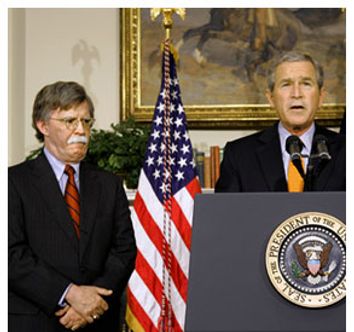
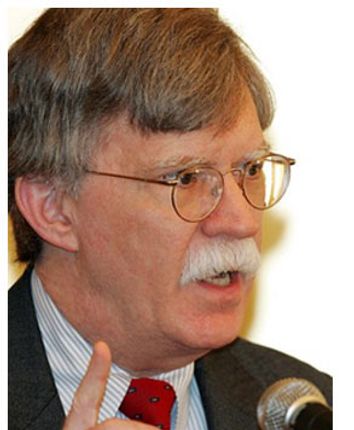
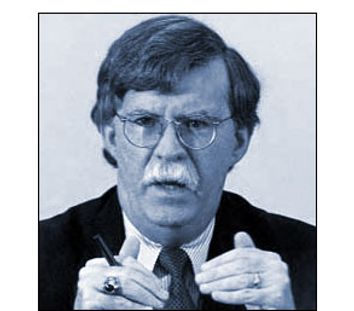
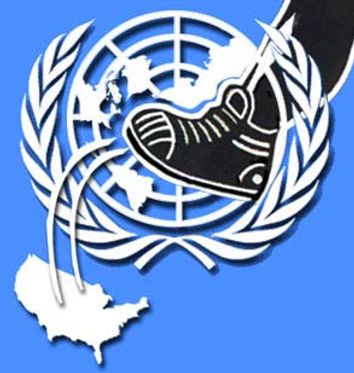
With Capitol Hill freshly vacated, Bush installed U.N.-hating John Bolton as ambassador to the U.N. If Democrats really were partisan hacks, they'd rejoice that the president chose this incompetent ideologue to sell his foreign policies.

This week is the 60th anniversary of the Enola Gay dropping the bomb on Hiroshima, so perhaps it is entirely appropriate that George W. Bush has gone for the nuclear option and dropped John Bolton on the United Nations in New York. Bolton’s diplomatic talents are such that he could start a shouting match in a Trappist monastery. He should make things at the U.N. go with a bang.

It almost counts as tact on the part of the White House that it waited until Monday to announce Bolton’s recess appointment, instead of making the announcement on Friday as soon as the limos speeding senators to Ronald Reagan airport on their ways home had left the U.S. Capitol.

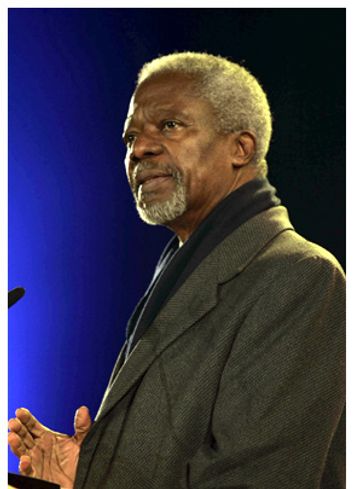
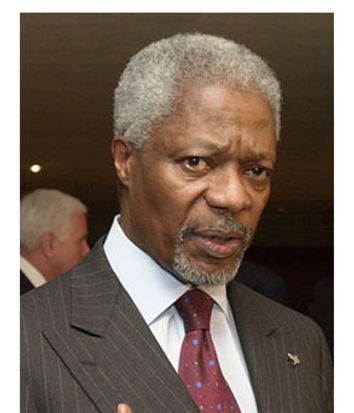
President Bush tried to justify the recess appointment by the urgent need to have a permanent representative in place at the United Nations for another 60th anniversary — the summit to commemorate the founding of the international governing institution in 1945. U.N. Secretary-General Kofi Annan has tried to put forward a reform package that will guarantee a new lease on life for the organization. Bolton has repeatedly made it plain that he wants it pensioned off. His notorious pre-retirement package for the organization famously included knocking 10 floors off the U.N. headquarters building. His like-minded colleagues in Congress, like Henry Hyde and Norm Coleman, are already trying to bilk the U.N. of half the dues the United States owes. Out of loyalty to the White House, Bolton has not publicly supported the call, but he has hardly repudiated it either, since it is in line with his lifetime’s prejudices. If there is an urgent need to reinvigorate the U.N., then the last person who is “needed” there is Bolton.

There has been loose talk about a Democratic filibuster of his appointment, but that is inaccurate. A filibuster in its strict sense is an attempt to hold off a decision procedurally. The Democrats in the Senate have been raising serious and substantial questions about Bolton’s behavior and suitability for the job — and it is in fact the administration that has been stalling, refusing to release information that, one can only assume, is damning for Bolton, for instance, about his rough ways with anyone who disagrees with his idiosyncratic views of the world.

There is credible evidence that he has commissioned intelligence reports on people in the State Department, and indeed he seems to have at least been in the vicinity of the Valerie Plame leak. In 2003, the State Department’s inspector general questioned Bolton as part of an investigation into the Niger-uranium controversy that led to Plame’s outing — a fact that Bolton conveniently “forgot” when he came before the Senate Foreign Relations Committee earlier this year. If he treats “dissident” civil servants, and indeed his own party colleagues in the administration, as if they were foreign agents when they show insufficient enthusiasm for his obsessions, what does it say about how he will treat actual foreigners when they have the temerity to demur?

If the Democrats were really as partisan as Bush says, and put party affiliation above national interest, they should be overjoyed that as incompetent a diplomat as Bolton would be at the U.N., provoking even greater resistance to Bush’s foreign policies by other nations.

For example, to work successfully on the U.N. Security Council, the U.S. envoy has to, at the very least, win over the other permanent members, let alone any new ones that may be added as a result of Annan’s proposed reforms. Bolton is on record as thinking there should only be one permanent member with a veto: the United States. He has dismissed Europe — which of course includes veto-holders Britain and France — as having had a free lunch at Washington’s expense. And China is unlikely to be impressed that his résumé includes a recent spell as a paid consultant for Taiwan. He may actually have been right about the issue — there are good arguments for U.N. membership for the island nation — but an American ambassador to the U.N. has to spend a lot of time persuading China not to veto resolutions. There may be people better qualified for the task, not least since Bolton, as he once said, does not “do carrots.” Diplomacy is about horse-trading. All stick and no carrot leads to rapid stalemate.

Among Annan’s core proposals, apart from the Security Council reform, are a new Human Rights Council with real teeth, an explicit definition of terrorism as violence against civilians and a definition of the “responsibility to protect,” which would allow the Security Council to intervene in internal affairs to protect civilian populations. The latter should at least provide an occasion for harmony between Bolton and the Russians and Chinese. None of them is particularly enthusiastic about woolly liberal ideas like rescuing populations from genocide. Bolton disagreed with the neoconservatives and opposed U.S. intervention in the Balkans.

Although he is often lumped in with the neocons, he has none of their enthusiasm for spreading democracy or rescuing the victims of tyrants. He does share their commitment to the American right to take unilateral action, but is in fact a paleocon, an American exceptionalist. The only foreign country that he has shown serious signs of affection for, apart from Taiwan, is Israel, particularly in its robust militaristic and unilateral mode, with Likud in control.

Bolton’s distaste for the U.N. has been ominously revealed by recent reports and allegations from insiders at the State Department. Under Democrats, U.N. ambassadors, such as Madeleine Albright, have been included in the Cabinet, while Republicans have traditionally downgraded the position. Even so, equipped as they were with large premises in New York, previous U.S. envoys to the U.N. have only had a small suite in the State Department. Bolton clearly has no intention of being downgraded and has been lobbying for much larger offices at State, since he intends to spend a lot more time in Washington than previous incumbents, away from all those foreigners, one presumes. The expanded State Department office, and the extra time Bolton spends in Washington, will not be spent representing the best interests of the United Nations to the administration.

To look on the bright side, Bolton may even drive a wedge between Bush and British Prime Minister Tony Blair, whose policy on issue after issue is diametrically opposed to Bolton’s public pronouncements.

The appointment also does not bode well for Condoleezza Rice, whose fan club has been applauding her support for Bolton at the U.N. as a cunning move to get him out of the State Department, where he spent the last four years frustrating Colin Powell’s efforts to keep the United States on speaking terms with the rest of the world. The U.N. ambassador is unique among American envoys in that he or she has a high profile domestically, appearing on television every time there is a world crisis. That has caused friction in the past between career diplomats and secretaries of state. On past form, Bolton’s big mouth and small-mindedness are guaranteed to undermine any leanings Rice may have toward maintaining normal diplomatic relations with the rest of the world, including the recent attempt to repackage the “global war on terror” — which so many other countries found indigestible because of its misapplication in the invasion of Iraq — as the “struggle against violent extremism.”

For that rebranding to have credibility, maybe the United States should offer a pact to outlaw chimerical weapons: the entirely spurious weapons threats that Bolton has specialized in reporting in any country that his alma maters, the conservative think tanks Heritage Foundation and American Enterprise Institute, dislike.

For most of the diplomatic corps and the world’s ambassadors, Bush’s message to the U.N. with the Bolton appointment is the same as the famous headline from President Ford to New York: “Drop dead.” Despite their privately expressed shock, it is unlikely that many of the other U.N. ambassadors, let alone the senior U.N. staff, will have the temerity to speak out in public. But in private discussions, they may well relish challenging Bolton’s credentials to speak on behalf of a nation whose legislature has failed to endorse him.

The spirits of 1776

You thought it was all about tea? Nope, the American Revolution started because the colonists were desperate for rum. Yo ho ho!

In the light of President Bush’s attempt at Fort Bragg, N.C., last Tuesday to co-opt the July Fourth celebrations to support his war, it is time for some counter-revisionist history.

The American Revolution was not about tea. It was about rum: the real spirit of 1776.

The tea that was thrown into Boston Harbor was actually tax free, and the men throwing it overboard were doing so at the behest of local merchants who had warehouses filled with more expensive smuggled tea that they could sell only if the British East India Co.’s cheaper cargo was unloaded. They knew that no amount of patriotism would stop the Bostonians from buying a cheaper product.

But the real conflict between the colonists and Britain began over taxes on molasses, not tea. And that’s where the French come in. The Founding Fathers not only loved the French, but they also loved the molasses that Paris’ Caribbean colonies produced — and they loved even more the rum that New England distillers made from it.

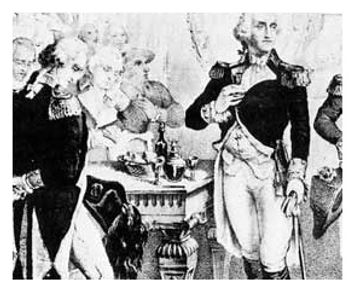
Years of temperance pressure and Prohibition — and probably the Walt Disney Co. and Hollywood — have essentially shoved the real history of the Revolution down a memory hole, and nowhere is that more apparent than in the iconic Currier & Yves print of Washington’s farewell to his officers.

The 1848 version, above, has the first president hoisting a glass to toast his comrades in arms, with a carafe on the table behind ready for refills. In the 1867 version, below, after 20 years of relentless temperance agitation, the carafe has morphed into a cocked hat, and the president’s glass has disappeared, leaving Washington clutching his lapel in a strange Napoleonic gesture.

New England had an insatiable thirst for molasses, since a gallon of it made a gallon of rum, and the inhospitable lands of the Northeast did not produce enough grain to make whiskey. The colonists drank a lot of the New England rum they produced and sold the rest to the Indians, with devastating social results, or bartered the rum for slaves from West Africa, with equally devastating results there. Benjamin Franklin chillingly put it that “indeed if it be the design of Providence to extirpate these Savages in order to make room for cultivators of the earth, it seems not improbable that Rum may be the appointed means. It has already annihilated all the tribes who formerly inhabited the Sea-Coast.”

However, they could not get molasses from the British colonies in the Caribbean, who used it to make their own — and much better — rum. Franklin actually wrote poetry about punch made with Jamaica rum!

So the colonists got their molasses from the French islands. Paris would not let its colonies produce rum for export lest it compete with French wine and brandy, so the French had a lake of molasses left over from sugar refining.

The ticklish problem was that for much of the 18th century the French and the British were locked in a life-or-death struggle — and no more so than in North America, where the French and their Indian allies posed a constant threat to the British settlers.

However, business is business, and the colonists did not let little details like wars interfere with commerce. They traded with the French enemy throughout the wars being fought for the survival of the American colonies. At one point the British Royal Navy ships based in Jamaica were unable to go to sea because they did not have enough flour to provision themselves, while as British Adm. Augustus Keppel pointed out, the French ships and garrison in Hispaniola had no such difficulties because of “the large supplies they have lately received from their good friends the New England flag of truce vessels,” which sailed there under the guise of returning prisoners.

When New York merchants heard that Britain was about to go to war against France’s ally, Spain, their response was to try to get permission from the governor to sell supplies to the Spanish garrison in Florida quickly, before the official declaration arrived. The end of what is known here as the French and Indian War shaped the modern world. The British chased the French out of North America completely — but they ended up paying a quarter of their GDP in taxes to pay off the deficit that had secured the victory. They thought the colonists should help, and they knew that local officials could be bribed and bullied. So they gave the Navy the job of collecting customs duties on the molasses — and the Navy was not gentle with the colonial merchants who had been trading with the French enemy so recently.

Freed from the French threat, the colonists increasingly regarded the British connection as a burden rather than a protection and ended up welcoming the French fleet and armies to get rid of the British. Even during the war, rum was the lifeblood of the opposing forces. In 1775 Abigail Adams wrote indignantly to her husband that British Gen. Thomas Gage in Boston had “ordered all the molasses to be distilled into rum for the soldiers: taken away all licenses, and given out others, obliging to a forfeiture of ten pounds if any rum is sold without written orders from the General.” Equally concerned with a rum gap, Washington wrote to Congress in 1777 suggesting “erecting Public Distilleries in different States.” He went on to explain, “The benefits arising from the moderate use of strong Liquor have been experienced in all Armies and are not to be disputed.” Indeed, he anticipated modern patriots when in 1781 he complained to Gen. William Heath because the latter was providing French wine to Continental soldiers, when everybody knew that they preferred rum. Washington laid down firmly, “Wine cannot be distributed the Soldiers instead of Rum, except the quantity is much increased. I very much doubt whether a Gill of rum would not be preferred to a pint of small wine.”

New Hampshire rose to the call and levied each town to provide 10,000 gallons of West India rum for the Revolutionary Army. It is ironic that Gen. Washington thought so highly of the martial virtues of rum, since one of his few outright military victories in the field — over the 1,300 Hessians at Trenton, N.J., on Christmas Day 1776 — was reputedly because the enemy was overfortified with the Christmas spirit.

Of course this is all ancient history. But President George Washington made and drank rum in prodigious quantities, and President George W. Bush, like the Taliban, is a total abstainer. Which one would you prefer to lead your country?

Continue Reading Close

The nuclear bully

The Bush administration tried and failed to strong-arm the rest of the world on nukes. As a result, the chances of runaway proliferation are higher than they've been in decades.

Although John Bolton has not yet been confirmed as the U.S. ambassador to the United Nations, his work goes marching before him. His “dead hand” was firmly clutching the throat of the American delegation at the Nuclear Nonproliferation Treaty review conference — a monthlong gathering at the United Nations that petered out May 27 without agreement on a formal agenda, let alone on further steps toward nonproliferation.

Without saying it quite as explicitly as Bolton has said it in the past, the American position was to deny that the treaty has any force over the United States while at the same time demanding that it be applied vigorously against those it has unilaterally nominated as bearings on the “axis of evil.” The Bush administration refused to allow anything else substantial, such as previous American commitments in the treaty and at earlier conferences, onto the agenda.

The failure of the conference led most of its delegates and observers to conclude that the chances of runaway nuclear proliferation are higher than they have been for many decades. Although most countries did not want to add themselves to future putative axes of evil by laying blame explicitly from the rostrum, their speeches and even more their off-podium talk made it clear whom they hold responsible for the failure of the conference: It was above all Washington, in its intransigence and seemingly untrammeled capacity for saying, “Do as we say, not as we do.”

With no such inhibitions, Alice Slater of the anti-nuke organization Abolition 2000 declared, “By refusing even to discuss the commitments it made at past meetings, the U.S. has turned the world of nuclear proliferation into the Wild West, with a complete disrespect for the rule of law. The U.S. delegation is using cowboy politics to sabotage the [treaty] review conference.”

Indeed, she and others accuse the die-hard nuclear hawks in the administration of deliberately trying to provoke North Korea into a nuclear test, since that would make it politically more feasible for the Pentagon to restart its own testing. And of course North Korea’s nuclear ambitions provide the latest excuse trotted out by the administration for expansion of the Strategic Defense Initiative, aka the “Star Wars” program. “They think they are going to bomb [their] way out of proliferation,” Slater comments sardonically.

In 1970, faced with the prospect of dozens of new nuclear states, almost everyone in the world greeted the Nuclear Nonproliferation Treaty with relief. The only nonsignatories were Israel, India and Pakistan, for reasons that are now all too apparent. With an original term of 25 years, the treaty was basically a deal among the five “public” nuclear powers — Britain, China, France, Russia and the United States — that they would move toward eventual nuclear disarmament in return for the nonnuclear powers staying that way. The nuclear powers also agreed to assist the others in the development of “peaceful” nuclear technology.

When the treaty was expiring in 1995, the Clinton administration tried to extend it indefinitely, without qualifications, but other countries had already become suspicious of the sincerity of the nuclear powers, and in particular of Bill Clinton’s inability to restrain the Pentagon’s fixation on nuclear weaponry. The nonnuclear powers therefore exacted a price for extending the treaty, part of which was a review every five years of how it was working.

Both in 1995 and in 2000, when the first review occurred, the United States joined in a unanimous agreement that included a pledge by all nuclear powers to reduce existing nuclear weapons and to refrain from working on new ones. It also supported a nuclear-free zone in the Middle East. In this year’s review, however, the United States refused even to allow those previous commitments onto the agenda and made it clear that the Bush administration had now “unsupported” them. It now regards these as “historic,” opening the way for other signatories to regard the treaty itself as historic and defunct, since they agreed to extend its 25-year life in return for those commitments.

Specifically, the U.S. delegation refused to allow any discussion of Israel’s nuclear weapons or of the failure of the nuclear states to meet their obligations under the treaty. Instead, the delegation wanted to concentrate on Iran, which, with some justice, claims that its present activities are permitted under the treaty, and North Korea, which had dropped out of the treaty — perhaps following the example of Bolton’s “unsigning” of the International Criminal Court treaty.

Unfortunately for the administration, the news about its plans to weaponize space — also a violation of existing treaties — broke in the middle of the conference. Adding to the undiplomatic signals it is sending the rest of the world, the administration has refused to send the Comprehensive Test Ban Treaty to the Senate for ratification, has earmarked billions in preparations for resumed nuclear testing, and has budgeted funds for research on new “bunker-busting” nuclear weapons while continuing to conduct computer simulations of new weapons.

The United States of course has long been complicit in Israel’s and, to a lesser extent, India’s and Pakistan’s becoming nuclear powers. Its reaction to their successful programs has been to try to sell them more conventional weapons, such as planes that can deliver the bombs, and to court them diplomatically.

And while the United States pressures Pakistan to “render” motley Islamists for incarceration, it has failed even to interview Abdul Qadeer Khan, the “father of the Pakistani bomb,” who has spent the past several decades hawking do-it-yourself A-bomb kits around the world in a fashion that makes the al-Qaida threat seem jejune. In convenient amnesia, the Bush administration even seems to have forgotten that his work was originally touted as the “Islamic bomb.”

Nor did it help the administration’s posture that while delegates were considering the Nuclear Nonproliferation Treaty in New York, the American Israel Public Affairs Committee’s annual convention in Washington was featuring a sort of ghost train touch-and-see exhibit on Iran’s potential for developing nuclear weapons. In contrast, Israel’s estimated nuclear arsenal of more than 200 weapons has gone completely unremarked by anyone in Washington.

The treaty clearly has some holes that need patching, but the Bush administration is ripping off the existing patches, not cooperating in creating new ones. The developments in North Korea highlighted one major flaw. A country can (and indeed did) use the cover of the treaty to build “peaceful” reactors with foreign help and then withdraw from the treaty, as Iran is also threatening to do. The problem is, if you build a nuclear-powered reactor, your byproduct is the fixings for a fission bomb.

Among the patches that the conference could, and probably would, have considered if the majority of countries had had their way are the addition of a no-exit clause and better enforcement and inspection. Some have suggested that a complete ban on enriching uranium may be in order, since there are no serious peaceful purposes for it, but in some ways that would be rendered nugatory by the trade in plutonium that some reactors produce as a byproduct.

Under the circumstances, it is perhaps surprising that more countries have not followed the nuclear path. In an otherwise gloomy outlook, the one bright spot of the conference review is that so many signatories so sincerely want it to succeed — even though the country that blusters most about nonproliferation sabotaged the conference so successfully.

All in all, it was a fitting curtain raiser for Bolton’s likely new job, since his publicly stated peculiar views on international law, and his previous job performance as head of the State Department’s disarmament affairs desk, are in large measure responsible for driving the North Koreans to nuclear weapons and for getting the Iranians to think wistfully about them. As the old curse has it, we face interesting times, certainly more so than in any period since the fall of the Berlin Wall.

Continue Reading Close

The good news about Bolton

Even if he's ultimately confirmed, those who spoke out against him have signaled to the world that he doesn't represent all Americans -- and ensured he won't wield a big stick.

Not since Pontius Pilate has there been such a public display of hand-washing. The nomination of John Bolton, the man the president wants to represent America to the world as our ambassador to the United Nations, was ushered unendorsed to the Senate floor by the Senate Foreign Relations Committee, with almost half of its Republican members holding their noses, while blaming the White House for its obduracy in forcing such an unsuitable candidate on them. Unable to muster a majority in his committee to actually endorse Bolton’s nomination, chairman Richard Lugar himself said “Secretary Bolton’s actions were not always exemplary.”

Rarely has a nominee been damned with such faint praise by his own party. Indeed, from their public disquiet about Bolton’s qualifications, we must assume that only the deepest party loyalties — or the fear that Karl Rove would put the severed head of their favorite horses in their beds while they slept — kept the likes of Lincoln Chafee, Chuck Hagel, George Voinovich and Lugar from outright rebellion.

It was reported late Thursday that Sen. Barbara Boxer, D-Calif., had put a “hold” on the nomination, raising the stakes for the White House, which will now need 60 senators to toe the line to push Bolton through. The lack of endorsement by the Foreign Relations Committee will make that even more difficult.

Appropriately enough for someone whom former Sen. Jesse Helms once looked forward to having at his side at Armageddon, Bolton’s nomination could be tied into the Republicans’ “nuclear option” aimed at ending the filibuster in the Senate.

In the course of these protracted hearings, the sound of silence from some quarters has been almost deafening. While previous GOP secretaries of state have been rolled out in support, Colin Powell has not said a public word in favor of the man whom Dick Cheney planted as a fifth column in the State Department.

And notably, British Foreign Secretary Jack Straw has said absolutely nothing to dispel the stories that he and other Europeans adamantly refused to allow Bolton’s participation in any of the multilateral talks with the various states that Bolton had designated as part of his eccentrically shaped “axis of evil.”

The old description of a diplomat as someone “sent abroad to lie for his country” is doubly inappropriate for ambassador-in-waiting Bolton. He will be dissimulating in New York, and based on past form, he will truly, deeply and sincerely believe every whopper he comes out with.

In the welter of accusations about whether he tried to browbeat, bully or transfer intelligence analysts, the committee seems to have lost track of the most salient point: He was wrong on the intelligence issues in question. Cuba did not have a biological weapons program; Syria was not hosting the “missing” WMD from Iraq.

Nor could he be, as his supporters have claimed, a strong representative of America in the world forum. In his own clumsy way, Bolton has epitomized the administration’s habit of inventing facts to back up preconceived policies and prejudices. Most Americans do not want more nuclear weapons, fewer inspections for chemical and biological weapons or more unregulated trade in small arms, as the Bush administration’s policies would lead one to believe. And if Americans knew the truth about the International Criminal Court, which Bolton and the U.S. have done so much to try to sabotage, they might even think that this much improved sequel to the Nuremburg trials represented a good thing.

The classic model for strong diplomacy is Teddy Roosevelt’s, which has a lot of validity: “Speak softly and carry a big stick.” Bolton clearly fails on the first point, and may not be as well endowed on the second as he pretends.

One relishes the prospect of a blustery Bolton, once a paid lobbyist for Taiwan, going to the Chinese ambassador on the U.N. Security Council to try to exercise his powers of persuasion and being asked, “Mr. Bolton, when do you want us to start selling the U.S. Treasury bonds that we own half of? Would this week or next week be the best time to trash the dollar? Or shall we just use our veto?”

President Bush has to be congratulated for inadvertently doing so much to improve Americans’ public consideration of foreign policy. Consider: In the Foreign Relations Committee the Democrats held firm from beginning to end, which is a much rarer event than conservative accusations of liberal partisan bias would have you believe.

One could be cynical and assume that one reason for such uncommon backbone is that no major domestic commercial lobbies had a dog in this fight. But certainly the legislators were also genuinely and sincerely appalled that the United States would be misrepresented abroad in such a public global forum by a bad-tempered, isolationist bigot like Bolton.

Significantly, the “grass-roots” conservatives who campaigned for Bolton by showering senators with e-mails and postcards did not do so on the “official” White House grounds that a now even-tempered and suave Bolton would help reform the world organization. They were pretty much the same people who want the United States to pull out of the U.N., for a variety of kooky reasons. In fact, the polls showed that the Democrats had called it right: An overwhelming majority of Americans opposed the nomination. (Polls have also shown a degree of support for the United Nations that you would never suspect from listening to the GOP’s representatives in Washington or to guests on conservative talk shows.)

While it would be easy to condemn Republican senators for not voting their consciences and blocking a nomination that had made many of them so visibly uneasy, we should also celebrate this first and most public revolt, no matter how low-key, by moderate Republicans against the members of the radical right that have taken over their party. We can assume that they too were watching those polls before breaking ranks.

If, as is far from certain, Bolton ever does find his way to the East River in New York, Democratic senators and their wobbly Republican colleagues on the Foreign Relations Committee have at least sent a message to the world that should help American self-esteem. Their resistance and visible distaste clearly signal that John Bolton does not represent Americans, at the U.N. or anyone else.

Along with his own lack of diplomacy, that will make him a broken arrow if he ever is fired in the direction of the U.N. When he stamps his feet and threatens to scream, scream, scream unless he gets his own way, other countries’ diplomats will simply shrug and say, “There, there, have your tantrum,” as they ask their aides to call Condoleezza Rice. Far from allowing him to wield a “big stick” to advance White House policy, the non-aye-sayers have ensured that Bolton’s diplomatic weaponry — if employed — will be distinctively detumescent.

Continue Reading Close

Reinventing “we the peoples”

Kofi Annan proposes the first major reforms of the U.N. since it was created 60 years ago, and he knows they won't please everyone.

In an effort to increase the relevance of, and confidence in, the United Nations, which was created 60 years ago to prevent a repetition of World War II, Secretary-General Kofi Annan on March 21 presented several proposals for reform of the world body to reflect the changed nature of global conflicts since 1945. The title of his 63-page report is “In Larger Freedom: Towards Development, Security and Human Rights for All.”

It is emblematic that among the few actual changes he recommends to the text of the U.N. Charter are the deletion of its clauses penalizing Germany and Japan and the abolition of the Military Staff Joint Committee that was supposed to coordinate operations against any resurgence by those nations. The committee has met every two weeks for all those decades without making a single decision, and the “former enemy powers” are expected to be invited to join the former victors as permanent members of the U.N. Security Council.

Instead of rewriting the charter — which would almost certainly lead to a weaker document than the briefly united Allies could achieve in 1945 — what Annan proposes is in effect a reinterpretation of the charter to meet modern circumstances. Instead of being primarily about avoiding a repetition of World War II, he suggests that the United Nations should now focus on the new threats to peace.

In the biggest reinterpretation, he asks the Security Council, in place of the traditional sacrosanctity of national sovereignty, to deem mass murder, repression and ethnic cleansing to be threats to international peace and security that the international community has the right to intervene to stop — and to adopt a set of principles to ensure that such intervention takes place only when there is no other option.

In another bold step, he proposes a succinct definition of terrorism and the creation of an international convention against it, along with strengthened controls on weapons to stop terrorists from getting their hands on them.

In case you think that’s easy, remember that diplomats have been tying themselves in knots over a definition of terrorism since even before Sept. 11, 2001. The Bush administration’s apparent working definition of terrorists as people whom we do not like who use violence leaves as much to be desired as definitions that justify any act as long as it is aimed against imperialism.

Annan’s definition cuts across talk about liberation struggles and state terrorism and states, “Any action constitutes terrorism if it is intended to cause death or serious bodily harm to civilians or non-combatants with the purpose of intimidating a population or compelling a Government or an international organization to do or abstain from doing any act.” Replying to critics who say this neglects misdeeds by governments, he notes that those are already covered by the Geneva Conventions and similar international laws against war crimes.

He also wants a more effective, and tyranny-free, Human Rights Council, to replace the current Human Rights Commission (whose members have included notorious violators of human rights), and new attention to building democracy and reconstructing failed states. While many developed countries have already called for such changes, Annan recognizes that a large majority of the world body still needs convincing, so he presents the package of reforms as a “deal” between the blocs of members. The developed world and the United States get what they’ve been asking for, in return for agreeing to put truth in the promises they made to the developing world five years ago about meeting specified goals to reduce poverty and underdevelopment with direct aid, loan forgiveness and an end to trade barriers, and to help combat AIDS, malaria and tuberculosis.

As Annan says eloquently in his report, “We will not enjoy development without security, we will not enjoy security without development, and we will not enjoy either without respect for human rights.”

The most visible change would be in the membership of the Security Council, a reform that will get far more attention than it merits, since most of the report is rightly concerned about what the existing members of the Security Council (China, France, Russia, the United Kingdom, the United States and 10 temporary members) and the General Assembly do and how they do it. Annan proposes two alternatives, both of which would increase the size of the council by nine seats. Plan A calls for six new permanent members — which would not have vetoes — and three new members elected for two-year, nonrenewable terms. Plan B envisions eight new “semi-permanent” members elected for four-year, renewable terms and one new temporary member.

Many U.N. members would like to do away with the veto, but the world war that gave us a Catch-22 in fiction also gave us one in fact. The five existing veto holders can veto any attempt to remove their veto, and adding six new vetoes would not make the council any more efficient.

The dilemma U.N. experts confronted in adding new council members was that Japan pays almost as much in dues as the United States does, and Germany pays more than four existing permanent members do, but since existing veto holders can’t be shifted, just adding new permanent members would leave the “South” even more underrepresented than it already is. There is a growing consensus on adding Japan, Germany, Brazil and India as permanent members, but the two proposed African seats are hotly contested, with Egypt, Nigeria, South Africa and Kenya angling for them.

Annan does not want the reform package to be held prisoner to the United Nations’ traditional preference for “consensus.” He suggests that these and other proposals be adopted by a two-thirds majority if necessary, since otherwise they might be held hostage by jealous states who were not nominated for permanent seats.

Adding to his case, Annan tactfully but accurately points out that the General Assembly, in which the developing countries have enough votes to call the shots, has failed in many respects to exercise its authority and has allowed itself to be marginalized, for example, by adopting resolutions that are watered down to ineffectuality in search of consensus.

With the arrival of unilateralist John Bolton at the United Nations, and possibly of interventionist Paul Wolfowitz at the World Bank, the time may not seem propitious for non-American interpretations of what the United States has said it wants, but Annan’s proposals are like Goldilocks’ porridge for most of the democratic world — just right. Canada, Europe, Japan, Latin America, South Africa and others are likely to broadly agree with almost everything in the report. Those who may need persuasion are China and other persistent human rights offenders jealous of their sovereignty — and some decision makers in Washington.

While some will see pandering to neo-imperial pretensions in Annan’s proposals to have the Security Council explicitly accept principles for humanitarian intervention, the John Boltons of this world will see its obverse — an attempt to set limits on U.S. action without Security Council approval, like the invasion of Iraq. Equally, one can doubt that the report’s robust support for the Kyoto Protocol and other measures against climate change, for the International Criminal Court, and for the land-mine and small-arms conventions is exactly what Bolton and his colleagues in the Pentagon have in mind when they talk about U.N. reform. Nor will the call for developed countries to send 0.7 percent of their gross domestic product in aid to developing countries exactly be music to congressional ears: That would involve a fivefold increase in current levels of U.S. aid, which have already risen since their low point under President Clinton.

American observers looking at the mire-storm that has been directed at Annan in the U.S. media may wonder at his powers of persuasion. Indeed, much of the news coverage in the United States has implied that the reform package is in some way an attempt to evade current charges against him and the U.N., such as allegations of mismanagement of the oil-for-food program in Iraq and sexual misconduct by U.N. peacekeepers. In fact, these proposals were signaled five years ago at the U.N. Millennium Summit and have been developing ever since.

In most of the rest of the world Annan’s prestige is undiminished — and it is worth remembering that the White House did not join the conservative feeding frenzy on the oil-for-food allegations. It still needs the U.N.’s help in Iraq, and is trying to enlist it against Iran and Syria, Bolton’s scorn notwithstanding.

In any case, Annan is not relying on his powers of persuasion alone. One of the purposes of the proposed deal is to get U.S. allies like Tony Blair to pressure the White House to go along with the package before the 60th anniversary summit at the U.N. headquarters in New York this September so that it can be ratified at that time. It would be silly to be too optimistic, but there are few such opportunities for a genuine change in how “we the peoples of the united nations” conduct our global affairs, and this package has a joint appeal to both altruism and self-interest — which often prove more potent than either on its own.

Continue Reading Close

Global gorilla

Bush's jaw-dropping nomination of John Bolton as ambassador to the U.N. is a slap in the world's face.

In the old days, Sen. Marcus Cato used to tell the Romans in every speech, “Carthage must be destroyed.” Even the Romans were never crass enough to send him there as an ambassador. It takes an imperial America to send to the United Nations a representative who has spent decades preaching that the organization should be destroyed, and that the United States should disregard the whole concept of international law on which it is based. But in and out of government, John Bolton has at least had the dubious virtue of consistency.

President Bush’s appointment sends an eloquent message of utter contempt for the U.N. and all its members — which happen to include almost every country in the world. Indeed, the only significant country without a vote in the U.N. is one of the few that will be happy with the appointment. Taiwan had hired Bolton as a consultant for $30,000 to advise it on its, as it transpired, unsuccessful bid to join the organization.

There is still the chance for a sanity clause to be resurrected in Washington. When it comes time for confirmation, the Senate Foreign Relations Committee is relatively evenly balanced at 10 to eight, and its majority chairman, Richard Lugar, is eminently sane and surely realizes the damage that this appointment will do to American diplomacy.

Bolton will be presenting his credentials to U.N. Secretary-General Kofi Annan, whom he accused in the Weekly Standard of a “power grab,” denouncing his “doctrine that force is unimportant while ‘international law’ is practically everything,” which he scornfully admitted “is widely held in Europe” and was also “popular here, particularly in the Clinton administration.” He also dismissed Annan, whose cooperation Bush is trying to secure in Iraq, as a “chief administrative officer.”

There will be few public negative comments from governments or diplomats about Bolton’s appointment, but there have been few signs of public ecstasy either. And behind the scenes, diplomats are scratching their heads trying to work out what the appointment reveals about American foreign policy. Certainly one major inference that the United States’ European alliance may draw is that the recent road show that the president and Secretary of State Condoleezza Rice staged across the Continent’s capitals was all sound and furry, in the pseudo-cuddly sense, signifying nothing.

The bad news is that there is every reason to fear that Bolton’s job is to repeat in Iran and Syria the fiasco of Iraq. Indeed, Cuba and North Korea are on the “axis of evil” he has kept expanding in successive speeches.

The good news is that he is almost certain to fail even more abjectly than his predecessors in winning support for these neocon wet dreams. They could at least compromise and cajole, and invoke international law and treaties. That is not the way Bolton has done things so far.

Examining the thinking behind the appointment further leads to two rational conclusions, neither of them reassuring. Was Bolton appointed as a deliberate insult to the organization, or is the Bush White House so absolutely unaware of how other countries, even allies, think that he just saw this as putting a “strong advocate” in position?

When Colin Powell was appointed as secretary of state, Vice President Dick Cheney and his entourage regarded him as dangerously liberal and unreliable. After all, even former Secretary of State Madeleine Albright had chided him for his unwillingness to put U.S. soldiers in the firing line. Their solution was to put the tried and trusted Bolton in the State Department as undersecretary for arms control and international security, whose explicit function was to be the conservatives’ commissar in the State Department, reporting to Cheney.

Bolton is such a conservative ideologue, with never a hint of self-doubt, that he makes the neoconservatives look like indecisive, hand-wringing liberals. Going beyond Theobold von Bethmann-Hollweg, the German chancellor who dismissed the treaties guaranteeing Belgian neutrality as a “scrap of paper,” he dismisses all treaties.

We are sending to the United Nations, which we founded, and for which we pretty much wrote the charter “to save succeeding generations from the curse of war,” someone who recently said, “It is a big mistake for us to grant any validity to international law even when it may seem in our short-term interest to do so — because, over the long term, the goal of those who think that international law really means anything are those who want to constrict the United States.”

One of the treaties Bolton has tried hard to tear into scraps is the one establishing the International Criminal Court, which he made his immediate personal task. The court was set up so that the perpetrators of mass murder — in the Balkans, in Rwanda, in Iraq — would never again have impunity for their crimes. Not only did Bolton “unsign” the treaty, previously signed by President Clinton — his “happiest moment,” Bolton said — he “unsigned” the Vienna Convention on the Law of Treaties, which binds countries not to frustrate the purposes of treaties they have signed.

Like a global gorilla, he then organized a rampage around the world, bullying and bribing countries to sign bilateral treaties, which were probably illegal in themselves, promising not to hand over the United Citizens to the new international court in The Hague. The United States even threatened to veto U.N. peacekeeping operations unless the U.N. Security Council put in similar exemptions. Under duress, it agreed, until the treaties came up for renewal — at the time the Abu Ghraib photographs were revealed.

Not even Washington’s best friends could pretend that American servicemen and women were uniquely incapable of committing war crimes, and Bolton’s proposal was defeated when it came up for renewal last year.

Last month the new government of Iraq, which under Saddam Hussein had been one of the tiny handful of countries to agree with the United States about the court, decided to join the court. Last week, without explanation, which with 150,000 U.S. troops in the country may have been considered superfluous, Baghdad quietly announced that it was changing its mind. That may have been Bolton’s last deed at the State Department.

But across the world, there are lots of resentful small countries, which had been bullied by Bolton. Noticeably, all other NATO members and the whole E.U. are strong supporters of the court, and looked askance at Bolton’s antics.

They ain’t seen nothing yet.

If Powell could not control Bolton when he was in the State Department with a license from Cheney to kill treaties, the question of how sincere Rice is in her recent imitations of a multilateralist becomes irrelevant. The State Department will be out of the loop. Across the globe, people, most of whom are already unimpressed with our chief executive, will be judging the United States by its most visible public face, its representative at the United Nations. Even if other governments wanted to cooperate with us — and it is noteworthy that our most abject ally, Tony Blair, publicly disagrees with Bolton’s stands on almost every issue — their electorates would not let them.

In the immediate future, the U.N. Security Council is deadlocked on what to do about Darfur, Sudan, for which Bush won many evangelical votes with his strong talk. The U.N.’s report on the mass killings there recommended, among other things, referring the perpetrators to the International Criminal Court. The United States apparently would rather leave the murderers running around for a few more years while a new body is set up.

To be honest, Washington is not the only problem here. China is one of the few countries that agreed with Saddam and the United States about the court, and it has a veto in the Security Council. When issues involving anything like humanitarian intervention come up, the Chinese have to be stroked into abstaining, persuaded that Tibet and Tiananmen Square are not in the minds of the movers.

Good luck to Bolton with his Taiwan connections and his version of diplomacy, which is to shout loud and wave a big stick.

Still, many Americans may to some degree agree with Bolton that this is all foreign stuff and has nothing to do with them. It depends on how many wars they want to pay for, in blood and taxes. It seems likely that Cheney & Co. persuaded the president to appoint Bolton on the grounds that he could get things done. After all, as Orwellian-ly named head of arms control he has effectively been sabotaging not only the ICC but also a nuclear test ban, a land mine ban, conventions on child soldiers and restrictions on trade in the small arms that have killed far more people than any putative weapons of mass destruction.

In a sense Bush has done the world a favor. He has shown that all that sweet talk on his European trip was persiflage, and revealed the would-be 800-pound gorilla under the dinner suit.

The cranks whose explicit agenda is to destroy the United Nations are already campaigning for Bolton’s confirmation. Perhaps it’s time for the silent majority of Americans who do not want more wars, who want war criminals to be tried, who think that nuclear disarmament is no bad thing and who would like the rest of the world to think well of them to let their senators know that, like the Founding Fathers, they still have a decent respect for the opinions of mankind.

Continue Reading Close

Page 1 of 6 in Ian Williams