Jason Leopold

Corporate getaways!

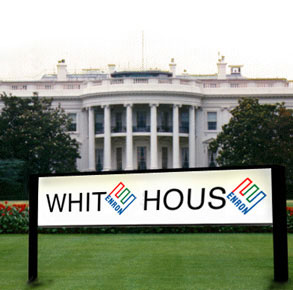
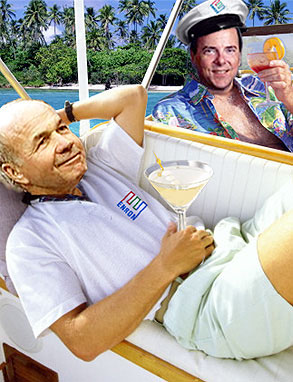
President Bush says he's getting tough on crime in the suites -- but his old friends at Enron might never see the inside of a jail.

  • more
    • All Share Services

Corporate getaways!

President Bush signed into law the accounting industry reform act on Tuesday, warning that “no boardroom in America is above or beyond the law.” On the heels of a series of high-profile federal crackdowns on alleged white-collar crime — the high-profile perp walk of Adelphia’s Rigas family, and likely indictment of WorldCom head Bernard Ebbers — Bush has been able to start transforming a public image that appeared more corporate lackey than crime buster.

With one major exception.

No one from Enron, the mother of all scandals, has been indicted, despite half a dozen congressional probes and judicial investigations and an SEC probe still diligently proceeding. And according to sources close to the investigation, nobody should hold their breath waiting for ex-CEO Ken Lay to make his own public walk of shame soon — if ever.

“It’s unlikely Jeff Skilling, Ken Lay or even Andrew Fastow will be charged with a crime right now,” said a Department of Justice prosecutor working on the case. “We’re dealing with a case here where Enron’s board of directors signed off on everything, and there were instances where there were some disclosures about these partnerships in federal filings. It makes it much more difficult to prove fraud.”

Enron’s outside auditors, accountants and law firms signed off on all the company’s controversial transactions. That could be a compelling defense tactic, according to the federal prosecutor.

It makes a striking contrast to the situation of John Rigas, the founder and chief executive of Adelphia, and his two sons, who were charged with looting the company by using more than $1 billion of company funds for personal business without disclosing it in Securities and Exchange Commission filings, an apparent bald-faced money grab. The corporate reform bill signed into law by Bush Tuesday forces CEOs and CFOs to certify their company’s financial results and requires executives to give back any ill-gotten gains. Had this legislation been in place prior to Enron’s bankruptcy, Ken Lay and Andrew Fastow would almost certainly have found themselves behind bars after details of Enron’s financial machinations were revealed.

But now is a different story. Enron made arcane references in past SEC filings to some of the complicated shell partnerships, particularly LJM and Chewco, it used to hide its debt, also disclosing that an Enron executive managed the partnerships. The SEC failed to review many of Enron’s past filings with the agency until it was too late. And despite the appearance of impropriety, Enron’s executives vetted all transactions through its board of directors and its auditing firm Arthur Andersen to use the partnerships. That means Skilling, the former president of Enron; Fastow, the ex-chief financial officer; and Lay, the former chief executive, could have a rock-solid defense.

And for a lot of people, that smarts. Especially politicians who have worked anti-Enron sentiment into such a fevered pitch, like Sen. Dianne Feinstein, D-Calif., who said Lay should be sent to prison and forced to pay back Enron’s investors hundreds of millions of dollars he received by selling stock, or Sen. Barbara Boxer, D-Calif., who said, “If Ken Lay knew about what Enron was doing, he should spend some time in prison.”

And on Tuesday, Senate Majority Leader Tom Daschle, D-S.D., suggested the SEC and the newly formed Corporate Task Force could bolster their credibility with a few key trophies. “I don’t know why we haven’t seen any indictments of Enron yet,” Daschle said. “I think more and more people, as I travel the country, ask, Why have there not been any indictments? What is going on there?”

And the public certainly followed their lead. In February, at the height of the scandal, a CNN/USA Today/Gallup Poll showed that 65 percent of the public thought Enron executives “did something illegal” (another 26 percent settled for “unethical”). More recently — and far less scientific — CNN’s “Moneyline” asked voters to respond online to the question: “How important is it to you as an investor that Enron executives ultimately be indicted?” Of those who responded, a whopping 97 percent said “very,” with 1 percent answering “somewhat” and another 1 percent saying it was not important.

How will that same public stomach images of Lay and other Enron executives lolling about in their Texas mansions on the one-year anniversary of Enron’s implosion? And what will that mean for a president whose own close ties with Lay and Enron are fixed in the public’s imagination?

Informed observers believe indictments are still likely, if not close. Phillip Hilder, a former federal prosecutor who represents Enron whistleblower Sherron Watkins, said he believes “indictments are absolutely inevitable.” Hilder explains that “it would be naive to think there wouldn’t be any indictments after all the evidence is in. There’s too much pressure on the government not to indict. The evidence I have seen is leaning toward indictments.”

Hilder also thinks political pressure on the Justice Department makes expediency all the more likely. “It’s understood within the ranks of the Justice Department that indictments will have to be handed down before the November election in order for the Bush administration to show that its close ties to Enron had no bearing on the government investigation,” he said.

A Newsweek report also suggested this week that the Justice Department prosecutors “have dramatically accelerated their probe of Enron” and that an “indictment of the firm’s former chief financial officer, Andrew Fastow, could come as early as next week.”

But both the prosecutor and Justice spokesman Bryan Sierra have denied such claims. The Enron probe is “not about politics,” Sierra said. “If and when charges are filed against former Enron executives it will be only when the Justice Department is certain it has very strong evidence and an open-and-shut case.”

But it could take, according the DOJ prosecutor, as long as two years to fully understand the scope of Enron’s partnerships and whether Fastow or other Enron executives engaged in fraud. The Justice Department is hoping to secure the cooperation of people who were directly involved in the partnerships and now face the threat of being sent to prison for fraud, the prosecutor said. Case in point: Last week Justice said it had indicted three former British bankers who worked for London-based National Westminster Bank, which owned a 45 percent stake in an Enron partnership managed by Fastow, and were charged with siphoning $7 million from the bank after it sold its share in the partnership in April 2000. The bankers were indicted last week and are expected to be extradited to the United States soon.

The prosecutor said the government has already received word from an attorney representing the bankers that they would cooperate with the Justice Department’s probe in exchange for immunity. That could help the Justice Department secure an indictment against Fastow within the next month, but that’s highly unlikely, the prosecutor said.

There’s certainly no proof that the government is going soft on Enron or its partners. In June, a Houston jury found Arthur Andersen guilty of obstruction of justice for shredding Enron documents after the SEC said last October that it was investigating the company’s accounting practices. And this week lawmakers claimed that Merrill Lynch aided and abetted Enron in some slippery investment deals.

But that’s not the same as bagging one of Enron’s big names. Newsweek also reported that lawyers for Fastow have tried to arrange a plea bargain. But a source close to Fastow claims Fastow was recently approached by the Justice Department and offered a deal in exchange for leniency, and that Fastow vehemently refused. “In his mind, he did nothing wrong,” the person close to Fastow said. “He was just doing his job.”

Hilder, meanwhile, says, “I don’t believe the government will try and offer Fastow a deal until after charges are filed. The government, from what I hear, wants to make Fastow the poster child for corporate greed and they will parade him around in front of the news after they indict him to prove it.”

White out?

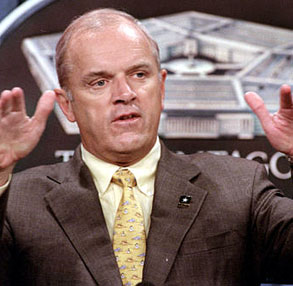
As Army secretary Tom White prepares to testify before Congress, Democrats predict the former Enron executive will be the first Bush administration casualty in the growing uproar over corporate sleaze.

  • more
    • All Share Services

White out?

For seven months now, Democrats on Capitol Hill have been trying to find out what, if anything, Secretary of the Army Thomas White knew about Enron’s suspect accounting practices while he was vice chairman of that company’s retail unit. Specifically, they want to know if he was aware that Enron used manipulative trading tactics to take advantage of California’s electricity market.

We may find out Thursday, when White — the highest-ranked administration official to do so — will testify about his role with Enron.

Or will he?

In a Newsweek report released Sunday, Republican sources are cited as saying that they wish White would resign rather than testify and also that White will invoke the Fifth Amendment and not answer questions if he does appear before the Senate Commerce Committee. That prompted Rep. Billy Tauzin, R-La., who heads the House Energy and Commerce Committee, to suggest that White might deserve a pink slip. “If you’re going to do that, maybe you ought to find another job,” Tauzin said on ABC’s “This Week.”

But on Monday, Pentagon spokesman Maj. Mike Halbig told Salon that White would testify and would not take the Fifth. Later, in a statement to the Associated Press, White said that not only would he testify, but also that he had no intention of resigning his post.

If he does testify, White will face some senators who appear to have made up their mind about him. The Army secretary has become a regular whipping boy for Democrats since last fall, when his job at Enron was first spotlighted. There was White’s failure to sell off his $12 million in Enron stock until October, five months after he took his job with the Bush administration. There was his statement to a congressional committee that he had had 29 contacts with his former colleagues at Enron, when that number proved to be 84. And, most controversial, there was his role as vice chairman of Enron Energy Services, the scandal-plagued unit responsible for providing electricity services to large and small businesses.

White rose to head the division during 11 years at Enron. But Energy Services has been accused of using bookkeeping sleight-of-hand to turn multimillion-dollar losses into multimillion-dollar profits. For example, Enron whistleblower Sherron Watkins told Congress that White’s retail division shifted losses totaling a half-billion dollars to his wholesale division, allowing retail to show a $105 million profit. But with his bonuses tied to performance, White raked in more than $30 million last year.

White’s performance before the committee will be made even more difficult by its timing. According to a Senate source, a morning hearing will precede White’s testimony and focus on corporate responsibility. It will include testimony from former Sen. Howard Metzenbaum (now with Consumer Federation of America), and Joan Claybrook, director of corporate watchdog Public Citizen, a dogged White critic.

Stacked deck or not, some members of Congress already have firm beliefs about White. According to sources close to Sen. Barbara Boxer, D-Calif., and Rep. Henry Waxman, D-Calif., both have concluded from interviews with former Enron employees that White is unfit to be secretary of the Army.

“Either Secretary White was an out-to-lunch executive while he was vice chairman of Enron or he knew about the company’s high jinks,” said a deputy counsel to one key Democratic lawmaker. “Either way, based on those two scenarios, he’s screwed. He’s certainly not fit to be secretary of the Army.”

White has maintained that while he was at Enron he was unaware of any of the company’s shady business practices.

But aides to Waxman and Boxer told Salon that they have spent the past month phoning more than two dozen former executives and salespeople of Enron Energy Services.

The questions posed to the former Enron employees: Was Thomas White familiar with Enron’s accounting practices? Did he take part in meetings where the company’s accounting practices were discussed? Did Thomas White ever tell you to use mark-to-market accounting when showing profits? What were White’s and EES’s roles in the gaming of the California electricity market?

Some employees told investigators that White — whom everyone referred to as “the general” — was unaware of Enron’s off-the-books partnerships and manipulative trading tactics. And other former colleagues contacted by Salon agreed.

“I know everyone would like to implicate him, but he didn’t know anything,” says Margaret Ceconi, a former finance executive at EES. Ceconi had written a letter to ex-Enron chairman Ken Lay last August, raising concerns about EES, saying it was hemorrhaging cash despite showing strong earnings.

But Steve Barth, an EES vice president who left the company last July, said White was fully aware of EES’s accounting practices and knew full well that the unit played a part in California’s energy crisis. White “was there every step of the way,” Barth told Salon. Barth left EES and went to Enron’s broadband unit in 1999 before leaving the firm last July. He has spoken with investigators for the Senate committee.

The energy crisis that rocked California in 2000 and 2001, with its unprecedented power prices and rolling blackouts, played a key role in the rise and fall of the Enron Energy Services division, former executives said. Some former EES executives said skyrocketing power prices enabled the division to sign contracts with large businesses whose owners feared they would be hit with expensive electricity bills — or would lose millions in blackouts. The crisis in California also helped the retail unit sign contracts with large businesses in other states because business executives feared deregulation of their electricity markets would result in a California-like crisis.

During the height of the crisis, EES signed more than $1 billion in long-term energy deals with companies such as Compaq Computer, Starwood Hotels & Resorts, Rich Products, and Prudential Insurance of America, all of which have operations in California.

Moreover, the December 2000 Enron memos, which detailed how the company’s traders tried to boost wholesale electricity prices and exploit loopholes in California’s electricity market, described the integral role played by EES. The Enron attorneys who wrote the memos outlined an example of a practice whereby Enron would schedule 1,000 megawatts of electricity for delivery to EES. But the unit would take only 500 megawatts, generating a bonus for Enron for the remaining electricity that California’s grid operator would pay under the market rules.

Enron also facilitated the strategy for other companies using a “dummied-up” load from EES, the memos say.

White told reporters shortly after the memos were made public in May that he had no knowledge of the trading tactics.

“We were a customer of the wholesale group. We were not privy to their strategies,” he told the Washington Post. If power buyers at his unit were involved, “I was not aware of it,” he said.

Still, several former energy services executives told Salon that White’s primary role, as “cheerleader,” was to cultivate new business for EES and help Enron sign contracts with the military.

Either way, White appears to be in a tough position: Did he know about EES’s shady practices? If not, why not? While taking the Fifth might mean political suicide, his options Thursday don’t remain substantially more attractive. The Washington Monthly recently argued that if “White [had] made his missteps in any previous administration, he most certainly wouldn’t have lasted.” His performance Thursday will surely determine if he’ll continue to.

Continue Reading Close

California payback may fall billions short

Gov. Gray Davis wants $8.9 billion refunded from energy companies. But Bush regulators tell Salon they'll recommend just a fraction of that -- and Democrats are ready to cry foul.

  • more
    • All Share Services

Now that President Bush has promised to hold corporations and CEOs accountable for corporate malfeasance, how will his appointees on the Federal Energy Regulatory Commission handle the thorny issue of $8.9 billion in refunds California says it is owed by energy companies that manipulated power prices in the state in 2000 and 2001?

According to one FERC commissioner, “the energy companies are going to get a slap on the wrist.”

“I am not looking forward to breaking the news to Governor Gray Davis,” one of the FERC’s four commissioners told Salon. “We just can’t justify granting California $9 billion in refunds. There’s just not enough proof to support the claim.”

Despite mounting evidence that shows how companies such as Enron, Reliant Energy, Dynegy Inc. and Williams Companies exploited loopholes in the state’s flawed power market to inflate revenues, FERC is gearing up to release an eagerly anticipated report that says California is owed no more than $1.2 billion, according to two FERC commissioners and an administrative law judge working on the issue.

When called for comment, Sen. Dianne Feinstein, D-Calif., said the FERC has turned a blind eye on California for too long. “How much more evidence do they need?” Feinstein said. “California was ripped off.”

Feinstein has sponsored legislation that would increase regulation of the multibillion-dollar market for such energy derivatives and give the Commodity Futures Trading Commission, which regulates the derivatives market, authority to ensure that energy markets were free from fraud and manipulation. The CFTC, however, is split on the need for such regulation. A similar measure was narrowly defeated as an amendment to the Senate energy bill. But many lawmakers said the collapse of Enron and increasing evidence of corporate wrongdoing have added urgency for congressional action to restore business and consumer confidence.

The FERC probe involved energy companies that sold power in California and 10 other Western states during 2000 and 2001. The companies filed sworn affidavits with the FERC, most of which said the corporations did not engage in manipulative trading practices. One FERC commissioner said most of the trading practices appear to be manipulative, but are entirely legal. But Congress is looking to give the FERC broad powers to impose civil and criminal penalties to deal with the issue of market manipulation in California.

The FERC commissioners, however, said their decision is also based on the possibility that forcing energy companies to refund billions of dollars could put some of the companies permanently out of business and wreak havoc on the already volatile energy market.

“Simply put, some of these companies, like Reliant, Williams and Dynegy, are facing a financial crisis,” one FERC commissioner said. “They have to borrow money just to stay in business. How are they going to refund money that doesn’t exist?”

The stocks and bonds of Williams, Reliant, Dynegy and at least a dozen other energy companies have been hammered since the collapse of Enron in December and continue to fall while new allegations surface almost daily about the companies’ financial machinations.

Steve Fleishman, an energy analyst with Merill Lynch in New York, agrees that the energy companies’ stocks are under pressure, and says that if a large refund were ordered by the FERC it could cause some of those corporations to collapse. “Clearly the energy merchants and independent power-producer companies are under severe financial stress and a large refund will certainly not help,” Fleishman said. “On the other hand, we’ve also never seen the basis for a refund that’s been alleged.”

Recently, FERC released documents that showed how some of those companies engaged in manipulative trading practices in California that resulted in skyrocketing power prices and led the state’s largest utility, Pacific Gas & Electric Co., to file for bankruptcy protection because it could no longer afford to buy power for its customers.

But now, according to an FERC commissioner, executives at Dynegy and Williams have taken the unprecedented step of handing over financial documents to the commission just to prove that their companies face a cash crunch. “I’m not an accountant but it doesn’t take a genius to figure out that these guys don’t have any money in their checking account,” the FERC commissioner said.

And the FERC administrative law judge said the agency’s decision was also based on a report released last month by the General Accounting Office that reports that California’s electricity crisis was caused by demand outstripping supply, along with a downturn in the economy.

Representatives for the Williams, Reliant, Dynegy and Mirant companies would not comment for this story, citing the ongoing FERC investigation. But Democrats said the statements by the FERC commissioner prove their point that President Bush’s close ties with big business — specifically giants in the energy industry — have had an impact on his administration’s ability to make sound policy decisions.

Steven Maviglio, press secretary for Davis, said it would be “inconceivable” for the FERC to order a refund of anything less than the full $8.9 billion. “After the recent reports of market manipulation and collusion among generators, it is inconceivable to Governor Davis that FERC would give California anything short of the full $8.9 billion in refunds,” Maviglio told Salon. “What it determines will be whether the agency does indeed have teeth or if it will revert to being a lapdog for the power industry.”

Since Davis was elected governor in 1998, he has spent much of his time in office deflecting criticism of his handling of the state’s energy crisis. His critics say he acted too late and spent too much time vilifying out-of-state energy companies and pointing fingers rather than taking proactive steps to deal with the issue.

The state spent $43 billion on electricity contracts at the height of the power crisis, but revelations about market manipulation by Enron and others led Davis to file a complaint at FERC to abrogate the deals.

And for Davis, in the middle of a reelection campaign, winning substantial refunds from FERC remains, for many reasons, an urgent priority.

Continue Reading Close

What did Skilling know?

Evidence suggests that the former Enron president knew more than he led Congress to believe when he testified.

  • more
    • All Share Services

What did Skilling know?

Now that federal prosecutors have secured a guilty verdict against accounting firm Arthur Andersen for shredding crucial documents related to Enron’s finances, the Department of Justice is expected to turn its attention to Enron, with possible indictments against former executives coming soon for violating federal fraud statutes.

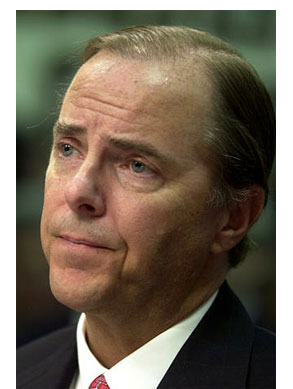
According to sources close to the Justice Department’s probe, former Enron president Jeffrey Skilling is facing particular scrutiny. And Exhibit A against him could be testimony he gave before Congress in February, when he claimed he knew little about one of Enron’s byzantine partnerships.

“Congressman, Enron Corporation was an enormous corporation. Could I have known everything going on everywhere in the company? I had to rely on the best people. We hired the best people. We had excellent, excellent outside accountants and law firms that worked with us to ensure,” Skilling testified. “At no time did I enter into any transaction or was I personally involved in any transaction that I believed was not fully in the interest of Enron shareholders.”

But that does not appear to be entirely true. Especially considering his close relationship to one particular partnership named after the furry but ferocious “Star Wars” character, Chewbacca.

Chewco accounted for two-thirds of Enron’s losses over a four-year period beginning in 1997. It is one of the complex partnerships that Enron employed to keep billions of dollars of debt off its books, boosting its profits and credit level along the way. Enron executives participated in these partnerships and earned millions of dollars, which has now raised major conflict-of-interest issues being investigated by Congress. The legality of Chewco remains central to the examination of Enron and its bankruptcy. Joseph Bernardino, the CEO of Enron’s auditor, Arthur Andersen, testified before Congress in December that Chewco’s creation may have been illegal because it lacked the required 3 percent interest from an independent third party necessary for it to be treated as a separate company and not an Enron subsidiary.

Federal investigators say they are interested in finding out who knew about Chewco, what they knew about its financial structure and when they knew it. Anyone who knew that Chewco didn’t qualify as an independent entity but allowed it to be treated as such might have violated federal fraud statutes, the investigators say. But in interviews with me (while I was at the Dow Jones Newswire), with the New York Times and with the Houston Chronicle in December, Skilling said he did not know the details of Chewco’s financial structure.

However, according to the minutes of a Nov. 5, 1997, meeting of Enron’s board of directors, which Skilling took part in via telephone conference call, the one-time president of the country’s sixth-largest corporation appeared to know much about Chewco from the moment it was being established.

At the board meeting, Skilling instructed his protégé, former Enron chief financial officer Andrew Fastow, to discuss Chewco. “Mr. Skilling explained the background of the joint-venture by an affiliate of the company and the California Public Employees Retirement System [CalPERS] in Joint Energy Development Investments Limited Partnership,” the board minutes state. “He called upon Mr. Fastow to discuss the recommended action. Mr. Fastow referred the committee members to the material for the meeting, a copy of which is filed with the records of the meeting. He explained that Chewco Investments LLC, a special purpose vehicle not affiliated with the company or CalPERS, would acquire the 50 percent interest owned by CalPERS in JEDI for $383 million. He stated that a corporate guaranty of a $383 million bridge loan and a corporate guaranty of a $250 million loan to Chewco would be required. He reviewed the economics of the project, the financing arrangements and the corporate structure of the acquiring company. He recommended that the committee approve the corporate guaranties associated with the transaction.”

A discussion of Chewco followed, details of which were not included in the minutes, and the board then approved the creation of Chewco.

Furthermore, sources close to the Justice Department’s probe of Enron told Salon that former Enron treasurer Ben Glisan, who was responsible for Chewco’s accounting matters, is cooperating with the federal government and is providing details about Skilling’s role in getting Enron’s board to approve Chewco. Glisan and his attorney could not be reached for comment.

Congress, in its months-long probe of Enron, questioned Skilling in February specifically about Chewco, but only briefly. At the time, the congressional panel was only interested in learning whether Skilling knew that a former Enron employee managed the Chewco partnership, which would have been a violation of Enron’s code of ethics. Skilling said he did not.

But had Congress fully understood the importance of Chewco, and that it was created to purchase the interest in another partnership Enron entered into with the California Public Employees Retirement System in 1993, then Congress also would have learned that Skilling had much to gain financially from Chewco’s creation.

In September 1997, Skilling and Fastow paid a visit to Sacramento, Calif., to pitch CalPERS on a $1 billion joint venture known as Joint Energy Development Investments II, or, following the “Star Wars” theme, JEDI II. The partnership would invest in broad energy projects around the globe.

CalPERS was already invested in a similar partnership, JEDI I, which Enron and CalPERS started in 1993 with $500 million. But JEDI I was limited to investing in natural gas projects, whereas JEDI II would have its pick of energy projects, from oil to fuel cells.

“JEDI II was a better opportunity investment-wise for CalPERS,” said CalPERS spokesman Brad Pacheco. “Skilling met with members of our board in September to discuss the idea.” However, there was a catch. CalPERS would only invest in JEDI II if Enron found a buyer for CalPERS’ 50 percent interest in JEDI I, which at this point was valued at $383 million.

Fastow spent six weeks attempting to find an investor for JEDI I, sources close to Fastow said, but there were no takers. So Fastow pitched the idea of Chewco to Skilling, and Skilling told Fastow “to make it happen,” according to sources close to Fastow.

Bruce Hiler, Skilling’s attorney, said his client believed that the assets in JEDI I were very valuable and that there were plenty of outside parties ready to invest in JEDI I, but ultimately Fastow came up with the structure for Chewco and that Skilling was “totally unaware” of the financial structure of the partnership.

“My client believed there were people ready to invest in JEDI I,” Hiler said. “These assets were very valuable. He thought that Chewco was a totally legitimate entity because that’s what he was told by Fastow.”

Gordon Andrew, a spokesman for Fastow, declined to comment.

Skilling spent the next two months speaking with CalPERS about the JEDI II partnership, assuring the pension fund that Enron would find an investor to purchase CalPERS’ interest in JEDI I, Pacheco said.

In October, Fastow worked on Chewco’s financial structure. The partnership was made up of Enron executives and some undisclosed outside investors. But Chewco didn’t have the $383 million to purchase CalPERS’ interest in JEDI I. So Enron lent Chewco $132 million and guaranteed a $240 million loan, all of which Skilling was fully aware of, according to people close to Fastow.

But there was still the matter of an additional $11.5 million for Chewco to come up with. It was an important number, because it was more than 3 percent of Chewco’s capital and if it had been invested by an outside source, it would have allowed Enron to keep Chewco off its balance sheet. However, Enron provided collateral for about half of Chewco’s $11.5 million investment, meaning it fell far short of the 3 percent requirement to be considered an independent entity. JEDI and Chewco should have been included on Enron’s books. By keeping the partnership off Enron’s balance sheet, the company inflated its profits by $396 million over the next three years.

Now, with Enron’s executive committee approving the Chewco transaction, Skilling went back to CalPERS, Pacheco said, and told the investment committee that Enron had found an investor to buy its share in JEDI I.

“We had no idea that it was Chewco,” said Pat Macht, head of CalPERS public affairs.

The following month, on Dec. 15, 1997, Skilling made a final presentation to CalPERS in Sacramento about the JEDI II joint venture and promised the pension fund a huge return on its investment. The CalPERS board voted and approved the fund’s investment in JEDI II.

And on Dec. 30, the financing for Chewco closed.

“Greed,” said one Justice Department official. “It was all about lining Jeff Skilling’s pockets.”

It appears that Skilling had a lot to gain from CalPERS’ investment in JEDI II. He held a 5 percent “phantom” equity stake in Enron Energy Services, an Enron spinoff that JEDI II invested in, according to a March 1997 Enron proxy statement. Phantom equity is used as incentive, primarily by small- and moderately sized and non-publicly traded businesses, to reward executives for helping to make a business grow.

EES was Enron’s then-newly formed retail-energy unit, and it was struggling to sign up small business and residential consumers to electricity services. Just weeks after Skilling sold CalPERS on forming JEDI II, the pension fund and the Ontario Teacher’s Pension Plan invested a total of $130 million in EES, according to an Enron news release at the time.

CalPERS’ investment in EES was done through JEDI II, and the Ontario fund invested in EES directly. The investments gave CalPERS and Ontario a combined 7 percent stake in EES. Enron then valued the company at $1.9 billion, based on that investment and forecasts of future business.

With the $1.9 billion estimate, Skilling’s 5 percent phantom equity was worth an estimated $100 million, according to Enron financial documents.

Enron booked a profit for EES based on the pension-fund investment at a time when EES still hadn’t secured any new business. Skilling did disclose his 5 percent stake in EES to CalPERS prior to the pension fund agreeing to invest in JEDI II, Macht said, and CalPERS did not view it as a conflict of interest.

Skilling’s lawyer, Hiler, said Enron converted Skilling’s 5 percent phantom equity in EES into Enron common shares shortly after the investments in EES by CalPERS and Ontario. But Skilling decided not to take the entire $100 million and instead settled on $33 million because he wanted to reinvest in Enron, Hiler said.

Enron kept Chewco’s activities off its balance sheet through last March, when Enron bought Chewco. The transactions with Chewco and other partnerships led in part to the $1.2 billion reduction in shareholder equity in October that was the start of Enron’s undoing. But by that time Skilling, who had resigned from the company Aug. 14, was long gone.

Continue Reading Close

What did Bush know?

An anonymous ex-Enron official says the White House knew about the company's impending demise as far back as August.

  • more
    • All Share Services

What did Bush know?

According to a former Enron Corp. executive under congressional investigation in relation to the company’s collapse last fall, an Enron lobbyist tipped off the Bush administration last August about the company’s impending financial problems.

Enron lobbyist Pat Shortridge met with White House economic advisor Robert McNally Aug. 15, the day after Enron president Jeff Skilling resigned, to alert the White House that Enron could face a financial meltdown that could possibly cripple the country’s energy markets, the former Enron executive told Salon this week.

“It was very well known that Enron faced a financial meltdown,” the former executive said. “The day that Jeff resigned our stock plummeted. We knew it wouldn’t rally. What we didn’t know was how the financial problems at Enron would impact the energy markets in the U.S. That’s why Pat met with Mr. McNally. To find out.”

When contacted for a response, a White House spokeswoman, Anne Womack, would only point out that the meeting was acknowledged by the White House on May 22 in documents released to reporters and Sen. Joe Lieberman, D-Conn., chair of the Senate Governmental Affairs Committee. In those documents, it was noted that “Mr. McNally met with Mr. Shortridge and another individual who was not from Enron.” Asked whether Enron’s future was discussed, Womack said, “If the meeting was about that, I would assume there wouldn’t be anyone else there besides Mr. McNally and Mr. Shortridge.” A spokesman for Enron refused to comment for this story.

If McNally was tipped off to Enron’s troubles it would mean that White House had been warned several months earlier than it has previously acknowledged of Enron’s failing fortunes, which caused thousands of employees to lose tens of millions of dollars in retirement benefits. It would also mean the White House received such a warning even before Sherron Watkins delivered her famous memo to then Enron chairman Kenneth Lay, warning that the company’s byzantine partnerships could destroy the company.

It also fuels the most common question plaguing the administration these days: What did President Bush know, and when did he know it?

On Tuesday, the White House turned over more than 2,000 pages of documents to Lieberman, complying in part with subpoenas from his committee seeking White House documents showing Bush administration contacts with Enron. It is still unclear whether further details of the Aug. 15 meeting are mentioned in the documents. Contents of the newly released documents are being reviewed by Lieberman’s committee, and will be released only when it “serves the public interest,” Lieberman said. In the meantime, Lieberman has agreed to provide the White House 24 hours notice before making public any of the documents, which will be highly guarded. Under an agreement with the White House, only a limited number of staffers from the committee will have access to the documents, and must first sign a confidentiality agreement.

When asked about the Aug. 15 meeting, Leslie Phillips, a committee spokeswoman, said it “should definitely have raised a red flag,” Phillips said. “We’ll have to investigate that.”

So far, all that is known of the documents released Tuesday is that they reveal communications between the administration and Enron relating to Vice President Dick Cheney’s energy task force, the California energy crisis, Enron’s bankruptcy filing and White House appointments, including a letter former chairman Lay sent Jan. 8, 2001, to Bush’s personnel director, Clay Johnson, recommending seven candidates to the Federal Energy Regulatory Commission. Two of the candidates Lay recommended, Pat Wood and Nora Brownell, were appointed to FERC by Bush; Wood was appointed chairman.

The August meeting raises further questions about the administration’s interactions with Enron, a company with especially close ties to the Bush White House, which has been notably inconsistent on its spin about Enron since the company filed for bankruptcy on Dec. 2, 2001.

On Tuesday, Bush’s chief counsel, Alberto Gonzales, would not comment on the substance of the meeting between Shortridge and McNally. He said that there is no known instance of Enron officials asking White House officials for help before the company filed for bankruptcy in December.

But Enron did seek help from the Bush administration prior to the company’s bankruptcy filing in December, according to documents released by the White House earlier this year. According to those documents, Lay called Treasury Secretary Paul O’Neill on Oct. 28, to advise him that Enron was heading toward bankruptcy. The following day, Lay asked Commerce Secretary Don Evans for help in heading off a downgrading of Enron’s credit rating by Wall Street credit rating agencies, which would push the company into bankruptcy. A week later, Enron president Greg Whalley called Treasury Undersecretary Peter Fisher six to eight times, seeking help in getting banks to lend more money to Enron.

The White House also announced in January that Lawrence B. Lindsey, who heads Bush’s National Economic Council, had directed a review in October — before the calls received by O’Neill and Evans — to see whether an Enron collapse could have a strong impact on the American economy. That admission prompted critics to sound several alarms.

As Jennifer Palmieri, a spokeswoman for the Democratic National Committee, said at the time, “it shows once again that the administration did a lot of thinking about the fact that the company was going to collapse but they did absolutely nothing to make sure that 50,000 Enron employees would not lose their life savings.”

It also drew closer attention to the intensely close ties between Enron and the Bush administration. Lindsey had been a paid consultant for Enron, receiving $50,000 in 2000. And he is just one of other top White House and Republican Party official with close Enron ties, including Robert Zoellick, the United States trade representative, who sat on an Enron advisory board in 2000; Karl Rove, the senior White House political strategist, who held more than 1,000 Enron shares before selling them in June 2001; and Marc Racicot, chairman of the Republican National Committee, who worked as an Enron lobbyist last year.

Then there’s Enron’s close financial ties to the Bush campaign. Enron and its employees gave more than $1 million to Bush’s 2000 election campaign, the Republican Party and the Bush Inaugural, and Bush aides used the Enron corporate jet during the post-election fracas in Florida.

White House press secretary Ari Fleischer told reporters this week that he hopes Lieberman does not use the documents turned over to his committee as a “fishing expedition.”

“I hope the question from the committee is focused on any prior knowledge about Enron’s bankruptcy, and communications with Enron where information about bankruptcy could have been conveyed, and not an open-ended fishing expedition about any contact with anybody at Enron for any reason,” Fleischer said.

Continue Reading Close