Jason Roeder

My life’s liner notes

At age 7, I exploded onto the pop/minimalist scene playing the first eight notes to "Star Wars." Note how "Barnaby Jones" swells as I leave to eat fish sticks.

  • more
    • All Share Services

My life's liner notes

Producer Brian Eno famously said that while only a few thousand people bought the Velvet Underground’s first album in 1967, almost all of them went on to start a band. Significantly, Jason Roeder was born just five years later. Crooner/prophet, proto-minimalist provocateur, Afro-Cuban puppeteer/rickshaw operator/YMCA member — try as we might, the usual generalities fail us. And as this compilation demonstrates, they failed Roeder, too.

1. The First Eight Notes to the “Star Wars” Theme: In December of 1979, Roeder turned 7. And he was worried. Sid Vicious had already checked out, and Roeder wondered if he’d make the scene before punk’s inevitable implosion. At the time, he said in his typical cryptic fashion: “What food group does Tang go in?” But more than anything, he wanted to be a Jawa, one of the cowled sand-dwelling gnomes with flashbulb eyes that appeared in “Star Wars.” Roeder, a natural but profoundly limited autodidact, sat down at the upright piano his mother had once taken lessons on and began to play. Ten months later, he finished the first cut on this CD. If you listen carefully, you can hear “Barnaby Jones” on the television in the background and eventually nothing but, as Roeder leaves the piano to go watch the show and eat fish sticks.

2. A Piece of Wood, Sort Of: Thousands of miles away from the burgeoning New Wave scene, Roeder was participating in a compulsory country-western performance organized by the bloc of 4th-grade teachers at his Florida elementary school. The 20 or so students prejudged as most untrustworthy with a solo instrument were provided with two sticks to knock together when very specifically pointed at. Roeder was given one stick. In this cut, a performance of the Oak Ridge Boys’ “Elvira,” Roeder is inaudible except for a small disruption in the second chorus during which he drops his stick.

3. Moonlight: While hair metal bands conquered the charts and hip-hop staked its own claim in popular music, Roeder spent most of the first half of the 1980s in a haze of book reports and sleeveless surf-themed T-shirts. His musical journey hadn’t even begun, but he was at a crossroads. Though he had already gone through three piano teachers, he was mature enough to lay the blame not on them, but squarely where it belonged: the piano. Shortly after picking up the guitar, Roeder was recruited by an acquaintance in his 8th-grade English class to join the band Dublin, an emerging U2 rip-off project. In “Moonlight,” written by some guy named Alan, Roeder drives the gibberish lyrics with a relentless E-minor chord until the clamor frays, each player bowing out to pick through Alan’s Playboy stash.

4. Three-Legged Lover: Nearing high school graduation, Roeder turned to lyrics in order to expand his artistic palette. It was during this period that he completed his only original song, “Three-Legged Lover.” Best known for its provocative chorus — “She’s got three legs and three very high heels/ something like a tricycle, except not with wheels/ She’s got two to run and two to jump/ she puts the third aside for her dog to hump” — the song somehow never climbed past No. 52 even on Roeder’s imaginary charts. In this track, Roeder mumbles a cappella while waiting for his mother to pick him up from his after-school job at the movie theater. The intermittent growling is from the lowrider circling the parking lot for no apparent reason.

5. Minuteman March: In the early ’90s, grunge exploded out of Seattle like a flannel supernova. Meanwhile, on the East Coast, Roeder was a college freshman who had grown frustrated with the many expressive limitations of the guitar. He had also put aside songwriting — “Words are for people with nothing to say,” he repeatedly declared without irony — and went in search of an instrument with more sonic possibilities. He took up the drums, and it only made sense: He was sharing a tiny dorm with a roommate, had a crushing course load, and had the rhythm of a cinder block rolling down a flight of stairs. Here, in “Minuteman March,” Roeder practices elementary snare rudiments. Curiously, he received few complaints from his neighbors, who would later report they would’ve felt awful disturbing someone’s physical therapy.

6. to 35. Gratuitous Remixes

And, suddenly, Jason Roeder was gone. He came back five minutes later because he forgot his keys, but then he was gone again, and for real. It’s been a decade. We’ve all heard about the dubious sightings — the grizzled transient who sleeps in a dryer, the pine-cone salesman, the thirtysomething who looks exactly like Roeder, claims to be him, and has matching fingerprints and dental records — but these are just phantoms conjured by a generation that needs a hero more than ever. Iconic music journalist Lester Bangs once remarked, “Every great work of art has two faces, one toward its own time and one toward the future, toward eternity.” Ten years after Jason Roeder vanished, this much is clear: I finally managed to work Lester Bangs into these liner notes.

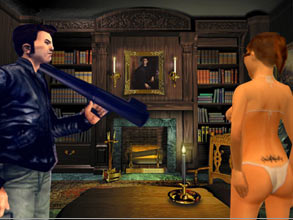
“Grand Theft Auto: Myst”

In the most gorgeously conceived AND ultraviolent video game in history, you can open fire on passing cars with a bazooka while exploring universal archetypes!

  • more
    • All Share Services

Objective: Climb the ranks as a gangland sociopath by ruthlessly solving a series of intricate puzzles dispersed throughout the fantasy worlds of “Myst.” But that’s just the game’s narrative dimension. Half the fun, of course, is exploration for its own sake, so if for some reason you’re losing interest in, say, valves and knobs, just take a break from the storyline and wander. The realms of “Myst” aren’t mere pixilated backdrops, but vivid and highly interactive landscapes. If you simply dash from screen to screen, you’ll miss out on many of the game’s treasures, not to mention some nicely situated sniping perches.

Start: The game begins simply enough: You find yourself on an island. You don’t know how you arrived in this magical place — you’ve only been out of the joint three hours, and you hope to fuck you’re not in Jamaica because you know way too many Rasta men with scores to settle. But unraveling the astonishing truth will take all your wits. Then, it will take the wits of smarter friends, and then it will take the wits of a shut-in who wrote a walk-through.

How did this game come about?

With the release of “Revelation,” the fourth installment of “Myst,” not to mention several derivative novels, the creative team at Cyan worried that the title had played itself out. For a jump-start, the company turned to collaborations with long-standing video game icons. Those early partnerships, however, failed to produce the desired synergy. In other words, there’s a good reason you haven’t played “Ms. Pac-Myst.”

But the “Grand Theft Auto” and “Myst” series seem so aesthetically opposed. How did the programmers manage to integrate them?

Obviously, compromises had to be made. For example, if you’ve played “Myst” before, you know that go-go clubs are scarce and that there’s no Little Havana, per se. Similarly, in “Grand Theft Auto,” the only reason you might find yourself in a library is because you’re hiding from the SWAT helicopter. Balance was key: Just the right amount of urban development — followed by just the right amount of urban decay — was needed to create a picturesque dreamscape that could also credibly be swimming in guns.

“Myst” is pretty much uninhabited, while “GTA” is all about the characters. How did they get around that?

To be honest, there wasn’t any coherent, plausible way to populate “Myst” within the existing mythos. Instead, the game’s creators took a bold meta approach. All the inhabitants of “Grand Theft Auto: Myst” are the virtual presences of players who attempted a previous version of “Myst” but gave up forever after 45 enchanting minutes. Without a directing intelligence to guide them, these “afterimages” eventually coalesced into a crude, benighted society — prostitutes, drug lords, tourists.

What about Atrus?

For those of you unfamiliar with the name, Atrus is the architect of all the “Myst” realms. He’s wise, avuncular, and needs your help — a lot, and for free. The folks at Cyan wanted to keep him that way. Rockstar Games, which puts out the “GTA” series, wanted to go in a different direction with “Myst’s” most important character. In the end, an agreement was reached: Atrus — still wise, still avuncular — would be recast as a harmless rare-book dealer who occasionally troubled players with small errands: picking up 700 kilos of rare books at an abandoned quarry, connecting a rare book to the ignition of a Russian mafia lieutenant’s car, and so on. In addition, Atrus’ ether addiction could be toggled on and off.

There’s something so pristine and nonthreatening about “Myst.” I’m worried that it will resensitize me to violence.

I know what you mean. There’s that one-of-a-kind “Grand Theft Auto” moment when you’ve beaten a hooker senseless with a golf club, dragged a tourist from his station wagon, and sped off down a crowded sidewalk, only to realize your sole regret is that you jacked a car with such crummy acceleration. Meanwhile, one of “Myst’s” strengths is the way it attunes you to your environment — not the state of mind for a proper rampage. If you don’t have preexisting grudges you can channel into mayhem, just let all the synthesizer music seep into the more reptilian parts of your brain for a few hours. Trust me, you’ll be ready for a drive-by.

How about some hints?

Sorry, I can’t just give the game away. All right, here’s one. When you find the corpse of Fabiano the Snitch in the crystal forest, jot down in your journal the bullet holes in his chest, abdomen and groin. You’ll be pleasantly surprised to find that they form constellations you’ll need to know later on.

I’ve always been a fan of nonviolent games. I just have to say that I’m really disappointed by all this.

If that’s the case, I highly recommend you also avoid the next version of “Tetris.” You’ll find the pimps distracting.

Continue Reading Close

“I remember the day … “

Commentaries rejected by "All Things Considered."

  • more
    • All Share Services

“I was at the grocery store the other day when I noticed that two of the checkout lines had customers but no one ringing them up. People were scanning their own soup cans and weighing their own tomatoes, and then they bagged their purchases at the prompting of a digitized female voice. Well, there goes another human interaction, I thought. What ever happened to the days — not too long ago, even — when there was a flesh-and-blood person to belittle, someone you could browbeat into hysterics for not doubling your coupons for Rice Chex from 1987. You know, I used to tell 15-year-old cashiers that they were so hot, TV dinners baked right in their hands. Try telling that to a computer.”

- – - – - – - – - – - -

“My daughter, Katherine, just turned 18. Like lightning, she’s gone from skinned knees to senior prom, from wobbling on her first Huffy to snatching the keys to my car. My husband and I knew it wouldn’t be easy sending Kat off to college. So, we’re not going to. Our bond with our daughter is too special, too morbid, for her to live out of our sight. Instead of Stanford, she can keep working at the Chick-fil-A or commute to the local cosmetology institute — as long as she calls between classes.”

- – - – - – - – - – - -

“I remember the day I stuck my mother in a nursing home. I didn’t have the courage to phrase it like that, of course. I just told her she was leaving the lonely, drafty house in which she had lived for 52 years, for a cheerier place where she’d make lots of new friends. But she knew what I meant. I’m sure she had it figured out months beforehand when I took down the portrait of my late father, huge and heroic in his Air Force dress uniform, and said to my wife, ‘Hon, what do you think about the flatscreen going here?’”

- – - – - – - – - – - -

“Last Christmas, I donned my red suit, galoshes, and my heartiest ‘ho, ho, ho!’ to have my picture taken with youngsters at my local shopping mall. I had just nudged another beaming child off my lap when I overheard a teenager telling his kindergarten-aged sister — just a tiny thing — that Santa was a fake, that he was just a ‘dude in a rented costume.’ I knew that, at that very moment, a fragile, uncorrupted heart was breaking. So, I jumped up and screamed, ‘Take that back! I am real, damn you! I am Santa! Santa is me! I’ll rip out your lying tongue, monster!’ Then I slumped into my throne and sobbed into my now all-too-synthetic beard as security guards worked their way through the food court.”

- – - – - – - – - – - -

“If you visit my old hometown, don’t expect to find the propeller factory in your Fodor’s guide. You can squint at its fold-out street maps all day, but you’ll never find Marty’s Delicatessen or the Honey Drop dance hall. Search the index, and if you come across Strayer & Sons Piano and Organ, I owe you a steak dinner. I know what buildings I torched.”

- – - – - – - – - – - -

“For me, spring-cleaning is more than just the annual tradition of unclogging the gutters, washing the windows, and throwing a new box of baking soda in the fridge. It’s my alarm clock, almost, my signal to reconnect with the people who, in the dark days of winter, played second fiddle to a mug of hot cocoa. In a scrubbing, sudsy kind of way, spring-cleaning is how I welcome back the world and get my head cleared for, with any luck, the final race wars.”

- – - – - – - – - – - -

“I had been using a simple Bic my whole life, nothing fancy. It seems like premium razors are all the rage now. You know, those super-deluxe, triple-bladed technological wonders that might as well have been designed by NASA — well, they’re sure priced as if they were. So, I gave in, and much to my disappointment, the first stroke gave me a tiny nick. I lifted my wrist from the bath water and thought, ‘This is sure going to take forever.’”

Continue Reading Close