Jean Tang

“There are no bad deeds, just deeds”

"Irreversible" director Gaspar Noe defends the nine-minute rape scene at the center of his sadistic revenge film.

  • more
    • All Share Services

Nauseating. Repulsive. Sadistic. These adjectives can easily describe Gaspar Noé’s improvisational movie “Irreversible.” It’s a revenge picture in rawest form, replete with drugs, jealousy, assault, racism, murder and the harrowing centerpiece — a nine-minute rape scene.

But to look at the picture as such would be to miss a crucial point. Noé’s jolting violence and shaky camera work is not for everyone — just those who can stick around for the moral. The story is told painstakingly in reverse, and there is a wistful irony to the idea that time — and acts we all live to regret — is just what the title says.

Noé spoke with Salon by phone from his hotel room at New York’s Soho Grand. Readers who haven’t seen the film may want to see it before reading this plot-revealing interview.

Let’s get this squared away first: Why did the rape scene have to last nine minutes?

That is simply as long as it might last in real life. Sometimes you hear stories of someone being raped for half an hour. It seemed the normal timing for the situation. I could have decided not to show the whole thing and panned the camera in and skipped parts.

But you didn’t, and you are being vilified for it. Did you speak to many rape victims in advance of shooting?

Many of the girls I dated had been raped, but people don’t like talking about it. When I ask a woman if she has been raped, she’ll often say “yes,” even, in some cases, “twice.” When you ask questions, you feel like it’s not your business. I guess you just guess what it would be like. Anti-rape associations have expressed appreciation for the movie.

Are you talking about date rapes? Or rapes by strangers, ambushes?

I know a lot of people who had been raped violently in the streets. It can be a 50-year-old woman who told you it happened 25 years ago. A member of the crew had been raped, too. I can’t say who she is.

It happens often in real life. It’s rarely portrayed in movies because it’s a much closer [more intimate] crime in everyday life than murder.

People don’t want to get involved. I was taught to yell “fire” instead of “rape” if it ever happened to me.

Yes, I’ve heard of that before. [In the movie] there is the guy who witnesses the rape, then leaves. People ask me, “Who was that guy?” It’s just anyone. It happens all the time. Witnesses get scared and run away.

There was a moment after the rape and before the beating when Monica’s character could have run away.

No, I don’t think so. I think he would have run after her.

Of course, the rapist is Jo Prestia, the professional boxer from France.

He used to be the world champion Thai kickboxer. He’s very, very famous in France. Some people would come to the set and would be more impressed with his presence than the actors.

What did he do to prepare for the rape scene?

None of us rehearsed anything aside from the kicking of [Monica's] head in [the rape] scene, and the [revenge] scene [with the] fire extinguisher. And we didn’t rehearse the whole scenes, just those parts. We had to do tests before to make sure the actors would not be really hit. For the rest, we just went on the set and shot them six times over three days.

What order did you use for the shoot?

We shot the story chronologically.

Of course, there was no script, right? What was the reason for that?

It was more convenient to change scenes on the way. And it helped the actors get into the scenes.

We came up with the idea [for the story] quickly. I’d wanted to do a movie with Vincent and Monica, and we only had six weeks before Monica went to Australia to shoot “Matrix 2.” The whole shoot lasted five and a half weeks.

Were you inspired by “Memento” to play the story backward?

Yes, of course. But many novels are told backward. There’s one where a woman seems very nice, then you discover she is a bitch, and has been cheating on her boyfriend all along. And there are Tarantino’s films. And Kurosawa.

When people play with time you can see stuff differently. I get tired of chronological films. It makes this movie much more tragic because you cannot escape from destiny. People can always intervene and change the path of things. Here, things are inevitable. And Monica’s character talks about the book, about predestination.

How did you simulate the rape scene?

One aspect of the digital editing makes it seem realistic — his penis is added after the shoot. His fly was actually zipped in the scene. It makes the whole thing much more realistic. With his penis visible, Monica loved it. But you don’t expect that, and that particular detail makes the thing more dramatic.

Do you really believe, as the first line says, that “time destroys all things?”

It’s very dramatic and it sounds good. There are two translations, and the original sentence in French is “time devours all things.” It’s a well-known Latin sentence, and I almost used that sentence, but it might have been too intellectual. I do believe it. Everything that happens is born inside time — so you can also put it the other way around.

But the counterpoint to that is the really nonjudgmental comment that follows: “There are no bad deeds, just deeds.” Can you comment?

The guy talking is a good friend of mine, very bright. He changed his language for each take. That statement was his personal opinion, although I happen to agree.

The very first scene — the prologue — is of the character of the butcher in your 1998 movie “I Stand Alone.” Will you use the last scene here — the one of the girl in the park — in the first scene of your next movie?

[Noé laughs.] Or maybe I’ll use a strobe light.

How do you expect gay groups in America will respond?

In France they love the movie. Gay people thought Vincent Cassel was so gorgeous and so sexy. There will always be people saying it’s homophobic. But the reaction of the gay community was better than the straight community. People most offended are really heterosexual men. Male dominants have problems identifying with a woman who’s raped.

Men can get raped, too.

The fear disappears with men when you are 18 or 20. I wanted this movie to bring back men’s old fear to show them how it is to be raped. Remember, Vincent’s character almost gets raped, too.

The movie contains violence not just against a woman, but against gays, transvestites, prostitutes, Asians. Is there no love lost between such groups?

It’s funny because you have to be in America to consider people as members of groups. In France people don’t use the word “community.” Even in France any sense of gay community is diluted. The whole ethnicity thing is much more mixed in France; no one says here you have the Arab community, the Asian community. Anyone can be racist when they get angry for the wrong reasons — the boyfriend [Cassel's character] was just finding a way to insult his Asian cabdriver. Before shooting that scene, Vincent asked me, “How far should I go?” I said, “You are angry. Say whatever your character would say to make him go faster.”

If you start taking care of all the communities in this world, you can never leave your house. Life is made of everything. The actors in my movie are not heroes, they’re just human beings.

Would the concepts work as well if the characters weren’t so young, beautiful and charmed?

Monica and Vincent — playing the happy couple — are the perfect couple for most people. When you see them naked on the bed you think they’re so perfect together. It creates a fascination to see their intimacy, but also a jealousy; you know they will pay for being so young, so pretty and so rich. You cannot hate them, because you know their happiness will not last.

How was working with Monica and Vincent as husband and wife?

The whole concept came with the proposal of doing a movie with them. They didn’t want to do a comedy. They were really involved. It was not co-directed, but a collective creation. I didn’t direct them, I never told them what to say. They were one person. Monica could have stopped the rape scene, but she went all the way through. The apartment scene — Vincent was nude — he didn’t give a fuck. Having actors like that makes the movie.

They were extremely pleasant to work with. I was not dealing with their egos, I was dealing with friends. They have agents, but they never listen to their agents. Here in America, your actors show up with five lawyers and three agents, polishing images.

You shot 80 percent of the movie yourself. How did you achieve the disorienting camera movement?

By shaking the camera with my hands. The actors were screaming, fighting and running, and I was doing the same thing with the camera. Mostly I was not putting my eye behind the viewer. There was a video screen linked to the camera, and I was watching that — instead of the lens — when I shot. I believe that operators wouldn’t propose such things to the director. If you direct yourself, you have more fun with the camera. Sometimes when directors frame their own movies, they make it look more weird.

How did you distort the music in the scene that takes place in the gay nightclub?

Thomas Bangalter (of Daft Punk) and I made it as if there were two different tracks playing at two different levels, which often happens in a club. Then we added 27 Hz of infrasound — a low frequency sound which the police use to stop riots. You can’t hear it, but it makes you shake. In a good theater with a subwoofer, you may be more scared by the sound than by what’s happening on the screen. A lot of people can take the images but not the sound. Those reactions are physical.

On a lighter note, who came up with the idea of a dress that makes Monica B look like her nipples are constantly erect?

We were looking for the sexiest dress we could find for her. The best, most beautiful party dress we could find that would be something you could really wear in Paris. She had her own green silk dress, and then this guy from Yves Saint Laurent came in and redesigned the whole thing (replicated). We needed 10 copies of that dress, because during the rape scene, after each take, it would be destroyed by blood, etc. It was designed right on her breast. It fits her perfectly.

When you watch your own movie, can you understand why people walk out?

When I see [the two violent] scenes, I see only special effects. But the ending gets me — I cannot see the kids [on the grass in the park]. I walk out one minute before the end because I feel like I’m going to cry. And it’s not because of the [scene], but because of the music, Beethoven’s “Symphony No. 7.”

“Bush is the ultimate Alden Pyle”

"The Quiet American" director Phillip Noyce compares George W. to the dunderhead hero of Graham Greene's Vietnam novel -- and finds scary parallels between U.S. foreign policy then and now.

  • more
    • All Share Services

Determined neutrality is a blissful condition — and then you have to choose a side. This is the basic theme of Phillip Noyce’s film adaptation of Graham Greene’s “The Quiet American,” but it’s also true for Noyce himself.

Noyce — a Hollywood director by way of his native Australia — has sustained, for the most part, a career filled with action-packed movies that fall squarely within the genre of political thriller: terrific, name-value actors, smart plots, real suspense, zero controversy. In the ’90s he made the Tom Clancy adaptations “Patriot Games” and “Clear and Present Danger” as well as the stylish Down Under hit “Dead Calm.” But Noyce’s latest two movies deliver a blow against white, paternalistic, big-daddy government, just in time for an imminent war. The first — and less likely to incite debate — is “Rabbit-Proof Fence,” a spare, heartfelt tale about an Aborigine girl and her conflict with a government that wants to separate her from her mother in an attempt to “breed out” her black blood. The other is “The Quiet American.”

Graham Greene set his prescient novel in Saigon in 1952, three years before he finished it. In both novel and movie, British journalist Thomas Fowler (Michael Caine in his usual droll form) is doing his best to balance the various elements of his easy expat’s existence: doing lots of opium, avoiding political views, evading work and living with his much younger mistress, Phuong, played with docile civility by the untrained Vietnamese actor Do Thi Hai Yen. When medical operative Alden Pyle (Brendan Fraser, in a very good performance) arrives in Saigon, Fowler finds himself competing to hold on to Phuong. This, combined with the gathering storm in Indochina, suddenly makes it impossible for Fowler to remain neutral.

After being shown to East Coast test audiences, the Miramax movie, which features a bombing sequence that post-9/11 audiences found disturbing, came close to being shelved stateside. Finally, Caine convinced Harvey Weinstein to bring it to the Toronto International Film Festival last year, to much critical acclaim.

I spoke with Noyce in the restaurant at the Regency Hotel in New York. Readers who haven’t seen the film may want to see it before reading this plot-revealing interview.

America is all about patriotism these days, so let’s start with that. Your movie features an American government operative sponsoring terrorism abroad. Is the movie anti-American?

I will quote Michael Caine as saying that it’s “anti-a few Americans,” the same ones that a majority of Americans would be “anti.” I don’t think that it’s any secret that American foreign policy has a practice of using terrorist activities, sponsoring alternative political parties, candidates, movements, [effecting] the destabilization of governments, whether they’re legitimately elected or not. And in many cases the exposure of those activities has been considered a responsibility. So no, I don’t think it’s anti-American, although at the time the book was written, Greene was accused of being anti-American, really for two reasons: one, Alden Pyle is a bit of a dunderhead. He’s just a complete big bumbling idiot who’s really not aware of any of the implications of what he’s doing. I don’t think that would have been true of a CIA operative at that time. And secondly, we have to remember the context that the book was written in, when Stalinism was still a valid and onerous enemy of America and of freedom everywhere. And a treatise like this might have been considered even by reasonable people to have been anti-American within the context of 1955.

The film is being released at a time when America is on the brink of what seems like an inevitable war.

The film was felt by some previous audiences, who saw it in rough cut at the end of 2001, to be anti-American and to be offensive. Of course, that was in the New York and New Jersey area in the wake of the violation of 9/11, when the images of carnage resulting from the aftermath of the terrorist bombing were not something that people wanted to see. It was not a time for self-criticism. And so the movie appeared at the wrong moment. I think people now are in a different era; the wounds have partially healed, and we’re preparing for war. The basic message that Greene wrote about was just simply, look before you leap, a theme which has suddenly become extremely valid as the nation prepares for what may be another massive misadventure that could have just as catastrophic results as the one that Greene was writing about.

So in that sense do you think you and this film have — however inadvertently — become part of Hollywood’s antiwar rallying cry?

Oh, I don’t think so.

Sean Penn was on “Larry King” …

Well, and good luck to him [chuckles]. I don’t see many Democrats contributing to the debate, so why not a Hollywood actor, in the absence of much else? He’s the best we’ve got! No, I don’t think it will become part of Hollywood’s antiwar movement. It’s not antiwar; it’s antiwar [as] declared by people who don’t do their homework.

You’ve said that this book answers questions. Do you mean historical ones, or relevant current ones?

Well, no, the big question with the war against Vietnam is simply: Why? Not, What happened in the Gulf of Tonkin? Not, What happened in the Catholic archdiocese here in New York? Not, What decree was issued on which day? But what, in the American personality, compelled America to prosecute that war so vehemently for so long? I’m not talking about the day-to-day events, I’m talking about something within the makeup of the American political personality at that time, which, as you know, was influenced by a number of factors — the defeat of Nazism, the rise of communism as the new “ism” and a very genuine enemy of freedom, the events of Dec. 7, 1941, the attack on America and abandonment of isolationism as a policy, the death of Roosevelt, who had promised the decolonization of Asia and Africa, and his replacement by Truman, ostensibly to bolster the democracies of Western Europe against communism, and therefore allow them to retain their money — rich colonies.

All of these factors — the war in Korea, and the near-defeat of the Allied forces against communism, Ho Chi Minh’s choice of communism as a sponsor of his independence movement. So many factors that they all produced a certain outlook amid Americans at the time, that they believed they were fighting a holy war on behalf of freedom and humanity. As the melting pot of humanity, America felt justified, interestingly enough, in acting on behalf of the rest of us in the world, and that evangelical/political animal that emerged in the early 1950s, fighting the good fight, has endured to this day in many ways.

What was the question? I forget. [Laughter] Greene defines, through the caricature that he wrote of Alden Pyle, he defines some aspects of American foreign policy that resulted from all of those factors coalescing. And, in doing so, he answered a lot of questions about the war against the Vietnamese that hadn’t yet been asked. And in many ways, Alden Pyle is alive and well today. And that’s either a mark of Greene’s brilliance, or the fact that some things just never change. I think his thesis has become very important to us, given the current administration. In theory, you’ve got a White House full of Alden Pyles. [Laughter] And that’s scary.

Let’s draw that analogy out a little further.

Well, George Bush is the ultimate Alden Pyle! He’s hardly been out of the country, he’s steeped in good intentions, believes he has the answer, is very naive, ultimately not that bright, and extremely dangerous. One only hopes that his advisors like Colin Powell are listened to carefully.

So how did a filmmaker like you become a political historian?

These last two films just came from experience. I didn’t study modern history at high school or in university. I studied ancient history; I actually took Latin!

I bet that comes in handy.

Yes, sometimes “O me miserum” comes in handy: “Woe is me.” But in the case of this movie, like so many Americans at the time, we in Australia went through the same journey from enthusiasm to complete and utter disillusionment. Except maybe we went through it more vividly than Americans did because we were the big domino at the end of the dominos that were due to fall. Remember, the domino theory was that unless a stand is taken against communism somewhere in Southeast Asia, inevitably this virus would spread from democracy to democracy and each would fall and the bottom of the dominoes was Australia. Huge island continent, which at the time had 13 or 14 million people, absolutely undefendable, except with the assistance of Uncle Sam. So we became involved in Vietnam as a means of spilling blood in order to impress America with our enthusiasm for its policies in the hope that — as in the Second World War — America would come to our aid, would defend us.

Would the phrase “human sacrifices” be apt? Australia ended up sending hundreds of thousands of people over there.

Yes, we did. That’s correct. We committed the same number compared to our population as America did, and we had the same number of casualties, as a percentage of our commitment. We went though the draft, we waited every three months as a lotto wheel was spun and a celebrity pulled out a marble with a birthday on it, and if your birthday came out, you ended up in the jungles of South Vietnam. It was like a reverse lottery. If you win, you’re in trouble. So I had two brothers, and next door was a family of two brothers. They went, and none of us were called out. Both came back, you know, and spread the disillusionment as they told us the truth of what was going on, the ridiculousness of it all. And I was taught, as a 14-year-old, to kill Vietnamese, during compulsory military training in Australia, in my high school, and to avoid a Vietnamese bamboo booby trap, and in a sense, as a 14-year-old in 1964, it was right to “go all the way with LBJ,” which was a motto that our prime minister coined.

Prime Minister Holt.

Yes, who later drowned. So my interest in Vietnam came from having lived during that era, but also the interest in the CIA operative came from the fact that my father was in the Australian equivalent of the OSS. He was a spy. He was in the Zed force doing exactly the same thing, training operatives to go behind enemy lines. He didn’t go, he just trained them on an island off the east coast of Australia. This was in 1945. And he told me the story of one guy called Minh who said to him, “I don’t care about the Japanese, I’m just here to learn how to defeat the French.” And at the time, there was no such place as Vietnam, there was just Indochina, and [my dad] realized of course that he was training a Vietnamese operative.

So that sounds like it’s where you got your interest in politics.

I’d certainly been steeped in World War II spy stories from an early age. And making “Clear and Present Danger” and “Patriot Games” was a way to explore that world initially. “The Quiet American” extended that.

It was a nice decision to shoot most of the film in Saigon. As a result, the movie is a mystery and a love story, but might also be a travelogue. It’s gorgeously evocative.

I suppose I was lucky to have [my cinematographer] Chris Doyle. In many ways, he is Thomas Fowler. He ran away from Australia and reinvented himself in Asia. “Rabbit-Proof Fence” [which he shot for me] was the first film that he had shot in his own country. He’s found himself, like Fowler, in Asia. He could not exist in Australia. He goes there for a day or two and is always on edge. While we were shooting “Rabbit-Proof Fence,” he would fly back to Asia for the weekend. On Friday morning he’d go straight from the set to Seoul, to Taiwan, to Hong Kong, just because he needed Asia. He’s spend Saturday and Sunday and then on Sunday night he’d leave Beijing [or wherever] and arrive in Sydney at 6:30 on Monday morning, and be on set at 7:30. Constantly. Like Fowler, he is addicted to Asia. It’s his lifeline.

But also, the location shoot is greatly helped by the passion that the Vietnamese have for this novel, for this story, because as much as it helps us to understand why we did what we did, remember that we rained hell on them. It’s of even greater importance because they’re on the receiving end.

Who was responsible for the extras in the bombing of Saigon square, some of whom I understand were actually limbless mine victims, rubbed with fake blood and raw meat?

The one who found all the extras for that sequence was my second unit director, Dang Nhat Minh. His father [a doctor working for the north] was killed by a B52 bomb. Dang was given the task of portraying the agony of the aftermath of that bombing. So he cast all of the extras, prepared them, trained them, worked with them, made it seem realistic.

The scene is crucial to the film, particularly for an American audience, because there’s a huge turn there. The audience needs to be upset by what they see, because a huge shift is going to be required in their allegiance. They have to identify with Fowler’s decision to act as judge and jury and executioner on his rival, and so the details in the description of the agony are what was important, and Dang Nhat Minh gave us those fine details in ways that I could never do as an outsider. Just the mother with the father who’s dying, and the mother who shields her child with her conical straw hat. The casting of those people was all up to him.

You spent a good number of years scouting out possibilities for this film. What would you have done had Miramax not cleared the film for release in the States?

Well, eventually, we would have won because it was positively received in its U.K. release. We don’t know if Michael Caine will be nominated for an Oscar at this moment, or if he’ll win. But if he is nominated, and he does win, neither event would have occurred if the film hadn’t been released in time, and that would have been a pity. To defend Harvey [Weinstein] for a moment, he already had so many horses in the awards race, with “The Hours,” with “Chicago,” “Gangs of New York,” “Frida,” that he had too many contenders to cope with as it was. Secondly, he had a genuine concern about the competition the film would have to face coming out in the fall.

Continue Reading Close

Why Ben Kingsley deserves another Oscar

As the terrifying villain at the center of "Sexy Beast" the English actor obliterated himself -- and invented an entirely new character.

  • more
    • All Share Services

There is a moment near the beginning of last summer’s “Sexy Beast” where you witness the miraculous brightening of an unhappy man. As bad guy Don Logan, a terrifying Ben Kingsley is getting ready to talk retired associate Gal Dove into returning to London for one final, “risk-free” heist. With a bottle of beer in his hand, Logan takes a seat on one of the lawn chairs on the patio of Gal’s Spanish villa. The sun is shining, the sky’s a vivid blue and his face registers a look of perfect contentment as he puts his beer on the table. For a career gangster who takes his job as seriously as Logan does, there may be no greater heaven on earth than the Spanish sun, a cold beer, an old friend and some decent work.

The look quickly disappears; his happiness is fleeting. We’ll only see him content once more in the movie. For like Greek myth, “Sexy Beast” can be summed up in one sentence, one that Kingsley utters on the DVD of the film: “Once upon a time lived the happiest man in the world, and the gods send to him the unhappiest man in the world.” Naturally, Kingsley’s character is the unhappy man, and Gal, Ray Winstone’s lazy sloth of a retired gangster, the happy one. Gal once served nine years in prison, and he’s got every reason now — a beautiful wife and a lovely life — to stay out of the slammer. Don won’t accept a no.

The plot might sound clichéd, but the film turns out to be not a gangster story as much as a character piece that demands dimension and depth of both Gal and Don. Kingsley gives the kind of needling, terrifying performance that could make an actor’s career, if his weren’t already legendary. Logan’s a flesh and blood Rumpelstiltskin, a limitless repository of childish rage. Twenty years ago, Kingsley, now 59, won an Oscar for his moving portrayal of Mahatma Gandhi. This year, he deserves another Oscar, for best supporting actor. His Logan is the polar opposite of Gandhi. Or, to repeat a phrase that got passed around a lot last summer, he’s the “anti-Gandhi.”

Yet Kingsley’s chances for winning are slim. Obviously, any artistic contest is by nature subjective, and demands the kind of apples to oranges comparisons that get jurists — and critics — in trouble. Of the five best supporting actor nominations, Kingsley’s strongest contenders are fellow Englishmen Jim Broadbent (“Iris”) and Ian McKellen (“Lord of the Rings: Fellowship of the Ring”). Although multiple Oscar holders (Tom Hanks, Jodie Foster, Kevin Spacey) show that the Academy is willing to reward an actor more than once, other considerations are at play. For one thing, neither McKellen nor Broadbent have gotten the little statue. Also, with older actors, the Academy has a habit of awarding a cumulative Oscar for lifetime achievement, rather than a given role (remember Judi Dench’s Oscar for a few lines of queenly dialogue in “Shakespeare in Love”). That could easily come into play here: This is the first nomination for 53-year-old Broadbent, and in 1998, Roberto Benigni (“Life Is Beautiful”) beat 63-year-old McKellen for the latter’s chilling performance as director James Whale in Bill Condon’s “Gods and Monsters.”

To make Kingsley’s odds even more dismal, “Sexy Beast” was released in the United States ages ago — early last June — long before the Oscar-bent, Christmas releases of either McKellen’s or Broadbent’s studio pictures. The British production had largely disappeared from domestic theaters by the end of summer, and 20th Century Fox didn’t release the DVD until March 12, just a week before Academy voting closed. Despite critical acclaim for smashing genre conventions, Jonathan Glazer’s first feature film has not received any other Oscar nods. And with other key nominations for “Lord of the Rings” and “Iris,” New Line and Miramax are — predictably — saturating the trades.

But leave politics aside, and Kingsley deserves the prize. As Don Logan, he delivers a solid, nuanced and integrated performance. Of course the same can be said of McKellen’s Gandalf, or Broadbent’s endearingly befuddled, doting husband. Yet only Kingsley has eliminated himself so entirely from his role. There is no compassion in his mournful, Gandhi eyes; when Logan narrows his gaze, he’s only sizing up how much aggression to apply. It’s a physical talent: Kingsley makes himself bigger than anyone else in the film, even though he’s smaller than the people he terrorizes. And there’s even something more in the role, and it’s what pushes Kingsley’s performance into Academy territory. You could argue that with Logan, Kingsley has invented an entirely new character type.

In general, movie psychos are pretty savory creatures. They’re usually more memorable than heroes. Jack Nicholson’s Joker stole the show from Batman. Robert De Niro’s Capone upstaged all the Untouchables. Their lines are almost always funnier — who can forget “The Silence of the Lambs” for Hannibal Lecter, his fava beans and his admiration of Senator Martin’s suit? And actors playing meanies get spectacular freedom to act — think Dennis Hopper hyperventilating into a gas mask in “Blue Velvet.”

You could say all these things about Don Logan. Yet even in the overstretched territory of gangster flicks, Logan is a standout. Glenn Kenny of Premiere called him “a giant phallus.” Logan is less violent than he is menacing; he’s at his most threatening when he’s talking. He lives on the surface of his consciousness. He’s almost childlike. With no filter in his brain, he’s a living, pulsing Id, full of quotable insults and puerile word choices. “Bigmouth Don,” he taunts himself in the mirror. Gal’s allegations are “insinuendos.” To Gal’s wife, whom he hates, he says, “You’ve got nice eyes, Deedee, I never noticed them before. Are they real?”

But as far as movie villains go, Logan defies categorization. He doesn’t love mayhem for its own sake, like Robert Carlyle’s Begbie, who in “Trainspotting” tosses his pint glass over the balcony just to start a pub fight. He’s not impulsive and incompetent, like Joe Pesci’s Tommy DeVito in “Goodfellas.” He’s mean and corrupt, but not pure evil, like Gary Oldman as the mesmerizing scar-faced pimp in “True Romance.” And he’s not a calculating revenge killer like Max Cady in either the original “Cape Fear” or its De Niro update, or Michael Caine in the original “Get Carter.”

Unlike all these men, Logan is first and foremost an attaché. Basically, he wants to do his job, and doing it means winning. In fact, Logan isn’t really even a killer — he only wreaks necessary havoc. At one point, clearly provoked and getting ready to lose it, Logan lights a cigarette on an airplane. He refuses to put it out for either the flight attendant or the passenger sitting behind him. As an audience, we expect him to go after the passenger, maybe with a weapon, a blow to the head or at least over-the-seat grappling.

Instead, Logan’s violence is verbal. He offers to use the man’s hands, then his eyeball, as an ashtray. And he says it with enough menace that you know he’ll follow through. Then, at the moment you think he’s going to bring his point home with a well-placed fist, he does nothing. He simply turns away.

In reality, Logan is more a victim than an instigator, more a reactor than proactive. Consider his first significant scene, when Logan sits in Gal’s living room with Gal and his wife, Deedee (Amanda Redman), and their friends Aitch (Cavan Kendall) and Jackie (Julianne White). Logan doesn’t say a word, and the others, too scared of him to open their mouths, don’t say anything either. For 20 seconds, the five sit in silence.

On a superficial level, this is the first of Logan’s intimidation tactics. But look deeper, and small talk actually seems to elude him the way it eludes well-meaning people who just don’t have the social skills. Later, Logan is left in the same room alone with Jackie, an old flame he’s still in love with. Ever so subtly, Kingsley allows a look to pass across his face — his second moment of happiness. He’s trying to come up with something to say, and it’s painful to watch him. He fails and Jackie silently slips away.

In Logan’s world, a predominantly “professional” one, pleasantry is irrelevant. When Logan dies, no one will mourn him, not even those who valued his work. Yet he still knows the vocabulary of civility. “Why are you swearing?” he asks Gal. “I’m not swearing.” He’s all work and no play. Professional associates are friends for life. He chides Gal for not keeping in closer touch: “It makes me wonder — have I done something to upset you?” For Logan, happiness and love are elusive concepts. He uses the language of both with all the fluency of a native, but he’s an impostor. When Gal explains to him that Jackie’s husband, Aitch, is with her because he loves her, Logan looks at him with the same blank expression that was on his face when he asked Gal earlier whether he was happy in Spain.

Logan is not psychotic, but he teeters on the edge of psychosis; he’s caught between worlds. He’s inhuman enough to be scary, but human enough to be sympathetic. He’s adult enough to make you hate him, but childlike enough to be clueless about improving his lot in life. You wouldn’t want to be in a room alone with him, but if you were you would try to get him talking. Logan’s not a psycho, so there is potential for redemption. It’s enough to endear him to your inner optimist. He’s always there to pull you back. When Logan says, “I love you, Gal,” he means it, but it wouldn’t stop him from obliterating his friend in a split second. He’s got his priorities straight.

Continue Reading Close

“I don’t think I was cut out to be a director”

Todd Solondz explains why moviemaking is a nightmare. Plus: The sex Americans are not allowed to see in his new film, "Storytelling."

  • more
    • All Share Services

No one said life was fair — especially not Todd Solondz. The unsparing social critic broke though a post-film-school funk in the mid-’90s with “Welcome to the Dollhouse” and “Happiness,” love-’em-or-hate-’em satires bursting with cruelty, hypocrisy and the kind of middle-class suburban dysfunctionality that has since matured into the cinematic shorthand used in films like Sam Mendes’ “American Beauty.” Laid bare, Solondz’s themes — rape, pedophilia, murder — are so repulsive to some that with neither explicit intercourse nor violence, “Happiness” received an NC-17 rating from the MPAA.

Solondz’s newest film, “Storytelling,” is more chilling than humanistic. Structurally, the film is cleft into two autonomous parts: “Fiction” and “Nonfiction.” In the first, the shorter “Fiction,” Vi (Selma Blair) plays a graduate student headed for the imminent collapse of her craven, reflexively p.c. world. Her boyfriend Marcus (Leo Fitzpatrick) has cerebral palsy, and together they are taking a creative writing class taught by the sole celebrity of their white, second-tier liberal arts campus: black, Pulitzer Prize-winning author Mr. Scott (Robert Wisdom). After a breakup with Marcus, Vi runs into Mr. Scott in a college bar, and allows him to seduce and then sodomize her. In order to get an “R” rating, Solondz agreed to visually censor the sodomy scene. Consequently, the images of Vi and Mr. Scott are covered by a prominent red box.

In “Nonfiction,” Toby Oxman (Paul Giamatti) plays a novice filmmaker. While combing a local high school for a documentary about the pressures of college admissions, he meets fame-hungry student Scooby Livingston (Mark Webber). The Livingston family, under the impression that being on TV is a good thing, overlook Toby’s lack of experience and welcome his camera into their home. The Livingstons’ upper-middle-class dysfunctionality makes for subplots richer than Scooby’s deadbeat ambitions. And the relationship between 11-year-old Mikey (Jonathan Osser) and the family maid, Consuelo (Lupe Ontiveros), provides startling insight into the willful callousness of privilege. “Storytelling” is currently in limited release, and will open in most of the country on Feb. 8. I spoke with Solondz in his Park City, Utah, hotel room during the Sundance Film Festival.

I understand the making of “Happiness” was quite stressful for you in the aftermath. How was the shooting of “Storytelling”? Does it get any easier as you go along?

No, the process is always assaultive and nightmarish and horrible. If I’m going to make another movie, I just have to make sure it’s worth putting myself through this.

What’s the most stressful part?

The shoot, the actual production, is really the most stressful period for me. This shoot lasted two months; it’s always assaultive and physically draining and fraught with all sorts of compromises that are part and parcel of the job. Some people have a directorial character. As for me, I don’t think I was cut out to be a director. I’m not a director because I want to be. It’s more that I don’t want someone else to direct my stuff; if someone’s going to screw it up, I’d rather screw it up myself.

Some people get excited from all the power they imagine they have being a director on the set. It gives me no pleasure — I just don’t have the personality for it. I’m completely absorbed in the process as it’s taking place, but very little of your time is spent with actors directing them; most of my time is spent figuring out all sorts of logistics, such as which location we’re going to use the next day and how the economic reality bears down on what you want to do artistically. I’m not the ideal director, but I haven’t yet found an alternative.

How did you decide to split “Storytelling” into two parts?

You always want to do something different — find a fresh structure, a fresh form and a different way of tackling what may be identical geographical material. Initially, I thought I’d do a college movie; I was thinking of “Carnal Knowledge,” and then I thought actually of “Full Metal Jacket,” also, but only in terms of structure, in the sense that there was a short prologue followed by a longer sequel. What I found after writing my first part, the fiction part, was that I didn’t want to do a sequel. I had no interest in that.

I wanted instead to come from some of the same ideas and themes, but from a different angle, different story, characters and so forth, and so at the end of the day, they would represent two panels of a painting. For some, the connections might be somewhat oblique, but for me, it’s very much one movie.

As a film about exploitation, it’s hard to know in the first part, “Fiction,” what’s going on. In your words, between the Selma Blair and the Robert Wisdom characters, who is exploiting whom?

Selma Blair’s motives are not as pure as they might appear in what she wants and what she’s pursuing, and what he’s going to get from her. It’s all fraught with ambiguity. Robert Wisdom is the lone black teacher on this white liberal arts campus; he’s well aware of his status. It’s really a story of a girl who gets into deeper water than she realizes. It’s a dance that takes place between the two of them; they both try to get something from each other, and the end result is humiliation and degradation and exploitation.

The red box that covers up the sex scene is a domestic ratings mechanism, but it nevertheless gets such a laugh in screenings.

The fact is, the studio didn’t want any big red box: It was “over my dead body,” they said. But I had it in my contract that I had the ability to put boxes and beeps wherever necessary in order to procure the “R” rating; I feel the audience is entitled to know what they’re not allowed to see.

The alternative is to remove the shot, and this is something I found unacceptable. You only get the opportunity to see the red box in this country, and certainly that makes my movie more politically overt than anyone else’s has been; it calls attention to something.

I chose red because I didn’t want it to be subtle. This is a very darkly lit scene, and I needed a very strong color to pop out so there would be no ambiguity. It’s not a mistake; it’s right in your face: You’re not allowed to see this in our country. For me it’s a great victory to have a big red box, the first red box in any studio feature. For the TV network version, we have many boxes and beeps all over the place, but of course I’m not very hopeful this will ever play on network TV.

For “Happiness,” when it came to the home video version, there was a lot of pressure for an R-rated version. I said I would put boxes and beeps all over the place, but they wouldn’t hear of it, and of course a lot of money was lost.

To make a distinction, by the way, the MPAA is a ratings board; they’re not a censorship committee. In fact, the only thing I’m not allowed to do is use the word “censor” — that’s the only word they censor. Do you ever notice on in-flight movies or on TV, they’ll say, “This movie has been altered or modified,” but won’t say it’s been censored. Studios are complicit, and there are larger forces at work, even if it’s tantamount to a kind of censorship.

How did you come to cast Leo Fitzpatrick as a student with cerebral palsy?

We auditioned a number of people with C.P. We did as thorough a search as we could afford. But I couldn’t find someone who could function as an actor as well as Leo could, and I love him. I cast him with the understanding he would do research to acquire some of the mannerisms that afflict someone with C.P. Of course, C.P. is an affliction with a whole range of possible degrees of manifestation; you can be wheelchair-bound, or mentally damaged, or functional with mild and unnoticeable symptoms. I needed the affliction to be apparent enough so that there would be no ambiguity that this is someone with C.P.

Do you spend any time rehearsing with your actors before the shoot?

No, I never do really. The audition is the rehearsal. With some of them I talk quite a bit; the parts are quite delicate and require a certain amount of sensitivity and bravery so I have to make sure they feel good about what they’re doing. I always wonder what actors do, when they get two weeks for rehearsal. It’s too expensive, but I wonder how that would come out anyway; I’m afraid to find out how little I know. My actors don’t really improvise very much at all; it’s pretty scripted.

[NOTE: The rest of this interview contains a major plot spoiler.]

Mikey is only 11, but seems already far more diabolical than his parents, who are perhaps only guilty of careless oblivion.

Mikey’s emblematic of the moral vacuum in which he grew up. I didn’t want a spoiled brat; I wanted a well-behaved, polite little boy, whom some might describe as a demon. I told the little boy, the actor, you want your parents to love you more; you want them to pay more attention to you. And of course the line which he has to use has been handed down from his family, and ironically he’s the only one who looks at Consuelo as anything other than a functionary, and tries to engage with her, to understand and explore who she is.

But he has this language that’s just this dagger that digs deeper and deeper with every word that he tries to get closer, it just hurts more and more. He spills grape juice; people might be horrified, but he’s behaving as he’s been told to behave. It’s not his role to go and clean up, it’s Consuelo’s role, and so it only seems natural he should ask her to do that. If she’s lazy, she should be fired; there’s no vindictiveness.

Would he have grown up to be like his father, or worse?

There is a certain purity of vision about this child, a certain intelligence that can scare you by its unassaultable logic. I think he would have been very successful in this world. I think he would make his way in life very successfully, and had a very nice place in society.

In most movies, the death of the main characters denotes a bad ending, but in your films, that’s not necessarily the case.

I don’t think there’s any moral value to be subscribed to an optimistic or pessimistic ending; it closes for me on a note of ambiguity. I’m not trying to make a feel-good movie, and I’m not trying to make a feel-bad one either, but one that I hope is exploring and examining certain truths about the way we live.

Continue Reading Close

To hell with happy endings

A sober, toned-down Sundance Film Festival delivers a crop of dramas dour even by indie standards.

  • more
    • All Share Services

To hell with happy endings

Try as she would, Karen Moncrieff could not eat her soup. The director’s first feature film, “Blue Car,” had earned the former soap opera star tremendous attention at this year’s Sundance Film Festival. Her schedule of back-to-back interviews in a Park City restaurant meant that her lunch, barely touched, had been cold for a long time. Yet neither hunger nor exhaustion could prevent her eyes from lighting up when she spoke to me about the character ambiguities in her film.

“I’m really interested in people who are flawed and who struggle. To me, they are simply more real than people who are perfect,” she said. “I wanted [the protagonist of my movie] to be a fully well-rounded, fleshed-out human being, someone … who makes mistakes, who shows very bad judgment at times, who struggles, but someone with whom our sympathies still lie. Meg is essentially searching for connection: Who can’t relate to that?”

Moncrieff’s coming-of-age story was just one of the more than 100 films that screened at the 18th annual Sundance Film Festival last week in Park City, Utah. “Blue Car” didn’t compete — which means that it was a showcase film not up for a prize — but its exploratory, personal tone fit in perfectly with dozens of feature films. In Moncrieff’s words, the balanced, lyrical tale about a 17-year-old girl captures the “perfect confusion of child and adult.”

Following the legacy of “sex, lies, and videotape,” “Welcome to the Dollhouse” and “Chuck and Buck,” edgy, taboo-shattering subject matter is expected at this festival of film festivals. But this year, with little exception, the festival’s strongest dramatic selections sought not to shock, but to replicate the tough realities of ordinary life. They did so with subtlety and grace — and very few happy endings.

In the best films, protagonists were often children or childlike, and they grappled with the natural dilemmas of growth, often bearing serious emotional baggage — death in the family (“Love Liza,” “The Slaughter Rule,” “Blue Car”), unrecognized talent (“Blue Car,” “Real Women Have Curves”), responsibility-phobia (“World Traveler,” “The Man From Elysian Fields”) and abuse (“Personal Velocity”).

At first glance, plot summaries sounded trodden and worn. But the films themselves were well executed, delivering a handful of nuanced portraits that fearlessly examined the motivations of their naive yet likable heroes.

Take, for example, Rebecca Miller’s “Personal Velocity,” winner of the Grand Jury dramatic feature prize. Shot with a digital camera in 17 days, the film adapts three of the writer’s own short stories. Each is a portrait of a woman in psychological transit. On paper, the tales read like programming for Lifetime Television: In the first, Kyra Sedgwick plays Delia, a young mother who has finally gathered the courage to leave her abusive husband.

But Miller’s use of multimedia forms and a voice-over with lilting prose complete Delia’s story in a way that helps to explain how someone so outwardly strong succumbed to consistent abuse. Miller homes in on Delia’s character deficiency — power — then prescribes the cure in the most unexpected way.

Nor does Miller’s sensitive film go for easy endings. All three of “Personal Velocity’s” vignettes — one of which stars indie idol Parker Posey in a decidedly unsentimental role as an ambitious cookbook editor — drops off its struggling heroines at the intersection of hope and restraint. They each play like a solemn fugue that ends unexpectedly in a major key.

Chock full of internal motivation, Moncrieff’s “Blue Car” features a luminous Agnes Bruckner as Meg, a high school student with a flair for putting heartbreak to page. With a mother too busy to notice, a disturbed younger sister and a father who has abandoned them, Meg turns to her male English teacher for friendship and guidance. “Blue Car” doesn’t judge its characters or portray any of them as saintly or demonic, yet it doesn’t allow anyone to get away with depravity, no matter how temporary.

Other Sundance fare offered even darker character studies. Todd Louiso’s “Love Liza,” whose screenplay by Gordy Hoffman nabbed the festival’s Waldo Salt Screenwriting Award, stars Gordy’s little brother, Philip Seymour, as Wilson Joel. The younger Hoffman pours himself into Wilson, a new widower whose emotional release valve is so underdeveloped that the only way he can think of to deal with his wife’s suicide is by getting high on gasoline. Intimate and sensual (you can practically smell the oily gas fumes), the film’s silent, lingering close-ups give you a real sense of the overwhelming confusion that triggers Wilson’s habit. The tale is a tad overwrought, but Wilson’s journey to healing works as a concave character arc; instead of climaxing upward, it collapses downward, to float back only tentatively on wings clipped by ambiguity.

Then, from Sundance’s “premiere” category — films already set for distribution — comes a different character study of a man taking desperate measures. In George Hickenlooper’s “The Man From Elysian Fields,” Andy Garcia plays Byron Tiller, an impoverished writer who becomes a reluctant gigolo to support his wife and son. Once you accept the premise, “The Man” succeeds on two levels. Byron suffers foreseeable consequences in his neglected marriage. And then Mick Jagger, as Byron’s pimp, turns the film into a ribald comedy, with line after line of dry, straight-faced wit.

Feel-good films were in short supply. Few attempted the exuberance of “Hedwig and the Angry Inch” (2001), the heady lightness of “You Can Count On Me” (2000) or the goofiness of “Happy, Texas” (1999) — all generators of big buzz at their respective festivals.

Still, there were several funny competition entries worth noting. The first was Steven Shainberg’s “Secretary,” which won a special jury prize for originality. Under an umbrella of sadomasochism, “Secretary” tackles the dominant-submissive head games between the self-effacing Lee Holloway (Maggie Gyllenhaal) and her older boss (a wicked James Spader). An ironic feminist fairy tale, “Secretary’s” many jokes pave the way to a happy ending, but only after some important initial bleakness establishing Lee’s desire to be controlled.

Meanwhile, “Tadpole,” which received a special jury nod for indie veteran Gary Winick’s direction, provided the jaunty comic relief of 15-year-old Oscar (Aaron Stanford). The precocious and passionate son of a Columbia history professor (John Ritter), the French-speaking, Voltaire-obsessed teen — home from boarding school — decides to confess his love to Eve, his 40-something stepmother (Sigourney Weaver). The elegantly slapdash result gets Bebe Neuwirth involved as Eve’s best friend.

These names shouldn’t surprise anyone: For years, the kind of independent films that play at Sundance have often featured big-name celebrities. The problem, say some critics, is that even smaller films are being ignored. Geoff Gilmore, the festival’s co-director, says that Sundance isn’t compromising its values to include celebrities. In the online trade daily Indiewire, he said that stars like to work on smaller films with no-name directors, which doesn’t necessarily make the star-studded films any less valid artistically — or give them a better chance of being included in the festival.

Still, the fact that almost every Sundance film now boasts a known cast does have advantages: namely, terrific acting by the likes of Mira Sorvino (“Wisegirls”), Robin Williams (“One Hour Photo”) and Nicole Kidman (“The Birthday Girl”) redeemed psychological thrillers with varying degrees of plausibility. Similarly, the jury commemorated fine performances by America Ferrera and the inimitable Lupe Ontiveros in the otherwise-mediocre audience award-winner “Real Women Have Curves,” about a Mexican-American high school student who comes to terms with her heritage and her future during a summer in her sister’s sweatshop.

As the features get grittier, documentaries get glossier. And while character-driven bleakness reigned over this year’s dramatic feature selections, both documentary competition winners explored historical identity within our increasingly globalized world.

Case in point: Lee Hirsch’s expository feature debut “Amandla! A Revolution in Four-Part Harmony” — 10 years in the making — examines the role of freedom songs in the fight against apartheid. With interviews, historical footage and recent recordings, the film manages to cut across several different themes — racism, freedom, the power of music. (Incidentally, it ends on a jubilant note.) And on a microcosmic level, Gail Dolgin’s and Vincente Franco’s “Daughter From Denang” won the grand jury prize for its portrayal of a Vietnamese-American woman’s journey to find her roots.

Are bleak, dark features the result of sensitive programming in the aftermath of Sept. 11? In the trade magazines, industry insiders claimed that their business has been unaffected. But you can’t help wondering why the indie world would be exempt.

There were fewer filmgoers at the Sundance festival this year, but the films that screened sold even better than usual. After 10 days, 23 films shared a $17 million booty. Some say that a slower year at the Toronto Film Festival — which was put on hold by the terrorist attacks in America — directly translated into better business as distributors picked up films after holding back in September.

Did the terrorist attacks affect content? Certainly the serious films that played at Sundance this year were largely developed and shot before Sept. 11, but festival selections were made afterward (and even some of the films were finished in the last few months). And undoubtedly, these are more depressing times — with a faltering economy, war and terrorism. So even if there isn’t a causal relationship between bleak movies and bleak times, it’s clear that movies are at least echoing the ambiguity and indecision of the current moment.

At one question-and-answer session, Joe Carnahan, the director of police action drama “Narc,” told an audience about trying to find a way to end his film. Unable to decide on one ending, he shot three versions. The one he went with refuses to shore up the plight of the protagonist, leaving the entire plot of the movie unresolved.

Continue Reading Close

“Lord of the Rings” vs. “Star Wars”

Peter Jackson's glorified video trivia game doesn't hold up to the grandly human epic that defined a generation.

  • more
    • All Share Services

A lot can happen in 25 years, and in the high-flying, high-budgeted realm of action moviemaking, a lot has. So much, in fact, that the seminal movie of a generation, “Star Wars,” really does seem like it came out a long, long time ago, from a galaxy far, far away. Yet the 1977 icon, still one of the top 10 earning films ever, continues to be revered by its fans as one of the all-time greats.

Enter Peter Jackson’s “Lord of the Rings: The Fellowship of the Ring,” hyped as the “Star Wars” for a new generation, complete with two more films in the can and action figures already on the racks. The movie’s rocket start at the box office — $205 million after 19 days and more than $350 million worldwide — is fueled by a massive fan base for J.R.R. Tolkien’s 20th century “Lord of the Rings” books. The numbers coincide with critical acclaim: The CGI-loaded fantasy is everything that makes a contemporary Hollywood action film notable. It has an epic story, it’s visually stunning and it has a transporting imagination behind it that gives the action life. The first installment of the three-part series remains faithful to the spirit of Tolkien’s novel. By and large, even the fanatics seem pleased.

“LOTR” and “Star Wars” share a long list of structural and thematic similarities. They’re both mythical creature fantasies hellbent on rescuing good from the clutches of evil. Both feature circumstantial heroes who make Oz-like journeys and come of age in the process.

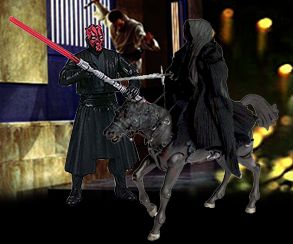
There are also dozens of superficial similarities. Both movies feature mentors who duel bad guys atop narrow passageways, as well as secondary villains — Darth Vader and Saruman the White, both deserters to the dark side, both fond of telekinetic violence — who provide the more visible nemesis. Along the way, both heroes encounter women in white gowns, cynical older-brother types, sidekicks playing for laughs and faceless cannon fodder (Storm Troopers and orcs). Both make use of mystical languages, mystical spiritual beliefs and pivotal scenes in bars and in watery mucky-mucks (compare the swamp at the gates of Moria with the garbage chute in the Death Star).

And both have monstrous, devoted followings. Even beyond the genre they share, these likenesses are hardly coincidence. George Lucas’ campy space western, made with $11 million, borrowed as liberally from Tolkien’s fantastic world as it did from Buck Rogers, the knights of the Round Table, Saturday afternoon cliffhangers, the “Wizard of Oz,” images of World War II dogfight combat, fairy tales and classic myth. At the same time, by beating “LOTR” to the screen, “Star Wars,” along with music videos, arcade games, “Star Trek,” Bruce Lee and legions of kung fu movies, “Alien/Aliens,” “Jurassic Park,” “Braveheart,” “Sleepy Hollow” and “Gladiator,” contributes to the inevitable been-there, done-that aspect of Jackson’s oeuvre.

Commercially, “LOTR” may not best the $925 million raked in by “Star Wars Episode I: The Phantom Menace,” the No. 2 earner of all time. But with high-flying effects technology and generations of book fans, “LOTR” could top sixth-ranked “Star Wars,” which grossed $461 million domestically and $798 million worldwide, and has just been surpassed by “Harry Potter and the Sorcerer’s Stone.”

Of course all these stats and dollar figures only tell one side of the story — and it’s a less compelling tale. Box office receipts are merely votes in a popularity contest, and the fact that drivel like “Independence Day” outgrosses the original “Star Wars” may not prove anything at all. A movie’s ability to entertain, engage or enlighten us, and its significance to the culture at large, aren’t things we can judge until after we’ve bought the ticket and contributed to the box office figures. And those figures can’t help us assess what’s in our hearts: Does “Lord of the Rings” hold up against “Star Wars?” Which is the better film, and why?

Far simpler than Tolkien’s intricately crafted Middle-earth, the universe of “Star Wars” is more similar to our own. Fittingly, “Star Wars” is the more human of the two movies, infusing each major character with thematic clarity befitting flesh-and-blood action heroes. Recall Luke Skywalker’s impatient dreamer, Obi-Wan Kenobi’s involved and steady-handed mentor, Leia’s spunky rebel princess, Han Solo’s self-serving cynic, and remember that all four undergo individual transformation: Luke learns to use the Force, Obi-Wan sacrifices himself for the rebel cause, Leia thaws and Han learns to care about others. Lucas even delineates the Laurel-and-Hardy-esque droids: C3PO as the talkative killjoy, R2D2 the headstrong one, with a child’s prankster sensibility. Undoubtedly, the dynamism of Lucas’ pop icons have formed many a case study for Scriptwriting 101.

Accordingly, the “Star Wars” universe is merely a setting for what is ultimately a highly compelling, if not entirely original, story. “Star Wars” makes use of technical-sounding jargon to give itself a sci-fi feel, but it’s clear at all times that any vernacular is subordinate to the needs of pure entertainment: plot, character, story arc, dramatic tension. For example, Luke’s Uncle Owen bickers about the capabilities of various droids, but the point is not to flaunt nonsensical vernacular but rather to illuminate the humor in the haggling rug-merchant tactics of a pushy little Jawa.

Indeed, humor runs throughout “Star Wars,” whose adventure-tale earnestness nevertheless refuses to take itself too seriously, squeezing jokes out of every “uh-oh” moment. When Luke and Leia nearly run headlong into the Death Star’s gaping cavity, the moment isn’t simply glossed over: It’s acknowledged by Luke’s understatement (“I think we took a wrong turn”), and Mark Hamill’s subtle gift for physical comedy. And in truly brilliant moments of character-driven funniness, Han Solo — hard-bitten space swashbuckler with a gooey, “aw, shucks” middle — shoots everything he finds threatening: his would-be bounty hunter (“sorry for the mess”), the creature in the garbage chute, the Death Star control panel.

“Star Wars” is only a movie, and it never loses sight of that. It doesn’t aim higher, and doesn’t have to. As a result, “Star Wars” refrains from pretending its heroes are anything other than flawed humans — and we love them for it. And yet, Lucas’ movie doesn’t shy away from displaying the gritty reality of human struggle: In a throwaway reference to the inferiority of droids (“We don’t serve their kind here”), Lucas allows dribbles of nasty things like prejudice to seep into his world. Nor does being on the same side guarantee people will get along: Darth Vader comes close to strangling a few generals, and as for Luke, his rivalry with Han is the kind you’d expect from the idealistic kid brother.

Incurably down-to-earth, “Star Wars” gives a guided tour of evil’s consequences, with a tailor-made John Williams score. Good guys do die: The very first scene sees all rebel fighters killed close-up. Then, in one chillingly evocative stroke, Vader obliterates Alderaan, Leia’s home planet, into a hailstorm of rocks and dust. Both acts help define a real evil, make it more tangible.

And the movie does something not often seen in contemporary action movies: It shows restraint. There are no slow-motion shots. Instead, Lucas, who grew up on pulpy cliffhangers, makes clever use of suspenseful cutting that defers to the audience’s imagination. Nothing is shown of what that floating ball of truth serum does to Leia, exactly, and there is a pregnant pause after the Sand Person raises his spiked baseball bat high over a fallen Luke, before you see he’s fainted.

In “Star Wars,” humanity is the point. In “LOTR,” with fans and followers in the tens of millions, Tolkien’s world is the point. And clearly, this emphasis on alternate worlds is better equipped to feed today’s appetite for sheer spectacle (see a long list of cinematic disposables, starting not least with “The Phantom Menace”).

Fanatics in any realm are difficult to satisfy, but Tolkien’s are the type who engage in prolonged, heated debate over authenticity, all the way down to the technical accuracy of props. (An unauthorized photograph of a spiked wheel taken on set created a global rift among faithful readers before the film came out.) Just in making the movie, Jackson shouldered enormous challenges safeguarding it against similar nitpicking.

So meticulous is Tolkien’s Middle-earth, with its genealogy charts and linguistic consistency, and so loyal Jackson and his crew to its detail, “LOTR” becomes a sort of glorified video trivia game, with dense graphics and a relentless pace.

But there’s a price for detail. For one thing, “LOTR’s” characters are uneven. Take Gandalf. One moment he’s a reassuring wizard, the next he’s shoving the young hobbit Frodo squarely out Bag End’s plump little door with nothing but a tense, hasty goodbye. Strider, one of the two men in the fellowship, is drawn with equivalent blotchiness: This gentle figure of incorruptible royalty makes his entrance on the screen as a noisome, pushy bully. You could make the case that his introduction allows a Prince Hal-like transformation, but at Jackson’s rushed pace it plays more like a quick suspense device that cheapens the character.

That kind of horse-trading is the movie’s chief weakness. “LOTR’s” characters are to its plot as rapids are to a raft: They move the story along. Everyone knows the next plot point will bring the next visual extravaganza, and the filmmakers seemingly did not have the patience, or the interest, in slowing down the visual progress.

Certainly, as the escape from humanity Tolkien intended, Middle Earth operates by its own rules. But as human entertainment, the film would be meaningless without the emotion that comes from human truth — the kind of emotion that a couple of Enya songs on the soundtrack cannot deliver. “LOTR” harbors some real emotion, but comparatively speaking it is presumptuous and finite.

As the reluctant hero, the worried, one-dimensional Frodo Baggins comes up short against Luke Skywalker, a young, impatient man with a sense of loyalty that tempers his desire for adventure, and it’s not something one can summarily blame on Elijah Wood’s wrinkled forehead. At first, Frodo takes the ring just to follow Gandalf’s orders. Later, when he meets the council, his offer to carry the ring to Mordor plays at best like a simple act of bravery, or at worst an impulsive decision that runs against his initial reluctance. But having made the offer, not until the very end of the film does he actually stop trying to give the ring away, and even then he seems far from convinced.

As for the other members of the Fellowship, film audiences aren’t given enough information for their sense of instant duty to be compelling. Whence comes hobbit buddy Sam Gamgee’s unswerving dedication to Frodo? Certainly not from the cowardice he showed under a furious Gandalf (again, this seems like comedy at the expense of character). And the loyalty of the two other undifferentiated hobbit sidekicks seems even more unlikely. Pointing to the book doesn’t work: Jackson very clearly wants his movie to stand alone.

Both “Star Wars” and “LOTR” have weird, racist undertones: For example, black is always bad. But superficially, Middle-earth appears to be a haven from discrimination. (Although there are certainly what passes for racial stereotypes, with greedy dwarves and flawed humans and stately, noble elves.) This smacks of pretense: Hobbits are addressed merrily throughout as “Halflings.” Likewise, there is little infighting on the same side of the conflict — everyone seems to know the human warrior Boromir is a potential bad seed (in his Hamlet-esque torture chamber, Sean Bean’s ambiguity is beautifully played), but no one confronts him about it, or even keeps him under any sort of special Ring Thief alert.

The insufficient development of emotions and character handicaps the movie’s ability to make us laugh. Like Gandalf’s fireworks, brief moments of shallow, situational humor dissolve swiftly into the night, subsumed by biblical solemnity: “The time of Elves is over,” “The race of men is weak” and “There is evil there that does not sleep.” Jackson could have at least tried to elicit laughter from moments of bizarre incongruity: For example, elf queen Galadriel’s know-it-all reply to Lord Celeborn when he demanded to know where Gandalf was. But they go untouched. In a moment of direct comparison with “Star Wars,” when Frodo and associates stop short of a precipice, the moment passes with neither comment nor the clever wringing of comedy from cliché.

And realism? “LOTR’s” odds step straight out of a Hong Kong karate movie. Nine warriors fighting armies of orcs and other unattractive horrors suffer but two casualties, and both die emphatically with deliberation — with three arrows in his chest, Boromir pulls a great Eveready bunny act — again, the moment calls for not even a snicker. (Whether attributable to logic or frugality with extras, Lucas dispatched his Storm Troopers in a trickle.) That’s not “LOTR’s” only suspension of logic: Apparently, when Hobbits turn invisible, you can hear their footsteps on concrete but not through dry foliage. And it is surprisingly easy to distract a ring wraith from his immortal duty with a piece of food thrown desperately from a makeshift hiding place.

True, some of this depends on what you want from the movies. Standards have changed — our 21st-century expectations define “show” to mean “show everything.” And here, digital tricks stand in for old-fashioned imagination; we see a schlocky image of a talking eye slit rather than visualize our own image of something far more evil.

That image is hardly the only thing getting in the way of the story. “LOTR” is an epic; it’s as macrocosmic as “Star Wars” (a fairy tale intimately involved with its good guys) is microcosmic. And the existence of a well-read, well-loved book handicaps “LOTR.” The book is a vehicle that allows shortcuts: Although Jackson compacts “The Hobbit” admirably in a few fact-bulging minutes for those who haven’t read it, the missing background nevertheless leaves fundamental loopholes. For example, who are these wizards and why do they care? Where does Frodo go when he puts the ring on? How is it that Cate Blanchett can read everyone’s mind? And what makes an orc inherently bad, aside from the fact that it’s ugly?

Obviously, making a movie out of a novel is not a cut-and-paste operation. Although a flawed film, “The English Patient” proved that the best adaptations are willing to murder characters and subplots as readily as they dismiss the internal wanderings of a novel. The visual translation of a thick volume into mere hours takes merciless loyalty to the new form, at a potential sacrifice to the old. In other words, had Jackson been more generous with his creative machete, he might have rivaled the book with a translation that truly stands on its own, rather than resorting to inevitable reference to the volumed set.

The verdict? “LOTR” isn’t a bad movie, but its wide acclaim shows just how much our story standards have declined, even as our visual standards have skyrocketed. Maybe filmmakers could learn an ironic lesson from “Star Wars.” Even though that film was a pioneer in both sound and visual technology, its relative restraint, compared with today’s Hollywood offerings, brings to mind the wisdom of an aged Jedi Knight. Today’s studios need to “switch off their targeting computers,” aka their fancy technology, in order to “feel the force” in moviemaking.

After all, this force requires nothing more than navigation, guided by the instinct of all we collectively know about life.

Continue Reading Close

Page 1 of 2 in Jean Tang