Jen Banbury

Rummy’s scapegoat

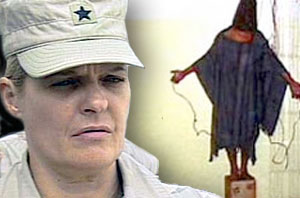
Brig. Gen. Janis Karpinski -- former commander at Abu Ghraib -- says she was hung out to dry by the Pentagon.

  • more
    • All Share Services

Rummy's scapegoat

In April 2004, when we first saw the Abu Ghraib photos — hooded Iraqis being tortured, menaced by dogs, sexually abused under the prods and grins of their American captors — our outrage and disgust were just barely tempered by the notion that the U.S. occupation of Iraq could not, and would not, ever be the same. It seemed certain that the photos would change the way the U.S. handles detainees, and bring down the policymakers who made it possible for such behavior to flourish. But a year and a half later, with a handful of low-level soldiers from Abu Ghraib — the proverbial “bad apples” — behind bars, what has really changed? In September, Human Rights Watch issued a lengthy report detailing how troops in the 82nd Airborne routinely tortured detainees at Camp Mercury, a forward operating base near Fallujah, often in response to direct orders from military intelligence. Three soldiers from the 82nd Airborne, including Capt. Ian Fishback, gave a full debriefing to Human Rights Watch after numerous attempts to report the abuse through their chain of command were ignored.

However, when the Abu Ghraib story broke open, one higher-up in the military did get hung out. Brig. Gen. Janis Karpinski arrived in Iraq in June 2003 with the understanding that she would be in charge of the 800th Military Police Brigade as it transitioned from guarding EPWs (enemy prisoners of war) to helping Iraqis retake control of their own prison population. Right away, Karpinski learned that many soldiers under her command who were supposed to be headed home were, in fact, being ordered to stay in Iraq for three to six additional months at least. She also learned that she would be overseeing 17 prisons, including the notorious Abu Ghraib, which was being used temporarily to house a few hundred felons and low-level criminals.

Given that she acted as commander of the prisons, it would seem obvious that Karpinski was responsible for what happened at Abu Ghraib. But her case is complicated. Within months of her arrival in Iraq, Abu Ghraib became a holding pen for massive numbers of Iraqis swept up in U.S. military raids and held as “security detainees.” And while Karpinski was in charge of the military police at the prison, she had no control over interrogations being handled by military intelligence, the CIA or even private contractors. Karpinski contends that as the chain of command and the policies regarding the security detainees at Abu Ghraib became murkier and murkier, she tried in vain not to be sidelined. Ultimately, she says, she had no clue as to the horrific acts taking place inside the prison.

In her new book (written with Steven Strasser), “One Woman’s Army: The Commanding General of Abu Ghraib Tells Her Story,” Karpinski makes a strong argument that she was made a scapegoat by George W. Bush, Donald Rumsfeld, her immediate bosses and military intelligence commanders. Frustratingly, Karpinski never steps up and takes responsibility, in any way, for what happened at Abu Ghraib. Yet, despite her lack of accountability or mea culpa, the book is an often shocking, guns-a-blazing indictment of the inept occupation of Iraq, and of the men who planned it and continue to run it today. Salon reached Karpinski by phone this week to talk about the Gitmo-ization of Abu Ghraib, the policy that keeps thousands of innocent Iraqis behind bars, and the reasons that the people truly responsible for Abu Ghraib are still in power.

At what point after you arrived in Iraq did the U.S. begin rounding up security detainees — people arrested by the U.S. military on suspicion of …

Terrorism. In late August [2003] they started these very aggressive raids. The first operation, up in Mosul, resulted in 37 security detainees arriving in Abu Ghraib. Within about 30 hours, the military interrogation teams had interviewed each one of those 37 and determined that only two of them had value and needed to be held. The other 35 were eligible to be released. And that was a firestorm, because nobody was going to be released.

I was at a briefing over at [Lt. Gen. Ricardo] Sanchez’s headquarters [as the head of coalition forces in Iraq] and the deputy commander, [Maj.] Gen. [Walter] Wodjakowski, turned around to me and said, “You are not to release any one of them, Janis.” And I said, “Sir, that information came from the military intelligence.” And he said, “Get me somebody from the military intelligence.” So this captain comes over and is trying to explain that none of these 35 had any further value. They were in fact in the wrong place at the wrong time, [gathered] up with the target individuals. So, Gen. Wodjakowski now turns on this guy and tells him, “You are not to release any of them. Do you understand me? Am I making myself perfectly clear? You are not to release any one of them.” And this captain tries valiantly to explain that we’ll be holding innocent people, and Gen. Wodjakowski says he doesn’t care.

Well, by the end of September they brought in just over 3,000 security detainees. And none of them were released. And the following month it was at least another 3,000 added to the already 3,000 that were not being released. So in two months’ time, the population at Abu Ghraib was 10 times more than what we had been holding when it was just a regular detention operation.

That means that a huge percentage of people who were in the prison had no reason to be there.

That is unfortunately true. So, say, generally 90 percent of the security detainees being held at Abu Ghraib were just innocent, had no information at all.

In September, Secretary [of Defense Donald] Rumsfeld had sent [Guantánamo Bay commander] Gen. Geoffrey Miller to come and work with the interrogation teams to help them improve their techniques and get more actionable intelligence from their interrogation effort. I was invited to come and sit in his introductory briefing. After the briefing was over, I specifically went to the JAG [Judge Advocate General] officer and I said, “How are you releasing prisoners down at Guantánamo Bay?” She said, “Releasing them? We’re not releasing anybody. These are detainees; these are terrorists; these are not prisoners. And every one of them will likely spend every last day of their lives at Guantánamo Bay.”

I thought, “How can we hold hundreds or thousands of these people in Iraq? We’ll never get out of here.” But that was the plan. And Gen. Wodjakowski said, “I don’t care if we’re holding 15,000 innocent Iraqis, we’re winning the war.” And I said to him, “No, sir, not inside the wire you’re not, because every one of those detainees becomes our enemy when they’re released, and they will be released one day.” [Last week a spokesman for the U.S. military's prison operations said that U.S. forces are holding a total of 13,885 detainees in a number of facilities throughout Iraq.]

So was there a general understanding that the security detainees did not fall under the rubric of the Geneva Conventions?

Yes, there was a general understanding from [Maj.] Gen. [Barbara] Fast [head of intelligence for the U.S. command in Baghdad] and Col. [Marc] Warren [Sanchez's legal advisor] and Gen. Sanchez that the Geneva Conventions did not apply to these detainees.

Talk about the detainees who were purposely not listed anywhere because they potentially had a very high intelligence value — the so-called ghost detainees.

Before those individuals were turned over to us by the task force or OGA [for "other government agency," typically a reference to the CIA], we received a message: “This individual will not be entered in any database. REPEAT not entered in any database. The individual will be secured in a separate section in a location with no contact with other prisoners.” So if the Geneva Conventions say that prisoners will be listed in a database, and you’re not calling them a prisoner, you’re bypassing the Geneva Convention. Most of these messages said at the beginning, “Rumsfeld Sends.”

What was your understanding of how they were being treated as individuals? Were they under the military intelligence people?

In some cases they were. And if the interrogators knew that an ICRC [International Committee of the Red Cross] team was coming to Abu Ghraib they would relocate them until the ICRC team was finished.

To hide them from the ICRC teams.

Yes.

Was there any time when you thought to yourself, I am being a party to, or I am being used by, some forces that are just not right in what they’re doing, i.e., Sanchez or Rumsfeld?

Well, I hate to say this, but I could detect that there were things that were amiss from the beginning. I know I sound like I’m defending myself, but I’m not. In July and August, we had a plan and we were following the plan. We repeatedly said we’re only using [Abu Ghraib] for as long as we need to until we can get the prisoners transferred to other prison facilities around Baghdad or other locations as they become available. We briefed [on] it every week to Bremer and Sanchez, every week.

Then, in August, it changed. They decided to do these raids, hold these security detainees in Abu Ghraib. Without any discussion with me whatsoever, they’re going to make it the interrogation center for Iraq, which makes even less sense. If you have a higher-value detainee, why are you going to put this individual in the middle of the most hostile fire zone in Iraq, the Sunni Triangle?

Let’s talk about what went wrong at Abu Ghraib and how it possibly got to that point.

In September [2003], Col. [Thomas] Pappas [head of military intelligence at Abu Ghraib] asked for control of cellblock 1A and a couple of days later, about a week later, he asked for control of cellblock 1B. And after Gen. Miller’s visit, all of these interrogators started to arrive at Abu Ghraib. Col. Pappas was under tremendous pressure to find Saddam. So there was a handover and then a request, a specific request for [Spc. Charles] Graner to work the night shift in cellblock 1A, because the company commander said he was a prison guard in his civilian role and he would be good to work on the night shift. And they were really shorthanded out there. They took on this mission, and by mid-November they were taking instructions directly from Col. Pappas.

And was he their official C.O. at that point?

No, no. There was never a transition made between him taking command of the units. However, Col. Pappas requested clarification on the chain of command and he was told by Gen. Fast that “he owned all of it” — that was his quote exactly.

So Gen. Fast told Col. Pappas that he was in charge.

Right. This was in November, early November.

Early November. But in fact, theoretically, you were still in charge of everyone in the 800th.

Yes, that’s correct, theoretically. Now, I’m not onsite out at Abu Ghraib, of course. I have 17 different prison facilities and I need to go visit the soldiers at all of them. I’m not going to run Abu Ghraib for the battalion commander because he is responsible for the battalion out there, and I’ve had several conversations about where he needed to improve. So I’m in fact mentoring him as he’s doing this mission. And then Col. Pappas starts to direct his work. That’s what raised the first concern, because the battalion commander came to me and he said, “Ma’am, I just need to know from you, is Col. Pappas my boss or are you my boss?” And I said, “I am still your boss, why?” And he said, “Because Col. Pappas is telling us how to run detention operations.” So when I saw Col. Pappas down at ambassador [Paul] Bremer’s headquarters that Friday, he said yes, that was his understanding, that he was giving instructions. And I said, “Does Col. Jordan work for you?” (He was a lieutenant colonel who was always running the operations at cellblock 1A and B.) And he said, “No, ma’am, he doesn’t work for me. He works for Gen. Fast.” And then I left Baghdad [for a few days on other military business] and when I came back, that was when I found out that they had transferred control of the prison to Col. Pappas.

But even before then it seems like it was a hugely confusing environment just in terms of who was doing what. Then add to that all of the contractors who were there interrogating people and the OGAs. Was there a time when you felt that you were no longer really in control of what was going on there?

Yes. When these security detainees were coming in, we had no release policy that applied to them. Nobody seemed to be concerned about a release policy. And ambassador Bremer, who should have been the person in the middle, didn’t object. This was supposed to be a function that was eventually turned back over to the Iraqi people — to run their courts, to run processing, to run detention operations, to release criminals, to hold criminals, to try criminals — and that was in ambassador Bremer’s lane. But he didn’t object.

And when our prisoner population out at Abu Ghraib in two months’ time went up to over 6,000 because of the security detainees, that’s when I felt, I have no control over this at all.

One of the moments in your book that I actually found the most — I don’t know, the saddest — is when you’re describing the photos that came to light, and included in your description is one photo that we’ve never seen. It’s of a female M.P. who was leading a female prisoner and some guy — was it other MPs or other prisoners …

No, it was a contract interrogator or an M.P. or military interrogator.

… The guy asked the female M.P. to lift the prisoner’s shirt up just as she was walking by.

Show us your breasts.

Right. And she did. How do you account for an atmosphere in which something like that would happen? That’s not really the same atmosphere as the other photographs.

That is a complete violation of trust, complete.

Well why would she get to that point? Doesn’t something like that emerge in a leadership vacuum?

If it’s nothing else, it’s an indication that there is absolutely a leadership vacuum. But when I go out and I talk to soldiers and I talk to prisoners, I have to trust what they’re saying to me is the truth. And this female prisoner was there because her husband was prostituting her, and I think she was being held for her own protection, if I remember the details. So when this female M.P. befriended her, I would believe that it was really out of respect. I mean, they couldn’t be friends, but she talked to her and took special time to make sure that the females [female prisoners] were OK.

But what makes a soldier violate that trust? I can’t answer that question. The people who they believed were authorized to give them orders and instructions have not answered those questions either. When I was at Abu Ghraib, I would walk through the cellblocks. I would walk through the compounds outside. No M.P., no interrogator, no contractor, no prisoner was saying to me, “Please ma’am, help us.” Nothing. Not a hint, not a suggestion. And I’ve never had an opportunity to speak to any one of those soldiers since they were removed from their positions. Not any one of them. So I can’t answer the details of what they were thinking or what went through their heads or why this was allowed to happen.

Yes, they knew the rules. They can’t deny that. But what the atmosphere was, I don’t know.

Do you feel like Rumsfeld is at the heart of all of this and should be held completely accountable for what happened?

Yes, absolutely. And so should his sidekick, [Undersecretary of Defense Stephen] Cambone. Really, I don’t have anything against Alberto Gonzales, but he was involved in the discussions about the departure from Geneva Conventions and dealing with terrorists. So why isn’t he somewhat accountable? Pappas is still on active duty. Sanchez, still on active duty. Fast, promoted and still on active duty, sergeant major of the Army. How are they silencing these guys or maintaining their silence? They’re under the control of Rumsfeld, under the control of the active component.

Do you think that your case is hurt by the fact that you don’t really, in your book or otherwise, take on much responsibility for any role you might have had?

Well, I can tell you that I think — I know — that it’s unfair to suggest, which they did from the beginning, that I allowed this to happen, that somehow I had knowledge and I allowed this to happen. That is untrue.

But this happened under your watch, and you haven’t really come forward saying, ‘I made a lot of mistakes.’ I felt that the book suggests that being a scapegoat, which you unquestionably are, somehow exempts you from any responsibility at all.

From failures. No. That’s a good point. Maybe I didn’t do it with enough effort, but I’ve said in interviews and otherwise, Hold me responsible for the things I could control. And there were a lot of mistakes made in Iraq. But when you then say well, yes, we didn’t do this as well as we could have, or this was a failure, I can tell you that we were so close to being in violation of the Geneva Conventions, just on the conditions for the prisoners. But then it goes to we couldn’t get funding. Why? Because the funds were being looted by American contractors. People can’t believe all of this. They can’t get their arms around all of it. So what they were comfortable with, from the beginning, was to associate my name with those photographs forever. Because without understanding all of the details or asking about the details, people would say, “Oh, Karpinski? Yes, those photographs, Lynndie England, Karpinski, Graner, Karpinski.”

Now, I’m finding that, particularly with the book tour, people are saying, “What did the soldiers say?” And when I say, “I don’t know because I’ve never had an opportunity to speak to any one of them,” it’s like a light bulb goes off over their head. Oh, so they really did deny you access? Absolutely, and continued to.

And yes, we made mistakes. We didn’t do everything perfectly. It was never pretty. But I’ll be damned if 3,400 soldiers are going to be charged as being guilty by association with the 800th M.P. Brigade. That is unfair. And Bremer comes back, $8 billion is missing, and he just simply says it was a war, we’re not always accountable.

Rage and danger in Kurdistan

Angry with the U.S. for betraying their dream of independence, the Kurds could ignite an Iraqi civil war.

  • more
    • All Share Services

Rage and danger in Kurdistan

When I found out the U.S. Coalition Provisional Authority had handed the governance of Iraq back to the Iraqis on June 28, two days earlier than planned, I was in the northern Kurdish city of Erbil eating a pizza. Though many hours had passed since the small ceremony in which CPA proconsul Paul Bremer handed the reins to the new Iraqi government headed by Prime Minister Iyad Allawi, the news took me completely by surprise. I had been up for hours, had driven across the city with a Kurdish driver and translator, and had made my way though half a pizza in a small but crowded restaurant called “Happy Time” without any sign that I had essentially been sleepwalking through a historic day in Iraq.

In a lot of ways, the lack of celebration shouldn’t have shocked me in the least. For many Iraqis, a government headed by Allawi, who previously punched a time clock in the employ of both Saddam’s early regime and later the CIA, has a distinct “Meet the new boss, same as the old boss” ring to it. Then, too, the outgoing CPA had essentially scooched Allawi into power past U.N. representative Lakhdar Brahimi’s own candidate. Before my trip to Kurdistan, I might have assumed that the Kurds, who have been the United States’ best ally in Iraq since the invasion began, would welcome a government that would seem to represent U.S. interests. But as I learned during my visit, the Kurds do not trust either the United States or their Arab neighbors to the south, and so they do not even begin to trust a U.S.-backed Arab government. These days, the Kurds aren’t celebrating much of anything. They are waiting to see what the new government will mean for them, and whether it was worth giving up the relative autonomy they’ve enjoyed over the last decade or so.

I arrived in Iraqi Kurdistan around the middle of June, crossing the border from Turkey and making the five-hour drive to Suleymania in the east. Having spent close to nine months in Baghdad since Saddam’s overthrow, I was interested in spending time in the Kurdish north during the transition to get a better sense of where the Kurds stand on the new Iraq. The road from the border switch-backed through mountains terraced into farmlands and dropped down into green and gold valleys where fat rivers rolled past villages and flocks of sheep. On a purely geographic level, Kurdistan has almost nothing in common with the rest of Iraq. In fact I had to remind myself I was in Iraq. A Kurdish man I met likened it to Switzerland. I’m pretty sure he had never been to Switzerland, but as comparisons go, it wasn’t so far off the mark.

Suleymania is a midsize city, visibly untouched by the kind of violence that has marked just about every non-Kurdish city in Iraq. Like most of the Kurdish area, which became semiautonomous in 1991 when the U.S. implemented a “no-fly zone,” Suleymania has proven to be quite safe for Westerners. It was the only place in Iraq I ever took a walk alone. (I met another American there, a privately contracted medic for the CPA, who told me he loved to walk around the crowded souk, or market, in shorts, in part as a way to encourage Kurds to wear shorts instead of the long pants that must be scorchingly hot in the summer. Probably a death sentence in non-Kurdish Iraq.) In Kurdistan, not a single U.S. soldier has been kidnapped or killed since the invasion. As far as I know, no Westerners at all have been kidnapped or killed in the region. Somewhere (the Army asked me not to tell where), tucked among the mountains, sits a modest resort hotel where soldiers get sent from other parts of Iraq for a few days of R&R.

The day after I arrived in Suleymania, the tiny CPA staff held a farewell press conference. I and the journalist I was traveling with represented the entire Western press corps. The press conference took place in a diminutive auditorium inside the soon-to-be-defunct CPA building. Before the conference began, I spoke with the press officer who told me he was worried that no members of the Kurdish press would show up. As it turned out, on the previous afternoon Paul Bremer had been in town for his own farewell moment, marked by a ceremony at the city’s nicest hotel, the Suleymania Palace. But due to an apparent misunderstanding, the Kurdish press had become angry when they were shunted into a waiting room and denied what they considered appropriate access to Bremer.

As time went on and I met with Kurds in both an official and an unofficial capacity, I realized that what I came to think of as the “Bremer access incident” summed up the way the Kurds feel they’ve been treated by the CPA in general: stuck in one area, asked to be patient, denied access to the policymakers, and generally ignored.

This was all a bit of a revelation to me. I knew that the Kurds felt the United States had not been as good to the Kurds as the Kurds had been to it, but I had no idea just how pissed off they really are at the United States. They are really, really pissed.

On the day of the press conference, the Kurdish press did show up. One Kurdish reporter even asked, very politely, why the Kurds weren’t getting more out of their friendship with the United States. (Another reporter was a bit more pointed, asking essentially, why the hell Muqtada al-Sadr, who’s been nothing but trouble to the United States, had recently been invited to form a political party and participate in elections.) The almost-former head of CPA for Suleymania began with a reminder that the United States had gotten rid of Saddam — the U.S. fallback answer to any question like that — and then went on to enumerate a few pretty anorexic projects before launching into fallback answer No. 2: “In a democracy there are always compromises. Not everyone gets everything they want.”

He was right. For strategic reasons, the United States could never have given the Kurds everything they wanted. But the Kurds still think that the United States has abandoned them. And they still can’t believe it.

So the conference ended with politeness and even photo ops, but I felt acutely aware of the anger and frustration that pumped below the surface. The Kurds have been more open with their anger at the United States recently but they’re not ready to show their cards yet, not ready to storm out of the press conference. They’re waiting. With their long history of being stomped on, they are a very patient people.

So what exactly do the Kurds want that they aren’t getting? Well, more than anything else, the Kurds want their own country. Kurdistan doesn’t just look different from the rest of Iraq: The Kurds are a distinct ethnic group with their own language, culture, dress, traditions. And though the majority of Kurds are Muslim, they are significantly more secular than Muslim Arab Iraqis. (Of course generalizations always invite exception: I knew plenty of secular Muslims in Baghdad, and the Kurdish terrorist group Ansar al-Islam holds radically Islamic views.) In the post-WWII redistribution of the Ottoman Empire, the Kurds found themselves cut and pasted into a number of contiguous countries including Iraq, Iran, Syria and, mostly, Turkey. An estimated 20 million out of the 35 million Kurds worldwide live in Turkey, causing the Turkish government deep and ongoing anxiety. In the past, the Turkish government has done just about whatever it could to keep its Kurdish population from allying itself with Kurds in other countries or even, for that matter, affirming their own Kurdishness. Until 1991 it was illegal for Turkish Kurds to speak Kurdish.

For now, the Iraqi Kurds know they cannot push for independence. Turkey, fearing a destabilization of its own Kurdish population, would do whatever it takes to prevent such a move. The United States would probably have to back Turkey, an important ally in the Middle East. In the long run, pleasing the Turks is a much greater geopolitical asset that dissing the Kurds is a liability. Any move by the Kurds to break away would also, of course, threaten to incite a civil war within Iraq.

For now, the Kurds will settle for maintaining autonomy within Iraq and hope that a federalist Iraqi government would provide the in-country independence they’re looking for. The problem is, the shape of the Iraqi government is still a big question mark. The Kurds are angry at the United States for not insisting on guarantees that the new Iraq would give them the same independence they had (courtesy of the U.S.) under the old Iraq.

Then, too, the Kurds feel as though they haven’t been given their share of the reconstruction pie. Despite the safe conditions of the region, there is not a whole lot of rebuilding going on. And despite the lush-looking countryside, Kurdistan is desperately poor.

At the Suleymania press conference, I met Maj. John Hubert, a civil affairs officer in charge of overseeing projects for the region. I spent an afternoon with him and a few of the men he works with visiting a school that the military had built in a meager village about a half-hour outside the city. We drove to the village in two white armored SUVs, turning off the main road and onto a dirt track for the last half mile. We pulled up in front of the new school and got out of the air-conditioned vehicle into the smack-down heat of the long Iraqi summer. I was reminded, as I often am in Iraq, how much it must suck to be a soldier and wear all that body armor.

In mud dwellings opposite the school, women in long nightgown-type dresses (purple and magenta and turquoise) edged out to see what was going on and quick kids edged right past them. As one of the soldiers began walking down beyond the school to check out the area, a flock of domesticated geese claimed him as their leader. If you’ve never seen a flock of geese follow a heavily armed and armored soldier, you’re missing out.

The school was not quite complete. Workers were finishing up with doors, windows, bathrooms. But Hubert gave us an intensely and justifiably proud tour. The one-story school had been constructed of cement and plaster into a wicket shape that wrapped around a courtyard. The old school, still standing, though barely, next door, showed just what an improvement the new one would be. It was a crumbling mess with one pit-toilet outhouse for the whole school. The village kids, kept outside the gates by the workers, shouted their approval along with the occasional “I love you” in English. (The “I love yous” were probably inspired by American TV and movies. In even the most desperately poor villages and neighborhoods of Kurdistan, TV satellite dishes rise like moons over mud and straw roofs.)

Hubert is one of those soldiers who make me feel that the military might, in fact, have more than a few good men. He is smart, thoughtful, driven and, above all, interested. But, though he clearly wants to help the Kurds, he doesn’t have a whole lot to work with. Apart from the school I saw that day, he and his men were working on about 28 other projects, the small school being one of the largest. At the press conference, Hubert announced that the United States will spend $435 million in Kurdistan. It’s only a fraction of the tens of billions that will be spent throughout Iraq, and it’s hard to see a lot of tangible results. Nailing down the exact amount that will be spent on Kurdistan, and whether in fact the Kurds are getting the short end of American reconstruction dollars, is virtually impossible. But I got the feeling that for the Kurds, the perception of neglect trumps any statistics. In reference to proposed spending in Iraq, a Kurdish employee at the Ministry of Humanitarian Affairs said, “George Bush claims 18 billion, 18 billion, 18 billion — where is billions? Billions of illusions exist.”)

Erbil, Kurdistan’s largest city and my destination after Suleymania, is one of the poorest cities I have ever seen. All over the city open sewage runs parallel to sidewalks, and makeshift shanty towns hold what seems an impossible number of people. Given the fact that Erbil has almost as good a safety record as Suleymania (there have a handful of incidents targeting Kurdish politicians), it seems like a no-brainer that now would be the time to implement a lot of projects, while work in the rest of the country remains nearly untenable. The lack of aid is part of the reason the Kurds feel so frustrated with the United States. I get the impression that, as far as U.S. attention goes, the Kurds are suffering from the good-child syndrome. While the troublemaking violent kid (that is, the rest of Iraq) gets all the attention, the good child, the one we never worry about, gets passed over. (This is not to say that I feel in any way that the United States should pay less attention to the rest of the country or provide less support. I think we’re doing a shitty job across the board.)

Erbil was home to a larger CPA contingency than Suleymania, but of course that, too, is now gone. The new U.S. Embassy, which will have thousands of employees in Baghdad, won’t have a single representative in Iraqi Kurdistan. The only thing close will be the three U.S. Embassy representatives based in Kirkuk, a city now hotly contested by Kurds and Arabs. Kirkuk, with its surreal suburb of high-yield oil fields, has developed into a major flashpoint for Kurdish-Arab relations.

For generations, Kurds and Arabs have been wrestling for control of Kirkuk, which lies on the edge of the Kurdish region. Under Saddam’s regime, the Kurds were forcefully ousted from Kirkuk (and other Kurdish-dominated territory Saddam coveted) in what is referred to as the Arabization program. Kurdish families were taken from their homes by Saddam’s secret police and forced to leave the city, often without any of their belongings. Their homes were given to what Kurds still refer to as “10,000 dinar” Arabs who moved into the city. Ten thousand dinars represents the amount of money Saddam paid Arab families to relocate to Kirkuk and other Kurdish towns. In today’s Iraq, 10,000 dinars is worth about seven bucks. But during the height of Saddam’s Arabization program — until the sanctions drove inflation through the roof — 10,000 dinars equaled around $30,000.

Under Saddam, Kirkuk was not part of the Kurdish region (which, with U.S. protection, had its own government, militia and even currency). Now Kurdish officials, anxious to reclaim Kirkuk, are urging — even compelling — Kurds to return to the city en masse.

“We don’t accept that Kirkuk is not part of Kurdistan,” the governor of Erbil, Nawzad Hady, told me. I had gone to meet with him in his office inside a well-guarded building in Erbil’s center. One of the governor’s many assistants led me up to the second floor, past some file-choked offices and through a series of increasingly well-decorated waiting rooms. In each room, a dozen or so men sat on couches along the walls smoking and drinking tea from fat hourglass-shaped teacups. After 45 minutes of drinking tea, I was ushered by another assistant into the governor’s inner office, a long room decorated with new-looking upholstered furniture and lush carpets. Hady emerged from behind his raft-size desk and greeted me. We sat opposite each other with his translator in a chair between us while his assistant hovered, furiously taking notes.

Hady told me that Kurds must return to Kirkuk and the “10,000 dinar” Arabs must leave. (Other Arabs, families who have lived in Kirkuk for generations, do not face the resentment that the “10,000 dinar” Arabs do.) The Kurdish government has been handing out leaflets and using television campaigns, telling families to return. And Hady confirmed that in some cases, families have been paid $3,500 to go back to Kirkuk. At least a portion of the money to help families came from a U.N. fund, established before the war to build housing for refugees in Erbil. But the project fell apart, and with no sign of the United Nations’ return, the government began using the money as aid and incentive for refugees to go back. Within his own government, Hady said, he directs all employees of the Erbil government who are originally from Kirkuk to move to that city, where they will be guaranteed an equivalent job and salary in the government there.

This hasty population redistribution program is as much about the future of Kirkuk as it is a question of reclaiming the past. Kurdish officials, including the governor, told me they intend to press for a referendum in which residents of Kirkuk will decide whether the city becomes reabsorbed into the Kurdish region. If the current Iraqi government refuses to allow Kirkuk’s future to be decided by vote, Hady said, the Kurds will opt for deciding its future by force. Kurds may make up only 20 percent of Iraq’s population, but their armed forces, or peshmerga, are nearly 100,000 strong — bigger than all other Iraqi militias and armed forces combined. In short, the Kirkuk question could destroy the cobbled-together new government of Iraq.

Last week, Allawi declared that a “special status” might be granted to Kirkuk to take into account its diverse population. At this point, it’s anyone’s guess what “special status” will mean in practice. The Assyrian International News Agency quoted Allawi on Friday as saying that a countrywide abolition of militias would include Kurdish peshmerga. “Some of the Kurdish peshmergas will be recruited to the Iraqi army while some of them will be added to Iraqi police force.” According to the agency report, Allawi added that the remaining peshmerga would lay down their arms and begin civilian life or would be retired. When Allawi first announced his intention to disband militias in June, a furious Kurdish response forced him to back down. I can’t imagine the Kurds would ever agree to relinquish what is essentially their own army, especially when their future status remains unclear. If Allawi tries to force a disbandment, the results could be very bloody.

(It’s interesting to note that Erinys, the South African security firm contracted to protect the oil infrastructure across Iraq, employs over 95 percent Kurds to guard Kirkuk’s oil fields. Most of them are former peshmerga.)

Kurdish designs on Kirkuk have become a big problem, not just for the new Iraqi government, but for the Turkish government, which is apt to wig out anytime it perceives the Kurds to be making a move of strength. A little over a week ago, the Turkish Foreign Ministry issued a warning to the effect that no “involved party” should attempt to change the demographic makeup of Kirkuk before its final status is determined.

These days, the Kurds don’t have a lot of friends in the region. But that may be changing. In a recent article in the New Yorker, Seymour Hersh described an increasing Israeli presence in Iraqi Kurdistan. “Israeli intelligence and military operatives are now quietly at work in Kurdistan, providing training for Kurdish commando units and, most important in Israel’s view, running covert operations inside Kurdish areas of Iran and Syria,” Hersh wrote.

An alliance between the two makes a lot of sense. For the Kurds, it provides a powerful ally, friendly with the United States, to train their commando units for deployment against potential Iraqi or other Arab enemies. For the Israelis, it allows them to infiltrate agents into their arch-nemesis, Iran, as well as hostile Syria. Certainly the Israelis would be delighted with the creation of a friendly, independent Kurdistan.

Israeli officials, not surprisingly, denied the story. The U.S. State Department refused to comment, but a senior CIA official confirmed Hersh’s report. After the article came out, Kurdish leaders vehemently denied its veracity, calling it “baseless” and a “vile campaign against the Kurds.” The denials were so adamant that they brought to mind my mother’s favorite Shakespearean phrase: “Thou doth protest too much.” For what it’s worth, when I was in Kurdistan I asked Kurds whether they knew about an Israeli presence, and none said they did.

On a brutally hot day (every day in Iraq’s summer can be categorized as “brutally hot” “extremely brutally hot” or “really very extremely brutally hot”) I took a trip to Kirkuk. By coincidence, it was July 1 — the original date for the first day of Iraqi self-governance. I made the one-hour drive from Erbil in the company of a Kurdish driver and translator and a fellow reporter. In the course of planning our trip to Kirkuk, we had received all sorts of advice as to how to stay safe. One Kurdish man we spoke to insisted that we should travel only in the company of some armed peshmerga. Another Kurd suggested we hire one of the many Western security companies working in Iraq. We would travel in a convoy of armored SUVs with a small cadre of very heavily armed men who would dress us in bulletproof vests and loosely encircle us whenever we got out of the car to interview someone. (The cost would have been at least a thousand dollars for the day). Some people tried to strongly discourage us from going at all. Most Westerners we met — CPA employees concluding their jobs or embassy employees commencing their jobs (in some cases those were one in the same) were on “lockdown” during a number of days leading up to and following the transition of power, in anticipation of heightened violence. This meant no leaving their fortified compounds or secured hotels.

During an informal conversation with the only other American woman I met in Kurdistan — a young, dedicated Southerner working for a Christian NGO — I asked what precautions she took when going to Kirkuk. “Not nearly enough,” she said. “I mean, I carry a nine millimeter, but…”

In the end, we decided that low-key would be safest. We started out early in the morning in a new model BMW. (“I think BM is a very good car,” our translator said. We advised him to consider not dropping the “W” when talking to Americans.) The road ran flat and straight though the countryside. Uneven mounds of recently harvested wheat punctuated the fields along the road. We sped along, passing other cars, tractor-trailers, and pickup trucks. In the back of many of the pickups, kids — boys in T-shirts and sweatpants and girls in granny-nightgown-type dresses — stood up in the beds and bobbingly clung to the truck cabs.

Other advice I received before the trip: If I had to go to Kirkuk, I should at all costs avoid the Arab neighborhoods. I would be safe in Kurdish neighborhoods, but I would be as good as dead in Arab neighborhoods, Kurds told me. The advice to avoid Arab neighborhoods stemmed, in part, from the ongoing attacks on Westerners by Arab groups: the kidnappings and assassinations of contractors and aid workers, the ambushes against U.S. troops.

The violence has amped up Kurdish mistrust. Throughout Kurdistan, peshmerga man an endless number of checkpoints. Kurds mostly get waved through, while Arabs, my translator told me, almost always get carefully searched. Precautions like this may have helped keep the region safe, but it’s a kind of racial profiling that doesn’t do much for Arab-Kurdish relations.

Hassib Rozbayani, who holds the title of assistant mayor for resettlement and compensation for Kirkuk, lives in a single-story home a mile or so from what had just recently been the CPA compound in Kirkuk. Now the compound is being used by representatives of the U.S. and British embassies and their support staff (the ratio is something like six embassy employees to 100 support staff). I spoke to Rozbayani at his home in Kirkuk shortly after we arrived in the city. Weeks earlier, July 1 had been declared a national holiday in celebration of the hand-over of the government. The premature hand-over made the day a little anticlimactic, but it remained a holiday nonetheless and all government offices were closed. When my translator reached Rozbayani on his cell phone, he generously invited us to come by his house on his day off. We got a little lost finding his house and stopped to ask directions from a soda vendor on the side of the road who pointed us in the right direction. Our driver, Dashti, peeled out and U-turned toward the correct street. Throughout that whole day, he drove like a cop in a car chase. Though we didn’t venture out of Kurdish neighborhoods, having a couple of Westerners in the back seat of the car was risky, to say the least. And so he did whatever necessary to avoid being stuck in traffic, turning down side streets and alleys anytime we hit congested roads. It wasn’t exactly comfortable, but it was comforting.

When we reached Rozbayani’s house, a guard out front (holding a Kalashnikov, the weapon of choice for guards all across Iraq) went to announce us. In the last year, a number of Kurdish political figures have been assassinated in Kirkuk. Having an armed guard goes with the territory. Rozbayani led us into the living room, where his own rifle leaned against the couch. He sat down next to it and began chain-smoking cigarettes. With his longish wild hair, he looked more like an aging rock star than a politician. The city power had gone off and, as he talked, the lights of the living room dimmed and rebrightened with the variations in the generator.

Rozbayani said that right now in Kirkuk there are 70 refugee camps of varying sizes. Despite the money going to some returnees, most Kurds have returned with almost nothing. The situation in the camps is very bad, he told me, but he, too believed the Kurds had to reclaim Kirkuk. He was angry at the CPA for what he referred to as “negative support” of the refugees. Though he had asked repeatedly for assistance, the CPA had refused to provide any aid at the camps, he said. In some cases, Rozbayani said, U.S. soldiers had expelled the refugees from camps and arrested those who refused to leave. He firmly believed (as did Hady, Erbil’s governor) that the United States had been pressured by Turkey to discourage the Kurds from returning to Kirkuk. Other Kurds I spoke to who worked with the CPA on the refugee question said that throughout its tenure, the CPA promised help and asked for patience. A CPA staffer I spoke to declined to comment. Given the volatility of the issue, it seems clear that the CPA is doing what it can to placate both sides (without really pleasing either).

Understandably, Arabs in Kirkuk don’t want or intend to relinquish their homes. But Arabs have been forced out from homes in Kirkuk and other rural areas of Kurdistan. Inside Kirkuk, ongoing harassment campaigns by both sides keep tensions high. Kurds fire shots at Arab homes, Arabs fire shots at Kurdish refugee camps. Assassinations have become a daily occurrence. Arabs have said that if the Kurds push too hard, they will fight back. They warn that Arabs from all over Iraq, including Muqtada al-Sadr’s supporters in the south, will come join the fight.

In Kirkuk’s current situation, there are no winners. Kurdish families return to Kirkuk every day hoping to effortlessly reclaim their former lives. Instead, they end up slogging it out in one of the miserable refugee camps throughout the city.

The Kirkuk sports stadium sits in a garbage-strewn, desolate corner of Kirkuk. As we approached it, I noticed a series of hand-painted signs along the road that depicted a young girl throwing her trash in a garbage can — the remnants of a long-abandoned anti-litter campaign.

Jerry-built shelters made of mud, straw, flattened cooking-oil cans and empty rice sacks surrounded the stadium. Shallow ditches of raw sewage linked the houses and scrawny, nearly featherless chickens pecked at the edges of the sewage in search of something edible.

We parked in the shadow of the stadium walls. Refugee families had made good use of the stadium, building shelters against its curving walls. Some curious kids and adults came to greet us, but many were sleeping off the intense afternoon heat or working in fields outside the city. Then, too, a lot of missing husbands and fathers had been killed years ago in Saddam’s murderous anti-Kurd campaigns.

We spoke to a woman who had returned to Kirkuk right after the fall of Saddam. It seemed most of the refugees in that camp had arrived not long after the end of the war, anxious to get back to their former city. They had imagined they would receive help from the United States and from their own Kurdish political parties, but they had received virtually nothing. (The woman said that the Americans had come once and given out some dishware. They made a list of needs and never came back.)

Bad as the conditions were at the stadium, the Kurdish refugees there are better off than those living in other Kirkuk sites where canvas tents act as the only shelter. Though the refugees have chosen on their own to return, I can’t help thinking that they have become the demographic pawns in a struggle over oil and power and real estate.

Those refugees, like all other Iraqi Kurds, believed the invasion and Saddam’s ouster would mean a tremendous step into prosperity. Make no mistake, the Kurds are grateful to be rid of Saddam. Talk to any Kurd about the United States and the first thing you’re likely to hear is how happy they are that Saddam is gone. But with their future in the new Iraq so uncertain, and their old pal the U.S. so unreliable, the Kurds feel more isolated than ever. Control of Kirkuk (“the city of black gold,” Rozbayani called it) represents their best chance for a strong position in the new Iraq. “If Iraq doesn’t return Kirkuk, it could cause civil war,” Hady told me that afternoon in his office.

A Kurdish-American I met doing business in Iraq put it another way. “Trust me,” he said. “They are going to the gym. They are getting ready.”

Continue Reading Close

Fleeing Baghdad

I didn't want to leave the nation my country tore apart. But then came warnings that our house was targeted. A farewell portrait of a place on the edge of the abyss.

  • more
    • All Share Services

Fleeing Baghdad

Last week, before followers of Muqtada al-Sadr began actively fighting coalition forces, before four Americans working for a private security company were killed and mutilated in Fallujah, I left — or perhaps I should say fled — Iraq. In the week or so preceding my departure, I felt the country undergo an essential, albeit subtle, shift. The anger previously focused on soldiers and members of the Coalition Provisional Authority seemed to morph, almost daily, into an indiscriminate ire toward Westerners in general. Almost overnight, I stopped feeling safe.

Many of my biggest concerns were wrapped up in the fact that I had been in the country so long. I (and the house I shared with other freelance journalists) had become well known. Some seasoned war correspondents — friends who had actually lived in the house last fall — warned us that they felt the house might be marked as an easy “soft target.” Journalists and contractors were moving en masse out of small, lightly protected hotels (such as the Mount Lebanon, which was bombed a few weeks ago) into hotels that lay within heavily guarded and restricted compounds. With fewer easily available Western targets, my friends believed that the house might be ripe for an attack.

Up until a month ago, my housemates and I joked about Western journalists and civilians who were obsessed with security. We made fun of our friends who worked for TV networks and had to get permission from New York just to come to our house for dinner. When they did come, they traveled in armored cars with armed British former special ops soldiers. For six months we had gone all over Baghdad and Iraq, driving in a regular old Iraqi car with an unarmed translator and driver. Going shopping, walking on busy streets, wandering into crowds. There was always some risk, but it was small. The soldiers were the real targets. Iraqis might hate the occupation, but they didn’t hate Americans per se.

Then, seemingly overnight, everything felt different. It began with the Mount Lebanon bombing. Though many journalists I talked to also sensed the city’s mood shift, it was hard to figure out exactly why that particular attack made us feel so different. We had been to blown-up hotels before; it happens every few months. But it wasn’t the bombing, it was how Iraqis were talking to us. Iraqis are fed up with the occupation. They’re fed up with what they consider to be a year’s worth of false promises. They’re fed up and the situation is getting very ugly.

A driver we worked with told us that our house had been targeted and we needed to “take a break” from Iraq. One of my housemates (who had been in Iraq as long as I had) heard that there was a rumor circulating that he was actually CIA. It was time to leave.

In the few days that passed between when I made the choice to leave and actually got the hell out, I became even more aware of the threat in the city. I wore a hijab pulled close around my face when I drove through town. Now all female journalists I know wear a hijab and even a full-on abaya when they leave their hotel. And not just female journalists — a few guys I know who are unfortunate enough to have blond hair have taken to covering it with a head scarf when driving through the city. On the one hand, we joke about it — “Shit, you make a good-looking old Iraqi woman” — but it’s deadly serious.

Now in Baghdad, in addition to the fortified “Green Zone” occupied by the Coalition Provisional Authority, other heavily guarded compounds have sprung up to encircle the hotels most populated by Westerners. During the war, almost every Western journalist who chose to stay and tough out the conflict took refuge in the large Sheraton and Palestine hotels that sit, almost lobby to lobby, a block away from the Tigris River, opposite the river from the Green Zone. Following the fall of Baghdad, American soldiers parked tanks in front of the hotels and (somewhat informally) secured the grounds. Still, it was possible to drive a car filled with luggage into the parking lot (as I did the day I first arrived in Baghdad last May) and move freely around the streets flanking the hotels.

Over the course of the last year, however, the security perimeter for those two hotels has slowly but surely expanded to encompass an entire neighborhood. Roadblocks, cement barriers, concertina wire, and legions of private guards keep a tight rein on anyone entering the area. A big chunk of Abu Nawas Street, the wide boulevard that parallels that side of the Tigris, is completely blocked to traffic. News organizations and foreign companies have rented many of the larger homes inside that secured zone and each employs its own security guards. Men with Kalashnikovs roam the empty street or park themselves at the front gates of the sandbag-wrapped houses. If you look up, you’re likely to see more men with guns pacing the flat roofs and keeping watch on passersby. The New York Times was one of the first organizations to take up residence there. Last spring, before Westerners of all kinds were being targeted, they rehabilitated a large home and painted the outside bright pink and purple. I used to joke that it looked like an MTV “Real World” Baghdad house. Not long ago, I noticed that the house had been repainted to a dull white-gray.

The isolation of Westerners only feeds the danger, in a kind of vicious circle. With journalists and civilians in Baghdad now living the same way soldiers and CPA staffers do, it’s no wonder the Iraqis differentiate among those groups less than they used to.

After our friends expressed their concerns about our house being vulnerable — but before we received the more specific threats — my housemates and I decided to consult with some of the security companies working in Baghdad to get an assessment of our danger level. The house we lived in was not in a cordoned-off area but rather a quiet residential neighborhood. Our idea was to be as low-key as possible. We had a guard at all times but he usually stayed inside the wall that fronted our house. Early last fall, when we rented the house, low-key was the best way to go. In fact, part of the impetus for getting the house in the first place was that hotels (even those with security) seemed the greatest risk to Westerners.

Private security companies can be found all over Iraq right now. Most of them consist of a cadre of well-trained Westerners — usually some version of former special forces guys from the U.S., Australia or South America — supplemented by Iraqi guards. The biggest companies, like Custer Battles (whose unfortunate moniker actually derives from its two founders’ last names) and Blackwater (the employer of the four men killed in Fallujah), are hired almost exclusively to act as armed security support for the military and Coalition Provisional Authority. They provide escorts for contractors and create secure areas (like the Green Zone) in which different arms of the coalition live and work. Some of the contracts are massive. Custer Battles essentially runs the airport.

A number of security companies have carved out multiblock areas in the wealthy Mansour neighborhood of Baghdad. I drove to Mansour with one of my housemates to talk to some people at Erinys Security, a large firm (with ties to Pentagon favorite Ahmed Chalabi) working throughout Iraq. When my housemate and I made an appointment over the phone, the Erinys guy had given us rough instructions to their compound. He told us to drive to a street behind the wrecked communications building and then look for a lot of men in blue shirts. We followed his instructions and, sure enough, came across a gaggle of beefy Iraqis wearing blue Oxford-type shirts and holding Kalashnikovs and mini-machine guns. My translator, Amjad, who was with us, explained we had an appointment. The men directed us to pull up to a barrier that marked the beginning of a blocked-off fragment of the neighborhood. We milled around outside our car while one of the guards crossed the barrier and ducked into a house just beyond to announce us. The dozen or so guards around us seemed bored. Some stood with their rifles hanging in front of them, supported by the kind of neck straps I associate with guitars. They chain-smoked cigarettes and laughed in surprise at my housemate’s decent Iraqi Arabic.

After a few minutes, a very scrawny American guy came out of the nearby house and walked over to greet us. He was casually, even sloppily, dressed with longish lank hair and teeth that reminded me of late-season corn on the cob. There was something decidedly creepy about him. Certainly, he didn’t inspire any strong feelings of security. After a slightly confused exchange, it became clear that we weren’t even at the Erinys headquarters. This was a different security company with different blue shirts and a separate compound. The man offered to help us, but we told him we had another appointment and had to move on. We asked if he knew where the Erinys compound was — we knew it was close. He shrugged and said that there were lots of security compounds in the area and he wasn’t sure which was which.

Though Mansour lies in the heart of Baghdad, it feels more like a suburb, or like parts of Los Angeles. Imagine driving through a suburban town in which, at any given moment, you’re likely to come across a roadblock manned by up to a dozen heavily armed men, marking the entrance to a small compound. If you live inside, you will have to show an I.D. and have your car checked for explosives whenever you enter the compound. Though right now Mansour seems to have the highest concentration of these compounds, they are quickly springing up all over Baghdad. For Westerners, it’s increasingly unrealistic to live outside the bounds of these mini-Green Zones. Iraqis whose houses get inadvertently annexed by these zones choose to rent their homes to whichever company has taken over. Others choose to stay and accept the trade-off: hassle for high security.

We did eventually find Erinys that day. As it turns out, they are a very large and high-tech operation with a contract to guard oil pipelines throughout the country. For that, they employ more than 10,000 Iraqi guards. Advising a handful of journalists on the safety of their living situation wasn’t exactly the company’s regular gig, but they were incredibly amenable to helping us and, the following morning, a consultant came by our house to advise us. He recommended that we increase the number of guards and line the inside of the wall in front of the house with sandbags. In general, he felt that we could make the house safe enough to warrant staying.

Then came the change in the atmosphere, and the threats.

The viciousness of the attacks on the four Blackwater employees in Fallujah illustrated, in an incredibly depressing way, the shift I felt on the streets of Baghdad. An explosive anger just below the surface of daily life. Of course not all Iraqis want to kill Americans. But the violent minority could easily tip the country toward yet another out-and-out war with the coalition. As I write this, coalition forces are fighting Saddam loyalists in Fallujah and nearby Ramadi and followers of Muqtada al-Sadr in a number of cities throughout the middle and south of Iraq. At least 18 U.S. Marines have been killed over the last three days, with 12 more reported slain today in Ramadi; at least 130 Iraqis have been killed. The next few days on those fronts will be very telling.

On the surface, the clashes in Fallujah and Ramadi aren’t related to the Shiite actions: The Saddam loyalists of Fallujah don’t historically have much in common with Shiite hard-liners, who were persecuted under Saddam’s rule. In that sense, the timing couldn’t be worse. The coalition is now fighting battles on several different fronts simultaneously. Their hard clamp-down may quell some of the violence. But I think it’s more likely that it will severely aggravate it. Al-Sadr’s followers, including his well-armed Mahdi militia, will fight fiercely to block his arrest. If enough of them get gunned down, non-Sadrists might join the fray. Though al-Sadr doesn’t command nearly the same respect as the more moderate Grand Ayatollah Ali al-Sistani, his outspoken vilification of the United States may position him as a “mouse that roared” figure and enable him to sidestep into Iraq’s severe leadership vacuum.

But even before the current crisis, something may have happened to ordinary Iraqis that cannot be reversed. When I sensed the country’s mood change before I left Iraq, I wasn’t hanging out with Saddam loyalists or members of al-Sadr’s militia. I was in Baghdad talking to average people.

To be fair, I think part of what changed in the last few weeks was me. After seven months in Baghdad, with low-level stress all the time and high-level stress a few times a day, the heightened danger and the disappointment of seeing the country fall apart was too much.

Last May I felt some sense of optimism about the future of Iraq. But since then I’ve witnessed the nation’s slow decline toward the present chaos. The occupation, perhaps doomed from the start, is proving to be a failure. I’ve heard from plenty of CPA employees (off the record, of course) that the governmental situation is a mess. Reinventing an Arab-nationalist socialist dictatorship as an American democracy is too great a task. The Bush administration’s fantasy about how it was going to transform postwar Iraq reminds me of a “Star Trek” episode in which a confident multicultural, quasi-military group beams down to a planet where people are following the wrong leader. The Enterprise crew quickly implants American-style democracy and, by episode’s end, are light-speeding toward another galaxy, safe in the knowledge that the changes they’ve wrought are good and right and will endure. It doesn’t work that way in real life.

Though I was against the war, when I first got to Iraq I couldn’t help feeling (especially after a trip to the mass graves) that getting rid of Saddam would improve the lives of Iraqis. Now I’m no longer sure.

In my final weeks in Baghdad, I started feeling constantly on edge. The gunfire that I had become so accustomed to hearing as part of Baghdad’s background noise was suddenly sending my stomach into my throat. Getting stuck in traffic no longer felt like a petty annoyance; it felt like a trap. When I visited a university to interview some students, I encountered a much more hostile reception than I had at the same university last fall. Pretty much all the American journalists I knew began saying they were Canadian (much to the chagrin of the actual Canadian journalists). Certain news reporters started “covering” stories about events in Iraq by recycling what they read on the Web and watching CNN instead of actually going to the scene.

Then, too, I became very worried about the safety of my driver, Thamer, and my translator, Amjad. In the last month, Iraqis working for American news outlets such as Time magazine, Voice of America, and the Washington Post have been threatened and killed. (Both Time and the Washington Post moved out of their relatively low-key houses and into hotels within security compounds.) While neither Amjad nor Thamer expressed any fear to me, the idea that they might be targeted truly terrified me. Neither had exactly advertised the fact that he worked with an American but, after seven months, word gets round.

The same experienced war correspondents who warned of the danger to our house told me that they believe the situation in Iraq right now is much more hazardous than it was during the actual invasion of the country (and they were both in Baghdad for it). It’s a question of the unknown. The increasingly large X factor of being in the wrong place at the wrong time.

On the day before I left, I was driving back to my house with Amjad, Thamer and another journalist. I was famished and asked Thamer to stop at my favorite roadside kebab stand to get some sandwiches. Amjad, the other journalist and I stayed in the car while Thamer jogged across the street (with its raised dirt median) to the kebab stand. I slouched in the back seat and watched a man sweeping the sidewalk nearby. Across the street, two men in jackets and ties sat at a small plastic table, eating a mound of food from the kebab place and laughing at some shared joke. Down the block, a woman in an abaya looked over the pile of lettuce at the vegetable stand. Cars passed us — junky orange-and-white paneled cabs, new-looking Mercedes, minivans filled like buses, a black car with no license plate.

Across the street, Thamer stood waiting for the kebabs with some other Iraqis. Amjad and the other journalist played games on their phones. The black car without a license plate passed us going in the other direction. Then, a minute later, it passed us again. I told Amjad to move into the driver’s seat and take off. We sped away, making a bunch of fast turns to be certain we weren’t followed. Minutes later we were at the house and Amjad went back to pick up a confused but understanding Thamer.

It’s possible that the driver of the black car (which contained at least one passenger) was lost or looking for an address or cruising for prostitutes. That he had no idea some Westerners were hanging out in a parked car, waiting for some sandwiches. It’s possible I was experiencing a case of short-timer’s paranoia. I’ve seen too many bad cop movies where the old sarge who’s retirin’ in a week to finally do that fishin’ he’s been talking about for so long gets blown up in the third scene. There’s no way to know. But right now in Iraq, the assumption of danger is the safest bet. It is not safe.

Continue Reading Close

“We are sleeping lions. We’re waiting to eat Americans”

For the first time, I've started to feel unsafe in Iraq.

  • more
    • All Share Services

The morning after the bombing at the Mount Lebanon Hotel in the Karada neighborhood, I traveled five miles from my home to visit the site. A block away from the hotel, the force of the explosion had shattered windows and strewn metal, brick and plaster along the road. Shopkeepers stood with blank, dazed expressions in the doorways of their messed-up stores. Some laconically cleared debris. Above one shop, a red plastic tricycle (like the Big Wheel I rode as a little kid) dangled by one handlebar from a metal window frame.

Farther down the street, I could see that the explosion had sheared the fagade of the hotel clean off, leaving a puzzle of half-rooms. Across from the hotel, two houses had been utterly destroyed by the blast. One was missing its roof and front and the remaining walls tilted outward. Amazingly, the whole family in the house had survived. Family members were venturing up to what was left of the second floor and sorting through belongings. Some chucked debris from the second floor onto a bigger pile of debris below. The family seemed anxious to be doing something, anything. It seemed as though, in throwing the debris, they were exercising some modicum of control over the chaos of their environment.

I spoke to some of the family members (through Amjad, my translator) next to pieces of a bedroom set that they had salvaged from the remains of the house. The family believed that American missiles had caused the destruction. A man in a plaid shirt, sweating from the heat and his exertions, said that he knew the Americans had fired missiles on purpose to kill Iraqis. They don’t really want security, he said. They want chaos. That way they can stay in Iraq and take all the oil. The man gestured broadly with his arms and as he spoke his chin shot forward as though firing the words out of his mouth. FBI forensic experts have said that the blast did, in fact, come from a car bomb. But the man’s insistence that the U.S. had fired a missile at the neighborhood is indicative of the streak of hatred and blame being aimed at the U.S. occupation right now. Iraqis who feel furious with the occupation see the U.S. presence as responsible (either actively or passively) for the continuing violence in their country.

The man pointed to his next-door neighbor’s house. “What have they done to deserve this?” he asked. Most of the occupants of his neighbor’s house — a Christian family — had died in the bombing (the man said eight, though other reports from the scene put the number at four). The man and I looked over at what was left of the house. Rubble, splintered wood. On a broken door poking from the debris, I saw part of a colorful wall calendar.

I turned back to the man and asked him a question many people have been asking Iraqis lately: “Was your life better before the war?” “Yes,” the man said. “Yes, yes,” his family agreed. “It was better.” Then I asked whether he felt the situation had been improving since the end of the war. “It’s getting worse all the time,” the man said. “Every day explosions. A year has passed and no law.” Again, his family voiced their agreement. “We want jihad against the Americans,” the man told me. When I asked whether he was Sunni or Shia, he said he was Shia, but that it did not matter. Sunni, Shia — they would all fight together against the Americans. “We are sleeping lions,” he said. “We’re waiting for the time to eat Americans.”

The man asked Amjad where I was from, a question I hear so much that I understand it perfectly in Arabic. “American,” I said. “I’m from America.” Usually, when I say I’m an American journalist, people become happily excited at the possibility of conveying their story to the American public, which they see as separate from the Americans of the occupation. But in this case, as soon as I properly identified myself, I regretted it. The man stopped talking, probably worried that his talk of jihad might get him in trouble, but he looked at me with a spiteful expression. Other American journalists at the bombing site told me they had been saying they were Canadian or Australian. Anything but American. Here in Iraq, on the anniversary of the invasion, bad feelings toward the occupation have morphed into a general anti-American and even anti-Western sentiment. And for the first time — Mom, stop reading this — I’ve started to feel unsafe.

To be fair, while that man’s pissed-off sentiments reflect those of many people in Iraq these days, they certainly don’t reflect all. The results of a recent poll conducted in Iraq for ABC and the BBC paints the situation a little more optimistically. The poll shows that more than half the population — 56 percent — feels as though their lives are better than before the war. That number may seem surprising given the grim news from Iraq these days. But on the streets of Baghdad, I meet plenty of people who would agree with that view. At the Mount Lebanon bomb site, for instance, I spoke to a man who said he owned the property on which the hotel had been built. He was an older Kurdish man dressed impeccably in a suit and tie. He told me that, under Saddam, he had been persecuted, forced to give up his Baghdad house and move to the South. Now he had hope for his future. As we stood looking at the wreckage of the hotel, he said things were getting better. It would just take time.

A year ago I sat watching television in my New York apartment, listening to President Bush make his case for the war in Iraq. Despite the massive international protests, despite the U.N.’s case for continuing to search for weapons of mass destruction, I felt a depressing sense of inevitability . While President Bush indicated that Saddam and his stores of WMD posed an imminent threat to the American people, there was an overriding impression that the choice to invade Iraq had already been made, long ago, behind closed Washington doors.

Now, a year later, Saddam’s weapons of mass destruction have yet to be found and it’s become increasingly clear that the intelligence regarding Saddam’s destructive abilities and intentions in regards to the U.S. was at best faulty and at worst criminally manipulated to serve the interests of the Bush administration. In addition, no credible evidence has emerged of a pre-war collusion between Saddam Hussein and Osama bin Laden.

In the U.S., we’re all familiar with the long discussion about the lack of WMD, the lack of a link between Saddam Hussein and al-Qaida. It seems very important to figure this out; whether the Bush administration did or did not prevaricate to justify occupying Iraq should stand as an essential piece of the debate in the coming elections. But here in Iraq, the point is moot. The essential question here now revolves around the war’s legacy.

Postwar Iraq has emerged as a nexus for terrorism. While some argue that most attacks are perpetrated by people crossing the borders from neighboring countries in order to maintain the lack of security, the failures of the U.S. over the past year are also creating a breeding ground for potential Iraqi terrorists, like the angry man at the bombing site. And while the majority of Iraqis would probably not take up arms against the U.S., it’s that minority that we have to worry about. Based on the ABC/BBC poll, 17 percent of Iraqis think that attacks against U.S. coalition forces are acceptable. That’s 17 percent of about 25 million people — more than 4 million people, in all. When the Bush administration declares that it is winning the war on terrorism, it is obviously discounting the situation in Iraq. What’s happening here is not a question of a few hiccups in light of the postwar transition.

I arrived in Iraq last May, when the country had just begun staggering to its feet following the fast knockdown of the American invasion and the days of riotous looting (unchecked by the new American occupying force) that left hospitals, ministries, museums, libraries, schools and countless other buildings as decimated as those actually targeted for bombing during the war. Garbage lay in drifts along street medians and sidewalks. The flipped, charred and skeletal remains of military vehicles dotted the freeway and open park areas that had recently been the scene of battles. Few women and children ventured outside those days. They stayed at home while men did marketing in the nervous city.

In some ways, a lot has changed in Baghdad since then. Most stores have opened again and women and kids walk the streets where vendors have set up shop elbow-to-elbow selling everything, literally, from soup to nuts. Construction is booming all over the city as Iraqis build or rebuild homes and shops. The U.S. is spending billions of dollars to fix aspects of the country’s battered infrastructure.

But despite the American investment in Iraq, the needs remain overwhelming. Last June, I visited Yarmuk Hospital, one of the largest public hospitals in Baghdad. The hospital was in a dire state, deficient in medicines, machines, staffing — in other words, everything. I returned to Yarmuk last week in the hope of seeing changes. Just inside the hospital, I met with Dr. Mariwan Hweel Saka and asked what, if any, improvements had been made. “Honestly,” he said, “regarding the hospital, we are in the same position.” He told me that, months earlier, American representatives from the Coalition Provisional Authority had come to inspect the hospital. They promised that Yarmuk would be the best hospital in not just Iraq but all of the Middle East. But nothing had changed and, except for journalists, he hadn’t seen any Americans since that day.

In the medical ward nearby, I met with Dr. Nora Hisham. I found her in her office, which was furnished with a bare desk and a pair of rusting metal examination tables covered in ripped vinyl cushioning. She was a young woman wearing a maroon hijab and a clean white doctor’s coat. As I introduced myself, another doctor popped into the office to borrow her stethoscope. There aren’t nearly enough at the hospital and most doctors don’t have their own.

Dr. Hishan offered to give me a tour of the ward and we walked down a corridor flanked by doors to recovery rooms. Along the corridor, in between the doors to the rooms, recessed niches behind glass held faded bouquets of red plastic flowers. Dust as thick as a wool blanket coated the flowers and the niches in which they sat. The cracked tiled floor of the hall showed occasional bloodstains and flattened cigarette butts. We walked to a room at the end of the corridor. “This room is for burn patients,” said Dr. Hishan. She ushered me into square, windowless room ringed by cubicles partially obscured by the dark. Each cubicle contained a bed tented over with a shabby assortment of blankets. The blankets were meant to protect the patients from infection, but looking at them it was hard to believe they could be very effective.

In one cubicle, a woman who had been sitting on the floor next to a tented bed rose to greet us. The woman’s 15-year-old daughter was in the bed, though the tent of blankets obscured her completely. Dr. Hishan told me that the girl had been burned when a kerosene heater exploded. She asked if I wished to see and pulled back the tenting to reveal the young girl’s fire-ravaged face. I had to swallow a gasp as I saw just how bad the damage was. Her condition made the dilapidated, unsterile surroundings all the more awful. The girl moaned for her mother who whispered and cooed to her but couldn’t hold her hands because they also were burned.

As we left the room, Dr. Hishan told me that the hospital did have medication to treat the girl’s burns, but that so many other things in the hospital were deficient she didn’t know where to start.

Yarmuk is just one of many hospitals suffering from neglect in Iraq a year after the invasion. There are a variety of reasons for the desperate conditions: the bureaucratic molasses of the CPA, corruption within the Ministry of Health, and the overriding lack of security that prevents nongovernmental organizations from doing work here.

But security isn’t the only reason for the absence of NGOs on the ground in Iraq. An anonymous source who works with NGOs within the Coalition Provisional Authority said that a number of them, especially those related to the United Nations, were sitting out for political reasons as well. When President Bush chose to invade Iraq without the support of the U.N., he created an environment in which many NGOs choose not to work. The absence of NGOs, whether due to the overly dangerous environment (which most Iraqis would say is the fault of the occupation) or political distaste for the occupation (again, the U.S. is to blame), has been hugely detrimental to this past year’s rebuilding process. Over the past year, Yarmuk has received occasional aid from NGOs, but not enough to make a real difference.

The events of the past week have shown that security in Iraq is not improving. It may even be getting worse. Dr. Hishan told me that the hospital’s ambulances are in constant danger of attack by people who would steal them in order to use them for suicide bombings. Every day the hospital sees gunshot victims and people badly beaten during robberies. In the past year, the U.S. has been moving toward turning the burden of security over to the Iraqis by creating the new Iraqi police force, army and Facility Protection Service. Members of the Facility Protection Service act like a nationwide security service, guarding government installations and keeping watch over crowded public areas. These men, who don’t wear body armor like the U.S. soldiers do, are under constant attack by people who see them as traitors for working in conjunction with the American occupying forces.

In Yarmuk, I met a young man named Saddam who had been a member of the service. He was in the hospital because he had been shot in the stomach while on guard at an open market. It was a random attack, not part of a robbery, and his assailant easily disappeared into the crowd. Saddam lay on a rusting hospital bed, covered up to his chest by a blanket that looked like it had probably been brought by his relatives from home. The room held eight beds altogether. The one next to Saddam’s was empty and I perched on it carefully because it was broken and couldn’t take my weight. On the floor in between us lay a catheter bag nearly filled with urine. A tube attached to the bag snaked upward and disappeared beneath Saddam’s blanket.

Dr. Hishan had told me that Saddam had almost certainly been paralyzed from the waist down by the bullet. He couldn’t move his legs. But he hadn’t been told how slim the chances were that he would walk again. He was desperate to get transferred to the U.S. military in the Green Zone, which he knew to be a state-of-the-art facility. He was sure they could help him where the Yarmuk doctors couldn’t. But the army hospital wouldn’t take him. Though he was with the Facility Protection Service, they told him he didn’t really work for the Americans.

Saddam told me that, because of all the attacks, a lot of men in the service (including his friend who stood at the end of his bed, nodding in agreement) were quitting. They didn’t feel adequately supported by the U.S. And they didn’t want to get killed. I asked Saddam what he had been thinking a year ago, at the beginning of the war. He told me, “Once the Americans occupied Baghdad I said, ‘A day after today, we’ll have a better life.’ It’s been almost a year. Everyone thought it has to get better. Instead it got worse.”

Though some aspects of life have improved in Iraq, overall it’s hard to feel optimistic. With the recent bombings and the targeted attacks against Westerners (Happy invasion anniversary!), this has been a particularly hard week. I spent part of today entangled in a fraught meeting about security concerns with some fellow journalists. These are all people who, like me, have tended to feel safe in Baghdad. But the last few days have us all a bit wigged out and we are carefully reassessing our security situation.

The people I meet who have the most hope for the country are those who are able to pull back from the day-to-day and see this period in the grander scheme of history. One such person is Donny George of the Baghdad Museum. After the war, as people well know, looters absconded with many of the museum’s most precious artifacts; some have since been returned, but a great many are probably gone for good. In a bizarre way, though, in the wake of the looting, the museum has become one of Iraq’s success stories. The wing of the museum that houses the offices is spotlessly clean. Each office contains new furniture and new computers, and the museum staff seems like the happiest bunch of people in Baghdad. Since the period of looting, the museum has received $3 million from the U.S. State Department as well as a promise for full U.S. cooperation on any projects, a directive that, according to Donny, came straight from President Bush. UNESCO has contributed another $3.5 million. Though the museum won’t reopen for at least a year, when it does, it will be on par with any U.S. facility.

Donny told me that, as an archaeologist and historian, he sees this period differently than those who despair over the current problems.

History is filled with periods like this, he said. Little by little, he told me, stability would come. Then he told me about a Sumerian text he had once studied, written long ago during a bleak period of occupation by the Guteans. Who remembers the Guteans? But the text despaired over the political unrest in the country. Its conclusion, as Donny quoted it to me: “We don’t know who’s the king and who is not the king.”

On days like this, I wish I were an archaeologist.

Continue Reading Close

“Guantanamo on steroids”

Abu Ghraib was an infamous prison under Saddam. Now, for Iraqis seeking relatives detained by the U.S. military, it is still a place where men disappear.

  • more
    • All Share Services

Abu Ghraib prison became famous in Saddam’s time as the place where men disappeared. Behind its high, ochre-colored walls and looping spans of barbed wire, prisoners faced miserable living conditions, regular torture, and (in some cases) execution. Now the U.S. military controls Abu Ghraib, calling it the Baghdad Correctional Facility (though no Iraqis I’ve met seem to be aware of the name change). And for many Iraqis seeking information about relatives detained by the American military, Abu Ghraib is still a place where men disappear.

Abu Ghraib now houses thousands of prisoners. The military will not release specific numbers, for security reasons, but the Associated Press reported that 12,000 people are being held there. Prisoners are pouring into the system: According to Human Rights Watch, in December and January the U.S. military said it was arresting approximately 100 Iraqis per day. Each visit requires two guards — one to supervise the prisoner and one to escort his family members. The backlog for visitation is months long. Families have no contact with their interned relatives while waiting for that date. Many of the people at the prison that day were waiting to hear whether their relative’s sequence number would be read so that they could come back in May for a visit. Others had come in November and were just now able to see their relatives. Some detainees are allowed no visits at all. And some relatives don’t even know where their parents, brothers or sons are being held. The system, frankly, is a mess.

Some Iraqis who have been held as security detainees claim they were subjected to ill treatment, including beatings, sleep deprivation and psychological abuse. Most of these allegations are anecdotal and cannot be confirmed. But a variety of human rights and peace groups, including Human Rights Watch, Occupation Watch, Christian Peacemakers, Amnesty International, as well as various Iraqi NGOs, have interviewed former security detainees who have described some kind of mistreatment at the hands of the Americans — at the time of arrest, during interrogation or during incarceration.

Last week, the U.S. military announced that 17 military personnel, including a battalion commander and a company commander, had been relieved of duty pending the results of a criminal investigation into alleged abuse of Iraqi detainees at Abu Ghraib. The military did not specify the nature of the abuse. But in a separate incident in January, the military discharged three soldiers who had been found guilty of beating, kicking and harassing detained Iraqis at Camp Bucca in the south of the country.

The detainees’ living conditions are poor. In Abu Ghraib, most prisoners are housed in tents that offer little respite from cold, wet winter weather and scorching summer heat and provide no shelter from incoming mortar attacks. And they are in the hands of a justice procedure that is, to say the least, highly fallible.

Last Friday, I drove out to Abu Ghraib with my translator Amjad and driver Thamer. I had heard that every day, hundreds of Iraqis gather in front of the prison looking for information about relatives or trying to make visitation appointments. Fridays tend to be particularly busy because, in this predominantly Muslim country, Friday is the day off. We took the freeway west from Baghdad, passing smaller and smaller houses, then scarcely defined shacks cobbled together with bricks, scrap metal and tenting. Farmers scraped away at the chickpea-colored land while kids in ratty frocks and sweat pants chased chickens and each other around the family dwellings.

Off the highway, a small open-air souk (market) bracketed the road leading to the prison. Vendors sold produce stacked in meticulous pyramids. The colors of the oranges, eggplants, lettuce and tomatoes seemed particularly bright against the monochrome of the surrounding area. Past the souk, the road continued through an open plain where piles of dirt and large holes alternately pimpled and pockmarked the ground. We turned into an uneven dirt parking area where scores of cars and pickup trucks squeezed together in barely parallel lines. Eventually, we found a space in one corner of the lot next to a snack cart selling potato chips, candy bars and soda.

In the distance, closer to the walls ringing the prison, I could see a crowd of hundreds of people. We walked along a dirt road toward the crowd and within a few minutes we had become part of it. An Iraqi man in a wool cap and sunglasses stood on a platform (actually, it may have been a car — the crowd blocked my view) and yelled out numbers that he read from a list he was holding. These numbers represented individual prisoners. Anyone arrested and detained in Iraq gets one of these “sequence” numbers.

Right now in Iraq there are two classifications for detainees: criminal detainees and security detainees. Criminal detainees are those accused of what the military refers to as “Iraqi on Iraqi” crime — theft, murder, black-market peddling. While these detainees are ostensibly the responsibility of the Coalition Provisional Authority (CPA), they are increasingly being processed through the Iraqi justice system. Their cases are heard in Iraqi courts and they are incarcerated in Iraqi-run prisons (or, at Abu Ghraib, in an Iraqi-run portion of the prison).

Security detainees, on the other hand, fall under the auspices of the American military. In the words of a military Judge Advocate FAQ sheet: “Under the Fourth Geneva Convention, coalition forces are authorized to detain and intern an individual who poses an imminent threat to the security of coalition forces or the Iraqi state. Additionally, coalition forces may detain and intern individuals who are reasonably believed to have committed crimes against coalition forces.”

Frequently, security detainees are people arrested by the military during nighttime house raids. The raids usually happen because the military has received a tip that the occupant or occupants of the home work with the resistance. The military shells out money for these sorts of tips. Not surprisingly, in a country where the massive unemployment problem has left many people broke, false accusations have become commonplace as a way for people to settle feuds and make some dough in the bargain.

But there are tons of ways to get arrested in Iraq these days. As an occupying force, the military has carte blanche. A woman working in the Iraqi Assistance Center, which helps the families of detainees, told me that people often get picked up because they happened to be nearby when U.S. troops got attacked. In the ensuing chaos, the soldiers make sweep arrests, detaining anyone in the vicinity who strikes them as suspicious.

I walked into the crowd in front of the prison and Amjad asked the people around us to explain why they were there. Men of all ages made a gentle scrum around us. An elderly woman with the blue tattoos on her chin that signal she’s a Bedouin clutched her abaya around her with one hand and grabbed Amjad’s arm with another. A young man who had, himself, been in the prison, started telling his story. Soldiers had stormed his house in Fallujah at the beginning of December. They arrested him and his father and charged them with being part of the resistance. On Jan. 20, they released the young man but his 54-year-old father was still inside. He didn’t know why. Neither he nor his father, he told me, had any connection to the resistance. As with all the stories told to me about mistreatment of detainees, I had no way to confirm the truth or falsity of his claim.

Another man started talking. “I was picked up with my brother when the Americans got attacked nearby,” he said. “They let me go but my brother’s still in there.” And another: “My uncle died in the prison four days ago. My other uncle died 14 days ago. Both were arrested four months ago when the Americans stormed the house. They were in bad health. They died 10 days apart. My brother and cousin are still inside.” A man next to him held up his wrists to show me his bruises. From being handcuffed, he said. He had recently been let out of Abu Ghraib after a month. His brother was still inside. The soldier who had interrogated the man in prison asked whether he had enemies in the neighborhood. Neighbors kept making claims, the soldier said. Another young man told me a soldier had hit him in the face with a rifle butt during a search of his house. He and five of his brothers had been arrested. Three brothers were out, three still in. It was his 10th trip to the prison to try to get information.

Amjad tried to keep up with translating as I furiously wrote notes. Though I remember the faces of the men telling the stories, I can’t match them to the stories themselves. Too much information too quickly. I planned to stay as long as I needed to to check out the stories more thoroughly. Not all of them were entirely consistent and I wanted to weed out exaggeration. I wanted to speak to the old Bedouin woman who still had a hand on Amjad’s arm and had begun quietly crying.

As I took down the stories, the man on the platform continued to read numbers. He would announce a date a few months down the road and read the sequence numbers of the prisoners who could be visited that day.

I had been at the prison a little under half an hour, and hadn’t had a chance to talk to the old Bedouin woman yet, when suddenly an American voice behind me hollered, “What the hell is going on here?” Iraqis parted to make way for a beefy M.P. in his 40s who appeared at my shoulder. Another M.P., a tall young guy in aviator sunglasses, stood a few paces behind. “Who gave you permission to be here? Did I give you permission to be here? Did you clear it with anyone?” Iraqis I had been speaking with began to fade away from me. While they couldn’t understand the words the M.P. was speaking, his bulldog tone of voice provided translation.

I told the M.P. I didn’t realize I needed permission to be outside the prison. I was just part of the crowd. “You can’t be here,” he said. “You have to leave now.” When I told him I’d like to get his name first he said, “My name is Sergeant.” His helmet identified him as Sgt. Reyes. I asked him what channels I needed to go through to return to the prison, perhaps even to interview him. He told me to speak to the public affairs officer (PAO) for the 16th M.P.s at BIAP (which stands for Baghdad International Airport) — a military base nearby. But he had no phone number or e-mail for the PAO and no civilian gets onto BIAP without a prearranged escort.

I began slowly walking in the direction of the parking lot. Iraqis who had wanted to talk to me tagged along and I took notes as I walked. Sgt. Reyes popped up at my shoulder again. “I asked you nicely the first time,” he said. He may have even believed it was true. He glued himself to my shoulder and we both ambled down the dirt expanse leading toward the parked cars. “Where are you from?” he asked. I was pretty sure he was asking what news organization I worked for. “America,” I said. He lowered his voice and began acting conspiratorially chummy. “Listen,” he said. “This isn’t a good time to be here. We’re expecting an attack.” Abu Ghraib prison regularly gets hit by mortar shells. In fact, the previous evening the prison had been briefly bombarded. But at that moment, I felt certain that the sergeant was bullshitting me to encourage a hastier retreat. And if he wasn’t bullshitting me, he was endangering the lives of the hundreds of Iraqis still lingering in front of the prison by not passing along that information to them.

As it turns out, Sgt. Reyes had every right to give me the bum’s rush off the property. When I finally tracked down a military public affairs officer by e-mail and inquired about the policy for press outside the prison, I got this response: “I can confirm that the area you referred to is considered part of the grounds of Abu Ghuraab [sic] and is therefore under military control for the purpose of security and force protection.” In the past week, I’ve spoken to other reporters who’ve gotten the boot from outside the prison as well — for the purpose of security and force protection. But there seems to be no consistency in the policy toward journalists outside the prison. A few days after my trip, another reporter I know went to Abu Ghraib. She interviewed Iraqis in roughly the same place I had and never encountered a single soldier. After two hours, she left of her own volition.

Iraqi security detainees do not have the right to representation by an attorney. They do not appear before a judge. After someone has been arrested as a security detainee, he is shunted through a system that is 100 percent U.S. military. I had heard that some security detainees, those considered “high risk,” do not have any visitation rights whatsoever. I contacted a military PAO via e-mail and asked for confirmation about this policy. When I didn’t hear back, I tracked the PAO down at his office inside the Green Zone convention center. He told me he had made inquiries and been informed that the military would not comment on issues of policy. In other words, the policy is not to discuss policy. I thanked him for his time and walked one flight down to the Iraqi Assistance Center where I posed the same question. The woman I spoke to there confirmed that some security detainees do not have visitation rights. This is a simple fact that gets conveyed to the relatives of those particular detainees. It’s not a military secret.

Obfuscation by the military regarding its detention and justice policies is not confined to Iraq these days. What’s happening here has strong parallels to the situation of the Guantanamo Bay detainees. Obviously, both there and in Iraq, many detainees are, in fact, guilty. But the justice system they encounter has little in common with the ordinary American standard of investigation and trial. Of course, wartime justice is never going to be identical to peacetime justice, and counterinsurgency tactics are not for the faint of heart. But that is no consolation to detainees and their families in U.S.-occupied Iraq — many of whom are innocent.

“This situation is like Guantanamo on steroids,” said Stewart Vriesinga of Christian Peacemaker Teams (CPT), a faith-based peace group. CPT has been interviewing former detainees and their families to try to shed some light on what happens to security detainees. I spoke to Vriesinga, who was also in Baghdad, over a crackling phone connection. (Land lines in Iraq are still virtually nonexistent. People communicate using satellite phones, U.S.-area code cellphones, or the new oversubscribed Iraqi cellphones. Heavy static and frequent disconnection are the norm with all three.)

Vriesinga said that former detainees regularly describe being hooded, handcuffed and left outside for hours on end (sometimes in the rain) at bases where they are initially taken for interrogation. Accusations of beatings during interrogations are also common. Given the mantle of military secrecy over the entire process, CPT fears that the stories they hear are just the tip of the iceberg.

It’s hard to know what to make of the allegations of abuse. I’ve met many soldiers who I’m sure would never think of abusing their power as members of an occupying force. But the military operates with nearly total impunity in Iraq, and there are an awful lot of soldiers here right now. Many of them are young, and not trained to deal with the situation they find themselves in. They are scared and pissed off by the ongoing attacks on American troops, which kill and maim their buddies and comrades. It’s easy to see how those feelings might translate into abuse of men allegedly responsible for the attacks.

A few days ago, I met a man who told me his story of incarceration. When we sat down to talk, he said he had promised his mother he would not reveal his name — she feels afraid all the time he will be arrested again — so I’ll call him Ali. Like all the other detainee stories that I heard, it was impossible to verify, but it was strikingly similar to many others and, to me, had the ring of authenticity.

Last July, based on a tip that Ali’s father was working with the resistance, around 40 American soldiers raided Ali’s house in the middle of the night. They broke the door down and cuffed Ali, his two brothers and a cousin using the plastic rip-tie cuffs that have become standard issue for soldiers. They wanted to know where Ali’s father was hiding. As it happens, Ali told me, his father died in 1975. (A lifelong neighbor of Ali’s family confirmed this was true.)

The soldiers transported Ali and his relatives to a military camp and made them lie on the dirt ground, still cuffed, until the following day (Ali estimates 12 hours). Eventually, soldiers rousted the men, gave them water for the first time, and recorded some basic information. Next, they transported Ali and all the other men picked up during the night to another military installation located in the Dora neighborhood of Baghdad, called “Scania” because it occupies a former Scania company factory. At Scania, Ali was taken into a bare room where a soldier and Iraqi translator interrogated him. The soldier told Ali that he knew he had attacked American troops. He said there was a witness and film shot from a satellite. The soldier demanded to know whether Ali had been paid by Saddam Hussein or was working with al-Qaida. He yelled at Ali, repeatedly calling him a motherfucker. He forced him to kneel, then jumped on his knees and beat him on his head. After about an hour of harassment, the soldier suddenly changed tactics. He told Ali that he knew he was innocent and, if he gave up a name — someone involved in the resistance — he would let him free. Ali had no names to give him.

After the interrogation, Ali had the chance to speak to his cousin and one of his brothers who had been interrogated by a different soldier who had treated them with kindness and respect. Later that day, those two were sent home while Ali and his other brother officially entered the security detainee system. They were moved to another camp at BIAP and then, a week later, yet another in Nasariya. On the bus trip to Nasariya, with the late summer temperature nearing 130 degrees Fahrenheit and the bus’s air conditioning broken, the soldier on guard in the bus refused the internees water, according to Ali. A young man died of heat stroke, Ali told me, and was taken from the bus halfway through the trip. After a week in the Nasariya camp, Ali was on yet another bus, this one headed for Abu Ghraib. During the trip, a diabetic man died. Though the soldiers on the bus treated the detainees kindly, Ali said they took souvenir snapshots of each other with the prisoners — a violation of the Geneva Convention.

Ali said he spent a little over a month in Abu Ghraib. Apart from his initial interrogation at the Scania base, he was never questioned. Forty-five days after his arrest, he and his brother heard their sequence numbers read aloud one morning at roll call as part of a list of prisoners being set free. By that evening, he was home.

Ali’s incarceration occurred last summer. Since then, the military has implemented some changes in its treatment of detainees. Now, for instance, security detainees held at Abu Ghraib no longer share quarters with criminal prisoners. (Ali described living in a large tent where fighting and theft constituted an ongoing problem.) But accusations of abuse continue, and not just at Abu Ghraib. Just recently Electronic Iraq, an antiwar site that carries many reliable stories regarding the current situation here, published accounts by an Iraqi man and his son who were detained at an unknown base and then at Scania in January. Their stories, as told to representatives of the peace and justice groups Occupation Watch and Christian Peacemaker Teams, include being struck, kicked and deprived of food, sleep and water. Psychological abuse also allegedly took place: The son said that one of his interrogators threatened to take pictures of his wife, mother and sister naked and show them on satellite as a sex film.

At the end of August, the military Judge Advocate established a Review and Appeal Board to help expedite the process for adjudicating security detainee cases. In its FAQ sheet, the Judge Advocate Office states that the board meets daily and considers an average of 100 cases per day and that, since its inception, it has reviewed over 2,500 cases and ordered the release of more than 1,500 detainees. It does not, however, state the criteria for keeping or releasing prisoners. Most of the investigations seemed to be based purely on initial interrogations. When I tried to arrange to speak to someone in the Judge Advocate Office, I was told that it was very difficult and that, if I submitted questions in writing, they might be addressed in one to two weeks. In all fairness, this probably has as much to do with the office’s crushing workload as it does with avoiding the press. But, as the policy regarding journalists visiting the prison grounds indicates, this is not an issue where the military invites transparency.

When I spoke to Stewart Vriesinga, he told me that these numbers of detainees currently being released do not mean the situation is improving. They mean that more people are being detained than ever, he told me. And many never make it onto the detainee list at all — they just get lost in the system. This is particularly true of those held at bases rather than prisons. Right now, the official detainee list hovers between 11,000 and 13,000 people. But CPT believes that number is by no means comprehensive. With so many detainees falling through the cracks, they feel the number is probably closer to 18,000 to 20,000. For families who cannot locate their relatives, he told me, the situation feels terribly reminiscent of the previous regime. A story on the Occupation Watch Web site quoted one Iraqi man as saying, “It was easier to get a visit under Saddam!”

Apart from the military, only the International Committee of the Red Cross has access to security detainees and they do not make their site assessments public. Iraqi and international human rights groups are doing their best to draw attention to detainee issues here, but they often find themselves stymied by the military’s invocation of security concerns.

I sat down one night with Hania Mufti of Human Rights Watch to discuss some of the organization’s concerns regarding the security detainee system. We met in a nearly empty hotel restaurant and I sipped at a beer while Mufti drank coffee. She had spent the day alternately in meetings and traffic and she seemed drained.

Mufti said that HRW couldn’t say for certain how systematic and widespread the abuse was, but that the proceedings against soldiers at Abu Ghraib and Bucca seemed telling. In her experience, most of the complaints dealt with violence and humiliation at the point of arrest (i.e., men getting roughed up, women not allowed to put their hijab on during house raids) and bad living conditions in the camps. They were told of beatings but could not prove they happened.

Mufti reiterated what Stewart had told me — that, after an Iraqi is arrested as a security detainee, it can take weeks before his name shows up on a computerized list, meaning relatives have no way of knowing what’s happened to him. (During this period detainees are held at an interim interrogation facility like Scania. Many people, like Ali’s brother and cousin, get released almost immediately and their name never enters the system.) If the detainee is not released, he’ll be shipped to a more permanent facility like Abu Ghraib to wait for his case to be reviewed. The criteria for when or whether a detainee gets released is uncertain. Ali believed, for instance, that he and hundreds of others had been released one day because an army general visited Abu Ghraib and witnessed the severe overcrowding. The specific criteria for initial internment is equally unknown, Mufti told me, because it falls under the rubric of “rules of engagement” and, at any given time, rules of engagement are military secrets.

I asked Mufti, as I asked just about everyone I spoke to about military detainees, what would happen to the system after the handover of power to the Iraqis at the end of June. Though the U.S. military will remain in Iraq, theoretically, they will be here only to support the Iraqi security structure. At this point, no one seems to know what power, if any, the military will retain in regards to detaining Iraqis. A military PAO I contacted told me that the issue has yet to be resolved. It’s hard to believe that this whole system will just end. That after an attack on troops, for instance, there will be no sweeping arrests. More and more, though, Iraqis see July 1 as a date of liberation. If the U.S. continues to act in any way as an occupying force, the consequences could be dire.

(Today’s events in Iraq acted as a disturbing example of just how antagonistic Iraqis have become toward American troops. In my house in Baghdad, I watched footage from the aftermath of the bombings in Karbala and Baghdad’s Khadamiya neighborhood on television. At one point CNN cameras captured American troops arriving in Khadamiya to restore order. Iraqis responded by hurling rocks, bricks and even chairs at the soldiers, necessitating their withdrawal.)

The Iraqi Assistance Center inside the Green Zone tries to help family members of detainees who have traveled from all over Iraq and even neighboring countries in search of information. They fill out a form with the detainee’s name and date of birth, then make an appointment to return in two weeks to find out the detainee’s sequence number and charge. Oftentimes the information they get is out of date. A lawyer I spoke to told me that he had gone to Abu Ghraib on behalf of a woman who wanted to find out whether she could visit her husband. At the prison, the lawyer was told that the man was a high-risk detainee and had no visitation privileges. When the lawyer went to his client’s house to impart that information, he found the recently released prisoner sitting on his living room couch.

In the al-Mansour neighborhood, the half-built al-Rahman mosque (the largest mosque in the Middle East) hovers over the landscape like a rising minareted moon. Even the neighborhood’s prodigious mansions look like dollhouses against such a backdrop. One of the nine Baghdad city council offices sits on a street right in front of the mosque, almost beneath its shadow. People refer to this office as “Orfalie” because, until the war, the building housed the Orfalie Art Gallery and a blue and white hand-painted sign identifying it as such still hangs over the door, behind the high cement wall that shields the front of the building from the street. As with any government office these days, armed Iraqi guards patrol around the barrier and search people entering the building.

In the Orfalie waiting room, I met several women who had come seeking information about husbands and sons. They sat in a row of chairs against the wall and, when the person in the last chair got up to meet with a council representative in an office, everyone else got up too and moved down a chair. One by one the women told me their stories. Husbands and sons arrested for reasons the women didn’t know. What had they done, the women wanted to know. How long would they be held. Why couldn’t they see them. One woman began crying. Her little daughter patted her comfortingly on the knee. “When we get rid of Saddam,” the woman said, “we feel happy because this is a new time for Iraq. Now I hate the Americans.”

Continue Reading Close

The hermetically sealed conquerors

Hunkered down in their weird security zone, the Americans who run Iraq have almost no contact with the country or its people.

  • more
    • All Share Services

The hermetically sealed conquerors

Though I can see some of Baghdad’s American-occupied Green Zone from the roof of the house I live in — there, just across the river — the vastness of the enclosure, encased by imported barrier walls, means that to reach the public entrance I must drive a crazy labyrinthine loop through the city. With hundreds of thousands of other cars on the road, all forced to circumvent this American-made fortress, the trip can take 20 minutes to two hours, depending on the vagaries of traffic. At the public entry point, rows of concrete barriers and looping razor wire block the wide boulevard that turns off toward Saddam Hussein’s former palace complex. No cars can get into the Green Zone at the public entrance. When I go there, my driver, Thamer, parks his car in a parking lot right next to the barricades and I get out and proceed on foot, down a sidewalk flanked by walls of sandbags. A few yards along the sidewalk I get to the first of many checkpoints, where an Iraqi guard does a cursory bag search. Next, American soldiers with M-16s slung over their shoulders stand with Iraqi guards and inspect I.D.s. This is the only entry where Iraqis without special Coalition Provisional Authority (CPA) badges can get into the Green Zone. Depending on the time of day, the line backs up along the sidewalk as Iraqis seeking jobs, or compensation for damaged property, or business contracts, or information about incarcerated relatives wait to pass through the security. Everyone at that point must show two forms of picture I.D. Since almost no Iraqis have passports, it can be a problem.

I get waved through using my passport and a press I.D. Next, the line enters an olive drab military tent, where it breaks in two — the right side for women and the left side for men. When my turn comes, I stand next to a table with my legs slightly apart and arms out to the side in a jumping-jack sort of pose. A young Iraqi woman (whose name I should probably know by now, considering she’s gone to second base with me on a number of occasions) pats and squeezes me from shoulder to toe. She asks me to turn on my camera and she pokes through the chaotic contents of my backpack. When she’s done, she always says, “Thank you.”

Having gone through the tent check, I am in the mini-America that is the Green Zone. To the left, up a driveway, and beyond a small grassy esplanade is the acre-size convention center that houses the U.S. Agency for International Development (USAID) office, the Iraqi Business Center, and the Iraqi Assistance Center, as well as a number of auditoriums used for press conferences and symposiums. Getting into the convention center requires another I.D. check, another pat-down. Polite soldiers who always seem to be hovering between a state of nervousness and boredom patrol the massive three-story atrium just inside the doors. This area is so cavernous that it feels perpetually empty, like an airport at 4 in the morning. Saddam’s parliament formerly met in this building, and the whole place was kept pristine in anticipation of Saddam’s occasional visits. Now, random computer printout signs point the way to several different offices (though not the ones people tend to be looking for). On some walls and pillars, posters for events that happened last week, last month, and last year are stuck at sloppy angles, waiting for the dried-out adhesive tape to give way completely. Tiled pictorials the size of boxcars ring the atrium’s second level. One depicts Iraqis surrounded by doves of peace. Another shows Iraqi soldiers decapitating dog-headed snakes and proclaims, “The martyrs are better than all of us.” They demonstrate the typically schizophrenic messages of Saddam’s time: Iraqis are lovers of peace, Iraqis are fierce fighters. Over another hangs a banner sent to the troops just after the war, proclaiming “Mooreland Elementary School, U.S.A.” in large red and blue bubble letters.

The convention center acts as the nexus for the Iraqi public and the CPA. It’s the only part of the Green Zone most visitors get to see. But it’s definitely not where the action is. The main hub for CPA activity, its inner sanctum, is the Republican Palace. (Immediately after the war, the Americans renamed it the Freedom Palace, but that moniker just didn’t take.) The palace lies a couple of miles from the main Green Zone entrance. Shuttle buses operated by Kellogg, Brown and Root (the Halliburton subcontractor that handles much of the military’s support structure here in Iraq and on bases around the globe) loop through the Green Zone, ferrying people to the Republican Palace, the hospital, the PX, and various military and contractor camps. The buses are driven by older American men who get paid very well for coming to Baghdad. And there’s another perk: If they stay for a set amount of time (a little under a year, one of the drivers told me), they don’t have to pay any taxes.

As you go from the convention center to the palace, you pass the Governing Council building, a boxy sand-colored tower with abstract metal figures making a failed effort to be a sculpture out front. Then there’s an empty stretch of road where a lone armored personnel carrier is always parked up on the curb. Once while driving past, I watched a soldier meticulously sweeping a small plot of sidewalk in front of the APC while another soldier sat up top, alternately sighting down his gun and waving a pink fly swatter. Further along the road come the crazy Saddam-built marble monsters where he, his family, and his inner circle lived and plotted (when not living and plotting in the scores of other palaces he owned around the country). I remember watching CNN during the war and seeing some of those very buildings get bombed, especially a modern ziggurat that spent one TV night haloed in flames. Now they’re half collapsed, mostly empty, and covered in dust. Some could almost pass as remnants of a war fought long, long ago.

I went to the Republican Palace recently to have lunch with Karen Walsh, a USAID program officer and CPA liaison. Karen works in the palace and lives in a prefab trailer right out back. I got a ride to the palace with one of her co-workers from the main USAID office at the convention center. Like most contractors in the Green Zone, USAID has its own fleet of SUVs and employs Iraqi drivers to zip them around without having to wait for the shuttle buses. As the nerve center of the entire American occupation, the Republican Palace requires a whole separate level of security. Anyone without a proper badge must swap out an I.D. for a visitor’s badge, get the familiar pat-down and bag search, and be accompanied at all times by someone with correct authorization.

Inside the palace most rooms have been converted into warrens of offices, often complete with recently imported (and decidedly un-Iraqi) fabric-coated cubicle separators. CPA employees hustle up and down the high-ceilinged halls, stopping one another to confirm meetings and discuss e-mail memos. I walked with Karen, who is in her 30s with long blond hair, bright blue eyes and a determinedly fast stride, to the mess-hall area in the center of the palace. It’s a little weird to use the term “mess hall” when referring to what is really a grandiose ballroom with marble floors and crystal chandeliers. This was Saddam’s presidential palace, his showplace for greeting visiting dignitaries. Now it’s a cross between an army barracks, a start-up company office, and a model U.N. convention.

At one end of this faux-Versailles room, Pakistani workers in white uniforms preside over steam tables that serve up traditional American cafeteria food: sloppy joes, boiled hot dogs, canned peas and carrots. A cloth-covered banquet table bisects the center of the room, offering up plastic bowls with pieces of layer cake and syrupy pie. Over a hundred tables fill the rest of the room and even extend into adjoining hallways.

When Karen and I arrived, most of the tables were packed by the lunchtime crowd: American civilians dressed in the Friday work-casual outfits favored by CPA employees, soldiers in fatigues with their rifles carefully placed beneath their chairs, and private Force Protection Service guards wearing jeans and T-shirts and wielding soldier-size guns. (Force Protection Service, or FPS, is a catchall phrase for private companies hired by the CPA and contractors to supplement the military security. FPS men tend to be former special operations soldiers from the United States, Britain, Australia and South Africa. As the military continues to phase out of front-line duties in Iraq, the private security companies will be increasingly responsible for safeguarding the American presence here — an important fact that has received little publicity.) While in the palace, I saw just a handful of Iraqis. Half of them were cleaning staff.

I sat with Karen at a table in one of the hallways and we talked amid the typical cafeteria din of scraping chairs and conversational white noise. She’s been in Baghdad almost nonstop since about the time of the official end of the conflict, when Bush declared on May 1 that “major hostilities” had ended. “I’m an original ORHAian,” she said. (“ORHA” stands for Office of Reconstruction and Humanitarian Assistance, the previous incarnation of CPA.) When she arrived, the whole ORHA staff under the direction of Jay Garner consisted of 250 people. They thought it would be enough. Now she estimates the CPA staff at around 1,500.

Staff turnover within the CPA is ongoing and enormous, a virtual tsunami of outgoing and incoming personnel. Most CPA employees sign up for the minimum three-month stint and don’t renew their contract. Some don’t even make it that long. I heard about a guy who flew to Baghdad, worked for one day at the palace, and then high-tailed it home on the next plane. Since Karen’s arrival, there’s been a full turnover of all senior advisors. People leave due to safety concerns, bureaucratic frustrations, and untenable living conditions. “Everyone comes with good intentions,” Karen told me, “but the weight of this place can really get to them.” Another CPA employee I spoke to (on the condition of anonymity) was a little less generous. In his view, a lot of Washingtonians come to Baghdad to pump up their résumés and then get the hell out.

Whatever the reason, that constant brain drain means that, at any given moment, a large percentage of the CPA staff is struggling to figure out what it took their predecessors three months to learn. The task is enormous. Basically, they’re trying to turn Iraq into a functioning state. That means fixing all the ministry-controlled infrastructure problems (power, water, sewage, phones, education, hospitals) while simultaneously trying to funnel decades of corrupt socialism into a free-market economy (with a new constitution and open elections thrown in, too). And just as people who show up to work here get a handle on the situation, it’s time for their goodbye party.

Some of the CPA honchos here may just be putting in time as a career move, but Karen definitely isn’t. She didn’t strike me as all that happy, but she certainly seemed dedicated. “People who survive understand that the goal is greater than personal satisfaction or glory,” she said. “The mission is greater than you.”

But the clock is ticking for this mission. American proconsul Paul Bremer has declared that, come hell or high water, the transfer of power will take place on July 1. There’s a sense of both resignation and a mad scramble at the CPA. There’s no way that everything can get done on time, but Bush is up for reelection four months after that, and they have to get it done. One CPA staffer told me that Bremer had sent around a memo saying something along the lines of, “I know I told you that the sprint would eventually become a marathon. But we’re back to sprinting again.” A different anonymous staffer told me, “It’s like a ticking bomb. If the ministries don’t get their shit together, things could go really bad.”

As we sat eating sandwiches off plastic plates and drinking coffee from Styrofoam cups (unsettling, considering the number of Kellogg, Brown and Root meals served every day in this recycle-free country) a co-worker of Karen’s stopped by and asked to join us. Karen said we were doing an interview. The woman laughed a little nervously and said something about how much she hated finding people to sit with. She had to be sure to walk with a purpose and avoid making eye contact with boring people, lest they wave her over. “It’s just like a high school cafeteria,” she said.

I asked Karen about the social environment of the Green Zone. As someone who works from 7:30 a.m. to midnight every day, she doesn’t have much of a social life. She spends most of her time in meetings that coordinate USAID programs with the CPA administration. When she does have free time, she goes to the newly constructed gym. Tuesday nights there’s karaoke in the palace. Once in a while Karen will go to the sports bar in the basement of the Al-Rasheed hotel: alcohol and the movies shown in the palace are sometimes the only escape. The Al-Rasheed sits opposite the convention center and used to house CPA employees, but since a mortar attack last October that nearly killed visiting Deputy Secretary of Defense Paul Wolfowitz, the rooms have remained largely empty. There are a few shops on the first floor and a mess hall. And there are rumors that some military personnel have taken up residence on the lower floors. But, for reasons no one really seems to know, the Al-Rasheed is now off limits to the press. (My personal theory is that the CPA powers that be would rather not have reporters in the one public place in the Green Zone where people are getting truly trashed and talking about how fucked up everything is.)

Karen said that one of the hardest things to deal with is the lack of privacy. She lives in a room that takes up half a trailer — and she has a roommate. On the other hand, she admitted, it could be a lot worse. About 10 feet from where we were having lunch I could see a phalanx of large wooden doors. Behind those doors lies another huge ballroom (complete with a mural of Scud missiles soaring over a deep blue sky) in which 350 CPA-ers — privates and officers; senior-level civilians and low-level flunkies; men and women — sleep in tightly packed-together bunk beds. As we finished our lunch, I watched a disheveled older man wearing a jacket and tie and clutching a pillow to his chest resignedly open one of the doors. I could swear he looked as though he was about to cry.

In the early days of the Green Zone, before suicide bombers and roadside explosives became the daily diet of risk in Baghdad, Karen used to leave the Zone and get out on the streets of the city. But for a long time now, soldiers, Coalition Provisional Authority employees and contractors have had to adhere to strict orders with regard to their movements. Soldiers leave on planned, heavily armed patrols. CPA employees and contractors occasionally make daylight visits to ministries or power plants. When they go, they travel in small convoys of humvees and military escorts. They are forbidden to go shopping on the streets of Baghdad or eat in a restaurant or visit the homes of their Iraqi co-workers. Some occasionally break the rules and sneak out. My roommates and I have occasionally sent cars to pick up furtive Green Zone escapees and bring them to our house for dinner. I’m sure others find ways to get out as well. But most don’t risk it for fear of getting hijacked or bombed or just getting caught. Recently, a contractor I met who lives and works in the Green Zone described standing on the inside of that last line of razor wire and looking out at the city beyond. It was an incredibly sad feeling, he told me. Here he was living in the middle of a city that may as well have been on the other side of the world.

The isolated nature of the U.S. occupation has always been an issue. Back in May I met a man working at what was then ORHA. He raved about the stupidity of holing up in the palaces, of not being out on the streets, available to the Iraqi people. Now, with the increasing attacks, it’s too late to do anything about it. The Iraqi hearts and minds that the Bush administration talked about winning are focused resolutely on American decampment. Despite the well-intentioned work being done behind closed doors, Americans are, first and foremost, inaccessible occupiers.

On a recent sunny day, I walked around the American section of the Green Zone. Tanks and jeeps lined the wide boulevards, men and women jogged past me in shorts and T-shirts.

The Green Zone Restaurant occupies a corner of an otherwise barren intersection about a half mile from the army hospital. Though it started last summer as a handful of open-air tables and small-kitchen shack, it’s since been enclosed in a sort of windowed tent. For a long time, it was the only private restaurant in the Green Zone owned and run by Iraqis, though I’ve heard that, recently, a Chinese restaurant opened somewhere. The Green Zone Restaurant serves a small selection of pizzas, burgers and Iraqi kebab. You can also order a “nargeelah” — a floor-standing glass water pipe used for smoking mellow fruit-flavored tobacco. I stopped there one afternoon to get a soda and sit down for a bit. Soldiers sat in clumps around the tables, joshing and sharing nargeelahs. By the back, one very young soldier sat hunched over a burger, eating as though he hadn’t seen food in days.

When I went to pay for my soda, I realized I only had Iraqi dinars and not dollars. Sometimes that’s a problem in the Green Zone, where the dollar is king. In fact, some entrepreneurial young Iraqis sell dinars as souvenirs to Americans in the zone. The Iraqi guy behind the counter laughed when I paid with dinars but kindly accepted them as viable currency.

I sat with three soldiers who were noodling with a recently purchased chessboard. All three — two men and a woman — worked in the hospital and, after a year, were preparing to ship out in the morning. The entire hospital staff was going to turn over — another brain drain. The soldiers told me they felt nervous about handing over the hospital to a fresh-from-the-U.S. staff, but they were definitely ready to go home. One guy said, “A year away and you miss everything. Every birthday, every holiday. It’s a year you’ll never get back.” His friend said, “Aw, shut up and play chess.” They played and talked and offered me a hit from their nargeelah. “Candy-flavored smoke,” one of them called it. They told me how they hated to go home without having seen any of Iraq. Forget about leaving the Green Zone — they could barely leave the hospital. I asked if they spent much time with the civilians in the Green Zone. I had heard, for instance, that the Bechtel people had a barbecue on Thursday nights. They had vaguely heard of Bechtel, but they had no idea where those people lived.

The Green Zone has a PX where you can buy American brands of soda and candy and electronics and cold medicine and greeting cards and backpacks labeled “AWOL.” For a long time, the whole PX was housed in a skinny trailer, but they’ve recently expanded into a bunker-type building. It’s the only place I know of in Iraq that has the technology to take credit cards. For 15 bucks each at the PX, you can buy DVDs to watch on your computer. But not many people buy their DVDs from the PX. Nearby, down a dirt street, Iraqi vendors sell hundreds of bootleg DVDs for about a quarter of the PX price. This street has been turned into a spare marketplace. Kiosks selling the DVDs, souvenir flags, leather sidearm holders, crystal geegaws , rugs, nargeelahs, Saddam watches, cigarettes and (of course) dinars stretch for about a block before petering out into the dust. The kiosks are owned and run by Iraqis who live in the Green Zone. It’s a chance for them to make some money off their uninvited neighbors.

I wandered up and down the marketplace, looking at the stuff. Americans both in and out of uniform wandered around too. There was something truly unnatural about the scene. It felt like a dirtier version of a Disney “Iraqi marketplace,” complete with real Iraqis. It brought home the reality of the Green Zone: Within its concrete barriers, Iraqis are the interlopers.

The July 1 transfer of sovereignty will change that. But it’s not going to be easy. No one really knows at this point how it will even work. If the United States leaves outright, the subsequent struggles for power could lead to civil war. If the United States stays in an overbearing regent sort of role, it’s bound to perpetuate the violence against those seen as U.S. collaborators. These days, Iraqis seem to feel that the American presence is responsible for pretty much all the ills of the country: the violence, lack of power, lack of jobs. With the U.S. election approaching, the Bush administration has a strong impetus to stick to the deadline and just get away from this debacle.

As I was leaving the marketplace, an Iraqi man held a book up to a browsing soldier. “This is dictionary,” the Iraqi man said. The soldier wagged his head back and forth. “No, no, no,” he said. “I don’t want to ever speak the language.”

Continue Reading Close

Page 1 of 3 in Jen Banbury