John Paul Rollert

The moral crisis of modern capitalism

Even conservative idol William F. Buckley took issue with "executive plunder." Can fairness be restored?

(Credit: AP/Wikipedia)
This article originally appeared on New Deal 2.0.

The Occupy Wall Street protesters were not immune to the news of Steve Jobs’ passing. “A ripple of shock went through our crowd,” Thorin Caristo, a leader of the movement’s Web outreach, told the Associated Press. He later called for a moment of silence from the stubborn assembly at Zuccotti Park, and the 99 percent paid tribute to an exceptional member of the other club.

The gesture failed to move some. National Review’s Daniel Foster envisioned “viscera of a thousand heads exploding from the sheer force of cognitive dissonance,” while conservative columnist Michelle Malkin said that the protesters honoring Jobs’ life and work “without a trace of irony” provided the “teachable moment of the week.” The lesson, it seems, is that one cannot critique capitalism without also rejecting every single capitalist, a conclusion that is not only logically flawed but one that was famously rejected by William F. Buckley Jr., the ideological avatar of the modern conservative movement and a founder of the National Review.

In a column written just a few years before his death, Buckley condemned what he called the “institutional embarrassments” of capitalism, CEOs whose enormous compensation packages defy the gravitational pull of poor stock performance. Buckley was no egalitarian, and he drew a contrast between the “executive plunder” reaped by certain CEOs and the allowances that may be made for the likes of a Thomas Edison. Were such a person alive today, he said, “it would be unwise to cavil at any arrangement whatever made by a company seeking his services exclusively.”

Unwise, but more important, unwarranted, for at the heart of Buckley’s argument is an appeal to fairness. It does not seem unreasonable that a Thomas Edison, or a Steve Jobs, be paid a lot more than the rest of us. But when it comes to people who not only fail to create value, but actually supervise its destruction, it seems outrageous that they should make more over a long lunch than most people make in an entire year. Or, as Buckley puts it, “What is going on is phony. It is shoddy, it is contemptible, and it is philosophically blasphemous.”

To be clear, were he still with us today, Bill Buckley would not be occupying Wall Street. His aim was to save capitalism from itself, and he would likely chide the protesters for trying to save us from capitalism. Still, the sense of moral outrage that infuses his column — aptly titled “Capitalism’s Boil” — is not altogether different from that expressed by the weather-weary demonstrators. Doubtless, there are some who want to uproot capitalism altogether and replace it with some other system for distributing scarce goods, but one suspects that most who have turned out are simply looking to air the familiar grievances of the financial crisis (joblessness, soaring poverty, crushing debt) and shame those on Wall Street who cashed in on a crisis they helped create.

The same may be said with even greater confidence for the support the movement is enjoying across the country. It is not the case that a nation of closet communists has finally found a voice; rather, the protesters have come to embody a common sense that something is wrong with American capitalism — that the system simply isn’t working. In this respect, the focus on Wall Street is both apt and overbroad. Overbroad because, if you brush the complex instruments that precipitated the financial crisis, you won’t find the fingerprints of every banker on Wall Street. Apt because the success of the financial sector as a whole not only defies the experience of the last few years, but the story of the American middle class for over three decades.

Paul Krugman has famously called this period the Great Divergence. “We’re no longer a middle-class society, in which the benefits of economic growth are widely shared,” he said in the inaugural post of his New York Times blog. “Between 1979 and 2005 the real income of the median household rose only 13 percent, but the income of the richest 0.1 percent of Americans rose 296 percent.” During the same period, the percentage of the nation’s wealth held by the top 1 percent grew from 20.5 percent in 1979 to 33.8 percent in 2007. These trends have helped to set the U.S. apart from other developed countries in terms of wealth inequality. According to the CIA World Fact book, the U.S. currently ranks 39th in unequal wealth distribution, edging out Cameroon and Iran but just behind Bulgaria and Jamaica. By contrast, the U.K. comes in at 91st place, with Canada 102nd and Germany 126th.

The financial sector doesn’t tell the whole story of growing inequality, but it certainly plays a central role. As Simon Johnson described its meteoric rise in a 2009 essay for the Atlantic:

From 1973 to 1985, the financial sector never earned more than 16 percent of domestic corporate profits. In 1986, that figure reached 19 percent. In the 1990s, it oscillated between 21 percent and 30 percent, higher than it had ever been in the postwar period. This decade, it reached 41 percent. Pay rose just as dramatically. From 1948 to 1982, average compensation in the financial sector ranged between 99 percent and 108 percent of the average for all domestic private industries. From 1983, it shot upward, reaching 181 percent in 2007.

The inequality within the financial sector is more striking still, with the most successful managing directors taking home enough to buy and sell a brace of lowly associates. Again, the numbers speak for themselves: In 1986, the highest-paid CEO on Wall Street was John Gutfreund of Salomon Brothers, who made $3.1 million. In 2007, the CEO of Goldman Sachs, Lloyd Blankfein, made just short of $68 million.

To be sure, Americans have always had a high tolerance for economic inequality, particularly compared with their European peers. The quintessential American tale is still the rags to riches story, and for Democrats and Republicans alike, “class warfare” is an accusation to be rebutted, not an open call to arms. Indeed, as the unlikely tribute to Steve Jobs attests, even for those who are willing to roundly object to the growing gap between the very rich and the rest of us, the problem is not inequality per se, but giving a satisfactory account for it. As Bill Buckley well understood, economic systems have to give a moral account of who wins, who loses, and why, particularly insofar as those systems are shaped by democratic choices. It is not hard to give a compelling account for why someone like Steve Jobs grows far richer than the rest of us — his success tends to vindicate capitalism, not undermine it — but the same may not be said for the financial sector in general. The problem isn’t that the average banker doesn’t work hard (the hours are grueling) nor that his work isn’t essential to helping maintain a modern, civilized society (it is); the problem is that the same may be said for an E.R. nurse or a sixth grade teacher, and it isn’t immediately clear why one should make 10 times as much as the other.

Buckley said of the CEO pay packages he so despised that “extortions of that size tell us, really, that the market system is not working,” meaning that the free market, left to its own devices, does not allow for such gross distortions. This is certainly the account conservatives prefer when they try to explain Wall Street’s inordinate success. According to them, anti-competitive regulations, cheap money from the Fed, and the cozy relationship between the big banks and Washington have allowed the financial sector to prosper not because of capitalism, but despite it.

To liberals, this sounds ridiculous. After 30 years of lower taxes, freer trade, weaker unions, and a general trend toward deregulation, the idea that growing inequality and Wall Street’s exceptional success somehow defy the natural tendencies of capitalism is an astonishing exercise in wishful thinking. The forces of the free market alone may not explain these trends, but they seem hardly at odds.

Increasingly, the Occupy Wall Street movement has been faulted for not taking explicit sides in this dispute, but like Buckley in his column, the aim of their protests is not policy prescription, but moral persuasion. When your house is on fire, you don’t stand around wondering whether faulty wiring or an arsonist is to blame. You raise a hue and cry until your neighbors fill the street.

The hardy myth of “job creators”

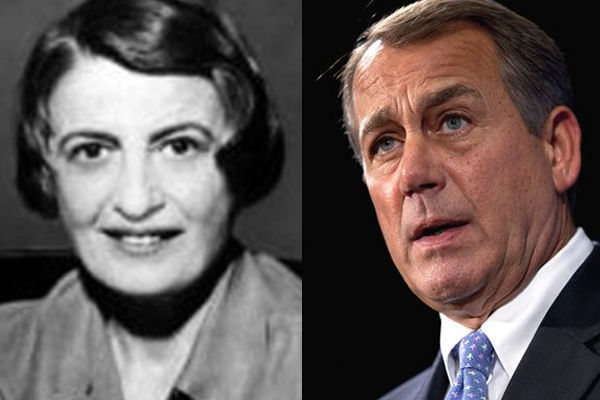
From Ayn Rand to John Boehner, a persistent talking point

(Credit: Wikipedia/AP)

With the announcement last Monday of President Obama’s plan to pay for his jobs bill with, among other things, the so-called “Buffett Rule,” we’re going to be hearing a lot more about the “job creators.” Over the last year, Congressional Republicans have consistently invoked them as a hex of sorts against any proposal to raise new tax revenue. “I am not for raising taxes in a recession,” Eric Cantor declared last November, when the Bush tax cuts were a bargaining chip in the protracted budget debate, “especially when it comes to the job creators that we need so desperately to start creating jobs again.”

Ten months, no new taxes, and one debt ceiling crisis later, Cantor said the same thing last week in response to the president’s jobs bill: “I sure hope that the president is not suggesting that we pay for his proposals with a massive tax increase at the end of 2012 on job creators that we’re actually counting on to reduce unemployment.” Given that 44 percent of the nation’s unemployed have been without work for at least six months and more Americans are living below the poverty line than at any time in the last 50 years, one marvels at Cantor’s faith in the truant “job creators” as well as his forbearance in the face of human misery. To the jobless, he is counseling the patience of Job.

But who exactly are these “job creators?” The phrase is not new. Republicans have been using it for years to underscore a particular vision of capitalism in which those who have benefitted most by the system are also most essential to its continued success. As long ago as 1991, Newt Gingrich characterized Democratic opposition to a cut in the capital gains tax as evidence that liberals reject this vision. “They hate job creators,” he told a gathering of Senate Republicans, “they’re envious of job creators. They want to punish job creators.” With no apparent sense of irony, Gingrich added this was proof liberals “believe in class warfare.”

A more telling example for our current political impasse is the debate over the 1993 Clinton budget plan, which aimed to cut the deficit by, among other things, raising the top income tax rate. Congressional Republicans fought the bill tooth and nail, no one more so than former Texas Senator Phil Gramm. On the eve of its passage, he expressed the hope that the bill would “defy history” and prove that “raising taxes on job creators can promote investment and promote job creation.” Gramm, of course, did not think this was very likely to happen. “Only in Cuba and in North Korea and in Washington, D.C., does anybody believe that today,” he said, “but perhaps the whole world is wrong.”

Hindsight suggests that the world wasn’t wrong so much as Phil Gramm, along with every other Republican member of Congress. Not one of them voted for the bill, which cleared the House by only two votes and required Al Gore’s tie-breaking vote in the Senate. While higher taxes on the “job creators” proved no obvious hurdle to economic growth — the economy grew for 116 consecutive months, the most in U.S. history — it did cut the deficit from $290 billion when Clinton took office to $22 billion by 1997 and helped put the country on a projected path to paying off the national debt by 2012.

So much for ancient history. If the term “job creators” is no new addition to the lexicon of American politics, it has enjoyed quite a renaissance since President Obama took office. A Lexis-Nexis search of U.S. newspapers and wire services turns up 1,082 individual mentions of “job creators” in the month before the debt ceiling deal was reached, or just 175 fewer mentions than for George W. Bush’s entire second term.

Jon Stewart, for one, did not fail to notice the uptick. “Republicans are no longer allowed to say that people are rich,” he noted during the deficit ceiling debate, “You have to refer to them as ‘job creators.’” Stewart’s observation is funny only to the extent to which you believe that saying you’re a member of the top tax bracket and saying that you create jobs is not an obvious redundancy. If you believe, however, that the cast of “Jersey Shore” has just as much claim to being called “job creators” as Bill Gates or Steve Jobs, then Stewart’s joke not only falls flat, but misses the point. The wealthy are the “job creators,” whether or not they spend their time actually trying to create jobs.

The problem, of course, with upholding a definition of “job creators” that does not turn on the dedicated effort to create jobs is that it becomes hard to figure out what distinguishes the “job creators,” as a group, from everyone else — at least beyond their relative wealth. All Americans spend, save, and invest in varying degrees; most just do so with a lot less money.

In this light, the “jobs creators” rhetoric highlights a theory of capitalism in which those at the very top of the economic pyramid end up supporting the base. We might call this theory the Visible Hand of Capitalism in order to distinguish it from Adam Smith’s Invisible Hand. In “The Wealth of Nations,” he famously located the enduring success of capitalism in an increasingly complex system of work and exchange that sees “the assistance and co-operation of many thousands.” In such a society, no single group can be meaningfully called the “job creators.” They are as much the managers of capital as the men on the factory line.

As an intellectual matter, the Visible Hand of Capitalism has enjoyed support from figures as disparate as Destutt de Tracy, the French philosopher and economist whom Thomas Jefferson championed, to the steel baron and indefatigable philanthropist, Andrew Carnegie. As a rhetorical matter, however, the phrase “job creators” appears to come directly from the work of Ayn Rand. She favored the term “creators” to describe an elite caste in society and her highest human ideal.

John Boehner made reference to “Atlas Shrugged,” Rand’s most famous novel, in a speech he gave recently to the Economic Club of Washington, D.C. “Job creators in America are essentially on strike,” he said, in an obvious nod to the decision by the “creators” in the novel to go on strike in defiance of an intrusive federal government. The nation immediately begins to falter, and the books concludes with its hero, John Galt, giving a marathon address in which he explains to the rest of the country why America is crumbling. The nation, in brief, has scared away the very people who keep the economy working, leaving behind those who are ill-equipped to fend for themselves.  Describing the economic and social theory underpinning this vision, Galt says:

In proportion to the mental energy he spent, the man who creates a new invention receives but a small percentage of his value in terms of material payment, no matter what fortune he makes, no matter what millions he earns. But the man who works as a janitor in the factory producing that invention, receives an enormous payment in proportion to the mental effort that his job requires of him. And the same is true of all men between, on all levels of ambition and ability. The man at the top of the intellectual pyramid contributes the most to all those below him, but gets nothing except his material payment, receiving no intellectual bonus from others to add to the value of his time. The man at the bottom who, left to himself, would starve in his hopeless ineptitude, contributes nothing to those above him, but receives the bonus of all of their brains.

For all that it lacks in human decency, Rand’s vision of who makes capitalism work at least has the advantage of isolating a group of people who actually create something. By contrast, the current “job creators” rhetoric seems to elevate a group of people whose shared tax bracket is their only outstanding trait.

As the debate over the president’s jobs bill takes shape, the “job creators” rhetoric is certainly deserving of a little more scrutiny, especially by those who don’t qualify for the distinction. Otherwise, they might as well accept the judgment of a far greater authority than even John Galt:

The fault, dear Brutus, is not in our stars,
But in ourselves, that we are underlings.

Continue Reading Close

What Republicans get wrong about capitalism

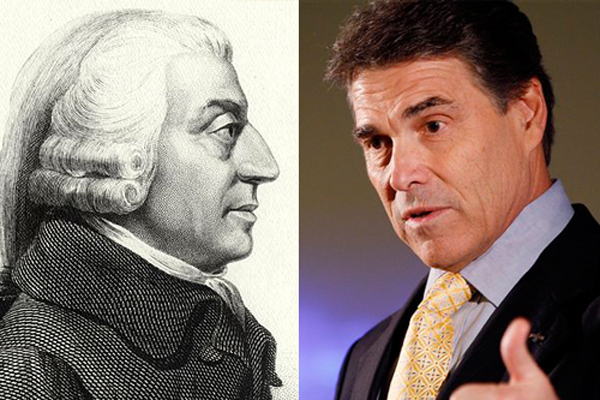
Conservative hero Adam Smith thought workers -- not Rick Perry's "job creators" -- were the engine for growth

To hear the Republicans tell it, even more than paying down the national debt, the key to solving our current economic woes is to make way for the “job creators,” a motley crew of Americans who appear to share no more in common than their membership in the top tax bracket.

The reasoning is relatively straightforward and was summed up recently by Texas Governor Rick Perry: “America is not going to move forward until we remove restrictions of over-taxation, over-regulation and over-litigation on the job creators and free them so the jobs can be created.” This is a familiar refrain, one that makes progressives shake their heads at a seeming indifference to hard choices and economic history. Still, by now it should be clear that the refrain is far more than convenient rhetoric. It is founded on a bedrock belief about the free market, one that answers What makes capitalism work? by addressing a different question: Who? For that is what is at stake in the term “job creators,” a vision of capitalism’s essential players, one very different from the original account provided by Adam Smith. His account of who makes capitalism work is at odds with the one we are used to. The essential players are found at the base, not the apex, of the economic pyramid.

Near the beginning of “The Wealth of Nations”, Smith calls our attention to what, for him, is one of the fundamental qualities of human experience: helplessness. “[M]an has almost constant need for the help of his brethren,” he says, for unlike animals, we cannot tend to even our most basic needs on our own. How exactly do we gain the help of others? The answer, says Smith, lies somewhere between the fawning cocker spaniel and the commands of an all-powerful king.

Let’s hold the king aside for a moment. When a cocker spaniel wants to be fed, Smith says, “it has no other means of persuasion but to gain the favor of those whose service it requires.” It wags its tails, licks its master’s hand, and appeals to him with puppy dog eyes. The cocker spaniel will occasionally succeed, and so too will the fawning beggar, but such an approach is obviously not an optimal way to get what you want. Indeed, most times people will simply pass by you, leaving you hat in hand.

Thankfully, says Smith, human beings have a natural propensity to negotiate or, as he describes it, to truck, barter, and exchange. “Give me that which I want, and you shall have this which you want” is not only the manner in which we acquire most things in this world, but it is the building block for an economically advanced society. Thus, Smith declares in his most famous passage:

It is not from the benevolence of the butcher, the brewer, or the baker that we expect our dinner, but from their regard to their own interest. We address ourselves, not to their humanity but to their self-love, and never talk to them of our own necessities but of their advantages.

People who read this passage and nothing else of Smith tend to regard it as an affirmation of the virtue and efficacy of selfishness over and against the relative impotence of altruism. But that isn’t its significance for Smith. Yes, our personal interests act as a sharper spur to action than the interests of others, but the same may be said for the cocker spaniel. The difference is not that we have selfish interests, but that only by understanding the interests of others are we able to fulfill our own.

Indeed, the passage attests to the human capacity for empathy, the focus of Smith’s other great work, “The Theory of Moral Sentiments”. It is because of our natural tendency to stand in the shoes of others and see the world through their eyes that we can appeal to their interests. The commercial effect of this practice is that we individually learn how to make the kinds of exchanges that, in the aggregate, lead to the wealth of a nation.

This brings us back to the all-powerful king. Fundamentally, he is no different from the rest of us. Regardless of the scepter and pomp, set him down on a deserted island and he would be just as helpless. Still, when he is seated on the throne he can remedy his helplessness by ordering others to attend to his needs. He can also force them to attend to the needs of one another. In this respect, he provides an alternative way of thinking about how we might distribute the resources of society apart from relying on the dull instinct of altruism or the even the organizational force of self-interest guided by empathy.

And yet, says Smith, if we consider those cases where, because of assumed wisdom and/or threatened force, a single person directs considerable resources, we will soon see that this third way fails to match the decentralized power of truck, barter, and exchange. Reflecting on the creature comforts that even the meanest person enjoys in a developed society, Smith says, if we

consider what a variety of labour is employed about each of them, we shall be sensible that without the assistance and co-operation of many thousands, the very meanest person in a civilized country could not be provided, even according to, what we very falsely imagine, the easy and simple manner in which he is commonly accommodated. Compared, indeed, with the more extravagant luxury of the great, his accommodation must no doubt appear extremely simple and easy; and yet it may be true, perhaps, that the accommodation of an European prince does not always so much exceed that of an industrious and frugal peasant, as the accommodation of the latter exceeds that of many an African king, the absolute master of the lives and liberties of ten thousand naked savages.

If the contrast Smith makes is not necessarily marked by cultural sensitivity, it underscores his broader point about who makes capitalism work. Not the all-powerful king, however wise and mighty, but “the assistance and co-operation of many thousands.” The butcher, the baker, and the brewer, the countless men and women who support and extend the division the labor — these are the people who ensure the increasing efficiency, growing complexity, and continued development of society. They are the base of the economic pyramid, and their actions ensure the bounty of the Invisible Hand.

So what happened to Smith’s account? Consider Andrew Carnegie’s perspective on who makes capitalism work in his essay “The Gospel of Wealth.” Writing a century after Smith’s death, the steel magnate describes the decisive moment when human beings began to favor a model of free competition that saw the separation of “the drones from the bees,” a process that allowed for the “accumulation of wealth by those who have the ability and energy that produce it.” Carnegie says of such people (who happen to look a lot like him) that they are so essential to society’s development that those who object to the inequalities of a free market system might as well “urge the destruction of the highest existing type of man.”In the same spirit, roughly 75 years later, Ayn Rand, in her aptly titled “What Is Capitalism?,” focuses on the “the innovators” who promote a society’s development. They are an “exceptional minority,” she says, “who lift the whole of a free society to the level of their own achievements.” What does everyone else contribute? On Rand’s account — nothing. “The man at the top of the intellectual pyramid contributes the most to all those below him,” she says, “but gets nothing except his material payment, receiving no intellectual bonus from others to add to the value of his time. The man at the bottom who, left to himself, would starve in his hopeless ineptitude, contribute nothing to those above him, but receives the bonus of all their brains.”

This is a striking alternative to Smith’s vision. Instead of “the assistance and co-operation of many thousands,” it is an elite caste that provides the vision, brains, and organizational savvy that ensure a thriving economy. They are the Visible Hand of capitalism, and for Carnegie, Rand, and others like them, if you want to know who makes capitalism work, simply stand at the base of the economic pyramid and look up. You’ll find the “job creators” at the very top.

Smith would be highly skeptical of such claims. In the final edition of the “Theory of Moral Sentiments,” written over a decade after “The Wealth of Nations,” he added a chapter in which he describes the “disposition to admire, and almost to worship, the rich and the powerful, and to despise, or, at least, to neglect persons of poor and mean condition.” This disposition, Smith says, colors the way we view the world, leading us to conflate wealth and greatness with virtue and poverty and weakness with vice.

It also leads to confusion in thought. Who makes capitalism work? is a very different question from For whom has capitalism worked best? We should guard against presuming the answers are necessarily one and the same.

John Paul Rollert is a doctoral student at the Committee on Social Thought at the University of Chicago.

Continue Reading Close
www.salon.com/writer/john_paul_rollert/index.html