Joshua David Stein

Kim, Mao dazzle; Rochette wins hearts

Olympic ladies figure skating begins with a big, bright, emotional twirl

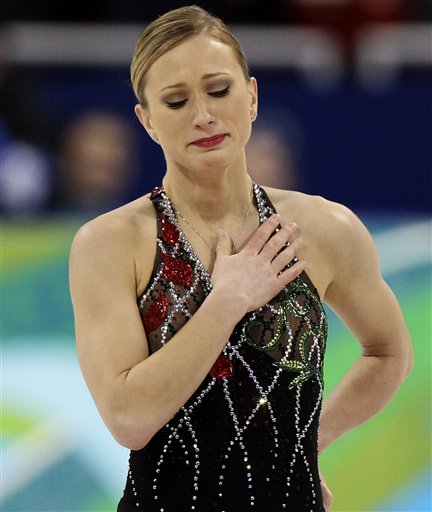
Canada's Joannie Rochette reacts after performing her short program during the women's figure skating competition at the Vancouver 2010 Olympics in Vancouver, British Columbia, Tuesday, Feb. 23, 2010. (AP Photo/Mark Baker)(Credit: AP)

There is little straightforward about figure skating. It is, instead, a sport of parabolas, of giant curves carved on oval ice, of spirals sparklingly etched in air. It is oblique and obscure in other ways too. Unlike bobsledding, wherein the rubric is time (the less of it the better), or ski jumping where it is distance (the more, the merrier) or, say, ultimate fighting, where success is measured in teeth missing of a beaten foe, the criteria for judging figure skating is not immediately apparent to the common man. Much of the technical nuance that determines who goes home and into history with a gold medal passes by the layman viewer unnoticed. The codex of skating law is Byzantine, rarified and known to few.

Still, last night’s Women’s Short Program was a joy to watch. When we don’t know facts, we tell ourselves stories. Our eyes, unhindered by expertise, can nevertheless discern the line of beauty and if not the line, at least the curve.

Sensing our need for narrative, the producers happily obliged. In the early going, during the routines of those deemed unable to podium, the announcers — Scott Hamilton and Sandra Bezic — happily trounced down the path of after-school special new historicism. We heard very little about Cheltzie Lee’s axel, though we did learn her father is Chinese, born of Dubai, and her mother is African-American, a daughter of Louisiana. (Also, her song for those of you who are interested, was an instrumental version Michael Buble’s already neutered cover of Nina Simone’s classic, “Feeling Good.”) Though Hamilton and Bezic had little to say about the technical elements of Turkish skater Tugba Karadamir’s routine, her mother, we know now, is an aerospace engineer and her father owned several restaurants in Turkey before moving to Canada to work menial jobs. Admittedly, there wasn’t much to hold on to during these routines but the athletes were there to tell their story on the ice. They deserve to live or die by their clean triple/triple combinations. Fortunately, the judges seemed immune and unsympathetic to the non-diegetic, a coven of unfeeling arbiters and all the better for it. 

At first American Mirai Nagasu seemed doomed to the condescending fate of her predecessors. Her parents own a sushi restaurant. She slept in a storage closet. Her mother has thyroid cancer. I might be crass — in fact, even I think I’m crass — but I don’t care about her mother’s cancer or about their restaurant Kiyosuzu (though the debate over its quality on Yelp is endlessly entertaining). My interest is in Nagasu’s skate. Though I might not understand the import, I want to know if she under-rotated her triple/triple combination (she didn’t). Thankfully, after an initial burst of narration, the announcers yammered down and let Nagasu’s skating shine through. That girl is bendy and sparkly and that’s all I know how to say about her program. She can spin, while peeling one leg from the ice and letting it float upwards like a fern tendril unfurling and she spun so hard she bloodied her nose. Call me an old codger of a new critic, but the joy ignited by her smile — her real smile, not the pre-skate simulacra — needs rely on no external context for its emotive power.

But of course, last night’s protagonist wasn’t Nagasu, who now stands in sixth place. It wasn’t even the breathtakingly perfect performances by South Korea’s Kim Yu-na or her Japanese nemesis Mao Asada, both of whom skated flawlessly, Kim in sparkly James Bond attire and Mao in a bizarre bordello-chic lace get up. A whole treatise could be written about a Japanese girl’s decision to embody an Englishman’s dick-guided construction of hypersexualized Japanese woman but here’s not the place. The night belonged to the Canadian skater Joannie Rochette in whom the twinned threads of life off the ice and life on the ice naturally, albeit tragically, were entwined.

In one of those off-putting fireside chats with Bob Costas, we learned Rochette’s mother had died unexpectedly of a heart attack on Sunday. Sitting across from Dan Jansen, the American speedskater whose sister Jane died hours before his race in 1988, (his story is told in under 30-seconds in Visa’s Go World ads) Costas swelled with empathy, repeating back to Jansen the fleeting moments of his sister’s life. “She was on her bed; she couldn’t speak to you but she could listen. Your brother held the phone up to her….” Nothing seems more barbarous torture than having Bob Costas repeat back to you tragic or important moment in your life in his profane, professional voice. Phrasing the most sincere and cherished memories so polished they come off as phony Kewpie Lifetime dramas. He’s a crap prism, taking in light and refracting dime store rainbows.

But despite Costas mawkish sentimentality, Rochette’s obvious emotional vulnerability couldn’t help but stir. Rochette had become Perseverance incarnate. Onto her sequined rose dress were pinned the hopes and needs of the minions whose hearts had been hurt and who yearned for redemptive resonance. She was no longer an athlete but a mascot for the human condition.

Thankfully, Rochette’s music wasn’t ridiculously overwrought Europop or the tinny phony flapper jazz of American Rachel Flatt. She danced instead to Gerardo Matos Rodriguez’s 1917 tango classic “La Cumparasita,” as emotive a piece of music as there ever was. Her skate was like something from a Pedro Almodovar movie. It was 2 minutes 50 seconds of sustained passion and of formalized pain. Great eddies of pathos swirled under the ice on top of which Rochette glided. Her bright red lips pursed in concentration, Rochette didn’t smile fakely nor concede to the tide of her woe. She skated seriously, expansively and confidently. She landed her combinations without under-rotation. She did exactly what she had trained to do. In her spins, she gathered her limbs unto herself and spun faster and faster, wrapping her story and her loss about her. And finally, flinging her limbs out and planting her toe in the ice, she stopped and gave it all away.


Skinny boys go up, big men go down

Siblings dance a romantic tango; ski jumping and downhill racing contrast; Bode Miller makes amends

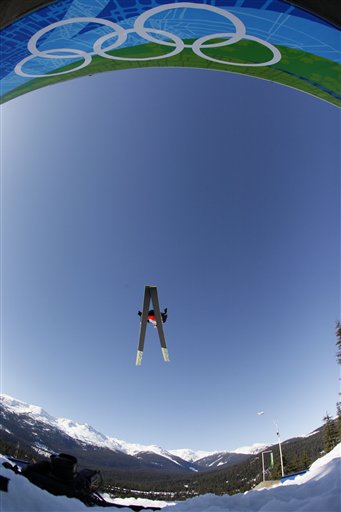
Switzerland's Simon Ammann makes his qualification jump during the Men's large hill ski jumping qualification round at the Vancouver 2010 Olympics in Whistler, British Columbia, Canada, Friday, Feb. 19, 2010. (AP Photo/Dmitry Lovetsky)(Credit: AP)

Deeper truths come fast and furious when you’re watching a pair of sequined siblings floating on the blades of desire to an elevator soundtrack stuck on Tango. It’s weird to see and triggers soul-searching. Watching Friday’s Olympic line-up, a cataract of Ski Jumping, Men’s Alpine Skiing, Couple’s Figure Skating and Women’s Skeleton, itself could have qualified as an Olympic sport. It was exhilarating, difficult and revelatory. Nattering Bob Costas led us not only down large snow-covered hills to weave between flags or to launch into the air. He led us to triple lutz into ourselves, to take a mythic Tango Romantica with our own souls. He’s the Virgil of Vancouver 2010. And so halfway through the journey of the Olympic Games, we found ourselves on a snowy hill.

Winter Olympic sports can be divided into three categories: those that go down, those that go up and those that are level. Last night’s spread included all three. While Alpine Skiing and Skeleton fall into the first category, Ski Jumping falls into the second and Figure Skating into the third.

Ski Jumping, a sport in which young boys in shiny green foam outfits slide down a large snow-covered ramp to launch themselves into the air, has been an Olympic sport since the first Winter Games in Chamonix-Mont Blanc in 1924. Ski jumpers are the gelflings of winter athletes, slight wispy doe-eyed boys (and for now, only boys) who, as has been much noted, starve themselves to fly higher. But it’s easy to understand why Ski Jumping hasn’t attracted much of an audience stateside. It’s straightforward to the point of dull and minimal to the point of static. [Poles, on the other hand, are reportedly mad for it.] There are basically only three positions — crouching, flying and landing and this series is repeated by every competitor with little variation. From the angle of NBC’s camera, the skier himself, as he floats through the air like an aerodynamic Canadian Goose, might as well be back at 30 Rock, wearing a silly suit and standing in front of a green screen in some Gumby-inspired SNL send up. But to focus one’s gaze on the barely moving part is to miss the point. There’s some sort of zen haiku calm to the sport that’s bores the mind but awakens the soul.

Once airborne, the skiers lean acutely into the wind beyond, like matadors of the air. They hold steady and still, the white ground reflected orangely in their ski goggles whirrs below them. For those of who appreciate the simple things in life–warm chocolate cookies, tax refunds, Fred Sandback’s string sculptures–the pure geometric simplicity of the sport is refreshing: two parallel planes, separated by a parabola, like a high school physics diagram made real. For those more metaphorically inclined, the striving ascension is a reminder of man’s hankering for transcendence of this realm of shadows and gravity. It’s Icarus on Ice.

But of course tonight’s event was just a qualifying round. The athletes weren’t competing to win but simply to move on to the next level. Accordingly, my eye was keyed toward failure, hoping secretly for a Vinko Bogatag Agony of Defeat moment. Sadly/happily it never came. Instead these boys glided down the ramp gracefully, floated between 119 and 142 meters, and landed as lightly as a dandelion seed.

If Ski Jumping embodies man’s transcendence, Alpine Skiing glorifies his descent. Here burly big-chinned men built like Clydesdales carom wildly down a mountain. The Super G is 2,076 meters of barely controlled chaos punctuated by great moments of difficulty. It, along with the luge, is the most unforgiving sport, one in which one error compounds into the next, where one miscalculation scotches the entire balance sheet. Anything that’s goes fast, has curves and loves going down is dangerous. [You can't see me, of course, but I'm winking really hard at the screen.] Compared to the quietude of the ski jump, it’s great fun to watch. Among the most spectacular on the slopes were of course Bode Miller who hewed closely to the flags, so closely in fact he wore arm pads. But Miller faced overwhelming competition both in terms of his ski time and redemption narrative from the Norwegian Aksel Lund Svindal who skied the course in 1:30:34 to win gold. Both are, to some extent, comeback kids. But whereas Bode Miller’s 2006 fall from grace was self-inflicted, involving an endless series of Italian nightclubs and subpar runs in the Torino games, Aksel’s fall was much more literal. In 2007, the highly rated Norwegian crashed hard in Beaver Creek, soaring unhappily through the air and breaking his face and groin upon landing. But, as we were told last night through a touching NBC montage, Aksel managed to come back to score a win at the very same course that nearly destroyed him less than a year later.

Does it perhaps say something about the indomitable American spirit that we prefer our heroes’ falls self-inflicted? Indeed, “Where were you when you learned Tiger Woods was a sex fiend?” is this generation’s version of “Where were you when JFK died?” We prefer our heroes on the way down than on the way up and besides, peripeteia is just so fun to watch on TMZ. This leads us somewhat unexpectedly to Figure Skating.

NBC might be losing $12 million on the Olympics but they aren’t going down without a fight. Throughout the games, Bob Costas, with his puppy dog eyes glinting mischievously, has tried to stir the pure Olympic cauldron, hoping some of the lesser qualities of mankind might rise to the top. He probably has a Post-It next to his mirror in his dressing room reading, “Double, double toil and trouble; Fire burn, and caldron bubble.” Last night Costas’ hankering for dirt was most evident in his stoking the flames between Evan Lysacek, the American cyborg who won Men’s Figure Skating Gold, and the Russian Evgeni Plushenko, who didn’t. Fireside, Costas endlessly needled Lysacek about the Russian’s mildly disparaging comments but Lysacek, though sleep deprived, remained gracious and even keeled. Costas O; Decency 1. But it was really in the Compulsory Ice Dance section of the night that NBC let its muckracking Automatic Grammatizator get going.

The Compulsory Ice Dance sounds like some sort of medieval torture and that’s not so far from the truth. If the Ski Jump is the haiku of the games, the compulsory ice dance is a villanelle, a sport corseted so tightly with rules and regulations that the gasps of creativity are remanded to grow through the cracks. Last night couples had to dance to something called the Tango Romantica, executing precise steps on certain beats in predetermined locations while describing proscribed patters on the ice. That does sound romantic! To comprehend the complexity take a look at this scoring sheet.

Bob Dylan might have said it best when, in his 1965 ballad of Figure Skating, he described the experience thus, “Old lady judges watch people in pair/ Limited in sex, they dare/ To push fake morals, insult and stare/ While money doesn’t talk, it swears/Obscenity, who really cares/Propaganda, all is phony.” Essentially inscrutable to the civilian, Ice Dancing seems like a bunch of men dressed as waiters dancing with women dressed as estate brooches to the same song. Compared to this my W9 forms seem compelling.

Enter Costas and Co. who spend an inordinate amount of time focusing on the drama between the two teams of Americans: Meryl Davis and Charlie White, and Tanith Belbin and Benjamin Agosto. In NBC’s hands, the rivalry–if there was one to begin with–escalates into an epic cold war. The younger Davis and White come to embody all that is light and white and right with the world. They’re young and dewy eyed. Charlie likes Jack Johnson and Kanye; Meryl’s favorite colors are blue and pink. They’ve been skating together since they were ten. Tanith and Benjamin are the Odile to Davis and White’s Odette. The duo are darker, more mysterious, dramatic, older and a little condescending. After minutes of off-screen NBC waterboarding, Agosto manages to say something a wee bit not very nice about Davis and White, something like, “We have more experience.” Davis and White manage to pooh pooh the rivalry itself which sounds suspiciously like they pooh pooh Belbin and Agosto. It’s not much but it’ll have to do and so the ice, once horizontal, starts to tilt and we merrily slide down it, picking up speed as we go.

Continue Reading Close
www.salon.com/writer/joshua_david_stein/index.html