Joshua Tucker
The biggest myth about Democrats and tax cuts
Their plan extends tax cuts for people making over $250,000, too. Can someone please report this correctly?
This article originally appeared at The Monkey Cage
I’m not sure this post is going to qualify as applying political science research to anything, but I just want to point out again that the current Democratic proposal for extending tax cuts is a tax cut for everyone who pays taxes. The cutoff rate is for income over $250,000 (or $1,000,000, or whatever). But people who earn over $250,000 will still get a tax cut on their first $250,000 of income. Yet here is how Politico reports on the bill:
The objection means any tax-cut votes will be delayed until Saturday while Reid begins taking the procedural steps necessary to open debate on two separate measures: first, to limit the tax cuts to people who earn less than $250,000, and second, to people who earn less than $1 million. [Emphasis mine]
I don’t mean to pick on Politico. I heard the exact same thing on two different NPR programs this morning, the news of the hour and yesterday’s “Marketplace.” (To their credit, the hosts at NPR’s “It’s All Politics” podcast, Ron Elving and Ken Rudin, got it right.) But I think we should really be calling journalists on this, which is what I’m trying to do here.
Now, to be fair, if you want to talk about the policy proposal in terms of what will happens to the amount of taxes people are paying right now, it is correct that people earning over $250,000 will pay more taxes come Jan. 1 if the Democratic plan passes, but only on income beyond $250,000. So if you make $250,001 a year, your tax rate will only increase on that last $1. But again, if you want to talk about extending the Bush tax cuts, the Democratic proposal ensures that those tax cuts will be extended to everyone for their first $250,000 of earned income.
Making sense of the Kindle’s highlighting feature
Why bother reading the whole book if you can skip to the end and find out what others thought was most important?
This originally appeared at The Monkey Cage
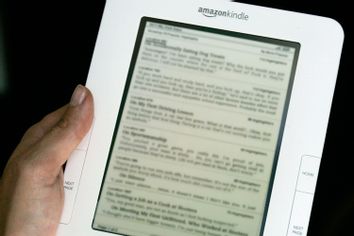
Recently back in the United States after an extended time abroad, I saw Michael Lewis’ “The Big Short” for the first time in an airport bookstore a couple days ago. Not wanting to add to my luggage — I apparently missed the fact that Delta has turned into a European discount airline and charges for checking even a single bag now — I downloaded the book onto my Kindle once I sat down on my plane (which was very fun from a modern technological standpoint) and began to read during my flight. (As a side note, does anyone know whether a Kindle counts as an electronic device you need to turn off while flying?)
Continue Reading CloseDid LeBron get played?
Using game theory to understand the decision of Bosh, Wade and James to join forces in Miami
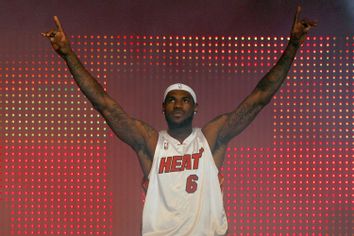
LeBron James greets fans at the Miami Heat's 'HEAT Summer of 2010 Welcome Event' in Miami on Saturday.
This originally appeared at The Monkey Cage:
We’ll probably never know what exactly went down between Dwayne Wade, Chris Bosh and LeBron James as they made their final decisions about where to play next year, but according to the media, it was certainly all LeBron all the time. But what about the other two, what kind of effect did they have on the outcome? This reminded me of something John Huber once said at a conference: that he liked formal modeling because it gave him a chance to understand interactions that he would never actually be able to observe. So with that in mind, consider my very modest attempt at asking what game theory might have to say about the end of the King James saga.
Continue Reading CloseA closer look at Family Research Council’s gays-in-the-military-bashing
Christian conservative group produces a highly questionable study about "homosexual assault" in the military
The Family Research Council has released a report on Homosexual Assault in the Military that is now getting picked up in the mainstream media. The central point of the report seems to be new data analysis that shows that 8.15 percent percent of sexual assaults in the military in Fiscal Year 2009 were of a same sex nature (p. 6), the vast majority of which involved two men (see footnote 4). The report also cites data showing that 2.8 percent of men and 1.4 percent of women in the U.S. general population identify themselves as gay, lesbian, or bisexual. On this basis, the report claims, “This suggests that homosexuals in the military are about three times more likely to commit sexual assaults than heterosexuals are” (see p. 1).
Continue Reading CloseWill British voters go with their guts?
Since voting for the Liberal Democrats isn't a "wasted vote" anymore, the British third party is expecting a surge
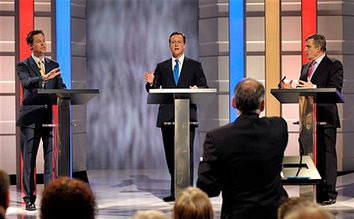
Britain's Labour party leader Gordon Brown, right, Nick Clegg of the Liberal Democrats, left, and Conservative leader David Cameron, center, during a first ever live televised political debate between party leaders broadcast to the nation, from TV studios in Manchester, England, Thursday April 15, 2010. Pollsters predict that about half of the British electorate, some 20 million people, plan to watch the televised debate between the leaders of the three main political parties Thursday, ahead of the British General Election on May 6, 2010.(AP Photo / Rob Evans) ** EDITORIAL USE ONLY - NOT TO BE RETAINED IN ARCHIVE AFTER MAY 14 2010 **(Credit: Rob Evans) When I teach strategic voting to my undergraduates, I define it as an instance where people rank candidates or parties in the order they would prefer to see them elected, and then subsequently choose not to vote for whomever they rank first. By contrast, a sincere voter votes for her first choice. There are a variety of reasons why voters might choose to vote strategically (e.g., they might want to send a message to a candidate running in a subsequent election, or they might want to moderate policy outcomes), but the most popular reason in the literature seems to be that voters do not want to waste their vote by voting for a candidate who has no chance of winning the election; this is also known as tactical voting.
Continue Reading CloseIs the Kyrgyz turmoil another of the color revolutions?
All uprisings are not born the same way
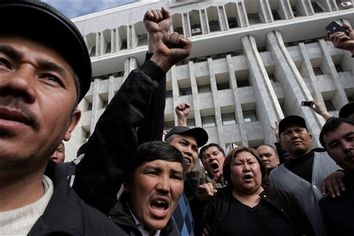
Protesters shout ant government slogans as they gather in front of Kyrgyz government headquarters on the central square in Bishkek, Kyrgyzstan, Thursday, April 8, 2010. An opposition coalition in Kyrgyzstan said it has formed an interim government that will rule the turbulent Central Asian nation for six months. Opposition leader Roza Otunbayeva said Thursday she will head the government that dissolved the parliament and will take up legislative duties. (AP Photo/Alexander Zemlianichenko)(Credit: AP) Writing yesterday about Kyrgyzstan, I stated that the events did not represent a Colored Revolution, and indeed might go on to be considered the first “post-colored revolution” revolution in the post-Soviet space. I’m writing now to elaborate a bit on what I meant by this.
Continue Reading ClosePage 1 of 2 in Joshua Tucker