Ken Ilgunas

My soggy, frustrating, inspiring week Occupying Wall Street

I needed to know if I believed in this movement. So I took a break from my job and traveled 4,300 miles to find out

  • more
    • All Share Services

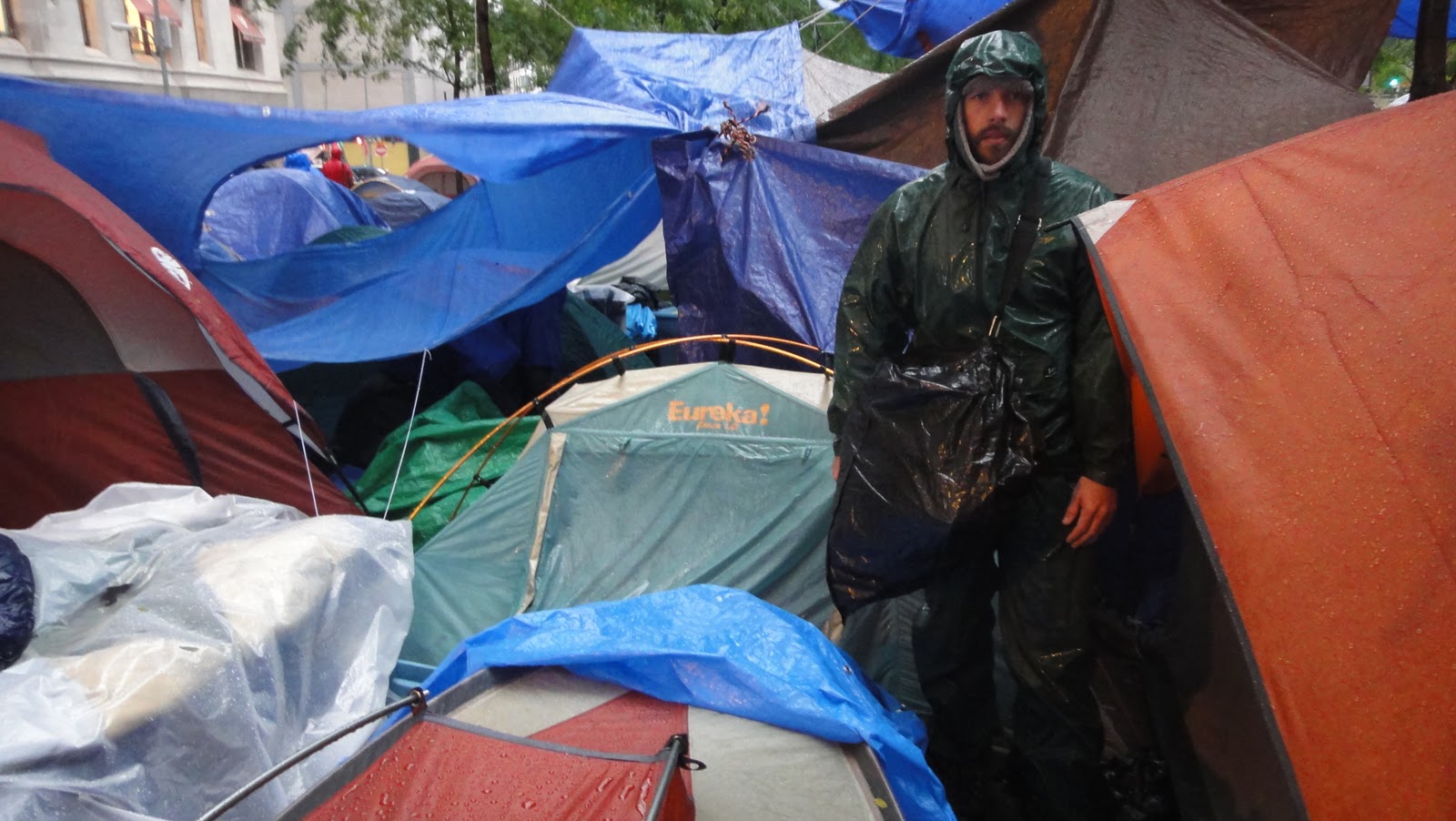
My soggy, frustrating, inspiring week Occupying Wall Street The author braves the rain at Zuccotti Park, as part of the Occupy Wall Street demonstration

“You want to know what I think of the ‘99% movement’? They’re the ‘Give Me Stuff movement,’” said Derrick, a 53-year-old mechanic.

I met Derrick during the five months I’d been washing dishes at a truck stop in northern Alaska. While he drove me five hours to the Fairbanks airport — where I’d hop on a flight to New York — he lectured me about my generation, who, according to him, were “a bunch of kids who don’t know anything about work or saving.”

Given that most occupiers were in debt because of tuition and couldn’t find work because of a crummy job market, he wasn’t entirely wrong. But unlike Derrick, I was inspired by these occupiers who’d had it with the corpulent Scrooges of Wall Street and the corporate scourges of America. Finally, here were people doing something about it, even if that “something” was a lot of sitting around.

So on Oct. 20, I arrived at Zuccotti Park, carrying a tent and sleeping bag, eager to see things for myself and excited to embrace the life of an “occupier” (if just for a week before I had to go back to work).

Zuccotti Park was smaller than I’d imagined — only 33,000 square feet, little more than half the size of a football field – yet hundreds slept here every night, and thousands visited throughout the day. There were folded blue tarps, piles of backpacks, heaps of cardboard, and rows of sleeping bags laid side by side like body bags after a deadly battle. From afar, I heard the clatter of the drum circle and the clunking of construction. There weren’t any distinguishable smells except for a hint of grilled hot dogs wafting over from a nearby food stand. Thousands of tourists slowly wove around established sleeping grounds through narrow, curvy lanes. A gaggle of reporters, like hens crowding a poultry feeder, surrounded a man in a wrinkled shirt screaming something about how the Jews were to blame for everything.

I set my pack down, joined a long line leading to the kitchen, and got a plateful of rice, pizza and vegetarian chili before unraveling my tarp, sleeping bag and sleeping pad next to a group of occupiers. I fell asleep to the leaves fluttering on the honey-locust branches overhead and a homeless person a few feet away, softly muttering obscenities in his sleep.

- – - – - – - – - -

As the week wore on, I got to know my fellow occupiers, as well as the ins and outs of the “occupying life.”

I attended educational sit-ins taught by local professors, went on a march to protest the NYPD’s racist “stop and frisk” policy, and made sweeping up the grounds with a broom and dustpan my morning communal duty. I grabbed a book from the “People’s library” and an extra tarp from the comfort station (where volunteers hand out clothes and camping equipment that have been donated to the occupation).

But the realities of occupying, I quickly learned, didn’t quite match up with my romantic expectations. Because porta-potties are banned from the park, I spent a good portion of every day frantically searching for a toilet or — when I happened upon a restroom in the city — straining to get “nature to call” as a preemptive strike against the digestive discomforts I knew I’d otherwise face later on.

For the most part, though, the occupying life is a simple life. Occupiers wake up whenever they want, work whenever they want, and eat food that’s served at most any daylight hour. Everything is voluntary, including the myriad marches and the nightly General Assembly meetings.

Most occupiers, I’d say, are there to protest, some are there for “the experience,” and others are just, well, there. This last group includes a lot of slightly crazy, slightly sketchy, slightly “I hope he doesn’t stab me in the neck when I’m sleeping” people in camp who, seeking a free meal and a place to stay, have little to no interest in the movement. It was these sorts of occupiers — the wackos, the drunks — who were treated like celebrities on the red carpet by the media.

On the other hand, regular everyday visitors would go out of their way to engage with occupiers who came for idealistic reasons. Even though I’d merely be sitting on my pack, several passersby would thank me for “doing what you’re doing.” One middle-aged male offered me ponchos, scarves and gloves, telling me, “This should have happened years ago. Thank you so much for believing.” I overheard a well-to-do lady lean over to her friend and say, “They need to storm the White House. They need to storm the Capitol. Seriously.”

I noticed the same thing over and over again: The first time that sympathizers visit Zuccotti Park, irrepressible grins spread across their faces. Perhaps they were merely amused with the festival-like ridiculousness of it all, but I detected something else. They were enchanted. This bedraggled, unkempt, scruffy-faced horde of occupiers had given people cause to — yes — hope.

Yet people here see what they want to see. Zuccotti is a Rorschach test, an ink blot that could, depending on your concern, end wars, put a stop to hydrofracking, or reinstitute Glass-Steagall. Enchantment is great, though it seems like it’ll only last as long as the possibility for actual change feels real. And, in this nascent stage of the movement, it’s easy for sympathizers to imagine that anything is possible. Yet without establishing substantive goals and winning clear victories, the movement might be frozen by winter doldrums. And while sympathizer and occupier alike agree that ambitious, long-range goals are necessary, it seems like  — for right now — it’ll be hard enough for occupiers to simply hold their ground, get through the winter, and establish stable communities.

On my third day, someone stole my sleeping pad. My neighbors complained that they were missing items, too. I’d heard rumors of heroin use and drug deals. Some regulars told me a woman was raped at knife point. Someone else, allegedly, was pricked by a needle used by someone who had AIDS. I had no way to find out if these harrowing stories were true, but there were enough shady people around to make me believe they could be. And while these shady few are in fact part of the “99%,” I couldn’t help thinking that these squatters were like particles of sand poured into a car engine. And unless the occupation, as a whole, challenges their happy-go-lucky egalitarian ideals and reevaluates the everything-goes anarchist strain of thought, the movement might only cough and sputter, and never get a chance to rev and roar.

- – - – - – - – - -

On my seventh night in the park, the problems of Occupy Wall Street were coming to a head.

The temperature had dropped to 38 degrees, the lowest temperature since the occupation began, and because it had rained the night before, everyone was freezing, soggy and groggy. Many spent the day rigging up ropes from tree to tree in order to create a protective canopy of tarps, which, when completed, looked like tattered, patched-together pirate sails that did little more than dump the rain on someone else a few feet away.

I slept on several layers of plastic on the floor of my one-person tent, but the rain, with no place other else to go, pooled on the sidewalk, crept into my tent, and saturated my coat and sleeping bag. I woke up feeling as if I’d slept inside a moist orifice. The back of my jeans, also soaked, made it look like I’d had a terrible accident. I now had a cough, a runny nose, and a bump on the back of my head the size of a pea. The temperature felt like it was in the 20s, the rain was relentless, and the wind unwavering. I wrapped my laptop in a trash bag, went to the comfort station for extra clothes, and donned the only long-sleeve shirt available: a woman’s tan cardigan with loose, bellbottom sleeves.

Depressed and haggard, the occupiers had wrapped themselves in foil emergency blankets like greasy burritos. Extra tents were handed out, but several occupiers who didn’t get one would stand atop tables and deliver impromptu, half-crazed speeches. One squealed: “I’ve been here for four weeks! And I got nothing! NOTHING!” There were yelling matches; men got in other men’s faces and barked like frothing dogs before a vicious fight.

At night, the rain stopped, so I plucked my sopping wet jacket and sleeping bag from the tent and hung them on the ropes so they could dry in the wind.

The park was unusually quiet on account of the late hour and wintry weather. Looking around, I recognized that, during my mere week here, the place had transformed. Hardly anyone slept under tarps anymore; everyone bedded inside tents now. Waterproof mesh flags designated the various stations (Legal, Media, Information, etc.). There were even cardboard street signs celebrating influential thinkers (Bakunin Ave, Gandhi Way, Trotsky Lane, etc.). We had a Livestream station, as well as a giant projector, which we used to display our General Assembly discussions. There was even a “Children’s Safe Zone,” where parents could bring their kids.

I’d never been awake at this hour in Zuccotti, so it wasn’t until then that I discovered this late-night ritual: small circles of people would huddle together at night to talk. I sheepishly inched over to one group to listen in. Five 20-somethings were speaking with an old man with a curly beard and a fedora. He spoke reverently about the occupation, and told us to be persistent and not to become cynical like his generation had. Everyone listened carefully, mulling over his words, before offering their own thoughts on the movement.

One guy of Indian descent said, “Occupying Wall Street is great, but it’s not enough. We need to do something big. Something huge.” Another guy with a crew cut added, “My parents think I’m crazy for coming here. They were in the military and they’re brainwashed. They think the government’s going to fix itself, like it always has. They don’t realize how messed up our system is.” A girl with dreads chimed in, noting how incredible it was that the General Assembly just sent 100 tents and $20,000 of our raised money to the injured and incarcerated occupiers from Oakland (who’d just been violently evicted from their encampment), before going on a thrilling march up Broadway as a symbol of solidarity with people we’d never met, 3,000 miles away.

In this little circle, three ethnicities, two genders and two generations were represented. These occupiers didn’t fit Derrick’s depiction of the movement: They were neither slackers nor stoners, neither shiftless hipsters nor food-stamped freeloaders. They were smart, informed, articulate and passionate. They didn’t want “handouts,” just a government in which our representatives weren’t servants to special interest groups. And they cared about democracy — so much that they were willing to sleep in wet sleeping bags in near-freezing temperatures.

Still damp, I went back to my tent, wrapped myself in two emergency blankets, and struggled to fall asleep. I’d have to leave the occupation in the morning to go back to work. Despite the discomforts, the flaws and the freaks — I hoped the movement would last. I hoped I would come back. I hoped.

I live in a van down by Duke University

How do I afford grad school without going into debt? A '94 Econoline, bulk food and creative civil disobedience

  • more
    • All Share Services

I live in a van down by Duke University

I was lying on the floor of my van where the middle pilot chairs used to be, trying to hide from view. This is it, I thought. They know. I’m going to get kicked out of Duke.

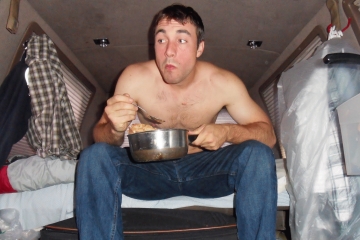
Moments before, I had been cooking a pot of spaghetti stew on top of a plastic, three-drawer storage container, which held all my food and my few meager possessions. I figured the campus security guard had parked next to me because he spotted the blue flame from my propane stove through the van’s tinted windows and shades.

I held my breath as he shut off the engine and opened his door. I was in my boxer shorts, splayed across my stain-speckled carpet like a scarecrow toppled by the wind.

As I listened to what sounded like a pair of Gestapo jackboots approach the driver-side door, I thought about how I’d almost gotten away with it. For two whole months, I had been secretly living in my van on campus.

For some, van-dwelling may conjure images of pop-culture losers forced into desperate measures during troubled times: losers like Uncle Rico from “Napoleon Dynamite,” or “Saturday Night Live’s” Chris Farley who’d famously exclaim, “I live in a van down by the river!” before crashing through a coffee table, or perhaps the once ubiquitous inhabitants of multicolored VW buses, welcoming strangers with complimentary coke lines and invitations to writhing, hairy, back-seat orgies.

In my van there were no orgies or coke lines, no overweight motivational speakers. To me, the van was what Kon-Tiki was to Heyerdahl, what the GMC van was to the A-Team, what Walden was to Thoreau. It was an adventure.

Living in a van was my grand social experiment. I wanted to see if I could — in an age of rampant consumerism and fiscal irresponsibility — afford the unaffordable: an education.

I pledged that I wouldn’t take out loans. Nor would I accept money from anybody, especially my mother, who, appalled by my experiment, offered to rent me an apartment each time I called home. My heat would be a sleeping bag; my air conditioning, an open window. I’d shower at the gym, eat the bare minimum and find a job to pay tuition. And — for fear of being caught — I wouldn’t tell anybody.

Living on the cheap wasn’t merely a way to save money and stave off debt; I wanted to live adventurously. I wanted to test my limits. I wanted to find the line between my wants and my needs. I wanted, as Thoreau put it, “to live so sturdily and Spartan-like as to put to rout all that was not life … to drive life into a corner, and reduce it to its lowest terms.”

It wouldn’t be hard for me to remain frugal. After buying the van and making my first tuition payment, I was only a few dollars away from having to rummage through Dumpsters to find my next meal. I was — by conventional first-world definitions — poor. While I faced little risk of malnutrition or disease like the truly poor, I still I didn’t own an iPod, and I smelled sometimes.

My experiment began in the spring semester of 2009 when I enrolled in the graduate liberal studies department. Months before, I had just finished paying off $32,000 in undergraduate student loans — no easy feat for an English major.

To pay off my debt, I’d found jobs that provided free room and board. I moved to Coldfoot, Alaska — 60 miles north of the Arctic Circle and 250 from the nearest store — where I worked as a lodge cleaner, a tour guide and a cook. Later, I worked on a trail crew in Mississippi in an AmeriCorps program. Between jobs I hitchhiked more than 7,000 miles to avoid paying airfare. When I couldn’t find work, I moved in with friends. My clothes came from donation bins, I had friends cut my hair, and I’d pick up odd jobs when I could. Nearly every dime I made went into my loans.

I hated my debt more than anything. I dragged it with me wherever I went. While I was still leading an exciting, adventurous life, I knew I could never truly be free until my debt was gone.

I finally got out of the red when I landed a well-paying job with the Park Service as a backcountry ranger. Finally, after two and a half years of work, my debt was gone. I had four grand in the bank that was mine. All mine. It was the first time I had actual money that hadn’t been borrowed or given to me since I was a 13-year-old paperboy.

The more money I had borrowed, I came to realize, the more freedom I had surrendered. Yet, I still considered my education — as costly as it was — to be priceless. So now, motivated to go back to school yet determined not to go back into debt, I had to think outside the box. Or, as Henry David Thoreau might suggest, inside one.

In “Walden,” Thoreau mentioned a 6 foot-by-3 foot box he had seen by the railroad in which laborers locked up their tools at night. A man could live comfortably in one of these boxes, he thought. Nor would he have to borrow money and surrender freedom to afford a “larger and more luxurious box.”

And so: I decided to buy a van. Though I had never lived in one, I knew I had the personality for it. I had a penchant for rugged living, a sixth sense for cheapness, and an unequaled tolerance for squalor.

My first order of business upon moving to Duke was to find my “Walden on Wheels.” After a two-hour bus ride into the North Carolinian countryside, I caught sight of the ’94 Ford Econoline that I had found advertised on Craigslist. Googly-eyed, I sauntered up to it and lovingly trailed fingertips over dents and chipped paint. The classy cabernet sauvignon veneer at the top slowly, sensuously faded downward into lustrous black. I got behind the wheel and revved up the fuel-funneling beast. There was a grumble, a cough, then a smooth and steady mechanical growl. It was big, it was beautiful, and — best of all — it was $1,500.

I bought it immediately. So began what I’d call “radical living.”

I removed the two middle pilot chairs to create a living space, installed a coat hook, and spent $5 on a sheet of black cloth to hang behind my front and passenger seats so that — between the sheet, tinted windows, and shades — no one would be able to see me inside. I neatly folded my clothes into a suitcase, and I hung up my dress shirts and pants on another hook I screwed into the wall.

I at first failed to notice the TV and VCR (that I would never use) placed between the two front chairs. Nor did I know about the 12-disc CD changer hiding under the passenger seat until weeks later.

Just when I thought I had uncovered all the van’s secrets, I found a mysterious button toward the back. When I pushed it, the back seat grumbled, vibrated and — much to my jubilation — began slowly transforming into a bed. I half-expected to see a disco ball descend from the ceiling and hear ’70s porn music blare from the speakers

Fortuitously, I was assigned a parking lot in a remote area on campus next to a cluster of apartments where I hoped campus security would presume I lived.

Over time, my van felt less like a novelty and more like a home. At night I was whirred to sleep by crescendos of cicadas. In the morning, I awoke to a medley of birdsong so loud and cheery you would have thought my little hermitage was tucked away in a copse of trees. During rainstorms, I listened to millions of raindrops drum against the roof and watched them wiggle like sperm down my windows.

I loved cooking in the van. As an adept backcountry camper, I could easily whip up an assortment of economical and delicious meals on my backpacking stove. For breakfast, cereal with powdered milk and oatmeal with peanut butter became staples; for dinner, spaghetti stew with peanut butter, vegetable stew with peanut butter, and even rice and bean tacos with peanut butter. Without proper refrigeration, I cut out meat, dairy and beer from my diet entirely. I became leaner, got sick less and had more energy than ever before.

By buying food in bulk I reduced my food bill to $4.34 cents a day. I was meticulous with my expenditures. I saved every receipt and wrote down everything I bought. Not including tuition, I lived (and lived comfortably) on $103 a week, which covered my necessities: food, gas, car insurance, a cellphone and visits to the laundromat.

The idea of “thrift,” once an American ideal, now seems almost quaint to many college students, particularly those at elite schools. The typical student today is not so frugal. Few know where the money they’re spending is coming from and even fewer know how deep they’re in debt. They’re detached from the source of their money. That’s because there is no source. They’re getting paid by their future selves.

My “radical living” experiment convinced me that the things plunging students further into debt — the iPhones, designer clothes, and even “needs” like heat and air conditioning, for instance — were by no means “necessary.” And I found it easier to “do without” than I ever thought it would be. Easier by far than the jobs I’d been forced to take in order to pay off my loans.

Most undergrads imagine they’ll effortlessly pay off their loans when they start getting paid the big bucks; they’re living in a state of denial, disregarding the implications of a tough job market and how many extra years of work their spending sprees have sentenced them to. But “facts do not cease to exist because they are ignored,” as Aldous Huxley famously said.

I have sympathy for my fellow students. I did many of the same things when I was an undergrad. Plus, escaping student debt — no matter how frugal they try to be — is nearly impossible. Even if they do resort to purchasing a large creepy van, most will still have to go tens of thousands of dollars into debt to pay for tuition.

While I found a way to afford graduate school, I by no means had the same financial responsibilities as the average student. I was so poor when I applied that my department took pity on me and significantly reduced the cost of my tuition. I even found a well-paying part-time job working for a government-sponsored program, tutoring inner-city kids.

Governments and financial aid departments normally aren’t so helpful. For decades, the government has let legions of college students — students who wished to better themselves and contribute to society — go into soul-crippling debt. Schools don’t make it any easier with steep hikes in tuition and baffling room and board costs. Students are oftentimes forced to pay for insanely priced meal plans and are barred from moving to cheaper housing off-campus. At Duke, the cheapest on-campus meal plan charges them 3.5 times more a day than it cost to feed me. Their dorm rooms cost 18 times more than my parking permit.

Here, the average undergraduate student who’s taken out loans graduates with more than $23,000 in debt — about the national average. The cost of education at Duke, as at most schools across the country, is disgracefully high. Tuition costs (not factoring in financial aid)  more than $37,000 a year. Additionally, students have to pay at least another $10,000 for books, meal plans, fees and dorms.

Duke’s egregiously hefty price tag is no anomaly. Nor is it unusual for students to unflinchingly take out massive loans that’ll take them years, sometimes decades, to pay off. Willingness to go into debt, of course, isn’t just confined to students; we’re a nation in debt, collectively and individually. Going into debt today is as American as the 40-hour work week; or the stampede of Wal-Mart warriors on Black Friday; or the hillocks of gifts under a Christmas tree. An army of loan drones we’ve become, marching from one unpaid-for purchase to the next in quest of a sense of fulfillment that fades long before the bill arrives. We’re little different from the Spanish explorers who dedicated their lives to the quest for El Dorado, which was always just around the next bend in the river, yet never there at all.

I refused to join those ranks. I became a deserter, an eccentric, an outsider. At Duke, I felt like an ascetic in the midst of wealth, a heretic in the Church of the Consumer. I had to hide.

Because I was so paranoid about campus security finding out about my experiment, I kept myself apart from other students. Whenever I did talk with a fellow classmate, I found myself souring the conversation with preposterous lies — lies I’d tell to protect myself. Whenever someone asked me where I lived, I’d say “off campus,” or I’d make up an address before changing the subject. I found it easier to avoid people altogether.

I worried that if students caught wind of my experiment, a Facebook group would be created for “People who’ve had a confirmed sighting of the campus van-dweller.” Campus security would find out, deem my lodgings illegal and promptly kick me out of the van and into some conventional and unaffordable style of living, wherein I’d have to buy a rug to tie the room together.

Deprived of human companionship, I cloistered myself in my van and in libraries where I was alone with my thoughts and my books. Time for self-reflection, study and solitude was what I thought I’d wanted all along.

But of all the things that I gave up for “radical living,” I found it fitting that the one thing I wanted most was that which couldn’t be bought. When a trio of laughing males drunkenly stumbled past my van, probably hoisting one another up like injured comrades after battle, I thought of my friends back home. On winter nights, when the windows were coated with a frosty glaze, I’d wish for a woman to share the warmth of my sleeping bag.

While I have plenty of good things to say about simplicity, living in a van wasn’t all high-minded idealism in action. Washing dishes became so troublesome I stopped altogether, letting specks of dried spaghetti sauce and globs of peanut butter season the next meal. There was no place to go to the bathroom at night. I never figured out exactly where to put my dirty laundry. Once, when a swarm of ants overtook my storage containers, I tossed and turned all night, imagining them spelunking into my orifices like cave divers while I slept. New, strange, unidentifiable smells greeted me each evening. Upon opening the side doors, a covey of odors would escape from the van like spirits unleashed from a cursed ark.

But no adventure is without bouts of loneliness, discomfort and the ubiquitous threat of food poisoning. I loved my van. Because of it, I could afford grad school. So naturally I was nervous as I listened to the security guard’s weapons jingle as he ambled by my windshield.

But he just kept walking.

I was overcome by an odd sense of dissatisfaction. Deep down, I think I wanted him to discover me. I wanted a showdown. I wanted to wave my arms at the dean and cry, “Impound my van? Over my dead body! I’ll take you straight to the Supreme Court!” Fellow students would rally behind me. We’d stage car-dwelling protests and after winning back my right to remain voluntarily poor, people would begin to consider me the campus sage. I’d wear loose white clothing, grow my beard, and speak in aphorisms to the underclassmen who journeyed the mile on foot to my sacred parking space where I’d serve them tea.

Today I still live in the van. I haven’t taken out loans or borrowed money from anyone. Really, the only thing that’s different is that I’ve set up my laundry area by the passenger seat. Also, after another summer with the Park Service, I have more money than I possibly need. Now, instead of being poor, I am radically frugal. Sometimes, though, I think it would be nice to have an ironing board, plumbing and a wood stove.

It would be nice. A middle-class family might think it would be nice to have an in-ground swimming pool. A millionaire might think it would be nice to have a yacht. The billionaire, a private jet. Someone, somewhere might think it would be nice to have food to feed her family tonight. Someone, somewhere might think it would be nice to live in a van in order to afford to go to a wonderful school. I could begin satisfying my desires and buying comforts, but I’ve learned to appreciate what little I have instead of longing for what I do not.

Admittedly, now that I have money I buy the fancy peanut butter from Whole Foods, and I’ve even purchased an expensive pair of hiking boots. But most things are the same: I still cook spartan meals, I don’t have an iPod, and I park in the very same spot. And I still have my secret. Well, that is, until now.

Continue Reading Close