Laura Deurmyer

The Year in Sanity: “Dude, you have no Quran”

Honoring the shirtless skateboarder who put a would-be flaming pastor in his place

  • more
    • All Share Services

The Year in Sanity: Jacob Isom

Sometimes, I don’t give my fellow West Texans enough credit. Sure, there are many people here who are unthinking followers of hurtful, hateful right-wing dogma. However, West Texas is also home to a hilariously effective foiling of an attempt to carry out the vile Quran-burning set off by Florida preacher Terry Jones.

With the simple declaration “Dude, you have no Quran,” Jacob Isom stopped a radical “Christian” group from burning the Muslim holy book in an Amarillo Texas Park.

Simple, direct common-sense action. Non-violent, casual, calm. Problem solved.

Good ol’ West Texas common sense. It’s still around. It’s shirtless, sporting an inexplicable braid and now shamelessly marketing “Dude you have no Quran” merchandise, but for a least a few minutes, Jacob Isom embodied sanity in West Texas.


My son’s kindergarten is a toy gun battlefield

In gun-crazy Texas, I struggle between teaching my son safety and respect and letting a boy be a boy

  • more
    • All Share Services

My son's kindergarten is a toy gun battlefield

Here in Texas, guns are an integral part of life. Many children have parents who hunt. People living out on ranches need a shotgun leaning in the mud room to take care of that rattler waiting on the front porch. And 200,000 Texans and counting have a concealed carry hand gun permit.

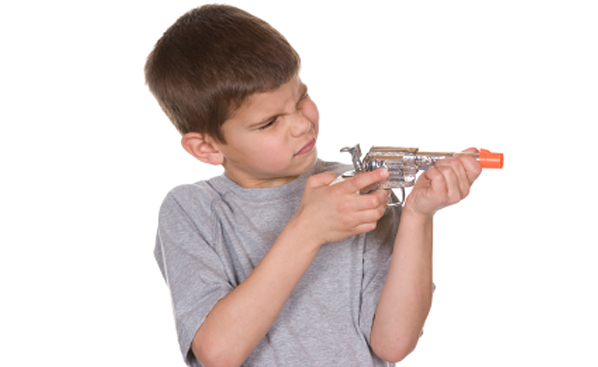
Our son is six; in the past few years I’ve seen him make a play gun out of his finger, a stick, a plastic grabber toy and, once, by chewing a peanut butter sandwich into a gun shape. We’ve also given him a couple of prop guns for imagination play – a pirate blunderbuss that goes with his pirate costume and a play rifle that stays in the closet unless Daddy can play with him.

We don’t let our son point guns – not even toy guns – at people. If he plays with his “rifle” (which looks fairly realistic), it’s with Dad, in a way that will teach him good gun safety habits.  We want to shape his respect for guns in advance of the day when he might learn to handle a real gun.

My gun stance is basically this: I am not anti-gun, I am anti-shooting people. 

This past weekend, I had occasion to think about our approach to Jacob and toy guns. Could allowing our son to play with toy guns  – even to the limited extent that we do allow it — make him less likely to handle guns safely? Or are we just keeping a boy from being fully a boy?

We were at a social gathering with a whole passel of parents and six year olds. The kids were playing happily in the host family’s backyard while the adults discussed school, summer plans, “American Idol” and the Final Four. 

I watched idly out the window as Jacob dashed by, a blur of red “Toothless the Dragon” T-shirt and artic-pattern camo pants. He had something in his hands. He was pointing it at his best friend. It was a toy gun – the twin to his own carefully-played-with rifle from home.

I pointed this out to my husband, who went out into the backyard, delivered the “Don’t ever, ever, ever point guns at people” lecture to all of the children, confiscated the misused toy gun and returned to our discussion. 

Not 30 seconds later, the child of the house dashed into the dining room. “Mom, it broke again!” he whined. “I told you to be more careful – I don’t know if I can fix it this time,” she patiently replied. Turning, she plunked the offending toy onto the table to jam the wayward piece of plastic back into place.

I almost choked. It was a machine gun. A toy machine gun. Not a neon green one or a red one; not a nerf gun or a water gun. A pretty realistic replica machine gun – camo paint coloring, scope and all.

His repaired machine gun in hand, the little boy returned to his game. Looking more closely out the window, I was able to tell that the children were playing war. We did that as kids – chasing each other around, trying to claim the tree house or the jungle gym as “ours.” But I quickly noted that the child with the broken machine gun wasn’t the only one armed to the teeth with replica plastic weapons. There were pistols, shotguns and another rifle in the armory as well. 

At one point, the hosts’ child staged a dramatic “death” on the battlefield, lying motionless in the yard with his sweet face pressed to the grass, blond mop-top splayed out in a static halo. His mom noticed and laughed.  “Ever since we watched ‘World War II‘ on the History Channel he’s been playing soldier!”

My husband is a history buff; he watched part of that series. I shied away from the graphic footage of long-ago carnage. I don’t think Jacob is capable yet of realizing that the soldiers fighting and dying on the screen represent people with moms and dads, brothers and sisters.  And if he could realize that, those are nightmares I’m not ready for him to have.

We are sheltering and shielding our child, protecting him from playing with toy guns, from falling off his bike without a helmet, from exposure to the horrible, violent things humans do to each other. All week, I’ve considered the idea that maybe the parents who graciously had us all over to play that day have the more realistic strategy — let the child watch a show about the reality of what guns do, and let him work it out through his play. 

For some reason, it doesn’t bother me when the kids play light sabre battle, duel fiercely with foam swords or “zap” each other dead with imaginary lightning bolts from their fingers. But it really disturbed me to see them “shooting” each other with realistic-looking guns in pantomime of war, mankind’s greatest horror.

As the afternoon wore on, my husband kept a close eye on the kids; he and a couple of other parents intervened when the guns got pointed at a person.  I was relieved to see that we weren’t the only parents in the bunch channeling the adults from “A Christmas Story.” 

Guns are something that these children, living here in one of the most hunting-friendly areas of a gun-crazy state, will almost certainly encounter in real life. I hope that playing with toy guns won’t give them a false sense of security: an idea that once shot, you can just jump back up from the grass and go about your business, despite the reality of so many accidental gun deaths among the very young each year.

But I’m comfortable with our decision about how Jacob should play with toy guns: very seldom and never pointing them at people. 

Continue Reading Close

Why Johnny can’t be deducted

As a foster mom, I clothed, fed and cared for a child in need. But it's the birth mother who gets the tax break

  • more
    • All Share Services

Why Johnny can't be deducted

The going rate for a kid in the United States is $4,600 and change to families making $110,000 or less in 2009 . At least that’s what my tax prep computer program is telling me. (A $3,650 dependent deduction plus a $1,000 child tax credit.) So the mightier your uterus, the bigger your tax break. My uterus is weak and puny and has produced only one child. But my husband and I foster-parent in our hometown of Lubbock, Texas, and one of the ways the government compensates foster parents is by allowing us to claim tax deductions and credits for our charges as though they had popped out of our own baby-makers. Or so we thought.

So, I set about doing our taxes to include the little boy who spent a little more than half the year with us in 2009. No big deal, right? Wrong.

According to our case worker, the only time you get to claim a foster child as a dependent is when the state has forcibly wrenched the child away from his or her natural family. Voluntary placement kids are still deductible by their natural parent(s). (Those who want to read the specifics of the law can at IRS.gov.)

Many kids are in foster care because their parents voluntarily gave them up — either because they could not afford to feed and house them or because they are in prison, or because they just don’t want to be bothered. One of our friends fosters two little boys who were voluntarily placed at birth. They are both 6 years old now. For six years, our friend has fed, clothed, loved, band-aided, taught and honored these children, apparently all without being able to deduct them as dependents. To a single mom on a high school teacher’s salary, that’s a huge disadvantage, financially.

A couple of years ago, when our finances weren’t as tight and we had not even dreamed of a child, I would have thought, “how crass — griping about a tax deduction instead of thinking about helping a child.” I still feel somewhat like that — we won’t stop fostering if we can’t claim tax deductions; in fact, if the government revoked all tax deductions and charged people for kids instead, we’d still have had our own son, and been just as grateful for it. I just have to wonder what we are trying to achieve as a society with the policies we have set around children and taxes.

On the one hand, we have a problem with more demand for social services than we have the will or the heart to budget for. The more impoverished kids, the more demand. Worldwide population growth is an environmental concern on many levels, from food scarcity to global warming. But instead of teaching family planning in our schools and encouraging young people to have fewer rather than more children, we offer the single biggest tax incentive available to average people (outside of the mortgage interest deduction) to those who procreate the most. And we discourage families from taking care of kids whose own parents can’t care for them by denying that tax deduction to at least some of those caretaker families.

The little boy we had in our home was moved to another foster family because he was behaving threateningly toward our son. He’s a great little boy and is now in a home with his natural sister, where his behavior is exemplary. He and our son still play together. We would have cared for him even had we known from the start that we would not be able to claim him as a dependent.

His mom has five children. She was broke and homeless and living in her Escalade when she placed the kids in care. Now she’s broke and living with some guy with whom she reportedly smokes dope and goes to bars when she’s not in hairdresser classes.

She sold the Escalade and bought a little BMW 5 series with the proceeds. My heart broke thinking of the eldest child seeing her mom’s new car. She’s a precocious 7 years old and can count well enough to see that three car seats, two booster seats and Mom will not fit in that car. Since the mom can claim all five children despite their being in other homes more than two-thirds of the year, she should get a handsome sum back from the government after she does her taxes. Hopefully, she will use the money to get a more suitable car and put a deposit on an apartment. That’s our case worker’s hope anyway. I’m not holding my breath.

Foster parenting is wonderful and terrible. Amazing children, amazing love. Monotonous paperwork that goes on forever, home inspections, CPR classes, licenses, continuing education. Getting attached and having to step aside for a natural family member. Getting attached and having to admit that there are some behavior issues that you just can’t handle.

Voluntary placements get turned away by our agency regularly because there is no home to place the child in. I wonder how many families won’t take voluntary placement children because of the tax rule giving the deductions/credits for voluntarily placed children to their natural parent if they choose to claim them. Personally, I think that we foster parents who’ve actually cared for a child during the greater part of the year have earned the $4,600. 

Continue Reading Close