Leslie Fenton
Do churches have the right to discriminate?
Catholic Charities is suing Illinois for revoking its funding after it refused to serve LGBT families
Imagine this scenario: As a part of its efforts to fight hunger, the State of Illinois gives out a number of grant contracts to private agencies that run food bank programs. One of these grants goes to the Catholic Church’s social services arm, Catholic Charities, which runs a number of food bank programs in several Illinois cities. Soon, state investigators discover that Catholic Charities has imposed a severe condition on its food bank program: They will not distribute the food to hungry families unless the recipients sign an affidavit stating that none of the family members are gay, lesbian, bisexual or transgender. Illinois then terminates its grant to Catholic Charities. The group immediately files suit claiming religious discrimination, and conservative legislators repeatedly introduce new legislation in an attempt to exempt all religious organizations from having to follow the state’s human rights laws even when they are using state money to fund their programs.
Outrageous, you’re thinking. This would never happen, you’re thinking. Even if the Catholic Church were so brazen in its bigotry as to deny food to hungry LGBT people, they have to know that they can’t use public funds to do so, right? Think again.
In the State of Illinois, a real battle is underway between Catholic Charities and the state’s human rights laws. Specifically, Catholic Charities has suspended its publicly funded adoption and foster care services because they anticipate state sanctions if they were to continue refusing to serve LGBT families. They have now filed a lawsuit seeking an injunction against the state from enforcing the Illinois Religious Freedom Protection and Civil Unions Act, which went into effect on June 1. The Act gives same-sex and opposite-sex couples the right to enter civil unions, which are defined as the equivalent to marriage. Partners in a civil union are to be treated as spouses as the word is defined by Illinois law. If a group such as Catholic Charities discriminates against civil union spouses by denying them access to programs funded with public state dollars, they are now in violation of several Illinois anti-discrimination laws and in danger of losing their state grants.
In many cities around the country, adoption and foster care services are farmed out to private agencies, many of them religious, through lucrative state contracts. Adoption and foster care have long been big business for the Catholic Church, and up until the last few years they have always been happy to benefit from public dollars. But now that states have begun to recognize LGBT families as part of the public, as members of the community who deserve equal treatment, those state dollars come with a catch. Publicly funded programs can’t deny services to members of the public whose rights are protected by anti-discrimination laws. That has now started to include every religious conservative’s favorite punching bag: LGBT families. This is not the first time Catholic Charities has gone to bat against LGBT families in states that have recognized their equality. Catholic Charities of Boston and D.C. both shut down their publicly funded adoption and foster care services rather than comply with anti-discrimination laws in those cities. But the Church still wants to have its cake and eat it too, and isn’t willing to give up on those state contracts so easily. In Illinois, they’re fighting on both the judicial and legislative fronts. In addition to the civil lawsuit seeking an injunction, they’ve also been pushing hard on friendly legislators to amend the civil union law to exempt religious organizations from having to comply.
So far, the legislative efforts have failed several times in committee. The lawsuit should also be a no-brainer. Catholic Charities essentially argues that the new civil unions law prohibits them from functioning as a religious organization according to their own religious values. Same-sex couples can go elsewhere, they say, to become foster and adoptive parents, and therefore they are not being denied access to these public services. (Never mind that the unfortunate children assigned to Catholic Charities suffer when loving, qualified parents are turned away for being gay.) To no great surprise, they have failed to anticipate constitutional arguments. Their complaint also glosses over the very real problem that many anti-gay religious groups have when attempting to use state funds to enrich their own programs: Cherry picking. Not only does Catholic Charities want to cherry pick between the members of the public who benefit from public funds, but they want to do so in a way that would not be legally permissible for a public agency. Further, the Church cherry picks through its own religious values. They have no ban on atheist applicants or applicants who have previously been divorced; these types of discrimination would also be illegal under Illinois law. Catholic Charities has never been allowed to discriminate on the basis of religion, and yet somehow managed to operate without a problem for all these years as a state contractor. The court should have a difficult time buying that being heterosexual is more integral to the Catholic doctrine than a belief in Jesus. Finally, no one is forcing Catholic Charities to take public money. They can continue to run private adoption services in as discriminatory a fashion as they like, using the Church’s own private funds.
There are some Illinois citizens who will buy the argument that the civil unions law forces Catholic Charities to compromise its religious values. For them, I included the fictitious food bank example at the beginning. Any decent person can see why the Catholic Church would be dead wrong to refuse to feed LGBT families and to call that discrimination an integral part of Catholic religious doctrine. The controversy over civil unions is exactly the same. Catholic Charities wants to ignore the fact that LGBT kids exist, are assigned to the agency, and may benefit greatly from being placed in a home headed by a same-sex couple. The Church leadership wants to ignore the fact that same-sex couples often make wonderful parents, as good or even better than their straight counterparts, and that there is a dearth of eligible foster families for the number of kids who need homes. By refusing to serve LGBT families, Catholic Charities appropriates a huge quantity of state resources and reserves them exclusively for straight members of the public. Now that the state has recognized that this is illegal discrimination, it’s time for them to either start serving the entire public or to give up the public funds.
Leslie Fenton is a 2005 graduate of the NYU School of Law. She is licensed in LA and IL and currently runs her own family law practice in Chicago. Follow her on Twitter @lawlesslawyer.

Should we release crack prisoners early?
Attorney General Eric Holder is backing a proposal that would retroactively reduce drug sentences
For the last few decades, activists have been warning that the severe U.S. drug sentencing policies instituted in the ’80s and ’90s have disastrous human consequences, particularly for minority communities. Starting with the Anti-Drug Abuse Act of 1986, the trend in federal U.S. sentencing policy was up, up and away: It established mandatory minimum sentences for all levels of drug offenses and, specifically, a 100-1 sentencing disparity between powder cocaine and crack cocaine offenses. This disparity is especially significant because 85 percent of federal prisoners sentenced for crack cocaine are black. The result has devastated African American communities across the United States. In the country that incarcerates the largest percentage of its population of any nation in the world, a majority of those prisoners — 60 percent — are racial minorities. Of the federal prisoners sentenced to prison terms for drugs, a whopping 75 percent are racial minorities. Some scholars have gone as far as to call the mass incarceration of African-American adults “the new Jim Crow.”
Continue Reading CloseThe anti-gay Tennessee bill no one’s talking about
While the media obsesses over the "Don't Say Gay" bill, the state just enacted a different bigoted ordinance
Last month, the City of Nashville made Tennessee history by passing an ordinance designed to protect the employment rights of gay, lesbian, bisexual and transgender citizens. While the city already had such protections in place for its own workers, the ordinance prohibited discrimination against LGBT workers by any private employer that contracts with the city. These extended protections would provide job security to thousands of workers who otherwise have no federal or state protection from being fired or refused a job simply due to their sexual orientation or gender identity.
Continue Reading CloseWhen I went back into the closet
As a teen, I shouted my gayness from the rooftops. How is it that, as an adult, I find myself lying about it?
Several months ago, when I was still living in New Orleans, I worked as a family law attorney for a legal aid organization. Trial practice is not as exciting as “Law and Order” makes it seem: Most of the time is spent waiting around, for clients or judges or court reporters or deadlines. On one particular morning, I was waiting in the courtroom for the judge to sign a few divorce judgments and a restraining order when a pro se litigant struck up a conversation. She hoped out loud that she’d filled out all her forms correctly, since her lawyer disappeared after he’d run into a bit of his own trouble with the law over some blighted properties. We engaged in idle chatter about the confusing maze of clerks and offices at the courthouse until, as it often does, the dreaded question came.
Continue Reading CloseThe show I never wanted to watch, until I had to
I dismissed "The Biggest Loser," but after job loss and new parent anxiety, it gave me something I needed: Hope
When you tell people you’re expecting a baby, there are two typical responses. “Now you’ll see,” said my mother and my maternal grandmother. This prophecy of doom has yet to bear out, though I suspect they were referring to the teenage years. Everyone else told us, “Your lives are going to change.”
My wife Ann and I laughed about this while she was pregnant. “You’re going to change our lives, baby,” I teased the zygote as we lay like beached whales on the couch in our New Orleans living room. Our evening rituals barely needed tweaking after the pregnancy test came back positive. Nightly dates consisted of macabre or depressing TV (“Dexter,” “The Wire,” “Six Feet Under,” “Treme”) or a free horror movie from our crappy On Demand selection, punctuated by ads that popped up at the height of suspenseful moments.
Continue Reading CloseWhy I have to legally adopt my own son
As lesbian parents, my wife and I are forced to jump through some strange hoops. This is definitely one of them
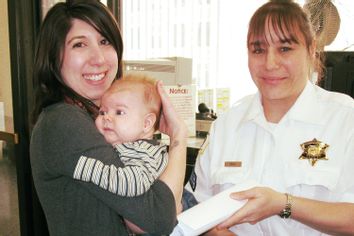
The author's wife and son with a sheriff's officer I woke up that morning, thoughts racing, at 2:30 and again at 4:30. When I rolled out of bed at 6:00, I’d already been awake for hours, running through various judicial mishaps in my head. I drank less coffee than usual to avoid the jitters. I left for the Cook County courthouse 30 minutes earlier than necessary. Since I’ve been litigating family law cases for about five years now, I don’t usually get this nervous before court. But that morning was different. That morning, I was the litigant.
Continue Reading Close