Marion Winik

Party on

I made my annual pilgrimage to Mardi Gras and was relieved to find that even waterlogged and wounded, New Orleans is still swinging.

  • more
    • All Share Services

Party on

If you have ever flown down to Mardi Gras, you know the drill. Beads in 10B, purple and yellow polo shirts in 16F, silly hats across Row 25, and then a whole herd of wildebeests in the back, shouting, “Yee-ha, Mardi Gras!” as they order vodkas three at a time. But the crowd waiting at the gate in Atlanta on Saturday for the flight to New Orleans was subdued, as if they were going to Cleveland, to a business meeting, or a funeral.

I guess it’s up to me, I thought, and put on the beaded, feathered Mardi Gras mask I’d bought the day before at a costume shop in York, Penn. Maybe three people smiled at me. One of them was my 5-year-old daughter, Jane. Then I spotted a woman in gold eye shadow, purple tights and several ropes of beads, and she simultaneously spotted me. “Happy Mardi Gras!” she called.

Twenty-three years ago, I went to my first Mardi Gras, dragged by friends who had to overcome my resistance to what I was sure would be a giant, awful frat party. Once there, I fell in love — in love with the city, in love with carnival, and in love with a gay bartender whom I later married and with whom I had a couple of kids before his death from AIDS in 1994. During our years together and in the decade-plus since, I returned to Mardi Gras many times. In fact, it’s my New Orleans friends Jack and Sue who connected me to Crispin, my second husband. We had Jack and Sue up to our house for New Year’s, and halfway through the second day of sad stories, I knew I had to go to carnival this year. Whatever the first post-Katrina Mardi Gras would be like, I wanted to be part of it.

As we were landing in New Orleans, I discovered that some of our quiet fellow travelers were headed to the festival after all. From rows ahead of us, I began to overhear plans to meet for the Bacchus parade, the names of streets drifting back to me like magic words: Tchoupitoulas, Magazine, Dumaine. Then a girl received a call on her cellphone saying Endymion, the traditional Saturday night parade known for being one of the biggest, most expensive, most Disneyfied displays, was canceled due to the threat of rain. It would roll instead after Bacchus on Sunday night.

This seemed impossible, and another passenger and I both said so. The girl said her friend was kind of a ditz and we should all check to make sure.

“The friend was probably already drunk,” we muttered.

We got off the plane and met Jack, who greeted us with beads from the Muses parade; he agreed that it was impossible that Endymion would be postponed. Having gotten this far, how could they balk at a little weather report? Anyway, he told us, there’s a local saying that it never rains on Endymion.

Then as we stood at the baggage carousel, Jack got a call on his cellphone. In fact, his wife, Sue, reported, what we’d heard was correct. Endymion would not rely on its legendary luck. Perhaps even thinking of rolling down the street soaking wet was wetter than anyone could stand to be.

On the way to Sue and Jack’s, we drove down Canal Boulevard, past the endless line of hollowed houses, their windows black and empty, their ruined walls spray-painted with the Xes and dates and initials of various inspectors and would-be rescuers. As we neared Lakeview, the neighborhood closest to the 17th Street canal, the devastation had been doubled by a tornado that roared through a couple of weeks ago. (They never had tornadoes here before — the local joke is that it’s because of all the trailers.) Here, trees and houses were collapsed into piles of sodden wood; a radio tower lay on its side, looking like a dinosaur skeleton. Then we arrived at Jack and Sue’s, where, miraculously, the floodwaters had stopped in the front yard. Their giddy, disbelieving joy when they saw their intact home for the first time on Sept. 9 has since been tempered by a kind of survivor’s guilt — as well as the invisible but highly allergenic mold that proliferates beneath the carpets and behind the walls.

With no parade to attend, we went out to find some dinner. Beneath a dripping, murky twilight sky, we cruised through more devastation — a house where we’d celebrated a bar mitzvah with brunch under the oaks, now completely gutted, its once-lovely yard a trash-strewn mudflat. Across house after house, for mile after mile, ran the waterline, a wide brown stripe hitting the upper part of the front door. By the canal breach itself, we found a parade after all: a line of cars filled with people snapping photos of hills of black mud, twisted boats, rusted cars, splintered wood. It’s 5 o’clock, said Sue. We better find someplace to eat before everything closes.

“Can we get a po’boy at Weavers, maybe?” I suggested, mentioning a favorite deli in the neighborhood.

They looked at me pityingly. I hadn’t quite gotten it yet. There are no concession stands in the Dead Zone.

To find food, we drove past the ghost of Sid-Mar’s restaurant and its lakefront brethren on the Orleans side of the canal and joined the huge crowd waiting to eat at the R&O, just over the Metairie line.

And that’s when the party began. Even the waiting area was filled with smiles and cocktails, a spirit of overflowing warmth and celebration. “Let her sit down with the baby,” a mom called to her kids, and room opened up on the bench for me and the little girl sleeping in my arms. Inside the vast, simple establishment, tables of 12 and 15 ordered trays of beer and piles of pizza, stacks of seafood and fries.

A tired but beaming waitress sashayed up and said, “What can I getcha, baby?” and I remembered what goddesses the women are down here, the care they give you with every small purchase. Somebody at a neighboring table asked his server to check on a long-awaited meal. “Oh, I can check, darlin,” she called gaily over her shoulder, “but I can tell ya it ain’t comin!” The man just laughed.

And after spending about two and a half hours getting sandwiches and not minding a single minute of it, we drove home through the pitch-black streets. “Look!” cried Sue as we rolled up to the corner of West End Boulevard and Veterans Highway. “That traffic light just went on today.”

When we got home at 8, we watched the televised performance of Endymion’s ball, which was going on despite the postponement of the parade, in the convention center of all places. Seeing the masked riders (who always look just a little Ku Klux Klannish) winging beads to dressed-up partygoers with drinks in their hands made me feel uncomfortable. I couldn’t help picturing the misery and chaos that went on in that place just six months ago, and for a moment the anti-Mardi Gras sentiments I’d read and heard seemed to make sense.

But Mardi Gras, like a jazz funeral, is one of New Orleans’ ways of turning reality, even the harshest reality, into a celebration. It is the revelers’ way of taking back their city, and the satirical hurricane and FEMA floats we would see all weekend were a part of it. In the morning, we would stand on St. Charles and catch necklaces from krewe members living in trailers who somehow found the money for cases of sparkly booty, and we’d be a part of it too. This rueful, life-affirming, wisecracking approach to death and misfortune is one I can’t get enough of.

————

I tried to fill Jane in on terms and traditions before our trip. “What’s a float?” she asked. “How do they move?” “How do you know where to find the parade?” “Do you walk with it or just watch it?” “What if you get tired?”

I answered every question as best I could. “When you get tired,” I said, “you sit on the curb.”

“What’s a curb?” she asked.

Ah, my little country girl. Glen Rock, Penn., is never going to look the same.

Our first two parades on this 74 degree Sunday morning under sparkling skies were as fine a Mardi Gras initiation as a 5-year-old ever had — perhaps as fine a morning as I’ve seen in all my years of Mardi Gras attendance. We stood out in front of the magically untouched mansions of St. Charles Avenue, as if the hurricane and flood had never happened.

The Okeanos parade was rolling as we approached and my husband laughed at me as I ran toward it, pushing the grocery cart I had just found on a street corner, now loaded with our folding chairs and coolers.

If there was any mark of Katrina here, it seemed a positive one, for the crowds of locals and tourists and kids and grandparents and huge fat guys in towering purple mullet wigs were nicer than ever, smiling radiantly, passing beads, cups, stuffed animals, beer and food from hand to hand like family. Guys from Lake Charles plied me with chicken barbecued on a hibachi and beer from their keg. Three people raced to light a stranger’s cigarette. A couple of blocks down, a propane-powered crawfish pot the size of a kitchen table steamed. The warm welcome is not only for out-of-towners but for displaced locals in for the party. Our friend Lowell moved home this weekend from Houston, though his house, a few feet from the breach, is no more.

The morning parades Uptown have always been a deeply family scene, a liberated Disney world, a giant block party. Out of towners, yes, beer at 10 a.m., yes, but the vibe is far from decadent. And did someone say there are no black people left in New Orleans? Untrue. Among the many was a beautifully dressed grandfather from East New Orleans. He and my friend Sue talked about the things people talk about here: damage, gutting, rebuilding, frustration. You hear the word “FEMA” so often it starts to sound like just another New Orleans expression.

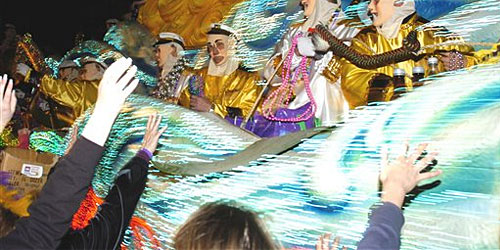
Meanwhile, the krewes of Okeanos and Thoth rolled by, throwing masses and masses of beads and toys and see-through bras. I taught Jane how to stand at the front of the crowd waving your arms and screaming and smiling at the riders, to march and clap with the bands and twirlers, then rush to the back, dump your loot in the shopping cart and hit the curb (look! a curb, Jane!) again.

On the way home, we stopped at a grocery store called Dorignac to buy vodka and Mardi Gras bread, a delicious, buttery sliced loaf swirled yellow and purple and green. Jane’s delight was complete.

————

Ordinarily I would leave New Orleans before Fat Tuesday. Years ago, I decided I just didn’t have the endurance for four days of this sort of thing. But this year it seemed crucial to stay on through the low-level maintenance partying of Monday, aka “Lundi Gras,” and rise up on Tuesday morning to see with my own eyes the costumed crowd on Bourbon Street, to dip my toe in Voo Carray beads, beer ‘n’ boobs ambience. But staying until Tuesday also meant I had to get a costume. I’d been keeping my eyes peeled for the 25-year-old kid I sat with last week in the parking lot of the costume shop back in Pennsylvania. It would be his first Mardi Gras, he told me. I smiled. I was 25 at my first Mardi Gras, too.

In the hour we’d had to kill before the shop opened — both a little overeager with carnival spirit — he’d told me about the felony convictions he racked up before he turned 18, what with conspiracies to steal golf carts, high school presentations on explosives design, and a brief tour in the Navy that ended with a bottle of vodka and a 14-year-old girl. For the last seven years, he’d more or less trod the straight and narrow, he told me, but this year for the first time he’ll join his parents on their annual Mardi Gras pilgrimage. (I could see why they didn’t want to take him before.) “I’ve heard the people of the United States sort of relax their rules and regulations down there,” he said hopefully, as he headed in to buy a wig and platform shoes. “Is that right?”

Yeah, baby, that’s right.

Gods and monsters

To my 3-year-old daughter, I am love incarnate. To my teenage sons, I'm nothing but a servant-jailer. Is it any wonder I feel schizophrenic?

  • more
    • All Share Services

Gods and monsters

Everybody knows what a monstrous emotional burden it is to have a mother. Whether the mommy in question is angelic, asphyxiating, absent, or just annoying, it is the task of the child to endure her, escape her, and then explain her, to unload her like containerized cargo, perhaps in therapy. In our child-centric culture, we see the relationship from one direction, as if the child were the living thing, and the mother something tremendously powerful yet insensate, like the ocean, or the weather.

But this high-pressure system I’m in right now is hardly barometric. As the mother of two teenagers from my first marriage (I was widowed in my mid-30s) and a toddler from my current one, I am experiencing simultaneously two phases that really should be separated by a decent interval — the wild tumble of falling in love with a baby and the bewildering pain of living with adolescents. As I respond to my daughter’s dependence on me with a passion that is no less fearsome for being evolutionarily ordained, I’m also coping with my sons’ break for the fence. Check out this bad love affair from my point of view, and you tell me who’s being scarred for life.

To my barely 3-year-old Jane, I am the world, I am God, and I am love incarnate. She can barely stand to let me out of her sight. She cries my name as soon as she wakes up and anytime we are separated. She lights up like Las Vegas at my reappearance, often leaping into the air with joy. There is almost nothing I cannot fix with my embrace, very little she prefers to my attention — sorry, Dora the Explorer, but it wasn’t even close — and she showers me with positive reinforcement at regular intervals. “You’re such a good helper, Mommy,” she tells me when I hand her the toilet paper. “That’s beautiful,” she says, when I put on a pink shirt. “I lub you,” she reminds me every hour or so, in case I have forgotten, sometimes racing into the room and shouting it as she flies past me, sturdy legs churning, dark blond tresses flying, as urgent in her errand as a medieval messenger.

I am not the only person to bask in the light of this little love-machine. She adores her father, whom she calls “Honey” with imperial confidence. She responds to her older brothers and sister (my husband has two kids from a previous marriage who live with us on weekends) with pure delight. But I am Mommy, and I am No. 1. What do you expect? The germ of her had been stored inside me since my own birth; for 18 months she took her food from my body. To say I am her favorite means little in such a rigged competition, I know, but I am.

This isn’t the first time this has happened to me. I remember the infancy of my son Hayes, now 15, as one long, golden afternoon, a swoon of nursing and cuddling and staring into his big dark eyes, the ceiling fan spinning overhead and the Dream Academy playing in the background. I had lost a baby, a full-term stillbirth, less than a year before he was born. Hayes washed over me like morphine for a person mangled, lying in the woods, waiting for medical assistance for quite a while. Then a couple of years later Vince came, so charismatic and radiant we called him the baby messiah.

But Jane is the last, and I know she’s the last, and I thought I would never do this again; I thought I would have sons but never a daughter. Even as struggle and irritation find their way into my responses, even as she learns to say No and Get my shoes! to whine and hound, Mommy this Mommy that Mommy Mommy MOMMY! — I am stunned to realize how connected, how consumed, how converted to a tool for her use I have become. (Again!) If anything were to happen to her, I think once or twice a day, and stop myself right there.

And something is going to happen to her even if none of my worst fears comes to pass and she grows normally to adolescence. At that point, I can expect to have precisely the inverse experience of the festival of love I am enjoying now. Torn from my pedestal like a statue of Saddam Hussein, I will be rejected as powerfully as I was once embraced. For just as a toddler is devoted to cathecting you, so a 12-year-old uses all the force of his being to tear free.

With emotionally muffled Hayes, it was a quiet junta, a revolution of rocky sullenness. He responded to less than a quarter of the conversation I directed to him, and to that fraction with icy rebuff or curled-lip scorn. The idea, it seemed, was that I would wait on him hand and foot while staying entirely out of his way, requiring nothing of him, and completely avoiding all public and private displays of affection. The summer he was 12, I remember, my mother asked him why he was being so mean to me. He replied simply, “Because I hate her.”

With the more passionate Vince, things have been livelier. At age 11 when it began, he once seemed about to literally explode with rage because I asked him to put the ketchup on the table (a few dozen times), then accidentally bumped into him in front of the fridge while he was finally complying. This past year, seventh grade — watch out, my friends, for seventh grade — it got much worse. He cursed at me, he screamed at me, he ordered me to shut up and leave him alone; I was without question the worst thing that happened to him on any given day.

In the preposterously rainy spring of this benighted year, it came to pass that Vince was not doing his homework, his grades were dropping, and thus a scheme was inaugurated where the guidance counselor and I were both to sign off on an assignment sheet he completed every day. One afternoon, I had asked him several times to see the sheet, and instead of answering me he left the kitchen and went to his room. A bit later I was up there knocking and asking him to show it to me — little Jane was right beside to me, I was on my way to take her to the bathroom, I think — and finally he responded: Go away! Just go away! Stubbornly, I did not. So he came out on the landing and stuck his face in my face and put his hand on my chest and shoved me, and he said, “Fuck you, you dirty bitch.”

My response to this was more profound and less coherent than anger. I was struggling to breathe. For three days, I would find tears welling up in my eyes on and off every time I thought of it. I could barely speak to him. Yet the infraction seemed virtually past punishment. When, the previous summer, he and friend had semi-accidentally set fire to a neighbor’s hayfield, I grounded him for a month. But what to do about this? Take away his screen name? Talk to him, I told his stepfather, and I believe he tried. I believe there was an apology of some sort, a conversation. But it could not turn back the clock. My baby messiah had turned into a demon-child, and he was determined to drive me off.

He has to, right? He has to separate, to break the bonds of my milky mothering, my cloying care. I did it too, so I know. I remember how it was, I remember how I treated my mother — though I stopped somewhere short of “Fuck you, you dirty bitch.” Adolescence is poison, it is torture, it is unbelievable frustration. I didn’t just hate her, I hated everything, which was her, and to escape her I wanted to molt my life like snakeskin and wriggle free to some unimaginable other world.

Even if I know this separation is necessary, it breaks my heart. And even if my heart is broken, I can’t just skulk off and lick my wounds, because the little infidels still need me to love them, still want that tiny dot in the distance that used to be the whole world to receive them warmly on their occasional visits. All I can do is find some cooler place to stand, some way to let go but not leave — so I can continue the task of caring about people who are conducting a vigorous multi-year exorcism of me.

But for God’s sake, do I have to go through both of these things at the same time, the toddler and the adolescents? It is truly insane. It forces me to remember that this boy who cannot tolerate my standing next to him once sucked me in as if I were oxygen. It makes me envision the day my darling lover girl will see me as the toxic cloud that blocks the sun. I know I’m supposed to accept this as perfectly normal, part of the job and the process, that it too will pass. But imagine the indignity: The people you once took baths with, whose very tushies you tenderly cared for, will not even answer you when you speak. And nature — that dirty bitch — doesn’t make you fall out of love with them the way it does them with you. They see your embrace as a chokehold; to you, it is still an embrace. They see your curiosity as a vile invasion; for you, it is still a natural act of care. And so I teach Jane to cut her food, to ride a bike, to say her phone number and address, knowing full well what I am pushing her toward.

Of course every day is not the same. Just last week I spent over an hour chatting amiably with Vince as we bodysurfed together at the beach. Not long from now, they will leave adolescence behind and become fresh-minted grown-ups, and I will fall in love all over again with these friendly, busy people who carry my whole beating heart in that back jeans pocket sagging below their asses. Then they will move on into their lives and patronize me, remind themselves to call me, brush aside my queries about their classes, their careers, their marriages. They will dread my death, but they will also dread the sound of my voice on the phone, like an old flame who won’t go away.

And like a billion mothers before me, I will make my peace with it. I will play cards, read novels, and make the favorite pie when asked. I will take my crumbs and hide my scars. I will smile a serene and knowing smile when they hand me my grandchildren.

Continue Reading Close