Marisa Meltzer

Venus abused

In the early 1800s, Westerners leered at Saartjie Bartmaan's curvy body and exotic skin. But do we gawk any less today?

  • more
    • All Share Services

Venus abused

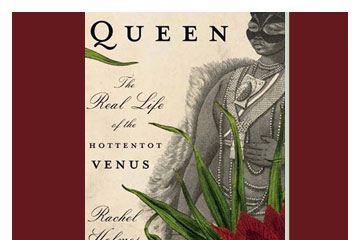
The life story of Saartjie Baartman, the African slave who was displayed in Europe in the early 19th century, contains so many layers of oppression to sort through that author Rachel Holmes begins by trying to untangle her name. In “African Queen: the Real Life of the Hottentot Venus,” Holmes concedes that Saartjie (pronounced “Saar-key,” meaning “little Sara”) might not even be the name she was born with, calling the -tjie diminutive suffix a “racist speech act.” Colonialist roots and all, it “was her name in life as she lived it.”

Baartman was born into the Eastern Cape Khoisan, the indigenous herding tribe that once populated part of South Africa. As a teenager, she was orphaned after her father and fianci were both murdered in a colonial war, and sold to a trader, Pieter Willem Cesars. He took her to Cape Town, where she worked for his brother as a nursemaid. Around 1810, once the family started experiencing economic difficulties, they looked to Baartman as their next source of income, figuring that in Europe, where curiosity about the Dark Continent ran rampant, “a pretty maidservant with notable buttocks and a spotty giraffe skin were a winning combination on which to stake their future.”

They settled in late Georgian London, where freak shows touting “the ne plus ultra of hideousness” or “the greatest deformity in the world” lined Piccadilly. As Holmes points out, England was transitioning from a sentimental primitivism — the noble savage — to the popular Victorian notion of ethnology. With the slave trade being abolished just a few years before and the black population of London at about 20,000, their challenge was to make the investment — Baartman — conform to stereotypes and yet also seem like a novelty. They marketed her as a kind of “scantily clad totem goddess,” the Hottentot Venus, sex incarnate. Hottentots, what European traders called the native Khoisan for the clicking sound of their language, “signified all that was strange, disturbing, alien, and possibly, sexually deviant.”

She was objectified in the most literal sense, put on display in front of gaping crowds six days a week, doing suggestive “native” dancing and playing African instruments. Her costume was a flesh-colored silk sheath deliberately cut like a second skin, with copious jewelry at the seams to conceal the fact that she wasn’t technically naked. They also fashioned her a kind of female codpiece, “the effect of its soft folds, fur fringes, and pendulous extensions was to imply that its purpose was to modestly conceal the supposedly elongated labia of a Hottentot woman” — a subject of great interest and speculation among the gawking masses. She became an instant sensation, a subject of countless life drawings (many of which are included in the book), editorials and political cartoons. The London Morning Post wrote, of her body, that “her contour and formation certainly surpass any thing [sic] of the kind ever seen in Europe, or perhaps ever produced on Earth.”

Holmes is so clearly besotted with her subject that her writing can tend toward the florid when describing her (“to behold the figure of Venus, or to hear her name was to be prompted to think about lust, or love”). Baartman physically exists in the story — the narrative is entirely devoted to her — and yet, since she was unable to read or write, very little exists in her own voice. As her story progresses, that absence becomes more and more notable. But perhaps that’s Holmes’ point: As a slave and as a woman, Baartman never did have any kind of agency in her own life. “Economically, sexually, and racially,” Holmes writes, “she was unfree.”

Her supposed liberation at the hands of abolitionists, who initiated a lawsuit to win her freedom, feels like further commodification from a party interested not in her ultimate well-being, but in drumming up publicity for their own cause. It did earn her a contract, read to her twice in Afrikaans, that covered standard demands like medical treatment, warmer clothes, profit sharing and the promise that she would eventually be sent home. “She was not seen as a sympathetic victim,” writes Holmes, who tries unsuccessfully at this point to sell Baartman as a cunning businesswoman who had “outmaneuvered her managers and made herself attractive to eligible bachelors as a woman of means.”

And while there are a few years in England where she managed to escape the probing public — she was rumored to have gotten married or had a baby, though there is no record of either — the arguably most grim period of her life came after this so-called freedom. In 1814, she and Cesars moved to Paris at the end of the Napoleonic era, where she was examined for three days by scientists at the Museum of Natural History, developed an addiction to alcohol, and, at some point, became a prostitute. She died in Paris of either a respiratory disease or syphilis — the records aren’t clear — at the age of 26. Her death didn’t bring her any dignity, either; her body was cast and dissected and became the property of the Museum of Natural History. Her brain and genitals were kept in bell jars just outside one creepy scientist’s private chambers.

Holmes devotes the last chapter to Nelson Mandela’s campaign to have Baartman’s remains returned to South Africa. It’s a reverent coda to the book, but Holmes’ own take on Baartman’s legacy might have made a more compelling end to her story. Holmes never deviates from narrating the story, which she does capably, but her reluctance to write about why she’s so moved by Baartman’s life is ultimately our loss. It never moves beyond a hagiography, and therefore doesn’t really add anything new or particularly timely. We’re left to speculate about Holmes’ motives — her bio says she divides her time between London and Cape Town, and the book is steeped in feminist theory, take your pick — but we’re left with no explanation of why she felt so drawn to this project.

She does hint at a post-Baartman world, briefly quoting Josephine Baker — “When it comes to blacks, the imagination of white folks is something else” — and she mentions the popularity of the bustle among fashionable Victorians. Holmes imagines Baartman would have laughed at buttock augmentation, the fastest-growing cosmetic surgery in the U.S. and U.K. But what does she have to say about Queen’s “Fat Bottom Girls” or Destiny’s Child’s “Bootylicious”? Now we can scoff at the clueless Valley Girls in the intro to Sir Mix-A-Lot’s asstastic “Baby Got Back” (“I mean, her butt, is just so big. I can’t believe it’s just so round, it’s like, out there, I mean — gross. Look! She’s just so … black!”), but does it mean that we’ve come a long way? In the simultaneous lasciviousness and curiosity we’ve lavished on Jennifer Lopez’s posterior, have we never stopped searching for that scantily clad totem goddess after all? We can pat ourselves on the back and feel disgusted by the story, and yet what made people leer at Baartman has the same effect on us today.

The knife life

In "Beauty Junkies," Alex Kuczynski's memoir-cum-expos

  • more
    • All Share Services

Just in case reading Alex Kuczynski’s “Beauty Junkies: Inside Our $15 Billion Obsession With Cosmetic Surgery” wasn’t enough to convince me that the plastic surgery craze has saturated society, my mother called me a few days after I started the book to cheerily announce she had made an appointment to get veneers put on her teeth.

My mom, a wiccan who wears clogs and writes poetry in her spare time, is not exactly the Joan Rivers type. But 50-something years of hating her teeth has driven her to the ranks of Faye Dunaway, Ben Affleck, Tama Janowitz and countless others whose smiles are veneer-perfect. She’s still a far cry from Michael Jackson or Jocelyn Wildenstein, the New York socialite who had plastic surgery to make her face appear more feline, but that’s exactly Kuczynski’s point; growing numbers of Americans are opting for a cosmetic fix. As she notes, in 2004, almost 12 million surgical and nonsurgical beauty procedures were performed in the United States. That’s up 44 percent from the previous year and includes 166,187 nose jobs, 290,343 eyelifts, 478,251 liposuctions and 334,052 breast augmentations — a surgery that has become so commonplace it may have contributed to an increase in the average bra size from 34B to 36C over the past 15 years. And then there’s Botox, injections of botulinum toxin A that can paralyze muscles in the face and erase wrinkles — which are up 2,446 percent since 1997.

Lest we get bogged down by the numbers and worry she’s penned some kind of alarmist polemic, Kuczynski blithely assures us she’s not out to shame us for our obsession with beauty. She notes that it was helpful for her, when attending plastic surgery conferences as part of her research for the book, to offer up her own work — then the doctors and pharmaceutical reps “don’t think you are a confrontational reporter hoping to root out the evils of vanity. By telling them you’ve tried Botox or lipo, you are saying that you’re one of them. You understand. You’ve been converted.”

Kuczynski, the author of the New York Times’ “Critical Shopper” column, confesses to a Botox habit that started at age 28 in this part memoir, part exposé, which has been both anticipated and mocked (often in the same breath) for what seems like an eternity at the New York Post and Gawker. She’s also had liposuction on her outer thighs, collagen in her lips and an eyelift. Now in her late 30s, she looks well preserved, and has the serene author photo (looking very pretty, I might add — hair liberally and expensively highlighted, creamy skin, wry smile and not a wrinkle in sight) on the back cover to prove it.

“Beauty Junkies” is most gripping as a history of plastic surgery — from the Koomas of circa 600 B.C., an ancient Indian caste of potters given the task of fashioning new noses for women who had had theirs cut off as punishment for adultery, to the surgeons who used plaster of Paris moulages to help reconstruct faces disfigured from air combat and grenade wounds during World War I. She gives us a laundry list of today’s zeitgeist-worthy procedures, like buttock implants (if you want the posterior of Jennifer Lopez), bellybutton enhancement (if the shape of your navel is the bane of your existence), and nipple enlargement (if your areola simply must match a new set of breasts). As a reporter covering the trend beat, she’s received solicitations for an array of procedures including snap-on temporary teeth, a “Russian thread lift” (in which barbed threads are pushed beneath the skin and anchored to the skull as an alternative to a face-lift), fat-dissolving herbal tonics, and a particularly painful-sounding operation that cuts open toes and removes the bones to better fit pointy heels. The Times doesn’t allow her to accept services from news sources, but that’s fine: Of the 600 or so offers of free treatments, she says, she would have considered becoming a patient of only maybe five of the doctors. She’s skeptical of physicians eager to have a signature cosmetic procedure or who need to hire public relations gurus to lure clients and can’t just rely upon word of mouth — and urges us, potential patients all, to adopt her standards as well.

She breaks down the new economy of cosmetic surgery, where Botox is the most profitable treatment for doctors, who can squeeze $3,000 worth of injections out of a $488 vial and, as an added bonus, don’t have to fuss with health insurance. These procedures were once the domain of the rich, but have increasingly become de rigueur across economic levels; credit cards, high-interest plastic surgery loans and even “cyberbegging” Web sites like myfreeimplants.com, where women seeking money for their boob jobs can post images and pleas to would-be male benefactors (Kuczynski tries it and makes $96 in three weeks), all facilitate expensive surgeries for the cash-poor. She pauses in her own cautionary tale of getting an allergic reaction to Restylane, an alternative to collagen made of hyaluronic acid, to marvel at how her housekeeper, a Guatemalan grandmother, manages to save up for an eyelift, and ultimately seems relieved to find this common ground between the two of them.

Cosmetic surgery has a culture of its own now, where Ashlee Simpson’s nose job graces the cover of tabloids like Star, a magazine that also runs a regular feature called “Knifestyles of the Rich and Famous.” TV shows like “Nip/Tuck,” “Dr. 90210,” “Extreme Makeover,” “A Plastic Surgery Story” and “I Want a Famous Face” and magazines with titles like Skin Deep, New Beauty and Elevate are all entirely devoted to cosmetic surgery. There’s slang like “trout pout” (for fishlike, overly plumped-up lips) and “kabuki mask” (a face so expressionless as to resemble a lacquered mask) that one can use while checking out Web sites like awfulplasticsurgery.com, which allow us to speculate on whether Avril Lavigne really did get a nose job or if Lindsay Lohan’s breasts are fake. Kuczynski delights in naming names, calling out Sarah Jessica Parker, Nicole Kidman and Marcia Cross (whose face she uncharitably compares to the embalmed Lenin’s) as Botox users.

We can always blame the baby boomers, who began to turn 60 this year, for the proliferation. Or Generation X, which has moved so far beyond the idea of what connotes adulthood — marriage, children, jobs you hate — that they’ve created a culture of being forever youngish. We can tell ourselves that the ubiquity of cosmetic surgery has lessened, and in some circles completely removed, the stigma of getting work done, or that we simply live in an image-based culture. But blaming our culture instead of delving deep into the self-hatred behind the quest for surgical beautification is an easy out. A knife-assisted makeover has become an increasingly common aspiration for teenagers and matrons alike, but shouldn’t we be worrying why we’re so looks-obsessed to begin with?

In her profiles of “regular” people, Kuzcynski appears to again blame the culture for creating a population who “view aging as a medical ailment that ought to be treated,” and conveys their various plights with the utmost sympathy: For instance, there’s a 19-year-old who’s getting prophylactic shots of Botox and two women from California who go to South Africa every year for surgery safaris (their fourth trip, however, is just for vacation). There’s Hollywood housewife “Mrs. X,” who has made maintenance a full-time job — including but in no way limited to injections of Gore-Tex (no longer reserved just for winter parkas), Botox, collagen, Restylane and Artecoll; liposuction; tummy tuck; brow lift; two variations on a face-lift — who had her breasts done three times (implants in, implants out, larger implants in), and who recently partook in vaginal cosmetic surgery. Men aren’t neglected here: There’s the lawyer whose goal is to live without such indignities as wrinkles or sweat and who gets Botox every two months and has to lie to and rotate doctors in order to get it so frequently. More creative still is the former Navy SEAL who gets a faux bullet wound to avoid shame in the locker room.

However stoic Kuczynski remains in the face of faked wounds and labia-plasties, in the chapter devoted to weight loss surgeries, she lets loose her inner Mean Girl. Looking at photos of formerly obese people whose 280-pound weight loss after gastric bypass has resulted in drapes of stretched skin covering the body, she says she would have rather remained obese or die than look like a human character from a horror movie. When confronted in the flesh with a lawyer who had excess skin removed after losing weight, she’s nonplussed: “To be honest and brutal and bitchy, she doesn’t look that great.”

Of her own experience, she’s almost evangelical when talking about the restorative effects of a well-executed eyelift. She speaks of her own inner torment, torn between wanting to challenge a doctor who’s trying to find a mathematical ideal to quantify a beautiful face and wanting to have her own face scanned in a computer to see what she should get fixed. She even tells her mom to get a nose job. She’s quick to call her decade as a beauty junkie “foolish and vain” — because no one serious relies upon their looks, right? — and writes herself off as “weak, and easily susceptible to the pressures of a morally debatable, deeply intoxicating subculture.”

She resents the pressure to conform to a beauty ideal, but at the same time she “won’t be accepted by a culture that embraces beauty until I look like someone who belongs inside it. And I can’t subvert what I can’t get access to.” She pays lip service to subverting the ever-escalating standard of beauty, but she doesn’t address why so many women (and some men) are trying so very hard to fix themselves in the first place. “Beauty Junkies” does little to incite or inspire change, stating that it is ultimately “our choice that damns us or elevates us” in the end.

Kuczynski goes as far as to call the ultimately self-serving act of cosmetic surgery a political statement. “Looks are the new feminism” is a point she’s so fond of she makes it twice over the course of the book. “Where once demanding equal rights and pay was a way for us to ask for an equal share of the power, the new way we show we have power is to be styled — from top to bottom, from shoe sole to eye tuck — to prove hat we have our act together. This is how we demonstrate to the world we have it all, both the yin and the yang, the masculine and the feminine.”

But she also wants us to know she’s opting out. On a recent appearance on the “Today” show, Kuczynski reported that not only has she been Botox-free for a year and collagen-free for two, but she is wearing no nail polish and has stopped dyeing her hair. She claimed to feel prettier than ever, but it’s too bad that her brow, presumably slow to recover from a decade of Botox-induced paralysis, still didn’t move when she spoke.

Continue Reading Close

Edwards vs. Clinton

The senator's wife said she's happier than Hillary. Is this dust-up about presidential politics, or the politics of motherhood?

  • more
    • All Share Services

And here we hoped the intraparty digs might wait till the presidential primary season. Last week, Elizabeth Edwards, wife of former Sen. John Edwards of North Carolina, apologized to her husband’s colleague (and likely rival for the 2008 Democratic nomination) Sen. Hillary Clinton. Why? Well, Edwards had allegedly been snide about Clinton in the press, telling Ladies’ Home Journal, “She and I are from the same generation. We both went to law school and married other lawyers, but after that we made other choices. I think my choices have made me happier. I think I’m more joyful than she is.”

It’s hard to know what to make of Edwards’ remark. Maybe it was just a not-so-nice way of explaining her own lack of interest in running for office — but it feels like an incredibly tardy rebuttal to Clinton’s oft-quoted 1992 statement on her own ambitions: “I suppose I could have stayed home and baked cookies and had teas, but what I decided to do was to fulfill my profession which I entered before my husband was in public life.” And, I kind of hate to say it, but Edwards’ comment also reminds me a bit of a “Sex and the City” episode in which Charlotte quits her job to stay at home with her husband, and starts shouting, “I choose my choice, I choose my choice” on the phone to her doubtful friend Miranda.

Anyway, Edwards, who has been on a tour promoting her memoir, wound up getting a little extra publicity for her book. She also said in a statement that Ladies’ Home Journal misrepresented her remarks, and that “this is particularly true with respect to my comments about Sen. Clinton, who holds a serious and demanding public office while I am largely home, joyfully I must admit, with two lovely children.” The magazine stands by its transcript, and regardless, Edwards called Clinton to apologize last week.

It’s very heartwarming that the duo was able to make nice and move on, but it’s also disheartening that some women — even cool women like Edwards — feel the need to deride their counterparts over work/family choices. Some women work outside the home, some work from home, some work as primary caregivers for their kids and some do none of the above. I for one would be a lot more joyful (to use Edwards’ odd word) if we could all just choose our choices and not have to defend them.

Continue Reading Close

Turning back the clock on single-sex education

The Department of Education retools Title IX, allowing more same-sex ed.

  • more
    • All Share Services

Welcome to the official Title IX backlash! Dear, sweet Title IX was passed in the halcyon(ish) days of 1972, banning sex discrimination in schools and activities that receive federal funds. It ensured equality in education for girls and is responsible for many of today’s female mathletes and soccer champs. Hooray!

But its days may be dwindling. Lately the so-called boy crisis in public schools has become every lazy media outlet’s topic du jour, fueling the perception that girls get better college preparation than boys. That theory has been officially debunked with genuine research — race and class turned out to be two of the real culprits for educational disparities, not gender — but the Bush administration has yielded to the overblown boy crisis hysteria anyway.

The latest result is a new amendment to Title IX, which allows public school districts to expand their numbers of same-sex classes and schools. According to the Education Department’s mellifluous press release, it’s not backtracking in history by promoting single-sex ed but giving communities “more flexibility in offering additional choices to parents in the education of their children.” To that end, enrollment in single-sex classes must be voluntary, and classes of “substantially equal” quality must be available for the other sex. Anyone uncomfortable with this “separate but equal” formulation, raise your hand.

For what it’s worth, the New York Times says that the ACLU, which often takes an interest in such matters, is considering going to court over the ruling.

Don’t get us wrong, we’re reasonably into the writings of Carol Gilligan and the notion that girls and boys can have different methods of learning. And any approach to school that makes academics the focus and promotes an environment in which kids can feel unselfconscious about being smart is great. But is amending Title IX really the way to go about making nuanced changes in the way we educate our kids?

Continue Reading Close

Equality in New Jersey

The state's Supreme Court finds that gay couples must be allowed the same rights and responsibilities as straight couples.

  • more
    • All Share Services

This afternoon New Jersey’s Supreme Court ruled that same-sex couples are entitled to the same rights and protections as heterosexual couples. While the move is a step forward, it’s still too soon to declare victory for same-sex marriage in the state, since the court leaves the question of whether to call gay unions by the anointed M-word “to the democratic process.” The upshot is that New Jersey is currently in a similar situation as Vermont, where civil unions are authorized; Massachusetts is still the only state that has legalized same-sex marriages as such.

The New Jersey case was brought by seven gay and lesbian couples who have been denied marriage licenses in the state. Though the question of whether the state will allow same-sex marriages remains unanswered, the ruling does establish critical rights and legal protections for gay couples. I can’t help wondering whether the highly publicized case of New Jersey cop and Broadsheet favorite Laurel Hester, whose pension benefits were denied (and subsequently granted) to her partner, Stacie Andree, was on any of the judges’ minds today.

The state Legislature has six months to enact legislation, but for anyone who’d like to support equality a little sooner, rallies are scheduled across the state tonight.

Continue Reading Close

Men munch on carcass; women pick at salad

Breaking food news from across the pond.

  • more
    • All Share Services

Women are so rarely given a chance to pen humor pieces for general-interest publications that I feel a little bad about what I’m about to say: I failed to find anything remotely funny in Mimi Spencer’s “A Girl’s Guide to Eating and Drinking” or Polly Vernon’s “A Bird’s Guide to Boozing” in the most recent edition of the British Observer Food Monthly.

The subtitle of Spencer’s essay — “When it comes to dining requirements, men and women are like fish and fowl” — really sums up the whole joke. Her take is that women prefer the lighter side of the menu: the realm of scallops, steak tartare and sashimi is our domain. But men get sausage, osso bucco, a rack of ribs — caveman stuff. Women are typified by a friend of Spencer’s who only orders arugula salads in public. And men — well, I’ll let her say it: “Men will dig in — taking a boisterous stab at whatever turns up, reducing it swiftly to its constituent parts by sheer force of will.” (As opposed to the rest of us, who must rely on the sheer force of silverware.)

Similarly, Vernon writes that women love champagne for its ability to “take the edge off all difficult carbohydrate cravings.” Spencer adds that chicks forgo pasta in public for fear of looking gluttonous — but she lets slip the secret that we eat it while we’re home, alone, painting our toenails and presumably crying ourselves to sleep because no one asked us out.

The lesson here, of course, is that men are chthonic masters of the grill pan and women secretly want to subsist on air. It’s such a quaint and retro notion, it’s almost charmingly anachronistic — but it winds up being unfortunate and depressing and totally infuriating. Need I add that Spencer advises waiters serving groups of women to flirt? Or that she makes tired jokes about women picking at the food of their male dining companions? Am I stuck in a “Cathy” cartoon?

The worst part about reading theories like these is that it makes me feel humorless. There’s no stereotype I hate more than a feminist without humor, but if commentators are going to try to make me laugh with wry recognition, I’d rather have my meal commentary served with fewer shopworn clichés.

Continue Reading Close

Page 1 of 2 in Marisa Meltzer