Megan McNamer

As we waft out into the world

Notes from a bar in Thailand: Potential binds us passengers together. Then, at the point of arrival, our camaraderie evaporates.

  • more
    • All Share Services

As we waft out into the world

The man’s face was delicate and fastidious, with a high forehead. He wore round glasses with tortoiseshell frames and his thinning hair was swept neatly behind his ears. Cradling his glass of beer with the tips of his long fingers, he talked constantly with his companion, a young woman with a muted, nondescript grace, a Caroline Kennedy appeal. Their words — English? German? Swedish? — were absorbed by the sounds of the humid night market and the sex shows all around.

I took my first bite of a long-awaited dinner, a bowl of noodles with squid. A slow-growing burn worked its way down my throat, an expanding mushroom cloud of peppery heat. The tourists scrutinizing the nearby stands loaded with T-shirts and sunglasses cast a few glances at my red, shiny face. Like me, they recently had walked — brisk and purposeful — past the open door to Pussy Galore.

The barmaid brought me a pile of napkins. I bent low over my journal, wiping my eyes. I was recording my day.

“I like to be going somewhere more than being anywhere.”

That seemed a good beginning.

“I like tickets and timetables, even seat assignments. Being on the road means being in line. Queued up. Ready to board. I like to be among those who are departing.”

I gulped beer in between sentences. I nibbled the fiery noodles, too, because I was hungry. Then I had to gulp some more beer, quickly, to drown the fire before it could spread. Scribble notes, nibble noodles, gulp beer.

“Hanging out on beaches is all right. For an hour or so.”

I hastily signaled for another big bottle of Singha.

“But I’d rather be in transit than in paradise.”

My tears were becoming the real tears of a person who was getting more than halfway drunk while alone and jet-lagged and filled with the standard engulfing emotions of longing and loss. I was filled with a prickly prescience as well, the kind that causes one to fixate on someone else’s face. The man with the longish blond hair — I felt an awe and mesmerism I hadn’t known since college …

“I didn’t go to the island in order to get there.”

Yes, the night felt epiphanic.

“I went there so as to have somewhere to go.”

He was, I decided, a critic, a poet, an experimental writer. No, he was a salesman, a dentist, a computer programmer. Thailand was a bargain right now. He’s just like you, I told myself. (I scowled at a family of four eyeing my table.) Another tourist.

Maybe so, I replied, but being here had released him, obviously. Because he had an aura, I could see it. He was transformed from his ordinary life, his double had been unleashed. He was this mesmerizing self.

The man glanced at me (were my lips moving?) and I quickly returned to my writing.

“I crossed the strait on a toy-colored boat.”

That seemed heroic.

“Islanders were returning from market on the mainland, baskets of silver sea-somethings at their feet.”

I couldn’t resist the travelogue imagery. I glanced at the man and saw that he was laughing, his eyes crinkled closed. I began writing for him. I began writing to him. I would tell him about my day.

“On the island, a parade of lone backpackers was in constant motion. Each wore that pinched traveler’s face, the one that focuses on the horizon and feigns distraction. This is just a chance happening, this slogging through warm, white sand next to a bright green sea. I am actually on my way to somewhere else — Malaysia, post-graduate studies, the pier for the next ferry out.”

The woman pushed back her chair. The man finished his beer. I wrote faster.

“On the island, I felt full of myself. But only myself. I felt aware of my singularity. Back on the boat, though, loneliness gave way to a close circumscription. There’s an intimacy to being anonymous in a small, unstable space.”

When the woman touched his arm, the man’s contained look of pure pleasure spilled over into a small, crooked smile. I remembered now what it was I wanted to clarify about my day trip, about travel in general.

“Ferry boats sink all the time. Like trains and airplanes, they are repositories of imminent disaster.”

(The boat that day had, in fact, been listing to one side and drawing water.)

“This potential, I feel, binds passengers together. Sadly, it is at the point of arrival that our tacit camaraderie evaporates, as we waft out into the world.”

The man stood. I took a last, long drink of my beer and bowed my head over my notebook.

“I raised my face to the whipping late-afternoon light. The ferry chugged along. We were all adhering to each other now, through tension if nothing else, like droplets in the sea.”

The barmaid brought my bill.

“Of course, when we hit the shore we scattered.”

He was gone when I looked up.

Travel by the book

Guidebooks ridiculously chart out a trip's every moment. And on some dark evenings, that's not so bad.

  • more
    • All Share Services

Travel by the book

Some years ago, when my husband J. and I were traveling in Europe, both barely 30, fairly ignorant and fairly brave, I hated the guidebooks that held us in thrall. They made a few days touring a foreign city read like weeks in the desert fleeing bandits. Was it really necessary to carry handy wash ‘n wipes, premedicated this ‘n thats, multi-use geegaws, mild detergent and clothes pins? All in secret pockets? Was it absolutely necessary to wear shirts that breathed? Must one stay hydrated, always? Sleep on schedule, like hostages or babies?

It was not clear to me that these books enhanced travel. Didn’t they, in fact, usurp it? I hated to see my experience — that wayside shrine I’d discovered, those sun-washed steps — appear in quotation marks. I hated to have reality rated. And no matter how much boldface print they used, guidebooks actually encouraged inattention, it seemed to me, with their neat categorizations of the world, their obsessions with mundane safety and comfort, their normalizing of the strange. Under “Dangers and Annoyances,” I thought, they should list complacency.

My antipathy lessened, though, one night in Italy, in the seaport city of Taranto. J. and I had overshot our day’s destination, the small resort of Metaponto. Only some trains stopped at Metaponto, a useful fact the guidebook — which tended to dwell at length on the intricacies and logistics of bathrooms — failed to mention. Our train was not one of these. So we arrived instead at Taranto, described as industrial, poor and crime-ridden, very late at night.

The depot was deserted except for two backpacking American college boys who would barely speak to us. They huddled over their guidebook, we huddled over ours. Battered taxis softly panted in a crooked queue, their various signs looking improvised. There were no meters. The guidebook said don’t get in unless there is a meter. But the drivers did not seem interested in going anywhere, anyway. They smoked and looked silently on as we set out walking.

J. had found a hotel in the book, “a few blocks from the train station.” I tried to look purposeful. We both tried not to seem to lug our luggage, our increasingly heavy, expandable shoulder bags. I had decided that shoulder bags were less touristy than backpacks, or anything on wheels. And the Air Canada tags were to ward off terrorists, since it was l986 and the United States recently had bombed Libya. They had worked, so far.

Nasty encounters of a more personal nature comprised our fears as we walked away from the station and down an increasingly dark street. J. stopped abruptly when no hotel materialized, saying we should go back, that it was silly to be out meandering at 1 a.m. But just as we turned around, an unmarked car crept alongside us, the driver posing one-word questions in English. Hotel? Taxi? Hotel?

We got in, with some trepidation, and J. jumped into a volley of questions and answers in Italian that seemed barely connected. He was in charge of this part of the trip (my responsibility had been France), and, while he had good command of basic guidebook grammar and vocabulary, his delivery, I could see, was often all wrong.

“Domani,” he might mutter to a desk clerk. No response.

“Domani!” I would echo, as if overjoyed or surprised or angry or desperate. Sometimes I’d elevate my hand, palm inward, fingers flat, as if I were a martyred saint indicating heaven. Guidebooks were fine for lists, but they forgot drama.

“Ah! Domani, sl, sl,” would come the unperturbed reply.

In the wee, dark hours in the back seat of that car, I had no energy or inclination for theater; J. had to fumble for the words alone. I realized, though, that he was trying to get the driver to take us all the way back to Metaponto.

“Non!” I interjected, picturing our bodies dumped out under the olive trees. So we ended up going, after all, to the driver’s friend’s “very good hotel,” an option J. had resisted.

It was a warehouse down on the waterfront. Absolutely dark within, no identifying signs, no streetlights illuminating it from without. We got out of the car and looked at each other, our eyes wide. J. paid the driver a seemingly arbitrary sum. (No meter.) The car crawled away.

All was silent. I thought I detected a feral movement in the periphery of my vision — a cat, maybe a rat. I clutched the back of J.’s shirt with my free hand as we approached the grimy glass door and rang the bell. After several long moments a voice came from somewhere deep within, calling out unintelligibly. We waited. The voice called again, sounding angry. J. and I were having a hissing exchange. I wanted to start walking. I wanted to go to Metaponto. Now he didn’t. We were here.

We heard a muttering approach and, after much rattling of the locks, the door swung open to reveal a portly, grizzled man wearing nothing but saggy underwear. He peered at us and waited.

“Is this a hotel, do you have any rooms?” J. asked, forgetting any Italian he might once have known. I said nothing. I whimpered, sotto voce.

The man’s face flicked on. “Hotel?” he demanded. “How many?”

“Due,” J. said, regaining his bilingual abilities, but holding up two fingers for good measure.

“Due!” the man repeated, as if he were a language instructor drilling his class. “Due!”

“Due,” J. said again, mumbling now.

Due!” I proclaimed, then jumped at the sound of a loud crash coming from some nearby garbage cans.

Sighing and rubbing his face, the man pulled the chain of an overhead light, which stuttered into keening fluorescence. He assumed his place behind what apparently was a registration desk. It was surrounded by metal bars, evoking the Wild West, or a pawn shop. Pushing a form toward us, he quoted, defiantly, an extremely low price.

J. looked cheered and reached for his special hideaway travel wallet. But I was whimpering again, and muttering supplications into J.’s ear and to the night in general. Our usual travel roles (J. cautious, me daring) were temporarily reversed. I really, really wanted to leave. I could picture that front desk on the evening news, accompanied by our passport photos, up there in the corner, J. and I grinning stupidly, permanently beyond any understanding of the newscaster’s recitation — operatic or otherwise — of all the grisly details.

We followed the man up a flight of dark, splotched stairs, stopping at a half-open door from which came the desolate sound of dribbling water. I was thinking of my miniature, plastic travel corkscrew, tucked inside the hidden flap pocket of my day-to-evening, wrinkle-free travel skirt. I figured that if I could get it quickly out of its convenient plastic sheath, I could do some damage to an eye.

But J. was smiling foolishly and nodding his head happily as the man showed us first the rust-stained sink and toilet of a bathroom and then a room across the hall with two single beds, the bare bulb swinging at our entrance.

“Due!” the man said, and laughed, pausing to leer a little, it seemed to me, before shuffling away.

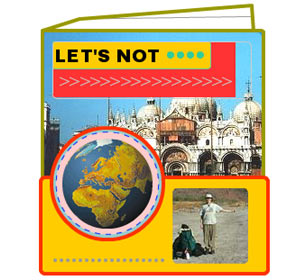
I quickly shut the door and locked it with a feeble-looking hook, ignoring J.’s exclamations about how he could see freighters out the window, over there. After first checking underneath, I sat down gingerly on one of the beds. We shouldn’t have been so precipitous at the train station. We should have made a plan. We should have just stayed put. I began perusing the guidebook, a dire and chirpy “Let’s Go,” which I’d bitterly renamed Let’s Not.

Rejecting the budget choices and zooming straight to moderate range, I settled on the Stella pensione. Tasteful hardwood furnishings, the book said. That sounded nice. Double and single, with or without bath … charming location, close to station … Previous guests recommended the rooms overlooking the sea.

“Pensione Stella,” J. said. He had pulled back the cover on his bed and was reading the faded pillowcase. He lay down and sighed contentedly.

I put down the book and looked around me.

Well, there was a wooden desk. And a kind of wardrobe thing. Maybe I’d hold off a bit before announcing my relocation plans. I rummaged through my bag and found my vial of Woolite. Actually, the room was not bad. I felt the rumbling basso continuo of a ship’s engine, heard the blast of a horn. I found my antiseptic face-cleansing pads. There was a certain unique quality to this place. I found my modest stash of Tanqueray in its extra-slim flask. That man had been amusing.

I regained equilibrium and began to relax. We were in the book. And being placed didn’t feel all that bad. Usurpation of experience? Be my guest! This story was … ordinary. (We could save the drama for the retelling.) If verification means obliteration — as I’d been known to propose — fine. Tonight was timeout for theory. Bring on oblivion! Better to be a conventional entry, though, than a witless statistic. I yawned, beginning to feel blissful, and eased toward an optimum sleep.

Continue Reading Close

M(r). Butterfly

At the heart of my Orient Escapade, R-o-n briefly fluttered by.

  • more
    • All Share Services

M(r). Butterfly

His real name has tones and diphthongs and unaspirated p’s. It sounds piquant and fluttering, the way he pronounces it, his voice guarded and clandestine. Quickly then he’ll revert to the businesslike “Ron,” a character that, clearly, he has created. Ron is a combination of police, priest, parent and pimp.

“Get into the temple,” he might say, his language pragmatic and unadorned.

I am smitten.

When I first shuffled down the chute and through customs in Thailand, I arranged my face to say: I am a writer and student of culture. Then I had my face add: I have slept on monastery floors, rubbed shoulders with shamans, observed factory workers amid the clang of their toil and studied the courtship songs of refugees.

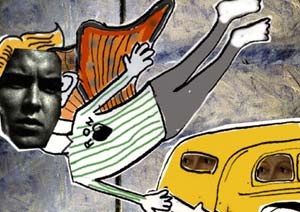
There was the beaming Ron, wearing a crisply laundered white shirt with thin, green stripes, a small, brass name tag centered neatly on the pocket. His smile, which appeared to be absolutely genuine, was also instantly, guilelessly flirtatious.

“My name is R-o-n,” he said.

“Ron!” I responded, a bit precipitously. His near-prissy physical brio (I quickly jotted in my journal) exudes machismo itself, deconstructed and distilled.

“Ah, your English is excellent,” he smiled. This made me feel good, in cahoots with Ron. He was saying: I know and you know and I know you know and I want you to know I know and I want you to know I know you know all those clichis. About all those others. Not you.

“Follow me,” Ron chimed, and swaggered away, confident of my attention. I gathered my things and followed him, down halls, up ramps and around corners. I followed him to the accompaniment of “Bridge Over Troubled Water,” a melancholy, duple-metered rendition strummed on a steel guitar. Through sliding glass doors I followed him, elbowing my way out into a fumey garage filled with restless, growling buses, waiting in the 2 a.m. neon glare at repressed throttle. I felt a quick stab of travel sadness. I was here. I’d never been here before. A door had stood open and now it was closed. Here I was. Wasn’t I?

The only colors in the gaseous gray were purple clumps of gardenia garlands, reminiscent of leis, and the brilliant magenta of the costumes of the lei attendants, languorous, silk-swathed girls accompanied by camera-equipped boys. The sex trade! No, welcome teams, working the arrivals.

The camera boys wore the same green stripes as Ron, though not so nattily. They stood with the girls, an appropriate number of garlands draped over each girl’s arm, at the open doors of the buses. Various toxins vied for space in the semi-enclosed area. As each panting, decompressing passenger waddled gratefully toward the steps of his or her designated vehicle, a girl would lasso him or her with a lei, saying “Welcome, sir (or madam),” with a quick fold of the hands to the forehead. Then the girl would stand next to this sleep-craving stranger, smooth cheek to rumpled cheek in a mini-position of intimacy, while a boy snapped a photo, redeemable later for U.S. $10.

I wanted to be a good sport about this. I wanted to seem unthreatened. I wanted to convey a stance that was not “anti,” but “post”: I’m beyond being ill at ease. That’s what I wanted my stance to be saying. I wanted to match Ron’s leading-man assertion. But I wasn’t there yet. I ducked the photo, though I couldn’t dodge the lei. Scuffling with my iridescent receptionist, I dropped several packages of peanuts I’d saved from the flight and also my journal, which I retrieved with a pounce. This awkward behavior created a catch in the smoothness of the whole maneuver, and my welcome girl’s face became knit with the faintest of frowns.

Ron, though, rescued us, blessing the moment with his big grin and his constant smile, full of pleasure and professionalism. He exudes a male animus that the equally short Norman Mailer would kill for, I made mental note to write. Also a soft concern. And total authority.

“Everything is OK?” Ron cocked his head ever so slightly, interrupting his pattering discourse on the local language (difficult), the local people (always smiling) and the procedure at temples for using the “happy room,” or bathroom (ask him, Mr. Ron). I nodded mutely, eyeing the leather sunglasses case he had strapped to his belt along with a black, collapsible umbrella, as compact as a billy club.

“Get into the bus,” he smiled. I did, with no further struggle.

Floating over the city and toward my bed, I wondered: Had the cool fingers I’d felt on my arm belonged to the silky girl or to Ron? A faint sensation still lingered of just the barest moment of contact, like a moth brushing skin. As I slipped into a semi-dream, I became the moth and Ron my captor. Then Ron and the girl became entangled. He was wearing her silks and she his name tag. Then I was the girl wrapped up with Ron. I gave him back his name tag. It said “Ron.” I put on my own. It said “Orient Escapade.” As the bus sighed along, I went fully to sleep, convinced I’d finally arrived.

Continue Reading Close