Michael Sragow
Pairs of pleasure
A much-pilloried year really wasn't so bad: Here's a top 10 list that's 17 movies long!
“All lousy on the movie front” read a USA Today headline on Dec. 20, for an article that posited 2000 as the worst year in movie history. I think 2000 has been pilloried primarily because 1999 was overrated as a renaissance for American movies: A dozen months ago, overblown pop-art objects like “American Beauty” and “The Sixth Sense” were hailed as milestones. I consider my top films of this year, “Quills,” “Wonder Boys” and “Best in Show,” more than equal to my favorite films of 1999 (“Three Kings,” “The Insider” and “The Straight Story”). In 2000, if there weren’t as many welcome strokes of movie art and entertainment, there were more than enough (including a trio of superb revivals) to stretch a 10-best list to 17.
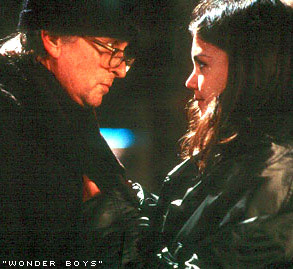
“Quills” and “Wonder Boys” Directors salute writers, with delirious results. Philip Kaufman’s “Quills” limns the Marquis de Sade as an irresistible object who meets an immovable force — the moral guardians (and hypocrites) of Napoleon’s France. Curtis Hanson’s “Wonder Boys” pivots on a contemporary novelist who finds it difficult to keep his footing in the success-crazed culture of America. Kaufman’s film is funny and fierce, Hanson’s funny and melancholic. Both overflow with a love of words and of the actors who speak them — Geoffrey Rush, Kate Winslet, Joaquin Phoenix and Michael Caine in “Quills,” and Michael Douglas, Frances McDormand, Robert Downey Jr. and Tobey Maguire in “Wonder Boys.”
“Best in Show” and “Dr. T and the Women” Taken together, these feats of controlled chaos by a young master and an older one — Christopher Guest did “Show,” Robert Altman “Women” — occasion the question, “Which is funnier: the canine condition or the human condition?” The answer is the canine, but only by a snout. Although Altman’s tale of high-class Dallas females and the one man who truly loves them (a dedicated gynecologist, played by Richard Gere) has been accused of misogyny, it’s no more anti-female than “Best in Show” is anti-dog. Altman reserves his most scathing barbs for the guys in their lives, just as Guest does for the pooch handlers.
“Chicken Run” Nick Park and Peter Lord subvert the slang meaning of “chicken” in this salute to the heroism of oppressed and rebellious poultry. Puppet-animation bliss.
“Judy Berlin” and “Croupier” Two more movies about writers — well, the first is actually about a would-be director with a novelistic sensibility. (Both premiered in the limited-run, 17-city Shooting Gallery series.) Eric Mendelsohn’s achingly beautiful “Judy Berlin” is about a young Long Island man and stymied filmmaker (Aaron Harnick) afflicted with nostalgia for the recent past and a former schoolmate (Edie Falco, of HBO’s “The Sopranos”) fixated on a dream of finding glory in Tinseltown. Mendelsohn’s hero is at once alienated from suburbia and in love with it — a paralyzing mind state. The late Madeline Kahn plays his addled mother, in a swan song at once tremulous and soaring. Mike Hodges’ “Croupier,” by contrast, renders alienation without an ounce of gentleness, pivoting on a control-freaky would-be novelist (the coolly charismatic Clive Owen) who reduces his life to a tell-all book about the gambling world: “I, Croupier, by Anonymous.” “Croupier” is melodrama with a satiric serration and an Oedipal kick, and the most intriguing neo-noir since “The Usual Suspects.” (For a great straight shot of the old noir, see the new prints of Jules Dassin’s “Rififi.”)
“Panic” and “Forever Mine” How about “The Sopranos” redefined? Writer-director Henry Bromell wrote his screenplay for “Panic” — not a diamond in the rough, but a diamond about a rough — at the same time that David Chase wrote his pilot for the HBO series. This film’s setup resembles a WASP-y “Sopranos” purged of ethnic and operatic excess. William H. Macy is heartbreakingly brilliant as the hit-man son of a hit-man father (Donald Sutherland). Macy can no longer lie to his wife (Tracey Ullman) or uphold the family business. But when a shrink (John Ritter) and an erotically quivering young woman (Neve Campbell) let fresh oxygen into Macy’s airtight box, the outcome is an emotional conflagration. Paul Schrader’s “Forever Mine,” like “Panic,” has played nationally only on cable. It’s an exquisite doomed romance that moves from Miami to Westchester and from the early ’70s to the mid-’80s. It stars Joseph Fiennes and Gretchen Mol as a Hispanic Byronic lover and his warm blond love who confront their destiny amid a backdrop of contract killing and drug trading — and equally deadly political corruption.
“Paragraph 175″ and “One Day in September” These dramatic documentaries make their points through sometimes subtle, sometimes startling juxtapositions, and are full of fresh reporting. “One Day in September” doesn’t just retell how Palestinian terrorists took Israeli athletes hostage (and then massacred them) at the ’72 Munich Olympics — it divulges the abysmal security in the Olympic Village and the absence of firm anti-terrorist strategies in the West German government. “Paragraph 175,” the best film yet by Robert Epstein and Jeffrey Friedman (“Common Threads,” “The Celluloid Closet”), fleshes out the plight of gays in Germany before, during and after the Third Reich. It wrings mournfulness, anger and awareness out of the gay survivors’ frank confessions of travails and delights; it shows how politics, ethics and temperament can complicate the most clear-cut issues of sexual preference and gender.
“Mifune” and “Black and White” “Mifune” is the least dogmatic film from the Dogma ’95 movement. Director Soren Kragh-Jacobsen’s camera follows characters through grubby interiors and gorgeous landscapes with the casual intimacy of a next-door neighbor. Kragh-Jacobsen tells a deft comedy of redemption about a Copenhagen businessman whose father is leaving him a dilapidated farm and a mentally impaired elder brother. He ends up falling hard for the housekeeper he hires for his brother — a former call girl played by alternately soft and edgy Iben Hjejle (far more dazzling here than in “High Fidelity”). In its own unassuming yet cheeky way, this movie outlines the emptiness of upward mobility in an age of unapologetic capitalism. “Black and White” is a movie from James Toback (“Fingers”) that out-radicals Dogma ’95 in its mix of volatile written setups and improvisation”. It illuminates the intersection of upper-middle-class, hip-hop-besotted white youths with street blacks yearning to sell their mystique for a slice of white America’s pie. This group portrait of Our City, USA, with guns, basketball, bimbos and bribes, has the heat and deftness of Norman Mailer’s journalism.
“Billy Elliot” and “Erin Brockovich” Young Jaime Bell’s fleet feet and Julia Roberts’ here’s-looking-at-me décolletage bring dynamism to these underdog fables about a boy ballet dancer in a northern England mining town and a Southern California single mother who battles a giant utility company that poisoned a small desert community. In the hands of first-time feature director Stephen Daldry, the scenes between Billy Elliot and his miner father (Gary Lewis) and his dance coach (Julie Walters) heart-rendingly convey the weight and tension of parent-son and teacher-student relations. Director Steven Soderbergh wisely plays much of “Erin Brockovich” as the rowdy social comedy of a woman who refuses to button her sexuality into a proper paralegal’s tailored suit. Roberts rewards him with gusto and sly knowingness, rising to unexpected peaks of empathy. For once her sympathetic frown is as eloquent as her toothy smile.
“A Hard Day’s Night” and “Gimme Shelter” Some uncanny karma conjured the nearly simultaneous restoration of the Beatles’ euphoric feature and the tragic documentary about the Rolling Stones at Altamont. There’s no better way to bring in the true millennial year (2001!) than to watch the Stones’ rock apocalypse and the Beatles’ pop bacchanal back to back.
“Thirteen Days”
This showdown on the nuclear frontier isn't about the U.S. vs. Cuba and the Soviets -- it's about the Kennedys vs. a vast old-man conspiracy.
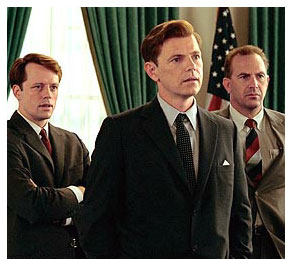
After President Clinton took over from George Bush père, his fellow baby boomers jumped all over him for being overambitious and disorganized, and for not pushing through a sound policy on gays in the military. After John F. Kennedy took over from Dwight D. Eisenhower, those in their 30s and 40s, overjoyed at having a virile young man in the White House, were able to forgive him anything — even the failed overthrow of Fidel Castro that started, and ended, at the Bay of Pigs. By the period covered in “Thirteen Days” — October 1962 — Kennedy’s best and brightest felt they had contained Cuba as an issue. So when American spy planes revealed that the Soviets were planting their missiles on Castro’s soil, 90 miles from the United States, Kennedy knew he had to move quickly to save both his party’s political fortunes and, well, the world.
Continue Reading Close“You’ll shoot your eye out, kid”
Everything you need to know about the great yuletide standards, from "It's a Wonderful Life" to "A Christmas Story."
Last weekend, the high point of Val Kilmer’s first guest-host appearance on “Saturday Night Live” came right at the beginning, when his intro turned into a parody of “It’s a Wonderful Life.” No film has led a more charmed afterlife than Frank Capra’s holiday perennial. Over the past 55 years it has become America’s celluloid yule log. A critical and box-office disappointment in 1946, it was treated as Capra’s masterpiece when he died in 1991, overshadowing his true masterpiece, the miraculously airy “It Happened One Night,” as well as his official classics, “Mr. Deeds Goes to Town” and “Mr. Smith Goes to Washington,” and his daring early works, including “Miracle Woman” and “The Bitter Tea of General Yen.”
Continue Reading Close“Wuthering Heights”
A DVD interview reveals Sir Laurence Olivier's acting advice for this wrenching classic: "The virgin presents the pelvis."
“Wuthering Heights”
Directed by William Wyler
Starring Laurence Olivier, Merle Oberon, Geraldine Fitzgerald, David Niven
HBO Home Video; full screen (standard 1.33:1 aspect ratio)
Theatrical trailer, interview with Geraldine Fitzgerald, soundtrack remastered in stereo
William Wyler’s 1939 film of Emily Brontë’s “Wuthering Heights,” No. 73 on the American Film Institute’s Top 100 movies list, tugs the audience immediately into a romantic, haunted vision of the Yorkshire moors. Its melancholy pull isn’t a matter of special effects; until the end the ghosts remain off-screen. The picture’s greatness arises from its aching beauty and the astounding piece of acting at its core: Laurence Olivier’s performance as Heathcliff, the stableboy locked in destructive thrall with a country squire’s daughter. Wyler ignites the 32-year-old Olivier’s gift for irony, his feral potency and his unique dynamic sullenness. With a Ben Hecht-Charles MacArthur script that extracts the central relationship from Brontë’s novel, the director and a crew of Hollywood’s finest — cinematographer Gregg Toland, art director James Basevi and editor Daniel Mandell — create a mood of thwarted yearning and sustain it for 100 minutes.
Continue Reading Close“Deliverance”
An extra documentary suggests James Dickey wanted someone else to make his movie; give him credit for not squealing like a pig.
“Deliverance”
Directed by John Boorman
Starring Jon Voight, Burt Reynolds, Ned Beatty, Ron Cox
Warner Home Video; widescreen anamorphic (2.35:1) and full-screen (1.33:1)
Extras: Behind-the-scenes documentary, “The Dangerous World of Deliverance”; plus trailer and production notes
James Dickey, the poet-novelist who wrote “Deliverance” and its screenplay, told Sam Peckinpah’s biographer, David Weddle, that he wanted Peckinpah to direct. When Dickey and Peckinpah met to discuss it, the director said to him, “You and I are doing the same thing, me with my images up on the screen and you with your words on the page. We’re trying to give them images that they can’t forget.’”
Continue Reading Close“Proof of Life”
Russell Crowe, all ironclad irony and bedrock honesty, makes competence look sexy in this intriguing action movie.
Everything about “Proof of Life” is intriguing and a little off. Set in the world of high-stakes kidnapping negotiations, this ripped-from-the-slicks fictional melodrama is absorbing without being satisfying. It’s better at holding you hostage to suspense than at delivering an emotional payoff.
The film, based partly on a Vanity Fair article by William Prochnau, stars Russell Crowe as a professional negotiator and Meg Ryan as the wife of an American engineer who is kidnapped in the made-up South American country of Tecala. In the smashing, vertiginous opening-credit sequence, our hero sits in a pristine, ultra-modern London office and blandly recounts a blistering exploit rescuing a Frenchman in Chechnya. The mission unfolding in flashback on-screen depicts a realm in which deals are brokered, and broken, with bullets.
Continue Reading ClosePage 2 of 23 in Michael Sragow