Shortly after the turn of the last century, a handful of scholars started making pilgrimage to Great Blasket Island, a storm-wracked lament of granite, bog, and pasture about three miles out into the Atlantic off the west coast of Ireland, home to some 150 souls and a lovely strain of the Irish tongue. The scholars, linguists from the mainland and from the Continent, came for the language but soon found themselves beguiled by the people and their island life.
There followed for 30 years a fruitful exchange between the residents and the scholars, which Robert Kanigel artfully and empathetically chronicles in “On an Irish Island.” And the coming of the scholars was none too soon, for though existence on Blasket had always been a fugitive state, life on the island was flickering, prey to a careening modernity and its economic tides, its wars and allurements. The scholars were among the last to partake of the islanders’ fundamental engagement with their circumstance — the pacing of life at its sweetest, they often felt, and the world at its best, if colored by “the beauty that inheres in all precarious and dying things.”
Kanigel animates both the people and the place. The village on Blasket reveals itself as a huddle of two dozen stone houses, a density of almost urban feel, with no plumbing, no shops, no priests. There is the bustle of the day, with “children, women, and men setting out in the boats, hunting rabbits, cooking, cutting peat, tending to animals, talking a stream of Irish among themselves.” At night — any time, really — there was storytelling, dancing reels and sets to the melodeon and fiddle, singing and canoodling — “the great litanies of the ought-and-should could seem remote, mainland verities not so much rejected as forgotten or ignored.”
It was that stream of Irish that induced the likes of John Millington Synge, Carl Marstrander, Robin Flower, Brian Kelly, Marie-Louise Sjoestedt and George Thomson — the hub of the story, along with island writers Maurice O’Sullivan and Tomás Ó Criomhthain — to make what was still in the early 1900s some hard travel to a distant place, there to bathe in the folk tales told by the islanders, the mysteries of the language’s “infixed pronouns, the vagaries of the copula, vocalic changes,” and good old common speech, with its foaming crests of rhetoric that so moved Thomson.
In passages that have a wonderful, ecstatic quality, Kanigel traces Thomson’s notion that Homer had come alive on Great Blasket. Their everyday language was poetic and vigorous, rhythmical and alliterative. In their communal life was the same collective intelligence and popular spirit that billowed forth in the Homeric epics through “the language of the people,” an eloquence without “single authorship … but work of the highest order that profited from the shaping influences of the many.”
For all the music Synge, Thomson, and company piped in praise of Blasket language and life, they were as transient as the Blasketers would ultimately prove. In their wake came a flurry of notoriety, fueled by Ó Criomhthain’s gritty and O’Sullivan’s high-hearted island memoirs, but it too flickered, no match for the throttle of modernity. Today, Great Blasket remains an unsullied, hauntingly beautiful place — only now there are no people.
At the opening of the 20th century, the North Pole lay unreached. Over 1,000 men had given the pole their best shot, by ship and sledge, without success, while 751 of them died in the trying. Only one team had the audacity to make the attempt in a balloon. They died, too.
Commanding the balloon was S. A. Andrée, a 33-year-old Swede. Andrée was an engineer by training and a firm believer in lighter-than-air travel. He had run the numbers. Leaving from the Spitsbergen archipelago, he and his two compatriots would float the 600 miles to the pole in 43 hours. A week later they would make landfall in Asia or Alaska, or maybe even San Francisco. Andrée packed a tuxedo just in case. You’ve got to admire his moxie – even as you wince at the fate-tempting presumption. The year was 1897.
Andrée is just the kind of eccentric traveler to whom Alec Wilkinson takes a shine, someone who confronts the world on his own terms because he can’t imagine doing it any other way. Wilkinson tells Andrée’s story in “The Ice Balloon” with economy and finish, light on its earthly feet while sharply administering the piquant stab that attends so many accounts of polar exploration. Time and place snap into focus: the North Pole, a land of severe, sacred purity, a capricious territory where romance, trial and mysticism merged, and the pole was at its pitiless heart; the late-19th century, when selfless heroism was still on the table and the mood still “receptive to the enactment of myths.”
Though more is known about the Andrée misadventure than might be expected, it doesn’t quite convey the full misery of Arctic travel, so Wilkinson fills in the gaps with the aches and stings of other expeditions, which make for fine, grim reading as debacle trips over fiasco. There are Adolphus Greely’s 1881-1884 Ellesmere Island troubles — “Elison’s frostbitten fingers fell off”; “To rest before leaving, Rice shared a sleeping bag with Linn, who was dead.” And Fridtjof Nansen’s errant quest nine years later: “Johansen grabbed the bear by the throat.” On the plus side, there were more northern lights than you could shake an ice ax at, and sunlight streaming “through icebergs as if through a prism, turning them different colors.”
Andrée’s expedition left both journals and diaries, but their formal doughtiness doesn’t give a peek into what had to be a nightmare. The balloon was a disastrous conveyance, rising and falling, bumping along the ground, and finally dumping the men to hell-and-gone in the high Arctic. “Our position is not specially good,” Andrée writes when he learns they must spend winter on a crumbling ice floe. “Joking and smiling are not of ordinary occurrence.”
Wilkinson makes the most of these scant means. He draws a gatheringly bleak picture — accompanied, amazingly, by a few existential photographs taken by the expeditionaries — to play against Andrée’s stiff upper lip. But shortly after Andrée and company found a tatty island on which to rest their weary bones, the words stopped. They vanished into thin air, much as the men had 33 years before their headless bodies were found — “bears had disturbed the remains” — which was about 33 years more than Andrée had expected to be gone.
Continue Reading
Close
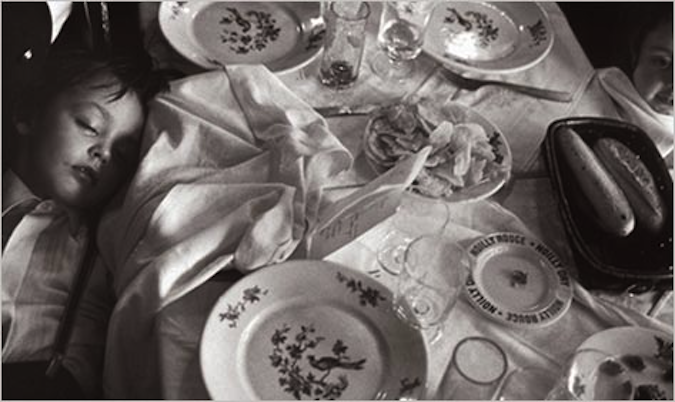
We sapiens are the only animals that look each other in the eye while eating without getting violent. At least most of the time. The other beasts fight over their food; we talk over ours, and share. We have ancient rules of the table, early glimpses of civilization, covenants that have softened into traditions reflecting the basic humanity we find in eating, its rituals, and its memories. If there is a leitmotif that follows the sinuosities of Adam Gopnik’s “The Table Comes First” — his investigation into the pleasures of the table, peeling back its veneer to examine the mechanisms that make it tick — it is “the simple path between eating well and feeling happy,” whether the table is at Noma or the humble home of a friend.
Gopnik writes with an easy cultural fluency; his sentences are roomy and comfortable, but agile. He alternates between chapters with definite shape and momentum, with specific centers of gravity, and chapters that chew on ideas, a ruminant grazing in a field of culinary philosophy.
The birth of what we would identify as a restaurant, in Paris in the mid-18th century, falls into the first group. It is a terrific story, told here with grace and insight, that buries the old tale of chefs being shown the château door during the French Revolution and, so, opening their own. The restaurant rose earlier, when Paris was awash in a cult of health and simplicity, when the Palais Royal assumed the mantle of the modern street store, and when notions of caste were already in disarray, long before the revolution. A public place, welcoming as home — women, too, anyone with a sou — but capable of “a primal magic, a mood of mischief, stolen pleasures, a retreat from the world, a boat on the ocean.”
Equally important for Gopnik is the start of the food scene in Paris, coaxed into being by practitioners, eaters and that newfangled creature, the food writer: “Words make worlds; authors make meals. (So sayeth the writers, anyway.)… [A] mass of critics, diners, chefs, and above all writers who were talking and writing about food in new ways.” Now Gopnik has an opportunity to delve into the worlds of Jean Anthelme Brillat-Savarin’s “warm ironic smile,” Alexander Grimod de La Reynière’s “brilliant epigrammatic grimace,” and Elizabeth Pennell, “the first to see the cookbook as a literary form.” This last was a radical sensualist, “a woman with an appetite on her and a hunger in her,” and Gopnik’s imaginary confidante, to whom he spills his head and heart about food (she, sad to say, though dead for many years, breaks that heart).
Gopnik moves on, making hay with food like a harvester mowing this way and that, with smart, argumentative chapters on meat eating; the puritanical anti-cosmopolitanism of locavorist ideology, but also the gratification of eating foods grown (almost) only in New York City, featuring a farm in Brooklyn composted with elephant manure from the Bronx Zoo (yes, it imparts a certain something); a Robert Parker takedown: “Our experiences of everything are too mediated — by context and intentions and likeness — to be summed up in a number”; and countless noodling digressions, including the sloppy elegance that links rice pudding to Keith Richards’ guitar tuning.
The philosophical chapters are fruitful, but it can be wearying picking the fruit, and sometimes it is difficult to know exactly what you have in your hand. Take the chapter on taste, which considers the taste in your mouth, how it feels when you eat, and moral taste, “the place of the food we eat within an epoch’s style or our own self-image,” the depth of commitment we bring to these tastes, and how they sway and evolve. “The smell in our nose changes the taste in our mouth, and the length of the line outside the restaurant changes our view of the taste of the food we’re waiting for.” It is a canny enquiry, the philosophy, psychology, and physiology as intricate as an Irish knot. Yet Gopnik can also take flights that lose you. “The submission to sequence is the source of the sublime.” “Taste begins at the door, and ends in our dreams.” Somewhere the butter’s burning.
Big deal. These are small potatoes that pale before his grandest point: that eating, that the table, is for slowing down life to promote good cheer. To eat well is to feel happy. It is easy to imagine Gopnik in the kitchen, aproned and focused, putting together something for his family. He dishes it out with a look of expectation, then obvious delight as they tuck in. Beaming, he joins them.
Continue Reading
Close
Our days pass by and by; the years, they pile into drifts, yea high. If we ever had any wisdom to impart in our old age, it is fast wizening as our brains become pickles gone to full sour and then some by an overlong immersion in the brine of life. This ripening of old age into deliquescence is one of many beefs that William Ian Miller brings to “Losing It,” his broad and often darkly humorous skirmish with getting too old.
What are the chances of finding graybeards and sachems among a population of elders with their wheels falling off? Small. Our shrinking brains are a neurofibrillary disaster of plaques and tangles, our mental ability “on a bullet train headed south,” our experiences disappearing into an ever more spongiform memory.
“Let us not even think about the collapse of the sense of touch, which now fails to warn you of large chunks of food you have managed to park on your chin.” Can an oldster claim virtue in chastity and abstemiousness when he no longer has the means to lust and glut? Will the disabled debauchee turn mean, his counsel “high-minded, priggish, ‘cold-complexioned’”? Will Viagra become the greased chute to senex amans, the dirty old men who fancy young ladies, geezers “who still cluelessly think that anyone would want to do it with them”? Pick your poison.
Miller can grouse and chide with the best, but not all is grim modern comedy. With equal facility, he brings a seriously learned and entertaining hand to the project of growing old in earlier times, back in the Middle Ages, and especially the days of the great, northern sagas, which he teaches in his law classes at the University of Michigan. He explores the terrible grief/revenge/frustration complex of old age as it impinges upon the sagas, the density of meaning in sickbeds and deathbeds, in the style one assumed retirement and approached death, and what about your stuff, the benefits of taking it with you: Think of how little we would know of the past if the dead had not burdened themselves for their voyage. Accelerating through history, he speaks of the gift of an Abraham Lincoln eulogy, and the feeling, in the end, of thankfulness, “the best argument for why we need gods, or God, lest there be no one to thank.”
Everywhere here is the twinkle in Miller’s eye. He is having a high and fine old time, and so are we. Old age has become a rueful burlesque, and Miller gives it a mordant poke with a sharpened stick, but he also makes us laugh — there has got to be some wisdom in the refuge of laughter — as we walk into the teeth, broken and stained no doubt, of old age.
Continue Reading
Close
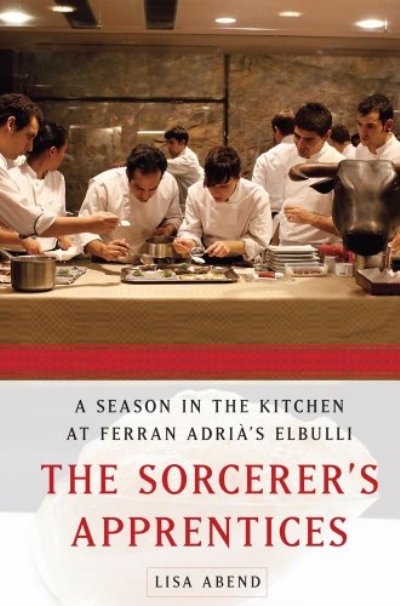
Take an olive. Wring its pretty neck. Collect the juice, process it with algae-based gelifiers and calcium carbonate and — hey, presto! — the liquid turns into a tremulous globule of olive essence, beyond divine with your martini. It’s subversive and witty, and Ferran Adria does equally outré, ravishing things to the likes of rabbit tongue, marinated fish liver, and prehistorically large cardoons, all in the service of flavor and slaying expectations, setting your hair on fire with his rarefied creations.
But all right already, enough ink has been spilled singing the praises of the avant-garde Spanish chef. What about those apprentices in the kitchen, asks Time magazine correspondent Lisa Abend, the ones actually making and plating much of the food served at the restaurant elBulli? Her book, “The Sorcerer’s Apprentices,” spends a revealing, dexterously rendered six months in their company, this troop of unpaid kitchen disciples known as stagiaires, part of the feudal tradition whereby young cooks gain direction and purpose from a great mentor.
They are an elect handful — Abend closely, sympathetically profiles a half-dozen of them — as lucky to get this apprenticeship as anyone else is to get a seat at elBulli, and thrilled with the opportunity, at least at first. “Like all great restaurants, elBulli’s dazzle rests in large part on the willingness of the apprentices, in the name of education, to do the dreary work no one else wants to do.” Say, making 2,000 lentils a day out of clarified butter and sesame paste. That’s right, lentils: typical Adria legerdemain.
The man himself remains aloof to them: “I don’t interact with stagiaires,“Adria snips, very unmentorishly, when one asked for advice. And some kitchen protocols seem plain weird: not only having to ask to use the bathroom; what about apprentices not being allowed to sample the food while putting it together? Too costly, claims Adria, though how’s an apprentice to know if the rabbit ear with sea anemone is as it should be? Simply execute, my child, as Adria has plotted every dish to the nth degree. What stagiaires do learn is that the brilliance of creation is well and good, but the genius is in the hard work of getting it just so, plate after plate, one perfect counterfeit lentil, one wobbly olive at a time.
Continue Reading
Close