
Stephen Prothero

Boomer Buddhism

American converts are taking a 2,500-year-old faith and making it over in their own image -- self-absorbed.

As anyone who hasn’t spent the last few years meditating in a cave in Asia knows, American Buddhism is booming. The 1990s saw three Buddhist movies and a gaggle of celebrity Buddhist pitchmen, including Beastie Boy Adam Yauch and actor Richard Gere. The United States is now home to at least a million not-so-famous Buddhists as well, most of them new immigrants from Asia. But Buddhism is also popular among hip Americans who have never attended a Zen center or visualized a Tibetan mandala.

Typically these sympathizers get their Buddhism, as beat author Jack Kerouac did, from books. Buddhist bestsellers used to come along once a decade: Kerouac’s “Dharma Bums” in the ’50s, Philip Kapleau’s “Three Pillars of Zen” in the ’60s and Shunryu Suzuki’s “Zen Mind, Beginner’s Mind” in the ’70s. Today they materialize monthly, along with more evanescent titles like “Zen and the Art of Screenwriting” (really). Demand for Buddhist books has turned many teachers into stand-alone brands with remarkable marketing muscle. The Dalai Lama and Thich Nhat Hanh are the Coke and Pepsi of this Buddhist generation, but homegrown brands such as Jack Kornfield and Lama Surya Das can also move 100,000 tomes without getting off their zafus.

James William Coleman is not a major brand, and his “The New Buddhism: The Western Transformation of an Ancient Tradition” is not destined for the bestseller list. It does shed light, however, on today’s oddly bookish Buddhist vogue. Coleman is a sociologist and a Buddhist, so it’s not surprising that he supports his sympathy for American Buddhism with a survey. His book focuses on a small minority of American-born converts and sympathizers rather than the immigrants and their children who make up three-quarters of American Buddhists.

These “new Buddhists,” as he calls them, patronize four types of Buddhist groups: Zen centers, Tibetan Buddhist centers, vipassana (“insight meditation”) centers and unaffiliated, nonsectarian centers. Most are baby boomers, almost all are white and all practice meditation, which sets them apart from the members of Sokka Gakkai International-USA (a group that prefers chanting to meditation), the largest Buddhist organization in the United States and the only Buddhist group that attracts significant numbers of blacks and Hispanics.

Coleman identifies some key tendencies among boomer Buddhists, including efforts to make Buddhism more egalitarian, more feminist and more socially conscious. The most audacious of these trends is a drift toward a secularized Buddhism that author Stephen Batchelor calls “Buddhism Without Beliefs” and Coleman dubs “bare-bones Buddhism.”

This supposedly revolutionary concept is actually rather old, even hackneyed. The idea is this: Strip Buddhism of what Coleman describes as its “traditional religious trappings — robed priests, elaborate rituals, sacred images of supermundane figures, devotional practices.” What remains is a demythologized practice that is both new and (supposedly) improved: no chanting, no incense, no monks and certainly no bowing. This stealth approach leaves Buddhists with little to do except meditate and read books like “The New Buddhism.”

Coleman’s book concludes that the new Buddhism is “a profoundly subversive force” in contemporary American society. But what exactly is this kind of Buddhism subverting? Is “Zen and the Art of Poker” subverting American obsessions with money? Is “Zen Sex” subverting American obsessions with sexuality?

Recently critics have suggested that the “new Buddhism” is subverting Buddhism itself. In Time magazine’s 1997 cover story on “America’s Fascination With Buddhism,” Robert Thurman (friend of the Dalai Lama, father of Uma and Buddhist studies professor at Columbia — in that order) derided Batchelor and his ilk as “non-Buddhists” preaching humanism but marketing it as Buddhism. In “Ignore the Man Behind the Curtain,” Ngakpa Traktung Yeshe Dorje and A’dzom Rinpoche blasted Lama Surya Das as a faker in an American Buddhist Oz. “Mr. Surya Das is therefore a Buddhist with ‘no Buddhist beliefs’ in a world where there is ‘really no Buddhism,’” they wrote. “This should perhaps cause anyone who would learn Buddhism from Mr. Surya Das to stop and ponder.”

I am not a Buddhist myself, but I have taught American Buddhism for about a decade, and I must admit I share a certain disquiet about the direction boomer Buddhism is going. I teach religious studies because I believe that studying religion is a truly liberal art. All of the world’s great religions provide profound challenges to the unexamined life. At their best, they offer devastating diagnoses of human sickness and radical remedies for it. They demand crazy things — that we love our enemies, that we deny our selves or that we vow to liberate all sentient beings. At their best, religions are difficult, confusing and mysterious. They don’t pat us on the back, assuring us that, in the words of a Buddhist bestseller by Sylvia Boorstein, “It’s Easier Than You Think.” In fact, they remind us that it’s harder than we think, much harder. Like a Zen master stalking his students with a stick, they whack us back to attention when we fall asleep.

Boomer Buddhism, by contrast, is all too often shallow and small. It soothes rather than upsets, smoothing out the palpable friction between Buddhist practice and the banalities of contemporary American life, cajoling even the Dalai Lama to direct his great mind to small American preoccupations like “The Art of Happiness.”

Almost four centuries ago, the Puritans came to New England intent on uplifting and improving Protestantism. By stripping Protestantism of all the last vestiges of Catholic superstition, by relying on the authority of the biblical book alone, they would craft a new and improved Christianity. Boomer Buddhists are modern-day Puritans. They too are suspicious of priests and rituals and other “traditional religious trappings.” They too believe that America is a sacred place destined to perfect the religious tradition they hold dear. Virtually every “new Buddhist,” including Coleman himself, seems to be carrying around a laundry list of the ways America is making Buddhism better. To take just one example, Lama Surya Das — who, despite the name, is a white guy — has a list of “Ten Emerging Trends” in American Buddhism. In the United States, he brags, Buddhism is “nonsectarian,” “psychologically astute” and “simplified.” Each of these trends is, in his view, an improvement.

What seems to be lost on the new Buddhists who populate Coleman’s book is the possibility that it may be America’s destiny not to make Buddhism perfect but to make it banal. It is, of course, far too early to determine what America’s effects on Buddhism will be. The religion has been in Asia for two-and-a-half millenniums; it has been a force in the United States for only a century or so. So far, however, things do not look good. Philosopher George Santayana once observed that “American life is a powerful solvent. It seems to neutralize every intellectual element, however tough and alien it may be, and to fuse it in the native goodwill, complacency, thoughtlessness and optimism.” Instead of preserving Buddhism, Americans seem intent on co-opting and commercializing it, dissolving a religion deeply suspicious of the self into an engine of self-absorption.

A few months ago I visited the headquarters of the Buddhist Churches of America in San Francisco. In its gift shop (yes, almost all American Buddhist centers have gift shops) sat a rock carved with the words “What Would Buddha Do?” If the Buddha were alive today, would he be a “new Buddhist”? Would he write bestsellers for Doubleday? Direct films?

Call me old-fashioned, but I think the Buddha would march his ass (mindfully of course) to an American Buddhist monastery. Like immigrants and chanters, monks are almost entirely ignored in Coleman’s book, but they are now dug in all across America, doing decidedly old Buddhist things like wearing robes, conducting rituals and even chanting. At places from the Dharma Realm Buddhist Association and Shasta Abbey in California to Zen Mountain Monastery and Dai Bosatsu Monastery in New York, ordained monks devote themselves full time not to improving Buddhism but to preserving it. Some of these monasteries focus on translating and publishing ancient Buddhist texts. Most host laypeople for intensive retreats. But many also shutter their doors for long periods to allow monks to pursue the hard work of what the Buddha described as waking up from a long, bad dream.

Many of the monks at these monasteries are foreign born, but a surprising number are people born in America who have, for one reason or another, decided to scuttle the easy answers of boomer Buddhism for something closer to the real thing. Thanissaro Bhikkhu began life as Geoffrey DeGraff. After graduating from Oberlin, he went to Thailand, where he studied in the Thai forest tradition under a Thai teacher for more than a decade. In 1991, he joined with another Thai teacher to found Metta Forest Monastery in the mountains north of San Diego. Thanissaro, who became abbot of that monastery in 1993, describes the “new Buddhism” as a grand game of telephone in which “things get passed on from person to person, from one generation of teachers to the next, until the message gets garbled beyond recognition.” One of the key Buddhist ideas lost in that grand game of telephone is sacrifice (“renunciation” in sutra-speak), which he calls the “huge blind spot in American Buddhism.”

Thanks to Thanissaro Bhikkhu and hundreds of monks like him, an authentically Buddhist form of American monasticism is alive and well. These monks are not above adapting Buddhism to American circumstances. They struggle with questions like whether to wear winter coats instead of cotton robes in Chicago, and whether to drive cars in Los Angeles. But they adopt American ways grudgingly rather than gleefully. Unfortunately, as “The New Buddhism” indicates, boomer Buddhists now have the stage. Lama Surya Das sells his books by the gross. Thanissaro Bhikkhu sells his by the unit. Only he doesn’t actually sell them. They are available for free on the Web — a gift from the old Buddhism to the new.

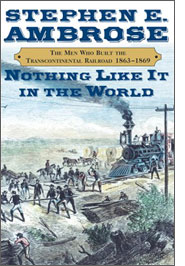
“Nothing Like It in the World” by Stephen E. Ambrose

The bestselling historian serves up the stirring tale of the unsung men who built the transcontinental railroad.

Walt Whitman’s poem “Passage to India” is supposedly about the union of America and Asia, but it never quite reaches the Ganges. It lingers instead on the Sierra Nevada and the plains of the Midwest. That’s because the inspiration behind the poem was an American event: the completion of the transcontinental railroad in 1869.

Stephen E. Ambrose is a historian in the Whitmanian vein. He is popular, prolific and patriotic, and his writing tends inexorably toward the grandiose. Ambrose has written on Eisenhower and Nixon, D-Day and Lewis and Clark. His bibliography includes works with titles (“Stephen Ambrose Collection” and “The Best of Stephen Ambrose”) typically reserved for aging rock stars.

His latest hit, “Nothing Like It in the World: The Men Who Built the Transcontinental Railroad, 1863-1869,” is, like most of Ambrose’s work, primarily an exercise in storytelling. And Ambrose tells a good story, describing the job of building America’s grand iron highway as a nip-and-tuck race between the Central Pacific (CP) in the West and the Union Pacific (UP) in the East.

Running that race were the great white men who made the railroad possible: financiers such as Leland Stanford and Collis Huntington, politicians such as Abraham Lincoln, generals such as Ulysses Grant and William Sherman and even religious leaders such as the Mormon patriarch Brigham Young. The key characters in Ambrose’s drama, however, are not those power brokers but, as his subtitle suggests, the tens of thousands of Chinese, Irish and Mormon laborers who graded the track, laid the ties and drove the spikes.

These men encountered all sorts of obstacles. Weather was one. They fought desert heat and mountain snowstorms. In fact, snow came down so hard in the Sierra Nevada that Central Pacific workers built nearly 50 miles of snowsheds to shield themselves and their work. Indians were another obstacle, conducting what Ambrose calls a guerrilla war against the onslaught of modern America and its steam-driven dynamo. Between 1863 when the railroad building began and 1869 when it ended, laborers were also killed by avalanches, nitroglycerin blasts, exploding engines and runaway trains.

But those who survived triumphed. They drilled tunnels through granite with nothing more than black powder. They laid track at over 8,000 feet. In the spring of 1869, Central Pacific workers built 10 miles of track in just one day. On May 10 of that year, Southerners and Northerners, Easterners and Westerners came together to witness the driving of the famous Golden Spike at Promontory Summit, Utah, that linked the eastern and western lines.

In the past, historians of the transcontinental railroad have been inspired more by Ralph Nader than Walt Whitman. They focused on the greed and corruption of the Gilded Age railroad barons. They spun morality tales, cautioning liberal readers against the evils not just of monopolies but of capitalism itself. Ambrose’s story is different. While he criticizes the capitalists, he praises them, too — as “men ready to take great risks and to accept great profits” (as if the latter were a difficult chore). He also defends the key role the government played in financing the railroad, arguing that some enterprises are just too grand to be left entirely to the private sector.

The theme of “Nothing Like It in the World” is not greed but greatness. Here the United States appears as a daring nation populated by courageous capitalists, politicians and laborers willing to do great things. Among the greatest of those things was the construction of the transcontinental railroad, which in Ambrose’s telling did nothing less than make modern America. While the victory of the Union in the Civil War kept the country from flying apart, he argues, the transcontinental railroad bound it together.

“Exaggeration is endemic to railroad historians,” Ambrose admits, and he has certainly caught the bug. The challenges facing the CP builders were, in his words, “unique in engineering annals,” while a UP bridge was “one of the greatest engineering feats of the nineteenth century.” The financing controversy that swirled around the project was “the largest scandal in America’s nineteenth-century history.” The day the CP laid 10 miles of track “will be remembered as long as this Republic lasts.” As for the railroad itself, well, there was “nothing like it in the world.”

What you think about this book, which reads in places more like a State of the Union address than a work of history, depends almost entirely on what you make of America. Most American studies professors I know would applaud Ambrose’s decision to emphasize the achievements of Irish and Chinese immigrants, but they would sneer at his exceptionalism — his smug assurance that America is the best and brightest of nations.

“Only in America,” Ambrose sings in a concluding Whitmanesque chapter, was there enough space, enough labor, enough government support and enough “energy and imagination” to make a transcontinental railroad a reality: “The railroad was the longest ribbon of iron ever built by man. It was a stupendous achievement. It spanned a continent, opened new lands for settlement, opened the mountains with their minerals. It had crossed a frontier of immense possibilities. It had inaugurated a new age” with a “nationwide stock market” and a “continent-wide culture.”

That is the sort of triumphalist rhetoric that makes many professional historians retch. But history isn’t written just for professionals. If Walt Whitman were alive today he would be singing Stephen Ambrose’s praises — and riding what remains of the rails.

Continue Reading Close

Skulls in the closet

What does membership in a bastion of privilege say about George W. Bush's character?

One evening in May 1967, a man dressed in a black hood and sporting a gold pin emblazoned with a skull and crossbones approached George W. Bush, slapped him on the back and offered him membership in Yale’s oldest secret society. The governor-to-be accepted and, like his grandfather and father before him, became a member of Skull and Bones.

Skull and Bones is one of the nation’s most exclusive and powerful secret societies. The list of past and present Bonesmen, as members are called, makes California’s Bohemian Grove retreat (also patronized by Gov. Bush and his dad) look like your local Rotary Club. Members have served as senators, secretaries of state, national security advisors, attorneys general, CIA directors and Supreme Court justices. They have also become presidents of universities, CEOs of Fortune 500 companies, foundation presidents and founders of investment banks. Two Bonesmen, William Howard Taft and George Bush, were elected president, a post Gov. Bush now hopes to fill.

Much has been made of the Texas governor’s “youthful indiscretions” and of his gentleman’s C’s at Yale. But membership in Bones shaped George W. Bush far more than road trips or college courses. In the wake of the Clinton-Lewinsky mess, character has emerged as a leading theme in presidential politics. An examination of the culture of Skull and Bones should shed some light on the character of the latest Bush who would be president.

Though a seniors-only society, Skull and Bones is more than a tad sophomoric. Each May on “Tap Day,” senior Bonesmen troll around Yale’s campus, selecting, or “tapping,” 15 juniors for membership in the upcoming class. The initiation rites that follow sound like something out of Fred Flintstone’s Water Buffalo Lodge or a Robert Bly retreat. Each knight, as neophytes are called, reportedly regales his fellow initiates with his sexual exploits. (He may or may not be naked and may or may not be lying in a coffin.) During initiation, he endures some sort of physical challenge (mud wrestling? diving into a dung pile?) before being born again with a new name and a new identity. In the outside world, members are never to speak about their society. If outsiders raise the topic, Bonesmen are supposed to leave the room.

Members take their secrecy oath seriously — no insider has ever published an exposi — so it is impossible to separate the realities from the rumors that swirl around the society. One rumor has each new member receiving a $15,000 payout. Another says the interior of the “Tomb” (the eerie Gothic headquarters where twice-a-week meetings are held) is decorated with human remains, including the skulls and bones of notables such as Mexican revolutionary Pancho Villa and Apache warrior Geronimo.

Are the rumors true? Certainly not all of them; the society is probably not the fountainhead of a vast international conspiracy to spread Hegel’s dialectic via the drug trade. But Bush is not helping to clear the air. Like his father, who has consistently refused to discuss Skull and Bones, he isn’t talking. And members of his 1968 Skull and Bones class whom I contacted either neglected to return my calls or refused to comment on what goes on inside the Tomb. “We don’t discuss those things,” said Roy Leslie Austin, now a sociology professor at Penn State. “We just don’t.”

Skull and Bones was founded by William H. Russell in 1832, more than a decade before Texas joined the union. At the time, men’s fraternal organizations were so popular that politicians like former President John Quincy Adams were denouncing their secret oaths as cancers on the body of the republic. When Phi Beta Kappa responded to the anti-masonry in the air by abolishing its oath of secrecy, Russell (who later become Yale’s valedictorian) founded “The Scull and Bones” as an alternative. For the next century and a half, Skull and Bones, as Russell’s society came to be known, guarded its secrecy with the zeal of Howard Hughes and the nuttiness of J.D. Salinger.

In 1856, Bones incorporated as the Russell Trust Association and members built the grim sandstone mausoleum that is still used as society headquarters. In 1876, pranksters broke into that crypt through a window and investigated its interior. Bonesmen responded by bricking up all the windows, which remain sealed today. Supporters describe Skull and Bones as a meritocracy that, by rewarding excellence in academics, athletics and the arts, has fostered achievement at Yale and beyond. From this perspective, the society’s rites, however secretive or sophomoric, promote fading virtues such as friendship and loyalty. And the society does have an astonishing record when it comes to turning out leaders.

Russell saw the society as a way to promote and reward academic excellence. But Bones gradually expanded its mission, tapping not only outstanding scholars but also football captains, Yale Daily News editors and members of the a cappella group the Whiffenpoofs. Eventually, the society also began selecting Bonesmen not for what they had accomplished in life but for who they were by birth.

George Herbert Walker Bush was no doubt selected in part because his father, Prescott S. Bush, was a U.S. senator and a Bonesman. But the president-to-be was also a decorated World War II pilot and captain of the Yale baseball team. George W. Bush, who had a less illustrious youth than his father, is more plainly a legacy member, tapped because of his genes and not his deeds.

From its inception, Skull and Bones has been a bastion of privilege — an ideal steppingstone from a preppie past to an establishment future. And so the society has been regularly denounced for its elitism as well as its secrecy. In 1878, the Yale Courant ripped Bonesmen as “vampires of darkness.” Bones, it wrote, was a “a curse to the college” that promoted “royal and stylish living” and divided the undergraduate classes into “castes.” That same year, the Yale Daily News called the society’s mummeries “supremely silly.” During the 1960s, critics claimed Skull and Bones and other Yale-only secret societies rewarded conformity rather than achievement. Today, denouncing those societies as anti-democratic cults is almost as routine at Yale as Tap Day itself.

Bones waited about a century to respond to the criticism. After World War II, it began admitting blacks and Jews. In 1991, the outgoing Bones delegation tried to tap the first Boneswomen. Patriarchs, as Bones alumni are called, literally barred the doors to the Tomb. Led by conservative William F. Buckley Jr., they obtained a court order temporarily blocking non-male members. In the society-wide vote that followed, however, the conservative blue bloods were defeated and a few women were admitted to the rolls.

There are likely many things this society does well. I would love to have been a skull on the wall in a private debate between, say, Sen. David Boren and Sen. John Kerry or authors Archibald MacLeish and John Hersey (all Bonesmen). But I doubt the Tomb fosters the sort of character necessary for leadership in multicultural America and the new global economy. And I am certain it is an unsuitable incubator for the presidency in the 21st century. This is true for Bonesmen tapped for their accomplishments in rowing or debating. But it is doubly true of those who, like Bush, were tapped primarily for the accomplishments of their forebears.

Since our country’s inception, Americans have been profoundly ambivalent about power and wealth. That is why Horatio Alger is as much a part of the American mythos as is the Titanic. We like to worship the high and the mighty, but we love to see them go under. True, the rich are different from the rest of us. So are the powerful. But both are supposed to live, at least in this country, by some rules. The rich are expected to earn their money through hard work or cunning. And the powerful are to earn their power in public elections, not private clubs. Just as many years ago George W. Bush was suddenly tapped for an exclusive society, critics today might charge that he similarly coasted into becoming an odds-on favorite for the White House before a single ballot had been cast.

Continue Reading Close

“Trials of Intimacy: Love and Loss in the Beecher-Tilton Scandal” by Richard Wightman Fox

A beautifully written book about a sensational 19th-century sex scandal unravels stories wrapped in stories about what really happened.

One of the country’s greatest communicators, a married man, stands accused of having
his way with a woman young enough to be his daughter. Instead of
confessing, he offers tortured testimony about what sex is and is
not. Though the man is not convicted, his reputation is tarred
forever. The woman withdraws from view but cannot escape public
ridicule.

Sound familiar? It shouldn’t, because this trial of the century was a
19th-century case. The year was 1875. The woman was Elizabeth Tilton.
And the accused was the Reverend Henry Ward Beecher, brother of
Harriet Beecher Stowe, pastor of Brooklyn’s Plymouth Church and the
nation’s most beloved preacher.

The Beecher-Tilton scandal is by no means undiscovered territory for
historians, who have made sport of trashing the not-so-reverend
Beecher for over a century. It is now common knowledge that Beecher
and Tilton had sex (whatever that means). But beating up the dead for
adultery is passi. So historians accuse Beecher instead of the
high crime (or is it a misdemeanor?) of hypocrisy. And they blame the
sentimental Protestantism he championed for paving the way for the
noxious self-absorption of New Age navel-gazing.

Given all that has been written about this scandal, it’s hard to
imagine anyone having something new to say about it. But Richard
Wightman Fox does find a new angle: agnosticism. After scouring
thousands of pages of trial testimony and private correspondence, Fox
concludes that there is no way for any honest observer to know for
sure what Tilton and Beecher did together. All we know, he argues, is
that the principals in the scandal told stories wrapped in stories,
and that those tales contradicted each other and changed dramatically
over time.

Fox’s method shows both modesty and restraint. He begins by allowing
his characters to tell their own versions of what happened. He then offers a variety of plausible
interpretations of what this “kaleidoscope of stories” might have
meant at the time. In the process, Fox gives the lie to the conceit
that a careful historian can peel back layer after layer of
conflicting testimony to reveal the kernel of truth underneath. In
this telling, it’s just stories all the way down.

Although there are elements here of a faddish postmodernism, “Trials
of Intimacy” is really a brief for old-fashioned history in which
evidence matters and the historian’s job is to judge that evidence
critically. On at least one occasion, Fox stands up and bangs his
gavel. About the emerging consensus (floated in “Other Powers,”
Barbara Goldsmith’s recent biography of suffragist Victoria
Woodhull) that Tilton and Beecher conceived an aborted or miscarried
love child, Fox says bunk, noting that the fetus would have been a
hoary 10-and-a-half months old when it was lost.

Fox has argued before that history is “a factual and a moral
inquiry.” And the moral here is that historians should allow the past
to be the past. By insisting that figures like Beecher have something
to say about the New Age (or, for that matter, the Clinton-Lewinsky
mess), Fox says, we rob ourselves of the lessons that real history
has to teach, among them the fact that there are “other ways of being
human” that might actually be preferable to our own.

If the past is a foreign country, then the historian’s job is to turn
characters like Tilton and Beecher into foreigners. Fox does just
that by allowing his characters both to “live and breathe in their
historical moment” and to “speak a language strangely different from
our own.” But he also makes Tilton and Beecher accessible to us by
translating their Romantic pieties, their Republican politics and
their Victorian social conventions into language we can understand.
That is a tricky task — making the past familiar enough to be
understood but foreign enough to be itself — but Fox executes it expertly, whether he is parsing what sentimental
Protestantism has to say about sin or explaining why a straight
gentleman would sit on his equally straight pastor’s lap and seal his
profession of devotion with a kiss.

Given his convictions, Fox does not tease out the obvious parallels between Beecher and Clinton, Tilton and Lewinsky. But he does offer this intriguing observation: that in this 1875 scandal we see the gestation of a new America in which “the private infiltrated and colonized the public” and “public discourse … became increasingly dominated by sensational disclosures or
inventions about private life.” To those sensational disclosures Fox adds not a whit. But his beautifully written book adds much to our understanding of love and loss not only in Victorian America but also in our own time.

Continue Reading Close

Books: Inner Revolution

Stephen Prothero reviews 'Inner Revolution' by Robert Thurman

“A specter is haunting Europe,” Karl Marx wrote 150 years ago in “The Communist Manifesto,” “the specter of communism.” Influenced by Marx’s claim that religion is “the opiate of the masses,” sociologists have traditionally viewed Buddhism as otherworldly, apolitical, pessimistic, socially apathetic and ethically inert — the most powerful of religious opiates. Robert Thurman’s “Inner Revolution” is a Buddhist manifesto that stands Marx and the sociologists on their heads. A specter is haunting America, he argues, and it’s the friendly ghost of Tibetan Buddhism.

Thurman is a Buddhist Studies professor at Columbia University and, if we are to believe Time magazine, one of the 25 most influential people in America. But his real job is playing James Carville to the Dalai Lama’s President Clinton. “Inner Revolution” is one part autobiography, two parts philosophy, three parts history and four parts spin. Here readers learn that Thurman was the first Westerner ordained a Tibetan Buddhist monk, that the Buddha was great in bed, that selflessness is the key to real happiness and that Tibet is “a mandala of the peaceful, perfected universe.” But Thurman’s aim is not to portray Tibet as Shangri-la. It is to portray Buddhism as deeply ethical and political — “a coup of the spirit.”

Like John Dominic Crossan, who has argued that Jesus was a revolutionary, Thurman portrays the Buddha as a liberator — a “cool hero” who initiated a “cool revolution” that radically transformed society by changing individuals first. His “politics of enlightenment” was countercultural at first, but it eventually went mainstream, finding its highest manifestation in “buddhocratic” (not theocratic!) Tibet.

As the world modernized, Thurman argues, Tibet modernized too. But while the West’s modernity was “outer,” Tibet’s modernity was “inner.” It explored inner rather than outer space, championed the spiritual over the material, sacralized rather than secularized the world, and put its trust in individuals over bureaucracies. Nonviolent and tolerant, it achieved its apogee in the monasteries of the “psychonauts” of Tibet. Militaristic modernity, Thurman concludes, has brought us to the brink of nuclear annihilation. Our challenge is to marry inner and outer modernity — to create a global society (a “United Nations of Earth”) that is both spiritually and technologically advanced.

In keeping with its manifesto style, “Inner Revolution” is replete with lists. There are five principles of the politics of enlightenment and four grounds for hope in the 21st century. An appendix, the book’s most controversial section, propounds 10 planks in what amounts to a political platform. Here Thurman gets down to business, blasting Newt Gingrich-style Republicans (though not by name) on taxes, crime, race, religious freedom, defense spending and the environment, and endorsing abortion rights, medicinal pot-smoking, universal voter registration and higher salaries for college professors.

Although Thurman presents his book as an antidote to the materialistic modernity of the West, it is also a welcome corrective to the pop Buddhism of Madison Avenue and Hollywood. Say what you want about his specific political proposals, Thurman’s vision of a kinder, gentler America merits a hearing. If nothing else, the book demonstrates that not every Tibetan lama is busy shilling something on TV. Robert Thurman may be no Jack Kennedy, but he isn’t Stephen Seagal either. His manifesto deserves a thoughtful read.

Continue Reading Close

Some Of The Dharma

Stephen Prothero reviews 'Some of the Dharma' by Jack Kerouac.

In the mid-’50s, the Dalai Lama was still in Tibet, and Zen centers were as rare as bellbottoms. So when Jack Kerouac tuned in to Buddhism in the winter of 1953, he was pretty much on his own. With no guru to guide him, Kerouac experimented with Buddhism for the next two and a half years. And he recorded the results of his experiment in 11 spiral notebooks just published as “Some of the Dharma.”

Begun as a series of notes addressed to another Beat Generation star, Allen Ginsberg, “Some of the Dharma” is an ambitious effort to translate Buddhism into an American idiom. As vast as Texas and as tangled as a Los Angeles freeway, the book is a hodgepodge of poems, prayers, sermons, scripture snippets, commentaries, essay and story fragments, dream sequences and journal entries. Though loaded with little gems (“I’m a farmer/I grow Nirvana”) and some clever translations (the Tibetan chant “Om mani padme hum” is rendered “Amen … The gem in the rags”), the book is a jumble. At least as literature. As autobiography, however, “Some of the Dharma” shines.

In most of his novels, Kerouac appears as a likable character. Here, however, we get Kerouac unburnished, raw: Kerouac the misogynist, the homophobe, the mama’s boy, the deadbeat dad. But we also get a refreshingly honest depiction of one man’s failed spiritual quest. The book’s key conflict pits the lure of “The City” against the lure of “The Path.” Kerouac repeatedly renounces alcohol, drugs, gluttony, women, friends — even jazz. His plan is as American as Thoreau’s, as ancient as the Buddha’s. He will take refuge in a secluded “monkshack” in Mexico (or perhaps in his mother’s “hermitage”). There, by meditating three times daily, he will achieve peace of mind, perhaps enlightenment. At least that was the plan. In reality, Kerouac made a lousy monk. Repeatedly he was drawn back to the city — to parties with Beat friends, the temptations of literary stardom, the sheen of the creamy thigh. “Go on drinking and the world’ll roll you,” he wrote in 1955. And the world did.

“Some of the Dharma” concludes in March 1956 with Kerouac’s agent about to nail down a deal for “On the Road.” Soon Kerouac will be hailed as the voice of a new generation and hated as a corrupter of America’s youth. He will also renounce Buddhism, return to the Catholic comforts of his youth, and die a drunk’s death of cirrhosis of the liver. Kerouac, of course, did not know all this when he concluded “Some of the Dharma” with a vision of himself as “a Super Myriad Trillionaire in Samapatti.” But we readers do, and our prescience lends the book a quality of pathos careening toward tragedy. Today there are Zen centers in every U.S. city and Dalai Lama movies play at the mall. Being a Buddhist is easy. But in the mid-’50s, practicing Buddhism was hard. Without a lama to watch over him, Kerouac made his own way along his own path. His Buddhist improvisations were as fresh as Charlie Parker’s jazz or, for that matter, Kerouac’s own “spontaneous bop prosody.” “Some of the Dharma” is not, as Kerouac claimed, “a great book.” It’s not even as good as “Dharma Bums.” But it provides a unique glimpse into the life of a man Allen Ginsberg rightly celebrated as the “new Buddha of American prose.”

Continue Reading Close

Page 1 of 2 in Stephen Prothero