
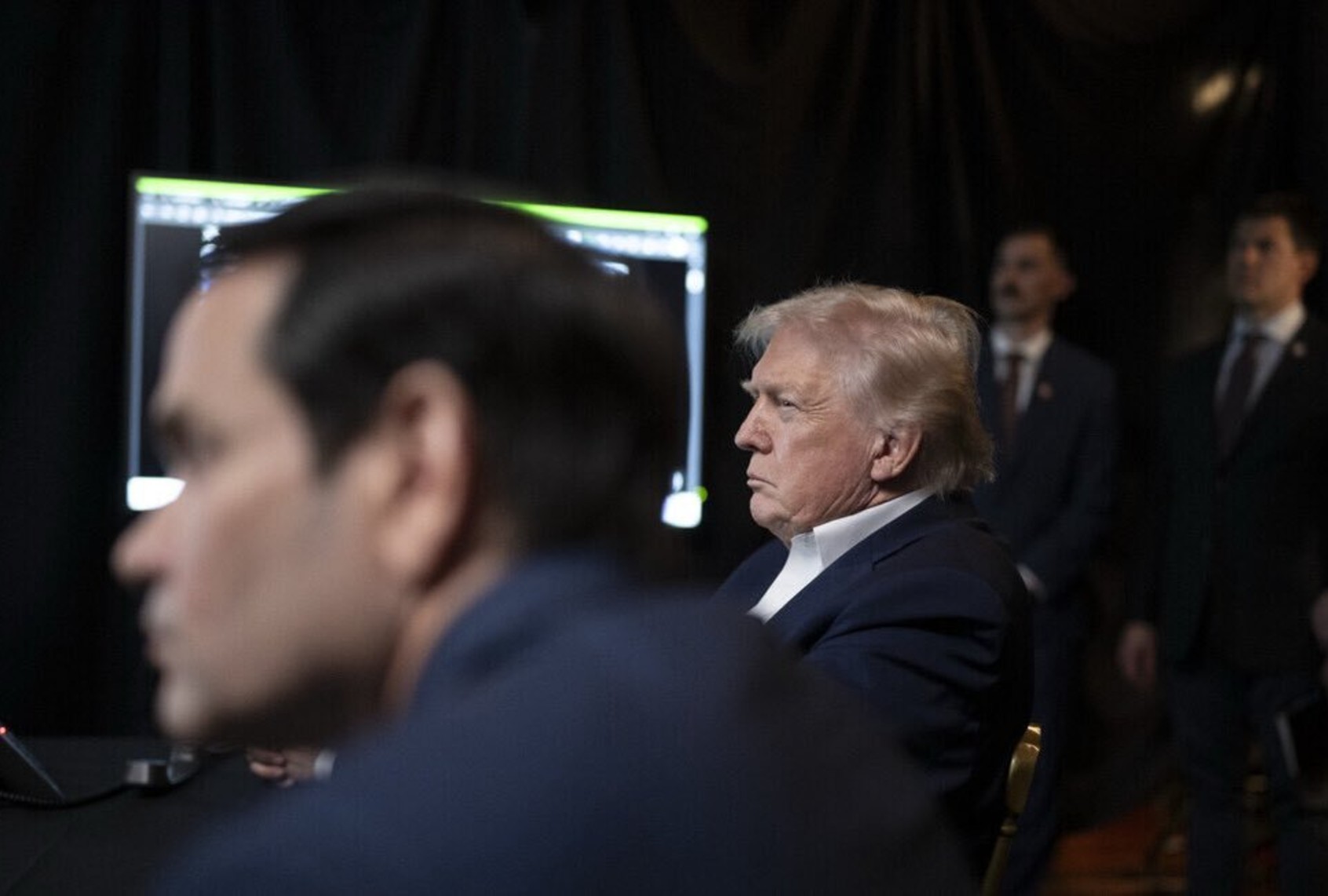

At the risk of sounding cynical, the first thing that came to mind when I woke up on Saturday to news of Donald Trump’s Operation Absolute Resolve was: Well, that’s certainly one way to keep him from falling asleep on camera. If there’s anything the president loves more than creating a spectacle, it’s getting to cheer it on as a spectator. The January 3rd wee-hours raid on the residence of Venezuelan president Nicolás Maduro was everything he loves in a neat package — one for which he was creator, producer, star and transfixed audience.
It’s been almost a decade since the United States unofficially became Trump Television, and the brand is only getting stronger. When he called into “Fox & Friends” on Saturday morning, Trump gave his own work an unsurprising rave review, enthusing that he “watched it like a television show” and bragging to his hosts, “If you would have seen the speed, the violence . . . it was an amazing thing.” Acting as his own peanut gallery, he later that day delivered a grandiose televised address to the nation, proclaiming that “overwhelming American military power — air, land and sea — was used to launch a spectacular assault. And it was an assault like people have never seen since World War II.”
If there’s anything the president loves more than creating a spectacle, it’s getting to cheer it on as a spectator.
In his statement to House Republicans on Tuesday, meanwhile, the president sounded like a critic offering blurbs for a movie poster, speaking in sentence fragments (“You know, people are saying it’s — it goes down with one of the most incred —”), setting the scene with a flourish (“The electricity for almost the entire country was boom, turned off”) and employing a dehumanizing shorthand to keep the focus on him. (“Nobody was killed. And on the other side, a lot of people were killed.”) He also took the time to admonish Senate minority leader Chuck Schumer for not complimenting him on the operation’s success (“You know, at some point they should say, you know, you did a great job. Thank you. Congratulations. Wouldn’t it be good?”), echoing his menacing February 2025 demand that Fox News “say we did a great job” in his first Cabinet meeting.
It’s not news that Trump has run both of his presidencies like a reality series. He’s cast his cabinets for telegenic big personalities who pop onscreen and aren’t there to make friends; he’s whipped up gotcha moments that even Jerry Springer would deem tasteless. And, of course, he’s taken plenty of time to alternately brag and complain about the ratings. New York Times television critic James Poniewozik, author of “Audience of One: Donald Trump, Television, and the Fracturing of Television,” noted in a 2020 Salon interview that Trump is a figure ideally suited for the Peak TV era, whose profusion of cable channels, online outlets, and streaming services means “increasing rewards for more polarizing programming, whether it’s entertainment or news, fiction or nonfiction.”
Though that’s undoubtedly still true, it’s starting to seem like the president is rethinking this strategy. For viewers, one of the few saving graces of Trump Television is both the amount and the quality of counterprogramming: At any given time he appears on a network or cable channel, there are any number of riveting, well produced and Trump-free alternatives to watch. New generations, bless them, will never know the disappointment of a favorite weeknight show being pre-empted by a breaking news story or the particular discombobulation of hearing “We interrupt this broadcast for a special news bulletin” and suddenly realizing that every network is the same live feed of a burning survivalist compound or a freeway chase to nowhere.
Want more from culture than just the latest trend? The Swell highlights art made to last.
Sign up here
But despite Trump’s fondness for professional wrestling and Shark Week — his sole relatable characteristic might be his propensity for fear-viewing — he doesn’t actually want audiences to have all those other options. The president’s love of watching himself on television is well-documented, but the Venezuela strike is a reminder that he has almost as much of an appetite for watching action-packed spectacles that don’t star him but also wouldn’t happen without him.
Along with Marco Rubio, Pete Hegseth, and Joint Chiefs of Staff chairman Dan Caine, Trump watched Operation Absolute Resolve from an undisclosed location inside Mar-A-Lago. The military invasion of Venezuela was classified as top-secret, but the president was quick to make the surveillance itself a spectacle, posting photos on TruthSocial from the makeshift war room. And Trump wasn’t the only one who knew exactly how it should look: Several shots find Pete Hegseth attempting his best Blue Steel, and a low-angle photo shows Stephen Miller, arms crossed, looking at the camera as if daring it to make him look cool. (Spoiler: It does not.) The most notable thing in the photos, however, is that the largest screen visible in the room is open to X, formerly Twitter — which suggests that the team was not only watching the operation unfold, but monitoring its social-media virality. On Tuesday, which marked 5 years since Trump whiled away hours in the White House watching his supporters wreak havoc at the Capitol, he boasted that voters “loved” the attack on Venezuela.
The Venezuela strike is a reminder that he has almost as much of an appetite for watching action-packed spectacles that don’t star him but also wouldn’t happen without him.
The resemblance to another war-room photo has not gone unnoticed. In May 2011, White House photographer Pete Souza documented the palpable tension in the cramped room where Barack Obama, Joe Biden, Secretary of State Hillary Clinton, Defense Secretary Robert Gates and the rest of the national security team watched via live drone feed as Navy SEALs executed Operation Neptune Spear. The so-called Situation Room photo captured history in the airless silence of a room holding its collective breath — and just as Trump wants everything else his predecessor had, there’s little doubt that he hoped that his photos would match the gravitas of Souza’s.
As a president, Trump is the most watched man in the world; as someone playing the role of media mogul, it seems no amount of eyeballs will satisfy him. A July 2024 ProPublica report noted that the Trump Media & Technology, despite earning almost no revenue, had announced a “Standby Equity Purchase Agreement” that allowed for the creation and sale of “up to $2.5 billion worth of new shares” — a clear benefit to the president, who holds a majority stake in the company. Despite that, the company reported a more than $400 million loss in 2024, and the August 2025 launch of the streaming platform Truth+, which includes global expansions of conservative TV stations Newsmax and OneAmerica, has not made much of a splash. Though it purports to be a direct competitor with streamers like Disney+, Hulu and Netflix, Truth+ has not yet generated a profit infrastructure; its December 2025 announcement of a merger with the nuclear-fusion technology company TAE has set off some serious ethical alarm bells.
We need your help to stay independent
Trump’s erstwhile media empire has infrastructure and valuation; what it doesn’t have is an audience. The July 2025 New York Times piece “What’s going on with Trump Media’s streaming service?” noted that “Truth+ hasn’t disclosed how many people are using the service, paid or free, though the number is probably a tiny fraction of the roughly 125 million people who pay for Disney+.” The atomization of media that helped Trump build a loyal base no longer appears to be enough.
Without being inside Trump’s head, it’s hard to say whether this struggle for viewers has fueled his recent series of vendettas against ABC and CBS, the latter of which has already distinguished itself by doing the administration’s bidding. But we do know that, while the president has welcomed Trumpist fringe media properties to the White House press pool, what he really seeks is the imprimatur and legitimacy conferred by the nation’s legacy institutions. And his recent efforts to reshape TV networks and cultural standard-bearers like the Kennedy Center in his own image suggest that he’s determined to make America a monoculture again — one that keeps him in the foreground at all times.
Trump’s political aspirations have never been about governance. The hallmark of his presidencies has been the speed and volume with which he’s channeled his political power into culture wars, and his second administration began with a lead foot on the revisionist gas pedal. In the first few months of his second term, he announced the executive order “Restoring Truth and Sanity to American History” that targeted 8 Smithsonian Institution museums with a review of practices and priorities meant to “ensure alignment with the president’s directive to celebrate American exceptionalism, remove divisive or partisan narratives, and restore confidence in our shared cultural institutions.” This summer, Defense Secretary Hegseth ordered the U.S. Navy to rename the USNS Harvey Milk, and seeks to strip the names of other “woke” vessels named for civil-rights leaders (including Thurgood Marshall, Ruth Bader Ginsburg and Harriet Tubman) as part of a larger plan to re-establish the armed service’s “warrior culture.”
The quid pro quo machinations that attended this summer’s Paramount-Skydance merger — and the president’s ire at being a regular punch line on “The Late Show With Stephen Colbert” — resulted in CBS announcing that the top-rated late-night show would, for ill-defined financial reasons, end in May 2026. And now that the big three networks have begun bending to Trump’s will, there’s no real need for flimsy excuses about finances. Among the passel of Truth Social mini-screeds he posted in the early hours of Christmas, Trump came right out and threatened to pull the “very valuable” broadcast licenses of “Network NEWSCASTS, and their Late Night Shows” that “are almost 100% Negative to President Donald J. Trump, MAGA, and the Republican Party.”
The president followed up three minutes later with a hearty, all-caps “MERRY CHRISTMAS!” It was a fitting one-two punch of the paradox that defines Trump’s relationship to the mass media: He wants to determine what information Americans get by taking control of its biggest conduits, and he wants to be loved and praised for doing so — not by his own people, but by the institutions that have defined American culture and history. And he’s made it clear how far he’ll go to have a front-row seat.
Read more
about the never-ending Trump show
