
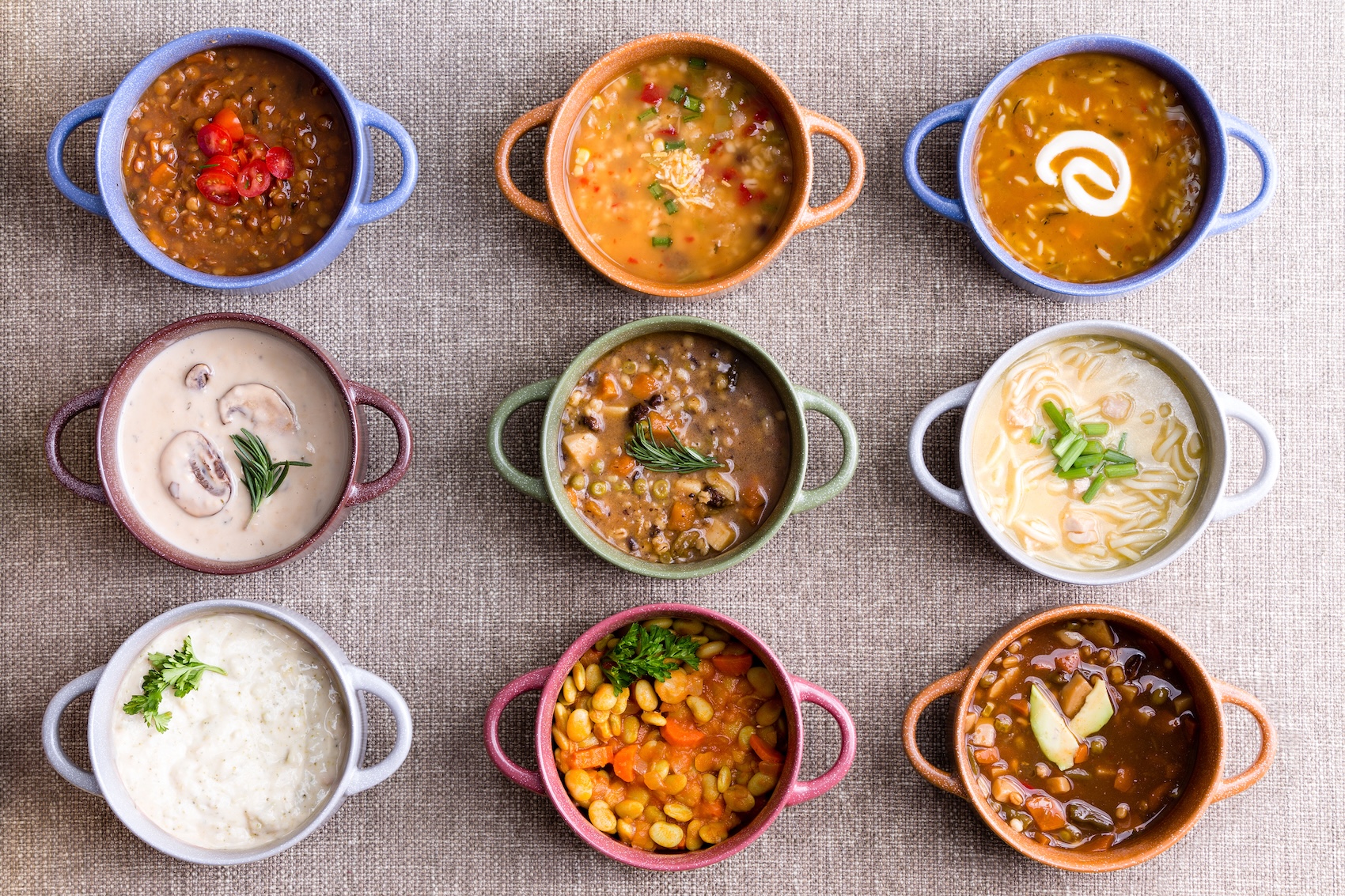

Grab your coat. Grab your scarf. Come take a walk with me. We duck into the nearest deli—the kind with a handwritten soup board and a line that moves just slowly enough to read it twice. There’s a creamy baked potato soup, pale and plush, freckled with salty bacon. Chicken and wild rice, sturdy and reassuring. Tomato, brightened with a final drizzle of garlic oil, like punctuation.
If we linger here with a pen and paper — just for fun — and begin to take these soups apart, something interesting happens. Patterns emerge. Every good soup, no matter how humble or ornate, seems to rely on at least a few of the same quiet categories: something aromatic to begin, something hearty to anchor it, something savory for depth. There’s often softness, too, ingredients that relax into the pot, and finally, a finishing touch, the small flourish that makes the whole thing feel complete. Maybe oil, herbs, cream, acid. The soup equivalent of putting on lipstick before leaving the house.
This isn’t just my fondness for lists revealing itself. Learning to recognize these elements — and how they work together — offers a simple, forgiving framework for making soup at home. It turns scraps, leftovers, and good instincts into something cohesive and deeply satisfying. Once you know what you’re looking for, the question stops being What recipe should I follow? and becomes: What do I already have?
So let’s pause our imaginary walk and actually name what we’re seeing. This is the part where soup stops feeling mysterious and starts feeling friendly. Most soups are built from a handful of elements that show up again and again, no matter the cuisine or the weather. Think of them less as rules than as roles, ingredients stepping in to do a particular job.
Aromatics are where things begin: ginger, garlic, onions and their cousins; the soft clatter of mirepoix or soffritto; a bloom of spices warming in fat.
Hearty elements give the soup its backbone—potatoes, rice, dumplings, lentils, beans, even torn bread—ingredients that make a bowl feel like a meal.
Savory components provide depth and resonance: broth or stock, meat, mushrooms, tomato paste, miso, soy.
Soft elements are the vegetables and greens that relax into the pot, yielding sweetness, color and ease. And then there are the finishing touches: cream, fresh herbs, a slick of oil, a splash of vinegar—the small, deliberate choices that make a soup feel finished rather than merely done.
Want more great food writing and recipes? Sign up for Salon’s free food newsletter, The Bite.
Of course, ingredients are flexible. A pea might be hearty or soft, depending on how you use it, and that’s part of the pleasure. Most satisfying soups combine two to four of these elements, overlapping just enough to feel generous without becoming crowded.
Take beef chili with beans: it’s aromatic with onions, garlic, and spices; hearty thanks to the beans; savory with beef, stock, and tomato paste; soft with tomatoes. A creamy roasted red pepper soup, by contrast, might rely on aromatics and stock, lean heavily into soft vegetables, and finish with a swirl of cream. Different soups, same underlying logic.
How this works in your kitchen
Back home, the exercise becomes even more useful. Before you reach for a recipe — or a grocery app — take a minute to assess what you already have. I like to keep a small notebook in the kitchen for this sort of thing, a place to jot down ideas while the kettle boils or something softens on the stove. Think of it as reverse shopping: instead of asking what you need, you’re noticing what’s already there.
Start by scanning your pantry, fridge and freezer for ingredients that fit each category. Don’t forget to pop open your leftovers containers, too. Aromatics first, then hearty elements, savory ones, soft vegetables, finishing touches. You don’t need one from every group; you’re just looking for promising overlaps. Italian sausage, sun-dried tomatoes, kale and half a portion of leftover restaurant tortellini? That’s a soup waiting to happen. The pieces already know each other.
If nothing immediately announces itself, let your aromatics—or whatever protein you have on hand—do the decision-making for you. Ginger and chickpeas might nudge you toward a warmly spiced, curry-leaning soup. Onion and bacon tend to point elsewhere: perhaps a baked potato soup, or a congee-style porridge finished with a fried egg. Again, the logic is less What should I make? and more What wants to be made from what I have?
We need your help to stay independent
Seeing soup this way also makes it easier to diagnose what’s missing.
If you’re light on fresh aromatics, you can layer that flavor in later with garlic or onion powder, or finish with chopped chives or scallions. If your pot feels thin or underpowered, it may be craving something savory — a spoonful of bouillon, a splash of soy sauce, a handful of mushrooms. Many a pot of chicken noodle soup or beef stew has been quietly improved by a generous smear of white miso stirred in at the end.
From there, the path from countertop to soup is usually a simple one. Begin with heat and fat, then add your aromatics, giving them time to soften and bloom. This is not the moment to rush; most good soups start quietly, with onions turning translucent or spices warming until they smell like themselves. Add your hearty elements next, along with enough liquid to cover them, and let the pot settle into a gentle simmer. Time does a surprising amount of work here, coaxing starches to tenderness and flavors to meet each other halfway.
Savory elements can come early or late, depending on what they are — meat and tomato paste benefit from time, while miso, soy and other delicate sources of umami are often better stirred in toward the end. Soft vegetables and greens usually follow once the soup is nearly there, wilting and yielding without losing their shape. Throughout, taste and season as you go. Salt is not a final act but an ingredient in its own right, added gradually, adjusted patiently. When everything feels cohesive, finish with whatever bright or creamy flourish you’ve set aside. Then let the soup rest for a moment.
Like most good things, it gets better once it’s had time to settle.
This is how soup becomes less of a dish and more of a method. Once you know the order of operations, once you trust time and salt to do their quiet work, almost anything can be coaxed into a satisfying bowl. Not every soup will be transcendent — but most will be good, and many will be better than you expected.
Read more
about this topic
