
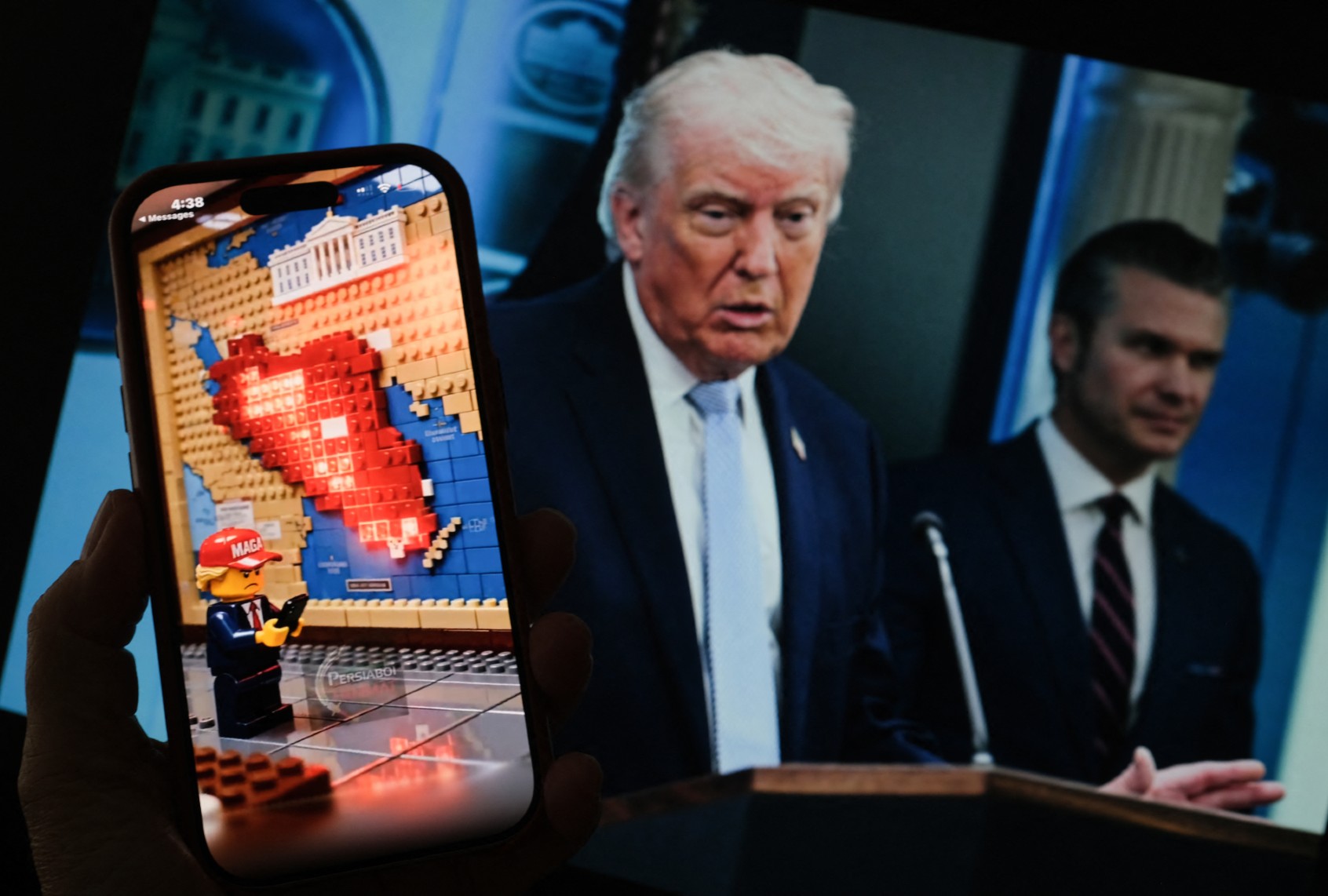

Here’s a sentence I never thought I’d type: The propaganda coming out of Iran is having a moment. Since the first days of the U.S.-Israeli attack on that nation, a group calling itself Explosive Media has been releasing AI-generated memes excoriating Donald Trump, Israeli Prime Minister Benjamin Netanyahu and the president’s closest advisers.
This in itself isn’t extraordinary, especially when one of the most prolific generators of hyperbolic, incendiary digital misinformation is the White House. In the battle for hearts and minds, the president’s social media team has, among other affronts, ripped off Studio Ghibli’s animation style to cutesify its deportation efforts. More recently, it ran afoul of Pokémon’s legions by cribbing that franchise’s signature font and imagery.
The Iranian Lego team, as they refer to themselves, is a small group that has found broad appeal by capitalizing on Millennial and Gen Z nostalgia for a toy central to their upbringings.
None of it has been as broadly embraced as the public’s reaction to Explosive Media’s Lego-style memes portraying Trump as a crybaby, Netanyahu’s puppet and worse, all set to hip-hop diss tracks.
Common refrains tout the theory that Trump attacked Iran as a distraction from the Epstein files, linking government officials to Satan worship, and accusing them of abusing women, children and people of color. One places Iran on the side of Native Americans, survivors of the Vietnam War and the bombings of Hiroshima and Nagasaki, Malcolm X, Jeffrey Epstein’s victims and pro-Palestinian activist Rachel Corrie.
A very special episode hammers Defense Secretary Pete Hegseth, calling him a tattoo-covered clown with “that cafe ink on your arm. Think you a crusader? Nah, just a drunk infidel in a fake uniform” before riffing on Hegseth’s reported history of alcohol abuse and the details of a sexual assault claim made in 2017. (Hegseth was never charged with a crime and paid his accuser $50,000 as part of a confidentiality agreement, according to documents obtained by CNN.)
Ghibli and Pokémon iconography may be broadly recognizable, but Lego’s appeal, represented by its zillions of plastic blocks and many movies and TV series, transcends nations. It is one of the planet’s top-selling toy brands, and the toy’s singular pixelated appearance is instantly recognizable on any screen. A representative from Explosive Media was correct when he told the BBC that the Lego graphical style is “a world language.”
So is hip-hop, which they use as a soundtrack to each digitally rendered block attack. Drawing on a musical form created by an oppressed people adds a Western bite to their braggadocio and claims to stand for all the people America has exploited. A ditty anchoring one of Explosive Media’s most popular videos, “L.O.S.E.R.,” tops a Spotify playlist that it created.
Artists seeking affordable, sustainable forms of art media find that with Legos and their imitators. Branded sets may be expensive, but bulk lots of mixed pieces can be purchased by the pound for a few bucks. This makes Lego a kitschy means of egalitarian expression, effective for conveying all manner of messaging and symbolism.
During The Strokes’ recent Coachella performance, lead singer Julian Casablancas told the audience, “I was tempted to come out tonight with a laptop and show you guys some of those Iran Lego videos. You guys see those? Very good. More facts than your local news.” But he didn’t show any, blaming YouTube for taking them down. “Land of the free, am I right?“ (Currently, Explosive’s content still posts on those platforms as well as Facebook, Telegram, TikTok and X, along with an assortment of imitators.)
Knocking off the Lego animation style is a cleverly layered strategy. On its shiny plastic face, the Iran War animations get their point across with adolescent crudeness, showing Trump, Hegseth, Netanyahu and other politicians as minifigures engaging in vulgar acts or throwing childish tantrums. The accusations are serious and the delivery is earnest yet somehow silly. There’s subtextual significance at play here, too, intentional or otherwise. In case you’ve forgotten the events of 2014’s “The Lego Movie,” it’s about a group of heroes resisting the conformist authoritarianism of a ridiculous figure called President Business, also known as the despotic Lord Business. The Iranian Lego team, as they also refer to themselves, is a small group that has found broad appeal by capitalizing on Millennial and Gen Z nostalgia for a toy central to their upbringings.
Lego’s effectiveness as a visual lingua franca must be both a point of pride for The Lego Group and, at times, its bane. Pieces and minifigures represent endless possibilities. Over the years, that versatility has challenged the company to live up to that promise of creative freedom.
Last year, the Seattle Art Museum hosted an expansive exhibition of Chinese artist Ai Weiwei’s work that was worth several visits. During each new trip, I was newly struck by the way millions of Legos can grant a sense of physical heft to heavy ideas. Pieces like “The Cover Page of The Mueller Report, Submitted to Attorney General William Barr by Robert Mueller on March 22, 2019” are exactly as advertised, re-created in puny squares and rectangles on a scale that reaches from floor to ceiling.
Other immense sculptures of pages show redacted sections of the document in massive black bars, magnifying the hostility of government censorship as massive obstacles constructed by many small players and devices. The actual Mueller Report pages can fit in one person’s hands. The conclusions that Special Counsel Robert Mueller reached within them differ from Barr’s questionable interpretation and summary, but Barr’s version became more or less the final word in the media. Thus, our disenchantment with the justice system takes up the most memory space. Like Ai’s installation, the Mueller Report is a colossal monument to inaction.
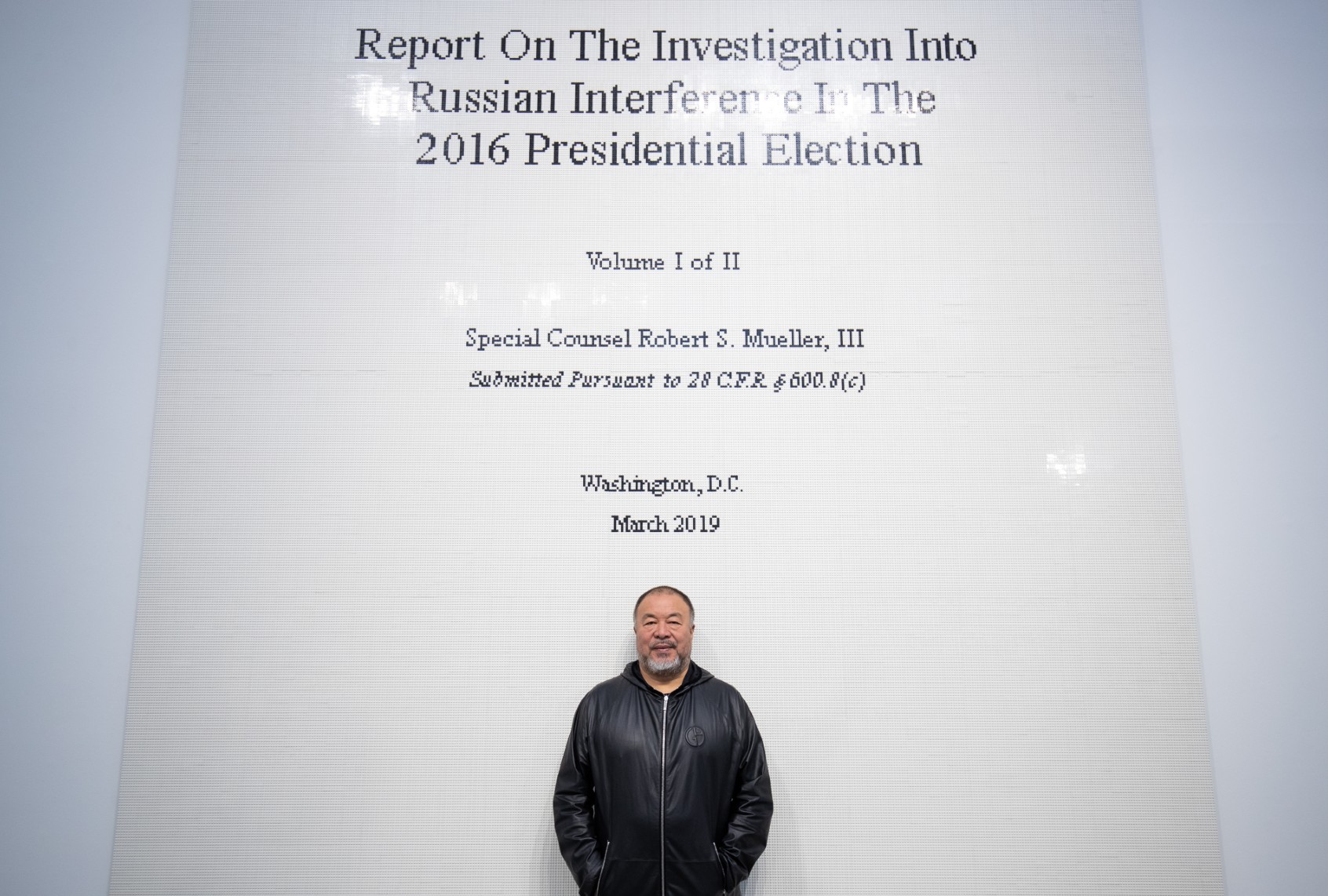
( Aaron Chown/PA Images via Getty Images) Chinese artist Ai Weiwei stands in front of “The Cover Page of The Mueller Report, Submitted to Attorney General William Barr by Robert Mueller on March 22, 2019,” made from Legos
Meanwhile, those Lego-style memes almost made a guest appearance on one of music’s biggest stages. Instead, The Strokes ended their set by performing their 2016 song “Oblivius” as a video montage featuring world leaders either deposed or assassinated in coups allegedly or provably orchestrated by the CIA, which ran on giant LED screens behind them.
Artists seeking affordable, sustainable forms of art media find that with Legos and their imitators. Branded sets may be expensive, but bulk lots of mixed pieces can be purchased by the pound for a few bucks. This makes Lego a kitschy means of egalitarian expression, effective for conveying all manner of messaging and symbolism.
Ghanaian-Canadian artist Ekow Nimako’s extravagant Afro-futuristic Lego sculptures pay homage to the African continent’s varied histories and cultures, using a Danish-created product to center Black people and stories. One sculpture transforms the European hero Robin Hood into an African bandit queen who raided slave traders and freed their captives.
Another massive piece, “Kumbi Saleh 3020 CE,” resurrects the medieval city of Kumbi Saleh, the capital of the ancient Ghanaian empire, as a gleaming, futuristic hub. In these examples, Legos become what Nimako described to CNN as a means of “speculative reclamation,” celebrating cultural identity and hope.
We need your help to stay independent.
Ai Weiwei, probably the most famous Lego artist at the moment, prefers them to paint. The Lego Group hasn’t always supported his work. In 2015, the company refused to fulfill Ai’s bulk order of Lego bricks, citing that their product’s usage “cannot contain any political statements.” In the previous year, his “Trace” exhibition at San Francisco’s Alcatraz featured portraits of people he considers activists, prisoners of conscience, or advocates of free speech, created with nearly a million toy bricks.
Years before that, the Lego Group was caught off guard by Polish artist Zbigniew Libera’s 1996 installation, “LEGO Concentration Camp.” The company donated bricks and minifigures to Libera and was shocked at how closely the artist recreated its branded packaging, even featuring the company’s official logo. Libera also claimed the work was sponsored by Lego.
When Lego denied Ai, he crowdsourced pieces on social media. “As a powerful corporation, Lego is an influential cultural and political actor in the globalized economy with questionable values,” he said in an Instagram post. “Lego’s refusal to sell its product to the artist is an act of censorship and discrimination.” The company reversed its policy in 2016. Years later, Ai had nothing but praise for Legos in a profile published in The Independent. “I think Lego is no different from Rembrandt’s paint or Van Gogh’s paint,” he said in 2021. “If they were alive today, they would love to play Legos.”
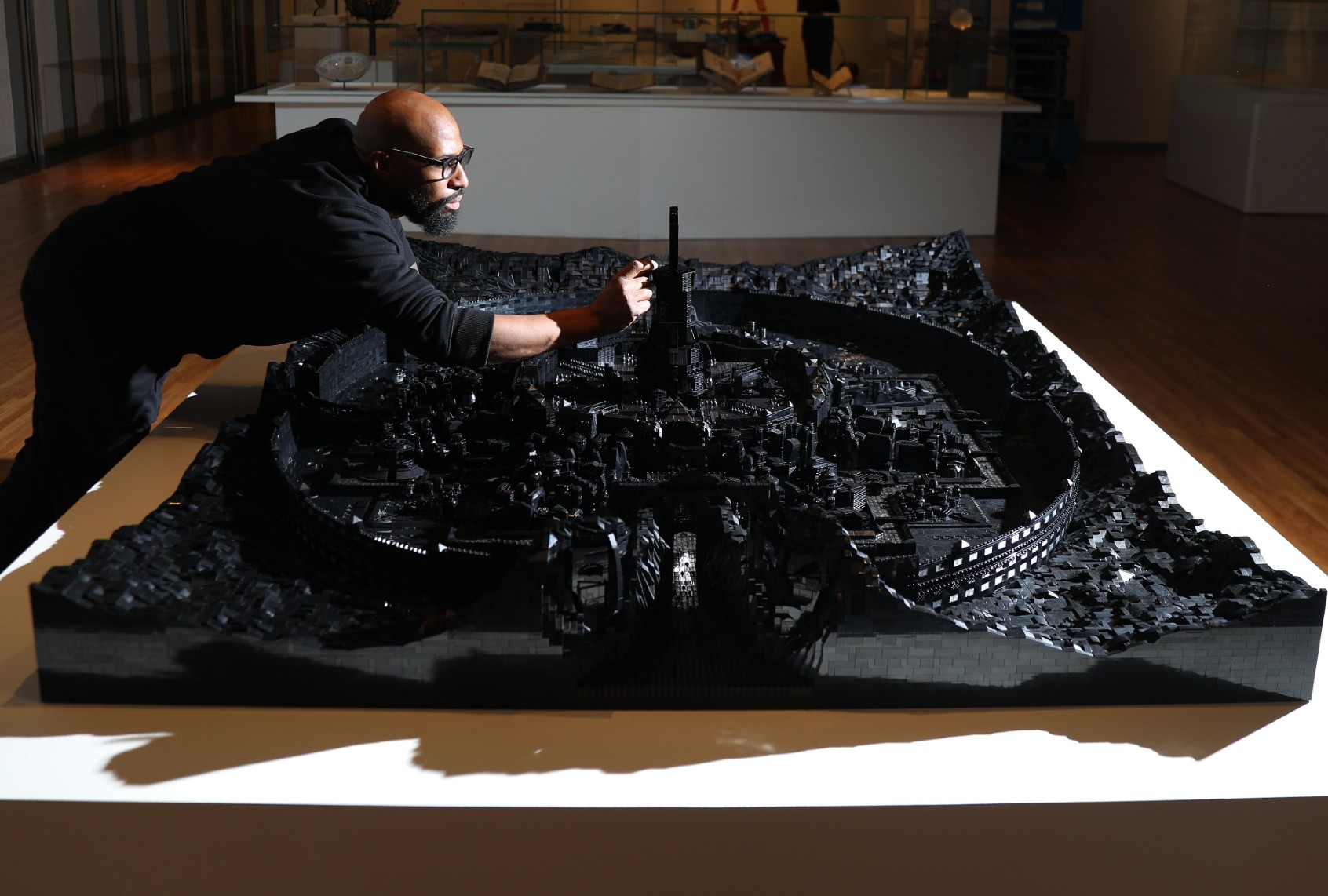
(Rene Johnston/Toronto Star via Getty Images) Ghanaian-Canadian artist Ekow Nimako creates a Lego sculpture at the Aga Khan Museum titled “Building Black: Civilizations.”
What creative visionaries achieve with Legos is very different from Explosive Media’s slopaganda cartoons, to be clear. The memes imitate a form we associate with Lego without using actual bricks or the company’s logo. Then, consider the philosophical gap: For instance, Ai is a dissident whose criticism of the Chinese government led to his imprisonment for 81 days in 2011, without any formal charges brought against him. Afterward, he lived under heavy surveillance and was banned from leaving China until 2015, when he relocated to Berlin.
In contrast, although Explosive Media says that it operates independently from the Iranian government, a representative recently told the BBC that the regime is a customer.
While the memes portray the Iranian military and government leadership as spunky saviors, the country’s leadership was condemned for its violent suppression of nationwide anti-government protests that erupted late last year. Early February statistics provided to the Associated Press by Human Rights Activists News Agency estimate that more than 7,000 people were killed, including 214 government forces. Other agencies place the death toll in the tens of thousands. The Iranian government’s official count as of Jan. 21 placed the death toll at 3,117 people, although the AP clarified that it has a history of undercounting or not reporting fatalities in past uprisings.
Want more from culture than just the latest trend? The Swell highlights art made to last.
Sign up here
Iran is no bastion of free expression, in other words, which anyone bopping to those raps about enacting revenge on “the Baal-worshipping Epstein crew” must remember. Still, the fact that they’re being cheered in the West, including among Americans, reflects the massive unpopularity of Trump and his war.
In 2014, my colleague Andrew O’Hehir said this about “The Lego Movie”: “If the LEGO universe’s version of Lord Business can be overthrown, the real one continues to rule from on high unmolested, and the movie’s critique of conformity becomes its opposite, a benevolent reassurance that the dominant order can tolerate a bit of disorder at the micro-LEGO level.”
The Iran war memes are, in their way, a real-world version of that small-scale disorder — entertaining taunts directed toward a superpower whose military overreach has thus far been thwarted by an underestimated nation. They do not contain more facts than your typical mainstream newscast, contrary to what Casablancas claims. Many are dotted with conspiracist folderol, antisemitic tropes and flat-out disinformation. But they cater to an increasingly common desire to see Trump and his cronies humiliated out of power, even as they cast a repressive government as the good guys. Like the movies tell us, in the land of Lego — and its copycats — everything is awesome. That’s an attractive message in a time that, for most people, is anything but.
Read more
about Lego
