
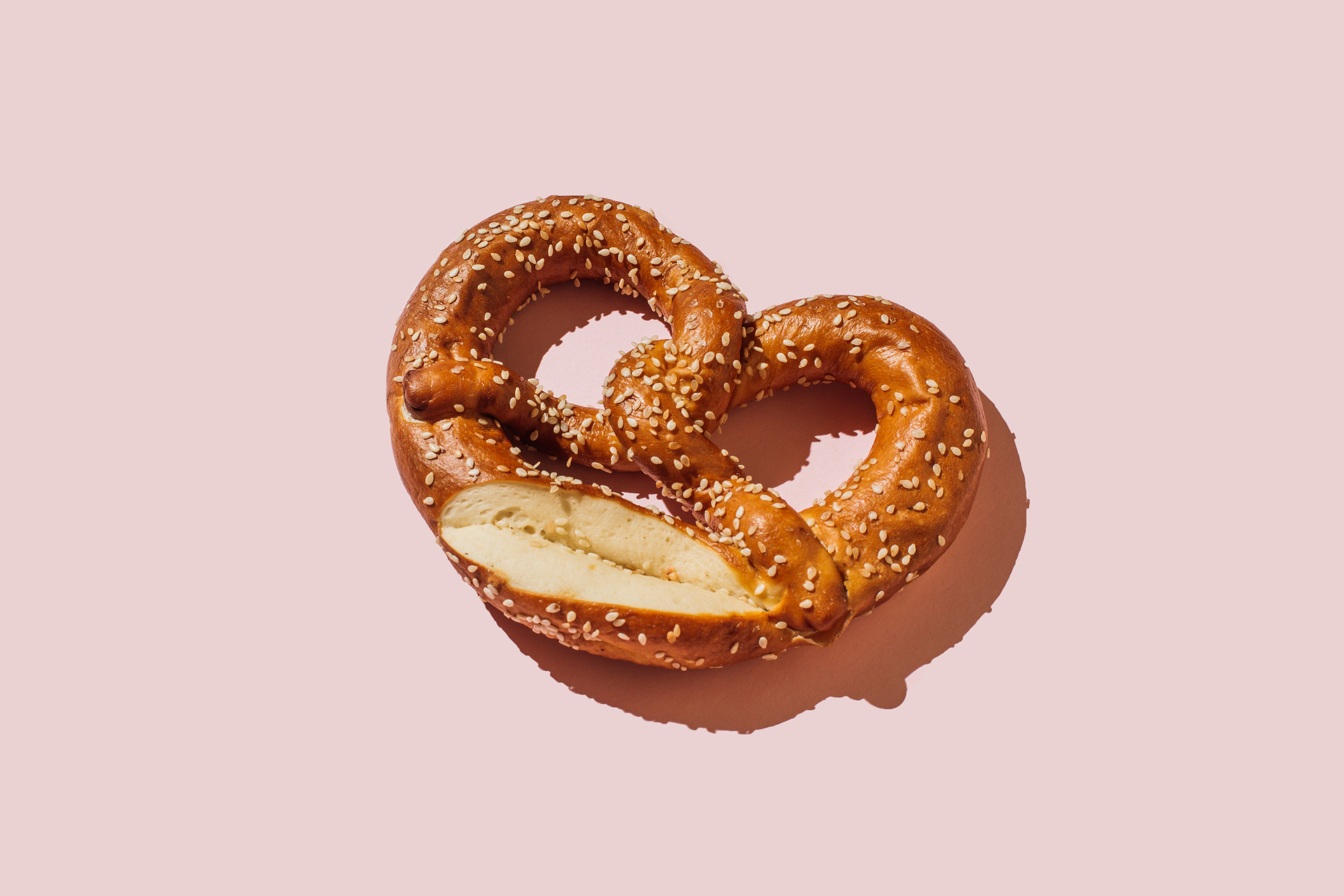

Everyone has that one food item, be it an elaborate meal or a humble snack, that unlocks even the deepest of core memories. For me, it’s the fresh-baked cinnamon sugar pretzel from Auntie Anne’s. Growing up, it was a must-have treat after long trips with my mom to the local shopping mall. Just the thought of those pretzels is enough to transport me back. There’s the chewiness of the dough, the warm aroma of melted butter, cinnamon and sugar united in holy matrimony. Each bite is guaranteed to be a delicious medley of both sweet and spice, never just plain browned crust.
Over the past decade, I’ve fallen victim to the online shopping epidemic, meaning I haven’t stepped foot inside a mall and enjoyed an Auntie Anne’s pretzel in years. That childhood craving has grown rather strong as of late, especially in anticipation of National Pretzel Day, officially on April 26th.
Pretzels, revered for their simplicity, have made a name for themselves as one of America’s most beloved snacks. As of 2020, 181 million Americans consumed pretzels, with the average person indulging in an estimated two pounds per year, according to data from the US Statista Research Department. But a quick deep-dive into the baked good’s rich history suggests that it was first created overseas — and deeply embedded in religious tradition.
In the seventh century, the Catholic Church enforced strict Lenten rules, prohibiting the consumption of all meat, dairy, and eggs throughout the fasting season. Soft-baked pretzels were thus seen as the ideal food to eat, since they only called for four basic ingredients: flour, water, salt and yeast.
“Seen as a symbol of good luck, prosperity and spiritual fulfillment, pretzels were also commonly distributed to the poor, as a way of providing them with both spiritual and literal sustenance,” writes Sarah Pruitt for History.com.
Other origin stories claim that pretzels were called “bracchiatus,” the Latin term for “branches” or “arm,” which was derived by the Germans to create “bretzel,” ultimately inspiring the name we use today. Some accounts state that pretzels were a sort of reward, handed out by monks to their young postulants for learning and correctly reciting their prayers. Referred to as “pretiola,” meaning “little rewards” in Latin, their twists were meant to look like arms crossed in prayer, with the palms of each hand touching the opposite shoulder. The three holes also resembled the Holy Trinity, representing the Father, Son and Holy Spirit.
By the Middle Ages, pretzels rose in popularity across Europe, so much so that it was documented in religious manuscripts. The first known depiction is believed to be in the Hortus Deliciarum (“Garden of Delights”), the first encyclopedia written by a woman — namely Herrad of Landsberg, a 12th-century nun and abbess of Hohenburg Abbey in Alsace, France. The humble pretzel can be spotted, rather subtly, in a painting of a luxurious banquet.
Pretzel’s lore intensified amid the Siege of Vienna in 1529, when the Ottoman Empire attempted to capture the city by digging extensive lines of trenches. Legend has it that monks baking pretzels in a basement bakery heard noises below them and alerted the rest of the city of an impending invasion. Their impeccable hearing and quick thinking were rewarded by the Austrian emperor, who bestowed the pretzel bakers with their own coat of arms featuring two lions holding a massive pretzel.
“As charming as this story is, it is most likely apocryphal,” writes food writer and vegan activist Colleen Patrick-Goudreau on her Substack. “But even if it’s more legend than fact, it speaks to the long-standing connection between pretzels and Vienna, where they remain a beloved part of the city’s culinary and cultural identity.”
Fast-forward to the 17th century, pretzels became commonplace in Germany, where necklaces adorned with the baked goods were worn by children on New Year’s Day to usher in good luck. German immigrants, who came to the States and settled in Pennsylvania well into the 18th century, are credited with introducing pretzels — and pretzel culture — to America. Alongside soft pretzels, hard pretzels became a popular yet cheap bar snack thanks to Julius Sturgis, who founded the first commercial pretzel bakery in the town of Lititz, located in Lancaster County.
Want more great food writing and recipes? Sign up for Salon’s free food newsletter, The Bite.
Today, pretzels — soft, hard, savory and sweet — remain a staple snack nationwide and for various occasions. Packaged, mini hard pretzels are often a go-to treat in school lunches. Soft pretzels are also a classic snack at shopping malls, amusement parks and sports stadiums.
In Lancaster County, there’s a lot of pride tied to fresh pretzels, says Misty Skolnick, co-owner of Uncle Jerry’s Pretzels, a family-owned business best known for their handmade pretzels. Uncle Jerry’s specializes in sourdough pretzels. Their best-selling offering is an extra dark pretzel that’s slow-baked for a blackened finish.
“When I think of Pennsylvania pretzel culture, I particularly think of the all-natural, handmade sourdough pretzel,” Skolnick states. “I think of the real classic, prayer-shaped pretzel.”
“People just really take pride in being the home of this great pretzel,” she adds. “It’s natural. It’s handmade. And it’s local and community-based.”
Read more
about pretzels:
