
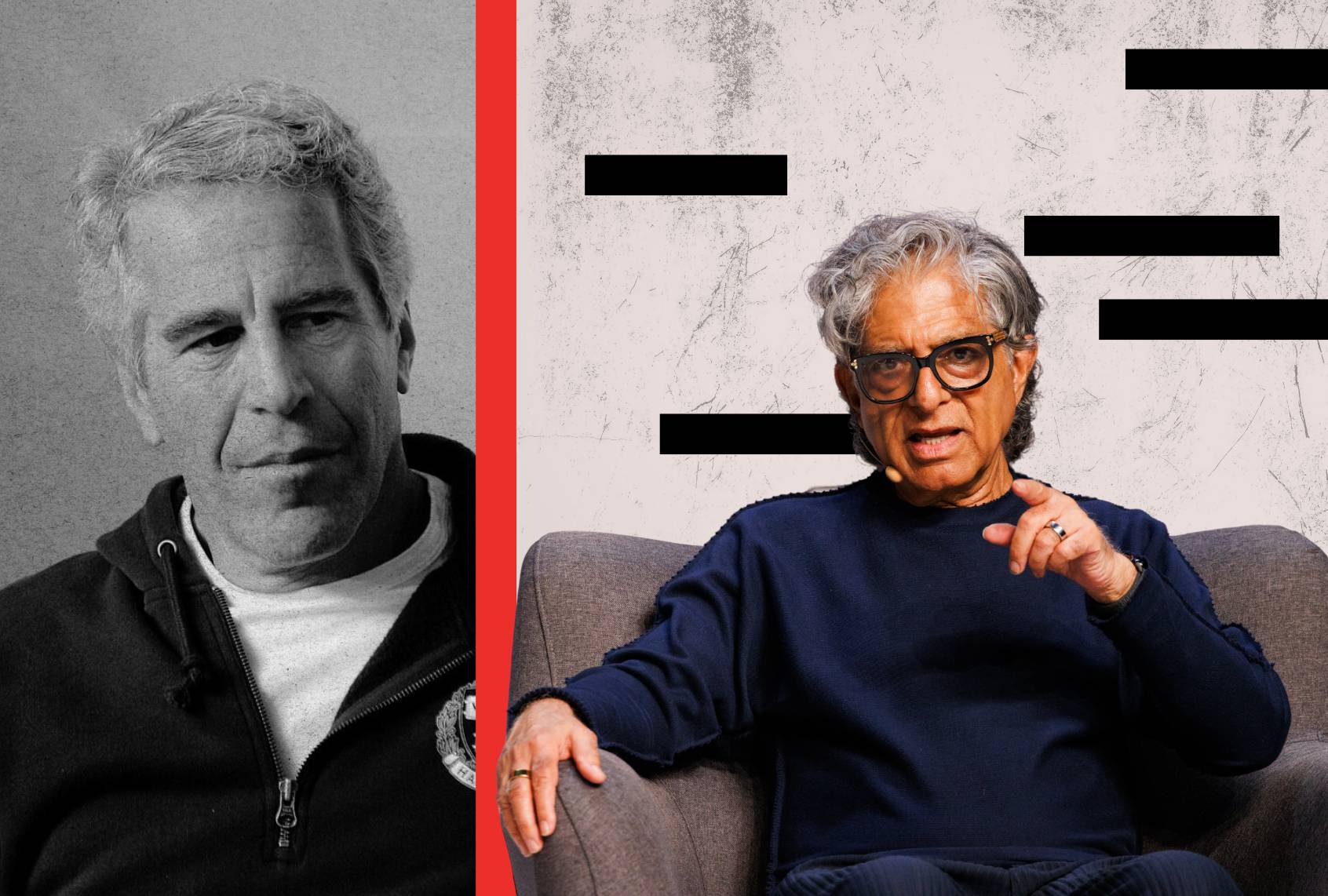

In July 2016, best-selling author and wellness guru Deepak Chopra contacted Jeffrey Epstein, the wealthy financier and convicted sex offender, to thank him for his hospitality. By email, Chopra wrote that he was glad that philanthropist Barnaby Marsh had introduced them in person. Chopra added that he was “grateful” for what he saw as the beginning of a friendship.
Within a few weeks, this new friendship deepened. They exchanged gossipy emails about Epstein’s friendship with Donald Trump and Marla Maples, Trump’s second wife. Epstein recounted a story about losing a $10,000 bet to Trump and about a friend of Maples who was rumored to have used high-heeled shoes as sex toys.
Chopra responded, “Nothing human is foreign to me,” attributing that to a “Roman poet whose name I forget.” (Paraphrased slightly, the quotation is actually from the Roman playwright Terence.)
“Anything we share is between us,” Chopra wrote to Epstein later that same July. “I share nothing with anyone but trust you.”
Amid the 3.5 million Epstein files so far released by the Department of Justice, Chopra’s name appears more than 3,300 times. (Since duplicate messages frequently recur in different places in the Epstein files, the actual number of messages between Chopra and Epstein is somewhat less than that.) What the numerous emails and texts between the two men suggest is an intimate and affectionate relationship that went beyond a business or financial connection.
While they came from very different backgrounds and professional trajectories — Epstein from the world of high finance and Chopra from New Age philosophy, spirituality and medicine — the two seemed to enjoy discussing the nature of consciousness and other abstruse topics. They shared an unexplained inside joke, referring multiple times in their correspondence to the “tiger.” Their exchanges suggest that Chopra visited Epstein’s homes in New York and Palm Beach — locations where some of Epstein’s accused or apparent criminal acts took place. There is no evidence that Chopra was aware of Epstein’s criminal abuses. But on at least five occasions, as documented in the FBI files, Chopra mentioned Epstein’s “girls,” an apparent reference to young women who frequently accompanied Epstein. How Chopra perceived or understood these women’s relationship to Epstein is not clear.
Almost everyone reading this has already heard of Chopra, who is one of the biggest names in the New Age movement and the wellness space. Some might argue he is America’s top well-being expert. The 79-year-old physician and bestselling author has published more than 90 books. Frequently described as a guru, Chopra has served as a spiritual adviser to some of the biggest celebrities in the world, including Elizabeth Taylor and Michael Jackson. Chopra taught Jackson meditation at Neverland, the late singer’s California home, where Jackson was alleged to have sexually abused at least two young boys. There is no evidence that Chopra observed any impropriety during his friendship with Jackson.
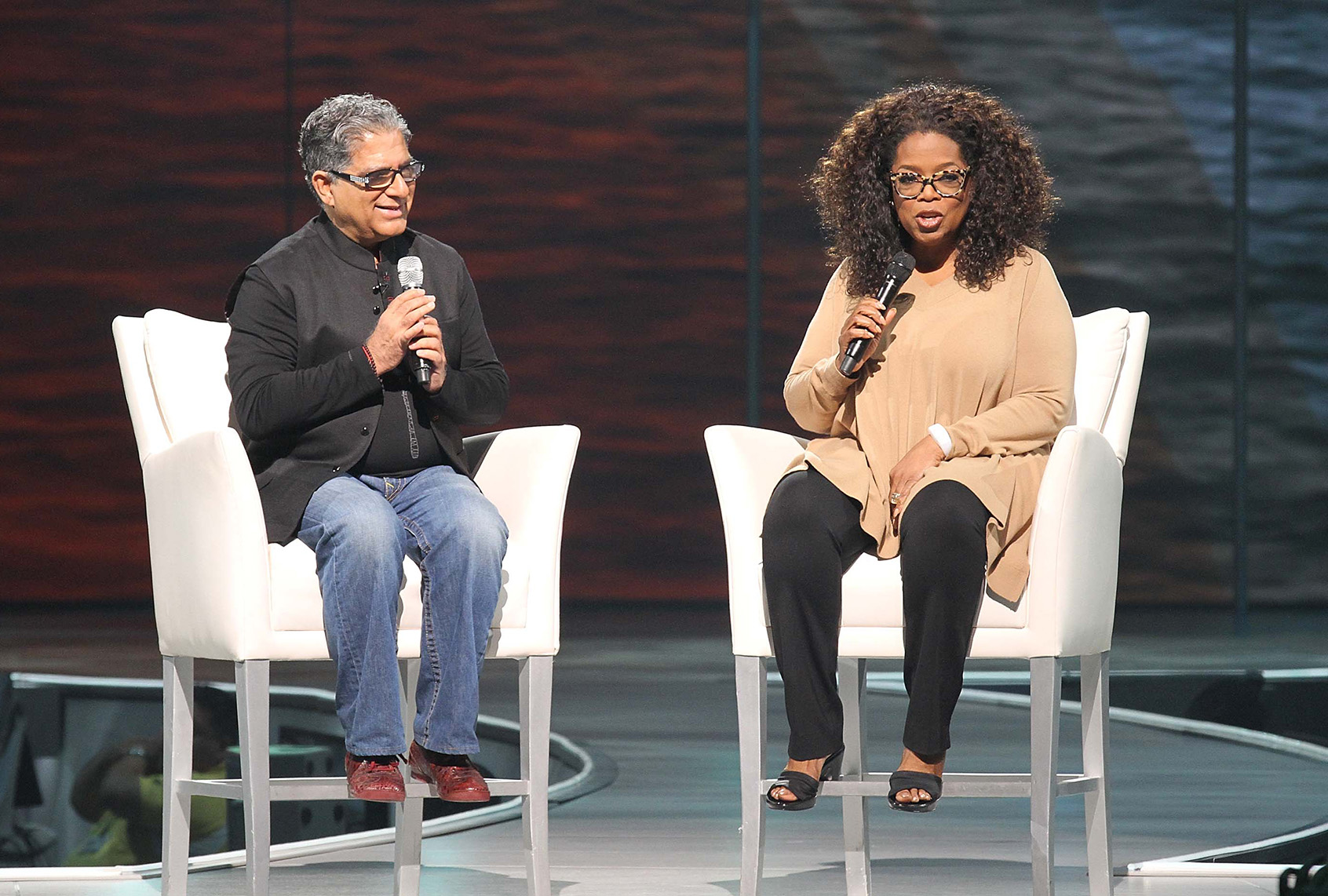
(Photo by Aaron Davidson/WireImage) Deepak Chopra and Oprah Winfrey onstage at Winfrey’s “The Life You Want Weekend” in Miami, Oct. 25, 2014.
Oprah Winfrey, one of Chopra’s earliest champions and business partners, gave him a huge boost with TV appearances in the early 1990s. In 2021, Chopra and Winfrey launched a meditation course together. Chopra’s website says he is on a mission to create a “more balanced, peaceful, joyful and healthier world.” His teachings, Chopra has said, aim to guide people to embrace their strengths and potential for both personal and societal growth.
On at least five occasions in messages documented in the FBI files, Chopra mentioned Epstein’s “girls.” How Chopra perceived or understood these women’s relationship to Epstein is not clear.
There is nothing in the Epstein files to suggest that Chopra was involved in Epstein’s sex crimes, or knew about them. But for many observers, the embarrassing details of their friendship raise larger questions that have less to do with Chopra than with the nature of the New Age wellness industry as a whole. To the extent that New Age spirituality is built on liberating the self from all constraints — as well as spreading universal love and positive vibrations — critics suggest, it may have helped to create an environment where abusers like Epstein can thrive.
* * *
A few months after their friendship began, in a November 2016 email included in the FBI files, Epstein sent Chopra a link to a Daily Mail article about a “troubled woman” who claimed that she had been assaulted by Donald Trump when she was 13 years old, at a party hosted by Epstein. (The article reported that those allegations had not been substantiated, and that the woman’s lawsuit against Trump was dismissed.)
“Did she also drop civil case against you?” Chopra asked. Epstein responded with one word: “yup.” Chopra said: “good.”
Over the following year, the two continued to exchange greetings, ideas and invitations. In February 2017, Chopra invited Epstein by email to attend a course the following month called “Journey Into Healing.” Chopra added that he would also be leading a weeklong retreat that June at a Canadian resort — he wrote “Bamf,” presumably meaning Banff, Alberta — and said, “The girls might enjoy it.”
In another email a few days after that one, Chopra invited Epstein to “Come to Israel with us” to “Relax and have fun with interesting people.” He suggested that Epstein might “use a fake name” and “Bring your girls.”
In April, Chopra emailed Epstein while on his way from Los Angeles to Saudi Arabia, describing a female friend as “v sweet – like your girls,” adding an emoji with hearts for eyes. In November 2017, he extended another invitation to Epstein and his “girls,” adding a “prayer hands” emoji, suggesting they attend a Chopra workshop in Switzerland.
In a July 2018 text message exchange, Chopra suggested that Epstein might enjoy meeting his son-in-law, a venture capitalist, but added in parentheses, “can’t talk about girls.”
In early February 2026, after the large-scale release of most of the FBI’s material on Epstein, Chopra released a statement on X denying involvement in “any criminal or exploitative conduct” during his friendship with Epstein. He described his contact with the convicted sex trafficker as “limited” and “unrelated to any abusive activity.” He did not directly apologize for anything he did or said, but wrote, “Some past email exchanges have surfaced that reflect poor judgment in tone. I regret that and understand how they read today, given what was publicly known at the time.”
In a July 2018 text message exchange, Chopra suggested that Epstein might enjoy meeting his son-in-law, a venture capitalist, but added in parentheses, “can’t talk about girls.”
By the time Chopra and Epstein first met, Epstein was a registered sex offender who had been convicted in 2008 on two counts of soliciting a minor for prostitution and had served a brief sentence in Palm Beach County jail. The full extent of Epstein’s apparent sex trafficking network did not become clear until his indictment on a broader range of criminal charges in 2019, and his subsequent death in a Manhattan jail cell.
Chopra said in his February statement that he was now focused on “supporting accountability, prevention and efforts that protect and support survivors.” It wasn’t the first time he had spoken out about his relationship with Epstein. After details emerged about Epstein’s calendar in 2019, which recorded at least a dozen meetings between the two in 2016, 2017 and 2019, Chopra told CBS News in an October 2025 statement that their appointments had mostly concerned Epstein’s sleep problems.
“After meeting, he shared he suffered from insomnia and expressed interest in learning meditation, which I taught him. Our meetings, focused solely on practicing meditation, lasted about 30 minutes each,” Chopra said in the statement.
Salon has tried to contact Chopra several times through the public relations firm that represents him, but has not received a response.
Very little of the communication between Chopra and Epstein, based on the evidence in the released FBI files, was about sleep. In November 2016, Chopra told Epstein by email that “sleep is consciousness in its default mode.” That appears to be the only time the subject was directly mentioned in the publicly available email and text exchanges between the two, although the FBI files provide no information about what they may have discussed in person.
In their documented messages, Chopra and Epstein were far more likely to discuss the nature of reality and consciousness, topics Chopra has written about for many years.
We need your help to stay independent.
In one 2016 email, Chopra shared an article he had written arguing that everyday reality is a “human construct.” In another email the following year, Chopra told Epstein that “reality is an illusion,” adding: “Whenever time permits I will do an experiment with you to show you why.” Epstein responded that he was looking forward to it. The two men seemed to share the conclusion that “reality” did not exist.
In March 2017, Epstein wrote to Chopra, “find me a “cute israeli blonde. Matter over mind.” In the same exchange, Chopra took the conversation to a different level, writing: “Atoms galaxies mind body are hallucinations that imprison humanity. We have to get rid of 2000 years of human conditioning.”
Later that same day, Epstein responded, “I would argue that there is no awareness or consciousness there is only chemistry.”
A few days after that, Chopra wrote to Epstein again, telling him that biological cells and the entire physical universe were “human constructs,” but that “cute girls are aware when they make noises.”
Epstein responded: “So when the girl says oh my god?”
“Yes. That’s divine transcendence,” Chopra said.
Epstein answered, “oh, I thought she was just referring to me.”
* * *
For some observers of the New Age and wellness industries, the controversy around Chopra’s association with Epstein doesn’t simply erode Chopra’s credibility as a guru, but also points toward deeper issues.
The unfortunate references to “cute girls,” and the context of Chopra’s apparent friendship with a registered sex offender, “undermine his self-presentation as a spiritual authority,” Stephanie Alice Baker, a sociology professor at City St George’s-University of London who studies wellness, misinformation and conspiracies, told Salon.
Chopra’s philosophical claims that there is no objective reality and that we have to “get rid” of thousands of years of “human conditioning,” suggested Matthew Remski, co-author of “Conspirituality: How New Age Conspiracy Theories Became a Health Threat,” may have offered Epstein a “spiritual framework” for his illicit activities. (There is no evidence that Chopra had any such intention.)
For Epstein, “his world [was] of his own making, probably more than anybody else in the last 100 years,” Remski said. Epstein was “simply able to decide what he wanted to do in any given moment, and then it happened. He organized his world like an old-timey tantric deity, where he could just think of something and then it appears. Somebody’s showing up to massage him and do sex work. He’s got amazing food coming in, and then there’s a plane taking him to a f**king island.”
Chopra’s claims that there is no objective reality and that we have to “get rid” of thousands of years of “human conditioning,” suggested Matthew Remski, may have offered Epstein a “spiritual framework” for his illicit activities.
That kind of behavior, Remski and others interviewed for this article agreed, involves what has been called “spiritual bypassing,” a term originally defined by therapist John Welwood as a “tendency to use spiritual ideas and practices to sidestep or avoid facing unresolved emotional issues, psychological wounds, and unfinished developmental tasks.” Or in simpler terms, to dodge accountability. Remski said he sees connections between the kind of New Age spirituality pioneered by Chopra and other developments in society, economics and politics that have enabled a hyper-individualist culture.
Craig Cashwell, a professor at Clemson University who has researched the impacts of spiritual bypassing, said that while he believes religion and spirituality can enhance people’s lives, it’s important “that we acknowledge that there is a shadow side of both, which most often comes in the forms of religious abuse, trauma and spiritual bypass.”
Cashwell added that it was “not possible to argue that spiritual bypass was involved” in Chopra’s case or any other specific situation without more information, but said, “It is certainly true that sacred teachings can be twisted and used to justify actions incongruent with the actual teaching.”
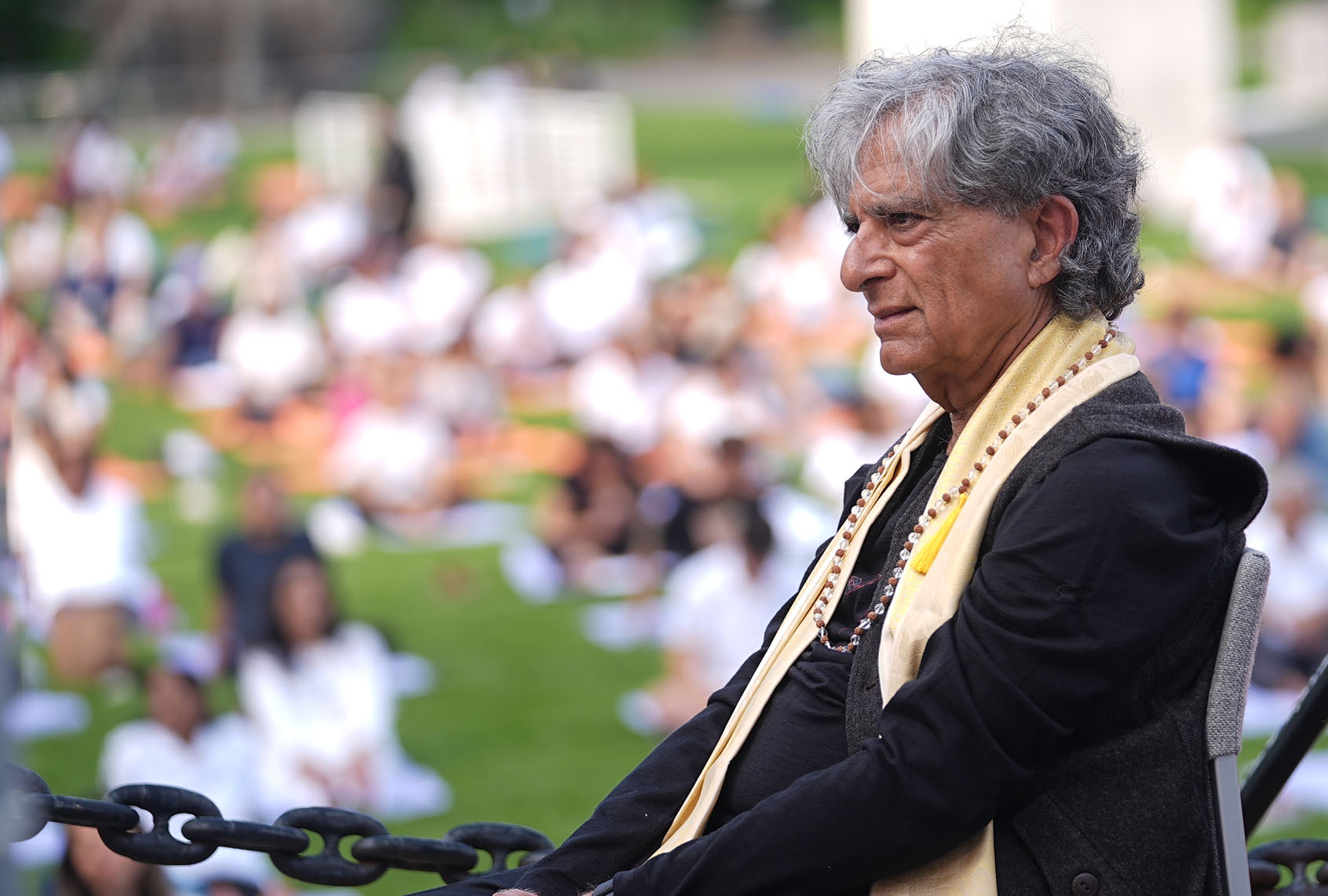
(Selcuk Acar/Anadolu via Getty Images) Deepak Chopra attends June 21 International Day of Yoga event at the United Nations’ North Lawn in New York.
Baker agreed that it was unclear whether Epstein had used Chopra’s teachings to justify his abuses, but cited “a long history of guru figures abusing their influence,” pointing to allegations of sexual misconduct against numerous yoga gurus, including Bikram Choudhury, John Friend and Gregorian Bivolaru.
Ronald Purser, a professor of management at San Francisco State University and the author of “McMindfulness: How Mindfulness Became the New Capitalist Spirituality,” sees the controversy around Chopra as more than another moment of high-profile hypocrisy. It’s a deeper reflection, he suggested, of why and how these scandals keep happening within the “contemporary guru economy,” which has three elements that don’t mix well together: moral authority, celebrity culture and the marketplace.
“As soon as someone becomes a brand, the incentives become relentless: preserve the image/persona, the audience, the flow of money and, last but not least, preserve the aura,” he said. “This is not unique to Chopra; it really seems to be a structural characteristic of the entire spiritual-wellness industry.”
“Market-driven spirituality,” Purser said, favors “charisma and certitude.” Conversely, it “punishes nuance, and often lacks real accountability.”
“Market-driven spirituality,” Ronald Purser said, favors “charisma and certitude.” Conversely, it “punishes nuance, and often lacks real accountability.”
So far, the revelations about Chopra’s friendship with Epstein have had limited effects in the real world. In a statement to Salon, the University of California San Diego said it would end Chopra’s appointment as an unpaid clinical professor at its medical school in June, calling any form of association with Epstein “regrettable.” Chopra does not “have any active responsibilities at UC San Diego nor will he have any active responsibilities at any point between now and the conclusion of his appointment term,” the statement said.
Aware House Books, a New Age-oriented bookstore in Regina, Saskatchewan, posted a video of an employee ripping up Chopra’s books, and announced it would no longer order or carry them.
Some former Chopra fans have also spoken out. On Substack, writer Scott Mills took a deep dive into the public details of the Chopra-Epstein relationship, writing at length about his sense of “heartbreak.”
Bestselling author Lissa Rankin wrote an extended Facebook post about her disappointment that “wellness gurus” such as Chopra and Peter Attia (another prominent New Age physician) appeared in the Epstein files. Rankin said she would no longer “reference” either man’s work. “When physicians prioritize access to power over ethical judgment, they often break the foundational covenant of medicine,” she wrote. “We need a basic standard for physicians and leaders built on the principle that scientific authority and ethical integrity cannot be separated.”
Stephen Dinan, CEO of The Shift Network, an online New Age network, wrote on Substack that the “global consciousness movement” was in the midst of a “global reckoning” now that one of its “most visible leaders, Deepak Chopra,” has been “deeply implicated.”
Start your day with essential news from Salon.
Sign up for our free morning newsletter, Crash Course.
For nearly a decade, Be Scofield, a reporter on cult movements and the author of “Hunting Lucifer: One Reporter’s Search for Cults and Demons,” has followed what she considers the New Age movement’s dark side. She said she found the response to Chopra’s association with Epstein noteworthy, given the industry’s tendency to overlook or ignore its own internal scandals.
“You can’t really compare how things are handled in the spiritual world with the normal world, because there are so many scandals within this field and most of the teachers and the institutions remain silent,” Scofield said. “So for the spiritual field, what happened is very significant.”
Still many who follow the industry expect little change in an industry they describe as largely driven by profit, despite its claims of a greater concern for the public’s well-being.
“There’s no more accountability in the wellness and yoga industry than there is in any other form of capitalism,” Remski said. “It might actually be worse because there’s nothing institutionalized about any of this.”
Purser said he sees “scandal” not as “an accident or a bug” but rather a “feature” of the New Age economy. It’s “a risk inherent in the guru-celebrity model,” he concluded.
Read more
about the Epstein files’ fallout
