
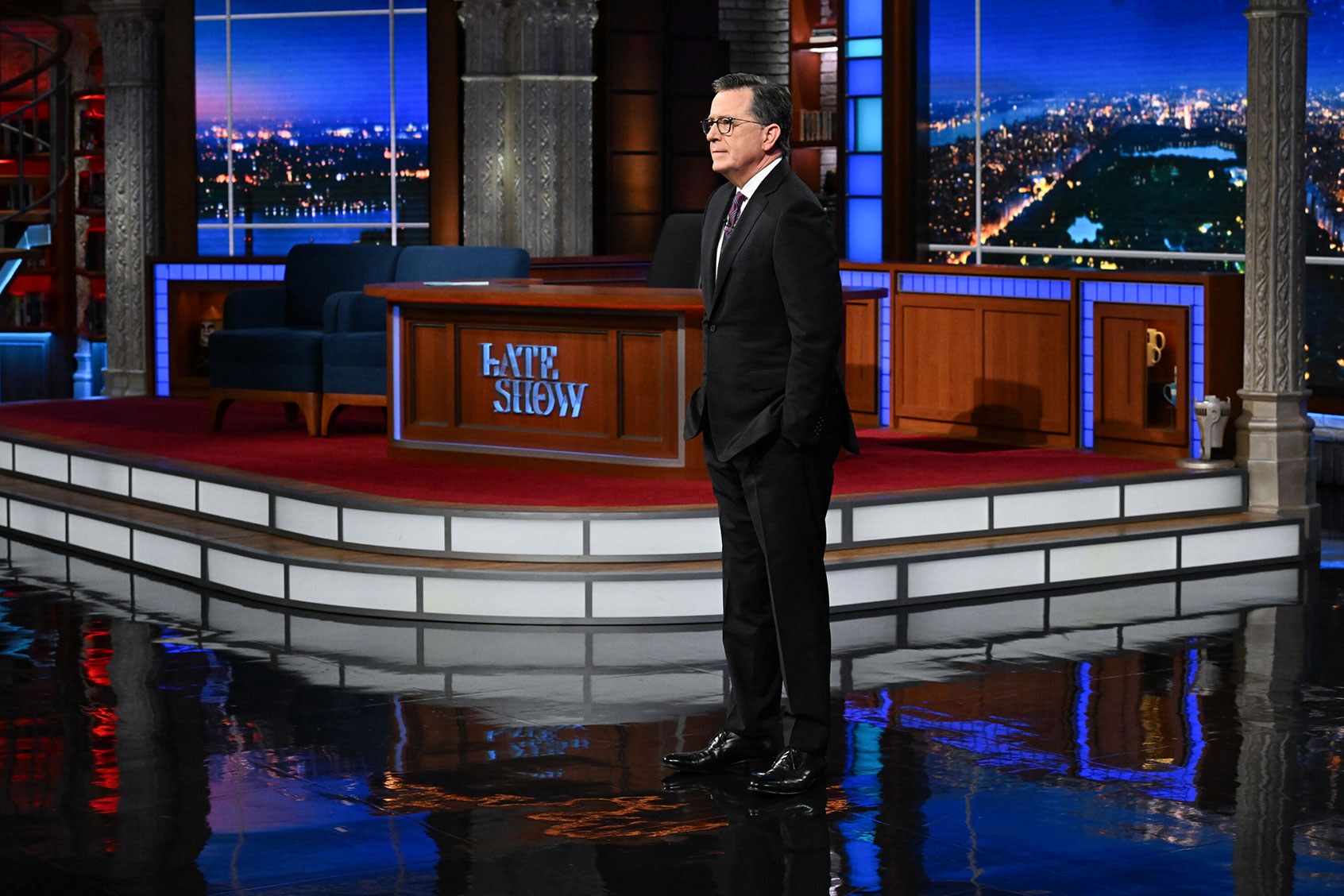

If you’ve watched the final episodes of “The Late Show with Stephen Colbert,” you won’t have missed the sense that something monumental is ending. When Jimmy Kimmel, Jimmy Fallon, John Oliver and Seth Meyers appeared on the show, Colbert’s fellow late-night hosts joked — half-seriously — about who might be cancelled next. The consensus, of course, was that it would likely be Kimmel.
In a separate appearance, former “Late Show” host David Letterman expressed open frustration with CBS, suggesting the network failed to recognize the value of what it had. Letterman also jokingly expressed concern for Fallon and Kimmel, asking if they would be “all right” after Colbert’s departure. Colbert responded humorously about a ‘captive breeding program’ for the Jimmys.
Taken together, these moments point to a broader reality: The end of Colbert’s show unquestionably marks the end of an era.
But what exactly is ending? Is this the death knell of American political satire? And if so, what does that mean for the future of ironic political commentary in the United States?
What is ending here is not satire, but a particular and powerful institutional form of it.
What is ending here is not satire, but a particular and powerful institutional form of it. Late-night comedy has a long history of offering Americans valuable political critique wrapped in ironic and entertaining wit. The broad audience reach and the nightly airing of these shows have ensured that the jokes create a broad interpretive community that translates comedic barbs into collective consciousness. For decades, America has woken up after watching late-night ready to discuss the jokes they saw and the critique behind it, and I’d argue that no show has had the same ability to influence our national political conversation as intensely as “The Late Show.”
Want proof? When a sitting president is hell-bent on getting you off the air, you can be confident that your satire has been making a difference.
CBS’s “Late Show” franchise has long been distinctive within the world of late night for its willingness to push beyond entertainment into critique. That tendency began with Letterman’s more unconventional approach to the format, but it became far more explicitly political under Colbert, whose version of the show blurred the line between comedy and commentary in ways that were unusual for a major broadcast network.
But that wasn’t all. At a time when the American public needed help making sense of the political landscape, Colbert offered viewers insight and analysis that went beyond the “both sides-ism” coverage of most mainstream media. Even more, the host refused to normalize the authoritarian tendencies of the Trump administration. Colbert’s ability to use critical irony to expose the absurd realities of Trump’s transgressions offered viewers a nightly dose of critical analysis wrapped in entertaining irony.
The end of “The Late Show” also raises more troubling questions about the vulnerability of satire to political pressure in the Trump era. Colbert’s tenure — which began in September 2015, just as Trump was beginning his ascent in Republican politics — was defined by sustained, often explicit criticism of Trump, and delivered from a platform that, historically, afforded comedians a degree of protection through scale, visibility and a commitment to free speech.
That protection now looks far less secure. CBS’s decision to cancel “The Late Show” came days after Colbert criticized Paramount, CBS’s parent company, for reaching a $16 million settlement with Trump over accusations that its newsmagazine series “60 Minutes” deceptively edited a 2024 interview with then-Vice President Kamala Harris. The cancellation, though, wasn’t just a reaction to Colbert going after his parent company. Instead, it coincided with a high-stakes, $8 billion merger between Paramount Global and Skydance Media, a deal that required regulatory approval.
Want more sharp takes on politics?Sign up for our free newsletter, Standing Room Only, written by Amanda Marcotte, now also a weekly show on YouTube or wherever you get your podcasts.
While CBS has claimed the decision to ax Colbert was purely financial, few believe it. Letterman made the point bluntly: “I’m just going to go on record as saying: They’re lying. Let me just add one other thing . . . They’re lying weasels.”
The alarm over these changes is further fueled by disruptions elsewhere in the late-night ecosphere point in a similar direction: Jimmy Kimmel’s temporary removal from the air in September by ABC/Disney following political backlash suggests that even high-profile hosts are no longer insulated from corporate caution. At minimum, the moment underscores how vulnerable even prominent satire has become to corporate and political power.
The cancellation of “The Late Show” also marks the loss of Colbert’s position in one of the most expansive platforms available for political satire. Network late night offered not just reach, but also a particular kind of cultural authority — one tied to routine, visibility and shared audience. What disappears with the show is not Colbert’s ability to produce satire, but the specific conditions that amplified it.
It is likely that we are witnessing the waning of a particular long-standing television tradition — late-night comedy shows that were originally designed to offer viewers a mix of entertainment and comedic release before heading off to bed.
More broadly, it is likely that we are witnessing the waning of a particular long-standing television tradition — late-night comedy shows that were originally designed to offer viewers a mix of entertainment and comedic release before heading off to bed. That model has been a fixture of American television since the late 1940s. While political satire will inevitably find other ways to reach an audience, the end of “The Late Show” franchise marks a significant loss to a media format that has often shaped American consciousness.
What we are not witnessing, however, is the end of satire itself. In fact, history suggests otherwise. Satirists can be censored, silenced, imprisoned, attacked and cancelled. Those assaults remind us not only of the power of satire, but also of how its targets can find the slice of comedians’ jokes threatening. The irony, of course, is that when satire comes under attack by those in power, it tends to come back even stronger.
When another CBS show, “The Smothers Brothers Comedy Hour,” was canceled in 1969 by the network amid political controversy, it did not mark the disappearance of televised satire. If anything, it revealed how threatening satire could be — and how quickly it reemerges in new forms when constrained.
That pattern has repeated itself. Moments of censorship or political pressure rarely eliminate satire; while they may displace it, forcing it into new platforms, formats and voices, the critical perspectives of satire remain. The point is: Conditions may change, but the practice persists.
We need your help to stay independent.
There is little reason to think this moment will be any different. The end of “The Late Show” does not mean the end of Stephen Colbert’s political comedy, nor does it signal a broader retreat from satirical critique. But it does signal that the form in which that critique has recently been most visible — network late night — is no longer as stable as it once was. And it means that Stephen Colbert, one of the nation’s best vehicles for satirical critique, will no longer be on the air to make sense of the madness of the moment.
In one of the show’s final episodes, Letterman offered perhaps the clearest reminder of the power not just of satire, but specifically of Colbert’s satire: “You can take a man’s show, but you can’t take a man’s voice.”
“The Late Show” may be leaving CBS, but Colbert’s voice — and his biting satire — aren’t going anywhere.
Read more
about late-night comedy
