
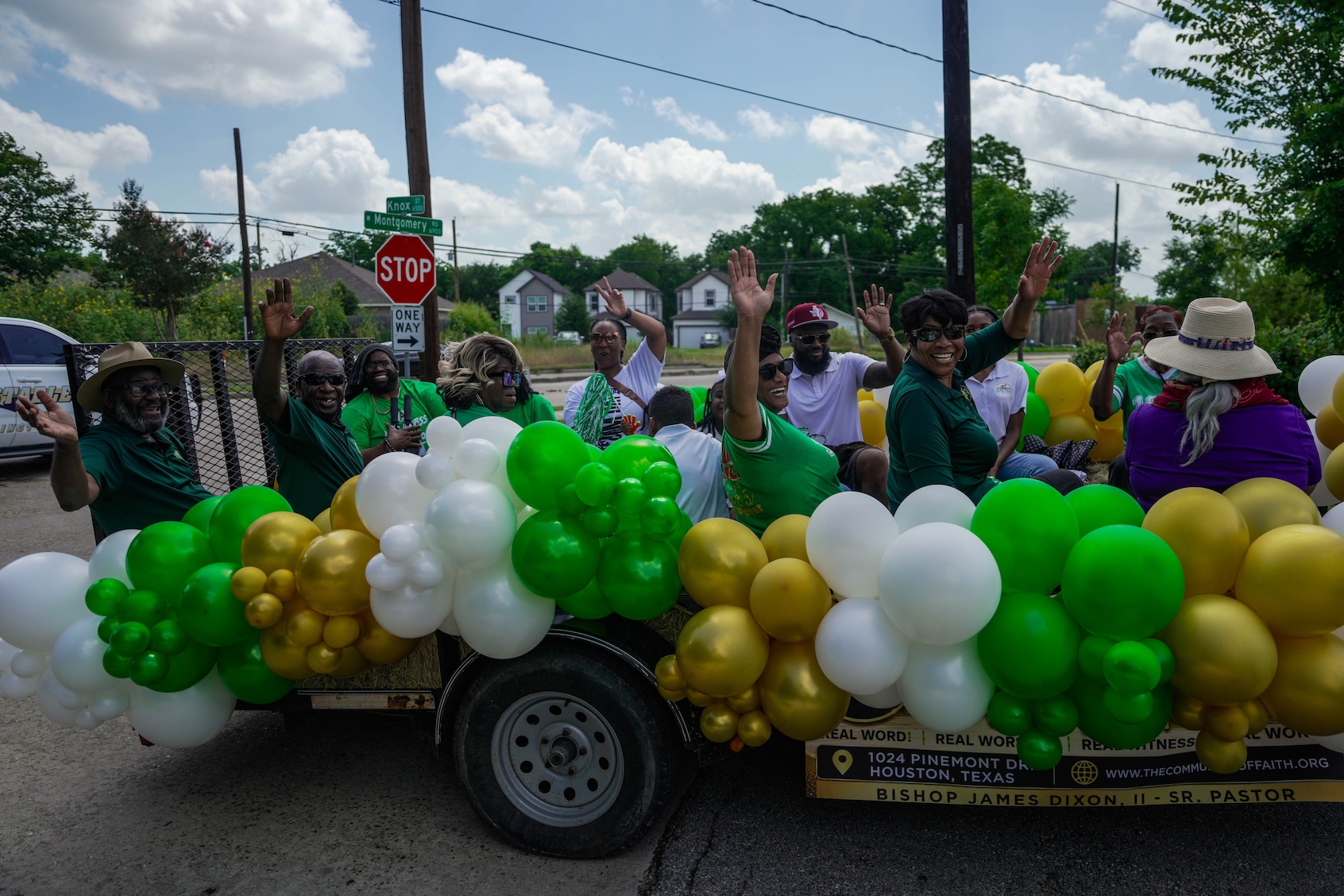

This year marks the sixth anniversary of the U.S. honoring Juneteenth as a federal holiday, and 161 years since the day chattel slavery was considered to have ended in this country.
“People just think of Juneteenth as a festival and as a Texas thing,” Black activist Opal Lee noted in an interview conducted shortly after the Biden administration and Congress had officially made June 19 a federal holiday.
I was very much in that camp being described by Lee, the “grandmother of Juneteenth,” who had devoted years of her near-century-long life to gaining the day federal recognition.
As a Black kid going to school in the Michigan suburbs in the ’90s, my K-12 education on slavery was like that of many other Americans — both concise and, to put it mildly, imprecise. And my awareness of Juneteenth was virtually zilch. But Juneteenth has come to mean a lot to me, as it has to millions of other Americans, although there’s still little consensus on what exactly the day means. Its cultural and political value is arguably more in flux today than ever.
Despite the passage of time, even the basic lore behind Juneteenth is still murky, and feverishly debated. Did Gordon Granger, an otherwise obscure Union Army general, really stroll into Galveston and read a decree from President Abraham Lincoln declaring, to a sea of onlookers, that all enslaved people were now officially free? Or did his men just plaster up some notices containing the decree across the city, roughly as utility workers warn locals about downed power lines?
And what about the potentially anticlimactic matter that enslaved people in Texas may already have known they were free, if only legally? The consensus among historical experts is that many were already keenly aware of the altered situation, thanks to the elaborate word-of-mouth information relay of enslaved people’s social networks. And Granger’s pronouncement, however authoritative, didn’t necessarily mean that all remaining enslaved people were immediately released, nor did it diminish the determination of slave owners to keep them in bondage.
Did Gordon Granger, an otherwise obscure Union Army general, really stroll into Galveston and read a decree from Abraham Lincoln declaring, to a sea of onlookers, that all enslaved people were now officially free?
The most consequential debate about Juneteenth today, however, concerns what exactly it represents for contemporary Americans. Is it a noble, symbolic centerpiece of our nation’s post-Reconstruction redemption arc, following the end of slavery — an interpretation barely tolerated by Republican politicians and favored or embraced by many liberals and Democrats? Or is Juneteenth a celebration of the strength and excellence that both grew out of the great evil that slavery represented and despite it, an evil that still afflicts the nation in 2026?
As the shibboleth of DEI unavoidably enters the chat, we also have to entertain the question of whether Juneteenth reflects a collective triumph for humanity, one that should be celebrated by all Americans, or is a racially exclusionary holiday, a sort of Trojan horse designed to marshal white shame and guilt that should be jettisoned.
For me, “celebrating” Juneteenth involves a form of oscillation: On one side, a begrudging celebration of our ancestors’ unmatched resiliency; on the other, the desire that our intensely racialized 21st-century society didn’t require so much of it. There are new efforts among humanists like myself and others to reset these debates by rethinking the agency and contributions of enslaved people. Our goal is to offer an alternative to the deficit-oriented narratives that have long flavored the political and pop culture discourse on American slavery and the tens of millions of people who were subjected to it.
Earlier this year, I was invited to conduct a cultural engagement training with a nearly all-white environmental nonprofit in Minnesota. This event came amid the ICE protests that had been roiling Minneapolis, about an hour and a half away, and against the backdrop of a deepening nationwide anti-DEI movement that has made the delivery of trainings like this one to a federally funded organization a bit dicey.
During the first part of the training, I described the many historic instances where American environmentalism has engaged in overt racism: John Muir espousing white supremacist attitudes toward Indigenous people; conservationists who lobbied for public lands to be made inaccessible to Black Americans, modern-day activists encouraging (or at least tolerating) the destruction of Black and Latino neighborhoods to build green spaces, bike lanes and so on.
I could see in the faces of the 20 or so trainees that none of this was new information. So I shifted gears, pivoting into what is called “strengths-based” pedagogy — in this instance, meaning a discussion of how enslaved people contributed to American environmentalism as we know it today.
We need your help to stay independent.
When most people think of the foundational figures in American environmentalism, they likely conjure up such wistful white Transcendentalists as Henry David Thoreau, Ralph Waldo Emerson and Margaret Fuller. They probably think of Muir, Rachel Carson and others of their ilk when they think about the early conservation movement.
As I explained to the trainees, however, an exceptional amount of knowledge about botany, forestry, gastronomy, aquatic systems and topography was not just passed along by enslaved people, but created by them. Academic programs like the Underground Railroad Ethnobotany Project, a reclamation project at Guilford College, have sought to spotlight this kind of little-known information, at the risk of upending the popular, inoffensive view of enslaved people as powerless and voiceless.
An exceptional amount of knowledge about botany, forestry, gastronomy, aquatic systems and topography was not just passed along by enslaved people, but created by them.
My recitation about the environmental ingenuity of enslaved people in the Underground Railroad was clearly jarring to many in the audience, perhaps even hostile to their understanding of what Blackness was, and what it could be. We spent the next 15 minutes in that training discussing power — what it really meant during slavery and how it could be skillfully forged and wielded even by people in the grip of slavery. The episode punctuated how reflexively we latch onto the idea of weakness as the primary outgrowth of racial injustice. It further telegraphed the kind of ideological inertia in which Juneteenth — and any other present-day discussion of slavery in America — too easily becomes mired.
According to a YouGov poll conducted last year, 87 percent of white respondents and 60 percent of Black respondents said they knew either just a little or nothing at all about Juneteenth. The majority of both white and Black respondents, associated it with Abraham Lincoln’s Emancipation Proclamation, which was declared two and a half years before Juneteenth. And what do Americans think of when they think of the emancipation of enslaved people? If pop culture — with its fixation on depictions of enslaved people as lowbrow and brutish — has had any part, which research suggests it has, the answer is damning.
Historically, representations of enslaved people in mass media have embraced a bevy of negative tropes. One primary trope holds that enslaved people were ignorant of who they were and their relationship to the larger world. Another trope concerns their exposure to physical and emotional violence — mostly as the recipient, occasionally as the perpetrator. A third trope is about the enslaved person’s good fortune; essentially, they lucked their way into freedom, almost always with the aid of good-hearted white folks. These tropes course through in Alex Haley’s “Roots” TV miniseries and melodramas like Steven Spielberg’s “Amistad,” as well as acclaimed 21st-century films like “Django Unchained” and “12 Years a Slave.” The entertainment industry has offered a palatable way for viewers to digest the horrors of the institution, without confronting either its banality or its larger implications.
But change may be afoot. In the last few years, the entertainment industry has shifted toward covering enslaved people’s artistic and culinary creations, as in the Netflix soul food documentary series “High on the Hog.” American museums that chronicle slavery increasingly focus on enslaved people’s community-building skills and entrepreneurial nature. Historical archaeologist Cheryl Janifer LaRoche, one of the leaders of the Underground Railroad Ethnobotany Project, succinctly describes one major aspect of this transformation: “Gone are the century-old definitions of the Underground Railroad dominated by images of shivering, frightened fugitive slaves.”
As longstanding media narratives are reworked through a strengths-based prism, a distinctive new risk emerges: painting slavery as a net positive, as some on the right have shamelessly argued.
But as longstanding media narratives are reworked through a strengths-based prism, a distinctive new risk emerges: painting slavery as a net positive, as some on the right have shamelessly argued. Ultimately, it’s unclear whether truly holistic interpretations of slavery can survive our current political ecology. In recent years, the tide has shifted dramatically against discussions of the corrosive impacts of American slavery as well as overt celebrations of Black identity and efforts to advance opportunities for Black people, as evidenced by the widespread axing of DEI offices, defunding of ethnic studies programs, and closure of racial minority support initiatives across the U.S. But Juneteenth has survived harder times than that.
“Emancipation Day was usually the occasion of the beating of drums and the marching of militia,” wrote A.A. Taylor, a Black Reconstruction-era historian, describing community celebrations for Juneteenth (then referred to as Emancipation Day). “Negroes were anxious to have the whites cooperate, but they haughtily refused. And little wonder that they abstained therefrom, for the Negro orators of these occasions idealized liberty and the inalienable rights of man, which the native whites thought belonged only to their race.”
Start your day with essential news from Salon.
Sign up for our free morning newsletter, Crash Course.
In 1980, Texas, through the dogged advocacy of Democratic state Rep. Al Edwards and the eventual buy-in of Republican Gov. Bill Clements, became the first state to recognize Juneteenth as a holiday, even as racist busing practices thrived there. Several times during his tenure, including as recently as 2025, current Republican Gov. Greg Abbott has publicly affirmed Juneteenth and Texas’ mark on the day. Considering the Lone Star State’s current outsized role as a national model for DEI purges, this political tightrope walk over a racially charged symbol like Juneteenth stands out as highly unusual.
After decades of ceremonial nods from Congress and statehouses across the country, Juneteenth then got its biggest, albeit most dubious, boost in 2020: Donald Trump publicly flirted with declaring Juneteenth a federal holiday as part of his “platinum plan” for Black America. That was something Bill Clinton and Barack Obama had never seriously attempted despite showing Pollyanna-ish reverence for the day on several occasions.
In an interview with the Wall Street Journal, as the COVID pandemic raged and Black Lives Matter protests in response to George Floyd’s murder began to rock the nation, Trump took credit for making Juneteenth “famous.” He also admitted he’d only recently learned what the day even was, and hadn’t been aware that his White House had released statements honoring the day for the previous three years. “Oh, really?” he asked incredulously when he was so informed. “We put out a statement? The Trump White House put out a statement. OK, OK. Good.”
It didn’t take long for the political calculus on Juneteenth to change for Trump. Five months into his second term, Trump had become a full-on DEI antagonist, and took to Truth Social last Juneteenth to denounce “non-working holidays,” a barely veiled jab at the newest federal holiday. Juneteenth is awash in ironies, both naturally occurring and of our own making.
And the cynicism coloring Trump’s juvenile attitude about Juneteenth is hardly shocking. Little about his approach to racial discourse and policymaking should shock us at this point. It’s born out of willful ignorance and a deliberately unreflective, self-involved worldview that defines the cult of personality around him.
This Juneteenth, we should try to confront and reclaim this holiday’s contradictory history, in all its facets. There is a new call, though: Not only to continue to reconcile America’s centuries-long embrace of the systems of slavery and the consequences of it, but to embrace an America that affirms both racial strife and unrecognized ability, without discounting one in favor of the other.
Read more
about the politics of culture in 2026
