
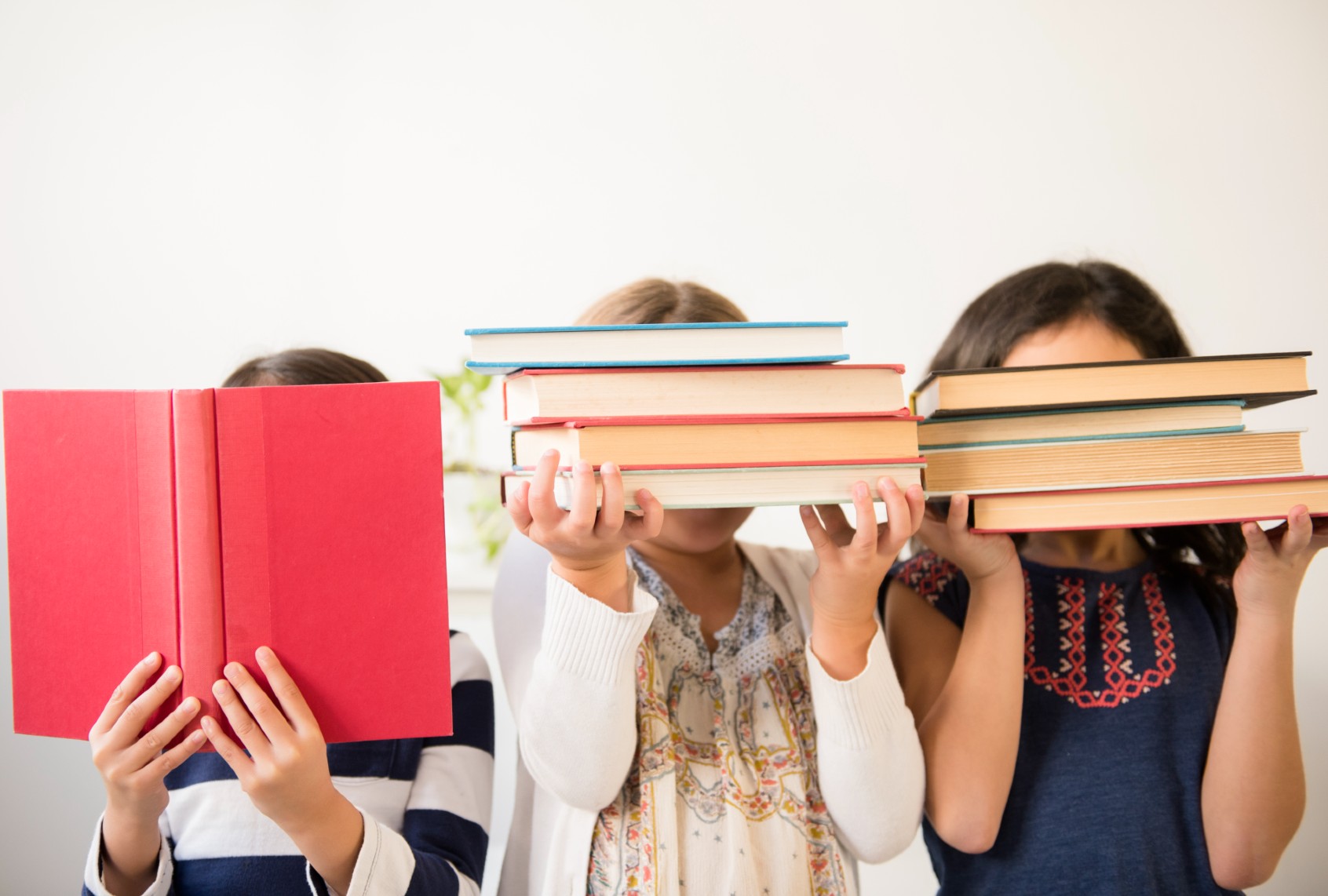

Veronica Arreola found out that a children’s book she authored was among the most banned in the United States from an unlikely source: People magazine. “Someone I had a date with sent me a text of a screenshot and was like, ‘Is this you? And is your book banned?’ She sent me a link to the story in People, which was about the rise of nonfiction books being banned, and a link to a PEN America report that listed the top 29 books banned in the 2024–2025 school year. And my book was on that list. I was like, this is bizarre. It’s bizarre that it’s being banned, and this is a bizarre way of finding out.”
No one thought Pete Hegseth was spending his time paging through a towering pile of books looking for subversive content; the DoD list was simply a result of challenging any book that mentioned justice, or activism, or rainbows.
Arreola’s book, “J Is for Justice! an Activism Alphabet,” was published in 2023 by Sunbird Books. The small, colorful board book isn’t the typical banned book, mostly because parents are usually either doing or directing the reading. It introduces simple, appropriate words for things associated with activism, but not only with activism; “Q is for quilt” pictures the AIDS Memorial Quilt, “F is for folding chair,” nods to Shirley Chisholm‘s quote “If they don’t give you a seat at the table, bring a folding chair.” “I wanted this book to be a way that adults could have difficult conversations with kids. Kids see things, and they want to know why,” says Arreola, a Chicago activist (and, full disclosure, a longtime friend and colleague). “The example I’ve been using is that when my daughter was 5, she recognized that we had homeless encampments in one part of the city, and there were a lot of empty buildings in our community. She was like, ‘Why don’t we let homeless people live in those empty apartments?’ It’s hard to explain [why] to a 5-year-old, [especially] while we, as a society, are trying to teach them to be kind and share.”
Want more from culture than just the latest trend? The Swell highlights art made to last.
Sign up here
Bans of and challenges to reading material in K-12 schools have been on the rise since 2021, when the American Library Association and PEN America noticed a sharp uptick in the number of books on the no-no list. The classics of the banned-book genre remained — “Brave New World,” “Animal Farm,” “Beloved” — but those were joined by an escalating list of picture books of two-dad families, young-adult novels tackling race or suicide, graphic novels in which teens make informed choices about their sexuality or their mental health. It quickly became clear that these challenges were not ones initiated by individual parents (only about 3% are) but were large-scale initiatives organized by pressure groups and anti-woke crusaders like Moms for Liberty and No Left Turn in Education — and, in the case of “J is for Justice,” the Department of Defense.
“The DoD runs the schools at military bases for [children of] enlisted people, officers, diplomats,” Arreola explains. “Last year, when everyone was paying attention to DOGE and all the science grants they were cancelling, they were also doing a list of books to ban.” The process for both was the same: Arreola, on a recent episode of WBEZ’s “In the Loop,” called it “a Control-F ban.” “They were searching keywords like ‘diversity,’ ‘gender,’ ‘DEI’ — they had a whole list.” Obviously, no one thought Pete Hegseth was spending his time paging through a towering pile of books looking for subversive content; the DoD list was simply a result of challenging any book that mentioned justice, or activism, or rainbows.
The shift from banning individual books based on content to banning them based on words, as well as the growing number of challenges to nonfiction books, reflect that book bans are now systematized efforts to fundamentally change what people know and how they know it. PEN found that “92% of censorship attempts in 2025 were initiated by pressure groups and decision makers swayed by them.” Noting the growing number of bans on textbooks, history books, biographies, reference texts and more, its report references “a strain of anti-intellectualism . . . [that] mirrors the broader political attack on facts and knowledge and the skepticism and devaluation of, and disdain for, experts and expertise—tactics long associated with the rise of authoritarian regimes and intended to sow distrust in democratic institutions.”
And then there is the rise in censorship efforts in higher education. “There has been a steadily growing effort to expand a web of political and ideological control over the higher-education sector,” says Jonathan Friedman, the managing director of PEN America’s Free Expression programs. “More than half of U.S. college and university students now study in a state with at least one law or policy restricting what can be taught or how campuses can operate.”
As with book bans in K-12 schools, challenges in higher ed began ramping up in the last half-decade; on campuses, changes to and restrictions on course content, lecture topics and reading materials increasingly take the form of what PEN calls “indirect censorship” — “efforts to exert ideological and political control over the operation of universities and colleges as a whole.” In other words, these efforts are about more than conservative boogeymen like critical race theory and DEI, but about constraining facts already in evidence — not unlike attempts to remove mentions of enslavement and climate change at national parks and museums.
The shift from banning individual books based on content to banning them based on words, as well as the growing number of challenges to nonfiction books, reflect that book bans are now systematized efforts to fundamentally change what people know and how they know it.
The prevailing argument for removing books written for children and young adults from school libraries is that parents deserve to have a say in what their children read — a rationale that would seem to fall apart in higher education. But a recent case at the University of Nebraska, where the textbook for a Human Sexuality class was challenged on the basis of its allegedly “disgusting” images, suggests that the goalposts move as needed. In higher ed, Friedman says, the argument for restriction or outright removal of educational materials is still nominally about protection. “In this case, [it] focused on the appropriateness of the text and its images — though it hardly seems inappropriate that a nursing student’s college-level course textbook [has depictions of] human genitalia.” (We can assume that, likewise, no students are being strong-armed into taking a course on Human Sexuality.)
Another alarming trend is that challenges are increasingly likely to come directly from government officials. PEN is seeing more cases in which government operatives intervene in academic affairs “to a surprising degree,” says Friedman, adding, “It is highly unusual for governors [or] senators to get involved in rather mundane academic curricular decisions.” But after an Indiana senator took issue with a lecture by a college professor, her contract wasn’t renewed. The complaints that led to the University of Nebraska’s textbook challenge appear to have originated with a former staffer of Nebraska governor Jim Pillen.
At the college level, Friedman explains, “Explicitly directing professors and universities not to teach about race or gender didn’t really work [because of] protections for academic freedom.” To achieve their goals, the plan is now “to attack, weaken, and undermine the foundation of academic freedom first. That’s why we increasingly see political efforts to undermine shared governance, abolish faculty senates, change tenure, or create new ‘audits’ of curricula.”
Alabama now gives the governing boards of universities leeway to exert control of the subjects taught there, and allows governing boards to fire tenured faculty for reasons including “failure to meet professional responsibilities” or behavior that “adversely affects” a school. In other words, faculty can be fired for whatever infraction the school’s governing board decides is a fireable one. (The University of Alabama and Auburn University are exempt, thanks to existing protection under the state’s Constitution.)
New laws in Tennessee, meanwhile, aim to undermine tenured faculty and prohibit student and faculty protest on campus. As with Alabama’s law, they are worded vaguely enough that they can be applied to pretty much anything: One law’s refusal to define “misconduct,” along with its provision that tenured faculty no longer be allowed character references from or hearings before their peers, seems designed to undermine the meaning and distinction of tenure. “Tenure, shared governance and academic freedom make up a very important infrastructure,” Todd Wolfson, president of the American Association of University Professors, recently told Inside Higher Ed, “and if you look at the bills that have come out in the last three months, what you see is an attack on each one of those three pillars.”
Illinois was the first state in the nation to enact a “Freedom to Read” law that protects librarians and prohibits the removal of books from libraries on ideological grounds. The law was passed in 2023, 13 years after Chicago Public Schools, without explanation or warning, removed Marjane Satrapi’s graphic novel autobiography “Persepolis” from classrooms and libraries, sparking a student movement against censorship. Eight other states, including California, New Jersey, Connecticut and Rhode Island, have since passed similar legislation.
We need your help to stay independent.
And yet, the encroachment on academic freedom has become both more extreme and more inchoate. The chair of the School of the Art Institute of Chicago’s graduate program in art therapy, Savneet Talwar, was removed this past April after assigning the students in a course called “Cultural Dimensions in Art Therapy” a case study sympathetic to Palestine. According to Hyperallergic, Talwar directed her students to create a course of treatment for a hypothetical patient, “a queer Arab woman who sympathized with pro-Palestinian protests and feared retaliation under the Trump administration.” The next day, she was told by the school’s provost that she was being put on leave effective immediately following a student complaint that the school believed “threatened immediate harm to the student or to others within our community.” The school has yet to tell Talwar and her lawyer what the complaint actually alleged.
As an activist, Arreola is probably the perfect person to stand up to book banning, but should she have to? In perusing board books similar to hers, I encountered no less than 5 titled “J is for Jesus,” which, in theory, someone whose religion isn’t Jesus-centered could complain doesn’t belong in the children’s section of a library. That it hasn’t seems ironic, given that the Christian ideal of Jesus is in both word and deed a seeker of justice. Hypocrisy allows parents, or the DoD, or whomever, to target the book itself. But what allows these ban lists to flourish is that they are being produced at scale by organizations on the grounds of: Who’s going to stop me?
“People can look at what’s happening in this country right now and see that there don’t seem to be rules,” says Arreola. Those who have witnessed Donald Trump bulldoze the White House’s East Wing, slap his name on the Kennedy Center and call for the heads of everyone from talk-show hosts and pop singers to museum curators and college presidents are learning that anything and everything can be a culture war — and, even more important, that objective truth is whatever a well-funded anti-woke advocacy group says it is. “History is told through stories, and we do not agree on stories,” Emily Knox, author of “Book Banning in the 21st Century,” told “In the Loop.” In that case, Arreola — and the rest of us — need to make sure new stories are being written as fast as the current ones are erased.
Read more
censorship
