
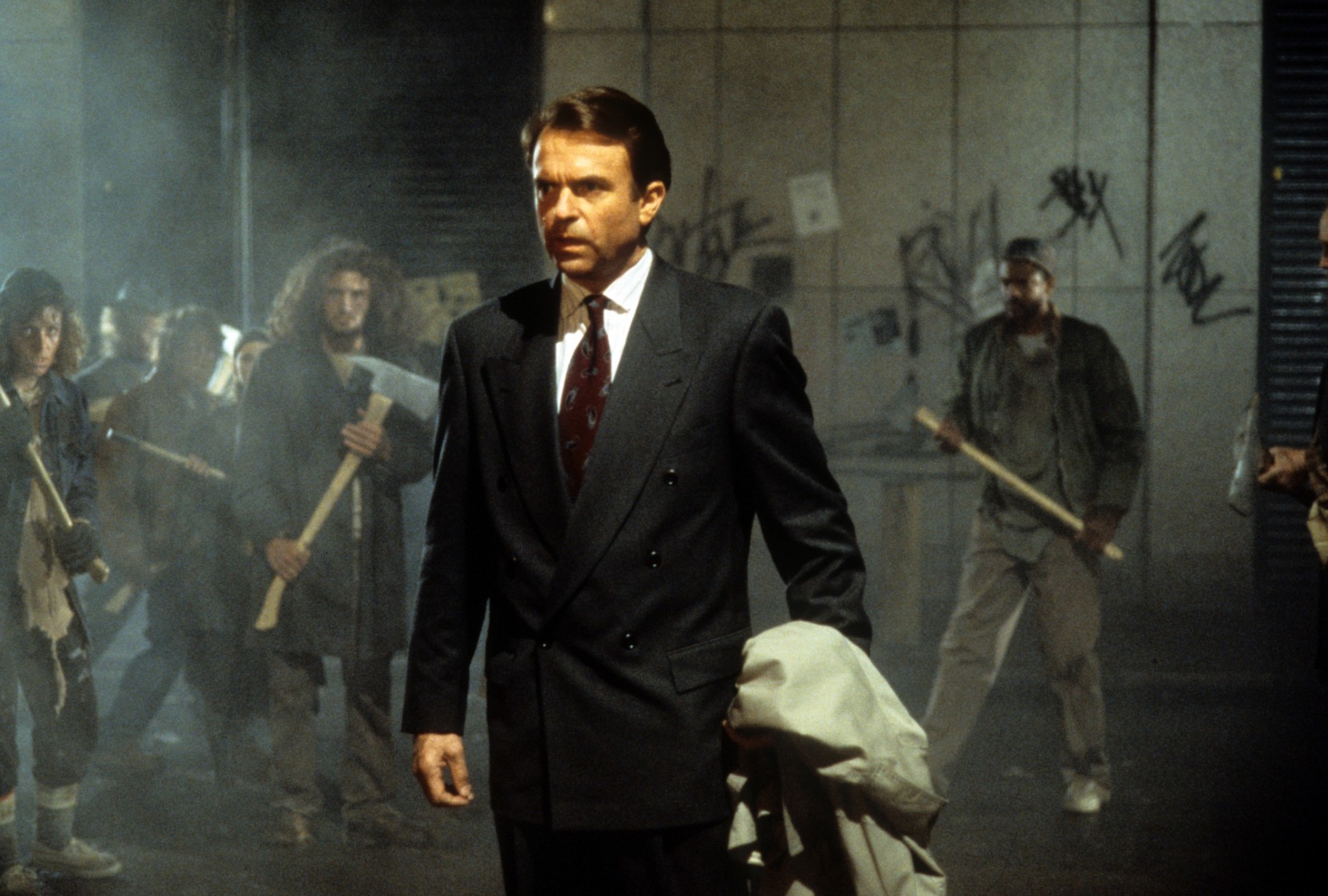

When news of Sam Neill’s death at the age of 78 broke earlier this week, much of the public sentiment for the late New Zealand actor revolved around his humor and charm. Neill was a consummate character actor, hard-working and driven by a love for his craft, with a filmography spanning decades and roles that touched countless lives. And as such, Neill was a fount of fascinating stories and notable quotables — products of keeping his eyes open to all of the world’s strange beauty.
The New York Times’ Kyle Buchanan reminisced on an interview with Neill from 2022, promoting his return to the “Jurassic” franchise alongside former costars Laura Dern and Jeff Goldblum, in which Neill spun a truly incredible anecdote about his son farting in front of Princess Diana. On X, a user posted a magazine clipping in which Neill revealed how he’d commit a murder. (At the time, he was making the rounds for the BBC miniseries adaptation of “And Then There Were None.”) “I’d use a steamroller,” Neill confessed. “There’s a couple of people I’d put under a steamroller, but I won’t say who they are; otherwise, when they see a steamroller coming their way, they’ll be on full alert. And steamrollers don’t go very fast.”
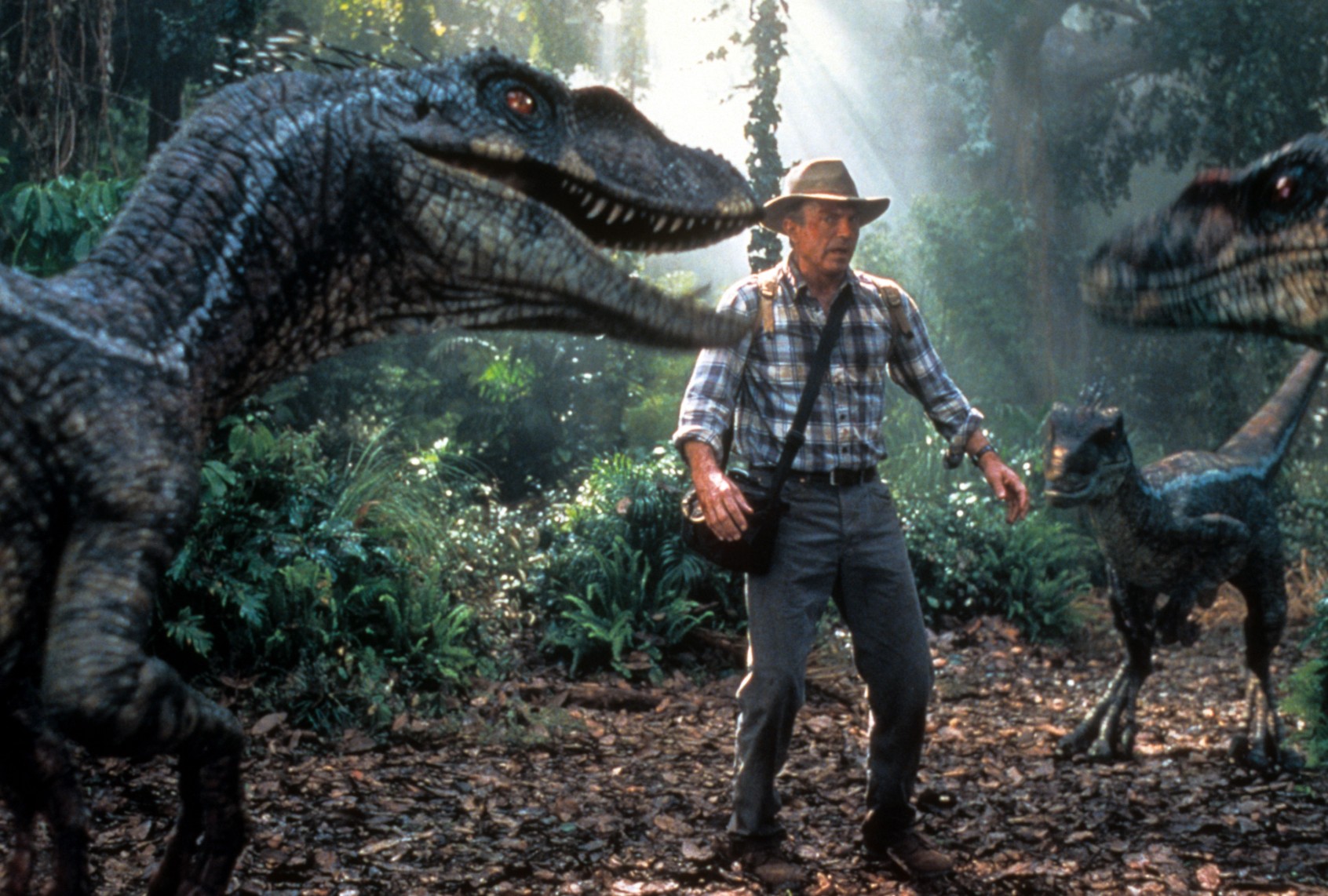
(Universal/Getty Images) Sam Neill in “Jurassic Park III”
Few performers could make your blood run cold one minute and have you laughing the next. And Neill relished that ability, returning time and again to characters whose unpredictability mirrored life’s, creating an oeuvre that is both grotesque and supremely human.
Beyond making us laugh, Neill’s wit was one of those special traits that enhanced all the other aspects that made him so lovable as both an actor and a person. His real-life geniality provides a stark contrast to some of his most famous roles as monstrous men committing equally hideous deeds. His best work tunneled into life’s darkest spaces to excavate ideas about our fears and obsessions, often reflected through dazzling practical effects that matched the naturalism of his greatest feature: a singularly expressive, malleable face. The mixture of satisfaction, excitement and sheer bewilderment that Neill wore in the first dinosaur scene in “Jurassic Park” was so effective that it made viewers feel like they, too, were witnessing something beyond imagination. To convey so much using nothing but the God-given tools in your arsenal is the mark of a truly great actor.
Though “Jurassic Park” may be Neill’s most loved work, it’s far from his most impressive. To quantify a career like Neill’s is impossible, but “Jurassic Park” points to a trend that spanned his filmography, even defined it. Throughout his career, Neill pitted himself against creatures both real and imagined — or, even more often, somewhere in-between — to reveal humanity’s foibles in the face of the freakish and fantastic. Neill’s penchant for the weird and abstract allowed him to use his unique features and distinct, gravelly voice to create characters who were as devilishly memorable as the beasts they went up against. Few performers could make your blood run cold one minute and have you laughing the next. And Neill relished that ability, returning time and again to characters whose unpredictability mirrored life’s, creating an oeuvre that is both grotesque and supremely human.
It’s telling that Neill’s first major film role outside of a few sleepy Australian movies was as a grown-up version of “The Omen” antichrist Damien Thorne in 1981’s “The Final Conflict.” With his slick black hair and steely gaze, he was practically born for the part. But those features were on far more chilling display — and for a significantly better film — in Andrzej Żuławski’s “Possession,” which debuted the same year, making for a pair of roles that supply a sturdy outline for Neill’s career. In Żuławski’s famously imposing psychological horror film, Neill stars alongside Isabelle Adjani as Mark, a young man whose life and marriage are falling apart at the seams after his wife, Anna (Adjani), has an affair and begins to exhibit strange behavior. As the first person the viewer sees in the film, Neill has the responsibility of setting the tone — a nearly inconceivable task for a movie that twists itself into a knot before consuming and regurgitating itself 10 more times. But Neill is up to the task, creating an atmosphere of sheer bleakness with little more than a look that is, somehow, both vacant and teeming with emotion.
Want more from culture than just the latest trend? The Swell highlights art made to last.
Sign up here
Though many critics and historians have tried, it’s impossible to get to the true root of a work as oblique as “Possession.” There are 100 feasible readings of Żuławski’s film, and just when those all seem to make sense, you could conjure up a 101st. What’s certain is that watching Adjani give herself over to Anna — and the gurgling, tentacled creature that may or may not be a figment of her fractured reality — is one of the most terror-inducing experiences you could have with a movie. But it’s important to note that “Possession” is a two-hander; Adjani’s performance needs Neill’s to sing, or perhaps, screech. He rises and falls at the same pace as his companion in this nightmare, laying the groundwork on which Adjani can create something so enormous. Neill’s performance is as flailing and furious as hers, and together, they turn “Possession” into a radical piece of filmmaking that has deservedly earned its cult following and late reverence. It’s really no wonder that Neill would go on to play characters who echoed Mark’s descent into madness, splitting off into equally extraordinary works of spine-tingling creature feature dread.
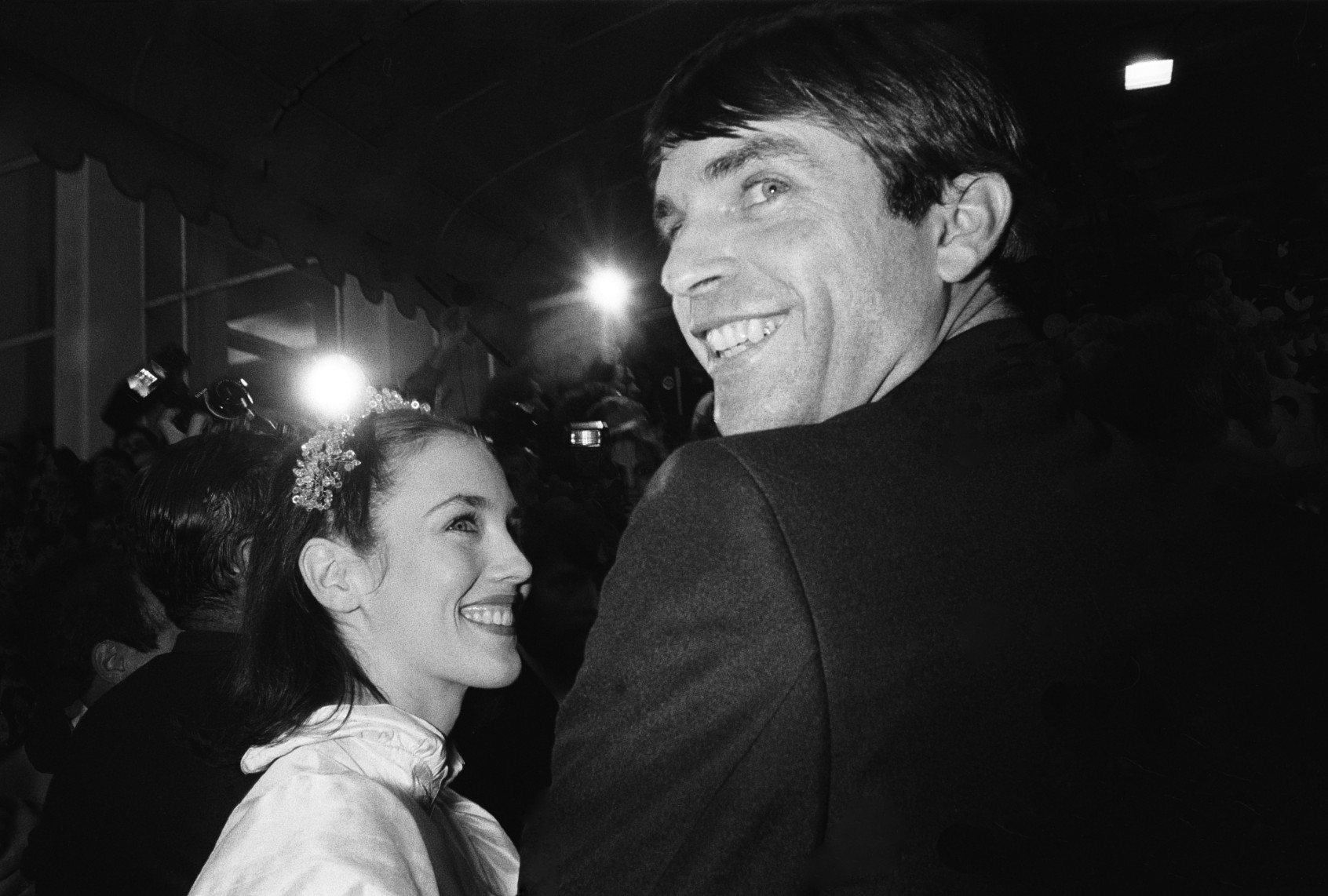
(URLI/Gamma-Rapho via Getty Images) Isabelle Adjani and Sam Neil at the premiere of “Possession”
While some might cry sacrilege at comparing a filmmaker like Żuławski to Paul W.S. Anderson, the man behind such cinematic triumphs as the “Resident Evil” film franchise and “Alien vs. Predator,” both directors knew exactly how to push Neill to his most frightening limits. Like “Possession,” Anderson’s 1997 space horror, “Event Horizon,” took its time becoming a cult classic. Though the film was initially a critical and box office flop, it contains some of the most captivating sequences of outer-space terror you’ll find in any film, largely thanks to Neill’s petrifying turn as Dr. William Weir, a spaceship designer driven mad by mysterious visions. Weir and a small crew are sent on a recovery mission after the lost spaceship, the Event Horizon, suddenly reappears in orbit around Neptune, issuing a distress signal. When they arrive, they discover an inexplicable massacre has occurred, potentially the result of the ship’s ability, engineered by Weir, to fold space-time and travel great distances in a flash.
We need your help to stay independent.
“Event Horizon” demonstrates a major theme in Neill’s most gruesome creature feature performances: the slow, onscreen transition from good to evil. Though Neill had more than a lifetime’s experience playing characters who were solely benevolent or entirely wicked, he was remarkably adept at navigating the journey back and forth between these two polarities. Even when they were written simply, his characters were never one-note. Neill seemed to savor the chance to go deeper, to look more closely at our innate capacity for acts both moral and depraved. Often, it’s trauma that changes us, that pushes us past the confines of what we know to be righteous and toward something cruel and unusual — a picture of ourselves that looks unfamiliar.
Dr. Weir, trying to do good for the world while still grappling with his wife’s suicide, reaches that threshold with unnerving speed (and even a bit of camp). But in “Event Horizon,” Neill avoids hokeyness in what could otherwise be an extremely hokey film, finding the emotional center in a character whose inner demons become real-life manifestations of Hell. It’s rare that an audience will sympathize with a character who is almost too nightmarish to bear, but Neill’s ability to consistently humanize the inhuman is precisely the kind of quality that we go to the movies for.
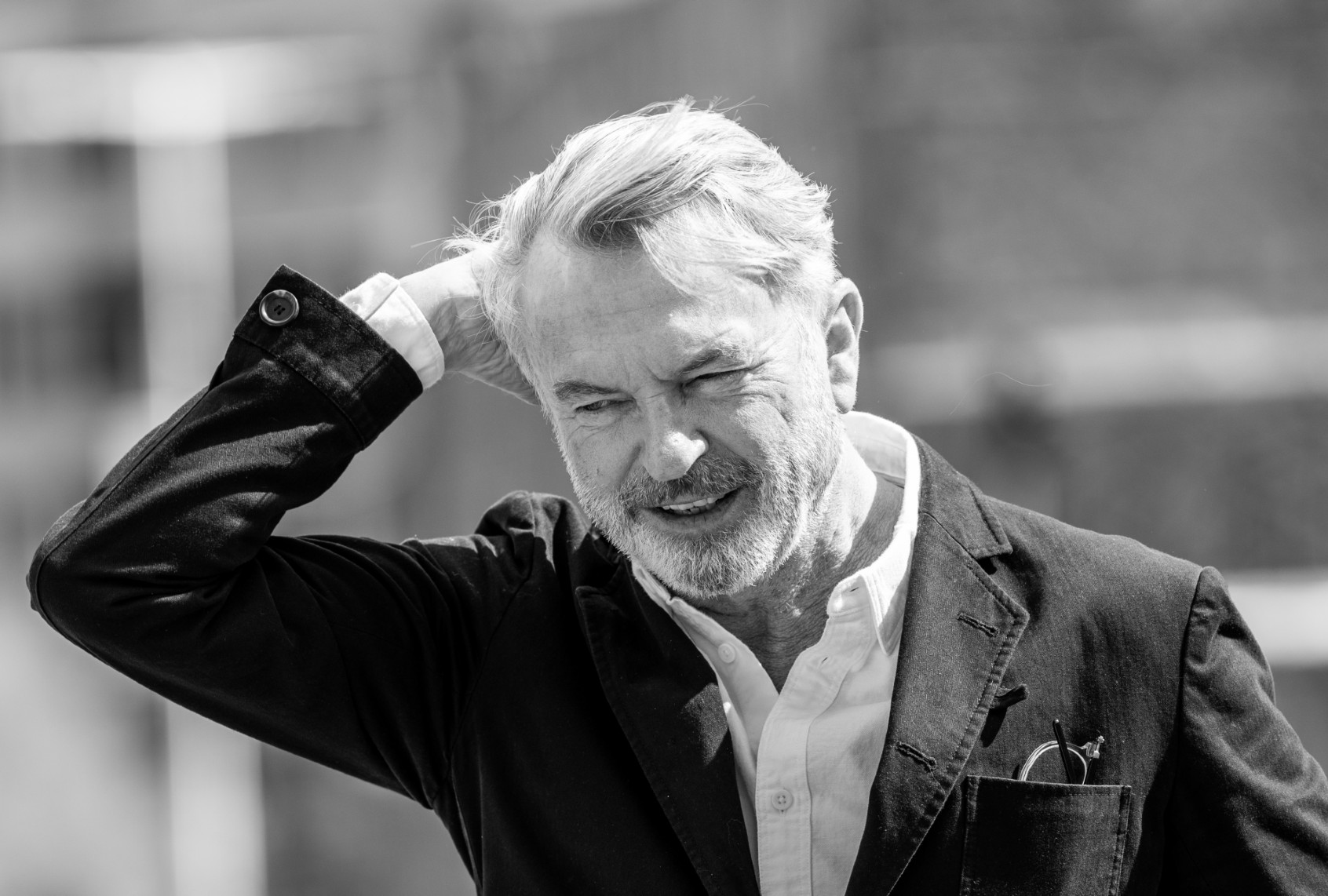
(Manuel Romano/NurPhoto via Getty Images) Sam Neill
Even when they were written simply, Neill’s characters were never one-note. He seemed to savor the chance to go deeper, to look more closely at our innate capacity for acts both moral and depraved.
Of course, we also go for stories that are larger than life, that traverse beyond this realm into a place that only movies can go. One may argue that “Jurassic Park” is Neill’s perfect example of such a power. But my personal favorite will always be John Carpenter’s “In the Mouth of Madness,” a film that, by its title alone, is so fitting for Neill’s career that it’s almost comical. If you watch any film of Neill’s to pay tribute to a life well-lived and a career well-balanced, let it be this one: a hauntingly prescient, brilliant work of horror that perfectly encapsulates Neill’s most notable characters.
In the film, Neill stars as insurance investigator John Trent, who has been hired by the book publisher Arcane to track down their missing horror author, Sutter Kane, whose next book is hotly anticipated by the adoring, obsessed public. John’s work leads him to Hobb’s End, the fictional town in all of Kane’s novels come to life, where a series of strange occurrences that seem to lead back to Kane are happening more and more frequently. But John believes all of it to be an elaborate publicity stunt concocted by Arcane — or, at least, that’s what he tells himself.
Riffing on the public’s fanatical response to Stephen King’s work with a culty, Lovecraftian spin, Carpenter and screenwriter Michael De Luca craft a fascinating tale of how idol worship alters our collective consciousness, in which Neill is an essential component. As an ordinary man thrust into a world of monsters and maniacs, Neill is inherently playing with ideas about art and celebrity that reflect his own career. “In the Mouth of Madness” ponders just how powerful media — and our relationship to it — can be, and Neill gives an electrifying turn as a man caught up in a myth made real.
Neill said that, in filming “Possession,” he “only just escaped with his sanity barely intact.” And with “In the Mouth of Madness,” he once again evaluates the price of making great art, but this time from a safer distance. One could easily read the film as a meta examination of Neill’s work, of the kinds of characters he was drawn to, the ones that no audience member could soon forget. These men were striking figures, as intimidating as they were irresistible. They were characters who made us remember why we look to certain actors for specific things, and how important it can be to pay attention to the feelings they conjure within us. For Neill, it was the passion for complex, wily characters, and how those types of people reacted in situations that were equally complicated. His performances reminded us how easy it is for a person to lose their senses when they come face-to-face with something spectacular and indescribable. And what is life if not spectacular and indescribable? Through Neill’s work, we could explore our fears about what we can’t always understand. He wore the terror for us, making life’s big mysteries seem just a little less daunting — even if they, like Neill, will always be unpredictable.
Read more
about tributes to the greats
