
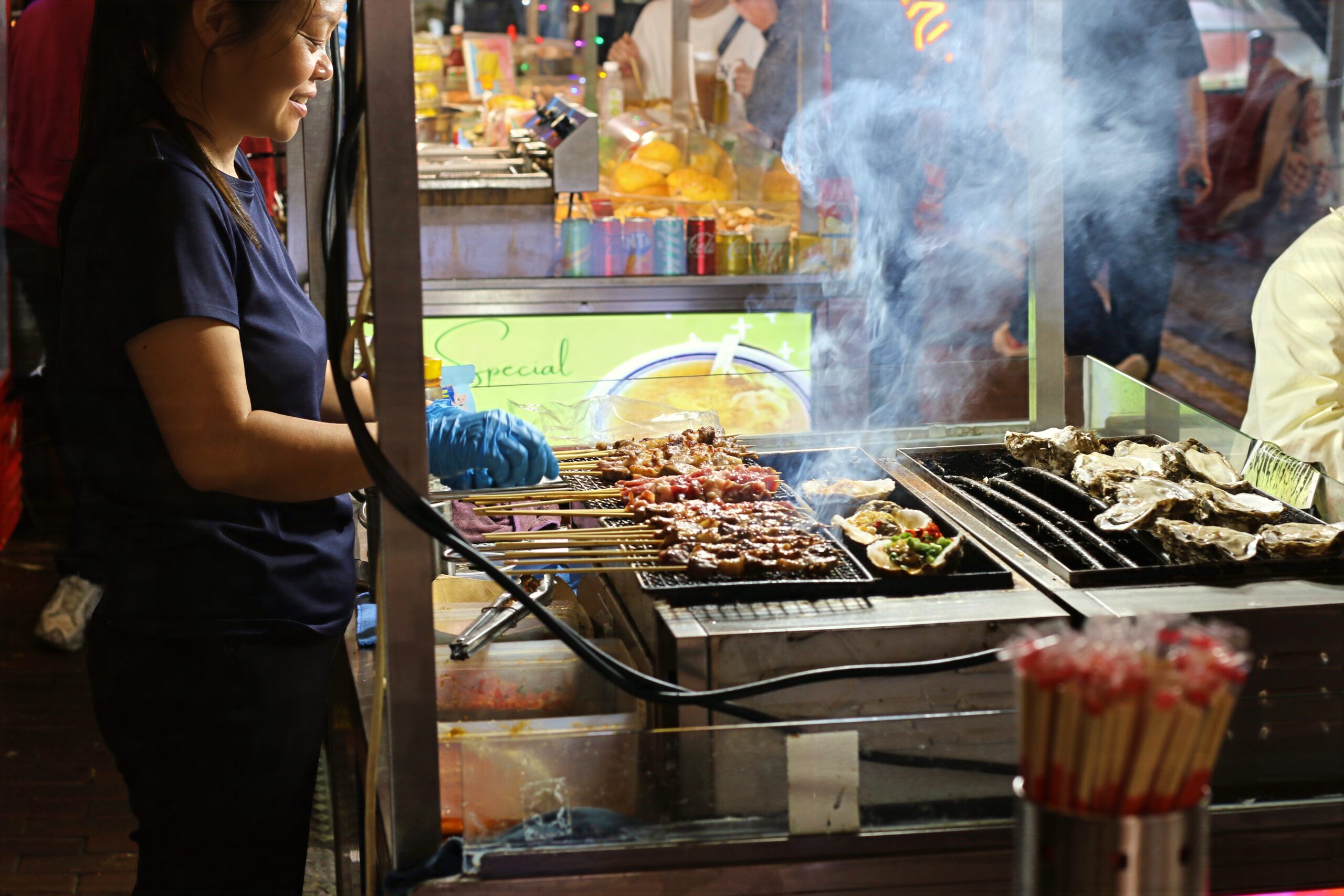

The smell hits first, garlic and char on skewered meat, chiles brushed over buns, oyster sauce mingling with the syrupy edge of black vinegar on sizzling noodles. Then comes the sound, clams tossed in hot pans, cleavers pounding roast pork, a Cantonese rock ballad barely rising above the crowd. At Temple Street Night Market, steam rises, neon buzzes, just like the guidebooks promised.
My first bite of Hong Kong is a fried soup dumpling, filled with truffled pork and that holy trinity, garlic, ginger, scallion. Crisp-bottomed, soft-topped, doused in soy. I eat it standing, careful not to scald my tongue. It’s divine. It’s street food. A memory made to be eaten. But something’s different.
Temple Street Night Market grew after World War II, a “nightclub for regular people,” says the woman beside me, also eating soup dumplings carefully. She remembers when the blocks up to Tin Hau Temple brimmed with food carts, trinkets, and the occasional fortune-teller. COVID changed that. Now food stalls are limited, corralled onto a single block. The rest? Brick-and-mortar, cleaned up, regulated. “It’s a performance,” she says. Still, this is one hell of a dumpling.
I’m not satisfied. Something as embedded and sentimental as street food doesn’t just vanish. I call on two friends, industry insiders at Lee Kum Kee. Yes, that Lee Kum Kee, the ones that invented oyster sauce. Ki Tang and Park Ng are locals, insatiable eaters. If anyone knows where Hong Kong’s old street food pulse still beats, it’s them.
We walk Sham Shui Po, once among the city’s densest working-class food neighborhoods. The differences here are sharp. “Sure, the hygiene issue moved some sellers into shops,” she says,” but Hong Kong-style street foods, they haven’t changed.” We stop at a popular shop, newly under a roof, for cheung fen, rice-flour rolls dressed in sesame, soy, and chile, and eat standing up, like before.
These rice rolls, siu mai dumplings, egg waffles, and curried fish balls, the classics remain. The two agree, the scene’s adapting to keep the favorites around, just in more refined settings. Ki adds, “Many Chinese styles have also come to Hong Kong.” Chinese brands with deep pockets are creatively moving in. Hot and dry noodles with seafood, Beijing crêpes filled with satay beef, Sichuan pancakes stuffed with char siu pork. On food, the mainland is fusing with Hong Kong.
We stop at a northern-style dumpling chain, a new import that’s caught on fast. I try the pork and corn pot-stickers with XO scallop sauce, plump, garlicky, fast. A walkable bite of New Hong Kong. Next, crispy fish-filled siu mai on a stick from a nearby shop. Old-school Hong Kong, salty and hot. The street food menu is expanding.
We need your help to stay independent.
QR codes are everywhere we see food. “People are ordering and picking up later,” Park explains, “queues are shorter… delivery apps also help.” A trend that predated COVID, but the pandemic cemented it. Takeaway meant survival for most vendors. The old crowded wait has become a couch scroll until your green bean skewer and brisket noodles appear by e-bike.
Ki and Park peel off, and I continue to walk south toward Tsim Sha Tsui, A long slog, enough to digest and think. I recall correspondence I had with Virginia Chan, founder of Hong Kong’s “Humid with a Chance of Fishballs” food tours. She romantically contends that street food is an “impulse buy – you pass by it, and it smells good, so you buy it to eat quickly.” True. But it does strike a blow to eating-by-app. She also mentioned something I hadn’t considered: Malls.
“The younger generation goes to malls that have a ton of ‘street food’… The plus is that there is air conditioning.” Right again. As rents rise and street-level spots vanish, street food culture perseveres. A/C replaces gritty urban ambiance. Eaters stay cool. Vendors move up.
Walking through the neighborhood, I see take-out windows everywhere. Pandemic innovation or just smart business? Especially at bakeries and cha chaan tengs, Cantonese diners. You don’t have to sit anymore. You walk. Grab a pineapple bun stuffed with ham and butter, a corned beef egg tart, a sourdough one, even pistachio. (Egg tarts—once a humble snack—have gone global and experimental. And they’re good.) You’re off to work in sixty seconds flat. I watch office workers walk off mid-bite, sipping from paper cups of milk tea.
And that’s the truth I walk away with. Street food isn’t just hawker carts and smoke-filled alleys. Not anymore. It’s not about frenetic, but it is about motion. Food that moves and moves people. To borrow the dim sum moniker, it touches the heart.
It’s still here. Just in new clothes. And still damned delicious.
Read more
from Howie Southworth
