
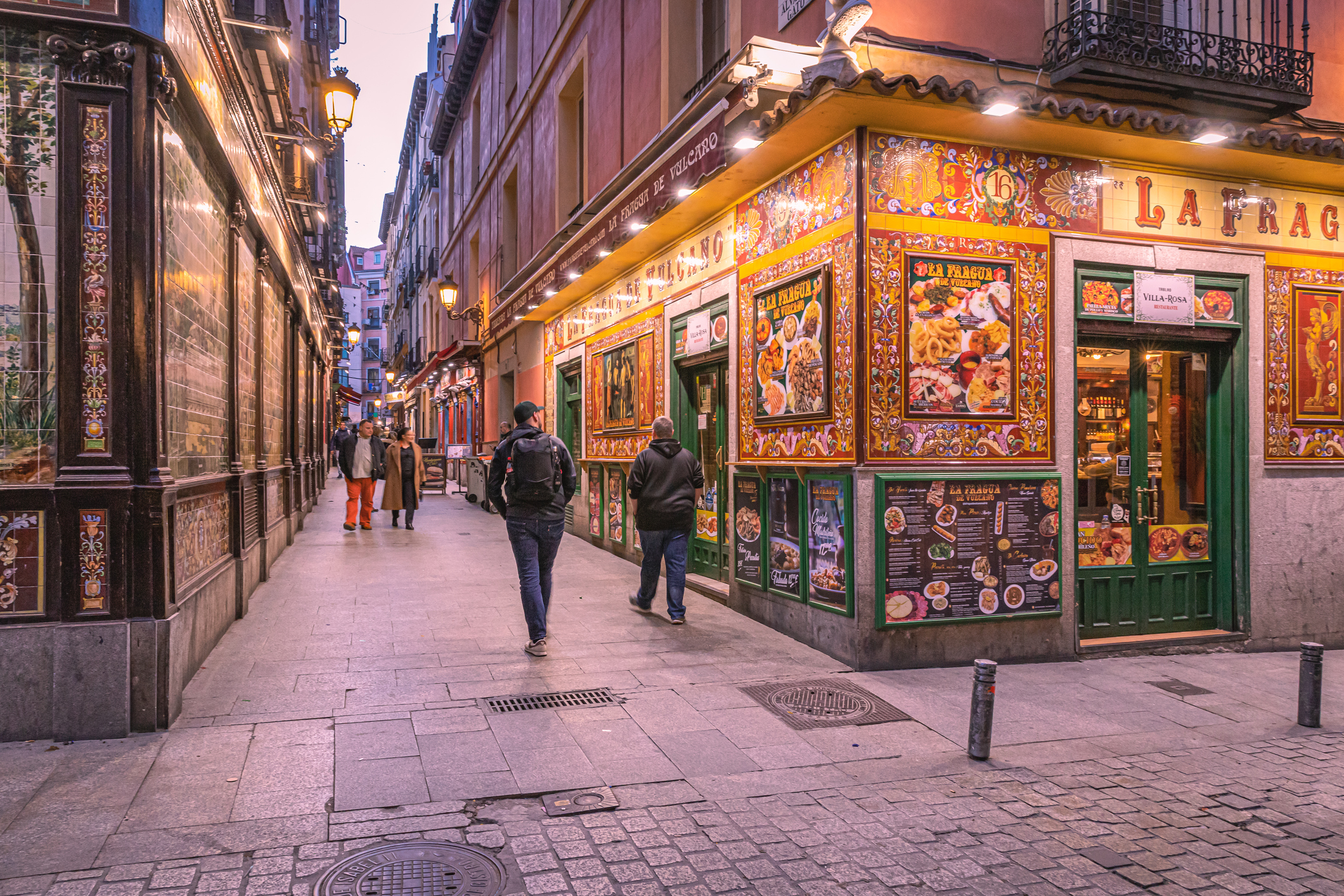

Madrid remembers its writers. Barrio de Las Letras never let them leave.
By the 16th century, it was theaters that drew the bohemians. Poets, playwrights, novelists, dreamers. The printers, the bookshops, the guesthouses and taverns, they followed. Lope de Vega wrote of honor and conflict a few doors down from where Miguel de Cervantes penned the first quixotic quest. Francisco de Quevedo drank in long-gone watering holes where Luis de Góngora muttered his verse. Hemingway drank everywhere, but we’ll get to that. These streets made room. And literature flourished.
I begin this literary day slightly off-topic, to the west of Las Letras, but with reason. Ramón Valle-Inclán wrote his 1920 critique of Spain’s monarchy in play form, fueled by fried dough, “cacao… bread of the gods,” and long nights below Chocolatería San Ginés. They say this place is for tourists, but it’s been tucked into an alley off Puerta del Sol, next to a church of the same name since 1894. I follow a pair of nuns to a second, smaller counter with less neon, away from the block-long queue off the latest tour bus. The local move. The right move.
For me, porras, not churros. The thicker, chewier cousin of Spain’s more famous snack is the real draw at San Ginés. And of course the dipping chocolate, thick and hot, not terribly sweet, but brooding and smoky. This is fuel to a Madrileño, not dessert. The San Ginés Bookshop sits in sight, founded in the 17th century. Even in its crispy-fried satisfaction, this San Ginés alley has always been a thinker’s refuge.
After a mid-morning indulgence, I set out to keep to a writer’s diet. An acquaintance is an expert around this neighborhood, Maryvic from Trip Tours Madrid once laid it out for me. She said of tertulias, the literary debates that took over an evening in a home or tavern, “they certainly ate, but above all, they drank and debated passionately.” Olives, hams and sausages, tinned seafood, fresh loaves, classic Spanish cheeses. Wine. A lot of wine. If the exchanges lasted long into the night, warming stews may show up. Marching orders, indeed.
I walk east, past the embedded brass quotes on Calle de las Huertas, where Golden Age scribes Cervantes and Vega and the Generation of 1927’s Federico Lorca and Valle-Inclán are literally underfoot. A city willing to step on its poets is one confident in its memory. The streets are also named for these weavers of words, so they’re overhead and underfoot.
Want more great food writing and recipes? Sign up for Salon’s free food newsletter, The Bite.
I step just off Huertas and into Casa González, a wine bar and grocery since 1931. I stop for a quiet glass and a plate. Not a place of legend, but a supply line for the other taverns. I order cured tuna two ways – mojama, salt-cured and firm like jamón, and atún ahumado, smoked, like lox but bolder. A drizzle of good arbequina olive oil and few crackers. A pour of red from León. The walls carry bottles, cans, jars, and echo hushed conversation.
Cervecería Alemana is next and Ernest Hemingway followed in the churro-filled footsteps of Valle-Inclán as regulars of this establishment. During the Spanish Civil War and after, Hemingway made the place his own, held court along with honorary Madrileña, Ava Gardner, both enjoying a constant flow of bullfight enthusiasts, practitioners, and of course, writers. The tertulias at Alemana became the space where artists, journalists, and drunks overlapped freely. I sit with a small plate of snappy chorizo and olives, a vermút in hand, and let the ghosts argue around me.
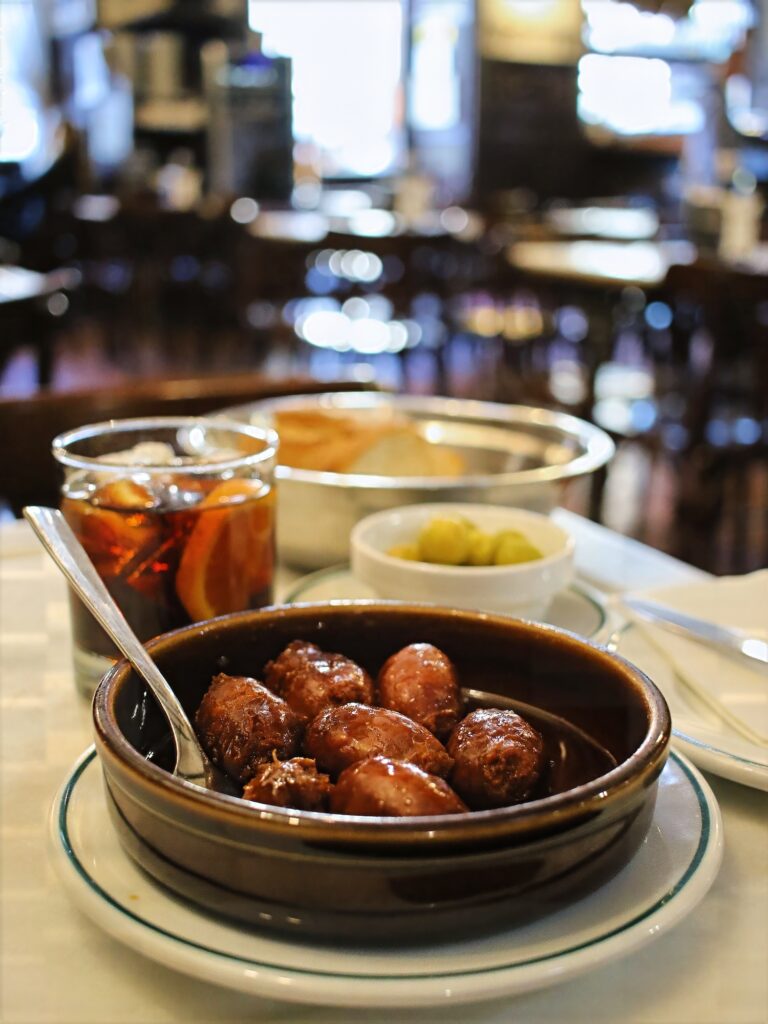
(Howie Southworth) Cervecería Alemana
Down a small alley is Casa Alberto, where the weight of Cervantes is heavy. The writer lived in this building, well before it was known for its oxtail, and the restaurant honors him by displaying a dusty bottle rack said to be his, I don’t ask. I take a tapa of rabo de toro, a stewed tail so tender it forgets it was ever muscle. I mop their famous gravy with a hunk of sourdough and hear Sancho Panza in my head and I grin. “With bread, all sorrows are less.”
I welcome a stroll after my helping of bull and wind my way back to La Venencia, a storied sherry bar with a silence all its own. During the Civil War, Hemingway drank here seeking news to report of the Republican front. Today could well be 1937. You don’t take photos. You don’t talk too loud. You don’t swirl your glass like you learned wine in Bordeaux. You order mazanilla, maybe some cured beef, and you listen. Hold your glass wrong and someone might suspect you of being a Francoist spy. The barkeep does not smile. All part of the charm.
We need your help to stay independent.
A few blocks away, at the edge of las Letras, I pass the Ateneo de Madrid. Founded in the 1830s, or maybe earlier, it’s been a private arts club, a home for nonconformist thinkers and drinkers since gaslights burned. There’s some event here, I catch a spillover crowd outside at a bar nearby. I ask about their gathering. A new book, they say. Something about bullfighting and the first female torera. The author’s there, the affable Fernando González Viñas, flanked by a matador and his entourage. Fernando, in true writer form, smirks when asked about being at the Ateneo and does his best Groucho Marx, “I refuse to join any club that would have me as a member.”
Smoke. Laughter. A touch of hubris, another glass. For moments, it’s our own tertulia, though I know better than to question the bullfight. The Spanish also feel the pull, we take a final sip.
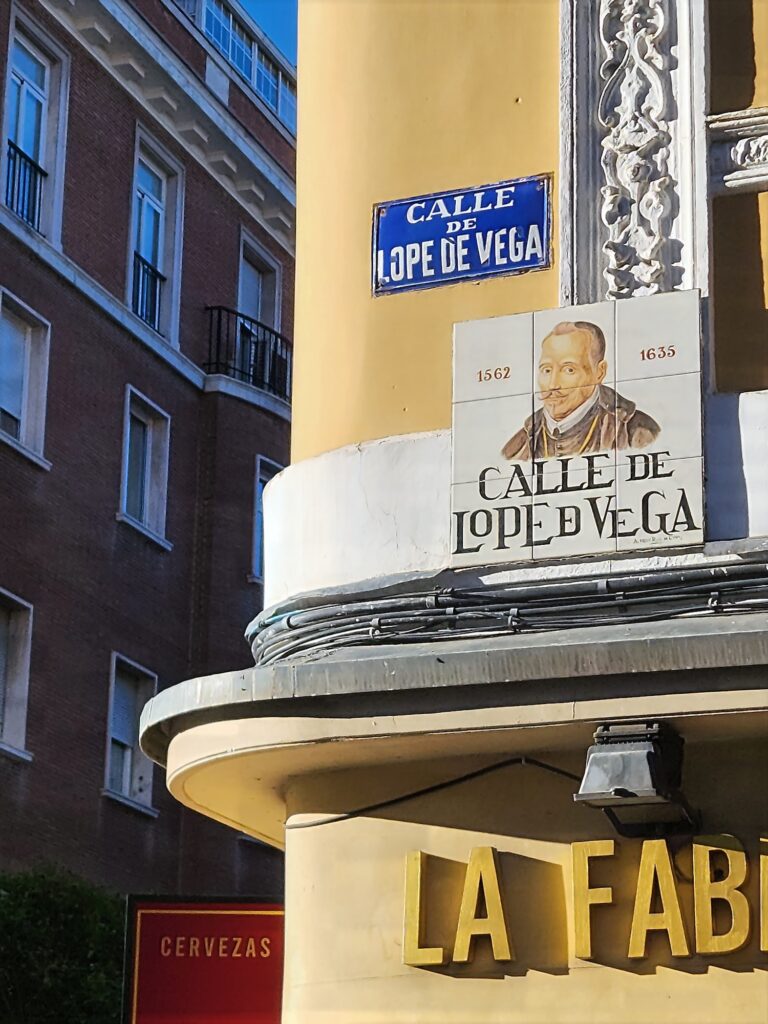
(Howie Southworth) Lope de Vega Street sign in Los Letras
After bidding a hearty olé to my literary brethren, I reach Café Gijón, outside the bounds of Las Letras, but not its spirit. Hemingway enjoyed a tipple or three here and joined the likes of Federico Lorca and Salvador Dalí in talk of the arts and society. I sit for a slice of tarta de Santiago, almond and lemon and a work of art itself. The waiters move slowly, the mirrors hold onto the past. If Madrid had a thinking room, it would be this.
Later, back at NH Collection Suecia, Hemingway’s old Madrid address and my lucky perch for the week, I detour into the restroom. Next to the normal sign is a curious addition, the signature of Hemingway himself. Mysterious. Past the stalls and the sinks through another door lies plush red velvet, shadows, and the hum of 1950. This was Papa’s speakeasy. There is no tertulia here, just spirits in all forms. I don’t linger but admire the genius of it, grab a fist of Rioja Alta and head to the rooftop lounge for a sunset thought amid stunning views of the city. Through my glass, Barrio de las Letras fades into its own rosy haze.
Madrid does not hurry. It reads. It walks. It eats and drinks. It remembers. And so do I.
Read more
about this topic
