

There have been many changes in America’s political system in the last decade or so, but some things are perennial. If you would have told me in August 2015 that we would be in the middle of Donald Trump’s second term, in which he’s slapping his name on buildings all over Washington, building monuments to himself and declaring that the country is under attack by communists, I would have laughed out loud. But if you had told me instead that the media would be framing the upcoming midterm elections as a referendum on the Democrats going too far left and alienating the rock-ribbed Americans who matter, I would have shrugged and said, “What else is new?”
If there is one thing we have been able to count on for the last 30 years, if not longer, it is that it doesn’t matter how extreme the right wing might become or how far down the conspiratorial rabbit hole they go. The media interprets all political events in this polarized environment as validation of the belief that conservatives are always more in touch with Real America, and therefore more deserving of positions of leadership. According to this thesis, if Democrats want to win power, they will have to radically change their positions.
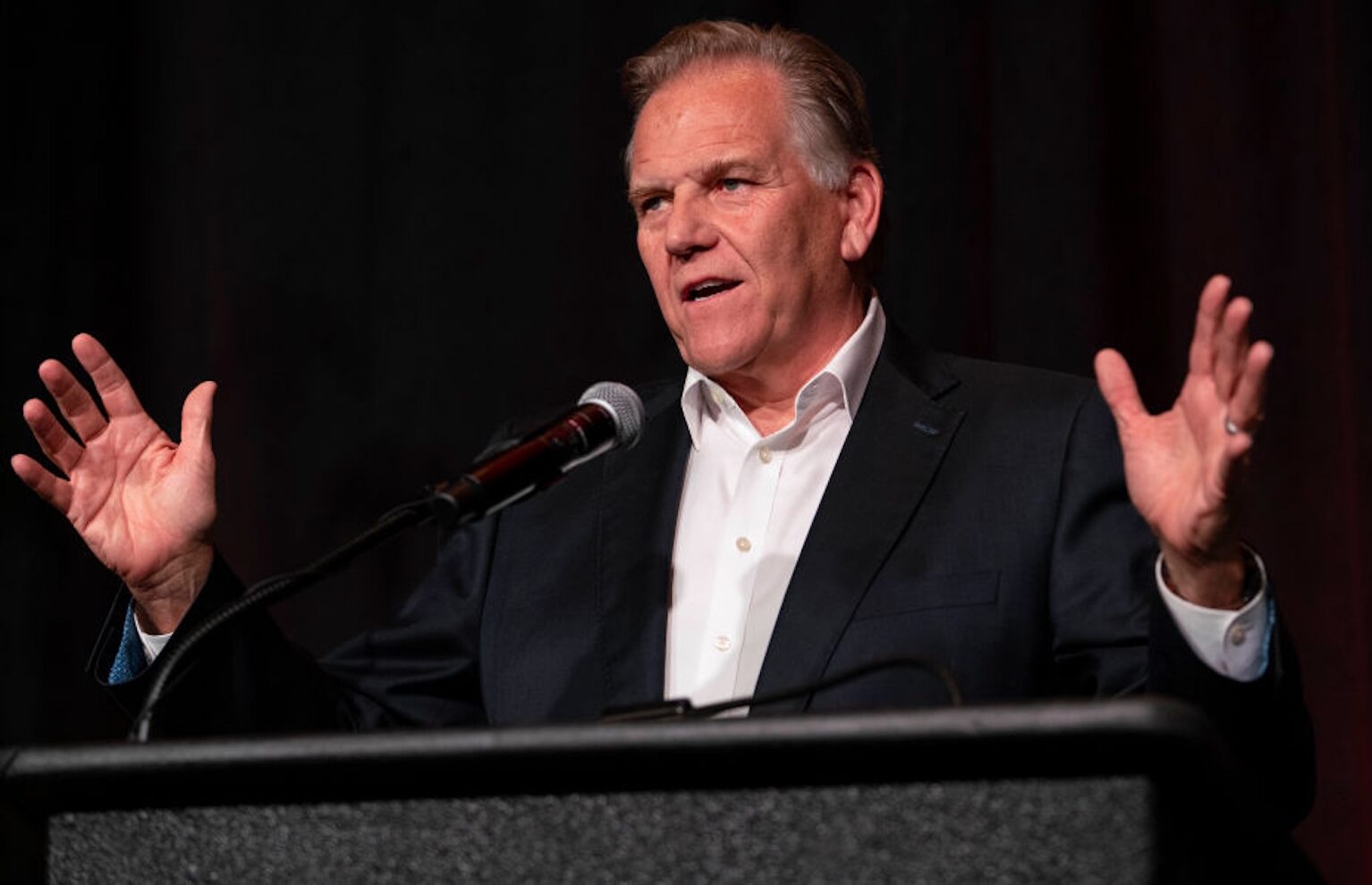
That’s the conventional wisdom when it comes to the Michigan Senate race. After Dr. Abdul El-Sayed’s win on August 4 in the Democratic primary, an avalanche of articles, editorials and op-eds — not to mention analysis by television pundits and social media influencers — have appeared claiming that he is too far left for Michigan’s general election voters. Practically no one is doing the same for his GOP opponent, former Rep. Mike Rogers, who has tacked so far right that he has become a Midwestern hologram of the president.
This pattern is fascinating, especially considering the fact that in the last 35 years, Democrats have won the presidency five times to the Republicans’ four, a number that includes the two times (George W. Bush in 2000 and Donald Trump in 2016) the party lost the popular vote but won the anachronistic Electoral College. Coupled with the fact that control of Congress has been evenly split, it’s not as though the GOP has had their fingers on the American pulse this whole time. Instead, they have built a massive partisan media infrastructure and stolen Supreme Court seats to further put their thumbs on the scale of the electoral system with big money and voter suppression.
With the deep unfairness of the Senate giving far more power to small, rural (and conservative) states, the institutional advantage held by Republicans is profound. And yet, according to conventional wisdom and the predictable knee-jerk reactions by too many establishment Democrats, when Republicans win it’s because conservative ideas have won over the people, and when the Democrats win it’s also because conservative ideas have won over the people.
This dynamic was on full display Sunday when CNN’s Fareed Zakaria analyzed the Michigan Senate race by saying that working class voters have abandoned Democrats as the party has moved left — even as they have tried to appeal to people on economic grounds and offer ideas that will help them materially. “The lesson is not that economics don’t matter,” he said, “but the Democratic Party’s problem is not that it is seen as too centrist on economics. Democrats routinely lead Republicans on issues like healthcare, and even now, the cost of living. Their liabilities are cultural and social issues — crime, immigration, the border and the so-called woke agenda.” In other words, Democrats must move right on cultural issues to win elections.
When Republicans lose — which, as we’ve seen, happens at least half the time — they aren’t harangued to take up diversity, equity and inclusion initiatives, open the borders or clamp down on excess policing, even though their excesses on those issues could just as easily be seen as dispositive.
When Republicans lose — which, as we’ve seen, happens at least half the time — they aren’t harangued to take up diversity, equity and inclusion initiatives, open the borders or clamp down on excess policing, even though their excesses on those issues could just as easily be seen as dispositive. The press will blame Trump or individual candidates for a lack of character, but they rarely apply the kind of analysis that Zakaria does, which essentially demands that Republicans abandon elements of their base to pander to Democrats.
The result is that only Democrats have agency to break the impasse.
When Bill Clinton won the presidency 34 years ago, Democrats had been in the presidential wilderness for 12 years. Their last two presidents, Jimmy Carter and Lyndon Johnson, had left office under the clouds of the Iran hostage crisis, in the case of the former, and Vietnam with the latter. The party decided to do just as Zakaria suggested, and Clinton won a plurality of voters in the 1992 general election on a platform of fiscal and personal responsibility, challenging the Democratic base on, you guessed it, culture war issues. Two years later, the GOP won the House majority for the first time in 42 years. So, that worked out well.
According to surveys conducted by the Pew Research Center, over the past 35 years, the public has actually moved left on culture war issues, following a progressive shift among Democrats, while the right has clung to its prejudices. (Republicans’ cult worship of Trump and conspiratorial thinking is hard to measure in these terms, but there is no doubt they have changed dramatically in this regard.)
Start your day with essential news from Salon.
Sign up for our free morning newsletter, Crash Course.
It should come as no surprise then that Democrats, feeling their strength in opposition to the extremely unpopular Trump, would see an opportunity to more explicitly push their message. Generally speaking, midterm elections are seen as a referendum on the party in power, and with the economy in an ongoing slump and Trump more polarizing than ever, you cannot blame them. As the New York Times reported, the party’s left wing has been energetically organizing all over the country, and it’s paid dividends in primaries in blue and purple states alike in the upper Midwest. And, once again, the media is falling back on the same old fear-mongering about the left alienating the Real Americans.
We have article after article hand-wringing over El-Sayed’s primary win because he supports issues they consider beyond the pale, such as Medicare for All, abolishing Immigration and Customs Enforcement and ending unlimited support for Israel, even though each of these issues have majority support. His primary opponents are now holding unity rallies to bring the various factions of the party together after the bruising campaign, and the national party has mobilized in support of his candidacy, including former President Barack Obama and former Transportation Secretary — and current Michigan resident — Pete Buttigieg, both of whom carry serious clout among more conservative members of the Democratic base and independent voters. In other words, Democrats are doing everything they can to reach out to the broad middle of the state.
Rogers, meanwhile, is doing the opposite, tacking hard to the right and even going so far as to join the most noxious, destructive conspiracy theory of all: election denialism.
Rogers, meanwhile, is doing the opposite, tacking hard to the right and even going so far as to join the most noxious, destructive conspiracy theory of all: election denialism.
As a member of Congress between 2001 and 2015, Rogers was a standard conservative in the George W. Bush mold, voting for tax cuts and deregulation, and later chairing the powerful House intelligence committee in the last four years of his term. When he retired from the House, Rogers worked as a talk radio host and commentator for CNN. Although he supported Trump after he won the GOP presidential nomination in 2016, he refused to go down the road of the Big Lie following Joe Biden’s win in 2020. In an op-ed for the Washington Post — published the day before the Jan. 6 assault on the Capitol — Rogers called Trump’s call to Georgia Secretary of State Brad Raffensperger, in which he urged the secretary to find him additional votes, “more gangster than presidential.” Rogers wrote, “This trend of refusing to accept free and fair elections, without any proof of fraud, must end for the sake of our democratic republic.” A year later, he said Trump’s political career was over.
But times have changed.
In 2024, when Rogers ran for the Senate against Elissa Slotkin, who would go on to win the race, he needed Trump’s endorsement. He gave his in return. Rogers has also adopted the president’s Big Lie, which should be disqualifying among thinking people everywhere.
We need your help to stay independent.
I’m not seeing a lot of hand-wringing among the pundits about how Rogers is losing Real Americans with his extreme views; that criticism is being reserved for El-Sayed. Likewise, Texas Attorney General Ken Paxton, who is locked in a close Senate race against Democrat state Rep. James Talarico, isn’t being browbeaten to moderate his views.
The Democrats may very well lose those races. But in this closely divided electorate, they might have lost them anyway with more moderate candidates. After all, Republicans have been running on racism and left-wing hippies for decades, no matter what their views were. The very centrist Clinton was vilified 35 years ago because he played the saxophone with sunglasses on “The Arsenio Hall Show.” Barack Obama’s middle name — Hussein — remains an Islamophobic meme all these years later. So, it’s not as if Republicans wouldn’t deploy the same insults to other candidates, no matter their positions.
This year, Democrats are talking straight and taking it right to the people, and both El-Sayed and Talarico, with their populist messages, are powerful communicators. Maybe it won’t work. But it’s long past time for the Democratic Party to stop allowing candidates to be harassed by the conventional wisdom that says the only way to win is to run to the right.
Read more
about the 2026 midterms
