

In June, I became briefly preoccupied with the question of what kind of reader I intended to be that summer. This happens to me periodically, usually when the weather changes and I begin imagining that a new season might also produce a new personality. Perhaps I would read slim English novels in the park. Perhaps I would develop a sudden expertise in close-up magic. Perhaps, for reasons unclear even to me, I would become very interested in rural schools.
The Chicago Public Library was happy to indulge all three possibilities.
I began gently optimizing my library use the way someone might optimize a coffee-shop punch card. Except the library had devised a vastly superior arrangement: There was nothing I had to purchase in order to qualify.
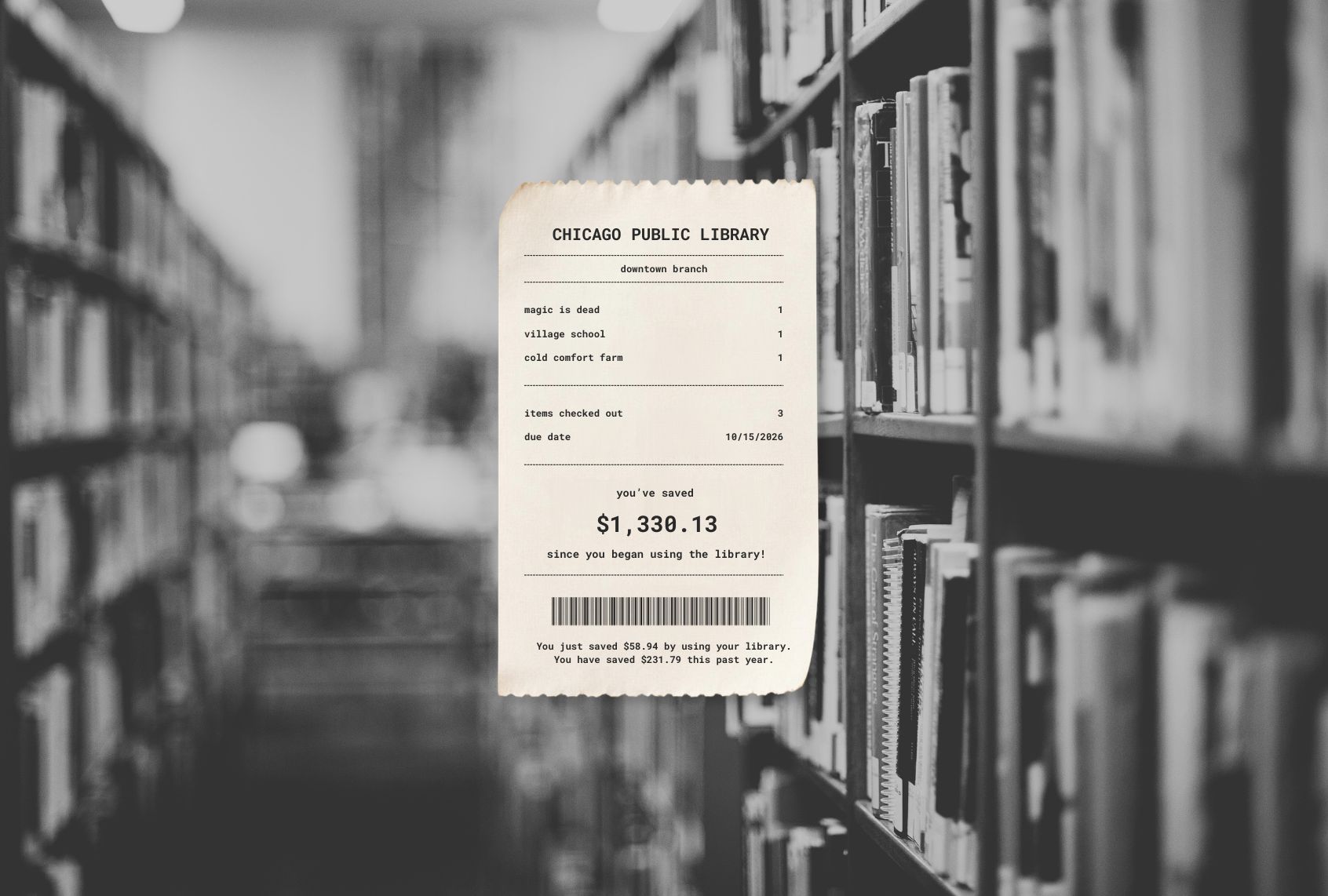
One afternoon I came home with “Magic Is Dead: My Journey Into the World’s Most Secretive Society of Magicians,” “Village School” and “Cold Comfort Farm,” a stack suggesting either eclectic tastes or a person throwing darts at a bookshelf. Shortly afterward, I received the standard email from the library listing my new acquisitions and their due dates.
Then, underneath the administrative business, came a little piece of information I had somehow never noticed before: You just saved $58.94 by using your library. You have saved $231.79 this past year and $1,107.24 since you began using the library!
I stared at this. My first thought was not, “What a compelling demonstration of the economic value of municipal services.”
My first thought was: I want that number higher.
I took a screenshot and sent it to my sister, who lives in another state.
“Oh, that’s satisfying,” she replied. “I wish my library did that.”
She was right. Somewhere inside me, a tiny rewards-program customer had been activated.
After that, I started browsing the library website differently: less like a catalog, more like a streaming service with unusually eccentric licensing agreements. Did I need the complete box set of “Nip/Tuck”? Maybe. A Blu-ray collection of British noir? Quite possibly. What about both movies called “The Illusionist” — the bittersweet French animated one about an aging magician and the Edward Norton one in which he is also, confusingly, a magician?
Depends what “need” means.
Want more from culture than just the latest trend? The Swell highlights art made to last.
Sign up here
I began gently optimizing my library use the way someone might optimize a coffee-shop punch card. Except the library had devised a vastly superior arrangement: There was nothing I had to purchase in order to qualify.
Everything was already free. I simply kept winning.
By the end of the summer, the number had become part accounting device, part civic high score. A stack of books about sourdough: another $33. Year-to-date savings: $454.68. Lifetime savings: $1,330.13. I began eyeing $3,000 the way someone playing a very gentle video game might eye the next level.
Obviously, I had not literally saved $1,330.13. Without a library, I would not have purchased every cookbook, obscure DVD and book about secretive magicians that caught my eye.
But the number was doing something more interesting than keeping track of imaginary thrift.
It was giving a price to access.
We need your help to stay independent.
And perhaps because so much of modern life trains us to understand value through price, that silly little dollar amount made the library look newly enormous to me. Not merely free. Abundant.
I emailed Brent Lipinski, the Chicago Public Library’s assistant commissioner for patron experience, to ask how the counter came to be there. The origin story was pleasingly unceremonious. CPL began using the feature in 2025, after one of its data analysts started “playing around with the different tools available in our system” and discovered the option.
“After testing it out and seeing how much he had saved,” Lipinski said, “he brought it to a team meeting and everyone immediately thought it was a great idea.”
The number was doing something more interesting than keeping track of imaginary thrift. It was giving a price to access.
The calculation itself is almost comically literal. When CPL buys an item, its system records the retail price; when a patron checks it out, that amount gets added to the running total. My $1,330.13 was, in other words, the accumulated sticker price of my particular trail through the stacks.
What CPL hoped patrons would take from the number, though, was something bigger than thrift.
“We hoped that providing data around how much someone saves using a public service would give patrons a sense of ownership to utilize their local library,” Lipinski told me.
That phrase — “a sense of ownership” — seems almost paradoxical for an institution whose entire premise is that you do not need to own the things you want to use.
And yet I knew exactly what he meant.
The number made the library feel more mine, not less. Not mine in the sense that I could keep the “Nip/Tuck” box set forever, but mine in the slightly embarrassing civic sense: I live here. I have a card. This place is available to me. All of these books, movies, CDs and other materials are sitting there waiting to be used.
Apparently, plenty of other Chicagoans have experienced the same little jolt.
Lipinski said some of the earliest excitement around the feature came from a Reddit post by a patron whose receipt showed more than $118,000 in lifetime savings. CPL shared the post on Instagram, where other patrons began volunteering their totals in the comments — a spontaneous little leaderboard for people whose competitive edge expresses itself through returning DVDs on time.
My $1,330.13 suddenly seemed less like an achievement and more like a tutorial level.
Not everything needs to be translated into dollars. I would not necessarily improve an afternoon at the Montrose Bird Sanctuary by having someone stationed at the exit to hand me a receipt: You saw $46 worth of warblers today.
Frequent CPL users can accumulate $50,000 to $80,000 in savings, Lipinski said. The library has even encountered someone whose total approached $1.5 million.
One and a half million dollars.
I had thought I was playing aggressively because I checked out both “The Illusionists.” Clearly I lacked vision.
The funny thing is that nearly everyone I have shown the counter to understands the appeal immediately. Friends in California, Texas and Georgia have all had some version of my sister’s reaction: Wait, your library does that? I wish mine did.
Which makes me wonder what, exactly, the number is doing for us.
There is a mildly unsettling answer available. Maybe it says something bleak about American consumer culture that the public commons has to speak in the language of shopping before we recognize its value. We understand “YOU SAVED $17.43” instantly because grocery stores, loyalty programs and shopping apps have spent decades training us to do so.
Not everything needs to be translated into dollars. I would not necessarily improve an afternoon at the Montrose Bird Sanctuary by having someone stationed at the exit to hand me a receipt: You saw $46 worth of warblers today.
Although now that I think about it, I would absolutely keep that receipt.
This is the double edge of attaching prices to things that are valuable precisely because they are not transactions. The number is artificial. The experience is not.
But I find myself less troubled by CPL borrowing the language of commerce than delighted by what it has done with it. The same machinery normally designed to make me acquire more has, in this case, made me more aware of what I can enjoy without acquiring at all.
And once you notice that trick, it becomes tempting to imagine where else it might work.
Recently, I watched someone stop on the street to read a flyer for a Repair Fair. “Maybe they can teach me to fix my cheap toaster, so I don’t have to buy another cheap toaster,” she told her friend.
“Yeah, girl,” her friend said. “You’ve already bought three.”
There was no receipt involved, no running lifetime total for Toasters Not Purchased. But the arithmetic was suddenly visible anyway: one broken appliance repaired, one replacement avoided, however many dollars still in somebody’s pocket.
Maybe that visibility is the useful part.
Public and communal resources can be easy to undervalue precisely because so much of their worth is ambient. The park is there. The library is there. The program is free. Nothing dings your credit card, so there is no little electronic moment announcing: Look what you just got.
CPL’s counter does.
It takes something diffuse — access to a vast collection of things you do not personally have to own — and renders it in the language of a grocery receipt. It is slightly absurd. It is probably imperfect. It is also, apparently, extremely effective on people like me.
“When patrons see how much money they’ve saved,” Lipinski told me, “we hope they are inspired to keep coming back and saving even more!”
I have $1,669.87 to go to reach the next level.
Read more
about this topic
