
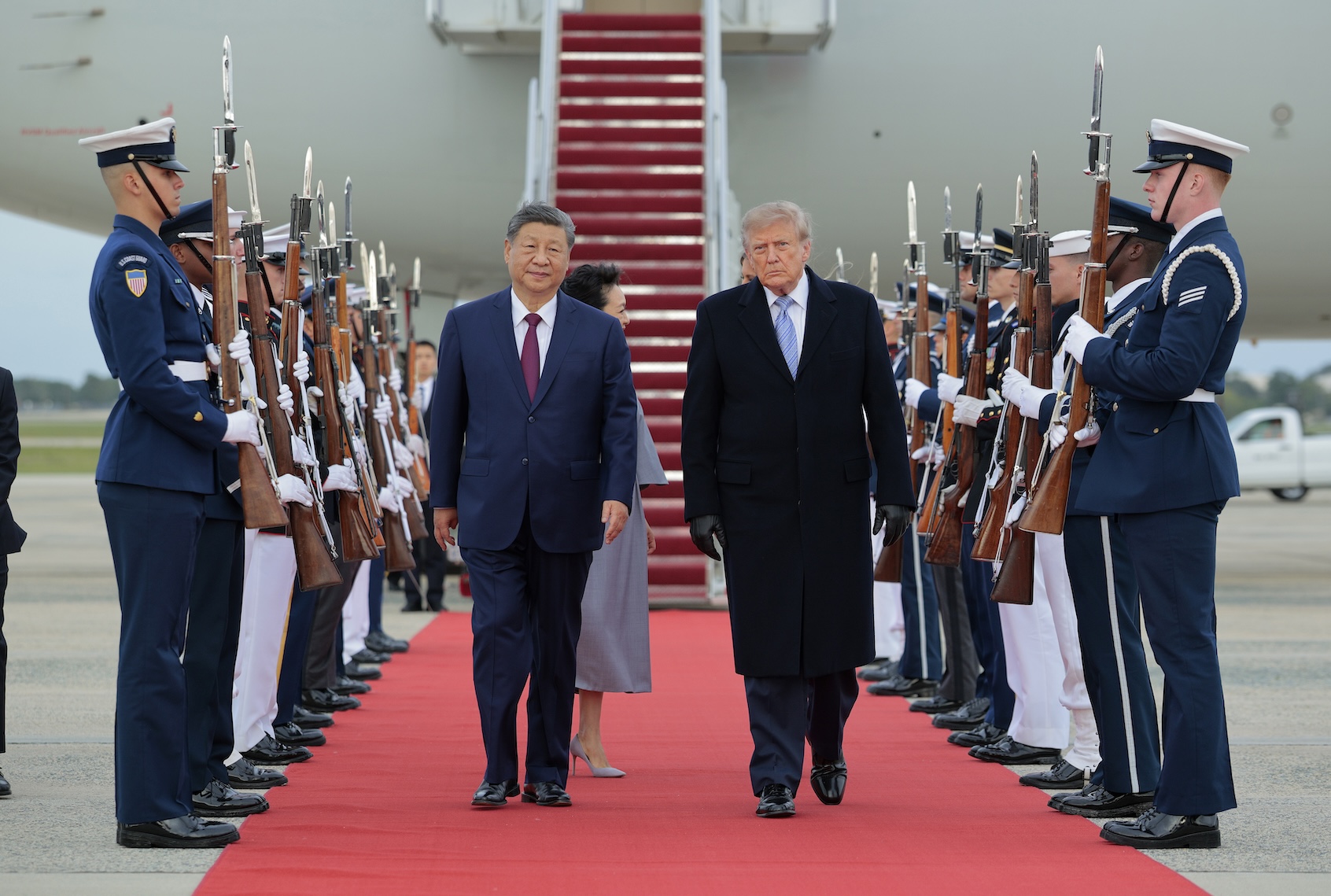

Certain obvious questions arise from Chinese President Xi Jinping’s visit to Washington this past week, a spectacle that one observer has described as “diplotainment” rather than actual diplomacy. Exactly how much did Donald Trump abase himself in service to a temporary and transactional friendship with the dictatorial leader of a nation that is, at least by conventional standards, America’s principal strategic enemy?
No one knows; I am tempted to surmise that Trump doesn’t know himself. The man who in sunnier times for his regime enjoyed calling himself “your favorite president” does not seem to be his own favorite president these days. Trump almost visibly glowed with delight when Xi praised the quality of service and attention to detail of his White House visit. “Everything is done to the highest order of perfection, and there is thought in every little detail,” the Chinese president said through a translator. “And it’s greatly appreciated.”
You could describe that as the meaningless courtesies of routine statecraft, but it also suggested a high-flying hotel guest offering his compliments to the concierge: The eggs this morning were entirely delicious. And the way your people turn down the sheets at night: exquisite!
If we could somehow remove ourselves from the anguish and destruction caused by Trump’s improvised policies (which resemble comic-book versions of Big Brother’s “Two Minutes Hate” from the film version of “1984”) and his aggressively stupid public persona, we might be able to perceive some pathos in his predicament. He cannot escape from a situation he believed he had created and felt he could control: He is the massively unpopular elected leader of a rapidly collapsing superpower, whose downward slide he promised to reverse but has only accelerated, perhaps to the point of terminal velocity.
Trump visibly and hungrily longs for things he cannot have: the alleged greatness of the mythological American past, rendered as white supremacist schlock inherited third hand from the more vigorous fascist movements of the last century; the enforced adulation and obligatory public spectacle of a totalitarian regime such as Xi’s China or Kim Jong-un’s North Korea; most of all, perhaps, his own youth as a brash Manhattan philanderer and unstoppable political renegade, when he didn’t fall asleep in public or stumble around awkwardly with an unexplained contraption under his clothing.
Trump visibly longs for things he cannot have: the alleged greatness of the American past, rendered as white supremacist schlock; the enforced adulation of a totalitarian regime; most of all, perhaps, his own youth as a brash Manhattan philanderer and unstoppable political renegade.
To consider such matters is not a distraction; it begins to point us toward the larger and more painful questions behind the Xi-Trump pseudo-summit. It surprised literally no one that the two leaders negotiated no new agreements on regulating A.I. (or “Super Intelligence,” in Trump’s self-parodying rebrand), the status of Taiwan, the sporadic trade war between the two nations or ending the war with Iran and restarting the global flow of Middle East oil. No mention was made of Trump’s vaporware claims last May that the Chinese had agreed to buy hundreds of Boeing aircraft and $10 billion worth of U.S. beef and soybeans, but Xi promised to send two pandas from China’s breeding facility to the Atlanta zoo. So much winning. It’s impossible to calculate.
In large part, the absolute nothingness of this summit reflects the fact that China is already winning across the board and Xi needed nothing from Trump beyond the legitimation provided by a diplotainment spectacle “to the highest order of perfection.” As China scholars Nicholas Bequelin and Yaqiu Wang write in a Foreign Policy analysis published before the summit, over the first 19 months of Trump’s second term, the geopolitical “balance of power has shifted in Beijing’s favor”:
China has weathered the trade war, narrowed the technology gap, tightened its leverage over critical supply chains, increased pressure on Taiwan, and deepened ties with Russia and much of the global south.
Contrary to more Sinophobic commentators, they argue that China’s ruthlessly pragmatic leadership is not interested in dominating the world, or at least not in the same way postwar America did. But it does have a long-term agenda, they write, which includes breaking the global dependence on U.S.-centric financial institutions, discrediting democracy and furthering a historical process Xi has described as “the rise of the East and the decline of the West.”
We need your help to stay independent.
I don’t disagree with any of that, but the most important aspect of Bequelin and Wang’s analysis gets a little buried beneath a forest of impeccably organized policy details. Xi has no need to strike an overtly aggressive posture and can afford to cosplay friendship with Trump because “the West,” or at least its greatest military and economic power, is doing a terrific job of declining all on its own. To borrow the nostrum attributed to Napoleon, the Chinese president is smart enough not to interrupt an opponent while he’s making a mistake.
It may take generations — if there are any future generations — to measure the scale of America’s self-inflicted damage, which goes well beyond material issues into the realm of psychology or perhaps spirit. (If it’s pretentious to use the Hegelian term Geist, it still fits.) It remains astonishing, not to mention upsetting and enraging, that in the face of a global climate crisis that has already caused millions of deaths and is obvious to nearly everyone on the planet, the U.S. has deliberately chosen to double down on fossil fuels while “China is consolidating its worldwide dominance in batteries, solar, and EVs,” as Bequelin and Wang write.
Faced with America’s spectacular self-own, who can blame people in the Global South for suspecting that the tradeoff between “democracy” and “authoritarianism” was never as straightforward as they were led to believe?
Chinese solar panels and batteries, often offered at steeply discounted prices, are revolutionizing transit and energy issues in many poorer countries, beginning to break the expensive and damaging addiction to foreign oil. Meanwhile, the U.S. has largely abandoned or dismantled its foreign aid programs aimed at fostering economic development, public health and education, while doing its level best to destroy its own reputation as a multiracial secular republic rooted in the rule of law. Faced with America’s spectacular self-own (which didn’t start with Trump, to be clear), who can blame people in the Global South for beginning to suspect that the tradeoff between “democracy” and “authoritarianism” was never as straightforward as they were led to believe?
Despite the widespread anger and disillusionment of Trump’s second term — an encouraging trend, to be clear — it’s still too easy for Americans to duck the biggest and most glaring question of all: To paraphrase one of the greatest works of postmodern angst, how did we get here? It no longer feels remotely adequate (if it ever did) to suggest that angry, vicious people accidentally elected an angry, vicious president who is pursuing a self-destructive and nihilistic agenda, and that at some future date our national sanity and our “indispensable” role in world affairs will be reasserted.
Want more sharp takes on politics?
Sign up for our free newsletter, Standing Room Only by Amanda Marcotte, also a weekly show on YouTube or wherever you get your podcasts.
We tried that, remember? It didn’t work. Perhaps, from some great historical remove, Joe Biden’s presidency will appear noble and tragic. But it was also doomed, trapped in a vision of the past every bit as delusional as the MAGA fantasy, and nearly as damaging. The Biden regime’s self-appointed mission of enforcing a “rules-based order” involved pretending that the world had not changed, that America was still widely beloved and admired, that our so-called republic had not bred and nurtured Donald Trump and that he did not embody its bottomless greed, its gleeful ignorance, its wounded and flatulent national pride.
And so we arrive at the final conundrum of the Trump-Xi summit, and our president’s stopped-clock tendency to stumble upon hard truths. In his inimitable ass-backward fashion, Trump has discerned that the “free world” has become a meaningless abstraction and liberal democracy is in a state of systemic failure. He is correct about that, at least to a point. But he can provide no answer beyond prostrating himself before dictators and building monuments to himself in imitation of their grandiosity. If China’s repressive techno-state makes a distinctly unappealing candidate to lead the world into the future, America can only offer competing versions of an imaginary past. Hey, at least we got those pandas.
Read more
from Andrew O’Hehir
