
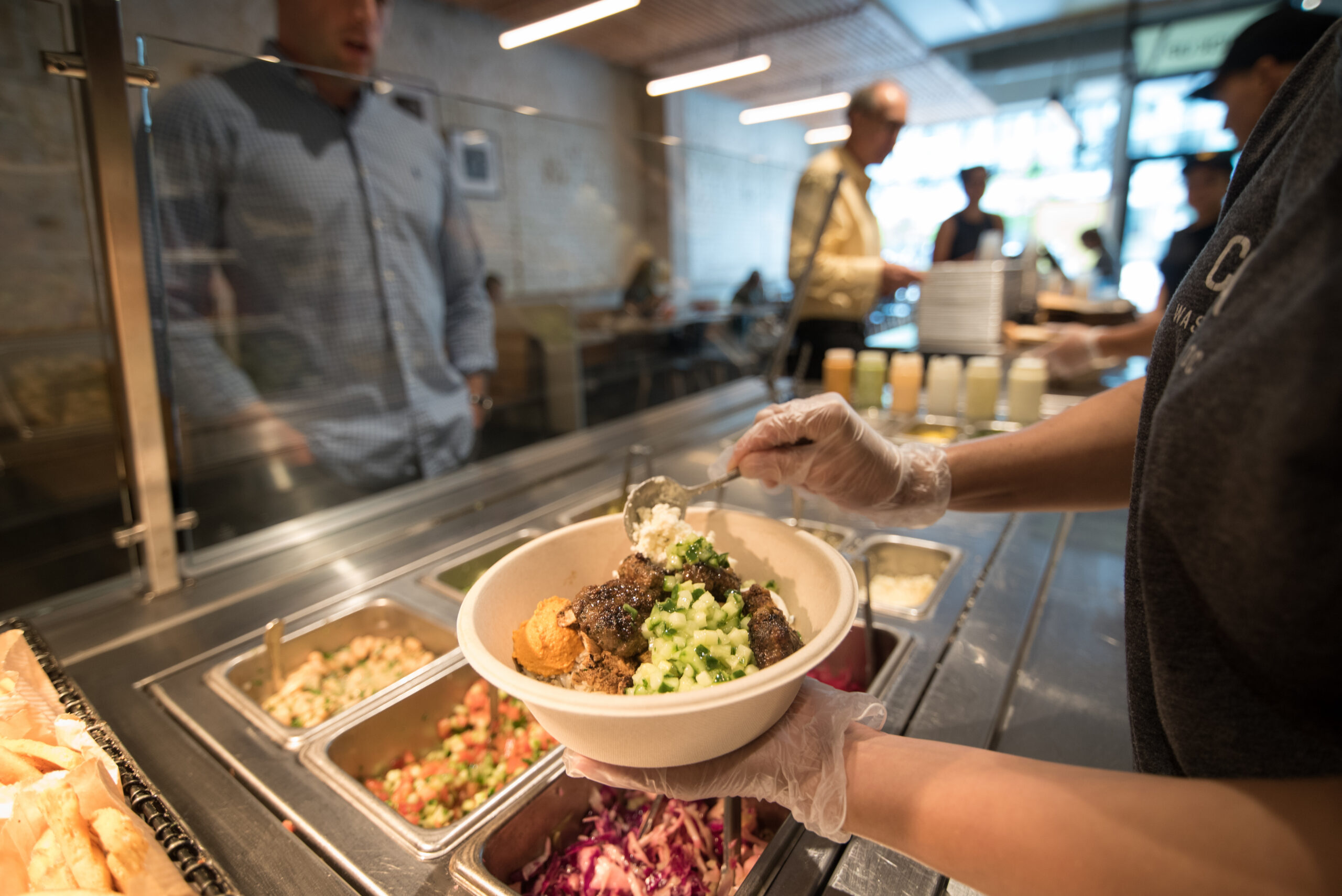

Recently, between medical appointments, I ended up at a grain-bowl-and-salad place in a suburban strip mall, the kind of sleek fast-casual restaurant that looks a little like an Apple Store decided to start serving brown rice and green goddess dressing. There were a few customers in scrubs and two self-order kiosks, both broken. The menu wasn’t posted anywhere else, except via a QR code printed on the back of several glossy takeout menus behind the register, which the cashier repeatedly warned us not to take because they only had a few.
The bowls themselves were fine. Watching them come together was more memorable: the cashier held each plastic container practically at arm’s length as he scooped, two vapes clacking around in his apron pocket, with the air of someone completing a task wholly unrelated to food. What arrived cost about $14 and tasted perfectly acceptable. It was also, somehow, shockingly anonymous.
There’s a word for this feeling now: slop.
It describes several overlapping anxieties about modern restaurant food, but its prehistory belongs, at least partly, to the ghost kitchen.
In March 2020, as dining rooms shut down, Chuck E. Cheese launched Pasqually’s Pizza & Wings, a delivery-only brand operating out of its existing kitchens. The name was technically an Easter egg: Pasqually P. Pieplate is the chef in Chuck E. Cheese’s animatronic house band.
To anyone not conversant in Chuck E. Cheese lore, though, Pasqually’s looked on Grubhub like a new pizza-and-wings joint. CEC maintained that the pizza itself was different — thicker crust, more sauce — but plenty of customers still felt tricked when they realized the restaurant at the address they’d ordered from was, in fact, Chuck E. Cheese.
The revelation inspired a small genre of internet consumer detective work. “Now I look up the addresses of places on delivery apps before I try something ‘new,’” one Reddit user wrote after discovering that an apparent new Indian restaurant was another business operating under a second name. Elsewhere, someone warned that “Pasquale’s Pizza and Wings on delivery is just Chucky Cheese.” In the same thread, though, came the rebuttal: there were good ghost kitchens. You were simply ordering from the lousy ones.
That argument feels almost quaint now. Ghost kitchens asked diners to accept a peculiar new distance between the restaurant being advertised and the human reality of the meal. What diners surrendered wasn’t necessarily quality so much as a little hospitality, a little transparency and, increasingly, the expectation that a restaurant represented somebody’s particular idea of what a restaurant should be.
From there, the abstraction moved onto the plate.
The “slop bowl” became internet shorthand for the familiar fast-casual mash-up — grains, greens, globally inspired protein, sauce, perhaps an avocado surcharge — assembled with the logic of a cafeteria line and an over-$10 price. The joke has always contained some affection; people like these bowls because they are easy, reliable and customizable. But the name also catches their underlying sameness. There is a reason so much online energy is devoted to “hacking” them: swapping sauces, doubling proteins, gaming the system in hopes of coaxing a little more pleasure from something designed, above all, to be frictionless.
We need your help to stay independent.
And now the same aesthetic has escaped the bowl. AI slop has begun appearing on restaurant menus, signs and advertisements, offering food imagery that looks optimized for appetite without necessarily resembling anything a person could cook. My digital feed is littered with truly uncanny generated sandwiches, but I’ve only encountered a few in the wild: outside a cafe, a poster for a coffee drink topped with marshmallow “pearls” so perfectly round and iridescent that they looked less edible than cultured in a lab; on the train, hamburger ads where the meat resembled slabs of smooth, steak-rippled marble. The images have the visual grammar of food photography without much evidence that food has ever been involved.
Diners, meanwhile, are already expressing an aversion to the whole thing. Late last year, CNN’s Jordan Valinsky noted that Cava, Chipotle and Sweetgreen — “the big three slop slingers” — were all reporting softer business among younger customers, particularly those between 25 and 35. Some of that was straightforward economics. On Chipotle’s final earnings call of 2025, CEO Scott Boatwright said younger customers weren’t defecting to another chain so much as returning to the grocery store. “They feel the pinch,” he told analysts, “and we feel the pullback.”
Yet alongside that financial retreat, though, there is a more aesthetic refusal taking shape. In one food group I follow, posts about AI restaurant marketing increasingly read like miniature boycott pledges. “If you use AI to advertise your restaurant, market, or anything else,” one person wrote, “I will know that you don’t care about food or the planet and I will never ever patronize your business.” Another was more prescriptive: “Take pictures of your food. Spend a little time and effort to make your own flyer.”
The complaint isn’t merely that the pictures are creepy. Diners are reading them as evidence: if a restaurant cannot be bothered to photograph its own food, hire an artist or make an ugly little flyer itself, what exactly is being communicated about the care happening elsewhere?
That inference may not always be fair. Restaurant margins are brutal, and a generated image costs less than a photo shoot. But fairness is almost beside the point. Once diners begin treating evidence of human effort as part of the product, efficiency itself can start looking suspicious.
Which may explain the newest addition to the slop lexicon: PE, or private-equity, slop. The term is less a description of any particular food than a prediction about what happens when the people optimizing a restaurant become increasingly distant from the people cooking in it.
Want more great food writing and recipes? Sign up for Salon’s free food newsletter, The Bite.
Consider Los Tacos No. 1. The New York taco shop opened in 2013, earned a devoted following for its al pastor and handmade tortillas, and eventually grew to nine locations. As The Guardian reported, when it announced this September that it had taken an undisclosed investment from private-equity firm TSG Consumer to pursue what a press release called “thoughtful, founder-led growth,” customers immediately began writing its obituary. Social posts predicted “the beginning of the end,” along with smaller portions and worse food. The response became so intense that Los Tacos’ founders issued a reassurance that sounded almost like parody: “No, we’re not going to start charging extra for guac. We’re not switching to horse meat. And no, we’re definitely not messing with the tacos.”
The tacos had not, at that point, been messed with. That’s what makes the reaction interesting. “PE slop” names an anticipatory fear: that somewhere down the line, somebody who has never stood over the grill will notice that a particular ingredient costs slightly more, or a particular process takes slightly longer, and ask whether anyone would really notice if it disappeared.
My colleague Alex Galbraith recently argued that food may be where consumers most easily recognize the otherwise abstract mechanics of private equity. Newspapers can become thinner and health care more Byzantine in ways that are difficult to trace back to an investment firm. Lunch is more intimate.
Galbraith points to a recent interview with comedian Stavros Halkias who summed it up like this: “Everybody understands that Wendy’s has gotten s**ttier. The spicy chicken sandwich now uses shredded lettuce. Right there, that is private equity. That is someone saying ‘We don’t want a fresh head of lettuce that costs more money. So, we’re going to give you bagged sh**ty lettuce. I know in the grand scheme of things it’s not a big deal, but people will notice.”
I don’t think all these things are “slop” because they’re necessarily bad. I think we’ve reached a point of saturation with food that feels devoid of human authorship. For years, restaurants have been encouraged to become frictionless, scalable, customizable and infinitely replicable. Now diners seem increasingly sensitive to the moment when all that optimization scrubs away specificity.
The opposite of slop isn’t necessarily handmade, independent, expensive or even particularly beautiful. A chain can have it; a bowl can have it; a restaurant backed by investors can have it. It’s simply the sense that something looks and tastes the way it does because somewhere along the line a person said, I like it this way, so I make it this way.
This isn’t an argument for turning every anonymous strip mall back into a village of idiosyncratic mom-and-pop shops. It’s something smaller, and probably more achievable. After years of food designed to work everywhere for everyone, diners may simply be hungry again for evidence that somebody meant it.
Read more
from Ashlie D. Stevens
