
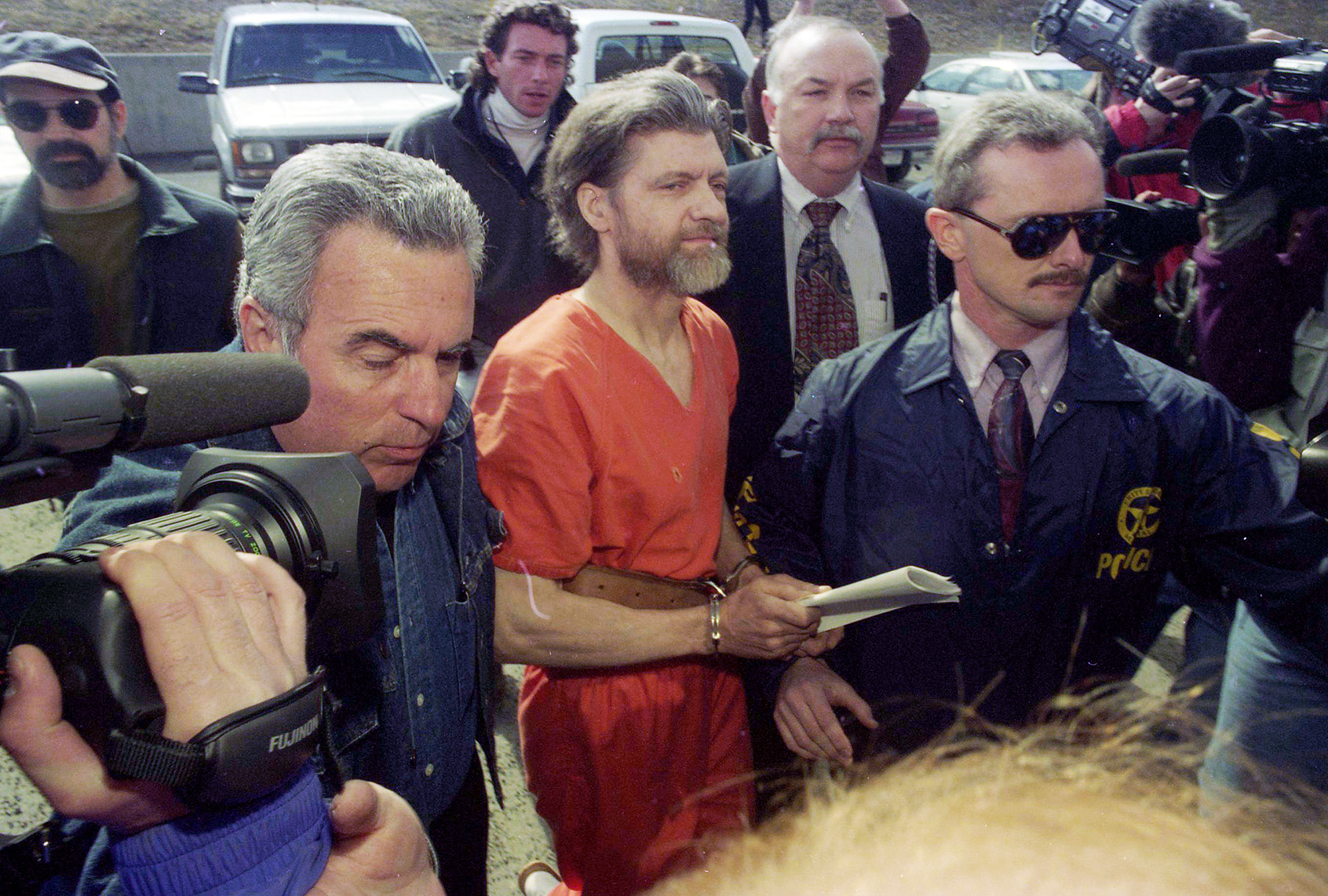

Netflix’s film “Unabomber” arrived last Friday, and by the weekend it was the most-watched movie on the platform — despite reviews calling it “dangerously simplistic” (IndieWire) and “another box checked on Netflix’s long, long list of true crime content” (Decider). Mixed is putting it kindly.
I watched this streaming content through a unique lens because I have a vantage point on this story almost no one else does: I grew up next door to Ted Kaczynski. For 16 years, the Unabomber was my neighbor in Lincoln, Montana. Which is why you’ll notice I don’t call this a “true-crime thriller.”
The violence I uncovered in our shared backyard was harrowing: the strychnine fed to my beloved jet-black dog, Wiley, a threat against my little sister’s life when she was still a toddler, and evidence that Ted had built and tested bombs in the very woods where I’d ridden horseback and built childhood forts.
Ted wasn’t always the wild-eyed figure the FBI dragged out of a 10×12 cabin in the woods. He was a son, a brother, a student, a professor — the perpetrator of one of the longest domestic terrorism campaigns in American history was once a baby in his mother’s arms, a boy idolized by his younger brother, David. When Ted and David bought 1.4 acres from my grandfather in 1971, Ted still looked like the buttoned-up Berkeley professor, not a disheveled hermit with a taste for murder.
“Teddy,” as our family called him in those early years, didn’t just live alongside us. In the ’80s — before a text message counted as a greeting — he shared meals and dinner conversation with our family. He held me in his arms when I was a baby, brought me gifts as a child, played cards with my parents, and even worked for my family. Ted didn’t present as a monster. He presented as an eccentric neighbor who’d chosen a peaceful, off-grid lifestyle.
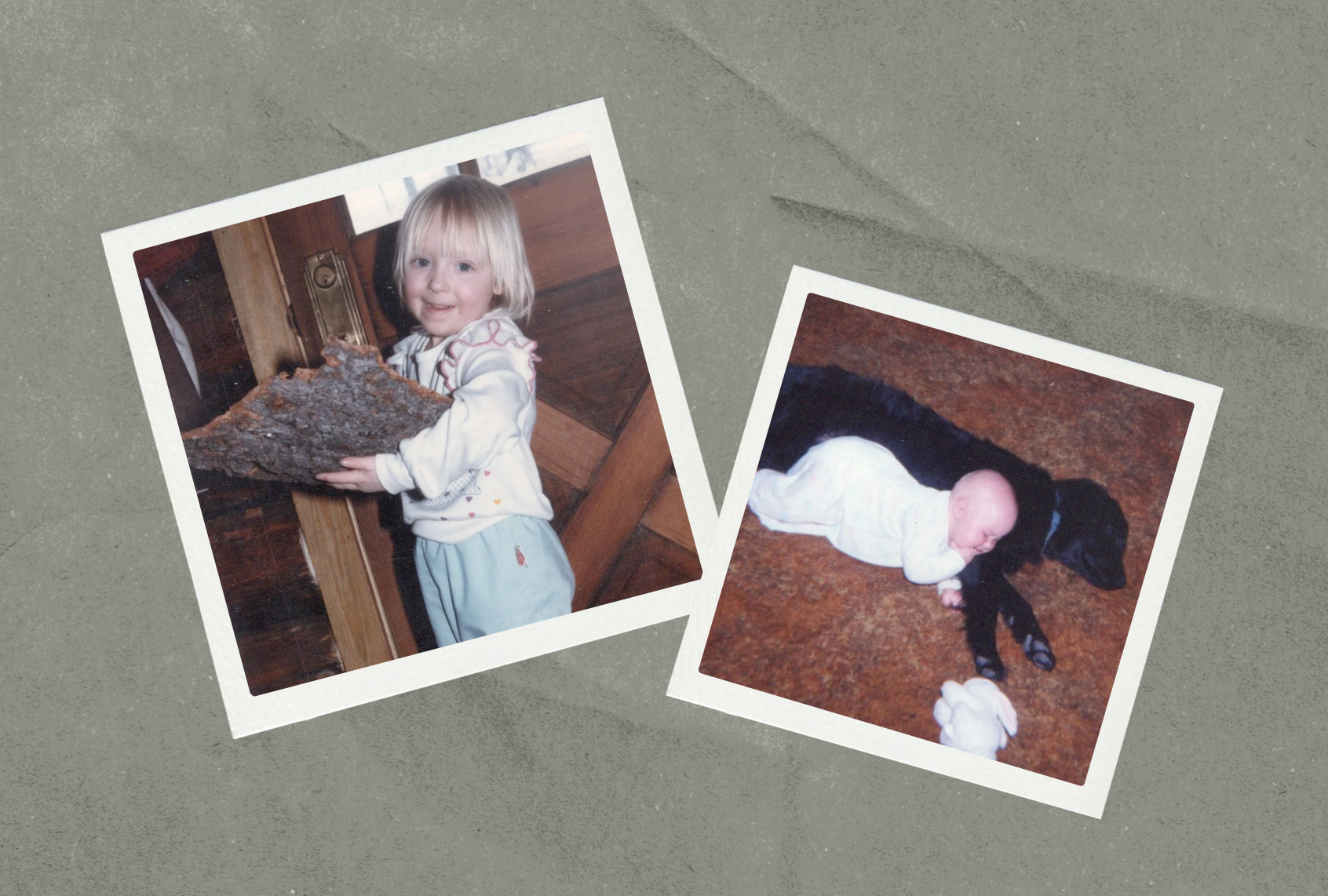
(Illustration by Salon / Images courtesy of Jamie Gehring) A young Jamie Gehring, left, in the early 1980s in the cabin where her family shared meals with Ted Kaczynski. Right, her sister, Tessa, with the family dog, which Gehring says Kaczynski poisoned.
I only began to grasp the full extent of his violence while writing my book, “Madman in the Woods: Life Next Door to the Unabomber.” For five years, my evenings were spent trying to crawl inside not only a killer’s mind, but the mind of the man next door who spoke to me in the gentle voice in which people reserve for children. I interviewed people who knew him and people who hunted him, reading thousands of pages of his journals, and corresponding with Ted himself at ADX Florence — the federal supermax known as the Alcatraz of the Rockies.
The violence I uncovered in our shared backyard was harrowing: the strychnine fed to my beloved jet-black dog, Wiley, a threat against my little sister’s life when she was still a toddler, and evidence that Ted had built and tested bombs in the very woods where I’d ridden horseback and built childhood forts, under the ponderosa pines.
But here’s what complicates the monster story, and what Hollywood has failed to illustrate in this movie: I also found a young man failed by nearly every system around him. A baby separated from his mother during a critical window of his development. A child so advanced in school he couldn’t relate to his peers. A teenager shipped off to Harvard at 16.
It’s that Harvard chapter where the Netflix film plants its flag. And look — the Murray experiments make for good cinema. Jacob Tremblay’s young Ted sits under bright lights, electrodes on his chest, while Russell Crowe’s Henry Murray takes him apart. The film wants this to be the moment. The scene where the monster gets made. A monster that discovers he cannot be “broken.”
Here’s what complicates the monster story, and what Hollywood has failed to illustrate in this movie: I also found a young man failed by nearly every system around him.
Some of it is true. His code name was Lawful, and Ted did want to prove that he couldn’t be defeated. There was a camera rolling, electrodes measuring heart and respiratory rates. The experiments were designed to break down a subject’s ideals and measure the stress response. They were unethical and cruel — especially for a 16-year-old who placed such importance on identity and intellect.
But the film mistakes a chapter for the whole story, and a dramatization for the record. If this is your first encounter with Kaczynski, the movie hands you a clean origin story and calls it a day. The experiments were not the single catalyst that turned a teenager into a man who would kill three people and injure 23 others. Were they part of the imperfect storm? In my opinion, yes. But an origin story is what Hollywood needs. The story is deeper, more complicated, and far from clean-cut black and white. There are so many interesting facets of this story, and I wish that the film would have taken the time and the care to tell them.
Want more from culture than just the latest trend? The Swell highlights art made to last.
Sign up here
Ted isn’t here to give his take on the reenactment, but I can tell you what he said about the experiments themselves. In a letter Ted wrote in response to a pen pal who was concerned about what the man went through with the Harvard study, he said: “The truth is that in the course of the Murray study there was one and only one unpleasant experience. It lasted about half an hour and could not have been described as ‘torture’ even in the loosest sense of the word. Mostly the Murray study consisted of interviews and the filling out of pencil-and-paper personality tests. The CIA was not involved. . .”
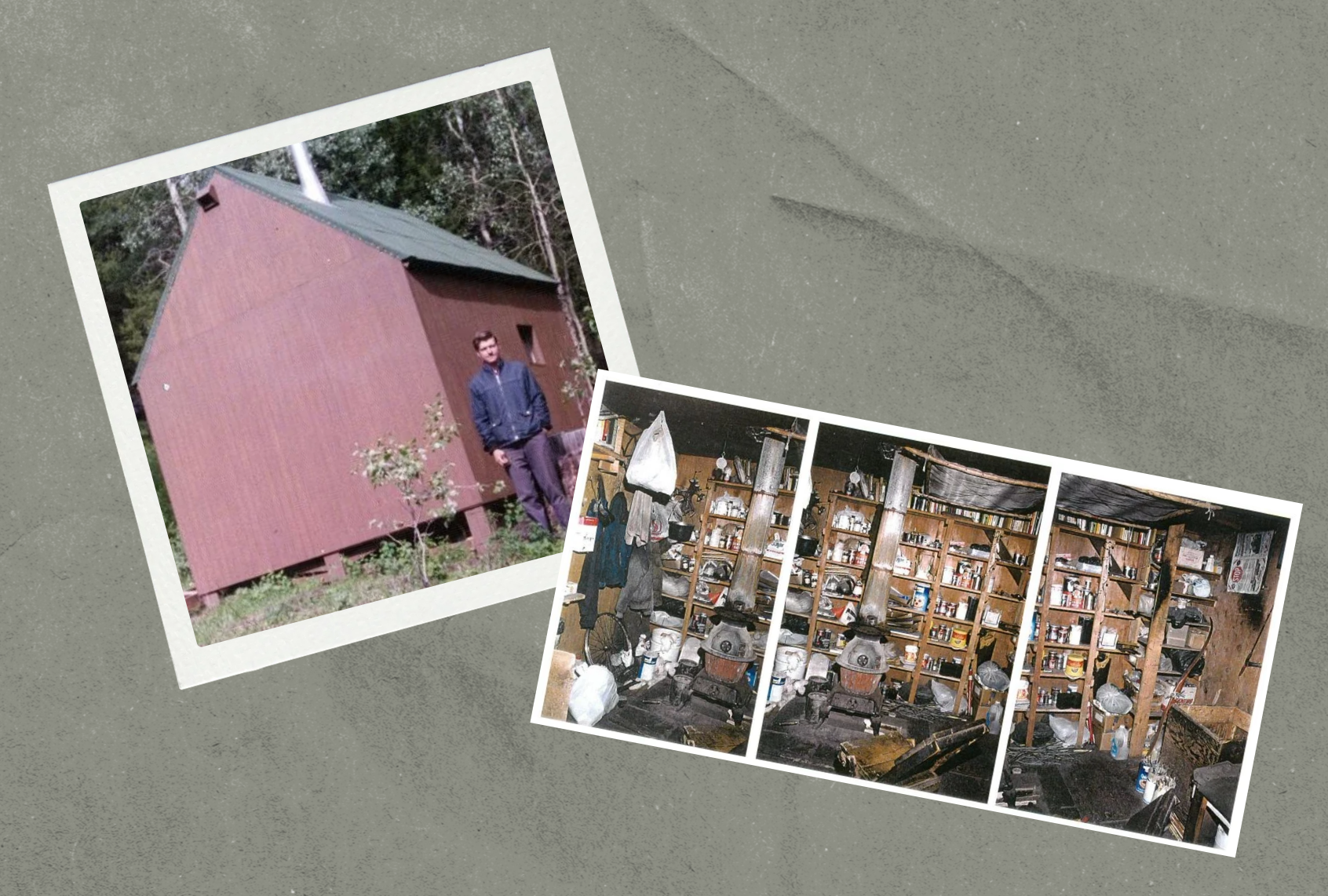
(Illustration by Salon / Images courtesy of Jamie Gehring) A young Ted Kaczynski stands outside his cabin near Lincoln, Montana, left. Interior photos taken after his 1996 arrest.
I believe I know which half hour he meant. Buried in a transcript of one session, I found the interrogator attacking the young man’s philosophy, then pivoting — with a cruelty so casual it’s almost worse — to his appearance: “. . .don’t interrupt me, please. On this avoiding of society or of society is a bad thing, is that why you’re trying to grow that beard?” Ted: “. . .I mean, really, this isn’t really a beard yet.” The interrogator: “. . .you’re darn right it’s not.”
It was cold. It was damaging. But was it the singular experience that set a man on a decades-long mission to dismantle technological society? Simply put: no.
We need your help to stay independent.
And as far as the additional timeline in this movie — the hunt, just read my book. The agent is fictional, the heroes were erased, and just about the only thing I found factual was the re-creation of Kaczynski’s mailbox. But I will admit that Russel Crowe, Jacob Tremblay, and Shailene Woodley all deliver riveting performances. Jacob Tremblay embodies a young Kaczynski almost exactly as I have imagined him, minus the smiling and the forging of his mother’s signature. But there were moments of his performance in which I recognized a young version of my own childhood monster.
Hollywood keeps asking what made the monster, because a monster with a making is a monster we can understand — and contain. The harder truth, the one I lived next door to for 16 years, is that there was no single breaking point. There was a baby, a boy, a brilliant teenager, an eccentric neighbor — and, somewhere in the shadows, a killer. No one scene explains him.
Read more
about this topic
