
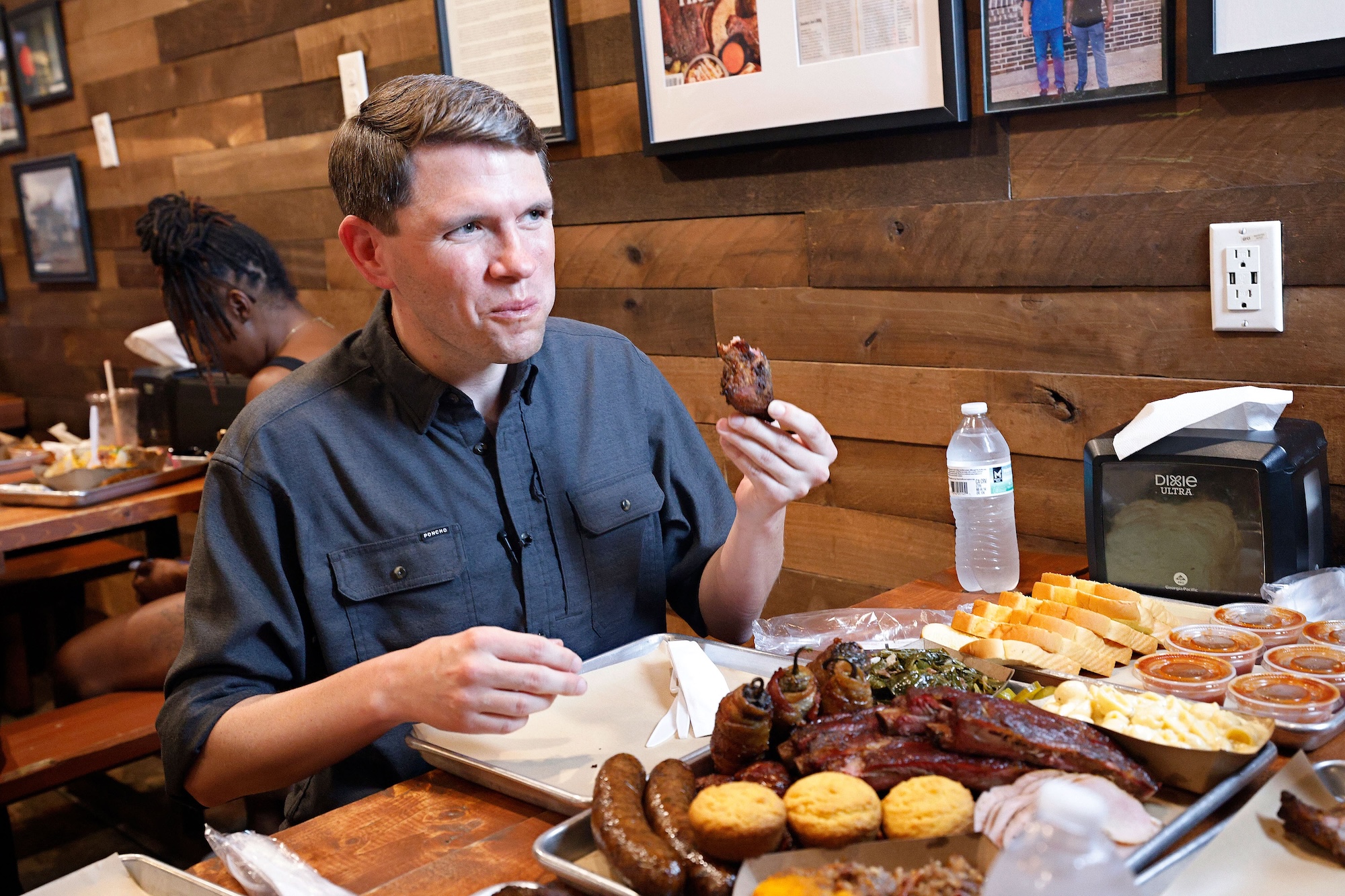

President Donald Trump has lately been telling a story about James Talarico that comes with its own setting, action and reliable third-act catastrophe. The Democratic candidate for U.S. Senate in Texas, Trump says, goes to barbecues, forces down meat and then slips behind a tent to vomit. The tent is a surprisingly durable detail. The menu changes.
At an Oct. 2 rally in Mobile, Alabama, Trump described Talarico as a vegan who was now “eating meat like a pig.” After every barbecue, he claimed, the candidate retreats behind a tent and “throws up all over the place.” In Nebraska, the offending meat had become steak. By San Antonio, Trump had incorporated Talarico’s recent absence from the campaign trail into the plot: The candidate, who said he had the flu, was supposedly sick from eating meat “for political reasons.” The president seems particularly taken with this little drama. He has returned to it repeatedly, refining the details like a comedian workshopping a bit.
The premise is that Talarico is a secret vegan.
Just for the record: He isn’t. The story ties back to 2022, when Talarico advocated reducing meat consumption and announced that his state House campaign would purchase vegan products from local businesses. He did not announce that he had become vegan himself. Since then, he has been photographed eating chicken, steak and a turkey leg. His campaign has repeatedly denied the accusation.
Ordinarily, one might expect the turkey leg to settle things.
Instead, Trump has supplied an imaginary sequel to every public meal.
At his San Antonio rally, the president turned to Talarico’s Republican opponent, Attorney General Ken Paxton, and offered an assessment: “I have a feeling Ken likes meat.” He then launched into praise of Texas’ exceptionally tough men and strong women, invoking Davy Crockett and the other heroes of the Alamo. It was a remarkably efficient progression from barbecue to regurgitation to virility to American legend. However, Americans have long used a man’s dinner to make assumptions about his character.
A few years ago, I wrote about the meat-and-potatoes man, that sturdy fixture of sitcoms, country music and nostalgic Americana. In an episode of “The Andy Griffith Show,” Andy confronts a French menu and simply asks for steak and a baked potato. Barney, determined to appear worldly, accidentally orders snails and brains. Andy’s plainspoken certainty is the point. He knows what he wants, and he doesn’t particularly care whether anybody else approves.
Where meat-and-potatoes masculinity once suggested a certain rugged, if slightly hayseed, self-assuredness, its latest incarnation is curiously obedient.
Consider Trump’s fondness for distributing Florsheim leather oxfords to the men in his orbit. The president has reportedly taken to guessing their shoe sizes and ordering pairs accordingly. Some recipients apparently feel obliged to wear them, lest they offend the boss. The old meat-and-potatoes man knew what he liked and ordered it without apology. His successors are walking around in matching shoes because someone else likes them.
And that’s before anyone sits down to dinner.
Several senior administration figures have embraced the “meat and ferments” diet promoted by physician Sean O’Mara: grass-fed beef, sauerkraut, kimchi and relatively little room for improvisation. Health and Human Services Secretary Robert F. Kennedy Jr. has praised its supposed effects on his visceral fat. His wife, Cheryl Hines, has described the embarrassment of bringing his pungent sauerkraut into restaurants. Picture the leather shoes pinching beneath the table, the fermented cabbage making itself known above it. These men are all, supposedly, very, very manly.
The meat-and-potatoes man has become the man with a meat protocol. What once signaled a cheerful lack of fuss now demands a highly specific menu, bodily surveillance and an almost devotional attention to what enters the digestive tract. It is not so much dinner as a program.
Want more great food writing and recipes? Sign up for Salon’s free food newsletter, The Bite.
There is something genuinely romantic about the self-sufficient cowboy who can build a fire and cook a well-seasoned steak beneath a blanket of stars. But the romance depends on his independence. If Trump decided tomorrow that everyone should trade their Florsheims for Stetsons, one suspects Washington would experience a sudden proliferation of cowboy hats. What ought to resemble John Wayne riding into the sunset would begin to look more like the Kens in “Barbie,” each earnestly serenading his respective date with the same Matchbox Twenty song. One man strumming a guitar by firelight can be charming. An entire beach of men performing the exact same romantic gesture becomes cringeworthy. What was supposed to be a spontaneous expression of rugged individuality has become something closer to choreography.
Which brings us back to Talarico. It is not enough for him to eat meat. He must eat Texas barbecue. More than that, he must actually enjoy it. And even that is insufficient. In Trump’s version, the evidence of fraud is waiting just beyond the camera’s view, behind the tent.
There, in a scene of the president’s own invention, Talarico can always be caught dropping the act.
Food has embarrassed politicians before. In 1976, Gerald Ford famously bit into a tamale without removing its corn husk during a visit to San Antonio. Ford committed an observable mistake. Talarico’s supposed misstep takes place somewhere nobody can see it. Once, a candidate could be judged for eating the local specialty incorrectly. Now he can be accused of eating it correctly and not meaning it.
We need your help to stay independent.
The trouble with masculinity as a group project is that it rarely remains confined to the group. When belonging depends on following an increasingly elaborate set of rules, there is a temptation to start enforcing them. And those expectations have a way of extending beyond men themselves, toward how women should dress, behave and exercise autonomy. The performance acquires an audience, and then the audience is expected to participate.
The idealized American man is, after all, supposed to be a self-assured loner: the pioneer charting his own course, the cowboy slipping into the night to find a lost horse, the man who simply does what needs doing.
Instead, this version of manhood seems to require an extraordinary amount of coaching. I keep thinking of “The Birdcage,” in which Robin Williams’ Armand attempts to teach Nathan Lane’s Albert how to walk like John Wayne. The more deliberately Albert performs masculinity, the more conspicuous the performance becomes.
Of course Trump imagines Talarico disappearing behind the barbecue tent to drop the act. For a political culture increasingly invested in prescribing how a man should dress, eat and behave, the idea of someone secretly abandoning the performance must be familiar. Maintaining it looks exhausting.
Read more
from Ashlie D. Stevens
