
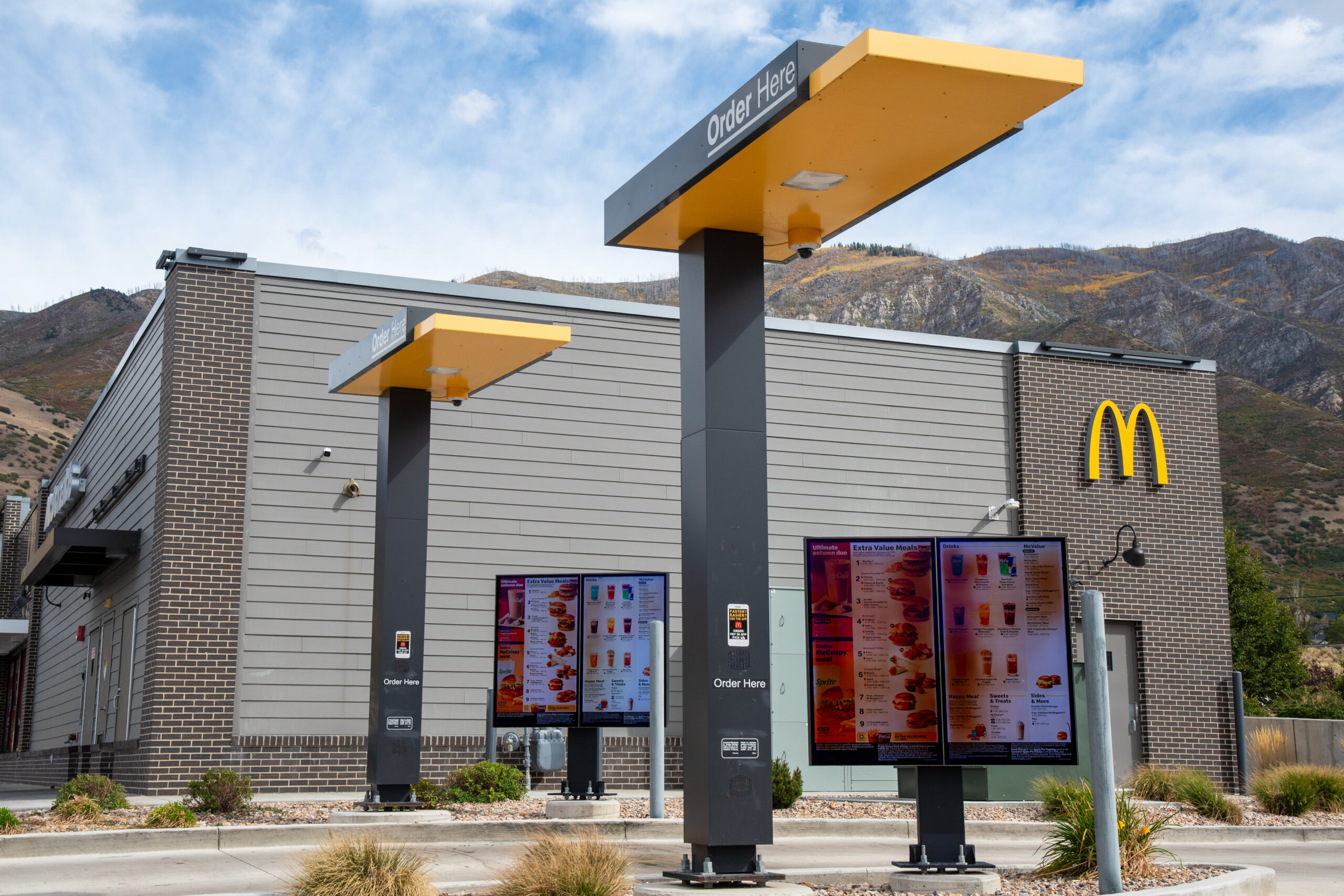

A few years ago, an experimental McDonald’s drive-thru system became convinced that two customers needed an almost ceremonial quantity of chicken McNuggets. As a video of the exchange showed, the number kept climbing: 240, 250, 260. The customers shouted for it to stop. The machine, unmoved, continued adding nuggets.
The clip went viral, in part because the mistake was so specifically inhuman. Someone wearing a headset might mishear an order for 26 nuggets. But one imagines that, somewhere between the second and third hundred, a person would pause to ask, “You sure you want 260 nuggets, hon?” The machine had no such reservations.
McDonald’s eventually ended that IBM pilot in 2024, after testing automated order-taking at more than 100 restaurants. Now, it’s trying again.
The company’s new voice assistant, Archy, is part of its Google-powered ArchIQ system and can take drive-thru orders in English and Spanish. McDonald’s says its early tests have topped 90% accuracy, with plans to expand the technology as part of a sweeping modernization initiative. The pitch is familiar: Faster service, fewer mistakes and less repetitive work for employees, who will theoretically be freed to concentrate on something more important.
Hospitality.
But another chicken chain is drawing a line. Chick-fil-A CEO Andrew Cathy recently told CNBC that his company has no plans to replace drive-thru order takers with AI, even as it explores ways to use the technology elsewhere. The reason, he explained, is that the chain wants its hospitality to remain “human to human.”
At first glance, this sounds like a disagreement over whether a computer can be trusted to hear “no onions” rather than “more onions.” But underneath that technical question is a more consequential one: Which parts of hospitality do restaurants think are automatable — and which are worth keeping human?
There is, of course, a genuine appeal to frictionlessness.
Sometimes you’re tired, antisocial or running spectacularly late. Sometimes you want to make a substitution to an order without worrying whether it will get lost between the person wearing the headset and the person assembling your food. Sometimes you just want to tell a box that you need fries and trust that fries will appear.
I understand this instinct completely. I’ve walked into plenty of busy restaurants where the prevailing atmosphere suggested human error was the expectation rather than the exception, and a kiosk felt like a little gift.
Nor is there anything inherently noble about making employees spend eight hours deciphering orders shouted through crackling speakers while the ice-cream machine is down and a small diplomatic crisis is unfolding in the PlayPlace. Taking orders is part of the job, certainly; trying to do it while the rest of the restaurant threatens to unravel is another matter.
The optimistic version of AI-assisted service makes some sense: Let the machine handle routine tasks. Give employees more time to solve problems, help customers and perhaps make their shifts a little less frantic.
The less optimistic version is that companies will realize they can run the same restaurant with fewer people.
We need your help to stay independent.
McDonald’s own financial projections offer some reason to examine that distinction carefully. In its September presentation of the company’s broader “> NEXT” strategy, the chain said Archy could free at least 50 labor hours per week as the technology scales. It also projected that its larger package of restaurant improvements could generate approximately $100,000 in annual gross cash-flow benefits for an average U.S. restaurant, with most of those gains eventually benefiting the bottom line.
Neither figure tells us precisely what happens to the employees who would otherwise be working those hours. But it does reveal how closely the language of hospitality is intertwined with the language of efficiency.
And McDonald’s has experimented with this vision before. In late 2022, the company unveiled a smaller-format restaurant outside Fort Worth, Texas, designed around customers ordering ahead through an app and collecting their food from a conveyor system. Employees still prepared the meals, but the design dramatically reduced the need for face-to-face interaction.
The concept was presented as a more convenient way to get food into customers’ hands. Fair enough. But if the great promise of automation is that it gives employees more opportunities to practice hospitality, it’s worth asking what that hospitality looks like when customers scarcely encounter those employees in the first place.
Chick-fil-A, meanwhile, has made a rather different calculation.
The company has always been unusually explicit about its values, which are rooted in the religious principles of founder S. Truett Cathy. Its restaurants remain closed on Sundays, including locations where that choice may seem commercially inconvenient like airports and college campuses. Its employees are famous for responding to customers with the relentlessly chipper “My pleasure!” The brand talks about service not merely as a function of getting food to customers, but as an expression of care.
That self-image is not without complications. Chick-fil-A has faced years of criticism over its charitable foundation’s past donations to organizations with anti-LGBTQ positions, which it said it would stop funding in 2019. Its public vision of care has not always been received as universally inclusive.
Still, the consistency with which the chain has made personal hospitality part of its identity is instructive.
And it’s not as though Chick-fil-A is technologically timid. At a Georgia location opened in 2024, food travels from an elevated kitchen to employees below on a conveyor system designed to deliver a meal every six seconds. Customers can order ahead digitally or place orders with workers in the drive-thru. The technology is decidedly futuristic, but the company has deliberately preserved a person at the point of service.
That distinction strikes me as meaningful.
Technology can expedite a restaurant’s work without necessarily becoming the face — or voice — of the restaurant itself.
Of course, a scripted “My pleasure!” isn’t necessarily more authentic than a cheerful voice generated by a computer. And anybody who has ever worked in a customer-facing job knows that hospitality, particularly of the relentlessly sunny variety, can involve a tremendous amount of emotional labor.
Employees shouldn’t have to manufacture delight on demand while working short-staffed shifts for inadequate pay, fielding customer complaints about things outside their control. A good restaurant culture takes more than telling workers to smile. It requires adequate staffing, good managers, training, compensation and enough breathing room for employees to exercise judgment.
This is the problem with imagining hospitality as another task that can be optimized. The value of an interaction isn’t always apparent in advance, and the most meaningful parts of it often have little to do with completing the transaction.
But I think there’s a difference between demanding that employees perform warmth and creating an environment where warmth has room to develop.
Disney World, for example, has practically made an industry out of carefully cultivated hospitality. The entire experience is choreographed, from the language employees use to the way they interact with guests. Yet some of the most memorable moments happen when an employee notices something unexpected and responds in kind: A bus driver making a tired child laugh, or a character performer taking an extra moment with someone who’s been waiting all morning.
The environment is engineered. The little spark between two people isn’t.
And that’s what makes this debate about AI ordering feel more consequential than the technology itself might initially suggest.
Because hospitality isn’t entirely something a restaurant provides. It’s also something customers participate in.
Recently, I was ordering coffee at a neighborhood café, one location of a regional chain. A woman ahead of me, well-dressed and perhaps in her early 30s, was asked by the barista what she’d like. Instead of answering, she wordlessly handed over her phone. The barista looked confused. The woman sighed, tapped her screen with a fingernail and said, “It’s right there.”
It was a small moment, over almost as soon as it began. Nobody yelled. Nobody demanded a manager. But something about the exchange bothered me. The barista had asked a perfectly ordinary question. The customer seemed irritated that the answer required any effort on her part. The information existed on a screen. Why should she have to communicate it?
We’ve spent years teaching machines to understand human behavior. I wonder whether we’ve also begun expecting humans to behave more like machines.
It’s difficult to shake the feeling that something has frayed in our public interactions since the pandemic. We got used to contactless delivery, app-based ordering, packages appearing at our doors and transactions completed without speaking to anyone. Those conveniences were useful, sometimes essential. Many remain genuinely wonderful.
But I’ve also noticed more impatience. Less eye contact. An increasingly common expectation that the person behind the counter should function as an extension of whatever digital system we’ve already been using.
And perhaps there’s an uncomfortable lesson here for customers, too. We demand personalized service, but don’t always seem particularly interested in the people providing it. We want our preferences remembered, our mistakes corrected and our food ready precisely when promised. We don’t necessarily want to offer much patience, curiosity or goodwill in return.
Service workers have always dealt with difficult customers, of course. There’s no reason to romanticize some vanished golden age of American politeness. But the incremental disappearance of ordinary interactions raises a question worth considering: What happens when convenience becomes the organizing principle of our public lives?
Want more great food writing and recipes? Sign up for Salon’s free food newsletter, The Bite.
I keep thinking about the spaceship in Pixar’s “WALL-E,” the Axiom, where every human need has been anticipated and met. Passengers float around in automated chairs, surrounded by screens, food and entertainment. They are comfortable, in the technical sense. They are also profoundly disconnected from one another and from the world around them.
The unsettling thing about the Axiom isn’t that its passengers are miserable. It’s that they don’t seem to notice everything they’re missing.
No one individual convenience creates that kind of world. But taken together, thousands of decisions to eliminate small inconveniences can also eliminate opportunities for connection. And those encounters, however insignificant they seem, are part of how we learn to share space with other people.
A few months ago, I was shopping at Trader Joe’s when I noticed the cashier’s earrings. They looked like tiny illustrations of fish pulled from the label of a particularly fancy tin of sardines, with hooks attached. I told her I loved them. “Shrinky Dinks!” she replied.
It turned out she was a crafter. She pulled out her phone to show me some of her work, which included garments she’d fashioned out of Trader Joe’s tote bags. There were pants. Actual pants, made from the grocery store’s reusable bags.
I was delighted. Here was this woman who liked her job, or at least the store where she worked, and liked making things, and had found a wonderfully weird way to combine those interests. For a minute or two, the checkout lane became something other than a place where groceries changed hands.
It wasn’t a life-changing encounter. I don’t know the woman’s full name; her name tag simply said MB. I couldn’t tell you what I bought that day. But I remember her earrings, and the pants, and how much fun it was to meet someone who was so enthusiastic about something so delightfully specific. I wouldn’t have had that interaction if I’d been scanning my own groceries. And, importantly, I wouldn’t have had it if I hadn’t noticed the earrings and said something.
Neither of us was obligated to participate. That’s part of what made it lovely.
This is the problem with imagining hospitality as another task that can be optimized. The value of an interaction isn’t always apparent in advance, and the most meaningful parts of it often have little to do with completing the transaction.
A machine might eventually take my order perfectly. It might remember my favorite coffee, anticipate the substitution I’m about to request and move me through the line several seconds faster. On certain mornings, I’d welcome every bit of that.
But it cannot offer the particular surprise of encountering another person who has decided, for no reason other than the pleasure of it, to show me something strange and wonderful.
The real danger of automating our ordinary encounters isn’t that we’ll suddenly forget what human connection feels like. It’s that we’ll gradually make fewer opportunities for it, until its absence begins to feel normal.
Communities are shaped by the ways we participate in them. Even at a coffee counter. Even through a drive-thru window.
Sometimes that participation amounts to nothing more than a little patience, an unexpected compliment or somebody asking, Wait, is that really what you meant?
And sometimes that’s where the magic happens.
Read more
about this topic
