
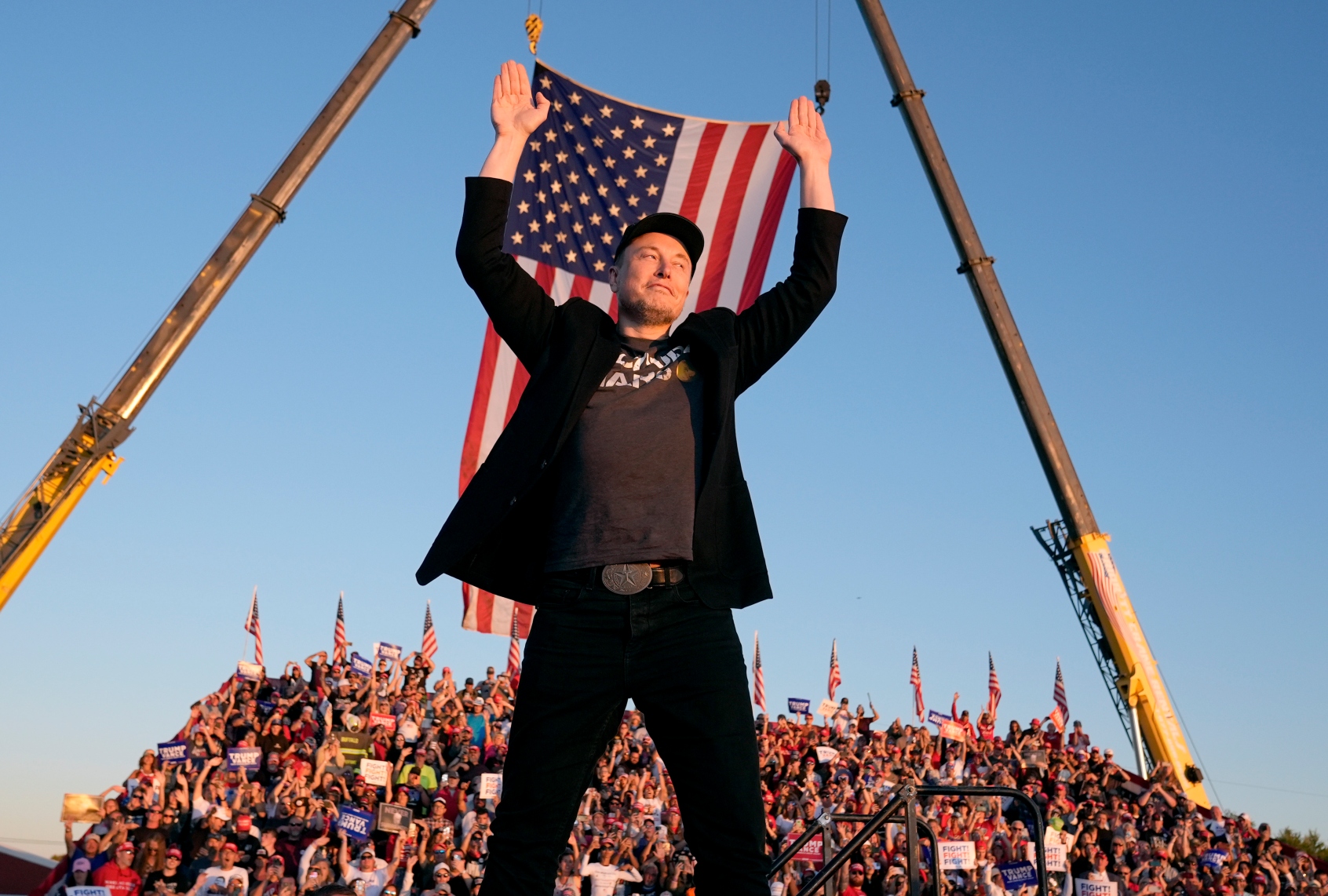

From the moment Alex Gibney announced he was working on “Musk” in 2023, it became one of the most anticipated documentaries around – and a source of trepidation for its titular subject, tech mogul Elon Musk. But we may have underestimated how far the world’s wealthiest man and his ilk would go to prevent audiences from seeing it.
Weeks before “Musk” hit theaters, its distributor, Bleecker Street, couldn’t buy ads on TikTok, YouTube, Mark Zuckerberg’s Meta-owned Facebook and Instagram or, here’s a shocker, Musk’s own X. A Hollywood Reporter story published on Sept. 25 made YouTube and Meta reverse course – a rare case of two media giants shamed into living up to their free-speech claims.
But this attempted media suppression shows “Musk” has struck a nerve, despite its namesake dismissing it as a “hit piece that misses.”
It was not lost on Gibney that at the same time that was happening, Zuckerberg, Musk and Washington Post owner Jeff Bezos were dining with Donald Trump and China’s Xi Jinping at the White House. He’s confronted gravely perilous corruption and dangerous figures in previous, fearless documentaries such as 2019’s “Citizen K,” about a Russian oligarch who was crushed by Vladimir Putin, and 2015’s “Going Clear: Scientology and the Prison of Belief.”
What happened to Bleecker Street, then, is both familiar to Gibney and extraordinarily alarming. “You can see how a few platforms coalescing around the endorsement of what these tech viziers are doing decide that a criticism of tech power is somehow political and can’t be allowed in terms of open discourse on their platforms,” Gibney told Salon. “So that was really disconcerting.”
It’s shaping up to be a dark autumn for Silicon Valley’s villains. In early December, Luca Guadagnino’s “Artificial” turns our attention to OpenAI CEO Sam Altman, played by Andrew Garfield.
Meanwhile, “Musk” was recently joined in theaters by Aaron Sorkin’s “The Social Reckoning,” in which Jeremy Strong portrays Zuckerberg as a soulless ghoul prioritizing clicks over user safety. In “You Can See Everything,” notorious prankster Nathan Fielder shadows notorious (for different reasons) Theranos fraudster Elizabeth Holmes in the days before she went to prison.
Gibney also profiled Holmes in his 2019 work “The Inventor: Out for Blood in Silicon Valley,” which adds another layer of coincidental symmetry: Fielder’s film hits theaters on Oct. 16, the same day “Musk” opens nationwide.
But “Musk” is unquestionably a tougher watch, and given its subject’s extensive integration into the second Trump administration, it can’t help but be political.
Of course, “Musk” isn’t campaigning for anything except our need to confront the existential threat posed by one man exercising significant control over our media and our military.
A chorus of testimony from people who were once closest to Musk builds a profile of a megalomaniacal con artist. Two of Musk’s most incisive critics, his ex-wife Justine Musk and former right-wing influencer Ashley St. Clair, describe him as a gaslighter and a nuke, respectively.
But perhaps the most damning testimonial comes from Musk himself – or rather, existing audio recordings of Musk delivered by an AI version of the Tesla and SpaceX CEO, since he refused to participate.
All of it boils down to simple questions Gibney poses at the film’s outset: How could Musk assume so much power, and why have we given it to him? I discussed those questions with Gibney, and what they taught him about Musk and our penchant for enabling men like him, in a wide-ranging conversation transcribed below.
This interview has been edited for length and clarity.
Salon: You’ve done a documentary on Putin. You did one on Scientology, a famously litigious organization. You have a vast filmography featuring subjects who might have taken issue, or have taken issue, with what was said in your documentaries. Where does this rank in terms of threat level, legal or otherwise?
Gibney: Well, high. I mean, when just before “Going Clear” was released, the Church of Scientology took out full-page ads in the New York Times and the L.A. Times with a big picture of me, sort of denouncing me. And there were people, you know, who would pop up in dark parking lots, you know, sort of accosting me, trying to kind of destabilize me psychologically. But I think in this case, he’s the richest man in the world. He has a lot of resources… And he has this platform, Twitter, which has become a kind of Thunderdome of hate and vitriol, and that activates, you know, unpredictable characters who sometimes act on their own…
That said, I don’t want to exaggerate what’s happened to me so far. Other people put themselves at greater risk than I, in the sense that they came forward and appeared on camera.
One of the things that you said in other interviews, and I think you actually said this in the documentary as well, is that you used to be a fan of Elon Musk’s products.
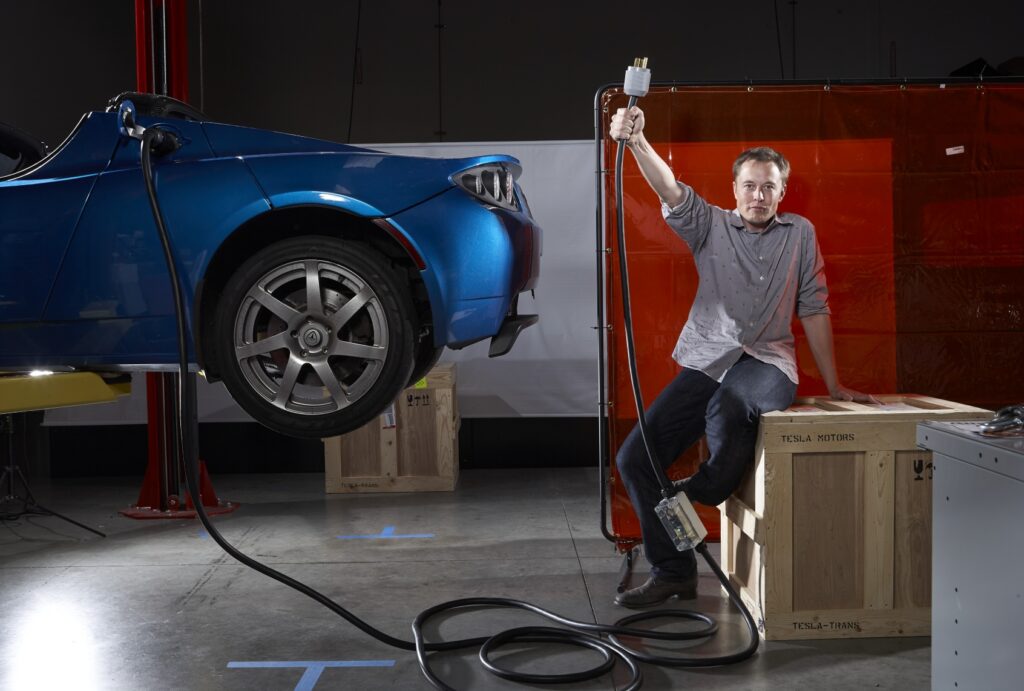
I mean, I looked at him from afar. I have some history on this whole electric car thing because I was brought in long ago to help with the editing of a doc called “Who Killed the Electric Car,” which is about GM’s first foray into the world of electric cars. A woman I met on that film, Jessie Deeter, later produced a film called “Revenge of the Electric Car,” and Elon Musk is in that. And Jessie, when she worked with him on that, was a big fan. [Deeter is also a producer on “Musk.”]
 ( Gregg Segal)
So, you know, I had a certain connection to him. And I’m a big electric car guy. I own one — not a Tesla— but I own one, and I had a Tesla Powerwall in my house. I also sort of liked the kind of mumbling charisma that he had for a while, because he seemed like very much a regular guy. He was joking with people around on Twitter and stuff like that.
That said, he could also do unpredictable, chaotic and sometimes offensive things. But largely speaking, my view of him was positive. But I was interested in the fact that he accumulated so much power, and so that was the basis on which I dug in back in 2022.
Do you think that his ability to amass this much power is related to the fact that he is doing it in the American capitalist system, or do you think he could have done it in any other place in the world?
Well, I mean, there are a lot of intersections of opportunities for Elon Musk, and I also think he discovered, to use a phrase of his, the anomaly in the matrix for the American system. And that is money. He discovered that not only can you get a lot of money from the federal government, but if you have a lot of money, you can use it to influence sometimes how much money you get from the federal government or state governments. So I think there was that.
The other big thing is that in America we also have a kind of grudging admiration for the P.T. Barnum-like qualities of certain larger-than-life entrepreneurs, you know, and you see that a lot in Silicon Valley . . . That is a kind of cultural trope in this society for which I think we have a weakness. We sort of like to see them trick us all, though we also do like to see them go down after they’ve tricked us. So I think for all those reasons that maybe Elon was able to succeed here in a way that really exploited some of the flaws in our system and our psyche.
There’s also a propensity in our culture to believe in some superhuman aspect of genius, which I think your documentary gets at very well.
Yeah, it’s also that our weakness for money, or the power of money, in this culture also causes us somehow to think that if you’re wealthy, you’re also wise rather than just ruthless, right?
I often think of that famous line from “Citizen Kane,” where Orson Welles is joking with somebody, you know, having been very successful playing this William Randolph Hearst character, who said, “It’s no trick making a lot of money if all you want to do is make a lot of money.” Meaning, if you’re ruthless and determined, you can make a lot of money. Doesn’t mean you’re a genius, and it doesn’t mean that you’re a tech genius either.
I also think Elon Musk, having seen the ascent of Steve Jobs, was sort of defining himself in that way too – or going back to Thomas Edison, who had his own P.T. Barnum-like qualities in terms of inventing a character for himself to play. It’s not just the investor; it’s the inventor.
We need your help to stay independent.
“Musk” runs for almost four hours. Did you always know it would be that long?
No. In fact, I had a cut of the film in the spring of 2024 that was under two hours. We were moving to release that and put it into the fall festivals. Then, in Butler, Pennsylvania, Trump is nearly assassinated, and Musk hitches his wagon to the Trump train. And my friends at HBO said, “You’re not done. You have to follow this story because it could go to places that you don’t expect, and having spent as much time as you have, you have to follow it to at least a moment of greater conclusion.”
So I did, and that ended up being the reason that it’s at such a length. You see patterns from the first film that then repeat themselves, but on a much larger scale, in the second film. Suddenly economic power meets political power, economic and technological power meets political power, and that is the making of an epic story.
(Ken Cedenoupi/ UPI Alamy News) Elon Musk
In addition, it just so happened that as he embarked on his political project, a lot of people that I was talking to in the background, trying to persuade them to come forward, did come forward because they saw some of the more problematic aspects of Musk wielding power as part of MAGA world. That gave the story a kind of human dimension as well.
Weirdly, you know, I was having trouble kind of putting it all together, and I didn’t really get a sense of how to shape it until I watched Guillermo del Toro’s “Frankenstein,” which in itself was a kind of take on the tech bros. That helped me kind of find a way forward in terms of what became a kind of epic narrative.
How so?
Well, you know, you start with a scientist who wants to do something big and important. And there’s even a sense of idealism about his ambition. But then he literally creates a monster, and the whole enterprise becomes utterly reckless and irresponsible and all about his own sort of grandiosity. Rather than a mission that might help people, it becomes about him.
What are you hoping this documentary will do in terms of making people a little bit more aware of who Elon Musk is and getting at the man behind the curtain, so to speak?
Well, I mean, it is an agent provocateur. I don’t provide a solution, but I do provide, I think, a pretty compelling story, which asks the kind of fundamental question I posed at the beginning, which is, how did this guy get so much power, and why did we give it to him? Because it’s both about him and it’s about us, and it asks some discomforting questions about how literally existential power rests in the hands of one man who is increasingly chaotic, unhinged, and seemingly pursuing power without reason. There’s a chilling moment at the end of the film where somebody asks him, “Why have you accreted so much power?” And he literally can’t answer the question…
He’s a very peculiar character who’s a chaos agent. But we’ve allowed him to become normalized in a way.
I remember writing about him being on “Saturday Night Live” and people shrugging it off, like, “Oh, it’s not that big of a deal.” But it was a very big deal. Those kinds of things make him into a character when the reality is he has massive access to power.
And he’s saying things, even on “Saturday Night Live,” that were patently untrue… Even when he says, “Did you think I was going to be a chill, normal dude?” Well, there’s a funny hidden message there, which is kind of discomforting if you really think about it. Like, if you want to drive a Tesla, be prepared to endure a lot of performative cruelty from me, including cruelty that may end up killing people. . . That’s a pretty brutal message, honestly, for “Saturday Night Live.” But it was a joke, right? And that’s the genius, in a way, of Elon Musk: he’s constantly saying stuff that is deadly serious and a joke at the same time.
Speaking of that, the images and the joke, let’s talk about using the AI avatar. I remember when the news first broke about that, someone said, “Well, I wonder if that’s Alex kind of trolling Musk back.”
I mean, it’s kind of a troll-back, yeah. In a way, it’s kind of investing in him, playing in his sandbox, because he didn’t agree to appear.
And I should make it clear, as I tried to do in the film, that what we hear from him are actual audio recordings of him. In other words, they’re not AI-confected answers. We didn’t ask AI what Elon would say. We’re taking real audio recordings, but how to couch that visually? And we took our cue, having done all this research into stuff that Elon said, from something he kept going over again: This idea that we’re likely living in a simulation. So I thought, OK, how about a simulated interview?
And yes, he’s famous for trolling people. He’s famous for creating memes. What was it he said in 2020 on Twitter? He said, you know, parodying “Dune,” he said, “He who controls the memes, controls the universe,” right? OK, well, here’s a meme for you, Elon, of you.
Want more from culture than just the latest trend? The Swell highlights art made to last.
Sign up here
What, if anything, about this documentary may help illuminate a few things for people, regardless of their political leanings, as we approach the midterms?
I mean, this should be our concern, whether you’re from the left or the right, is giving people unaccountable power. Also, this whole idea that our politics and, indeed, our Department of Justice and our Department of Defense can be utterly transactional.
We’re not getting the best that money can buy. We’re getting what money can buy. Period. In other words, the military stuff that you’re seeing is a third-rate frontier AI technology being fully integrated into our Department of Defense. And why is the worst technology being integrated? Because Elon Musk is literally paying for political advantage. So it’s a payback system, and we should all be outraged about that, left, right, or otherwise.
And now you’re seeing him trying to buy the midterms. He’s spending way more now than he did for the presidential campaign in 2024, and in part that’s to get more money for himself in the form of military contracts. But also, he knows that a reckoning is coming for him if the Democrats take over the House and the Senate, and there’s going to be a lot of investigations into him for corruption and abuse of power, taking our information, particularly possibly relating to DOGE, and doing God knows what with it.
Our whole system is built on a system of checks and balances, and the idea that the government is our instrument for making a better world, rather than, you know, making a few people rich…
But I think that what’s changed now with Trump is that the Department of Justice has become a protection racket for those who flatter and ally themselves with the president, and an instrument of revenge for those who oppose the president. You can’t depend on it as a kind of law-enforcing mechanism, and that may be the scariest thing of all. . . What we’re talking about is Putin’s Russia here, right? And if people want to avoid that, then I would strongly urge them to go out to the polls. Because this is a rogue administration that goes beyond any kind of sense of party affiliation. It’s a rogue administration that’s literally destroying our democracy.
“Musk” is playing in theaters nationwide.
Read more
about other worthwhile documentaries
