

In the title of his 1997 bestselling adventure tale, “Into Thin Air,” mountaineer and writer Jon Krakauer employs a double entendre so clever that its effect is extraordinary. Throughout the book, Krakauer recounts his attempt to summit Mount Everest the year earlier in what would become, at the time, the mountain’s deadliest season. I’ve been momentarily halted by that title each time I’ve picked up my tattered $5 thrift-store copy over the last few weeks. It’s witty, but not grim; accurate but also imaginative. In three words, “Into Thin Air” conveys not only the literal effect of Everest’s high altitude and how quickly the mountain can take a life, but also the ardent, almost fatuous confidence of those who choose to climb it.
The dissonance between reason and ambition is what makes “Into Thin Air” such a compelling read. For someone like myself, who knows next to nothing about climbing, Krakauer powerfully elucidates the pull of a mountain like Everest and the trance-like state in which it ensnares its adversaries. Unlike some climbers, Krakauer can wax poetic while staying honest about the stakes. He writes about mountaineering as a spiritual practice, good for the mind and body alike, while questioning why some find that clarity only by staring death in the face. In that respect, extreme climbing is an incredibly selfish endeavor. Before he begins his push for the summit, Krakauer remembers his wife, Linda, telling him before he left for Nepal: “If you get killed, it’s not just you who will pay the price. I’ll have to pay, too. For the rest of my life.”
That sentiment echoed in my mind throughout “Everest: The Other Side,” the remarkable new documentary from National Geographic, helmed by “Free Solo” and “Nyad” co-directors Elizabeth Chai Vasarhelyi and Jimmy Chin. The film is brutally honest in its depictions of cold human narcissism and the relentless pursuit of glory in the name of nebulous spiritual fulfillment. Yet it’s just as candid about humanity’s collective desire for all those things in one form or another.
Such a wanton, helpless display of pride makes for a character study as gripping as it is frustrating. From that disharmony, “Everest: The Other Side” forges a uniquely human story of actualization at all costs, revealing the true price of a life spent looking up and not around.”
We are an arrogant species, frustrated by our humble place in this ecosystem. And yet, we feel everything intensely. When we love, we want to take that love to the ends of the Earth. We want physical proof of emotions we cannot put into words. Maybe then all of this will mean something.
As “Everest: The Other Side” asserts, nothing in this already mystifying life is ever so simple. The film’s subjects, mountaineer Jim Morrison and his partner Hilaree Nelson, found love at the edge of the world and made a life together, with Morrison becoming co-parent to Nelson’s two young sons. But their shared lust for adventure created a prickly tension within their family unit, a strain between their passion and parentage that sits at the documentary’s emotional center.
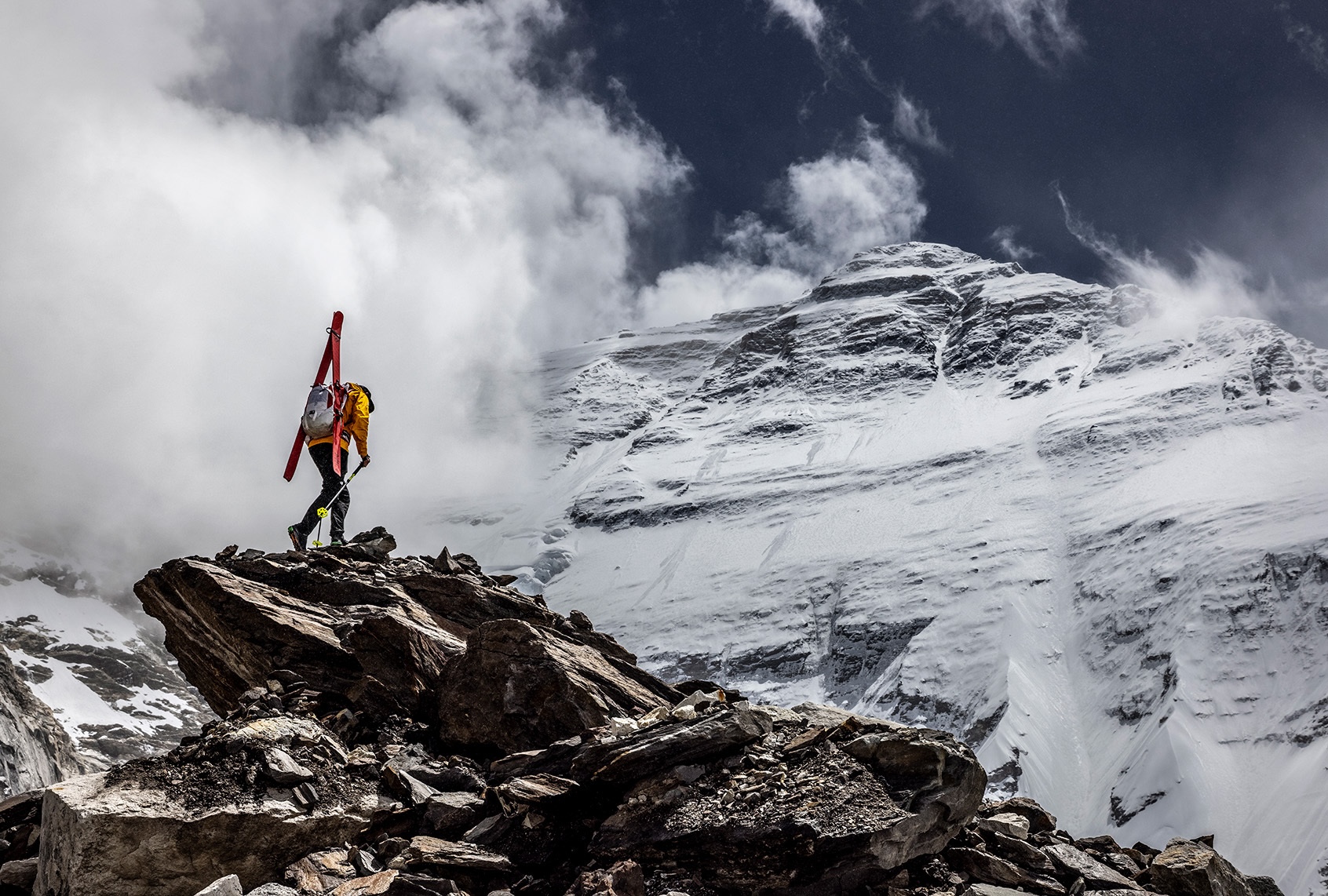
Like those pulled by devout religion or extreme acts of faith, Morrison and Nelson are powerless before their distinct higher calling — especially with the literal highest calling of all, Everest, in their sights. They don’t just want to summit the mountain from its treacherous north face; they want to be the first people ever to ski down it. In their quest, personal glory and public vanity are forever at odds. Such a wanton, helpless display of pride makes for a character study as gripping as it is frustrating. From that disharmony, “Everest: The Other Side” forges a uniquely human story of actualization at all costs, revealing the true price of a life spent looking up and not around.
Because this is National Geographic, the film is only partially concerned with relaying that price. This documentary is made for IMAX-loving, secondhand adventure seekers. Those who want sweeping shots of impossible sights won’t be disappointed.
But while “Everest: The Other Side” includes countless breathtaking sequences of Earth’s tallest mountain and plenty of nail-biting anxiety in the eventual summit push and ski attempt, those moments are merely the film’s selling points. The crux of this story is on Nelson and Morrison’s shoulders, and their sincerity flies in the face of good judgment and self-editing, giving viewers a palpable sense of their egos. This isn’t to say that either of them is a raging narcissist who cares only about themselves, but there’s no doubt that their sport’s seismic, life-altering dangers are on full display, warts and all.
Early in the film, Nelson tries to communicate the draw of climbing, and how fundamentally at odds it is with her role as a mother. “People ask me, ‘How do you find balance?’” she says. “There isn’t. It’s just chaos. You’re just hanging on. You want to be with your family, but you have a passion, and you want to work, and you need to make money. You’re all over the map.”
We need your help to stay independent.
It would be easy to dismiss Nelson as selfish, or, at the worst and most damning, a bad parent. How can someone have young children and decide to part with them for two months for a climb that is about, at face value, little more than bragging rights? How can a parent let their children spend two months wondering if their mother is dead or alive?
These are easy questions to ask from the comfort of a living room or the cushion of a theater seat, but much harder to answer when you’re living the life. It’s important to remember that, in life, most of us have desires that would yank us in severe directions. It reminds me that cult experts will tell you that any of us could fall into the clutches of a cult, and those of us who argue otherwise are likely among the most vulnerable. Anyone who insists they are too self-aware to be pulled into something that goes against their own interests is admitting that they don’t know themselves or humanity very well. That’s one of life’s great mysteries: Why do we do things that we know are wrong, or bad for us? Death and taxes might be certain, but so are mistakes and regret, no matter how much we’d like to believe that we’re big enough to let go.
Conflict is ever-present in Morrison, who chooses to climb Everest despite its perils. For him, the adventure is about more than pride or titles; it’s about honor and love. The journey is intended both to strengthen his bond with Nelson and honor the memory of his late wife and their two children, who died in a horrific commuter plane crash in 2011, a decade before he and Nelson decide to attempt Everest. Recalling the aftermath, Morrison tells how climbing brought him clarity. Unable to move from the edge of his driveway, consumed by grief, he eventually found the strength to simply walk up the slight incline and into his home — a microscopic example of the human spirit’s extraordinary tenacity he hopes to commemorate in the Everest climb.
We are an arrogant species, frustrated by our humble place in this ecosystem. And yet, we feel everything intensely. When we love, we want to take that love to the ends of the Earth. We want physical proof of emotions we cannot put into words. Maybe then all of this will mean something.
But more tests lie ahead. The route to Everest proves demanding in heart and health. And while training together for the big summit push by climbing a lower peak in Nepal in 2022, Nelson loses her footing in an avalanche the size of a small snow drift. On a ski slope, the drift would be minor. But on a mountain, every movement is measured. Nelson is swept away and under the snow, toward a cliff. We see it happen in real time, captured on a helmet GoPro. The moment is almost unassuming in its speed, but it permanently shapes everything that follows. Nelson is lost amid a series of avalanches, and the clock starts ticking.
Counting the seconds seems futile. But climbing is futile, too. For Morrison, left to search for his partner amid the snow, hazardous ridges and cliffs, it all seems like a waste. More pain, more trauma, more memories that are left for only one person to hold onto. I was immediately reminded of what Krakauer’s wife told him by satellite phone before he began his push from Everest’s base camp. “Saying goodbye to you was one of the saddest things I’ve ever done,” he remembers her saying. “I guess I knew on some level that you might not be coming back, and it seemed like such a waste. It seemed so f**king stupid and pointless.”
Want more from culture than just the latest trend? The Swell highlights art made to last.
Sign up here
It’s hard not to dwell on that sentiment, already knowing what and who Nelson would leave behind if disaster struck. On some level, and to some people, it is all stupid and pointless. But that split second fortifies Morrison, confirming that his quest to Everest is for everyone that he’s lost, and every heartstopping moment along the way. It’s a spiritual pursuit, the kind that we make when we travel to a family member or friend’s favorite place to scatter their ashes; the kind that we make when we give eulogies, or just sit in the grass, staring into space, thinking about everything and nothing, everyone and no one.
Some may be driven to climb Everest just to say that they did it, while others are looking for something else, something with no name. They want to pierce the heavens and reach through the atmosphere to grasp the indescribable truth that unites us all. And if they don’t make it back down to share that peace with the rest of us, it might be enough to experience it just once.
Read more
about what’s happening on Mount Everest
