Emily Jenkins

Bridal fantasies

It's easier to talk to anonymous strangers about your sex dreams than about your future dreams.

  • more
    • All Share Services

Bridal fantasies

I am getting married in a couple of months, and I have been hiding my bridal magazines from prying eyes like a stack of porn.

I first encountered these magazines 10 years ago at my friend Rachel’s house. She got engaged right after college, and I remember feeling shocked and a little embarrassed to see that she subscribed to Modern Bride. She had even earmarked certain pages that featured puffy white gowns and romantic floral arrangements. It was like seeing a Penthouse subscription on the coffee table with the owner’s favorite spreads dog-eared: an open revelation of intense fantasizing.

When I got engaged at 31, I realized that I had spent my entire adult life repressing similar reveries. Somehow, despite a hippie childhood, divorced parents, feminist politics and a preference for black above all other colors, I had developed a wealth of bridal dreams. I had just never acknowledged them before, denying my arousal at the sight of a glittering diamond ring or a bouquet of tightly bound miniature roses.

I’m not the kind of woman who gets aroused by that stuff, I told myself. I don’t want to be adored by my man for my poignant beauty, to press up against him as we dance in celebration of our union, to slice a sumptuous cake so tall it can serve hundreds, to make myself dizzy on champagne and then tumble into a lush hotel room, drop the crisp white folds of my gown on the floor and then …

Well, of course I was aroused. I just didn’t want to admit it. Bridal fantasies had always symbolized conventionality to me. They were manufactured by an industry dominated by purveyors of diamonds and $6,000 dresses. I would be a sucker to buy into those prefabricated romantic dreams, dreams that set up an antiquated ideal bound to be crushed by the pedestrian nature of everyday life. And since there was no one I wanted to marry, anyway, indulging the fantasies seemed stupid and self-defeating. I would only start to want what I couldn’t have.

Later, when there was indeed someone I wanted to marry, I repressed my thoughts for a different reason. In today’s society, I think, it’s easier to share our anonymous sexual fantasies — involving, say, a stranger in an airport lounge, or a team of lacrosse players undressing in a locker room — than fantasies that suggest a future. Purely physical turn-ons, in our liberated yet commitment-phobic dating world, indicate a person is erotic and open. Bridal dreams, on the other hand, are shameful because they’re about sex and love together. They may be incredibly hot — doing it on the crumpled tatters of a white wedding gown below a gilded mirror, say, or sneaking a quick one in the coatroom at the Pierre while relatives dance a distinguished waltz — but fantasizing about devotion (or indeed, any kind of emotional connection whatsoever) is tantamount to getting hot over a house in suburbia and 2.4 children — simply not cool if you’re a career woman, a feminist or just a New Yorker.

Even when Daniel and I decided to get married, I was sure that he would be turned off by the sentimentality of a conventional wedding. If he knew I was a woman with bridal fantasies, I figured, he would surely turn tail more quickly than if I confessed to oceans of credit card debt or a secret career as a dominatrix. I assumed we would get married at City Hall.

Turns out my assumptions were wrong. We are having a wedding. My intended, my lover, my fiancé — he wants one. And for the first time in my life, I am allowing myself to want one too.

Still, I bought the bridal magazines with a measure of shame. They were the first I had even allowed myself to look at since Rachel’s wedding 10 years ago. I pressed them secretively against my chest when I met a colleague outside the newsstand. I read them in bed and hid them when Daniel came home.

But as I browsed through the long-forbidden glossies, I began to see that bridal fantasies are not equivalent to a dream of suburban domestic life. The pages of the magazines barely mentioned the possibility of children, buying houses, apportioning chores or growing old together. They were focused on the sensual apparatus of a single event: thick paper cards with curly calligraphy; slices of cake oozing liquor-filled frosting; lush Vera Wang dresses and explosions of roses. Their goal was a “zipless fuck” of a wedding, in which every moment is smoothly orchestrated for pleasure.

And that’s just it: Weddings are erotic pageants. Yes, they’re about commitment, a life together, the union of two families. But they’re also about dramatizing the sexual connection between two people. An erotic encounter expresses love privately, and a wedding uses fabric, flavor and music instead.

Weddings also used to be about the end of virginity, the veil and the white dress symbolizing the last moments of sexual innocence. Cascades of blooming flowers suggested a bride was ripe for defloration, a trousseau of fine undergarments accompanied her on her honeymoon and she returned from the trip a sexual being.

Now that intercourse usually occurs before marriage, weddings celebrate sex that is already happening between two people, rather than sex that is about to happen. Some might say that the erotic symbolism of the event has now lost its importance, but to me that isn’t so. It just means that the drama of the pure white veil becomes playful. If the bride wants to wear it, it’s because she likes the idea of that imminent defloration; it means something to her in her sexual and emotional connection to her partner.

The traditional reception has now evolved into a lavish extravaganza that reflects a couple’s aesthetic passions — and those passions are very often at the heart of an erotic connection. Bringing together everything a couple finds pleasurable theatricalizes their sexual union; it’s a dramatization of what they find attractive, an opportunity to make extreme sensual indulgence a priority. The physical and the spiritual are linked, and the pleasures of the body are an inextricable part of the marriage bond.

I did eventually show my magazines to my fiancé. He chuckled a bit, shared a few wedding fantasies of his own, seduced me and encouraged me to have whatever turned me on. He looked at photographs of clustered flowers and mountainous cakes; we scouted hotel rooms for atmosphere (though we never found a heart-shaped bed); he presented a ring to me on bended knee. The bridal dreams are out of the closet now. I can carry my magazines on the street with pride.

I believe that being a feminist should mean that I’m not ashamed of my desires, but I had long felt more shame about my bridal fantasies than about any other part of my sex life. Coming to terms with tradition, and finding a way to embrace the parts of it that feel good to me, is a step toward self-definition, even if it means doing things that seem rooted in an outdated set of values and conventions. Having a wedding, I’m not only giving myself a chance to make my sensual and sexual fantasies a reality — I’m renegotiating my idea of a liberated woman. And I expect it will feel pretty damn good — out of the bedroom, as well as in.

Of course, the reality will not match the fantasies, exactly. I will never own a $6,000 gown and Daniel hates liquor-filled cakes. But there will be black feathers on my dress, a diamond on my finger, and deep red roses in my hair. We’ll eat pad thai, gingerbread and a tiered white cake. We’ll get dizzy on champagne. Maybe we’ll even sneak into the coatroom.

Sexual moderates

The American media makes us think we are strange if we aren't thinking about sex all the time.

  • more
    • All Share Services

Sexual moderates

I am a sexual moderate. I have intercourse — or at least something that involves two naked bodies and leads to orgasm — three or four times a week, sometimes less. Sex books and magazine articles tell me that’s about the norm for a person in my married state.

I don’t think of sex when commercials come on TV. I don’t get hot when I see Robert Downey Jr. with his shirt off on the cover of Details. And I don’t sweat when the “Thong Song” comes on the radio, although I read somewhere that the average person thinks about sex several times an hour.

When I have it, I like sex probably an average amount — which is to say, I enjoy it very much, but it’s not a preoccupation or anything. I do an average range of sex stuff. I’m not a prude, but I have certain things I’d rather not do (like have sex with other people watching) and certain things I enjoy on a regular basis that are so mainstream as to be pedestrian (like the missionary position).

Sometimes I’m in the mood for sex to be an epic and systematic debauchery, but other times I just enjoy it in a moderate sort of way and am ready for it to be over in about 15 or 20 minutes.

I am outing myself here. As a sexual moderate in today’s climate, there is a lot of encouragement for me to stay in the closet.

Two recent books — Elizabeth Abbott’s “The History of Celibacy” and Carol Groneman’s “Nymphomania” — point out that moderation has traditionally been the norm. Throughout history, both abstention and enormous desire have ostracized people from mainstream culture. Surprisingly, this happened partly because both nymphomania and celibacy are associated with frigidity, if you define frigidity as a lack of sexual satisfaction. Celibacy is connected to frigidity because so long as it’s voluntary, the person is presumably either out of touch with, psychologically incapable of or immune to the urges that plague the rest of the population; nymphomania, because in the first half of the 20th century it was associated with women being stuck in a juvenile, clitoris-centered sexuality that prevented its sufferers from ever achieving the mature bliss of the vaginal orgasm. “It was frigidity that provided the ultimate push-over-the-edge into sexual abandon,” writes Groneman of the attitude in the ’40s. “Not lascivious desires or hot blood, but lack of sexual satisfaction most often bred nymphomania.”

As a moderate, I essentially fit the confused definition of sexual health that led midcentury doctors to treat diagnosed nymphomaniacs with analysis and mood-altering drugs: That is, I want it just about as much as my husband does, so my desire doesn’t frighten anybody, nor is anyone calling me a cold fish. But in the aftermath of the sexual revolution, the definition of health has changed. These days, the ideal level of erotic interest (in the popular mind, if not in the medical professions) can essentially be summarized as “Me so horny.”

Abbott contends that celibacy is not unnatural and she goes to some length explaining that all the different levels of desire and practice should be socially acceptable. Yet, her long descriptions of hardships endured by the many people forced into abstinence suggest that perhaps there is at least something natural about fornication, if not unnatural about celibacy. Prisoners will suspend their deeply embedded homophobia to fulfill their sex drives, and according to Abbott’s book, about 40 percent of Catholic priests — who voluntarily renounce sex — are sexually active on a regular basis, especially in countries where celibacy impinges on a man’s standing in his community. These figures suggest that even unusually religious people will break their vows to God to satisfy their urges, and that others will suspend prejudice and preference for the sake of a little nookie.

In this sense, “A History of Celibacy” contributes to an idea that we are particularly fond of in this culture today: that the sex drive is very high in human beings, that we’ll give up almost anything for sex, that we are basically a very horny bunch of hound dogs, heh heh heh. This idea has something to do with the image of the Marlboro man — a loner, one with the landscape — and also with the wet-behind-the-ears adolescent, two icons that are very important to the self-definition of the American male, and that together equate masculinity with a high level of desire. It also has to do with our living in a country that went through the sexual revolution, including the idealization of free love and the explosion of the myth of the happy homemaker.

We Americans like this conflation of ideas, all of which suggest that it’s natural to want it all the time, that it’s the healthy state of the human body to be ready for it, dying for it, thinking about it in the office, jerking off once a day and generally willing to risk jobs, marriages and money in pursuit of gratification.

No one says proudly that he’s only moderately interested. No one says, “I met this guy at a party and he wanted to screw me on the roof deck, but I just wasn’t in the mood.” No one wants to be thought of as having a medium amount of sex, or of caring about sex only moderately, or of being average in the bedroom in any way. We idealize the heroines of “Sex and the City,” the urgently horny Howard Stern, the ultralustful Pamela Anderson, the self-proclaimed hot lovers Angelina Jolie and Billy Bob Thornton.

To be average in bed is to be not good enough, so in talking about our sex lives we have a tendency to portray ourselves as wanting sex all the time, being preoccupied with it in the way our books, music and movies are, being people who know just what to do to satisfy a lover.

Celibates, as Abbott points out, come in two forms: voluntary and involuntary. Those who choose celibacy do so largely for religious reasons, but the last chapter of her book looks at the so-called New Celibacy — the reclamation of virginity by organizations like True Love Waits, movements that sometimes have religious values at stake and sometimes don’t. Books like Wendy Shalit’s “A Return to Modesty” and Tara McCarthy’s “Been There, Haven’t Done That” hold out the promise of marital sexual fulfillment’s being increased by maintaining virginity until one’s wedding night.

Abbott claims that most of these books and organizations share idealized notions of romance: Celibacy is only a temporary state, to be abandoned when the right mate comes along and everything is made legal. True Love Waits has put considerable marketing energy into making celibacy chic for teens: There are T-shirts, bumper stickers, Christian rock and other kid-friendly products that aim to take the stigma out of virginity. And that’s because, despite the emergence of these movements, despite all the P.R. Shalit got, there is still a stigma: To be devoid of sexual appetites or even to repress them successfully is to have one’s social standing threatened.

People in our culture wonder about people who don’t have sex: Are they strung out? Anorexic? Fanatically religious? Or are they in some way neuter, cut off from their urges because of some childhood trauma or deep personal failing? As Abbott writes, sexuality is equated with normalcy in this post-sexual-revolution age, and abstinence is “tantamount to being branded as an emotional deviant, an errant soul in a world where adult sexuality is a mark of mental health and a measure of social adjustment.” Therapists, she notes, even try to restore the fearful or asexual to a state of sexual interest, rather than affirm celibacy as an acceptable way of living. In any case, to be celibate is to be called into question; it is not, in this day and age, normal.

Therefore, understandably, most Americans shy away from proclaiming any lack of interest in sex — something that’s as fundamental to being a sexual moderate as it is to being a celibate. Sometimes, for example, I am just not in the mood, not for days and days. Or I just want to do something relaxed and familiar, rather than something adventurous and especially hot. And I wonder if that means there’s something wrong with me. The norm these days is to aver something closer to sexual rabidity — not only as a marker of liberation and modernity but also as a marker of health, both mental and physical.

I’m not suggesting that the notions of moderate normalcy Groneman describes in “Nymphomania” weren’t tyrannical and restrictive. They were. And I’m certainly glad for the Kinsey reports of the late ’40s and early ’50s, which unsettled — if not upended — terms like “natural” and “unnatural” in the study of sexology, and for Albert Ellis’ 1960s argument that behavior wrongly labeled “nymphomaniacal” in women was considered completely normal in men and that sexual promiscuity was not a mental illness. However, our current ideal of being always in touch with our desire — of mental health being partly defined by a perpetual, uninhibited openness to sex that’s actually a form of bravado — is tyrannical as well. It makes me wonder some days if I’m repressed or anhedonic because I’m not in the mood; if my marriage is a hollow shell because we haven’t screwed in several days; or if my lack of interest in, say, dildos is a symptom of my self-loathing.

And that’s a sad thing.

Continue Reading Close

Stuck in the minors

A new book says that women will soon equal men at sports. If only it were true.

  • more
    • All Share Services

Stuck in the minors

In the 1990s, “Tinker Bell gymnasts were no longer praised for their tininess. Developing figure skaters talked openly about devising changes in their technique to address the shift in balance produced by growing breasts and hips. They didn’t make their bodies stop growing to accommodate the sport, as gymnasts and skaters used to have to do; instead, they made the sport accommodate their growing bodies … The social skeleton look had vanished.”

So writes Colette Dowling, author of “The Cinderella Complex,” in her entertaining feminist argument about women’s strength: “The Frailty Myth: Women Approaching Physical Equality.” “By making themselves physically equal [through exercise and self-defense training],” Dowling writes, “women can at last make themselves free.”

I loved this book. Dowling describes the achievements of the first woman to play men’s pro baseball, the girls’ soccer team that beat all the boys’ teams in the 1993 Ohio games, a 10th-grader who made the all-state Georgia football team. Katherine Switzer dodged irate officials to compete in the all-male Boston Marathon. Bev Francis changed the face of women’s bodybuilding by refusing to limit the size of her muscles to appropriately feminine proportions. Billie Jean King beat Bobby Riggs. These stories are so inspirational that I would like to believe every word Dowling says — but some of her argument is just wishful thinking.

As anyone who has lately opened a fashion magazine knows, the social skeleton look is alive and well, and to her credit Dowling later tempers her joyous proclamation that we are a nation of happy mesomorphs with a section on the much-publicized crisis in adolescent body image. Also, as anyone who watched skater Tara Lipinski win the Olympics can see, tiny bodies still earn gold medals in the most visible of women’s sports. And as Joan Ryan attested in “Little Girls in Pretty Boxes” (and as Dowling later acknowledges), many competitive gymnasts and skaters suffer from severe eating disorders.

Dowling argues that by closing the strength gap women can gain social and political ground, and her central point is excellent and well-documented. However, I have two problems with her belief in the power of sports for women. First, many of the values of the current exercise boom are still very much in sync with the values of traditional femininity. And second, the sports we play are almost all designed for men.

When I arrived at college in 1985, the fitness craze was in full force. Jamie Lee Curtis flaunted her physique in the health club movie “Perfect.” Madonna flexed her muscles on MTV. Jane Fonda sold millions of books and workout videos, and sexy bodybuilder Rachel McLish strutted her stuff in commercials, reminding women: “Before you primp, you’ve got to pump.” Exercise was in — and to me, it seemed like a feminist revolution.

I signed up, did aerobics every day and miraculously became a jock when I had always been a feminine weakling.

Back in the schoolyard, I was a girls girl. At recess, I skipped rope and played house under a favorite tree. My friends and I braided one another’s hair. My mother, caught up in the rush of the emerging women’s movement, the sexual revolution and the dawn of the New Age, did not intentionally teach me this traditional role. Rather, I clung to it in response to a world that was quickly changing. Living with a single parent in a communal household, my life emphatically did not correspond to the ordered, clearly defined lives I was seeing on television and in storybooks. Being feminine was a way of normalizing my childhood.

Back then, I felt that boys were different from me — stronger and more physical. They seemed magically initiated into the use of their own bodies: They could throw, catch, run fast, fight duels. As a girl, it never occurred to me to play the way they did. I knew it was allowed, but I didn’t have the physical skills I needed to participate and couldn’t see how to go about acquiring them. Boys just seemed to know how to play ball, do karate or climb a tree. I did not.

In my imagination, though, I played those boys games all the time. I fought battles and ruled the land as king. I was the pitcher on the winning team. I ran races faster than anyone. And always, in these imaginative victories and achievements, I was male. Maleness, I felt, was the ticket to daring adventures, and also the ticket to the physical confidence one needed to embark on them.

I felt I was a member of the weaker sex. I did not strive for victory on the playing field. I cowered when it was my turn at bat in gym class. Unsure of the rules of the game, and the smallest kid in my class, I was always picked last for teams. “Bunt,” the teacher told me, noticing my panic. And so I did, never once trying for a home run.

Like so many other little girls, I took ballet. I was thrilled to get to use my body in a way that didn’t challenge the notions of femininity that were so central to my sense of self. Dancing, I could be graceful, small and flexible. I would not have to be powerful or strong to succeed. I could imitate the only female sports heroes I had ever heard of — ballerinas like Margot Fonteyn and Suzanne Farrell. I dreamed of performances, flowers and sparkling tutus. I would be a princess, and I forgot my dreams of being a king.

Aerobics — and the fitness movement in general — offered me a way out of what Dowling calls the “frailty myth”: the notion that women are inherently delicate and that, even if they aren’t, being a jock is inherently masculine. Whereas years of daily dance classes had taught me about my limitations, because my feet would never arch beautifully and my legs would never be long, cardiovascular exercise offered me a physical goal — endurance — that I could actually achieve. For me, this was a new concept. It promised to make me strong when I had always felt weak.

But being able to jump up and down in an aerobics class for two hours and execute a series of pushups didn’t completely solve the problem. Looking back, I recall myself — my “fit, athletic, liberated” self — cheering girlishly on the sidelines at softball games in which I had been invited to play. I remember going bowling in short skirts and laughing flirtatiously as my ball ran into the gutter. I remember feeling too awkward to play Frisbee or hackeysack on the campus lawn and watching my male friends’ pool games because I didn’t know how to shoot. I would cheer my lovers’ sports teams on to victory.

I was fit, true — and I felt a strength in my body that was undeniably liberating. But I was also still firmly entrenched in a number of embarrassingly typical feminine behaviors. (Another example of how self-empowerment through fitness fails to launch women out of traditional roles: Patti Davis, daughter of former President Reagan, overcame profound fears and childhood insecurities by learning to lift weights. Unlike dressing up and other kinds of body care, fitness did not remind Davis of her mother. She rhapsodized about exercise in a 1992 conversation with Gloria Steinem, saying she felt proud of new muscle in a body that used to be fragile; she no longer felt weak. But after more than nine years of exercising every day and weight training several times a week, where did Davis’ personal empowerment through exercise land her? On the cover of Playboy in June 1994.)

I’d venture to say that although sports have been a vehicle for women’s liberation in the past (the invention of the bicycle, for example, started women wearing pants), this end of the 20th century fitness craze developed alongside ’70s feminism not because it was part of it but because it was part of a backlash against it. That is why it gained massive popularity in the 1980s, when much of the women’s movement lost momentum. As other feminist critics have noted before me, the present economy is dependent on the continued underpayment of women. Fitness (as opposed to sport) helps perpetuate that inequality by reinforcing the notion that women should be noncompetitive — and very often unhappy with our bodies because so much value is still placed on appearance instead of accomplishment. Dowling’s failure to differentiate between in-line skating and ice hockey, jogging for health and running races, is a serious blank spot in her argument.

So it would seem that the solution is simply to get women into competitive sports. The problem is not physical weakness, it’s cultural conditioning. Take girls to soccer practice, watch Women’s National Basketball Association games with them on television, teach them they are just as good as men. Get them developing their physical skills from toddlerhood on through high school, abolish “girls rules” and enforce Title IX. Then watch what Dowling calls “learned weakness” disappear. This idea is the core thesis of “The Frailty Myth,” and it’s certainly a valuable one. As sports historian Mariah Burton Nelson writes, “baseball and other manly sports are more than games. They constitute a culture — the dominant culture in America today.” Learn to compete, girls, and the world is yours. Prove your body is just as strong as a man’s, and men will have no reason to think of you as inferior. Certainly, female sports participation can lead to vital personal and political changes.

But on the other hand — and this is something Dowling doesn’t address — this plan isn’t much good if women limit themselves to the sports based on skills at which men will always excel. Games that depend on upper-body strength will be dominated by the sex that has a stronger upper body, and as long as we are weight lifting, sprinting and high jumping, we are trying to do sports designed on a male model, sports that demand height and muscle that men tend to have more of than women do. Even in sports that are thought of as women’s — gymnastics and figure skating, for example — men do higher jumps and more rotations in the air. In one way or another, these are almost all men’s games.

And as much as I hate to say it, men also beat us at speed, height and lower-body strength. On average, they are 10 to 15 percent taller than we are. Their times are simply faster. Truth is, women’s bodies do not measure up in the primary ways we measure physical power in this society. Dowling asserts that we might indeed measure up if only given a real chance, and she may be right — but she is still measuring achievement against the male yardstick.

Women live longer, withstand cold better, sweat more efficiently, have a low center of gravity and float really well. But right now there are very few sports that stress these abilities. Distance sports do, and women have consistently excelled at them. (Shelley Taylor-Smith holds the record for swimming around Manhattan; Seana Hogan beat the men’s record by almost an hour cycling 400 miles.)

The problem is, these sports are not popular, and these superiorities are not ways we measure strength; they don’t hold much currency. The recent controversy over John McEnroe’s claim that he or any decent male player at the college level could beat either of the Williams sisters at tennis proves that sexism is alive and flourishing, even in sports where women have achieved unbelievable feats. What we need are new sports and more media coverage — not just of the sports that women excel in but of the ones in which we can actually beat men. Yes, it’ll be a long haul to get “Monday Night Football” fans to tune in to distance swimming, but people are watching the WNBA, the World Cup and all that tennis, so there’s certainly an audience for female athletes that no one would have believed 15 years ago. And many of these sports we so revere have only been around for 100 years. We can invent others; we can shift our attention; we can remake a cultural institution that was built on the basis of the male body.

It’s great to play with the big boys, but demoralizing if you always lose to them. Women’s physical equality will never be acknowledged until we change our sports — and our definition of strength itself.

Continue Reading Close

There’s something about Jane

Why imitators and sequel writers can't leave Austen alone -- and why they should.

  • more
    • All Share Services

There's something about Jane

The heroine of Nicole Bokat’s first novel, “Redeeming Eve,” has a cat named Mr. Knightly. That tells you all you need to know, right? Cat owner: single woman. Named after a Jane Austen hero: single woman with misplaced romantic delusions about how her life will turn out.

The premise of the book is rather clever: to pursue the Austen-obsessed heroine beyond the marriage that so conveniently closes the classic novelist’s six completed works. “Austen never looked at life after her heroine’s marriage,” Bokat writes, “the swelling of Elizabeth Bennet’s belly, the agony of childbirth, the potential that Mr. Darcy could lose his fortune.”

Eve, Bokat’s heroine, is a New York grad student writing a dissertation titled “Emma’s Entitlement: Jane Austen’s Feminist Models.” The finished project is rejected by her advisor, which prompts a major crisis of identity. Eve then leaves her mild-mannered husband, infant daughter and overbearing Jewish mother for an indefinite sojourn in England. By the end, her husband forgives her and her dissertation is awarded a book contract.

But Bokat’s attempt to update Austen fails miserably, and here’s why: Austen’s characters do not value accomplishment. They value sense and kindness. Elizabeth Bennet does not play piano particularly well, Emma Woodhouse is reluctant to apply herself to her drawing and Catherine Morland has no abilities whatsoever. But to Bokat’s heroine, accomplishment is everything.

The problem, for any reader attracted to “Redeeming Eve” for its investigation of Austenian themes, is that the ambitious Eve resembles a combination of fretful, pseudo-intellectual Mary Bennet (the plain, piano-playing sister from “Pride and Prejudice”) and self-involved Isabella Thorpe (who spurns a loving fianci for someone more glamorous in “Northanger Abbey”) more than she does any of Austen’s forthright heroines. It’s also that the subject of Eve’s monograph is tried, true and hackneyed.

“Austen’s heroines are more powerful feminist models than many of the female characters in twentieth-century literature who reveal a disturbing propensity for masochism,” she says, purportedly demonstrating her originality but in fact recycling an idea that has been an accepted interpretation since the emergence of feminist literary criticism. (Full disclosure, possibly indicating sour grapes: I got my doctorate from the school on which Eve’s is probably modeled, and wrote papers on both “Emma” and “Sense and Sensibility” when I was there.)

“Redeeming Eve” is worth examining, however, if only because it is the most recent of many attempts to capitalize on Austen’s continuing appeal. The half-dozen films of recent years are only high-profile versions of a quieter literary Austen-mania. Not only do both of Helen Fielding’s bestselling “Bridget Jones” books steal plotlines (one from “Pride and Prejudice,” the other from “Persuasion”), but noted fantasy writer Joan Aiken has written “Jane Fairfax,” “Emma Watson” and “Mansfield Revisited” — all sequels to Austen’s originals. Stephanie Barron has made Austen a sleuth, penning five mysteries with the author as the heroine, and Julia Barrett has written two sequels, “Presumption: An Entertainment” (to “P&P”) and “The Third Sister” (to “S&S”).

This summer, Barrett steps even more boldly into the footsteps of genius by completing Austen’s last work of fiction, the never-finished “Sanditon.” Though her book is a massive failure as well, it too illustrates the modern passion for Austen — and how fundamentally even the most ardent fans can misunderstand her.

Bokat’s heroine says that Austen’s novels “are the perfect wish fulfillment fantasy.” That is, they offer the romantics among us the thrill of seeing stoic heroes like Mr. Darcy and Captain Wentworth converted into ardent masses of jelly. The secret of Austen’s staying power is her precise modulation of character identification: In all of her novels a single female personality suffers agonies of misunderstanding with the almost unreachable hero, and yet Austen’s omniscient narrator inevitably gives us a few brief peeks into the mind of the desired object.

For example, in Mr. Darcy’s breast “there was a tolerable powerful feeling towards [Elizabeth], which soon procured her pardon, and directed all his anger against another.” And in “Northanger Abbey,” Henry Tilney finds Catherine Morland’s lack of education charming: “She was heartily ashamed of her ignorance — a misplaced shame,” the narrator informs us. “Where people wish to attach, they should always be ignorant. To come with a well informed mind, is to come with an inability of administering to the vanity of others, which a sensible person would always wish to avoid.” Catherine agrees with everything Henry says so earnestly “that he [becomes] perfectly satisfied of her having a great deal of natural taste.”

Austen’s brief excursion into the man’s point of view hints that the happy ending we demand is forthcoming, teasing us with it so we turn the pages all the faster. It assures us of the softening of the hero’s heart. It’s a formula, it works beautifully and it is indeed part of the novels’ enduring charm. But right before her death, Austen started off in a new direction, apparently breaking with the romantic paradigm. She began composition of “Sanditon” in January 1817. In July of that year, she died of Addison’s disease, and the subject of health is her explicit topic in the unfinished novel, less a love story or a novel of manners than an investigation of the economic and medical issues at stake in the oceanside developments that offered the “sea cure” to 19th century invalids.

Reading Barrett’s completion of “Sanditon,” titled “Charlotte,” the Austen fan feels disoriented. There is no indication in the new book of where Austen’s text ends and Barrett’s begins; nor does the short explanatory note tell whether Barrett has trifled with Austen’s prose at all or left it intact. Therefore, every sentence is suspect. Is it the work of a literary genius or a hack imitator?

For example, Austen’s previous descriptions of her heroines are absolutely precise, full of affection and criticism simultaneously: “No one who had ever seen Catherine Morland in her infancy would have supposed her born to be an heroine,” she wrote in “Northanger Abbey.” “Her situation in life, the character of her father and mother, her own person and disposition, were all equally against her.” Here, readers see Catherine’s fantasy life juxtaposed with her own ordinariness and can sense her buried frustration, her youth and her naiveti. What, then, are we to make of the following description: “Their invitation was to Miss Charlotte Heywood, a very pleasing young woman of two and twenty, the eldest of the daughters at home, and the one who under her mother’s directions had been particularly useful and obliging to them”? Too simple, too bland, too neutral to ever be Austen!

But it is. Minimal research proves “Charlotte” faithful to Austen’s text until Page 74, when Barrett’s begins. One reason it is hard to tell the difference is that the first third of “Sanditon” is not the Jane Austen we know and love: It is something more ambitious in its social scope. Charlotte, the ostensible protagonist, doesn’t appear until the end of Chapter 2, and the narrative is concerned with none of the exquisite social embarrassment Austen’s heroines so often suffer. Instead it deals with the emerging hierarchies of a community that is just forming itself in a newly booming town, and with the folly of hypochondria. It is harder to articulate why Barrett fails, because Austen was trying something new.

I shall try, however. Following Austen’s lead, but certainly in a most misguided manner, Barrett diverges wildly from the romance novel formula. She gives us at least eight different personalities to identify with, characters in bathing suits (!!) and a plot involving spice smuggling and some lowlife types down by the shore. The minute feminine dramas of the drawing room are abandoned for manly concerns of commerce. There is no impediment, either, to Charlotte’s marrying the designated hero, Sydney Parker. Indeed, he must simply overcome his rather apathetic nature and her heart is his. He loves her. She loves him. There’s no problem whatsoever — so who cares?

In addition to their other failings, neither Bennett nor Bokat provides anything like Austen’s scathing social critique. They do deliver the happy ending that seems to symbolize Austen to some readers. But mass market romance novels abound — they’re a dollar a dozen at any used-book store. People continue to read Austen in particular not just because she delivers the wish fulfillment fantasy but because she delivers it in a package that subverts many of its qualities. She is knowing, scathing, even caustic.

Smart readers can suck up the jelly of Mr. Darcy’s love without failing to note that Elizabeth dates her affection for him back to the moment when she first visited the enormous grounds of his beautiful house, Pemberley. We can drink in Henry Tilney’s fondness for Catherine and still congratulate ourselves on our worldliness, for the narrator reminds us that “though to the larger and more trifling part of the [male] sex, imbecility in females is a great enhancement of their personal charms, there is a portion of them too reasonable and too well informed themselves, to desire anything more in woman than ignorance.”

Modern readers are, I think, starved for this precise combination of satisfying romance and socially astute wit. The bitterness of the latter allows us to guiltlessly enjoy the honey of the former, which would choke us if swallowed pure. Austen’s enduring appeal is not costume-drama elegance, and it is not romance alone. It is woman-centered comedy that criticizes the follies of humanity.

Our most observant female novelists hardly ever attempt humor. Possibly because they’re still fighting for respect in a world populated by the Big Male Novelists Who Get Taught in Graduate School, they concentrate on serious topics like slavery (Toni Morrison), philosophy (Iris Murdoch), apartheid (Nadine Gordimer) or the darkness of the human soul (Joyce Carol Oates). And readers like me continue to make bestsellers out of lackluster romantic comedies by authors like Melissa Bank, Carrie Fisher and Laura Zigman. We buy books with heroines who name their cats Mr. Knightly, and slap down cash for feeble sequels by Austen imitators. We are desperate for that female voice raised loud in irritation, ironic and teasing, but still full of hope for the lovelorn. No one but blunderers like Bokat and Barrett even tries.

Jane Austen gave us that voice, that critique and that happy ending, too. It is a truth universally acknowledged. And we will love her forever for it.

Continue Reading Close

The dark side of puppy love

Sure, dogs are cuddly and loyal, but people like them mostly because they're easy to boss around.

  • more
    • All Share Services

The dark side of puppy love

Due to circumstances beyond my control, I recently acquired three robotic dogs. Inspired by Sony’s AIBO (the $2,500 artificial terrier that became a sensation last year), they respond to my presence using light, sound and touch sensors. The toys are small, about Chihuahua-size, and metallic. They bark a good deal, chew on magnetic bones and wag their tails enthusiastically when I pat their heads. The cats hate them, crawling with bellies low to the ground whenever the dogs are awake, huddling together in the corner suspiciously.

I hate them, too.

Sure, they are small and moderately cute. They sit or come on command and bark winsome renditions of songs like “When the Saints Come Marching In” and “B-I-N-G-O.” One of them even farts. But they lack something fundamental — they don’t engender the rush of sentiment I feel whenever a flesh-and-blood dog passes my way. Big or small, cute or ugly, mutt or purebred, I’m completely indiscriminate toward real dogs. “Hello, you lovely handsome thing, you!” I coo to the fat chocolate lab that lives in my building. I stroke the warm, wriggling body of the local Rottweiler and anxiously watch the growth of a bichon frisi puppy that has moved in up the block. (I have not had a dog since my mother gave a husky mutt named Trouble away to some close friends in 1972. Clearly, it is high time.)

People love dogs for two basic reasons. First, they are cuddly, whereas the robot dogs are not. “Neoteny,” the retention of juvenile features and behaviors in an adult, is a big part of why we feel so emotional about dogs, two recent books argue. Second, though people don’t much like to think about it, dogs are easy to dominate. We love them because we can control them.

In “How to Speak Dog,” which is essentially a guide for humans who need help interpreting doggish tail wagging, ear wiggling and barking, Stanley Coren argues that “domestication and neoteny seem to go hand-in-hand.” People have bred pet dogs for floppy ears, short muzzles, frequent barking and other infantile behaviors that no adult wolf or fox ever displays. “In effect,” writes Coren, “our dogs are the Peter Pans of the canine world.”

We prefer pets that resemble puppies long into their adulthood partly because their perpetual juvenility allows us to express huge degrees of affection and sentiment toward them. It would be harder to snuggle and kiss an adult animal that had all the qualities of an independent creature. Wolves are not cuddly; Peter Pan dogs are. That is why I feel instant fondness toward even the inanimate lump of a Beanie Baby SharPei, while my robot dogs’ hard metallic bodies and stiff postures fail to trigger any emotion.

Less practical, but more rigorous in its examination of the emotional allegiance between dogs and humans is Elizabeth Marshall Thomas’ follow-up to her bestselling “The Hidden Life of Dogs.” In that first book, Marshall Thomas argued that what dogs really want is other dogs. She wrote about her own pets’ forming a pack that essentially excluded the humans on whom they were dependent.

Now, in “The Social Lives of Dogs,” her remarkably touching sequel, she argues that sometimes dogs do want human beings. When new puppy Sundog finds himself excluded from the established elderly pack in the author’s house, he commits himself to the people, forming a group with Marshall Thomas’ husband and the top cat of the household, a bruiser named Rajah. Subsequent dogs bond across species as well.

Marshall Thomas reasons that neoteny is part of this phenomenon — dogs treat us like parents. But she also notes that the dog-human bond is more complicated than that and, without providing any ultimate answers, traces the stratification of her multianimal home while speculating persistently on the reasons for her dogs’ choices. Eventually, she asserts that she and the members of her animal group share a telepathic connection:

What happened to one of us happened to us all. In our lives, in our minds, in our joys and sorrows, and even in our deaths, we were united. We were related, like the wolves of a pack, or the parrots of a flock, or the cats of a barnyard, or the people of a little band of hunter-gatherers. Perhaps we belonged to different species, and perhaps we had not shared a common ancestor since the Permian or the Triassic, so that three hundred million years divided us, but we were one thing.

Whether telepathic or simply sentimental, the emotional response dogs elicit in humans is the subject of nearly every dog story ever written. We begin with children’s book heroes like Clifford, Carl, McDuff, Blue, Biscuit and Spot, and never get tired of them. Recently we’ve had works by Willie Morris (“My Dog Skip”), Margot Kaufman (“Clara, The Early Years”) and Peter Mayle (“A Dog’s Life”) — and almost every year brings a new litter of dog books. On shelves now, Marshall Thomas sings the song of Sundog, who “demonstrated such a complete understanding of human behavior that if I believed in reincarnation, I’d have been convinced that in an earlier life he’d been a person”; Charles Siebert’s “Angus” projects readers into the dying memories of the author’s spunky Jack Russell terrier; and Rick Bass’ “Colter: The True Story of the Best Dog I Ever Had” is a portrait of a runty brown animal who became “one of the greatest bird dogs that ever lived.”

Indeed, almost all books of this genre are stories of the best dogs their authors ever had — making the dog memoir the opposite of the regular old human memoir. Humans like to read about other people’s depression, sexual confusion, artistic struggles and failed marriages, but we don’t much like to read books that chronicle the brilliance of their authors’ children. We don’t want to know how young Harold saved another kid from drowning, became champion of the debate team and won honors at Yale. Not unless he plunged into a drug addiction afterward. But we do want to read such things about other people’s pets: the perfect dog, the best bird dog, the best dog ever, the bravest dog, the dog with the biggest heart.

We can stand it all because people are dominant over dogs — and that, of course, is the other reason that we love them, next to their cuddly neoteny. Unlike Harold, whose accomplishments might easily make us feel inadequate in comparison, a dog never competes with a human being. We can feel empathetic pride in Angus’ bravery or Colter’s skill because they do not threaten our own.

Two nearly identical spring releases — “Working Dogs: Tales From Animal Planet’s K-9 to 5 World” by Colleen Needles and Kit Carlson, with photographs by Kim Levin, and “Dogs With Jobs: Working Dogs Around the World” by Merrily Weisbord and Kim Kachanoff — mimic the memoirs in that they generate a glow of readerly pleasure in the achievements, heroics and exploits of canines, and at the same time remind us that in dominating them we do not treat dogs as equals. Much of their perceived happiness may be human projection.

Using text and pictures (Levin’s are lovely, humorous and full of character) both books stress how pleased dogs are to work as drug enforcement agents, actors and Seeing Eyes — a suspect assumption, but one that feeds our image of canines as perennially joyful in their servitude. Dogs who find land mines in Bosnia, for example, wear no protection whatsoever (although their handlers do), but the pictures show them grinning wide doggy grins. A dog actor named Wrangler (featured in “Very Bad Things” with Christian Slater and Cameron Diaz) sits quietly in a crate under a sign that asks people not to pay any attention to him. He is “studying” his part, and the authors assume he genuinely desires privacy, rather than that his owner keeps him isolated so that he’s more pliable when he arrives on the set. Both books steer clear of aggressive guard dogs and mistreated racing greyhounds, emphasizing rescue dogs, shepherds and celebrities instead, painting a picture of respect and gratitude.

In loving them for their neoteny and obedience, we infantilize our dogs. We like to think of their lives as simpler than ours, their hearts filled with treacly, unambiguous affection. Weisbord and Kachanoff, for example, describe a nursing home dog named Honey Hurricane as “a small castaway mutt graced with the gift of reawakening love and hope in all those her little body touches.”

And even the more emotionally powerful (that is, better written) dog books take readers into a world where pleasures are huge and relatively easy to get, where, for instance, a neglected mutt’s solution to a silly test becomes a moment of triumph. Marshall Thomas measures her dogs’ intelligence by putting a dog biscuit under a dish towel. The smart dog will remove the towel and scarf the treat. Others wonder sadly where the biscuit has gone, or look pleadingly at the human for assistance in moving the covering. But one naughty, incontinent creature does something different: “Ruby simply grabbed the lump that was the hidden biscuit and crunched it right through the towel. Moments later she danced from the room having swallowed the entire test — biscuit, cloth and all — leaving me speechless with surprise and my best kitchen towel reduced to a rag with a hole in it. Ruby was unconventional, it’s true, but she was a dear little, smart little dog.”

Dogs are a kind of screen onto which we project our idealized notions of their perpetual happiness and our satisfaction in their willing submission. They are a funnel for our sentiment, sentiment we have trouble conveying to one another, relying instead on inadequate greeting cards and boxes of chocolate. To dogs, we express it directly: We coo and praise and cuddle and kiss. They are the perfect children — forever cute, willing to perform on command and always happy to see the master or mistress when he or she arrives home from work.

Of course, this is not the truth about dogs themselves. It is the truth about our notion of dogs. I suspect Wrangler is miserable in his crate, and that the Bosnian land mine dogs suffer injury that belies their wide grins. These animals may well feel resentment, or loneliness, or frustration. They may feel emotions of which human beings cannot conceive, or they may feel much more pain and fear than we are able to recognize.

We do not care. We hold onto our fixed image: the sweetest dogs, the bravest dogs, the best dogs that ever were. Dear little, smart little, almost human servant/babies. Holding that notion, we can love our big infantilized pets more easily than we can prickly adult human beings who might threaten our social standing, children who grow up and rebel and anyone who ever talks back.

Continue Reading Close

The sensitive Bond

Even as a preteen girl, I knew that Ian Fleming's James Bond was a vulnerable guy -- and his creator, an equal-opportunity voyeur.

  • more
    • All Share Services

The sensitive Bond

Believe it or not, James Bond had a childhood. In Ian Fleming’s “On Her Majesty’s Secret Service,” the seaside promenade of Royale-les-Eaux reminds Bond of “the velvet feel of the hot powder sand … of the swimming and swimming and swimming through the dancing waves — always in those days, it seemed, lit with sunshine — and then the infuriating, inevitable, ‘time to come out.’ It was all there, his own childhood, spread out before him to have another look at. What a long time ago they were, those spade-and-bucket days! How far he had come since the freckles and the Cadbury milk-chocolate Flakes and the fizzy lemonade.”

I, too, had a childhood. There was lemonade and hot powder sand and all the usual stuff. But it ended in 1979 — the same year I discovered 007 and his license to kill. I was 12, desperate for pantyhose and fuzzy velour shirts, enamored of white roller skates with shiny blue wheels. After school, I used to throw myself down in the small space between the back of the couch and the stereo, turn the Kinks up loud and read about James Bond. I started with 1953′s “Casino Royale,” Fleming’s first novel, and barreled my way through “Doctor No,” “You Only Live Twice,” “The Spy Who Loved Me” and all the rest.

James Chapman, author of the smart new book “Licence to Thrill: A Cultural History of the James Bond Films,” points out that reviewers have largely reviled Fleming’s novels as sadistic, sexist schoolboy fantasies. The majority of literary critics locate the books’ appeal in their propagation of an ideology of almost imperialist British supremacy. And Chapman himself notes that the irony and humor in the character’s film incarnation are noticeably lacking from the books.

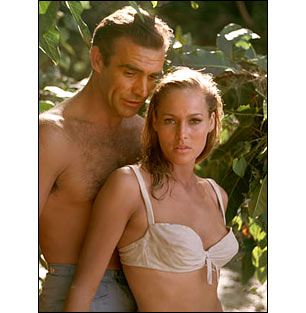
Why then, would an American preteen girl (whose other favorite authors were Judy Blume and S.E. Hinton) read Fleming? I didn’t like other espionage novels. International politics bored me silly. The books weren’t funny, and by all rights I should have been alienated by what critics call their voyeuristic sexism. For example, Honeychile Rider, the heroine of “Doctor No,” playfully throws her naked body against Bond as they stew in the villain’s luxury spa/prison. “Honey,” Bond tells her, “get into that bath before I spank you.” She obeys, pouting, “You’ve got to wash me. I don’t know what to do. You’ve got to show me.” Infantilized, stupidly ignorant of the danger of her situation and as horny as hell, Honey epitomizes all that any budding feminist should detest.

Nonetheless, sex is interesting to an adolescent girl, whether it’s sexist sex or not, and certainly Fleming’s eroticism was part of the books’ appeal for me. The author once said that the target of his stories lies “somewhere between the solar plexus and, well, the upper thigh.” Still, I don’t think the relatively infrequent moments of nudity and arousal would have been enough to make me love James Bond novels if the heterosexual male gaze were really as pernicious and pervasive as the critics say — and as it is in the movies. The films portray the dominant Bond, if not the definitive one, and it’s hard for most people to read the books without images of Sean Connery or Pierce Brosnan in their heads. And in the movies, Bond is a hypermasculine spy whose lustful eyes rove over bodacious female bodies, filmed through the vehicle of a camera that does likewise.

In contrast, Fleming is an equal-opportunity voyeur — a point lost on most critics. His sensual catalogs of men’s bodies easily equal those of women’s. An example, from “Thunderball”: “In contrast to the hard, slow-moving brown eyes, the mouth, with its thick, rather down-curled lips, belonged to a satyr … the muscles bulged under the exquisitely cut shark-skin jacket. An aid to his athletic prowess were his hands. They were almost twice the normal size … Largo was an adventurer, a predator on the herd.”

In “From Russia With Love,” SMERSH’s psychopathic head executioner is receiving a massage. The masseuse tries to analyze her “instinctive horror for the finest body she [has] ever seen” as she rubs him in the sunlight by a pool: “She poured about a tablespoon full [of oil] on to the small furry plateau at the base of the man’s spine, flexed her fingers and bent forward again. This embryo tail of golden down above the cleft of the buttocks — in a lover it would have been gay, exciting, but on this man it was somehow bestial … she shifted her hands on down to the two mounds of the gluteal muscles.” The description lasts for four pages.

Fleming also describes cars and meals with much of the same erotic charge. In “Secret Service”: “A low white two-seater, a Lancia Flaminia Zagato Spyder with its hood down, tore past him, cut in cheekily across his bonnet and pulled away, the sexy boom of its twin exhausts echoing back from the border of trees.” To Bond, a pair of exhaust pipes is as sensual as a dish of crabmeat, which is as sensual as a pair of breasts.

Another thing I liked about Fleming’s Bond back in those days was his vulnerability. He’s not the unflappable, historyless dandy of the films, but a man with a childhood, a heart several times broken, a body covered in scars. On-screen, as Chapman points out, snobbery was an essential part of the Bond character. When Connery picks up a champagne bottle to use as weapon in the first film, Doctor No remarks, “That’s a Dom Perignon ’55; it would be a pity to break it.” Bond, ever the aesthete, replies, “I prefer the ’53 myself.” But in the books, he is neither so particular nor so educated about his pleasures. He is a sensual man and smokes a particular brand of cigarette, but he’s as likely to drink a gin and tonic or a glass of bourbon as the famous “vodka martini, shaken, not stirred.” In the Bahamas with American sidekick Felix Leiter of the CIA, it isn’t Bond who objects to the watered-down gin in the casino martinis; it is Felix. He gives a lengthy diatribe on the shifty economics of hotel bars, sends the drinks back and advises Bond not to let himself be taken in. “I always knew one got clipped,” Bond says in astonishment, “but I thought only about a hundred per cent — not four or five.”

Fleming’s Bond is often frightened. Though you never see it in the films, the text tells us his heart is pounding in fear, his breath sounding in his ears: His “stomach crawled with the ants of fear and his skin tightened at his groin.” Rather often, too, he is embarrassed or emasculated. For example, when “pimping for England” in Russia, he wonders whether the defecting spy he makes love to in exchange for an enemy cipher device has found him too rough in bed. Near the end of “You Only Live Twice,” he is an amnesiac living in a Japanese fishing village, frustrating Kissy Suzuki because he has forgotten “how to perform the act of love.” (Never fear: She solves the problem by buying him a pillow book, and — virility restored — Bond begins to remember that he is a superspy.)

In “Doctor No,” Bond is nervous about keeping his job, having flubbed his assignment in “From Russia With Love” by failing to recognize an obvious trap and by losing a fight with an elderly woman who injects him with nerve poison. Physically depleted, Bond is given a minor job investigating a personnel problem in Jamaica because M. feels it will allow the spy to get some R&R. In “Thunderball,” he has once again been judged weak by the Secret Service and is forced by M. to renew himself in a spa, dining on weak broth and submitting to numerous physical examinations: “He had a permanent slight nagging headache, the whites of his eyes had turned rather yellow, and his tongue was deeply furred. His masseur told him not to worry. This was as it should be. These were the poisons leaving his body. Bond, now a permanent prey to lassitude, didn’t argue. Nothing seemed to matter any more but the single orange and hot water for breakfast.”

Though he’ll call a woman a bitch and doesn’t hesitate to forcibly kiss his massage therapist, Bond is still a sensitive guy. He is unbribable, says SMERSH’s dossier, but has a weakness for the ladies. On-screen, that weakness translates as a strong sex drive and roving eye, but in the books it is his genuine failing as a spy — a susceptibility, an almost needy urge, to drop everything for love. “Your brother was killed by Largo, or at least on his orders,” he tells Domino, the Italian mistress of the villain with the giant hands. “I came here to tell you that. But then … you were there and I love you and want you. When what happened began to happen I should have had the strength to stop it. I hadn’t.” After she saves his life in an underwater battle, he awakes, weakened and disoriented, in a hospital room. All he can think about is Domino, and the book ends with a cuddle: He finds her in a neighboring ward and collapses in exhaustion on the rug beside her bed, “with his head cradled on the inside of his forearm.”

Of course, Domino is gone and forgotten by the start of the next novel, but the point is that Bond’s character features the alluring mix of hard and open that typifies the heroes of romance novels. He’s not a womanizer in any calculated way: He feels a rush of emotion, lust and affection when a woman touches any of his few soft spots; he tries to protect whoever it is, but she usually rejects his efforts and rescues herself (as Honey and Domino both do) or rescues him (as Domino and Kissy do).

More important, the Fleming novels do something the films cannot possibly do: They put us inside Bond’s body. We’re not looking at the well-dressed Timothy Dalton driving a sleek car through an action-packed chase; we’re in the driver’s seat with Bond, with his aching head and multiple scars, his stomach tightening with the ants of fear, his job on the line because of some recent failure and part of his mind on a woman he’d be better off leaving alone. Fleming lets us in, and the movies do not.

When I read those books in seventh grade, I was James Bond. They elicited in me a kind of transvestite empathy that transcended whatever unarticulated problems I may have had with their politics or values. Bond is the spy of all spies not because he’s the hero of the most popular film series ever made, not because he knows what to drink, loves ‘em and leaves ‘em and never bats an eye, but precisely because he does not do these things. Before I moved on to “Still Life With Woodpecker” and “The Hitchhiker’s Guide to the Galaxy,” Bond gave me a sense of the mysterious anxieties of the macho psyche — something I urgently wanted to understand.

Continue Reading Close

Page 2 of 3 in Emily Jenkins